Loading summary
Transcript7 lines
- [00:00]
A
This is an iHeart podcast. Guaranteed Human.
- [00:04]
B
Why should you listen to Armstrong and Getty on Demand? We're not boring. A lot of news is boring and tedious and depressing. It makes you angry. You don't want to live your life like that. Hey, I'm Jack Armstrong. He's Joe Getty. We're Armstrong and Getty. We try to bring you the truth and help you figure out this crazy modern world. How about something about a comedic tone? We have a winner. Yes. Listen to Armstrong and Getty on Demand on the iHeartRadio app, Apple Podcast Podcasts, or wherever you get your podcasts.
- [00:39]
A
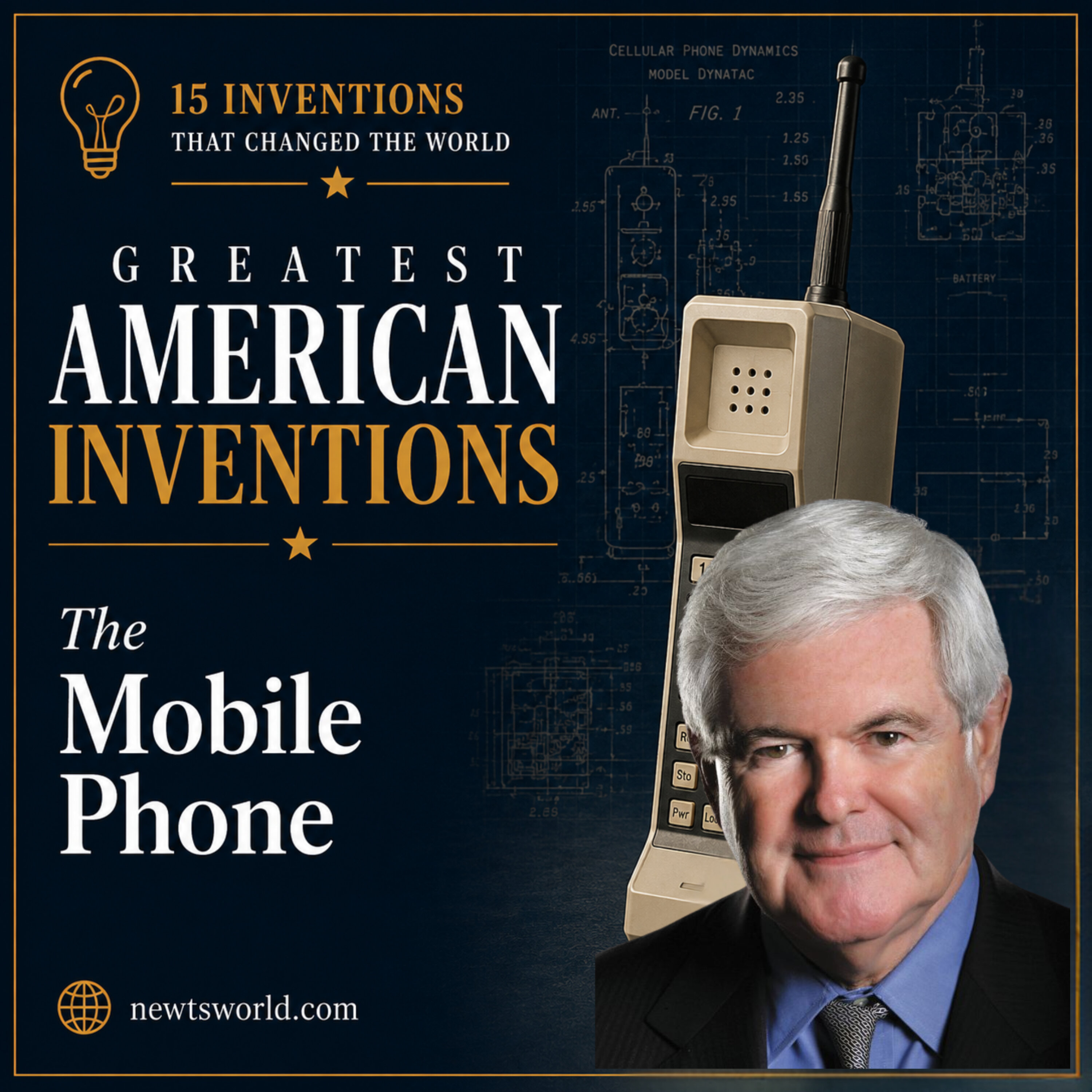
Welcome to Newts World podcast on the iHeart Podcast Network, episode 11 of the Greatest American Inventions Today. The device that connected the world, not the Internet. We've covered that. The device to put a phone in every pocket on every continent, reaching people who had never had access to a landline. The mobile phone. On April 3, 1973, a Motorola engineer named Martin Cooper stood on a sidewalk on 6th Avenue in Midtown Manhattan, held up a device that weighed two and a half pounds and stood nine inches tall, and made a phone call. He called Joe. I'm sorry. He called Joel Engel, the head of cellular research at Bell Labs, Motorola's chief rival in the race to build a handheld cellular phone, to tell him politely that Motorola had done it first. Cooper's prototype could make calls for about 30 minutes before the battery died, needed 10 hours to recharge, had no display, and did nothing except make and receive calls. It cost the equivalent of about $30 million to develop. The concept of cellular communication had been developed at bell Labs in 1970. The key insight instead of one powerful transmitter covering a wide area, divide geography into small cells, each served by a low power base station. And as the user moves from cell to cell, the call is automatically handed off. This made mobile telephony scalable. You could serve far more simultaneous users. This made mobile telephony scalable. You could serve far more simultaneous users. AT&T proposed to the FCC that they build a cellular network. The FCC allowed trials that included Motorola. The race was on. Motorola won the race to the portable handset. AT&T built most of the early network infrastructure. Commercial cellular service launched in Chicago in October 1983. The first commercial phone, the Motorola DynaTAC 8000X, retailed for $3,995, roughly $12,000 today. A phone for wealthy business people. Throughout the 1980s and 1990s, phones shrank and prices fell. Networks expanded. In 1990, about 5 million cellular subscribers in the United States by 2,100 million. By 2010, smartphones had arrived, and the mobile phone had become something radically more than a phone. But before we get to smartphones, that's our next episode. I want to spend time on the mobile phone's impact in parts of the world that often get less attention in the developing world, the mobile phone leapfrogged infrastructure that wealthy countries had spent a century building. Vast populations in Africa, rural South Asia and Latin America never had landline service. The economics of copper wire networks hadn't reached them. Then, in the 1990s and 2000s, mobile networks arrived. Cellular towers were far cheaper and faster to build than copper wire. Suddenly, people who had never had any phone had a mobile phone. The effects were immediate. Fishermen in Kerala, India, began calling ahead to ports to check prices rather than sailing to the nearest market and accepting whatever they could get. Fish prices became more uniform across the region. Fishermen's profits increased and consumer prices fell because information could flow. M? Pesa, a mobile money service launched in Kenya in 2007, let people without bank accounts send and receive money via text message. Within a few years, more than half of Kenya's adults used it. People in rural areas could receive money from city relatives. Small merchants could accept page. Small merchants could accept payment without cash. The unbanked became financially included for the first time. Today, there are more than 8 billion mobile subscriptions in the world. More subscriptions than people. The most connected communication network in human history, built on a concept from Bell Labs and realized by a Motorola engineer on a New York sidewalk. Martin Cooper, now in his 90s, remains enthusiastic about mobile technology. He does express one regret. Distracted walking people staring at their phones while walking into traffic. He feels somehow personally responsible. Next time we reach the invention that merged the mobile phone, the personal computer, the Internet and the camera into a single device. That 6 mil into a single device that 6 billion people now carry. The smartphone. New World is produced by Gingrich360 and iHeartMedia. Our executive producers, Garnesy Sloan. Our researcher is Rachel Peterson. Special thanks to the team at Gingrich 360. If you've been enjoying Newts World, I hope you'll go to Apple Podcasts and both rate us with five stars and give us a review so others can learn what it's all about. Join me on substack@gingrich360.net I'm Newt Gingrich. This is Newt's World.
- [06:40]
B
Why should you listen to Armstrong and Getty on demand? We're not boring. A lot of news is boring and tedious and depressing and makes you angry. You don't want to live your life like that. Hey, I'm Jack Armstrong. He's Joe Getty. We're Armstrong and Getty. We try to bring you the truth and help you figure out this crazy modern world.
- [06:56]
A
How about something about a comedic tone?
- [07:01]
B
We have a winner. Yes. Listen to Armstrong. You get it on Demand on the iHeartRadio app, Apple Podcasts, or wherever you get your podcasts.
- [07:10]
A
This is an iHeart podcast. Guaranteed Human.