Loading summary
Transcript7 lines
- [00:00]
Newt Gingrich
This is an iHeart podcast.
- [00:02]
Jack Armstrong
Guaranteed Human why should you listen to Armstrong and Getty on Demand? We're not boring. A lot of news is boring and tedious and depressing. It makes you angry. You don't want to live your life like that. Hey, I'm Jack Armstrong. He's Joe Getty. We're Armstrong and Getty. We try to bring you the truth and help you figure out this crazy modern world.
- [00:21]
Newt Gingrich
How about something about a comedic tone?
- [00:26]
Jack Armstrong
We have a winner. Yes. Listen to Armstrong and Getty on Demand on the iHeartRadio app, Apple Podcast Podcasts, or wherever you get your podcasts.
- [00:38]
Newt Gingrich
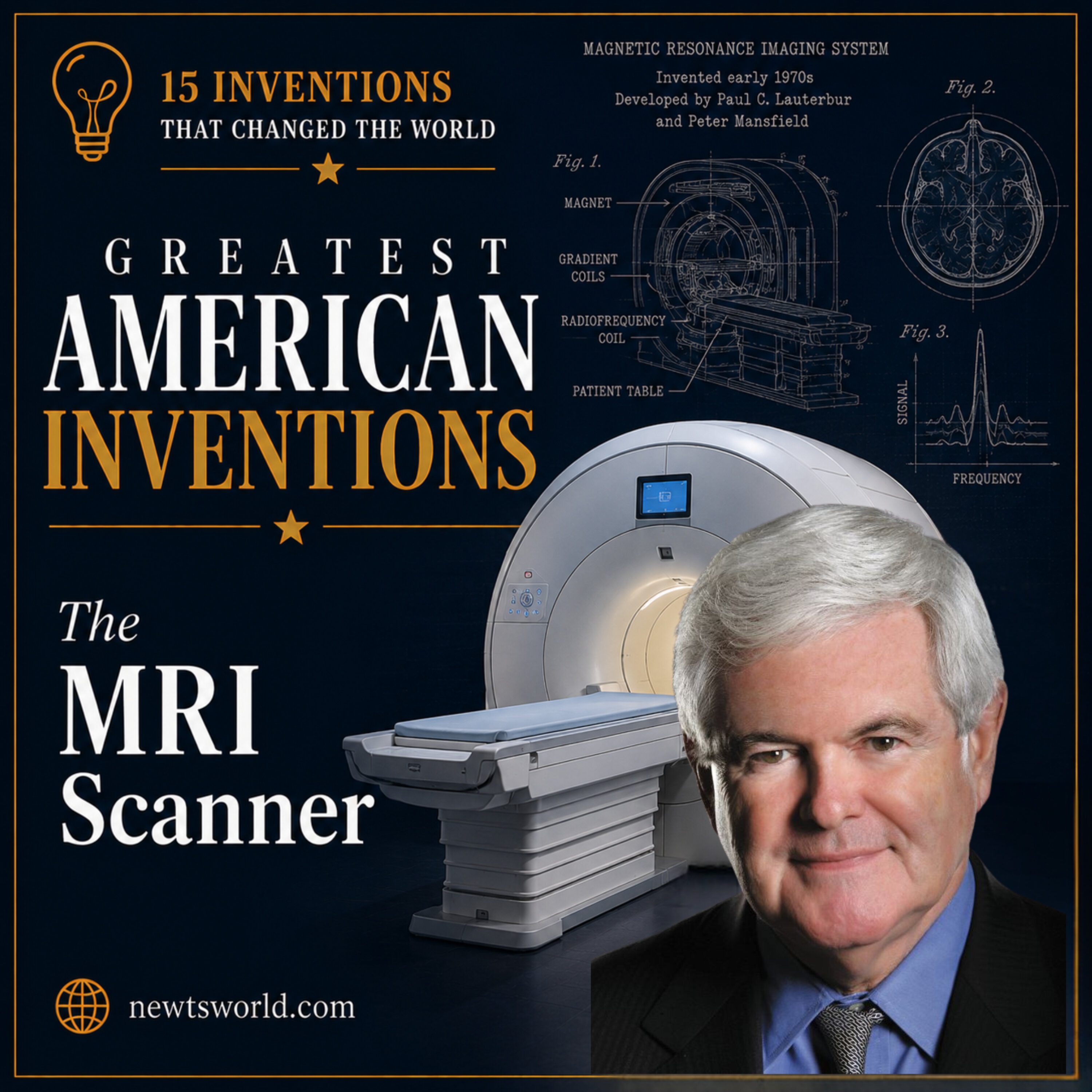
Welcome to Newts World podcast on the iHeart Podcast Network, episode 13 of the Greatest American Inventions. Today, we step away from communications and computing and talk about something more personal. A machine that, if you've ever had a serious medical concern, may be the reason you're still here. The MRI scanner For most of human history, looking inside a living body without cutting it open was impossible. X rays discovered in 1895 were transformative. They made bones visible without surgery. But X rays pass through soft tissue with poor contrast. They can't show a brain tumor clearly. They can't distinguish one type of soft tissue from another. And they involve ionizing radiation, which carries its own risks. The MRI scanner changed everything. Magnetic resonance imaging produces extraordinarily detailed images of soft tissue. The brain's internal structures, the cartilage of a knee, the chambers of the heart. Without any radiation at all, it uses magnetic fields and radio waves. It is completely safe, and what it reveals still astonishes me. A living human brain cross section every structure visible in detail. The science underlying MRI is nuclear magnetic resonance NMR, discovered in the 1940s by Felix Bloch at Stanford and Edward Purcell at Harvard, who shared the Nobel Prize in Physics in 1952. The principle the hydrogen nuclei in our bodies behave like tiny spinning magnets in a strong external magnetic field. They align with it, hit them with a precisely tuned radio pulse, and they flip out of alignment. When the pulse stops, they relax back, emitting a radio signal. Different tissues contain different amounts of hydrogen, and their hydrogen relaxes at different rates. By analyzing those signals, you can reconstruct detailed images of tissue. In 1971, Dr. Raymond Damadian of SUNY Downstate Medical center published a landmark paper showing that cancerous tissue had different NMR properties than healthy tissue. He proposed that NMR could be used to detect cancer in living bodies. It was a profound insight, but turning it into a usable imaging tool required years more work. Damadian built the first whole body scanner with his own team, largely by hand. They named it Indomitable. It's now in the Smithsonian. On July 3, 1977, one of his graduate students became the first human being scanned in a whole body MRI machine. The scan took 4 hours and 45 minutes. Meanwhile, Paul Lederburg at SUNY Stony Brook and Peter Mansfield in Britain developed the mathematical techniques that made fast, clinically useful imaging possible. Lauterbuhr showed how magnetic field gradients could encode spatial information in the NMR signal. Mansfield developed fast imaging sequences that reduced scan times from hours to minutes. In 2003, Lauterburg and Mansfield received the Nobel Prize in Physiology or Medicine. The exclusion of Domadian, given his foundational role, remains controversial to this day. The clinical impact has been extraordinary. Before nmri, diagnosing a brain tumor often required exploratory surgery, opening the skull to look. Now it's a 20 minute scan. Before MRI, evaluating a torn ligament required arthroscopy. Now it's a 30 minute scan. MRI guides neurosurgeons during brain operations. It detects strokes in time to treat them. It identifies spinal cord compression before permanent damage occurs. It finds early stage cancers that physical examination would miss entirely. More than 40 million MRI procedures are performed in the United States every year. In the 1990s, functional MRI FMRI emerged, capable of detecting changes in blood oxygenation that correspond to neural activities. Essentially, you can watch which parts of the brain are working as a person thinks, feels or decides. The study of consciousness, emotion, decision making, addiction and pain have all been transformed by this window into the working human brain. I want to close with this reflection. The MRI scanner emerged from basic physics research. Nmr, developed for chemistry applications that had no medical purpose in mind. The researchers asking what happens to atomic nuclei and magnetic fields had no idea their answer would one day let us see inside a living human brain. This is a recurring pattern in the history of medicine. X rays were discovered in a physics experiment. Penicillin was noticed in a contaminated petri dish. The insights that became FMRI came from physics and mathematics with nothing to do with medicine. It argues for investing deeply in basic science, not because we know what it will produce, but because the history of medicine tells us the things we cannot yet foresee are often the most important ones. Next time, Silicon Valley, a Stanford garage and two graduate students who decided that finding anything on the Internet should be simple, fast and free. The search engine. Newts World is produced by Gingrich 360 and iHeartMedia. Our executive producers garnes E. Sloan. Our researcher is Rachel Peterson. Special thanks to the team at Gingrich360. If you've been enjoying Newts World, I hope you'll go to Apple Podcasts and both rate us with five stars and give us a review so others can learn what it's all about. Join me on substack@gingrich360.net I'm Newt Gingrich. This is Newt's World.
- [07:26]
Jack Armstrong
Why should you listen to Armstrong and Getty on demand? We're not boring. A lot of news is boring and tedious and depressing and makes you angry. You don't want to live your life like that. Hey, I'm Jack Armstrong. He's Joe Getty. We're Armstrong and Getty. We try to bring you the truth and help you figure out this crazy modern world about something about a comedic tone. We have a winner. Yes. Listen to Armstrong, you geti on Demand on the iHeartRadio app, Apple Podcasts, or wherever you get your podcasts.
- [07:56]
Newt Gingrich
This is an iHeart podcast. Guaranteed Human.