Loading summary
Transcript40 lines
- [00:00]
Podcast Host
This is an iHeart podcast.
- [00:05]
Annabe Sofa Advertiser
There's nothing like sinking into luxury. Anabe sofas combine ultimate comfort and design at an affordable price. Annabe has designed the only fully machine washable sofa. From top to bottom. The stain resistant performance fabric slipcovers and cloud like frame duvet can go straight into your wash. Perfect for anyone with kids, pets or anyone who loves an easy to clean spotless sofa. With a modular design with changeable slipcovers, you can customize your sofa to fit any space and style. Whether you need a single chair, loveseat or a luxuriously large sectional, Anna Bay has you covered. Visit washablesofas.com to upgrade your home. Sofas start at just $699 and right now get early access to Black Friday savings up to 60% off storewide with a 30 day money back guarantee. Shop now@washablesofas.com Add a little to your life. Offers are subject to change and certain restrictions may apply.
- [01:05]
Gain Super Flings Advertiser
Gaines Super Flings are here to take your laundry to the next level. Talking about Gain Super Flings Super Sized Laundry packs.
- [01:14]
Alireza Jafarzadeh
These things are huge.
- [01:15]
Gain Super Flings Advertiser
Super Fresh Super Clean Gain Super Flings Gain Super Flings Laundry packs have four times the Oxy Cleaning Power and three times the Febreze Freshness versus Gain Original Liquids Super Fresh Super Clean Gain Super Flings Super Flings for Next Level Laundry.
- [01:39]
Newt Gingrich
On this episode of Newtsworld on February 8th in Paris, thousands of opponents to Iran's authorities rallied to call for the fall of the government in Tehran, hopeful that President Trump's maximum pressure campaign could lead to change in the country. The protest was organized by the Paris based National Council of Resistance of Iran, which is banned in Iran. Two of the group's members face imminent execution with a further six sentenced to death in November. Here to discuss the Iranian resistance, I am really pleased to welcome my guest and my friend Alireza Jafarzadeh, Deputy Director of the National Council of Resistance of Iran. Welcome and thank you for joining me on Newts World.
- [02:39]
Alireza Jafarzadeh
Thank you so much Speaker Gingrich. You know you have been a great supporter of the people of Iran since the days that you were in the House. Even before you became the speaker in the House, you always supported freedom in Iran. You always supported our movement. You countered the challenge that were posed at that time by the so called moderates and there were people who were trying to justify reaching out to the Iranian regime under different pretexts and you stood firm against that and you stood on our side and we really appreciate it. Goes back to, you know, Decades. So really appreciate what you've done so far.
- [03:17]
Newt Gingrich
Well, I never forgot a conversation I had with Secretary of Defense Bob Gates, who had been a deputy in 1979 negotiating with the new Iranian dictatorship. And he said, based on his experience, there were no moderates in the regime. And anybody who thought there was simply did not understand the nature of the regime. So I have found in my experience that the National Council of Resistance of Iran has remarkable ties inside the country and has a tremendous amount of information about what's going on. Can you talk about the use of Iran's space program as a cover for their nuclear activities?
- [04:01]
Alireza Jafarzadeh
The NCRI has a great network of support, mostly based on their main pivotal member organization within the parliament in exile, which is known as the Mujahiden Khal or the mek. They have a network all over the country, and they have been very consistent in showing what the Iran regime is up to, not just on the nuclear side, but on all sides, on terrorism, on their killings inside Iran. Now, this is the same movement that exposed all the major nuclear sites of Iran In August of 2002, the nuclear site in Natanz and Iraq, which actually triggered for the first time the inspections of Iranian nuclear sites by the UN nuclear watchdog, the iaea. That has continued ever since. Now, the new information that we got that we just released was that the Iranian regime has been using the space program as a camouflage to hide their very extensive nuclear weapons program, actually building nuclear warheads. They have been working on solid fuel missiles with a range exceeding 3000 km that are being manufactured at two sites in Shahrud and Seminan that they were known to be as missile sites. And the regime always portrayed them as being the sites that they're launching missiles for satellite to put into orbit. But in reality, we found out that the top organization that is in charge of building nuclear weapons, known as Organization for Advanced Defense Research, or SAPAND SPND, which we first exposed in 2011 and was later confirmed by the IAEA and designated the U.S. government. That organization is all over these two sites in Semin and Shahrud, and they are covering the building of nuclear warheads under the COVID of launching a space program. Let me tell you this, speaker, you know, the nuclear program of the Iran regime has never been a peaceful one. It was always, since day one, it was meant to build the nuclear bomb for the Iran regime. And that process has continued. And I remember in 2002 when we first exposed in Washington the nuclear sites in Athands and Iraq, I mean, that was an opportunity for the outside world to stop that program. But unfortunately, they went the other direction. They went to appease the regime. They giving them concessions and sat down and negotiating, and they basically legitimized the program. And this is where we are 24 years later, that the regime is really very close to building the bomb.
- [06:45]
Newt Gingrich
Why do you think some people in the west talk themselves again and again into believing that you can trust the dictatorship? What do you think is the underlying rationale? Why do they do that?
- [06:59]
Alireza Jafarzadeh
Well, it could be a number of factors, definitely. I don't think they really understand the nature of this regime, that this regime is built on. Destruction is built on basically two pillars. One is external, which is building nuclear weapons, the missile program, their terror operations, their proxy groups, their drone program, all of that. And then internally, they're relying on repression, killing their own opponents, killing any voices of dissent. That's how they operate, and that's how they speak with the outside world. This is not a rational regime that you can sit down and negotiate and say, okay, we give you this, you give us that. No, this regime is ideology. Its raison d' etre is based on those pillars that I mentioned. So that's why if you sit down with the ayatollahs, you're going to end up legitimizing their terror operations. You end up giving them the chance. This regime has taken hostages since the 80s, and they got into negotiation with the outside world to give them money and resources in exchange for returning hostages, only to take a few more. So the west actually allowed the regime to make the hostage taking a very profitable business. And put yourself in the shoes of the ayatollahs. You know, why would they give up hostage taking if it brings them revenue? That's why I think the outside world were always wrong in just looking at Iran through the prism of the regime itself, as though Iran is only about the ayatollahs. No, the vast majority of the people of Iran are opposed to this regime. There is an alternative. There is an organized force trying to bring down the ayatollahs and establish democracy and freedom in the country. And because they were so fixated in them reaching out to the mullahs, they had to close their eyes to the opposition. And not only that, the number one demand of the Iran regime from their counterparts, whether the United States or Europe, was to harm the opposition. You fought the Designation yourself in 1997. That was during the Clinton administration. They designated the very same movement that exposed all the major northern states of Iran. They designated that as an FTO foreign terrorist organization. It took 15 years for this movement to fight the designation, get Congress on its side, go through the courts, and fight that designation and get off in 2012. Why would anyone want to harm those who are actual freedom fighters, who are fighting your enemy? So it's based on really this wrong perception that you're going to get something out of these mullahs. And I think after five decades, now is the time for the world to understand that the head of the snake of war and terror lies in Tehran. And the only way left for ending that terror is to crush the head of the snake. And, of course, that's the responsibility of the people of Iran, and we will do it. The outside world, they just need to understand it and recognize the legitimacy of those who are fighting to bring change in Iran.
- [10:06]
Newt Gingrich
Ayatollah Khamenei recently went on national television and said, when we say death to America, this is not a slogan, this is a policy. And then recently he said in a speech, negotiations with America do not solve any of our problems. I mean, given that, what do you think the impact will be of President Trump, who signed a national security presidential memorandum on February 5, which says, quote, restoring maximum pressure on the government of the Islamic Republic of Iran, denying Iran all paths to nuclear weapon, and countering Iran's malign influence abroad? What do you expect from the Trump administration given that presidential memorandum?
- [10:53]
Alireza Jafarzadeh
Well, certainly, this is a big change, you know, in terms of policy, because this is the last thing that the ayatollahs ever wanted. They wanted to have the ability to sell their oil and get all the revenue that they need so that they can fund their terror groups. They can increase the funding for the suppression of the population and actually buy legitimacy by that. When the maximum pressure policy is reinstated, that's a huge plus for the people and against the regime. But we need to understand that the situation now is very different than eight years ago. This regime is highly vulnerable now. There is a very serious opportunity to not just counter the threat or limit the threat or limit the ability of the Iran regime with the maximum pressure policy brings, but also empower those on the ground who want to bring about change. You want to end the threat once and for all. I mean, you don't want to punt it. You don't want to just delay it. You want to end it. The world shouldn't live in coexistence with the epicenter of terror and chaos in the region. And the people of Iran have long rejected that. Here's an opportunity without boots on the ground. Without even appropriating money. None of that to build pressure on the Iranian regime, but also at the same time, create space for those on the ground who are already fighting the regime to bring about change. And it's so important when I say on the ground because, you know, it's one thing to have critics and just talk about the problem of the Iran regime. It's another thing to actually bring it down. Remember in Syria, Assad, you know, the whole world was against it, but at the end of the day, it took those on the ground to push back the forces of Assad and bring down the Assad regime that probably had one of the best equipped armies in the whole region. But yet, you know, when the support from the outside was diminished, their pillars were weakened. That was the opportunity for forces on the ground. And that's exactly what the Iranian resistance has been trying to do. There have been nine rounds of major uprisings in Iran in all 31 provinces. People seek change. And at the forefront of that has been, you know, the resistance units of the mek. These are mostly young people who have been fighting the Revolutionary Guards, trying to target them and break down this aura of invincibility of the regime to show the people that this regime is not 10ft tall, that you can actually bring it down. That's where the investment should be. And that's exactly the opposite of what the regime wants to do. The regime is doing a huge amount of propaganda and demonization campaign against this very same movement that is trying to overthrow them and calling them cult that. Oh, they have no support, they're terrorists, they're this and that. And that's of course what you expect from the Iran regime. Right now there is a court set up by the Iran regime putting the leaders of this movement in absentia on trial, trying to create some kind of illegal precedence and use it against the Western nations, but also use that as propaganda to fend off the support of the youth in Iran for this movement. You need to counter that. And I think this is the opportunity. And that's why Congress has always been, since the time you were in speaker on our side. And there's a very bipartisan support in the House and the Senate for this movement, for Mrs. Rajavi and her ten point plan that has a very clear platform for the future of Iran that says Iran has to be ruled based on the ballot box, not, you know, legitimacy coming from the ayatollahs, which they say they get it from God, or if you have a better gene, which was under the Shah's dictatorship, the monarchy that didn't rule based on ballot box that needs to end. It has to be based on separation of religion and state. It has to be based on gender equality, free market economy, peace in the Middle east and a non nuclear republic, Iran. That's the platform that is gaining momentum in the House and the Senate but also in Europe and that's where you want to focus.
- [15:18]
Annabe Sofa Advertiser
Time for a Sofa Upgrade Introducing Annabe Sofas where designer style meets budget friendly prices everyanabe sofa is modular allowing you to rearrange your space effortlessly. Perfect for both small and large spaces. Annabe is the only machine washable sofa inside and out. Say goodbye to stains and messes with liquid and stain resistant fabrics that make cleaning easy liquids simply slide right off. Designed for custom comfort, our high resilience foam lets you choose between a sink in feel or a supportive memory foam blend. Plus our pet friendly stain resistant fabrics ensure your sofa stays beautiful for years. Don't compromise quality. For price, visit washablesofas.com to upgrade your living space. Today sofas start at just $699 with no risk returns and a 30 day money back guarantee. Get early access to Black Friday now. The biggest sale of the year can save you up to 60% off plus free shipping and free returns. Shop now at washablesofas.com offers are subject to change and certain restrictions may apply.
- [16:19]
Podcast Host
You know that big bargain detergent jug is 80% water, right? It doesn't clean as well.
- [16:24]
Annabe Sofa Advertiser
80% water.
- [16:25]
Podcast Host
I thought I was getting a better deal because it's so big. If you want a better clean, Tide pods are only 12% water. The rest is pure concentrated cleaning ingredients. Oh, let me make an announcement. Attention shoppers, if you want a real.
- [16:39]
Annabe Sofa Advertiser
Deal, try Tide Pods.
- [16:41]
Podcast Host
Stop paying for water down detergents pay for clean. If it's got to be clean, it's got to be Tide Pods. Water content Based on the leading bargain liquid detergent.
- [16:56]
Newt Gingrich
Israel Defense Minister Israel Katz warned of potential strikes on Iran's nuclear facility. What are your thoughts on the possibility of military action? How would that impact both Iran, Israel and the broader Middle East?
- [17:13]
Alireza Jafarzadeh
This is not a new issue. This issue has been going on for years and people are thinking, okay, what's the solution to the nuclear threat of the Iranian regime? But I think especially Since October of 2023, the world has realized that the threat of the Iran regime is not just limited to their nuclear weapons program. Look what they're doing with their proxies and how they're the epicenter of War and terror in the region. People, I'm sure they're thinking about bandit solutions, you know, temporary solutions here and there. But, you know, at the end of the day, what is the world going to do with the threat of the Iranian regime? The only really viable alternative solution to end the threat is to end the rule of the clerics. And of course, as I said, that's the responsibility of the people of Iran. No outside world can actually do that. You know, Iran is a huge country with 90 million population. So the role of the organized resistance on the ground is absolutely crucial. So I would suggest everyone should be focusing on those forces on the ground, those who have been fighting the regime. They are the real future of Iran. That future based on the vote of the population. A sovereign nation that, by the way, wants peace in the Middle east. Unlike the ayatollahs who say, push the Jews to the sea. This movement have been favoring peace since day one. So I would suggest everyone, whether, you know, countries in Europe, countries in the region, in the United States, everyone, to focus on how to empower those who are fighting the regime, but at the same time, deprive the Iran regime from the resources, from the funding. You definitely need to snap back all the sanctions on the Iranian regime. You need to definitely to deny them the resources, but at the same time, you want to create space for those on the ground to recognize the legitimacy of their fighting against the Iran regime. That's the real solution that, once for all, would rid the whole Middle east of the epicenter of terror and chaos. And think about it, speaker, you know, what an impact a free democratic republic Iran would have, not just in the region, but the whole world. It will change the face of everything. And that's the prospect we should be looking at.
- [19:40]
Newt Gingrich
You know, seems to be the model, in a way, is what just happened in Syria. Everybody sort of thought the Syrian dictatorship was stable, Assad was stable, and then, boom, the whole thing collapsed almost overnight. Do you think it's possible that the religious dictatorship could, in fact collapse at some point?
- [20:02]
Alireza Jafarzadeh
Well, definitely. I think you brought up a great example, speaker, about Syria. And everyone did think that, you know, they're stable. And remember, the Iranian regime had heavily invested on Syria. They had as many as 100,000 of their proxies, including Hezbollah and others in Syria. They spent at least $50 billion in keeping Assad in power. Khamenei spent all of the resources on Syria. He overtly said that if we lose Syria, we will lose Tehran. And he met twice with Putin. Khamenei did in November 2015 and March 2016, specifically on keeping Assad in power. Asim Soleimani, the terror master, regularly traveled to Syria. He actually met with Assad, but also met with Putin, trying to get Russia involved. And in December 2016, after about five years of fighting, they took back the strategic city of Aleppo. Now, as you said, within 11 days, the whole thing collapsed. And that's an important thing because Syria wasn't just Syria. It was the strongest ally of the Iranian regiment. They had done everything to keep it in power. And they seem to be, you know, stable. And suddenly this is the situation. I think this is the new reality of the region. And that reality is definitely on the mind of Khamenei and the leaders of the Iran regime, but also has its own impact among the population. The Iranian people are saying that, you know, the Ayatollahs always considered Syria as what they described as a strategic depth of the regime. Okay, that strategic depth is gone. We now have the opportunity. These dictators, they all seem very invincible until they fall. Remember the Shah that, you know, he had all the military might. He was so arrogant that, you know, he dissolved all the political parties and said, okay, there's a single party. It's my party. You are either a member of it or you go to jail. He had the savak, you know, he seemed to control everything until the population got it and through a major revolution, brought down that dictatorship. The same situation is with these ayatollahs. They don't have the support of their people. They have lost the clout and the power of their proxies. And now is the opportunity. If the world really focuses on the regime and the threat of the Iran regime, I have no doubt whatsoever that this regime will be brought down by the people of Iran. This regime has never been so weak, and the organized resistance has never been this powerful.
- [22:40]
Newt Gingrich
You're a major figure in the National Council of Resistance of Iran, and I have long supported the work of your organization. But I'm curious, for Americans, what do you consider to be the most significant achievements of the Council in advancing the cause of a free and democratic Iran?
- [22:59]
Alireza Jafarzadeh
The council since 1981 actually introduced an alternative to the Iranian regime. At the time that everyone was searching for moderates within the regime. They said, no, this regime must go in its entirety. They offered a platform that eventually was highlighted, the 10 point platform for the future of Iran. They address every single important issue related to Iran, whether it's the issue of the nationalities in Iran, the issue of women, the issue of Religion, you know, Iran is predominantly Muslim, but they said, no, it has to be a secular government, separation of religion and state. They didn't just talk about these issues. They didn't talk about women equality. They implemented it in the Council itself. You know, the majority of the members of the parliament in exile and the leadership are women. They talked about and they ratified platforms and plans for that. But also they have been extremely active in undermining the regime. We just talked about the new nuclear program of the Iran regime. The world didn't know anything about the nuclear weapons program of Iran until, you know, this movement brought to the attention of the world. The IAEA inspections were triggered by this movement, and they have continued to do that. The missile program of the Iran regime was exposed by this movement. Their terror operations, what they were doing in Iraq and elsewhere were exposed by this movement. But most importantly, they are the engine for change in Iran. They offer an alternative and they are in the forefront of fighting the regime. You know, since 1980, one other 20,000 members and supporters of this movement have been killed by the Iran regime for political briefs. You know, in summer of 1988, Khomeini, you know, the predecessor to Khamenei, issued a fatwa, a religious decree condemning to death every single member of the mek, which is part of the ncri, because they were modern, democratic, secular Muslims, opposing the ideology of Islamic fundamentalism, of the ayatollahs. And they killed as many as 30,000 political prisoners in summer of 88 within a matter of few weeks, hoping that this will end any kind of opposition in Iran. And yet now you can see the children and the grandchildren of those who were killed in 1988 in the streets of Tehran and all the 31 provinces of Iran, continuing the engine for change. The most important, I think, accomplishment of this movement has been continued fighting force against the regime, not just talking about change, but effecting change on the ground, having that network inside Iran. Just within one year, the regime arrested 3,700 members and supporters of the resistance units of the MEK inside Iran or kill them or they went missing. But the good news is that more have been added to it and they're more powerful than ever. So I think that's a huge accomplishment, not only to expose the nature of the regime, but also fighting it, offering an alternative so that the rest of the world wouldn't have to go to war or do anything like that. Rather, there is this genuine alternative on the ground that seeks no money or no boots on the ground and wants to bring about change in Iran and has a platform that benefits the whole world. That's why it has the support of some 4,000 parliamentarians around the world in Europe and everywhere else, but also the majority of the House here and has been really a big galvanizing force outside of Iran as well. In addition to inside the rally you mentioned speaker in Paris, that thousand came in Europe telling the Europeans that you need to pursue a firm policy regarding Iran. But also they're coming here in Washington March 8th. This coming March 8th in Washington, there's going to be thousands coming calling for firm policy on Iran.
- [27:11]
Annabe Sofa Advertiser
Tired of spills and stains on your sofa? Wash away your worries with Anabe Annabe is the only machine washable sofa inside and out where designer quality meets budget friendly prices. That's right, sofas start at just $699. Enjoy a no risk experience with pet friendly stain resistant and changeable slip covers made with performance fabric Experience cloud like comfort with high resilience foam that's hypoallergenic and never needs fluffing. The sturdy steel frame ensures longevity and the modular floor pieces can be rearranged anytime. Shop washablesofas.com for early Black Friday savings up to 60% off site wide backed by a 30 day satisfaction guarantee. If you're not absolutely in love, send it back for a full refund. No return shipping or restocking fees. Every penny back. Upgrade now@washablesofas.com Offers are subject to change and certain restrictions may apply.
- [28:12]
Downy Advertiser 1
Every now and then I rinse it out and I deep down I don't know what to do. I'm always in the dark. The sweat and dead short smells like a dark I'm down here.
- [28:34]
Downy Advertiser 2
Downy rinse fights star stubborn odors in just one wash when impossible odors get stuck in.
- [28:48]
Newt Gingrich
This month is the 46th anniversary of the fall of the Shah's dictatorship in 1979, and certainly things evolved differently than people thought they would. Could you talk first of all about what happened right after that and how we went from the notion of a collective, more open society to a religious, theocratic dictatorship. That brief period was just amazing. How rapidly it changed.
- [29:20]
Alireza Jafarzadeh
I was in Iran in the early days after the revolution. I could see how the fall of the dictatorship had created a tremendous opportunity for people, the freedom, the mood of the population. But you could actually at the same time see how rapidly the mullahs, who by the way came out of nowhere, stole the leadership of a genuine revolution. You know, when the uprising started, the mullahs had pretty Much no role in it. Khambah Khomeini himself was in exile in Iraq until four months before the fall of the Shah. You know, the uprisings were all over the different cities in the different provinces in Iran. That's when Khomeini saw the opportunity, smelled the opportunity. He moved from Iraq to near Paris in Neufahr chateau in October 78, and in February he was in Tehran and he stole the leadership of revolution. Why? Because the Shah had eliminated the nationalist forces. He had put in jail the intellectuals. Anyone who was intellectual, who was secular, he killed him. SAVAK was running the show, but he kept the mosque intact. The mosques were not affected by the Shah. To the contrary, he actually helped the mosque in different cities because they were praising the Shah. All these clerics would get on the stage and just say how great the Shah was. And Shah was selling the support for the mullahs to the west, saying, okay, these mullahs are against communism. That's why I'm empowering them. I'm getting rid of intellectuals, because, you know, he described them as Islamic Marxists and all of that nonsense. When the opportunity came, the only network that was intact that could take advantage of the situation was the clerics. And even though this revolution was not about establishing Islamic extremist ideology, but that created an opportunity and they stole it. In the first two years after the revolution, they put in jail intellectuals, the mullahs, and tried to dominate power, rallying people under the COVID of anti Americanism. They targeted people like MEK that fought against the Shah as well. Their leaders were executed by the Shah, but they became the primary target of the mullahs. That's why I think what we have seen, a clear deviation of a genuine revolution that was meant for democracy that ended up in theocracy. And I'm sure there are people remnants of the Shah's dictatorship, but also the regime itself are trying to prop up the remnants of the dictatorship of the Shah, saying, oh, look, you know, the Shah was better than the mullahs, that he killed less people. And they're just trying to create a comparison, whereas the comparison is not like that. It should be between freedom and dictatorship. And that's why the regime has an interest in propping up the remnants of the dictatorship, so that the outside world would not look at the real alternative, which is democracy. The alternative to this regime is not to go backwards to dictatorship of a monarchy, but rather to freedom, political pluralism, gender equality, and all of that. And that's why I think 46 years later, the Desire of the people is still alive for freedom in Iran now they are more experienced. They have seen both the dictatorship of the Shah, but also the theocracy of the mullahs. And that's why the only choice left for the people is freedom and political pluralism and a republic form of a government.
- [32:57]
Newt Gingrich
If you had to rank them, which has been more anti human rights and oppressive, the Shah or the ayatollahs?
- [33:06]
Alireza Jafarzadeh
Well, you know, these were different eras. The Shah did the most he could do under the circumstances because, you know, he was an ally of the United States. There were certain limitations that he couldn't do at the time. I think he did the most he could at the time to put people in jail. And the SAVAK was created under the Shah. Evin Prison, which is the most notorious prison right now in Iran, was built under the Shah. And he did everything he could, but. But that was the limit. Now when the mullahs came to power, it was a whole new circumstances because Khomeini was using religion as a cover. He was building a network, trying to transform the benign Islamic groups in the region into very fanatic anti American extremist groups. That's what they did. You know, from Algeria to Lebanon, look at Syria, look at Iraq, how they try to take advantage. And so of course, under that situation, it gives the mullahs more leverage to kill more people. There were definitely more people killed under the Ayatollahs, creating these proxy groups around the world and inventing new ways of torture, even though the Shah had different ways of torturing, but the mullahs just basically surpassed that. And that's why I think it's an opportunity for the people of Iran to abandon their past and look for the future. But also it's an opportunity for the west because they have experienced both the Shah's dictatorship and also the current theocracy. And the answer is really a democratic, free republic Iran, and what an impact it would have for the whole world.
- [34:41]
Newt Gingrich
Alireza, I want to thank you for joining me. And I've known you a good while now, and I know how consistently you and the National Council of Resistance of Iran have worked to create a free, independent Iran that would be beyond the Shah, beyond the Ayatollahs, be an integrated part of the world in a positive way that would look out and would offer the people of Iran a dramatically better future. We're going to have on our show page your website@ncr-iran.org your website is a daily Iran News and Brief which I recommend to people as a quick look at what is happening each day in Iran. And I want to thank you for taking the time today to help educate our listeners.
- [35:26]
Alireza Jafarzadeh
Well, thank you. You know, I've known you for decades and you have been very consistent yourself in highlighting the threat but also highlighting the solution. Because it may be easier to highlight the threat but a lot more difficult to highlight the solution. But it also takes a lot of courage and that's what you had. I've known you the same way when you were in the House and after that, and really appreciate what you're doing with these shows in spreading the word, educating everybody and pointing everyone to the right direction. And I'm very hopeful that Iran will soon be free and we'll invite you and everybody else to come and see free and Democratic Republic Iran.
- [36:06]
Newt Gingrich
It would be fabulous to be able to spend next year in Tehran.
- [36:10]
Alireza Jafarzadeh
Absolutely. Looking forward. Speaker.
- [36:15]
Newt Gingrich
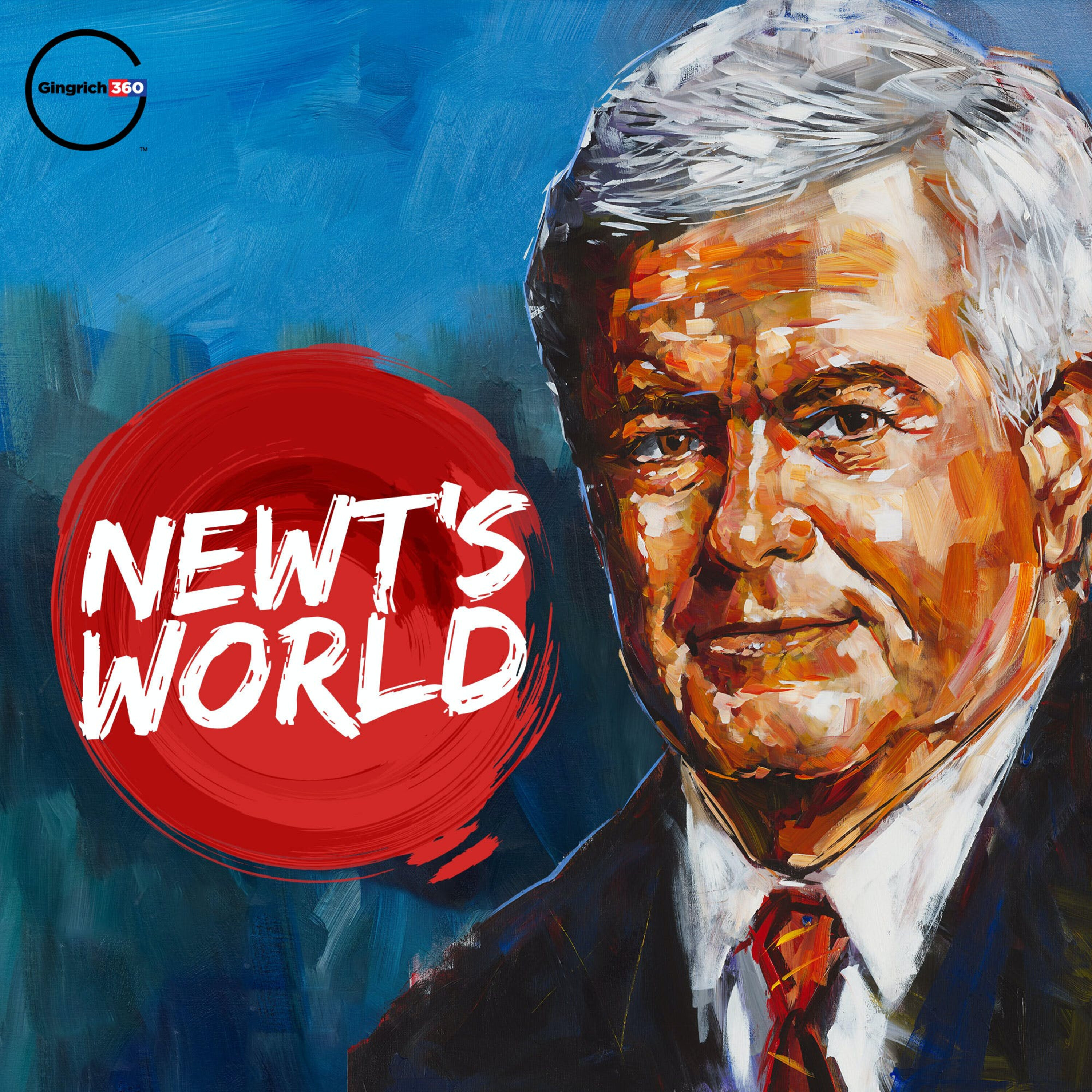
Thank you to my guest, Alireza Jafarzadeh. You can learn more about the National Council of Resistance of Iran on our show page@newtsworld.com Newts World is produced by Gingrich360 and iHeartMedia. Our executive producer is Garnesey Schlong. Our researcher is Rachel Peterson. The artwork for the show was created by Steve Pendley. Special thanks to the team at Universe 360. If you've been enjoying Newt World, I hope you'll go to Apple Podcast and both rate us with five stars and give us a review so others can learn what it's all about. Right now, listeners of NewTreeWorld Consent are for my three free weekly columns at gamers360.com Newsletter I'm Newt Gain Rich this is new Twirl.
- [37:25]
Downy Advertiser 1
Never leave I don't know what to do I'm always in the dark the sweat and that smells like a dark.
- [37:37]
Downy Advertiser 2
Downy rinse Fights stubborn odors in just one wash when impossible odors get stuck in.
- [37:44]
Podcast Host
This is an iHeart podcast.