Loading summary
Transcript62 lines
- [00:00]
Podcast Host
This is an iHeart podcast.
- [00:04]
Advertisement Voice
Time for a sofa Upgrade Introducing Anabe Sofas where designer style meets budget friendly prices. Every anibe sofa is modular allowing you to rearrange your space effortlessly. Perfect for both small and large spaces. Anabe is the only machine washable sofa inside and out. Say goodbye to stains and messes with liquid and stain resistant fabrics that make cleaning easy. Liquids simply slide right off. Designed for custom comfort, our high resilience foam lets you choose between between a sink and feel or a supportive memory foam blend. Plus our pet friendly stain resistant fabrics ensure your sofa stays beautiful for years. Don't compromise quality for price. Visit washablesofas.com to upgrade your living space. Today sofas start at just $699 with no risk returns and a 30 day money back guarantee. Get early access to Black Friday now. The biggest sale of the year can save you up to 60% off plus free shipping and free returns. Shop now at washablesofas.com offers are subject to change and certain restrictions may apply.
- [01:05]
Podcast Host
You know that big bargain detergent jug is 80% water, right? It doesn't clean as well.
- [01:10]
Advertisement Voice
80% water?
- [01:12]
Podcast Host
I thought I was getting a better deal because it's so big. If you want a better clean, Tide pods are only 12% water. The rest is pure concentrated cleaning ingredients. Oh, let me make an announcement. Attention shoppers, if you want a real.
- [01:25]
Robert D. Kaplan
Deal, try Tide pods.
- [01:27]
Podcast Host
Stop paying for watered down detergents. Pay for clean. If it's gotta be clean, it's gotta be Tide pods. Water content based on the leading bargain liquid detergent.
- [01:40]
Newt Gingrich
On this episode of Newts World. We're entering a new era of global cataclysm in which the world faces a deadly mix of war, climate change, great power rivalry, rapid technological advancement, the end of both monarchy and empire, and countless other dangers. In his new book, Wasteland, Robert D. Kaplan incisively explains how we got here and where we are going. Kaplan makes a novel argument that the current geopolitical landscape must be considered alongside contemporary social phenomena such as urbanization and digital news media. The singular dilemmas of the 21st pandemic disease, recession, mass migration, the destabilizing effects of large scale democracy and great power conflicts, and the intimate bonds created by technology mean that every disaster in one country has the potential to become a global crisis too. According to Kaplan, the solutions lie in prioritizing order and governing systems, arguing that stability and historic liberalism rather than mass democracy will save global populations from an anarchic future. I'm really pleased to welcome my Guest somebody who I admire deeply. I have used his book the Coming Anarchy for a Quarter Century now as probably the best single insight to what was going to happen and how it's happened. He is the best selling author of 20 books on foreign affairs and travel. He holds the Robert Strauss Hupe Chair in Geopolitics at the Foreign Policy Research Institute. For three decades he reported in foreign affairs for the Atlantic. I am thrilled to have him with us. Robert, welcome and thank you for joining me on Newts World.
- [03:33]
Robert D. Kaplan
It's a great pleasure to be here with you.
- [03:35]
Newt Gingrich
You begin Wasteland by going into the history of the Weimar Republic. Why did you start there?
- [03:42]
Robert D. Kaplan
I started there because I'm a journalist and you start with a long anecdote. You don't just jump into it and tell your thesis. And I thought that the Weimar Republic was incredibly eerily similar to our world today. The Weimar Republic to most people connotates doom because it led to Hitler. That's not where we're headed. But the Weimar Republic could have turned out well. There was a matter of contingency. Had this happened or that happened, had the Great Depression not happened exactly when it did, Hitler may not have come to power. But the reason I chose Weimar was because it's how geography has been shrunk by technology. In that sense, our world today, so interconnected, so shrunken, so anxious, so claustrophobic, connotates and is similar to the constant permanent crisis of the Weimar Republic. It's like our world is one big Weimar now. We don't have world government, there is very little world governance. But there is an emerging global system that doesn't mean order. It just means that every place can interact with every other place like never before. Like the far flung Germany of the Weimar years, when there was always a cabinet crisis. There was never a feeling of relaxation. It was just exhausting. And that's our world today.
- [05:23]
Newt Gingrich
You have an amazing term. You say Weimar is a candy coated horror tale. Yes, that's just a wonderful turn of phrase.
- [05:31]
Robert D. Kaplan
Well, that's because it gave birth to the arts, to the Bauhaus architecture, to the atonal music of Arnold Schoenberg, to so much else in the arts and literature, to Thomas Mann, Rainier, Maria Rilke and others. And yet what it led, because it ultimately had a lack of order. And the reason it had a lack of order was because the very formation of the Weimar Republic in the central, central German town of Weimar right after World War I was to prevent at any cost the rise of another Kaiser or another Bismarck and As usual. And as we all know, we all tend to overlearn lessons, and that's when we make mistakes, when we overlearn a lesson. And Weimar overlearned the lesson. They created a system which was so unmanageable that nobody was ever really in control. And that lack of order, that demonstrable lack of order led to Hitler.
- [06:36]
Newt Gingrich
It's interesting. I just recently got involved with this whole concept that Weimar did not try to suppress speech, but in fact, the Nazis, I think, lost some 200 lawsuits. There was a constant effort to push them down, and they kept bouncing back.
- [06:53]
Robert D. Kaplan
Yeah, well, that had a lot to do with vast, impersonal historical forces, namely the inflation of the early years and the Great Depression of the later years of the Weimar Republic. As I said, had the Great Depression not come when it did, and as it did, Hitler never would have come to power. So those are the vast, impersonal forces, the contingencies. Was the utter mediocrity of the leaders right before Hitler and how they thought they were in control, but they weren't. So what I'm doing is I'm painting a picture of our world today where literally anything is possible. It could get much better, it could get much worse. But don't think we don't have the raw material for tragedy in our world today.
- [07:43]
Newt Gingrich
And you suggest, as an example, that the chaotic US Withdrawal from Afghanistan might have encouraged Putin to invade Ukraine, believing the west had lost any capacity to be effective.
- [07:55]
Robert D. Kaplan
Yes. There were two ironic results to the withdrawal from Afghanistan. First is, if you're going to withdraw, don't announce it in advance. Don't do it at the beginning of the fighting, in the middle of the fighting season in Afghanistan. Do it slowly, gradually, during the winter, when there's very little fighting anyway. There are many different ways to withdraw. And they withdrew in a way that led to a catastrophe which had two ironic results. One was it demonstrated American weakness in that it couldn't get anything done. Right. The other thing it led to was the Biden cabinet actually started to work better among each other after the withdrawal from Afghanistan because it was like a coming to Jesus moment, kind of. And so they were better equipped to deal, at least initially, in the first few months of the Ukraine war. But I think it was overwhelmingly ironic because it gave Putin the idea that the west was finished, essentially, that the west was not going to challenge him. And that led him into what I still consider to be a disastrous war on his part.
- [09:11]
Newt Gingrich
I mean, it's obviously a disaster for Ukraine, but it's also A disaster for Russia. And I was struck that about two weeks before the attack, the chairman of the Joint Chiefs, Milley said in a Senate hearing, thought it would take the Russians three days to get to Kyiv. And I have a hunch that Putin's generals told him the same thing.
- [09:30]
Robert D. Kaplan
Yes. What I learned being embedded as a journalist with the Marines and the army in the Iraq war and in Afghanistan, was that the real jewel in the crown of the American military are the non commissioned officers, the NCOs. They're really the heart and soul and culture of the military. The officers Devise plans, the NCOs carry them out. And NCOs are sergeants, petty officers, corporals and the like. And the reason our NCO corps is so good, great, is because we're a middle class society and we produce people who are highly educated, even if they're not officers. Russia did not have, in reality an NCO corps. It had a very weak NCO corps. That did not matter in Russia's small wars or imperial policing operations in Abkhazia and sub Saharan Africa. Syria was an air war that the Russians never put troops in there on the ground. So Putin was living in this dream world where he learned from all these policing operations in Syria that he could do anything. And then he attempted a major land war where the component that was needed was an NCO corps or an equivalent, and he did not have it. And the first few weeks, first few months, when one could argue even longer than that, has been a shambles for Russia.
- [11:04]
Newt Gingrich
It seems to me that the misallocation, that's probably the wrong word but of both resources and human beings, is a diversion from what Russia might have become that they'll probably never fully recover from.
- [11:17]
Robert D. Kaplan
Yeah. One of the things I talk about in the book, one of my themes is that all three great powers, the us, China and Russia, are all in both different ways and at different paces in periods of decline. You can argue that, but I think Russia is the most extreme case because the Ukraine war has gone on for three years. That's a long time. That's a long time for intense urban industrial combat, fighting over inches and feet with large scale casualties, thousands of tanks destroyed. The only reason we don't read even more about it is because there's not that much novelty value in recent months. And the media loves novelty value. Something new to talk about, I believe, as every month that the Ukraine war has gone on has weakened Russia's ability to determine outcomes in the caucuses, in former Soviet Central Asia, in Siberia and the Russian Far East. So I think this war is really a sign of Russian decline. However it may turn out in negotiations.
- [12:40]
Advertisement Voice
Let's be real. Life happens, kids spill, pets shed and accidents are inevitable. That's why you need a washable sofa that can keep up. Our sofas are fully machine washable inside and out so you can say goodbye to stains and hello to worry free living. Made with liquid and stain resistant fabrics, they're kid proof, pet friendly and built for everyday life. Plus changeable fabric covers let you refresh your sofa whenever you want. Need flexibility. Our modular design lets you rearrange your sofa anytime to fit your space whether it's a growing family room or a cozy apartment. Plus they're earth friendly and trusted by over 200,000 happy customers. Get early access to Black Friday pricing starting at just $699. It's time to upgrade to a stress free mess proof sofa. Visit washablesofas.com today and save that's washablesopas.com offers are subject to change and certain restrictions may apply. Every now and then I rinse it out and I need Tommy rinse tonight.
- [13:47]
Robert D. Kaplan
And I need it more. My kid wet the bed and the smell never leaves. I don't know what to do.
- [13:56]
Newt Gingrich
I'm always in the dark.
- [13:57]
Advertisement Voice
The sweat and that short smells like a dark I'm down here busy downy.
- [14:03]
Robert D. Kaplan
Rinse fights stubborn odors in just one wash. When impossible odors get stuck in.
- [14:17]
Newt Gingrich
The one thing that I can't quite get my head around is they do have as a remnant of the Soviet Union so many nuclear weapons. Even if they're decaying, they're decaying with the potential to do unimaginable damage. You have to deal with them carefully.
- [14:36]
Robert D. Kaplan
Yes, and I bring this up in the book. I talk about Henry Kissinger's book written in his mid-30s as a young man, Nuclear Weapons and Foreign Policy, which was a very revolutionary book for its time because at the time we were pursuing mass destruction. Anyone messes with us, we had hydrogen bombs. Kissinger brought up what was then an original idea which is you could have a conventional war where low level tactical nuclear weapons were injected into the war in the middle phases by the party that was not doing well and that would be a real danger. Don't just think of nuclear war as nuclear holocaust, think about it in terms of conventional war with nuclear aspects to it. And if you look at today, I don't know about Russia, but generally the trend has been to develop low yield, high tech tactical nuclear weapons that are actually designed to be used. And that really raises the danger in our world today, frankly.
- [15:46]
Newt Gingrich
I think from our side, we have developed conventional weapons of such power that in effect, they're the equivalent of what a tactical nuclear would be. They're not psychologically the equivalent, but they're devastating. You raise a point here. People think of this as the beginning of violence in Europe. The truth is the Balkans had been, in a decade of violence, much of it horrendous with real efforts at genocide and bombing. I mean, we'd intervened, we bombed Serbia. So there was actually violence on the margins of Europe, much more than people want to talk about.
- [16:19]
Robert D. Kaplan
Yeah. Remember, it was only literally right after the Berlin Wall collapse that erupted in the former Yugoslavia. It was months we're talking about. And one of the reasons why the elder Bush administration did not intervene more dynamically, they did send peacekeepers to Macedonia, which many people forget, but they did not intervene dynamically was because, as James Baker indicated, the Europeans have been lecturing us for years that they can deal with their own own problems. Well, now, here's a chance. Let's use this as a test case. Let's see. So that was at the heart of the original go slow approach of the elder Bush administration not to intervene. And then it mushroomed into a much wider war. And then we had the Clinton administration, which had to take action.
- [17:15]
Newt Gingrich
And they were confused, I think, because as a member of Congress at the time dealing with them, I think they were so scarred by the Black Hawk down incident in Somalia that they were just terrified of getting into a situation where they'd lose a lot of Americans.
- [17:30]
Robert D. Kaplan
Yeah. That also influenced Rwanda, which occurred only six months after the Black Hawk down incident. But yes, the Clinton administration was very averse to getting sucked into a conflict where there would be large numbers of American casualties. And I think, though it's interesting that the Balkans dominated the 1990s, you know, the horrific war and ethnic cleansing there. And the US intervened twice in Bosnia in 95 and in Kosovo in 99. But they remained small wars. They never mushroomed into an Iraq or a Vietnam or anything like that. So Clinton really inserted forces in a delayed way, of course, with limits. It could have been a much different decade had this small war emerged into a middle sized war for the United States in the Balkans.
- [18:30]
Newt Gingrich
Do you think that when Putin took over Crimea that there was anything practical that could have been done at that point?
- [18:39]
Robert D. Kaplan
That's a good question. Remember, Crimea was always historically considered Russia. It was thought of as different from the rest of Ukraine. There was always romantic associations that Russians had for Crimea. The Tsar had his summer home there, his warm weather home there. Not just one czar, but several czars. The Soviet Politburo would take vacations there for the warmer weather. There was the literature of Tolstoy and all of that. Crimea had emotional, sentimental appeal to Russia that Donetsk and some of these other places in Ukraine utterly lacked. So that when they took Crimea, I think our options really narrowed. And that isn't to say we succeeded at deterrence for a wider war. We did not succeed at deterrence in a wider war.
- [19:36]
Newt Gingrich
I think Khrushchev was married to a Ukrainian, and it's Khrushchev who actually reassigns Crimea to be Ukrainian rather than Russian. And I think that that was always sort of a breakpoint. That made it harder.
- [19:51]
Robert D. Kaplan
Yeah, it was. And next thing you. Crimea was easy for Putin to do, actually. It was one of those plans that were on the table, on the shelf for any crisis that might erupt. And he did it, and there was nothing we can do.
- [20:09]
Newt Gingrich
You discuss the end of the Cold War as a decisive victory for the West. From your perspective, you give more of the responsibility to Gorbachev than to Reagan. Do you think had they not picked Gorbachev or had Gorbachev not decided to try to be a modernizer, that it could have gone on for another two or three decades?
- [20:31]
Robert D. Kaplan
It might have. Remember, Gorbachev had an opponent for leadership. I believe his name was Romanov, might be mistaken here. It gets very obscure. But Gorbachev was chosen in the wake. He was chosen by the Soviet Politburo in the wake of the SS20 Pershing missile crisis in Europe. That came, I believe, in the fall of 1983 and that I covered as a young journalist, where The Soviets deployed SS 20s. There were massive peace demonstrations throughout Western Europe. Millions and millions of people showed up telling the Americans, under no account, deploy more missiles. Stop it right here. And the Reagan administration went ahead and deployed Pershing missiles. And this peace demonstration stopped and the Pershing missiles were deployed. And I think that impressed the Soviet politics bureau, who thought, we have a really tough president on our hands in Washington. We need someone who's really vigorous, who's going to shake things up. Somebody vigorous, not just an old dying man. And I think that was the background for choosing Gorbachev. And remember, it was Gorbachev, really, who ended the Cold War by trying to reform the Soviet Union. And it collapsed all around him, essentially. And he made the decision that he would not militarily support the Communist parties in the Warsaw Pact if they ran into trouble, which was a different policy than the Brezhnev doctrine where they intervened in Czechoslovakia in 1968. But I think Gorbachev was the key figure for ending the Cold War, and he came into power indirectly through through decisions made by Ronald Reagan to deploy the Pershing missiles.
- [22:29]
Newt Gingrich
To me, it was an amazing moment. I'd spent my whole career trying to understand how to contain the Soviet empire. Suddenly they weren't there. There was sort of a sense of huge capital investment gone.
- [22:50]
Advertisement Voice
Time for a sofa upgrade Introducing Annabe sofas where designer style meets budget friendly prices. Every Annabe sofa is modular, allowing you to rearrange your space effortlessly. Perfect for both small and large spaces, Annabe is the only machine washable sofa inside and out. Say goodbye to stains and messes with liquid and stain resistant fabrics that make cleaning easy. Liquids simply slide right off. Designed for custom comfort, our high dry resilience foam lets you choose between a sink in feel or a supportive memory foam blend. Plus our pet friendly stain resistant fabrics ensure your sofa stays beautiful for years. Don't compromise quality for price. Visit washablesofas.com to upgrade your living space. Today sofas start at just $699 with no risk returns and a 30 day money back guarantee. Get early access to Black Friday now. The biggest sale of the year here can save you up to 60% off plus free shipping and free returns. Shop now@washablesofas.com Offers are subject to change and certain restrictions may apply.
- [23:51]
Podcast Host
You know that big bargain detergent jug is 80% water, right? It doesn't clean as well.
- [23:55]
Advertisement Voice
80% water.
- [23:57]
Podcast Host
I thought I was getting a better deal because it's so big. If you want a better clean, Tide pods are only 12% water. The rest is pure concentrated cleaning ingredients. Oh, let me make an announcement. Attention shoppers, if you want a real.
- [24:11]
Robert D. Kaplan
Deal, try Tide pods.
- [24:12]
Podcast Host
Stop paying for watered down detergents. Pay for clean. If it's got to be clean, it's got to be tide pods. Water content based on the leading bargain liquid detergent.
- [24:26]
Newt Gingrich
You make a point that I think people really don't understand, which is as the world gets closer to itself because of technology, et cetera, that doesn't mean it gets nicer or it doesn't mean that it gets less violent. You have more things crowded near each other and if anything it can become much more unstable. Can you expand on that? It's a very important insight.
- [24:48]
Robert D. Kaplan
Yeah. Now, as I said at the beginning, the world is more claustrophobic and anxious than ever before because of technology. It's not just new things, it's also the attrition of the same adds up the big change. More jet airplanes, more flights, more airports, higher populations, the Internet, email. Remember when the Cold War ended, there was no Internet for most people. There was no email. Nobody had web addresses. You didn't have all these fancy elite conferences that you united the global elite all over the world to come and go to. None of that existed. All that came in the wake of America's unipolar moment at the end of the Cold War. So the world is smaller, it's tighter, it's more connected, but because we still have our grave differences, that only makes the world more unstable because your enemy or your rival is closer. Take US China relations. China may be thousands of miles away, 11 time zones away, but it's not. It's one click away. So that cyber warfare, cyber attacks shorten the distance between the US and China and in fact help destabilize the US China relationship.
- [26:17]
Newt Gingrich
If you think about it in that context, it seems to me that people, particularly among the elites, had this notion that we were all kind of cookie cutters. We were all going to be the same kind of human. We could all understand each other and we could all somehow get along in sort of kumbaya. But in fact, both in terms of power and in terms of ideology and culture, there are really extraordinary differences across the planet.
- [26:45]
Robert D. Kaplan
Yeah, well, elites around the world are like each other because they're all highly educated, multilingual, they live in different countries, they're on the same corporate boards together, the same foundation boards together. So they're alike. At the very, very top level, there is a kind of a unity, but that's a thin top level. The moment you go down, there are real cultural and historical differences. And these are hard to talk about because they cannot be quantified. And elites love what they can quantify. That's what specialists do. So when you start talking about culture, the antennas go up. They get very, very nervous about this. And yet this is what drives history. And that's why China is such a chance, because its culture is so different from ours. Much different than Soviet culture was because the Soviets were Europeans at the end of the day. So there are real cultural differences. And it's fine to talk about cultural differences when you're praising a culture, but if you're making a critique of it, that's not allowed. And yet it's those kinds of things that can drive conflict.
- [28:06]
Newt Gingrich
How much does this inability to deal with reality by the elites reflect back into the, I think, sort of surprising ineffectiveness of the United Nations.
- [28:19]
Robert D. Kaplan
I remember growing up in the late 1950s, early 1960s, and the United nations was a big deal back then. Everybody knew the names of the Secretary General, Secretary generals were commonly known about. And you had great famous speeches. You had Khrushchev banging his shoe. Later on, you had the great speeches of Abba Eben, Daniel Patrick Moynihan when he was UN Ambassador. The UN really mattered because it gave the promise of a global world. But now a global world has actually come into being. Being the UN has been diminished because there are so many other global organizations. The UN was ultimately an elite project about soft power. Therefore, it worked well when there were no major wars going on, especially wars that involved members of the Security Council. But now you have a major war in Ukraine going three years on where one of the protagonist is a member of the Security Council and another protagonist, the United States, has been supplying billions of dollars of weapons. This kind of thing diminishes the United Nations.
- [29:34]
Newt Gingrich
If young leaders of the future came to you and said, what should we be aware of and what should we focus on to minimize damage to our world, what would you tell them?
- [29:47]
Robert D. Kaplan
I would tell them that it's a good practice to employ constructive pessimism, to always think pessimistically, but in a constructive way. Because in our lives, normal people who are used to tragedy and are used to adversity always think about what can go wrong. And foreign policy elite should do the same thing. Because if you think about what can go wrong, if you think four or five steps ahead, the chances are you will diminish the percentages that things actually will go wrong. In lives and in foreign policy, what goes wrong is what you're not thinking about, what hits you over the back of your head, which you hadn't considered. So I would say, like as a discipline of employ anxious foresight, constructive pessimism. This is not new. Machiavelli wrote about it.
- [30:45]
Newt Gingrich
So if you think about constructive pessimism, do you see any positive, constructive pessimism for Israel and the Middle East?
- [30:53]
Robert D. Kaplan
No. I think Israel has employed constructive pessimism. They've launched one attack on Iran, but not others. You know, they're all always thinking ahead of the curve. If we do this, what can they do? If we attack Gaza full out, even now, what will happen to the rest of the hostages? I think the Israelis live with constructive pessimism every day of their lives. Netanyahu is attacked from the right as well as from the left. People criticized him for making this deal with Hamas, but who knows what was behind it? Who knows what promises the Trump administration gave him if he made the deal? Maybe they made some concessions on helping him with Iran. I have no idea. But remember the Israelis. Whatever you think of Netanyahu, he deals with levels of stress and anxiety that would immobilize the average American politician on a number of levels.
- [31:55]
Newt Gingrich
I've known Bibi since 84, and I think that's exactly right. He has an astonishing endurance level, and maybe in part because most of it he doesn't feel he's trained himself. He's disciplined, and he doesn't let it get to him. I want to thank you for joining me. Your earlier book on the Coming Anarchy, I thought was a historic work, and I urge everybody to remember that also. And your new book, Wasteland A World in Permanent Crisis, is a pretty good guide to what we're likely having to deal with in our generation and our children and grandchildren's generation. It's available now on Amazon and on bookstores everywhere. It's a very important book because it resets how to think about the world around us, and I recommend every citizen get a copy and read it. Robert, I really appreciate you taking the time to be with me.
- [32:42]
Robert D. Kaplan
It's been my great pleasure to be with you. Thank you.
- [32:49]
Newt Gingrich
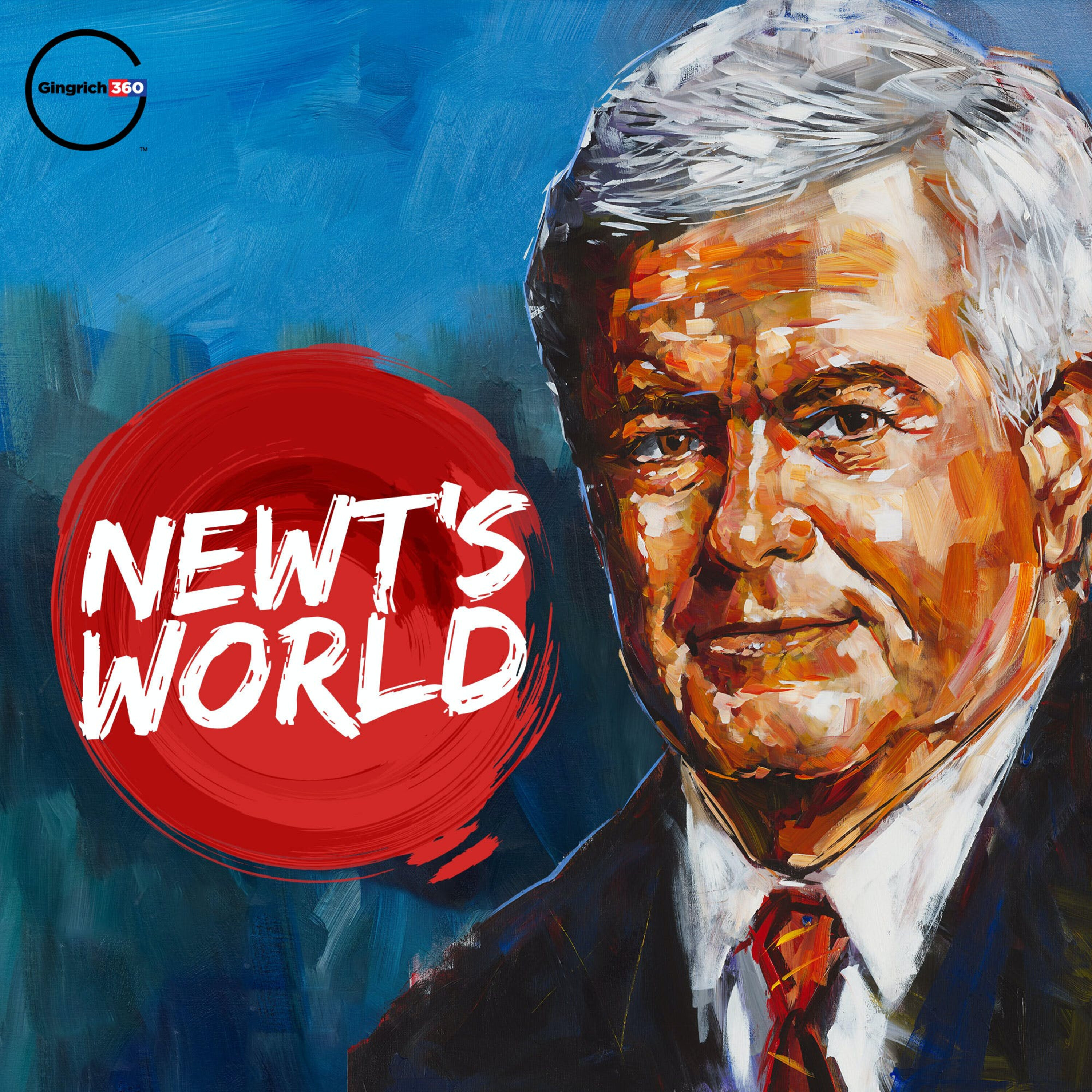
Thank you to my guest Robert D. Kaplan. You can get a link to buy his new book, Wasteland A World in Permanent Crisis on our show page@newtworld.com NewtWorld is produced by Gingrich360 and iHeartMedia. Our executive producer is Garnsey Sloan. Our researcher is Rachel Peterson. The artwork for the show was created by Steve Penley. Special thanks to the team at Gingrich 360. If you've been enjoying Newtsworld, I hope you'll go to Apple Podcast and both rate us with five stars and give us a review so others can learn what it's all about. Right now, listeners of Newtsworld can sign up for my three free weekly columns at Gingrich360.com Newsletter I'm Newt Gingrich. This is Newtsworld.
- [33:38]
Robert D. Kaplan
Foreign what's that sound? That's the sound of downy unstoppable scent beads going into your washing machine and giving your clothes freshness that lasts all day long.
- [33:56]
Newt Gingrich
There it is again.
- [33:57]
Robert D. Kaplan
It's like music to your ears. Or more like music to your nose. That freshness is iris resistible. Let's get a Downey Unstoppables bottle shake and now a sniff solo. Nice. With Downey Unstoppables. You just toss wash. Wow. For all day freshness.
- [34:17]
Podcast Host
This is an iHeart podcast.