Loading summary
Transcript35 lines
- [00:00]
Podcast Announcer
This is an iHeart podcast.
- [00:05]
Washable Sofas Advertiser
Let's be real Life happens, kids spill, pets shed and accidents are inevitable. That's why you need a washable sofa that can keep up. Our sofas are fully machine washable inside and out so you can say goodbye to stains and hello to worry free living. Made with liquid and stain resistant fabrics, they're kid proof, pet friendly and built for everyday life. Plus, changeable fabric covers let you refresh your sofa whenever you want. Need flexibility? Our modular design lets you rearrange your sofa anytime to fit your space, whether it's a growing family room or a cozy apartment. Plus, they're earth friendly and trusted by over 200,000 happy customers. Get early access to Black Friday pricing starting at just $699. It's time to upgrade to a stress free mess proof sofa. Visit washablesofas.com today and save. That's washablesofas.com offers are subject to change and certain restrictions may apply.
- [01:05]
Podcast Announcer
This is the story of the One As a custodial supervisor at a high school, he knows that during cold and flu season, germs spread fast. It's why he partners with Grainger to stay fully stocked on the products and supplies he needs, from tissues to disinfectants to floor scrubbers, all so that he can help students, staff and teachers stay healthy and focused. Call 1-800-GRAINGER, click grainger.com or just stop by Granger for the ones who get it done.
- [01:39]
Newt Gingrich
On this episode of Newts World, President Trump met this week with French President Emmanuel Macron and United Kingdom Prime Minister Keir Starmer to discuss the possible terms in which the war between Ukraine and Russia could arrive at a ceasefire. President Trump expressed quote, I think a lot of progress has been made. We've had some very good talks with Russia, we've had some very good talks with others, and we're trying to get the war ended with Russia and Ukraine, close quote. The Trump administration is also actively negotiating the release of the Israeli hostages still being held by Hamas. Here to discuss all of these topics, I'm really pleased to welcome my guest, Victoria Coates, former Deputy National Security Adviser to President Donald Trump and current vice president of the Katherine and Shelby Cullum Davis Institute for National Security and Foreign Policy at the Heritage Foundation. Her new book, the Battle for the Jewish How Israel and America Can Win, is available now.
- [02:52]
Victoria, welcome and thank you for joining me on Newts World.
- [02:55]
Victoria Coates
Of course, it's a great pleasure.
- [02:57]
Newt Gingrich
So President Macron visited the White House on Monday. Prime Minister Starmer is set to visit the White House on Thursday to discuss the Ukraine war and their relationship with the United States. What do you see as the primary goals of these leaders in their respective meetings, both in terms of their bilateral relations with the United States and their broader stance within Europe?
- [03:18]
Victoria Coates
Now, I think this has been a critical week for President Trump's stated goal of ending the Ukraine war. And for the first time in three years, we marked on Monday the three year anniversary of Putin's invasion of Ukraine. For the first time, we're seeing some diplomatic progress. The Biden administration took the approach of freezing communications with the Russians. Never a good idea. President Reagan certainly didn't do anything like that. They had very maximalist rhetoric toward Russia. And I had this strategy of as much as it takes, as long as it takes, which is a bumper sticker, essentially. And so I think President Trump, having inherited a really intractable situation here with a war of attrition between Ukraine and Russia, has prioritized ending the killing, as he says, and getting the war to an acceptable solution, to just tamp down that concern, because he knows we've got bigger fish to fry and bigger problems. Now, the Europeans, of course, have responded with panic to the return of the president, which I think is a good thing. And I think that's why you've had President Macron and Prime Minister Starmer visiting Washington this week. And we will actually also have President Zelensky at the end of the week to discuss the mineral deal and hopefully sign it. But I think what you're seeing here is President Trump getting results out of Europe. We had the prime Minister of the UK pledge to get to 2.5%. That's not enough, but that's better than, than where they are in terms of defense spending, percentage of gdp. You have Macron talking about a European army, which is a terrible idea. He should invest in his own defenses and NATO defenses. But at least they're talking about their defenses. And this is three years, though, into a war in Europe. Finally, we're getting some progress. So I think this is a huge week and very important for the transatlantic relationship.
- [05:11]
Newt Gingrich
I want to go back to the line you used to about the Biden administration, which was, you know, they should fight as long as it takes. The problem with that was it was Ukrainians doing the fighting, not the diplomats. And so young Ukrainians were being killed in enormous numbers with no strategy, no sense of how you're going to win. And it seems to me that's part of what Trump entered was that he'd watched three years of Total failure to cope with and defeat the Russian threat.
- [05:40]
No.
- [05:41]
Victoria Coates
And I think you could probably, with hindsight, identify a period in 2022 when Ukraine had the momentum that you could have done something decisive, maybe with major NATO allies. It wasn't done. The incremental assistance provided by the Biden administration was enough to keep Ukraine from losing, but not enough to let them win. And now, as you said, we're in this situation where we've had hundreds of thousands of dead Ukrainians. And I have to say in Washington, it's a standard line that, oh, they're not asking Americans to die in this war and we're modernizing our military, so this is great, but we're doing that on the backs of a lot of dead Ukrainians, which to do something, modernize our military, that we should do anyway. And I think that's what President Trump isn't willing to buy into and that he wants that carnage to stop.
- [06:31]
Newt Gingrich
It was interesting that French President Macron said in an interview before he met with Trump, quote, what I'm going to do is I'm going to tell him, basically, you cannot be weak in the face of President Putin. It's not you, it's not your trademark. But then during a joint news conference after their meeting, Macron said, quote, this peace must not mean a surrender of Ukraine. It must not mean a ceasefire without guarantees. This peace must allow for Ukrainian sovereignty. It strikes me that there's a desperate interest on the part of the internationalists to assume that somehow Trump is Putin's puppet, because they can't accept the idea that maybe there's an alternative path to getting this thing done. I mean, do you have that same feeling that the level of vitriol, the level of language, almost represents the degree to which their worldview has been repudiated, rather than an analysis of what's going on?
- [07:25]
Victoria Coates
No, I agree with that. And if you look at what President Trump has done since he's been in office versus some of his rhetoric, what he has done has been pretty rough on Russia. And that would be things like the energy renaissance that he's promising. With Secretary Bergam and Secretary Wright hard at work to unleash American energy, that's a terrible thing for Russia. They don't like that at all. And then this mineral deal with Ukraine, which gives the United States a vested interest in Ukraine's security, because that is a deal that theoretically will be very profitable for both our countries. So those are material steps he's taking. At the same time, sure. Maybe he's saying some Nicer things about Russia than the Biden administration said, but that costs him nothing. And sure, they adjusted the language on the United Nations General assembly resolution, but I can't think of anything off the top of my head more useless than the United Nations General assembly resolution. So that's an easy give. From President Trump's perspective, it doesn't cost anything. Meanwhile, he is taking material actions which actually do cost Russia something. So I would be very cautious about saying that he is Putin's puppet, especially because we have the fact that of the previous three presidents, the only president under whom Ukraine was not invaded was President Trump. So that's hardly what happens when you're somebody's puppet.
- [08:46]
Newt Gingrich
When I look at Trump's entire career, and if you go back and read his two best books, the Art of the Deal and the Art of the Comeback, he understands if you can't get the other guy in the room, you're not going to get a deal. So I think some of this posturing is designed to say to Putin, look, this is a different moment. I'm a different guy. We can find a way to work together. And it strikes me, if you have any possibility of getting to a truce or a ceasefire, Putin has to have a buy in, or he can just sit there and continue this war for 20 more years.
- [09:21]
Victoria Coates
No, absolutely. And I think that's also the problem with the way the media has characterized Putin as the devil and President Zelensky as the savior. You just have these two poles, and it made it impossible to deal with Vladimir Putin, regardless of what we might want to be the case in Russia. He is the decision maker. And President Trump has always been very clear with that, that he wants to deal with the decision maker for the reasons you described that are laid out in both of those books, that you can't deal with underlings, you can't deal with people who have to run back to their boss every 15 minutes to get the okay on something. You need the decision maker, and that is Vladimir Putin for Russia. It's just a fact. And, and so I do think what we've seen over the last couple of weeks is a leveling of that playing field. Certainly, I think President Zelensky's characterization of President Trump as being in a Russian disinformation space was an unfortunate episode. And I think the president struck back, as he will. And the other thing he hit on Newt, that really struck me is the fact that we haven't had elections in Ukraine because the Biden administration has sold this to the American people over the last three years as an existential threat to democracy and that that we were defending the very principles of democracy and that was why we were going to commit so much treasure to Ukraine. Well, we've learned this in the Middle east over the last 20 years, that going to war for democracy is not going to be a successful recipe. If you're going to go to war or contribute to a war, it has to be in your vital national security interests. And I love democracy. I'm an eager practitioner in it. I wrote a book about the history of it. I am in no way opposed to it, but it's not a cause for war war. And so that I think was a fallacy that President Trump really put his finger on when he was like and look, you know, and the guy that's supposed to be our savior is not practicing his democracy. He's not having elections. So I think that's been a very clarifying moment as well.
- [11:33]
Washable Sofas Advertiser
Tired of spills and stains on your sofa? Wash away your worries with Anabe Annabe is the only machine washable sofa inside and out where designer quality meets budget friendly prices. That's right, sofas start at just $699. Enjoy a no risk experience with pet friendly stain resistant and changeable slipcovers made with performance fabric Experience cloud like comfort with high resiliency foam that's hypoallergenic and never needs fluffing. The sturdy steel frame ensures longevity and the modular pieces can be rearranged anytime. Shop washablesofas.com for early Black Friday savings up to 60% off site wide, backed by a 30 day satisfaction guarantee. If you're not absolutely in love, send it back for a full refund. No return shipping or restocking fees. Every penny back. Upgrade now@washablesofas.com Offers are subject to change and certain restrictions may apply.
- [12:33]
Grainger Advertiser
This is the story of the One as head of maintenance at a concert hall, he knows the show must always go on. That's why he works behind the scenes, ensuring every light is working, the H Vac is humming, and his facility shines with Grainger's supplies and solutions for every challenge he he faces. Plus 24. 7 customer support. His venue never misses a beat. Call quickgranger.com or just stop by Grainger for the ones who get it done.
- [13:10]
Newt Gingrich
I was surprised when Trump first came up with this mineral deal. I would have thought that Zelenskyy would have grabbed it. Because if you get America deeply involved in Ukrainian economy, you make it much less likely that Russia will ever attack Again, absolutely.
- [13:28]
Victoria Coates
This is also what I think should be the model now that we're dismantling the broken paradigm of usaid, which had its role in the Cold War. It drifted from that mission clearly in the 90s and certainly over the last 20 years. It can't be fixed at this point. But if you look at deals for mutual sort of co development of resources, it kind of goes back to the Aramco model with Saudi Arabia and you create a corporation in essence, that is an asset to both countries and a source of prosperity. And so I would love to see this successful deal be replicated in Africa, in Latin America. It could be a great way to spread American influence and very positively shape the development of these countries and not just be a gift from the US taxpayer and certainly not be in the service of some very liberal woke social agenda as USAID has been in recent years.
- [14:27]
Newt Gingrich
Starmer has made a point. I'm just going to quote from a speech he gave at the Scottish Labour Party conference in Glasgow. He said nobody wants the bloodshed to continue, nobody, least of all the Ukrainians. But after everything that they have suffered, after everything that they have fought for, there could be no discussion about Ukraine without Ukraine. And the people of Ukraine must have a long term secure future. I agree with the last part. They should have a long term secure future. In the Korean War, the United States Chinese negotiations Panmunjon had neither north or South Korea in them. In the Vietnam War, the negotiations in Paris were between the United States and North Vietnam and didn't have the South Vietnamese in them. So it's not abnormal for great powers to sit down and deal with each other and not necessarily have their ally at the table. I mean, in that sense, isn't this trying to set a different standard?
- [15:21]
Victoria Coates
It is. And I think particularly the meeting in Saudi Arabia was just a very important re establishment of contact. One of the things that actually came out of the Helsinki summit between President Trump and President Putin was a directive for the National Security Council staffs to talk to each other. So we actually did during the Trump administration. We met with the Russians in Geneva, we went and met with him in Moscow and in Jerusalem. So there was contact, there was discussion, but that was between Russia and the United States. And I think the meeting with Secretary Rubio and National Security Advisor Waltz was very important for establishing that contact between the Russians and the United States and starting to have discussions. And I thought that was a particularly interesting meeting taking place in Riyadh because you had for the first time, to my knowledge, the three biggest Energy producers in the world in the same room. And apparently they did talk about energy.
- [16:18]
Newt Gingrich
You know, I had not thought of that. That's a great point, symbolically, that you have the overwhelming weight of the world's oil supply sitting in that one room. I also thought it was interesting and I suspect deliberate, as opposed to going to Geneva or somewhere in Europe. The kind of place John Kerry liked, where you had a good four star hotel, terrific restaurants. It both honored the Saudis and established a different structure of thinking about things to have the meeting in Saudi Arabia rather than in Europe. I'm sure it was deliberate, but it was just, to me, kind of a fascinating comment on how the world is changing.
- [16:58]
Victoria Coates
It is. And I think the Biden administration found out the hard way between pariah what Joe Biden, as a candidate, referred to the kingdom as, and then getting to the fist bump when he realized that there was this very significant role that Saudi has to play and the reason that we had an 80 year alliance with them. And so that is something President Trump obviously recognized from the get go. And the location of his first trip in the spring of 2017, he went to Riyadh first, and then he went to Jerusalem, and then he went to Rome. And that is, I think, what he's proposing to do again. And that demonstrates his appreciation for the significance of that relationship and the role that Saudi can play. Because obviously MBS is well known to both President Trump and President Putin. They both have his ear as well. I think it just makes a lot of sense.
- [17:53]
Newt Gingrich
I'm curious, with all the turmoil with the two speeches by Vance, both the artificial intelligence speech in Paris and then the very aggressive speech at the Munich meeting, and with Hegseth's very aggressive speech in Brussels, to what extent are the Europeans just kind of in a state of shock that this new administration is so willing to challenge them about patterns that have sort of defined Europe for the last 30 years, I think that.
- [18:22]
Victoria Coates
Should come as no surprise to them, but they are very, very surprised, even having lived through the first Trump term. So our message to them has been, you hold this relationship in your hands, and if you stop with the climate extremist nonsense and you start investing in your defenses, you will have no better friend and ally than the United States. And that was the message from Secretary Hegseth and from the vice President. We actually, as heritage, had a group over in Munich as well, having one of the very few conservative defense events with Senator Sullivan and Senator Schmidt. So it was a good opportunity to show support for the administration from the Congress from the think tank world that American conservatives are united on this and hopefully that message is received in Europe and they start matching their words about concern about Russia and their security situation with their deeds.
- [19:18]
Newt Gingrich
I described it in an article that in a sense what JD Vance was doing was the equivalent of having a neighbor who was an alcoholic. And it was an intervention that he's actually trying to say to the Europeans, look, we would really like for you to be successful. However, you have to confront these problems if you don't have any hope of being successful. I look at the decay of Europe over the last 40 years. You know, there are 19 trillion dollar companies in the world, 14 are American, four are Chinese and the last one is Aramco. Not a single European country as a competitive global company. It's just astonishing to me. When you think about it, you do have some Europeans. Hungary, Italy, Finland, and I think the Swiss presidents also said some things who are all actually closer to J.D. vance than they are to Brussels in the way they reacted. What do you sense about the next five or eight year evolution of European politics?
- [20:20]
Victoria Coates
I think it's trending in the right way. And even given what happened in the UK last year with Starmer's election, I think there is a path for UK Conservatives to reclaim the principles of Lady Thatcher and reassert British sovereignty and national interests. And we've seen that in, as you say, Hungary and Italy. I think we could see it in Spain, we could see more in France. What happened in Germany was actually positive last week. I think it's a good step, I think they can go farther. But it is a repudiation of the sort of EU centric globalist mindset, the Davos mindset, to borrow a phrase from my boss Kevin Roberts, that has been poisonous for what should be one of the most prosperous, successful partners of the United States in Europe. So hopefully the tough love message has been received and one of our jobs here at Heritage is to reach out to conservatives internationally and encourage them and share our best practices. So we'll be very focused on that as well.
- [21:22]
Newt Gingrich
Victoria, I want to thank you for joining me. Your new book, the Battle for the Jewish How Israel and America Can Win, is available now on Amazon and in bookstores everywhere. We're going to feature a link to buy it on our show page and I want to let our listeners know they can follow your recent work by visiting the Heritage foundation website@heritage.org thank you very much, Very much.
- [21:43]
Victoria Coates
Thank you, Newt.
- [21:47]
Newt Gingrich
Thank you to my guest, Victoria Coates. You can get a link to buy.
- [21:50]
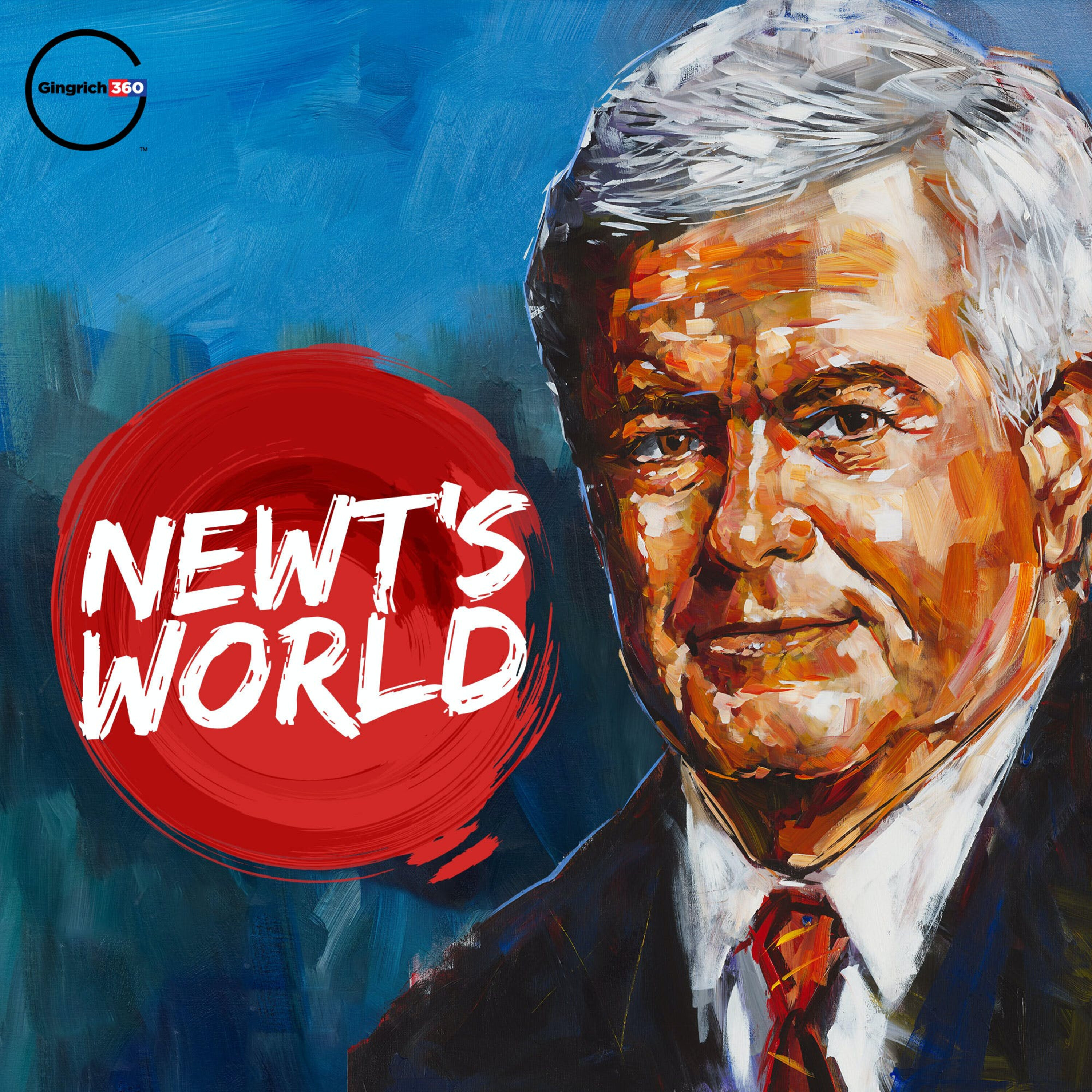
Her new book the Battle for the Jewish How Israel and America Can Win on our show page@newtworld.com New Trail is produced by Gamer360 and iHeartMedia. Our executive producer is Garnesey Sloan. Our researcher is Rachel Peterson. The artwork for the show was created by Steve Pendley. Special thanks to the team at Gingrich 360. If you've been enjoying Newts World, I hope you'll go to Apple Podcast and both rate us with five stars and give us a review so others can.
- [22:18]
Learn what it's all about.
- [22:20]
Right now, listeners of Newtsworld can sign up for my three free weekly columns at Gingrich360.com newsletter.
- [22:28]
I'm Newt Gingrich. This is Newtsworld.
- [22:44]
Podcast Announcer
Kay Jeweler's early Black Friday sale is happening now. Get up to 50% off Black Friday deals and up to 40% off everything else. Don't miss this sale. Start your season with savings only at Kay. Exclusions apply. See kay.comexclusions for details. This is an iHeart podcast.