Loading summary
Transcript33 lines
- [00:00]
Newt Gingrich
This is an iHeart podcast.
- [00:02]
LG Gram Laptop Advertiser
Guaranteed Human did you know Microsoft has officially ended Support for Windows 10? Upgrade to Windows 11 with an LG Gram laptop, voted PCMag's Reader's Choice top laptop brand for 2025. Thin and ultra lightweight, the LG Gram keeps you productive anywhere, and Windows 11 gives you access to free security updates and ongoing feature upgrades. Visit lgusa.com iheart for great seasonal savings on LG Gram laptops with Windows 11. PCMag reader's choice used with permission. All rights reserved.
- [00:35]
Better Picks Advertiser
Do you like free money? Well, today's your lucky day. Better Picks is offering a free $10 just for signing up. Download the Better app, Pick more or less on your favorite player's stats, watch the games and win some cash. It's that simple. Better Pick is available in 33 states, including Texas, California and Georgia. Download the Better app today. That's Better Betr and get a free $10. No deposit necessary. Must be 21 or older. In a jurisdiction where Better Picks operates, terms and conditions apply. Better Picks Sports just got better.
- [01:05]
Narrator/Host (Newt Gingrich)
Well, the holidays have come and gone once again. But if you've forgotten to get that special someone in your life a gift.
- [01:10]
LG Gram Laptop Advertiser
Well, Mint Mobile is extending their holiday offer of half off unlimited wireless. So here's the idea.
- [01:16]
Narrator/Host (Newt Gingrich)
You get it now, you call it an early present for next year.
- [01:20]
Better Picks Advertiser Alternate
What do you have to lose?
- [01:21]
LG Gram Laptop Advertiser
Give it a try@mintmobile.com Switch limited time.
- [01:25]
Narrator/Host (Newt Gingrich)
50% off regular price for new customers. Upfront payment required $45 for three months, $90 for six months or one for 12 month plan taxes and fees. Extra speeds may slow after 50 gigabytes per month when network is busy.
- [01:34]
Vizio and Shipt Advertiser
See terms get into the spirit with Vizio's MyHub, a new, simpler way to find everything you love on Vizio TV this holiday season. My Hub is your destination to discover new movies and shows tailored to you, find exclusive deals and discounts and keep your favorites organized in one convenient place. Plus, Vizio TVs have all your favorite apps built in like iHeartRadio so you can stream that favorite festive music playlist. My hub makes it simpler to find what you want when you want it. Visit vizio.com iheart and experience entertainment made.
- [02:04]
SpinQuest Advertiser
Easy today I'm here with Spinquest where you can play and win from the comfort of your own home with hundreds of slot games and all of the table games you love with real cash Prizes. Right now, 30 coin packs are on sale for $10 for new users. It's all at spinquest.com that's S-P-I-N Q.
- [02:26]
Vizio and Shipt Advertiser
U-E-S-T.com Spinquest is a free to play social casino void where prohibited. Visit spinquest.com for more details.
- [02:41]
Narrator/Host (Newt Gingrich)
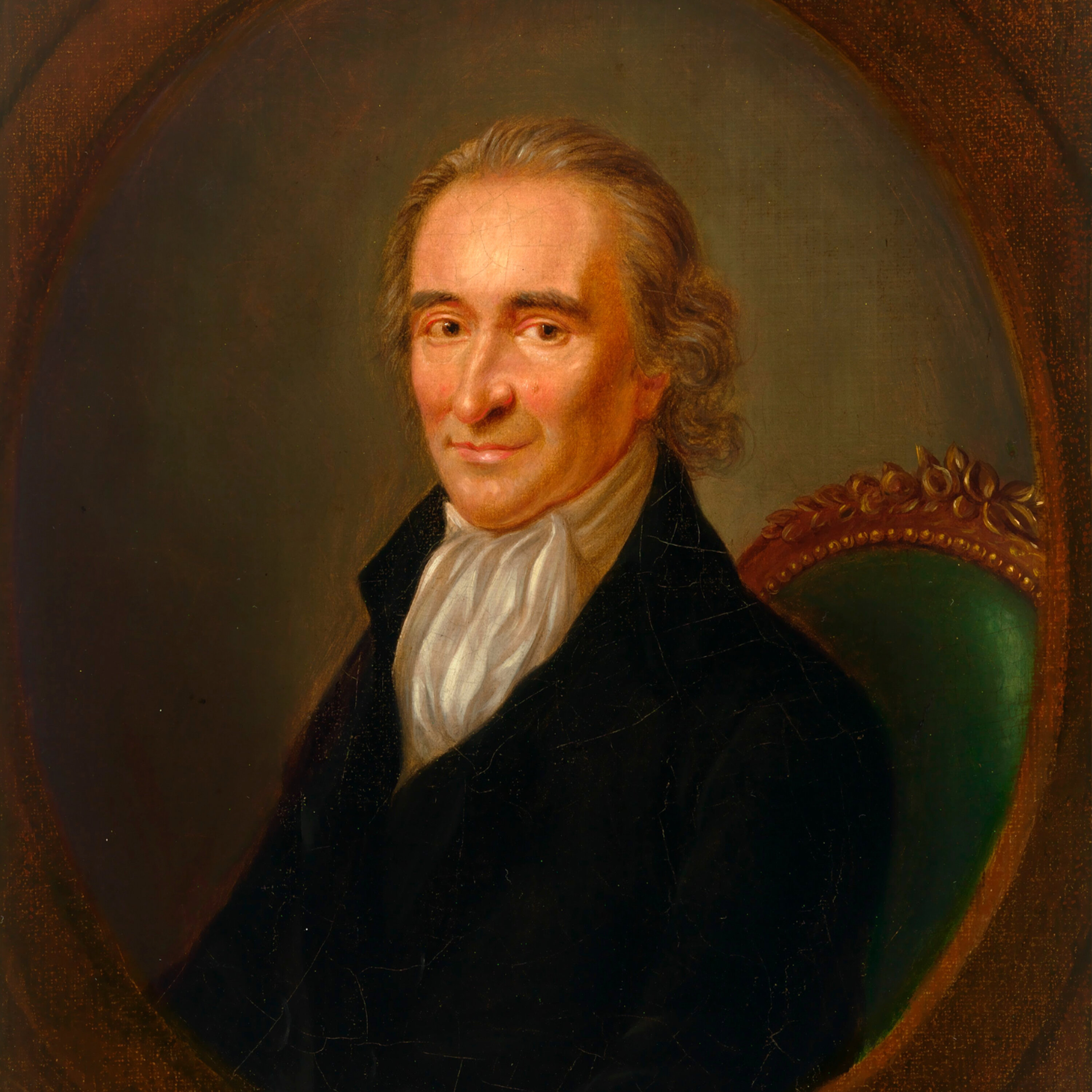
On this episode of Newts World. The lives of these men are essential to understand the American form of government and our ideals of liberty. The Founding Fathers all played key roles in securing American independence from Great Britain and in the creation of the government of the United States of America. And now the Life of Thomas Paine. Although Thomas Paine is now considered an American hero, at the time of his death only six people attended his funeral and papers wrote negatively about him. He was not popular and his reputation had been destroyed. His obituary ended with quote, he had lived long, did some good and much harm, and yet Paine was extraordinarily important in the American Revolution and was really very different from the Founding Fathers. As you'll see, he's a man who had a very complicated life, very complicated beliefs, was deeply opposed to the British government, and was enormously helpful to George Washington. But in the end, he was more of an opponent to order than he was an advocate of a new order. Paine was born on January 29, 1737, in the small village of Thetford in Norfolk, England, to Joseph Payne and Francis Cock Payne. He was an only child. His father was a stay maker, a maker of whalebone components for women's corsets. Payne attended seven years of formal education at the Thetford Grammar School. He left school around the age of 12 or 13 and began an apprenticeship with his father. He worked the trade for six years before running away from home to seek an adventure at sea. The first time he tried to win away, his father stopped him on a November morning in 1756, at the age of 16, he attempted to join the British privateer Terrible, but his father found him in London and talked him out of joining the crew. Paine later wrote, quote from this adventure, I was happily prevented by the affectionate and moral remonstrance of a good father who from his own habits of life, being of the Quaker profession, must begin to look upon me as lost. In April 1757, he joined the crew of the privateer the King of Prussia, where he spent six months at sea. Little is known about Paine's experience on the voyage or what he did because he barely mentioned it in his writings. In 1759, he married Mary Lambert. She and their child died in less than a year later in childbirth. In 1768, Paine began work as an excise officer on the Sussex Coast. He was a tax collector. Paine married Elizabeth Olive in 1771. Paine served as a tax collector for a short period, but in 1772, Paine published his first piece, Case of the Officers of Excise, which he personally distributed to members of Parliament, urging them to improve wages and working conditions for England's excise men, that is England's tax collectors. This probably cost him his job. Officially, the reason he was fired was for neglecting his duties as a tax collector while going to London to lobby for higher pay for tax collectors. In this piece, his first real effort at public advocacy, he wrote, an augmentation of salary sufficient to enable them to live honestly and competently would produce more good effect than all the laws the land can enforce. The generality of such frauds as the officers have been detected and have appeared of a nature as remote from inherent dishonesty as a temporary illness is from an incurable disease. Surrounded with want, children and despair, what can the husband of the father do? No laws compel like nature, no connections bind like blood. With an addition of salary, the excise would wear a new aspect and recover its former constitution. Languor and neglect would give place to care and cheerfulness. Men of reputation and abilities would seek after it and finding a comfortable maintenance would stick to it. The unworthy and the incapable would be rejected, the power of superiors be re established and laws and instructions receive new force. The officers would be secured from the temptations of poverty and the revenue from the evils of it. The cure would be as extensive as the complaint and new health outroot the present corruptions. Paine, you can already see in this very first pamphlet, his first effort at public advocacy. He's already mastered the ability to write clearly. He's already mastered the ability to present a case in an orderly, structured way. While Paine was busy lobbying, he and his wife fell apart. In 1774, Paine and his wife signed a formal separation agreement. It's unclear why they signed the separation agreement, but Paine never remarried nor have any children. At some point in 1774, it's not clear whether this was before or after he separated from his wife. He met Benjamin Franklin in London. Franklin had become the lobbyist for the then province of Pennsylvania, went to London. In fact, it was in London that Franklin realized he'd never be accepted by the British aristocracy. And it was said that he went to London as an Englishman and he returned as an American. But one of the key things was that in 1774, Franklin met Thomas Paine. And Franklin advised him to emigrate to America. He gave him a letter of introduction to bring with him, addressed to Ben Franklin's son in law, Richard bach. Franklin was 38 at the time. In the September 30, 1774 letter, Franklin wrote, quote, the bearer, Mr. Thomas Paine is very well recommended to me as an ingenious worthy young man. He goes to Pennsylvania with a view of settling there. I request you to give him your best advice and countenance, as he is quite a stranger there. If you can put him in a way of obtaining employment as a clerk or assistant tutor in a school or assistant surveyor, all of which I think him very capable, so that he may procure a subsistence, at least to him it can make acquaintance and obtain a knowledge of the country. You will do well and much oblige your affectionate father. My love to Sally and the boys. Three months later, Payne was on a ship to America, almost dying of scurvy. After arriving in Philadelphia, Paine became the managing editor of Philadelphia Magazine. Paine edited the magazine from February 1775 to to May 1776. Paine was a major contributor to the magazine, writing under the pseudonyms Amicus and Atlanticus. On January 24, 1775, before he became the managing editor of Philadelphia Magazine, Paine wrote his first essay on the importance of the press. This is Paine. The press has not only a great influence over our manners and morals, but but contributes largely to our pleasures. And a magazine, when properly enriched, is very conveniently calculated for this purpose. Voluminous works weary the patience, but here we are invited by conciseness and variety. As I have formerly received much pleasure from perusing these kind of publications, I wish the present success, and have no doubt of seeing a proper diversity blended to agreeable together so as to furnish out an oleo worthy of the company for whom it is designed. I consider a magazine as a kind of beehive which both allures the swarm and provides room to store their sweets. Its division in cells gives every bee a province of its own. And although they all produce hone. I'm sorry. And although they all produce honey, yet perhaps they differ in their taste for flowers and extract with great dexterity from one, then from another. Thus we are not all philosophers, all artists, nor all poets. This was Paine describing his belief in the written word and the importance of the written word. Paine was vocally against slavery. On March 8, 1775, an anti slavery essay written by Paine was published in both the Pennsylvania Journal and the Weekly Advisor. A few weeks later, on April 14, 1775, the first Anti Slavery Society in America was formed in Philadelphia, with Paine as one of the founding members. Now notice he's only been there a very short time already. He's active as a citizen, he's active as a writer. He's obviously a very engaged, very energetic person. In his March 8, 1775 essay, Paine wrote to Americans that some desperate wretches should be willing to steal and enslave men by violence and murder for gain is rather lamentable than strange. But that many civilized, nay, Christianized people should approve and be concerned in the savage practice is surprising and still persists, though it has been so often proved contrary to the light of nature, to every principle of justice and humanity, and even good policy, by a succession of eminent men in several late publications. Our traders in men and unnatural commodity must know the wickedness of the slave trade if they attend to reasoning or the dictates of their own heart, such as shun and stifle all these willfully sacrificing conscience and the character of integrity to that golden idol. So here we are with Pain, already the pamphleteer argue in favor of freedom over slavery. But now comes the moment that makes Paine a historic figure of the first order, and that truly makes him one of the great leaders of the American Revolution. Paine publishes Common sense anonymously on January 10, 1776, as by an Englishman, due to fears that it could be considered treason. Remember, you're dealing with king who is basically a monarch imposed by God. Any direct criticism of the King can be translated into treason, into a failure to be a loyal citizen. That's why so much of 18th century dialogue will refer back, for example to the Roman Republic or will have some other reference point. Everybody knows it's written about the present, but you can't say it directly. So here's Payne as an Englishman, worried that if people know he wrote it, he might be considered a traitor.
- [14:20]
LG Gram Laptop Advertiser
Did you know Microsoft has officially ended Support for Windows 10 upgrade to Windows 11 with an LG Gram laptop? Voted PCMag's Reader's Choice top laptop brand for 2025. Thin and ultra lightweight, the LG Gram keeps you productive anywhere, and Windows 11 gives you access to free security updates and ongoing feature upgrades. Visit LGUSA.com iHeart for great seasonal savings on LG Grand Laptops with Windows 11 PC Mag Reader's Choice Used with permission. All rights reserved.
- [14:50]
Better Picks Advertiser
Have you ever turned a dollar into ten grand? I doubt it, but now you can on better picks. Download the better app Pick more or less on your favorite player's stats, watch the games and win some cash. It's that simple. Better picks available in 33 states including Texas, California and Georgia. Download the Better app today that's Better Betr and get a free $10. No deposit necessary. Must be 21 or older. In a jurisdiction where Better Picks operates. Terms and conditions apply. Better Picks Sports just got better.
- [15:20]
Narrator/Host (Newt Gingrich)
I'm.
- [15:21]
SpinQuest Advertiser
Here with spinquest where you can play and win from the comfort of your own home with hundreds of slot games and all of the table games you love with real cash prizes. Right now, thirty dollar coin packs are on sale for ten dollars. For new users, it's all@spinquest.com that's S P I N Q U-E-S-T.com SpinQuest is.
- [15:43]
Vizio and Shipt Advertiser
A free to play social casino void where prohibited. Visit spinquest.com for more details. Get into the spirit with Vizio's My Hub a new, simpler way to find everything you love on Vizio TV this holiday season, My Hub is your destination to discover new movies and shows tailored to you, find exclusive, exclusive deals and discounts, and keep your favorites organized in one convenient place. Plus, Vizio TVs have all your favorite apps built in like iHeartRadio so you can stream that festive music playlist. MyHub makes it simpler to find what you want when you want it. Visit vizio.com iheart and experience entertainment made.
- [16:19]
Newt Gingrich
Easy today at TJ Maxx. Feel more you than ever without compromise because we never make you choose the quality you want, the styles you crave and the prices you love. It's all at TJ Maxx so you can focus on just being you. With so many finds arriving daily, that means so many ways to show your unique style. Shop in store and online@tjmaxx.com and Max, what makes you.
- [16:58]
Narrator/Host (Newt Gingrich)
Remember he's writing this in January 1776 before the Americans have declared their independence. So as an Englishman, he writes so brilliantly that in the first three months, Common Sense sold 120,000 copies. By the end of the revolution, 500,000 copies were sold since the estimated population of the colonies at the time, excluding Native Americans and African American slaves, was 2.5 million. An estimated 20% of the colonists owned a copy. After its publication, many American newspapers praised the piece. So here's a document which is sweeping across the country, being very widely read and it is shaping people's thinking about this historic moment. This is a moment of indecision. Nobody's yet really thought clearly about declaring Independence. They know they're mad at the English government. They know they feel cheated by Parliament. They know that the arrogance of the English government is driving them nuts because they have such a deep sense of freedom. They're, after all, thousands of miles away. They're on the edge of a continent. They're earning that with their own hard work. They're taking their own risks with, With Indians. I mean, from a standpoint of the Americans, London has become a place which is despotism rather than a place which is protecting them. And so Paine is here beginning to explain to them how to think about where they are. You know, the Pennsylvania Evening post on February 13, 1776, says, quote, if you know the author of Common Sense, tell him he's done wonders and worked miracles, made Tories wigs and washed blackamoor's white. He has made a great number of converts here. His style is plain and nervous. His facts are true, his reasoning just and conclusive. Close quote. I might point out that Whigs were the loyal opposition to the government. And so to be a Whig was, in fact to be critical of the established government. And as been pointed out by many historians, the Americans who decided to rebel were essentially in the Whig tradition. They were very close to the English Whigs in their thinking and in their sense of identity. So when the Pennsylvania Evening Post says that he has made Torrey's Whigs, they're saying basically he's converting people from defending the established government of England into being critics of the government of England. The New York Journal on March 17, 1776, says, quote, in your famous pamphlet entitled Common Sense, by which I am convinced the necessity of independence, to which I was before averse, you have given liberty to every individual to contribute materials for that great building, the Grand Charter of American Liberty. Now, think about this. Here's this Englishman who's come over and all of a sudden he captures, he articulates the spirit of the age. He gives words to people who had sort of thought about it, but they didn't know how to say it. And suddenly he becomes the catalyst for several hundred thousand Americans to begin to move towards independence. The new London Gazette, published in Connecticut on March 22, 1776, says, quote, to the author of the pamphlet entitled Common Sense, sir, in declaring your own, you have declared the sentiments of millions. Your production may justly be compared to a land flood that sweeps all before it. We were blind, but on reading these enlightening works, the scales have fallen from our eyes. Close quote. Now, it's just remarkable that he has had that kind of an impact. And of course, as a part of that process. That's why I say that in many ways he's one of the Founding fathers, even though culturally and in income and in stature, he doesn't really quite fit with them. He's more of a rabble rouser, more of an outsider, more of a radical, as you'll see in a minute. But he's now established a believability, a connection with probably close to a million Americans, out of a population of about two and a half million. However, the revolution doesn't go well. July 4th is terrific. Everybody's excited. They pass the Declaration of Independence. They've already created an army in Massachusetts. And to unify the country, they sent a Virginian, George Washington, to head up the army in Massachusetts. Washington, as soon as he gets a copy of the Declaration, has it read to the troops. Washington understands the importance of morale, the importance of propaganda, the importance of getting people to understand what they're doing. And yet, despite their great victory in Boston driving the British out of the city, they fall on hard times. The British have the power of the ocean because the Royal Navy dominates. They move their military. Washington marches down to Brooklyn. His army begins to be shattered. He barely survives, thanks to a providential fog coming in, so people can't even see what's happening. And they managed to get their army across from Brooklyn to Manhattan when, if the weather had been clear, the Royal Navy would have sunk the entire American Army. He loses Fort Washington, about 3,000 troops surrendering. And his army gradually shrinks from a high point of 30,000 in September down to about 2,500 effectives by Christmas. And people are defeated, despondent, demoralized. Washington, on the long march across New Jersey, runs into Payne, who has signed up as a rifleman, and he says, I don't need you as a rifleman. I need a new pamphlet. I need an explanation. You've got to tell us now, why has this become so hard? And so the man who wrote Common Sense and helped the country decide it wanted to be independent goes to Philadelphia, goes back to writing and produces the crisis entitled the American Crisis. And it begins with some of the most amazing words ever written, and I'm quoting Paine. These are the times that try men's souls. The summer soldier and the sunshine patriot will in this crisis shrink from the service of their country. But he that stands it now deserves the love and thanks of man and woman. Tyranny, like hell, is not easily conquered. Yet we have this consolation with us that the harder the conflict, the more glorious the triumph. So here's this great pamphleteer coming back once again saying, okay, I helped convince you, you ought to be independent. Now I'm going to convince you, you got to stick with it. As Washington, in the extraordinary, courageous last throw of the dice, takes his troops to cross the Delaware on Christmas night in a snowstorm with large blocks of ice in the river, gets them to march eight miles in the dark to surprise 800 professional German soldiers who collapse and are captured. As the men are getting on the boat to cross the river, Washington has the officers reading the crisis to remind them, this is why we're here, this is what we're trying to do. Yes, it's hard, but we can do it. So Paine has two great impacts. His first great impact is getting people to decide that they want to be independent. His second great impact is convincing them to keep working and to keep fighting. Now, in this period, Paine is actually serving serve as a war correspondent. He's reporting to the country and he actually wrote 16 articles sitting around the campfire about what's going on. During the retreat of Washington's forces from New York to New Jersey In December of 1776, Paine wrote an account which was published in the Pennsylvania journal only in January 29, 1777. This is after he's written the crisis, after he's helped the Americans decide they are going to keep fighting and they're going to stay at it. But here's what he writes. I am quoting Paine now from the Pennsylvania Journal. Fort Washington being obliged to surrender by a violent attack made by the whole British army on Saturday 16th November, the Generals determined to evacuate Fort Lee, which being principally intended to preserve the communication with Fort Washington, was become in a manner useless. The stores were ordered to be removed and great part of them was immediately sent off. The enemy, knowing the divided state of her army and that the terms of the soldiers enlistments would soon aspire, conceived the design of penetrating into the Jerseys and hoped by pushing their successes to be completely victorious. Accordingly, on Wednesday morning, 20th November, it was discovered that a large body of British and Hessian troops had crossed the north river and landed about six miles above the fort. As our force was inferior to that of the enemy, the fort unfinished and on a narrow neck of land, the garrison was ordered to march for Hackensack Bridge, which, though much nearer the enemy than the fort, they quietly suffered our troops to take possession of. The principal loss suffered at Fort Lee was that of the heavy cannon the greatest part of which was left behind. Our troops continued at Hackensack bridge and town that day and half of the next, when the inclemency of the weather, the want of quarters and approach of the enemy obliged them to proceed to Aqua Connock and from thence to Newark. A party being left at Aqua Connaught to observe the motions of the enemy. At Newark our little army was reinforced by Lord Stirling's and Colonel Hand's brigades which had been stationed at Brunswick. Three days after our troops left Hackensack, a body of the enemy crossed the Passaic above Aqua Connaught and made their approaches slowly towards Newark and seemed extremely desirous that we should leave the town without their being put to the trouble of fighting for it. The distance from Newark to acquaint is nine miles, and they were three days in marching that distance from Newark. Our retreat was to Brunswick. And it was hoped that the assistance of the Jersey militia would enable general Washington to make the banks of the Raritan the bounds of the enemy's Progress. But on the 1st of December, the army was greatly weakened by the expiration of terms of enlistments of the Maryland and Jersey flying camp, and the militia not coming in so soon as was expected. Another retreat was the necessary consequence. Our army reached Trenton on the 4th of December, continued there till the 7th, and then, on the approach of the enemy, it was thought proper to pass the Delaware. Now, that was a sort of description for the whole country of the way in which Washington's army is shrinking and getting to a point where it almost ceases to exist. In fact, at one point, in designing a very daring strategy, Washington reassures his generals by pointing out that if the army totally collapses, the revolution will be over. If the revolution is over, every general at that meeting will be hung. And therefore they have nothing to fear because they have nothing to lose. Has remarkable courage on the part of Washington. And it was a remarkable intelligence by Washington to recognize that Paine really was a person who could help understand what's going on. Paine writes the Crisis 4 in September of 1777, which opens with the following. And I think this is useful to us today because it's as true for us today as it was in 1777. Paine wrote, those who expect to reap the blessings of freedom must, like men, undergo the fatigues of supporting it. And near the close, it states, we fight not to enslave, but to set a country free and to make room upon the earth for honest men to live in. Now, I think that's probably as good a capture of what America is all about and of what we in our generation also have to do. And in that sense, if you allow him to Paine talks to our generation fully as much as he wrote for the Founding Fathers generation, you know in 1777, Congress appointed Paine as Secretary to the Committee for Foreign Affairs. He held that till early 1779 when he was forced to resign as a result of what was called the Silas Dean Affair. Silas Dean was a member of the early Continental Congress who was sent by Congress to France to obtain financial and military assistance. He successfully obtained and sent arms from France to America, but upon his return to the States he was accused of embezzlement and disloyalty because of accusations that he charged France for the supplies that were intended as gifts. These accusations were never proven, but they ruined Dean's political career. Paine publicly denounced Dean Dean's private arms dealing in France, but in doing so revealed secret negotiations with France, which led to his dismissal as Secretary to the Committee for Foreign Affairs. Later that year, he was appointed Clerk of the Pennsylvania assembly. In March of 1780, while clerk of the Pennsylvania Assembly, Paine wrote the Preamble to the act for the Gradual Abolition of Slavery, which was the first legislative measure for the emancipation of slaves in America. Paine originally hoped this act would immediately abolish slavery, but because of opposition, he was forced to write a compromise which outlined the gradual emancipation of slaves. Instead. The act specified that every child born into slavery after passing the act would be free upon reaching the age of 28. The bill passed with a vote of 34 to 21. So Paine has had an experience both of being pro freedom for the American colonies from Britain and being pro freedom for the abolition of slavery. In 1787, Paine returned to Britain but experienced persecution for his support of the French Revolution. The French Revolution is a much more radical revolution than the American Revolution, and that radicalism became a huge challenge to the very fabric of British society.
- [32:17]
LG Gram Laptop Advertiser
Did you know Microsoft has officially ended Support for Windows 10? Upgrade to Windows 11 with an LG Gram laptop Voted PCMag's Reader's Choice Top Laptop Brand for 2025. Thin and old, ultra lightweight, the LG Gram keeps you productive anywhere, and Windows 11 gives you access to free security updates and ongoing feature upgrades. Visit lgusa.com iheart for great seasonal savings on LG Gram laptops with Windows 11. PCMag reader's choice used with permission. All rights reserved.
- [32:47]
Better Picks Advertiser Alternate
Have you ever turned $1 into $10,000? I doubt it, but now you can on Better Picks, download the Better app, pick more or less on player stats, watch the games and win some cash. It's that simple. Better Picks is available in 33 states, including Texas, California and Georgia. Download the Better App today. That's better B E T R and get a free $10. No deposit necessary. Must be 21 or older. In a jurisdiction where Better Picks operates, terms and conditions apply. Better Picks Sports just got better.
- [33:19]
SpinQuest Advertiser
Forget everything you had planned for this weekend be because you are sitting on your couch and winning from the comfort of your own home. I'm here with Spin Quest where you can play hundreds of slot games, all the table games you love, and you could even win real cash prizes. New users $30 coin packs are on sale for 10@spinquest.com Spin Quest is a.
- [33:41]
Vizio and Shipt Advertiser
Free to play social casino void where prohibited. Visit spinquest.com for more detail. Get into the spirit with Vizio's My Hub a new, simpler way to find everything you Love on Vizio TV this holiday season, MyHub is your destination to discover new movies and shows tailored to you, find exclusive deals and discounts and keep your favorites organized in one convenient place. Plus, Vizio TVs have all your favorite apps built in like iHeartRadio so you can stream that festive music playlist. MyHub makes it simpler to find what you want when you want want it. Visit vizio.com iheart and experience entertainment made.
- [34:17]
Newt Gingrich
Easy today at TJ Maxx. Feel more you than ever without compromise because we never make you choose the quality you want, the styles you crave and the prices you love. It's all at TJ Maxx so you can focus on just being you. With so many fines arriving daily, that means so many ways to show your unique style. Shop in store and online@tjmax.com and Max, what makes you you?
- [34:55]
Narrator/Host (Newt Gingrich)
In 1791, Paine wrote the Rights of Man in response to the English writer and politician Edmund Burke's Reflections on the Revolution in France, which was written in 1790. Burke is probably the most famous conservative intellectual who's also a politician trying to think through the threat of the radicalism of the French Revolution. So now Paine is writing Defending the French Revolution. The Rights of Man was originally printed by Joseph Johnson and published on February 21, 1791, but it was withdrawn for fear of prosecution by the government. On March 16, 1791, J.S. jordan published Paine's 90,000 Word Book. In the Rights of Man, Paine wrote it is a perversion of terms to say That a charter gives rights, it operates by a contra that of taking rights away. Rights are inherently in all the inhabitants, but charters, by annulling those rights in the majority, leave the right by exclusion in the hands of a few. They consequently are instruments of injustice. The fact, therefore, must be that the individuals themselves, each in his own personal and sovereign right, entered into a contract with each other to produce a government. And this is the only mode in which governments have a right to arise and the only principle in which they have a right to exist. Close quote. Now, of course, if you think about it, this is a direct repudiation of the entire model of kingship in which power goes from God to the king and the king gives you rights. Pain is saying the opposite. He's saying, oh, no, power comes to you from God, and then you get to decide whether or not you want to have a contract with other people to create a government. Now, this writing is so radical for that time that Paine is charged with libel. He flees to France before being charged, and he never returns to England. So now he's moved from the heroic defender and explainer of the American Revolution to an advocate of a dramatically more radical French Revolution. Paine wrote Georges Jacques Danton, who's one of the great leaders of the French Revolution, on May 6, 1793. He had originally hoped to return to America in 1788, but the French Revolution encouraged him to stay. Paine wrote, quote, I am exceeding disturbed at the distractions, jealousies, discontents and uneasiness that reign among us, and which, if they continue, will bring ruin and disgrace on the Republic. When I left America in the year 1787, it was my intention to return the year following. But the French Revolution and the prospect it afforded of extending the principles of liberty and fraternity through the greater part of Europe had induced me to prolong my stale upwards of six years. As soon as the Constitution shall be established, I shall return to America and be the future prosperity of France, ever so great. I shall enjoy no other part of it than the happiness of knowing it. In 1792, Paine actually took a seat in the National Convention. We become one of the four major writers of the Constitution for the Republic of France. So here is an Englishman who helps create intellectually the American system, now is in France helping develop the French system, which is far more radical than the American system. And of course, in both cases, he's opposed to Great Britain. In 1793, as a member of the National Convention, Paine urged banishment, not execution, of Louis XVI and his family In November of 1793, he was arrested and imprisoned in Luxembourg prison for opposing the beheading of Louis xvi. Paine continued to write and publish works while in prison. He published the Age of Reason While imprisoned in 1794, after 11 months in prison through the intervention of James Monroe, the ambassador to France, Paine was released, narrowly escaping execution. In 1796, Paine published an open letter to George Washington criticizing him. Paine was upset that after he expressed American citizenship while being imprisoned in France, Washington and his administration did nothing to help him get released. In the letter, Paine wrote, quote, monopolies of every kind marked your administration almost in the moment of its commencement. The lands obtained by the revolution were lavished upon partisans. The interest of the disbanded soldier was sold to the speculator. After 15 years away, Paine remained in France until 1802, when President Thomas Jefferson invited him to return. On November 15, 1802, the National Intelligencer in Washington, D.C. published the first of many letters from Paine to the citizen of the United States. About his return to the States. Paine wrote in his first letter, quote, after an absence of almost 15 years, I am again returned to the country in whose dangers I bore my share and to whose greatness I contributed my part. As this letter is intended to announce my arrival to my friends and my enemies, if I have any, for I ought to have none in America, and as introductory to others that will occasionally follow, I shall close it by detailing the line of conduct I shall pursue. I have no occasion to ask, and do not intend to accept any place or office in the government. There is none it could give me that would be in any ways equal to the profits I could make as an author. For I have an established fame in the literary world. Could I reconcile it to my principles to make money by my politics or religion, I must be, in everything what I have ever been, a disinterested volunteer. My proper sphere of action is on the common floor of citizenship. And to honest men I give my hand and my heart freely. I have some manuscript works to publish of which I shall give proper notice, and some mechanical affairs to bring forward that will employ all my leisure time. I shall continue these letters as I see occasion, and as to the low party prints that choose to abuse me, they are welcome. I shall not descend to answer them. I have been too much used to such common stuff to take any notice of it. The government of England honored me with a thousand martyrdoms by burning me in effigy in every town in that country and their hirelings in America. May do the same. Close quote. Well, first of all, as you can tell, Thomas Paine thinks a lot of himself and he sees things focused on him. You can also see that he is inherently controversial, cannot help himself. He has no ability to edit himself to make it more acceptable. After his arrival, he found that his reputation was mostly negative, with the press calling him an outrageous blasphemer, a lying, drunken, brutal infidel and a lily livered, sinful rouge, among others. Upon his return to America, Paine resided on and off at the farm that the state of New York gave him in 1784 for his service in the cause of independence. In 1805, Paine moved to New York City permanently. On June 8, 1809, Paine died in New York and was buried on his farm in New Rochelle. Only six mourners were present at his funeral. At the time, he was not considered an American hero. As the New York citizen included in his obituary, he had lived long, did some good and much harm. Years after his death in 1821, Thomas Jefferson wrote positively about pain. No writer has exceeded pain and ease in familiarity of style, in perspicuity of expression, happiness of elucidation, and in simple and unassuming language. And this he may be compared with Dr. Franklin. And indeed his common sense was for a while believed to have been written by Dr. Franklin and published under the borrowed name of Paine, who had come over with him from England. I think in that sense, Jefferson sort of captured it. Paine was a remarkable pamphleteer. His first two great works, Common Sense, which really moved the country towards independence, and the Crisis which really convinced Americans we had to stick at it until we won, were historic and had an enormous impact on the American Revolution and on an entire generation of people. His passion for taking on the British government led him to the much more radical French Revolution. And his desire to continuously have a sharp pen, which attacked much more than it might have under other circumstances, ultimately isolated him. But to understand America, to understand the role of the common citizen, to understand how much the American Revolution was, at its heart a popular revolution of everyday people, people who'd been moved by reading a pamphlet to be reminded that ideas matter and that it is the power of ideas that drives everything else. That's the legacy of Thomas Paine. And it's a legacy worth all of us remembering and all of us teaching others about. Thank you for listening to Founding Fathers Week on Newts World. You can learn more about Thomas Paine on our show page@newtsworld.com Newtsworld is produced by Gingrich360 and iHeartMedia. Our executive producer is Garnesey Sloan and our researcher is Rachel Peterson. The artwork for the show was created by Steve Pendley. Special thanks to the team at Gingrich360. If you've been enjoying Newts World, I hope you'll go to Apple Podcast and both rate us with five stars and give us a review so others can learn what it's all about. Right now, listeners of Newtsworld can sign up for my three free weekly columns at Gingrich360.com Newsletter I'm Newt Gingrich. This is New 12.
- [45:10]
Vizio and Shipt Advertiser
Foreign.
- [45:20]
LG Gram Laptop Advertiser
Did you know? Microsoft has officially ended Support for Windows 10? Upgrade to Windows 11 with an LG Gram laptop, voted PCMag's Reader's Choice top laptop brand for 2025. Thin and ultra lightweight, the LG Gram keeps you productive anywhere, and Windows 11 gives you access to free security updates and ongoing feature upgrades. Visit lgusa.com iheart for great seasonal savings on LG Gram laptops with Windows 11. PCMag reader's choice used with permission. All rights reserved.
- [45:50]
Better Picks Advertiser Alternate
Not everybody can be good at fantasy football and at Better. We understand that. That's why we're giving away a free $10 just for signing up. Download the Better App, pick more or less on player stats, watch the games and win some cash. It's that simple. Better Picks is available in 33 states, including Texas, California and Georgia. Download the Better app today. That's Better Betr and get a free $10. No deposit necessary. Must be 21 or older in a jurisdiction where Better Picks operates. Terms and conditions apply. Better Picks Sports just got Better.
- [46:20]
Vizio and Shipt Advertiser
My favorite thing about Shipt since I signed up for target circle360. No price markups when I order same day delivery from tons of local stores. Only a handful of alcohol retailers and items don't count. I won't lie, I've had too much fun being like Markups on groceries not in my fridge. Markups on pet food not for my dog. Markups on tools, electronics, home goods, meds. Not in my house. Anyway. It's awesome. Order now@shipt.com 360trees apply. Get into the spirit with Vizio's My Hub, a new, simpler way to find everything you love on Vizio tv. This holiday season, My Hub is your destination to discover new movies and shows tailored to you, find exclusive deals and discounts, and keep your favorites organized in one convenient place. Plus, Vizio TVs have all your favorite apps built in like iHeartRadio so you can stream that festive music playlist. MyHub makes it simpler to find what you want when you want it. Visit vizio.com iheart and experience entertainment made easy.
- [47:20]
SpinQuest Advertiser
Today I'm here with Spinquest, where you can play and win from the comfort of your own home with hundreds of slot games and all of the table games you love with real cash prizes. Right now, $30 coin packs are on sale for $10. For new users, it's all@spinquest.com that's S-P I N Q U-E-T.com SpinQuest is a.
- [47:44]
Vizio and Shipt Advertiser
Free to play social casino void where prohibited. Visit spinquest.com for more details.
- [47:51]
Newt Gingrich
This is an iHeart podcast. Guaranteed Human.