Loading summary
Transcript18 lines
- [00:00]
Podcast Host
This is an iHeart podcast. Guaranteed Human did you know Microsoft has officially ended Support for Windows 10? Upgrade to Windows 11 with an LG Gram laptop voted PCMag's Reader's Choice Top Laptop Brand for 2025. Thin and ultra lightweight, the LG Gram keeps you productive anywhere, and Windows 11 gives you access to free security updates and ongoing feature upgrades. Visit LGUSA.com iHeart for great seasonal savings on LG Gram laptops with Windows 11 PC Mag. Reader's Choice Used with permission. All rights reserved. Do you actually know Ball well? Come prove it with a free $10 from Better Picks. Download the Better app, pick more or less on players stats, watch the games and win cash. It's that simple. Must be 21 or older in a jurisdiction where Better Picks operates, terms and conditions apply. Better Picks Sports just got better. Well, the holidays have come and gone once again, but if you've forgotten to get that special someone in your life a gift, well, Mint Mobile is extending their holiday offer of half off unlimited wireless. So here's the idea. You get it now. You call an early present for next year. What do you have to lose? Give it a try@mintmobile.com Switch limited time.
- [01:10]
Newt Gingrich
50% off regular price for new customers. Upfront payment required $45 for 3 months, $90 for 6 month or $180 for.
- [01:15]
Podcast Host
12 month plan taxes and fees. Extra speeds may slow after 50 gigabytes per month when network is busy. See terms@tj maxx feel more you than ever without compromise because we never make you choose the quality you want, the styles you crave and the prices you love. It's all at TJ Maxx so you can focus on just being you. With so many finds arriving daily, that means so many ways to show your unique style. Shop in store and online@tjmax.com and Max what makes you you. Spin Quest Social Casino the new year may be coming to an end, but the excitement never does on spinquest.com with live blackjack, crafts and and so many slots and jackpots that don't need a countdown, your New Year's resolution is more fun on spinquest.com new year and new players right now get $30 coin packs for just $10.
- [02:14]
Newt Gingrich
Spinquest is a free to play social casino void where prohibited.
- [02:17]
Podcast Host
Visit spinquest.com for more details.
- [02:25]
Newt Gingrich
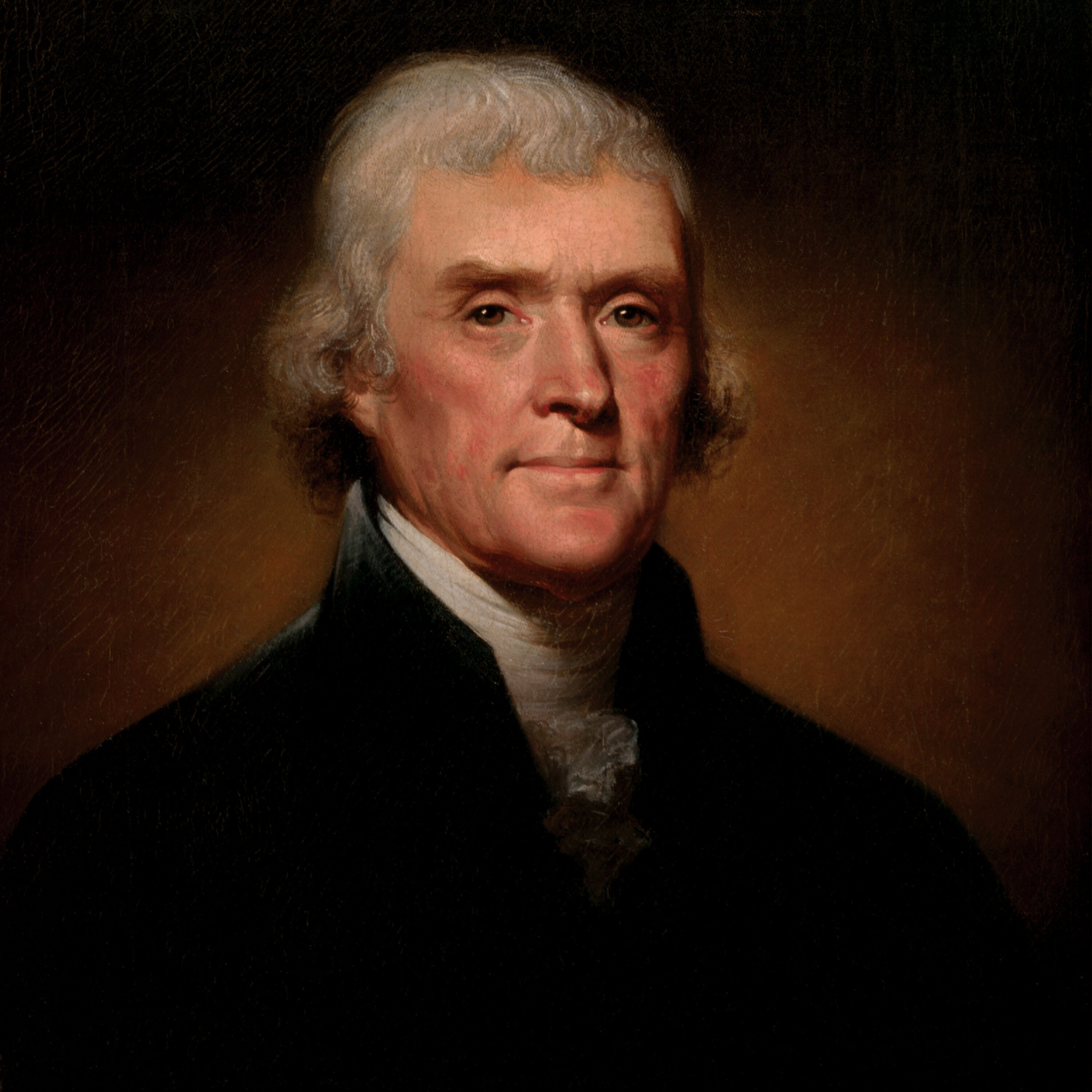
On this episode of Newt's World. The lives of these men are essential to understand the American form of government and our ideals of liberty. The Founding Fathers all played key roles in securing American independence from Great Britain and in the creation of the government of the United States of America. And now the life of Thomas Jefferson. I would argue that in many ways, Jefferson personified the spirit of freedom and had developed out of it something much more profound than most of his colleagues, his founding fathers. He deeply distrusted all governments. He didn't just deeply distrust the British government, he deeply distrusted the American government. And as a result, while he was the ambassador in Paris, as the American Constitution was being developed, he wrote his very, very close friend James Madison and said that he would oppose the adoption of the Constitution unless they added a Bill of Rights. And the whole fabric of American life has revolved around these 10amendments that came to define our rights. And remember, this is always one of the most difficult things to get across because it's counterintuitive. The Bill of Rights are designed to limit government, not to limit people. The Bill of Rights came out of a belief that, in fact, virtue resides in the people, but the government was always dangerous. Now, Jefferson, at the time, was the ambassador to France as the French monarchy was collapsing and as they were inexorably moving towards the French Revolution, which is a classic case study of a system that can't control itself. The American Revolution was a fight over who would govern in America. And it was between basically Americans who saw themselves as. As successful, independent, standing on their own achievement, and Americans who still were comfortable operating within the framework of the British king and the British government. And that fight ultimately was very controlled. If you go back and you look when the Founding Fathers won, they were very cautious about what they were trying to set up, and they had a lot of experience. Remember, there are 13 colonies, which means there are 13 constitutions. In several of the colonies. If the constitutions fail, so they write more constitutions. By the time they get to Philadelphia to write the Constitution of the United States, these folks had had more experience at writing constitutions than any generation in history. And all of them was aimed at a very core principle because they understood a world different than we do. They knew that the world was dangerous. It was dangerous to their west because Native Americans were still independent, armed, and capable of causing enormous casualties in the constant struggle over who was going to dominate. And remember, the west in this period is around Pittsburgh. We're not talking about the west of Cheyenne, Wyoming. So they're looking one direction at Native Americans, many of them armed both by the British and the French. And the British, of course, loved to subsidize the arming of the Native Americans, so they would harass and torment the new United States. At the same time, they were vividly aware of the great power struggle that was underway to see who would dominate Europe. So they knew that between the French, the Spanish, the British, the Prussians, the Dutch, that there was this ongoing, very deep and very powerful struggle of systems much bigger than the current American military or the current American navy. So, on the one hand, in order to protect our freedom, they wanted a government strong enough to offset these dangerous countries. On the other hand, in order to protect our freedom, they wanted to make sure that the government that was strong enough to protect our country couldn't then take over and control us. And in this effort to find a path between the two, the future of domination by foreigners and the future of domination by bureaucracy and government at home. Jefferson was one of the leaders in trying to find a way to have us be a genuinely free country, which meant freedom for the individual, not just freedom for the king or the president. Presidents basically are just temporarily elected kings, and it's the House and the Senate that make America so much different from the European monarchies. But Jefferson himself had spent a long and really quite curious life. I'm an amateur paleontologist, and when you visit Monticello, you will find, for example, teeth from mastodons and mammoths. You'll find part of the skeleton of a giant sloth that had gone extinct sometime in the Pleistocene. You'll find that Jefferson is collecting everything. He's fascinated by the world. And that, you know, I always tell people I'm willing to be a Jeffersonian, by which I mean that I will not buy more than half a continent at any one time. So think of that as limited government, and I won't do more than send the Marines to Tripoli without telling the Congress. And by the way, when he bought half a continent, he bought it and then told the Congress. One of the reasons I find Jefferson so complicated to talk about is that he's this mass of contradictions. On the one hand, he wants limited government, unless he decides he wants unlimited government, in which case he briefly deviates, buys the whole area, that is the Mississippi river basin, then he reverts back to wanting limited government. He vetoes a bridge over the Potomac as not the business of government because he's frugal. But then he spends millions buying the west from the French. You try to fit all this into one personality, and you begin to realize that if he'd been your uncle, he would have been a very complicated uncle. He also. He was a polymath in the sense that he learned everything in every direction. On one of his trips to Europe. Remember back then, if you say, I think I'll go to Europe, it was a long voyage by sailing ship. On one of his trips to Europe, he taught himself Spanish by reading Spanish novels. And you saw this image of Jefferson wrapped up in a blanket, sitting on the deck of the ship, gradually going east towards Europe and trying to literally teach himself Spanish. He already had French. He also was a person who had a very complicated vision of religion. Jefferson had written at one point that there should be a wall between government and religion. Now, people that interpreted that to mean the government should be anti religious. That's not what Jefferson said. Jefferson was living in an era when the Church of England was paid for by the government, when the Catholic Church in France was getting government money. And what he was saying was that no religion should get money from the government. But he did not intend in any way to have government be hostile to religion. In fact, while Jefferson was president, he signed a bill to send missionaries to the Indians. He allowed the treasury building to be used as a church because there were no very large buildings in Washington at that time. And the week that he signed the letter explaining that there would be a wall of separation between church and state that week, he got into a carriage and went up to the Capitol, where the Capitol was actually used as a church until the 1840s. So it's a little hard to say that he wanted total separation. What he did want is for people to be able to worship freely. He was very open to people finding God in their own way. And he wanted to make sure that the government wouldn't put its thumb on the scales in one direction or another. One of the places I go when I want to think about the Founding Fathers, there are really in my mind, three great centers. One is to go to Boston and look at the Adams family, Samuel and John and others, and think about what that whole experience was like there. The second is to go to Philadelphia and to stand in the shadow of Benjamin Franklin. The third is to go to Williamsburg. The Rockefeller foundation rebuilt Williamsburg in the 1930s. I find every time I go there that the historic part of my soul gets renewed and refreshed. They've done an amazing job. And you can imagine yourself walking down the street where Mr. Jefferson is studying and reading law under Mr. Wyeth, who's one of the great lawyers of that generation, and then going down to one of the taverns, which are still there, and having a libation and talking about the law and talking about what's going on in Europe and talking about the theoretical principles on which freedom should be based. And you have this whole notion that Jefferson was capable of talking about almost anything. Jefferson, first of all, is a reader. He loved to read so much that he actually built a movable desk so that he could, if he was going to go, say, to Philadelphia, which back then was a long trip, he had a desk that he could put in the carriage so that he could work both reading and writing while he traveled. And in that sense, he was constantly trying to improve things. He was constantly looking, can I do it better? Can I do it faster? And Jefferson, I've always thought was very happy learning and very happy thinking. And if he also had to deal with people, that was all right. But that was not his primary focus.
- [12:51]
Podcast Host
Did you know Microsoft has officially ended Support for Windows 10? Upgrade to Windows 11 with an LG Gram laptop voted PCMag's Reader's Choice Top Laptop Brand for 2025. Thin and ultra lightweight, the LG Gram keeps you productive anywhere, and Windows 11 gives you access to free security updates and ongoing feature upgrades. Visit lgusa.com iheart for great seasonal savings on LG Gram laptops with Windows 11. PCMag reader's choice used with permission. All rights reserved. Want to score? When your favorite player does well, you can't unless you download Better Picks. Who's giving away a free $10? Download the Better app, pick more or less on your favorite player's stats, watch the games and win some cash. It's that simple. Must be 21 or older in a jurisdiction where Better Picks operates. Terms and conditions apply. Better Picks Sports just got better. I'm here with spinquest, where you can play and win from the comfort of your own home with hundreds of slot games and all of the table games you love with real cash prizes. Right now, $30 coin packs are on sale for $10 for new users. It's all@spinquest.com that's s, p I N Q.
- [13:59]
Newt Gingrich
Spin Quest is a free to play social casino void where prohibited.
- [14:02]
Podcast Host
Visit spinquest.com for more details.
- [14:15]
Newt Gingrich
Jefferson had grown up in what then was sort of the western part of Virginia. If you look at a map, we're talking about central Virginia today. But back then, unlike Washington, who had grown up in the planter part of the state, with large homes and elegant dances and people who wore fancy clothes, Jefferson was much closer to the frontier. And he loved the frontier. He loved farmers as a group, and he really felt that virtue was to be found in small towns. In many Ways, I think that you would find that in 1896, when William Jennings Bryan gave his speech about mankind being crucified on the cross of gold, he was, in a sense, channeling Jefferson. Part of the reason that the bitterness between Jefferson and Alexander Hamilton is that Hamilton represents the cities, the moneyed class, bankers, and Jefferson represents all the people who owe money to the cities, the banker class, et cetera. So there's a deep sense in Jefferson's mind that virtue comes from being close to the land, and that a nation made up of farmers would by definition be freer and more virtuous than a nation that was made up of manufacturers or of bankers or of big cities. Jefferson learned enormously fast. He went to school in English at 5. He went in Latin at 9. He really constantly was learning, and he learned basically from a tutor, Mr. Douglas, who's a clergyman from Scotland. He learned every day. He read constantly. He built a huge library. In fact, the base of the Library of Congress was Jefferson's library, about 4,000 volumes at the time, which was a huge library back then, being Jefferson, of course, he sold it to the Congress. It wasn't an act of civic goodwill. He was trying to pay off some debts. And so he sold the library, which tragically was burned later, but it was the base of having a Library of Congress, which is today the largest library in the world. So it's come a long way from Jefferson's first 4,000 volumes. In that era, colleges were being formed, law schools were being formed, but he really was largely taught directly by tutors. And then he went to George Wythe, and George Wythe's law office still exists at Williamsburg. And you can imagine in the morning, Jefferson getting up, having a cup of tea or coffee, maybe a small piece of bread going in. And literally, back then, they called it reading the law, because that's what they were doing. This was before you had law schools and tenured professors and high tuition costs. So Jefferson is living in Williamsburg, which was the center of politics in that period for Virginia. So when the House of Burgesses, which was their legislature, when it was in session, people came from all over the state. And if you were a young person studying under George Wythe with knew everybody, and so you inevitably would end up at dinner surrounded by the whole state. Over the course of time, Jefferson came naturally to him to be engaged in politics. And in 1768, he's elected to the House of Burgesses. Now, he also began, and this is very typically Jeffersonian, he began to level a mountaintop at Monticello I mean, this is a guy who dreamed big, thought big, built big, and was permanently in debt because of all the things he wanted to do. And by 1780, he began building Monticello, which is one of the most remarkable buildings of the 18th century. And if you have never been there, it is really worth your while to go and to look at what he designed, how it was built, the degree to which it was at that time a remarkably advanced building, and also little side things you'll notice when you tour. For example, Jefferson tended to sleep sitting up. People thought it was better for you because if you lay down, you could get water in your lungs. And so it was really sort of a norm. Now, Jefferson himself was very tall. So you have this tall guy in a long bed sitting up. Jefferson finally gets really lucky and inherits 11,000 acres of land and 135 slaves, which means, of course, he quit practicing law. Unlike some people who loved practicing law, Jefferson had earned a living. Now, he didn't have to earn a living. So he didn't. It's interesting that Jefferson, in that very same time period, wrote an article called A Summary View of the Rights of British America. So 1774, the same year he's inheriting land, and he says, resolved, that it be an instruction to the deputies, when assembled in general Congress, with the deputies from other states of British America, to propose to the said Congress that an humble and dutiful address be presented to His Majesty, begging leave to lay before him, as Chief Magistrate of the British Empire, the united complaints of His Majesty's subjects in America. Complaints which are excited by many unwarrantable encroachments and usurpations attempted to be made by the legislature of one part of the Empire upon those rights which God and the laws have given equally and independently to all. Now, notice the forerunner of the Declaration. Where do the rights come from? Those rights which God and the laws and Jefferson would have argued, as would most of the founding Fathers, that the law was in fact the systemic implementation of God's will, and therefore that the rule of law was central to the rule of freedom, but that they were both based on God. This is a radical statement, hard to recognize today how radical it is because it's saying that the rights don't come from the King, the rights come from God. And it is the forerunner of what he will write two years later. So it's important to remember you have this sudden explosion of energy in the late 1760s, early 1770s, partially brought about because in winning the Seven Years War, or as we called it in the new world, the French and Indian War. The French were eliminated as a threat. And now, not having to be afraid of the French, the Americans looked up and said, well, if we don't have to be afraid of the French, why are we paying all this money to the British crown? And the British Crown basically said, well, because we own you. And the Americans said, actually, you don't. Our patriotism comes from God, not from the court. And we repudiate the idea that you owe us. There's a great statement a man who was quite elderly by that point, I think, in his early 80s, who had fought in the American Revolution, and somebody came to him and said, why did you fight? Was it the Tax Act? Was it the Stamp Act? Was it the imposition of taxes? Why did you end up fighting? And he said, young man, we intended to be free, and they intended for us not to be free. And so we fought and now we're free. And I think it was this sense which you see suddenly coalesce between 1770 and 1776 in ways that are amazing. You could not predict in 1770 that six short years later they would be passing the Declaration of Independence. Now, Jefferson was a little bit shy, and he understood that his great strength was not as a debater or an arguer. He was not a courtier. He was not a man who could go around and win over. And in fact, John Adams said that he was silent for his entire first year. He was elected in 1775 to the Continental Congress. And this is what Adams wrote in his autobiography. Mr. Jefferson had now been about a year a member of Congress, but had attended his duty in the House but a very small part of the time. And when there had never spoken in public. And during the whole time I sat with him in Congress, I never heard him utter three sentences together. The most of a speech he ever made in my hearing was a gross insult on religion in one or two sentences, for which I immediately gave him the reprehension which he richly merited. So you have this sense of Jefferson being taciturn, quiet, watching, learning, thinking. And then in 1776, he is asked to help write the Declaration of Independence. And there is no question that he developed the core language of that Declaration. He's also elected in 1776 to the Virginia House of Delegates, where he's appointed to revise Virginia law. Remember, all 13 of the colonies are going through the same process. He helped create the Virginia Statute for Religious Freedom. And this is extraordinarily important because it moves from just a political argument to a profound argument about liberty and a profound argument about the very nature of your relationship to the king and your relationship to God. The general assembly in Virginia appointed five men to a committee of revisers to review the law and to redraft them for the independent state. Three of the five men were primarily responsible. They included Thomas Jefferson, George with, and Edmund Pendleton. Jefferson drafted the majority of the bills. So while he was quiet, he was busy. But his strength was in the written word, where he had time to think, and where he could write with extraordinary elegance in a way that very few people have been able to equal. In 1779, when Jefferson had been elected governor of Virginia, the 126 bills that the committee he served on had drafted were presented to the general assembly. Most of them were not adopted or even seriously considered. However, Bill 82, the Virginia statute for religious freedom, which called for a separation of church and state, was considered and finally adopted in 1786. Notice, by the way, that sometimes these wave effects take time. You have to think of them as a video rather than a snapshot. And what isn't possible in frame one may be overwhelmingly possible by frame 30. And that's what's happening in this period. This famous bill, the Virginia statute for religious freedom, adopted in 1786, although it had been drafted initially a decade earlier, it says, we, the general assembly of Virginia, do enact that no man shall be compelled to frequent or support any religious worship, place or ministry whatsoever, nor shall be enforced, restrained, molested, or burdened in his body or goods, nor shall otherwise suffer on account of his religious opinions or belief, but that all men shall be free to profess and by argument to maintain their opinions in matters of religion, and that the same shall in no wise diminish, enlarge, or affect their civil capacities. Now think about that. You and I live in a time when there are many countries where you can be put to death for believing the wrong things. We live in a time when there are many countries when you can be put in jail for believing the wrong things. And yet here they are in the late 18th century, laying out a frame of reference that liberates people from government and says, your religious beliefs are up to you, and you will not be punished, you will not be fined, you will not be sent to jail, because you are protected in your right to approach God as you see fit. When Jefferson learned that the bill had passed, finally after all those years, he had it translated into French and Italian and distributed as widely as possible because he thought that religious liberty was one of his greatest achievements. James Madison, his close friend, later wrote that the Virginia Statute for Religious Freedom is a true standard of religious liberty. Its principle the great barrier against usurpations on the rights of conscience. As long as it is respected and no longer these will be safe. And as we go through some of our current fights and we watch the government encroach upon religious liberty, and we watch the woke left trying to impose their radical values on people of religion, you can understand how truly central Jefferson was in helping develop a very, very different approach.
- [27:14]
Podcast Host
Did you know Microsoft has officially ended Support for Windows 10? Upgrade to Windows 11 with an LG Gram laptop, voted PCMag's Reader's Choice top laptop brand for 2025. Thin and ultra lightweight, the LG Gram keeps you productive anywhere, and Windows 11 gives you access to free security updates and ongoing feature upgrades. Visit lgusa.com iheart for great seasonal savings on LG Gram laptops with Windows 11. PCMag reader's choice used with permission. All rights reserved. Have you ever turned a dollar into ten grand? I doubt it, but now you can. On Better Picks Download the Better App, pick more or less on your favorite player's stats, watch the games and win some cash. It's that simple. Better picks available in 33 states, including Texas, California, and Georgia. Download the Better App today that's Better Betr and get a free $10. No deposit necessary. Must be 21 or older in a trip jurisdiction where Better Picks operates. Terms and conditions apply. Better Picks Sports just got better. Forget whatever plans you have this weekend because you're staying at home and playing on spinquest. And there's never been a better time to sign up than right now. New users get $30 coin packs for just $10, all the table games you love, with hundreds of slot games and real cash Prizes. That's at spirit spinquest.com S P-I-N Q.
- [28:35]
Newt Gingrich
U-E-S-T.com Spinquest is a free to play social casino void where prohibited.
- [28:40]
Podcast Host
Visit spinquest.com for more details.
- [29:05]
Newt Gingrich
Now, Jefferson was involved in much more than just religious liberty. He actually believed it's something which I wish we could get back into the current political environment. He actually believed that knowledge mattered, and he actually believed that education mattered. In 1778 he drafted a bill on education entitled, quote, a Bill for More General Diffusion of Knowledge. Now this is one of Jefferson's great passions. Here's what Jefferson himself whereas it appeareth that however, certain forms of government are better calculated than Others to protect individuals in the free exercise of their natural rights, and are at the same time themselves better guarded against degeneracy. Yet experience has shown that even under the best forms, best. Those entrusted with power have in time and by slow operations perverted it into tyranny. Let me repeat this because it sort of fits the world we're currently living in. Even under the best forms, those entrusted with power have in time and by slow operations perverted it into tyranny. Jefferson goes on to say, and it is believed that the most effectual means of preventing this would be to eliminate, as far as practical, the minds of the people at large and more especially to give them knowledge of those facts which history exhibiteth that possess thereby of the experience of other ages and countries, they may be enabled to know ambition under all its shapes and prompt to exert their natural powers to defeat its purposes. And whereas it is generally true that people will be happiest whose laws are best and are best administered, and that laws will be wisely formed and honestly administered in proportion as those who form and administer them are wise and honest, whence it becomes expedient for promoting the public happiness that those persons whom nature hath endowed with genius and virtue should be rendered by liberal education worthy to receive and able to guard the sacred deposit of the rights and liberties of their fellow citizens. And that they should be called to that charge without regard to wealth, birth, or other accidental condition or circumstance, but the indigence of the greater number, disabling them from so educating at their own expense those of their children whom nature hath fitly formed and disposed to become useful instruments for the public, it is better that such should be sought for and educated at the common expense of all than that the happiness of all should be confided to the weak or the wicked. Now, if you go back and reread that and you realize that our current situation, schools that don't teach, teachers that don't educate, total avoidance of history, dumbing down of mathematics, giving people passing grades so they feel good even if they know nothing. You can sense that we have arrived at a counter Jeffersonian moment, when everything Jefferson feared in terms of ignorant people giving up their freedoms are far too close to becoming a reality. And it's why Jefferson is always worth revisiting and thinking about. Jefferson himself, by the way, gets to be elected governor and is a terrible governor. He doesn't like power, although he's brilliant at using it when he has to. And when he's president, he's brilliant at using power but in the period of 1779 to 1781, the British army was rampaging through Virginia. There was an effort to crush the rebellion, and Jefferson is really put in an awkward position. He's not an effective wartime governor. It's not his strength. And as a result, I think he would say that his governorship was one of the least impressive of his activities. However, being Jefferson, he doesn't just stop while he's governor, he also writes his only book, Notes on the State of Virginia. He didn't intend to write or publish it and he actually worried that their publication would do more harm or good. But he says things he really deeply believes in and again he goes back to freedom of religion. In query 17 religion, Jefferson defended separation of church and state, saying, it does me no injury for my neighbor to say there are 20 gods or no God. It neither picks my pocket nor breaks my leg. Again, he's arguing that you have freedom and that you shouldn't be taxed to pay for their beliefs, but that they should therefore be allowed to have their beliefs without the government interfering. He actually took the manuscript to his book to Paris and he contracted a printer who printed 200 copies. Jefferson's little book on notes in the state of Virginia was sufficiently controversial that James Madison and George Wythe put copies in the college library rather than giving them to students, saying such an indiscriminate gift might offend some narrow minded parents in Paris. Jefferson gave a few copies to close friends and confidential persons, writing in each copy a restraint against publishing it. However, a copy fell into the hands of a bookseller who, according to Jefferson, employed a hireling translator and was about publishing it in the most injurious form possible. To keep that from happening, Jefferson entered into agreement for the translation into French with the highly respected writer Abb Morelais. Unfortunately, Jefferson and Morley had different ideas as to what the translation meant. Jefferson wanted the translation to be a strict word for word translation of his text. Morally, however, believed that the translator's job was to be an active collaborator and ended up changing the work. Jefferson was very displeased. Jefferson then turned to John Stockdale, an English publisher, who agreed to print the work, but told Jefferson, I know there is some bitter pills relative to our country. After all, this was shortly after we had defeated the British and earned our independence. On August 14, 1787, Jefferson wrote to Stockdale that he'd received the initial copies. In all this period, Jefferson remains active. He is elected delegate to Congress in 1783. Between 1784 and 1789, he serves in France as the commissioner and U.S. minister. In 1787, he wrote to a good friend, Francis Hopkinson, his desire for this position to be silent and to be out of the limelight. And this gives you a flavor of Jefferson which is so oddly contradictory. He says, my great wish is to go on in a strict but silent performance of my duty, to avoid attracting notice and to keep my name out of newspapers, because I find the pain of a little censure, even when it is unfounded, is more acute than the pleasure of much praise now. So here you have this guy who, on the one hand, really is secretive and really doesn't want to be noticed. On the other hand, he is active in politics. He's Governor of the state. He's ultimately going to be Secretary of State and Vice President and then President of the United States. And that sort of captures Jefferson. He is a very complicated person of enormous willpower, great patience and discipline, enormous capacity for work, and he's just really, really smart. You could probably argue that he and Benjamin Franklin were the two smartest of the Founding Fathers. They were both able to learn almost everything, and they both made major contributions to knowledge. To give you an example of Jefferson's genuinely diverse interests, in 1791, he and his friend James Madison made a botanical tour of the Northern Lakes, and his most lengthy journal entries was on the fly. The final report was never presented to anybody, but it still exists. So again, here's a guy who has written the Declaration of Independence, served in the Congress, served as governor, served as ambassador, and he's off writing a discourse on the nature of the fly. Jefferson also served committee referred in the society's minutes of June 16, 1797, as the bone Committee, whose priority was to procure one or more entire skeletons of the mammoth. In 1807, when Jefferson financed the dig conducted by William Clark at Big Bone Lick, Kentucky, of the over 300 bones that Clark sent back, Jefferson offered the Society any of the fossils that were not already in their collection. On March 3, 1797, Jefferson became president of the American Philosophical Society. The day before he became Vice President of the United States, he served as President of the Philosophical Society for the next 18 years. He offered three letters of resignation when the government moved to Washington, D.C. when he retired to Monticello, but the the Society refused to allow his resignation. They finally accepted his resignation on January 20, 1815. And so you can see that Jefferson's a complex person with an enormous range of interests. And in the next part, I'm going to talk about Jefferson as president and the extraordinary, complex nature of his presidency and of what he did after that. So I hope you'll listen also to Jefferson as an American immortal in part two, on Newt's world. On the one hand, Jefferson was a very idealistic person. On the other hand, he's a very sophisticated, subtle, and often duplicitous politician. And both are somehow captured in the same person. He's a man of great principles. But on the other hand, as you'll see as president, he sometimes broke those principles in amazing ways. The term Jeffersonian democrat for a very long time meant somebody who was for limited government, was for lower expenses, and was essentially very, very suspicious of power in Washington. But at the same time, as you'll see, this is a guy who bought half a continent. He's a person who sent the marines and the navy to the shores of Tripoli without telling Congress. And so, on the one hand, he was sort of for limited government, unless he wasn't for limited government. And it's this kind of complexity that makes Jefferson so fascinating. He was also not only extraordinarily smart, one of the three or four smartest of our presidents, but he was, in addition, a person of extraordinarily wide, eclectic interests. Jefferson read widely, taught himself Spanish while on a ship going to Europe by reading Don Quixote. He studied fossils, collected them. If you go to Monticello at his home, you'll see some of the fossils that were collected while he was president. He sponsored an expedition which was almost the equivalent of going to Mars. And Lewis and Clark crossed the continent to explore the territory that Jefferson had just bought from France. Napoleon very cleverly sold it because he realized, with the Royal Navy controlling the ocean, that the French would not be able, in the long run, to keep the western part of the United States. So he sold the entire Mississippi valley to Jefferson. And Mississippi, through its tributary the Missouri, really goes an amazing distance west. And so they ended up more than doubling the size of the United States in this one purchase. All of these are things by a president who claimed to be for extraordinarily limited government. In order to win, he actually had to invent a political party. So Jefferson had risen and ultimately had become the secretary of state. Because he had served in France, he had a pretty good bit of diplomatic experience, and. And I think Washington thought that he was the right person to try to represent the United States in foreign policy. He very difficultly coexisted, if that's the right term, with Alexander Hamilton. Hamilton represented the commercial interests, had worked out how to Borrow a huge amount of money from the Dutch and was able to stabilize the American debt, was able to create, in the first place, Report on Manufacturers. Probably the best single statement ever written about why there are times when a country with a brand new small industry should protect itself. That's a remarkable statement in favor of tariffs. And Hamilton himself was clearly brilliant. I would say that if you look at Hamilton, Franklin and Jefferson, you're looking at three of the brightest people ever to be involved in American government. But Hamilton's interest and his vision of the world was remarkably different from Jefferson. Jefferson really represented a rural, agrarian world, he would have said, a world of small farmers, although the truth was that he owned slaves and basically had a plantation. But Jefferson was capable of envisioning this world of limited government and representing the interests of rural America, which at that time was the dominant part of America. And Virginia at that time was the biggest state in the country. On the other hand, Hamilton had this vision of a manufacturing and commercial future, of an America which would grow strong enough to defend itself and an America which would find its ultimate source of wealth in big cities and in factories, things which Jefferson found abhorrent. Jefferson wanted a much more rural lifestyle, would claim to want a more egalitarian world, although the truth is, Jefferson himself was clearly aristocratic and not particularly egalitarian. In order to seize power, Jefferson and his sidekick, James Madison, also of Virginia and the author of the Bill of Rights, invented the Democratic party, as John F. Kennedy used to say. He was out gathering butterflies because the excuse that Jefferson and Madison used for going to New York to meet with Aaron Burr was that they were collecting butterflies. In fact, what they were doing was plotting with Burr to create a party in order to win an election. Jefferson had won the vice presidency in 1796 with John Adams, the former vice president under Washington, becoming president. But Adams represented a New England and New York vision of the world and was really pretty close to an aristocratic rather than an egalitarian sense of how America should develop. Jefferson represented an upsurge of populism and was a brilliant political plotter, maintained through correspondence, a network across the whole country, aroused people to, in effect, petition against what Adams wanted to do. Got Adams so angry that he passed the Ellen and Sedition Acts, which would have punished people for criticizing the government. And those were then thrown out as unconstitutional. They were wildly unpopular. Jefferson came along and really was in open rebellion. It was the last time that they would have a president and vice president of opposite parties. It was a totally unwieldy project, and Adams unfortunately, totally changed American history because Adams and his sidekick Alexander Hamilton, who represented the New York Federalist, hated each other. And the result was their party was totally split. Well, faced with a split and decaying Federalist Party, really representing New York and North, Jefferson was able to mobilize rural America. And as I said earlier, he had the largest state in Virginia. And Jefferson won a sweeping election in 1800. And it's really the first peaceful transfer of power between two clearly opposed sides. And it created a sense of stability for the republic. Jefferson would then govern as seen by modern liberals in an idealistic way, although since Jefferson owned slaves, he's now out of fashion with the modern left. But for a very long time he was kind of their model. But in fact, what he was doing was very methodically destroying the Federalist Party. And by about 1812, the Federalists disappear. And for a brief period of time, what were called the Democratic Republican Party was the only major political force in the United States until it broke down with the populist insurgency of Andrew Jackson, who was a Democrat. And that led to the formation of the Whigs as the opposing party. But that doesn't occur until the late 1820s. So there's about a 20 year period where the Jeffersonians are totally dominant. You get three presidents in a row from Virginia in Jefferson, Madison and Monroe. And remember that the first president, George Washington, was also from Virginia. So four of the five initial presidents of the United States all come from Virginia, which was the dominant state. And Virginia represented an agrarian interest remarkably different from the commercial and banking and manufacturing interest of people like Alexander Hamilton. Jefferson ends up in a very strange situation in 1800 because they had not quite figured out that if you had the same electoral college votes for both the president and Vice president, they would be tied. Now, everybody had agreed that Jefferson was the candidate for president and Burr was the candidate for vice president. But Burr, who is a remarkably despicable and dishonest figure, a man who came very close to treason later on in his life, and the man who shot and killed Alexander Hamilton in a duel. I mean, I always remind people when they worry about how intense and how difficult our political process occasionally gets, that we have not had a former secretary of the treasury killed by a former vice president for over 200 years. So these guys understood a level of toughness that we fortunately have not had repeated. But Jefferson and BURR each had 73 electoral votes. Well, there was no provision at the time for breaking the tie. Everybody agreed as a gentleman's agreement that Jefferson would be President. But There was no real proof of what would happen, and it actually took 36 ballots. They started meeting on February 9, 1801, and finally on February 17, on the 36th vote, Jefferson was elected outside the Capitol. By the way, there were over 100,000 people who had gathered as a gigantic crowd. It was just an amazing moment.
- [48:15]
Podcast Host
Did you know Microsoft has officially ended Support for Windows 10? Upgrade to Windows 11 with an LG Gram laptop voted PCMag's Reader's Choice Top Laptop Brand for 2025. Thin and ultra lightweight, the LG Gram keeps you productive anywhere, and Windows 11 gives you access to free security updates and ongoing feature upgrades. Visit lgusa.com iheart for great seasonal savings on LG Gram laptops with Windows 11. PCMag reader's choice used with permission. All rights reserved. Yo, do you know Ball well? Come through with a free $10 from Better Picks, download the Better app, pick more or less on your favorite player stats, watch the games and win some cash. It's that simple. Must be 21 or older in the jurisdiction where Better Picks operates. Terms and conditions apply. Better Picks Sports just got better Spin Quest Social Casino the new year may be coming to an end, but the excitement never does on spinquest.com with live blackjack, craps and so many slots and jackpots that don't need a countdown, your New Year's resolution is more fun on spinquest.com new year and new players right now get $30 coin packs for just $10.
- [49:24]
Newt Gingrich
Spin Quest is a free to play social casino void where prohibited.
- [49:27]
Podcast Host
Visit spin quest.com for more details.
- [49:49]
Newt Gingrich
Jefferson then is sworn in, and on March 4, 1801. This has all changed after FDR becomes president in the 1930s, and they realize that there's just too long a period between an election in November and the taking of power in March. And they bring it up to January 20, which has been ever since. But notice that in the earlier era, when everything is done without a telegraph, without radio, by people riding horses, they had allowed a great deal of time for the election to occur, the electors to gather, and finally the President to be sworn in. So on March 4, 1801, Jefferson delivered his inaugural address, and he said in part, let us then, fellow citizens, unite with one heart and one mind. Let us restore to social intercourse that harmony and affection without which liberty and even life itself are but dreary things. We have called by different names, brethren of the same principle. We are all Republicans. We are all Federalists Now. He didn't actually mean that. What he really Meant was, as Democratic Republicans, we are going to wipe out the Federalists. And in fact, they were very aggressive in exerting their power. Jefferson, of course, was not a great public speaker, and he knew it, but he was a great writer. So when it came time to address the Congress, Jefferson decided that he would write it and send up his written address, having his secretary, Meriwether Lewis, who'd become famous later for the Lewis and Clark expedition, having him deliver the address. And throughout his eight years as president, Jefferson never addressed Congress in person, instead opting to write it to the Congress. So they got written addresses that continued just as a tradition until Woodrow Wilson appeared. And Woodrow Wilson, who had been a college professor at Princeton, liked to give speeches, saw himself as a great orator. And so in 1913, Wilson appeared in person to deliver the State of the Union. But from the time Jefferson sent up a written version until 1913, it had always been done in writing. And, for example, Lincoln's amazing addresses to the Congress, which are among the greatest writing in American presidential history, were all just delivered in writing. They weren't delivered by Lincoln himself. Jefferson argued that it wasn't that he didn't like to speak in public. He instead he wrote to Benjamin Rush on December 20, 1801. Our winter campaign, the winter session of Congress, has opened with more good humor than I expected. By sending a message instead of making a speech at the opening of the session, I have prevented the bloody conflicts to which the making an answer would have committed them. They consequently were able to set into real business at once without losing 10 or 12 days in combating an answer. In other words, Jefferson figured if he showed up in person, he would so irritate some of the members of Congress that they would feel compelled to spend their time attacking him. And instead, he thought that he had diffused the emotional tension by sending the document up in writing. He also defended not doing it when he wrote John Wales Epps on January 1, 1802. Congress have not yet done anything nor passed a vote which has produced a party division. The sending a message instead of making a speech to be answered is acknowledged to have had the best effect toward preserving harmony. So I think it's fair to say that from Jefferson's perspective, he's always thinking strategically. Now that he has power, he's concerned with relaxing and consolidating the power. And he knows that the less he fights with the Federalist and the more he allows them to just atrophy and gradually disappear, the less friction there is, the less fighting there is. The Better off he is because he's president and he already has all the power of the presidency. The fact is that he also wasn't a great public speaker. And in fact, when he gave his second inaugural address on March 4, 1805, a lot of people in the room couldn't even hear him. So the address was sent in advance to the newspapers, and the newspapers could publish them even if you couldn't hear them. Now, Jefferson had moved west, and it's hard to believe nowadays because you don't think of Charlottesville as all that far west. But in fact, the Tidewater farmers, the great planters, the government that had been in Williamsburg, all those things, from Jefferson's perspective, were behind him. And his focus was to the West. His father, Peter Jefferson, was one of the founding members of the Loyal Company created to ask for grants of land west of the Allegheny Mountains. Remember, back then, the frontier is the Allegheny Mountains. Nowadays, we think of that just as Eastern. And if anything, you might think of the Rockies as the frontier. Interestingly, Lewis Meriwether, his father, had been a member with Peter Jefferson in founding the Loyal Company, which was trying to open up the west and asking for land in the West. Now, when you look at that period, Jefferson is fascinated with the west, but frankly, he personally doesn't have that much time to go do things. If anything, he's spending time in France where he's the minister, he's spending time in Philadelphia, and he's helping other people go west. But he is not himself able to go west. And in a funny way, Washington was more of a frontiersman than Washington really was. Physically, very, very active. Washington goes west both as a surveyor. He surveys places like Little Washington and Virginia. He goes west as a head of the Virginia Militia and helps start the French and Indian War, what became called the Seven Years War in Europe. So Washington was a genuine frontiersman and understood a great deal about the frontier. Jefferson's really a gentleman farmer and an intellectual who's fascinated with the west as an idea. And interestingly, at one point, he subsidizes, when he's the minister to France, he subsidizes a guy named John Ledyard, who's an American explorer. And their idea is that the way they will explore the west is he will go east across Siberia and travel to the western coast of North America. However, when he tried to do that, he was arrested by the Russians and. And sent back to Europe. So that failed. In 1793, Jefferson enlisted members of the American Philosophy Society, which at that time was the leading kind of intellectual gathering in America. And he got a group of them to sponsor Andre Michaux, a French botanist, to quote, find the shortest and most convenient route of communication between the US and the Pacific Ocean. But it didn't get very far and didn't have anything accomplished. In 1805, the territorial governor of Louisiana, General James Wilkinson, persuaded President Jefferson to authorize an expedition to explore the beginning of the Mississippi. Now interestingly, by the way, I always find this fascinating. The Mississippi itself starts in Minnesota, but the great source of water is the Missouri, which starts much further west and pours into the Mississippi at St. Louis and has dramatically more water than the Mississippi, but is subordinated and named the Mississippi when they join. So they're looking for the origin of the Mississippi, when in fact far more important is to find the origin of the Missouri. Jefferson did agree with General James Wilkinson, the territorial governor of Louisiana. And Lieutenant Zebulon pike, for whom Pike's Peak is named, was appointed to lead the party to negotiate peace treaties with the Indian tribes they encountered. But they reached the present day Canadian border and then turned back. A year later. Pike was appointed to lead an expedition to explore the Red and Arkansas rivers. He entered Colorado, unsuccessfully, attempted to scale the mountain that today is called Pike's Peak. After entering Spanish controlled New Mexico, he was captured and sent back. But Jefferson still had not abandoned the idea. On January 18, 1803, Jefferson sent a letter to Congress asking for $2,500 to fund an expedition to the Pacific Ocean. They approved it. And by the way, the expedition, as often happens with government projects, turned out to cost far more than $2,500. A year later, about 45 men headed by Meriwether Lewis and William Clark left on what became a very, very famous expedition. There is a remarkable book called Undaunted Courage which I recommend to everybody. It captures day by day this extraordinary expedition, which as I said earlier, is in many ways that era's equivalent of going to Mars. I mean, these guys are leaving St. Louis, they're paddling their way up the Missouri, they are crossing over around Yellowstone, they're going down the Columbia, they are encountering all sorts of Native American tribes, they are encountering grizzly bears and generally roughing it in really an expedition that just took a level of personal endurance and personal courage that is absolutely astonishing. And if you go to Philadelphia, the Academy of Natural Sciences, which became the repository for the American Philosophical Society, actually has the material that Lewis and Clark brought back. And so you can actually go and see what it was they were gathering up. And they were gathering things about plants and animals. They were taking notes about geography. They were reporting on all sorts of meetings with different native tribes. And it is one of the great romantic expeditions in American history. They're also helped dramatically by a Native American woman who both helps them talk with tribes and helps them survive. They have an African American as part of the expedition who has a vote. And they said, look, he deserved the vote because his life was at risk too. So when they got to certain big decision points, they would all talk it out. And it was kind of like a traveling democracy. Jefferson had a very busy presidency, was involved in reshaping the judiciary. The Jeffersonians hated the Federalist judges. They saw judges as instruments of government to oppress the people. And they very much favored a much more popular society in which juries played a bigger role and judges were very limited. Lawyers will all cite Marbury vs Madison, which was a major decision involving the grant of a certificate to a person who had been appointed to a job by the Federalist and who, now that the Jeffersonians were taking over, was not going to get that job. If you actually read the case carefully, what you find is that the new Chief justice of the Supreme Court, Justice Marshall, is very aware that the Jeffersonians hate the Court. And he knows that if he takes Jefferson head on immediately after Jefferson having won control of the presidency and control of the House and Senate, that they'll simply abolish him. And so he maneuvers to maintain the independence of the Court without infuriating Jefferson. And it's actually not some key moment where the Court stands up boldly, but rather a brilliant maneuver to preserve the independence of the Court by not standing up boldly. And it's worth your studying because it both tells you how lawyers sort of aggrandize their role in life, and it tells you that the Court has always been inherently political. That's the nature of a Supreme Court in a free society. They have to pay some attention to deep popular interests. Jefferson having succeeded in eight years, and he did an amazing amount. I mean, as I said earlier, you know, buying half a continent, sending the Marines and the Navy to Tripoli to defeat the Barbary Pirates, organizing the dominant majority party, which is still today, the Democratic Party, is the longest serving political organization on the planet. It's outlasted the Nazis, the Communists, the fascists. It's outlasted most monarchies, and it's a remarkable institution. And Jefferson was, in fact, along with Madison, at the very center of organizing it. In 1809, Jefferson goes home. He leaves the presidency, he leaves public life and he helps found the University of Virginia. It was then Central College, but it becomes the University of Virginia. Jefferson plays a major role. When in February 14, 1816, the Virginia General assembly established a charter for Central College, which becomes the University of Virginia, Jefferson was elected to the college's Board of Visitors and rector of the college. Jefferson also designed the college, and again as an example of his intellectual reach. Remember that Jefferson is an architect. He designs Monticello, he designs other public buildings. He's also a bibliophile. The original Library of Congress is Jefferson's personal library, about 4,000 volumes, although it might be pointed out he sold them to the government because he needed the money for his entire life. Jefferson is short of money and is constantly trying to find sources of additional revenue. He's not a particularly great farmer, doesn't focus on farming, doesn't make a huge amount of money. Very different, by the way, from George Washington, who was a great businessman, a great farmer, and was generally competent at everything he touched. I think it's fair to say that Jefferson had a deep, passionate interest in education. Jefferson was not anti religious. Jefferson did write a letter to the Baptist in Connecticut saying that there should be a wall of separation between church and state. But what Jefferson was saying was in a world where the Anglican Church got paid tax money, that he did not think any church should get government money. However, he was not for an anti religious position. In fact, Jefferson allowed the treasury building to be used as a church. He himself went up to the Capitol, which was a church up until the mid-1840s. Jefferson signed a bill to send missionaries to the Indians. So the whole notion that he was in any way anti religion is just wrong. And in fact, if you go to the Jefferson Memorial, you'll see a great quote from Jefferson where he has sworn eternal hostility against all forms of tyranny over the minds of man. And I think that that's the heart of Jefferson. He really was committed. And to give you a sense of the depth of his commitment on education and the depth of his commitment on religious liberty, he wrote out for his own tombstone. Here was buried Thomas Jefferson, author of the Declaration of American Independence, of the Statute of Virginia for Religious Freedom, and father of the University of Virginia. Born April 2, 1743, Old Style. Died July 4, 1826. He thought those were the three things he wanted to be remembered for. Not president, not vice president, not foreign minister, not ambassador to France, author of the Declaration of American Independence, of the Statute of Virginia for Religious Freedom, and father of the University of Virginia, and it gives you a flavor of what he had dedicated his life to, symbolically. He died on exactly the Same day, the 4th of July, as John Adams, his great rival in developing political power. They had gotten to write each other and sort of reconciled over the years. And there was something symbolic that on July 4, the date when Jefferson and Adams had helped author the Declaration of Independence, they both passed away. He is an immortal. There's no question that to understand America, you have to spend some time trying to understand Thomas Jefferson. And there's no question that that time will be well spent because he was a remarkable person. Thank you for listening to Founding Fathers Week on Newts World. You can learn more about Thomas Jefferson on our show page@newtsworld.com Newts World is produced by Gingrich360 and iHeartMedia. Our executive producer is Garnesy Sloan and our researcher is Rachel Peterson. The artwork for the show was created by Steve Pendley. Special thanks to the team at Gingrich 360. If you've been enjoying Newts World, I hope you'll go to Apple Podcast and both rate us with five stars and give us a review so others can learn what it's all about. Right now, listeners of Newtsworld can sign up for my three free weekly columns at Gingrich360.com Newsletter I'm Newt Gingrich. This is Newtworld. This is an I heart podcast. Guaranteed human.