Loading summary
Transcript10 lines
- [00:00]
Newt Gingrich
This is an iHeart podcast. Guaranteed Human.
- [00:05]
Better Picks Advertiser 1
Not everyone can be good at fantasy football and at Better. We understand that. That's why we're giving you $10 for free just for signing up. Download the Better App, Pick more or less on player stats, watch the games and win some cash. It's that simple. Better Pick is available in 33 states, including Texas, California, and Georgia. Download the Better App today. That's better. B E T R and get a free $10. No deposit necessary. Must be 21 or older. In a jurisdiction where Better Picks operates, terms and conditions apply. Better Picks Sports just got better did.
- [00:35]
Rebel.com Advertiser
You know you can save up to 70% on the best brands just by shopping at from rebel.com we're talking about strollers, car seats, high chairs, espresso machines, cookware. Everything you need for way less. Here's how it works. Every single day, Rebel drops thousands of new products on the site for up to 70% off. It is a constant stream of endless deals from top brands like UPPAbaby, Nuna, Baby Bjorn, Breville, Nespresso, KitchenAid, Le Creuset, and more. But you have to act fast because every deal is one of a kind. So if you see something you love, make sure you add to cart fast. So stop paying full price when you don't have to. Whether it's baby gear, kitchen upgrades, or a treasure for your home you didn't know you needed, Rebel has it for way less. Up to 70% less. Shop from rebel.com and save big.
- [01:36]
Newt Gingrich
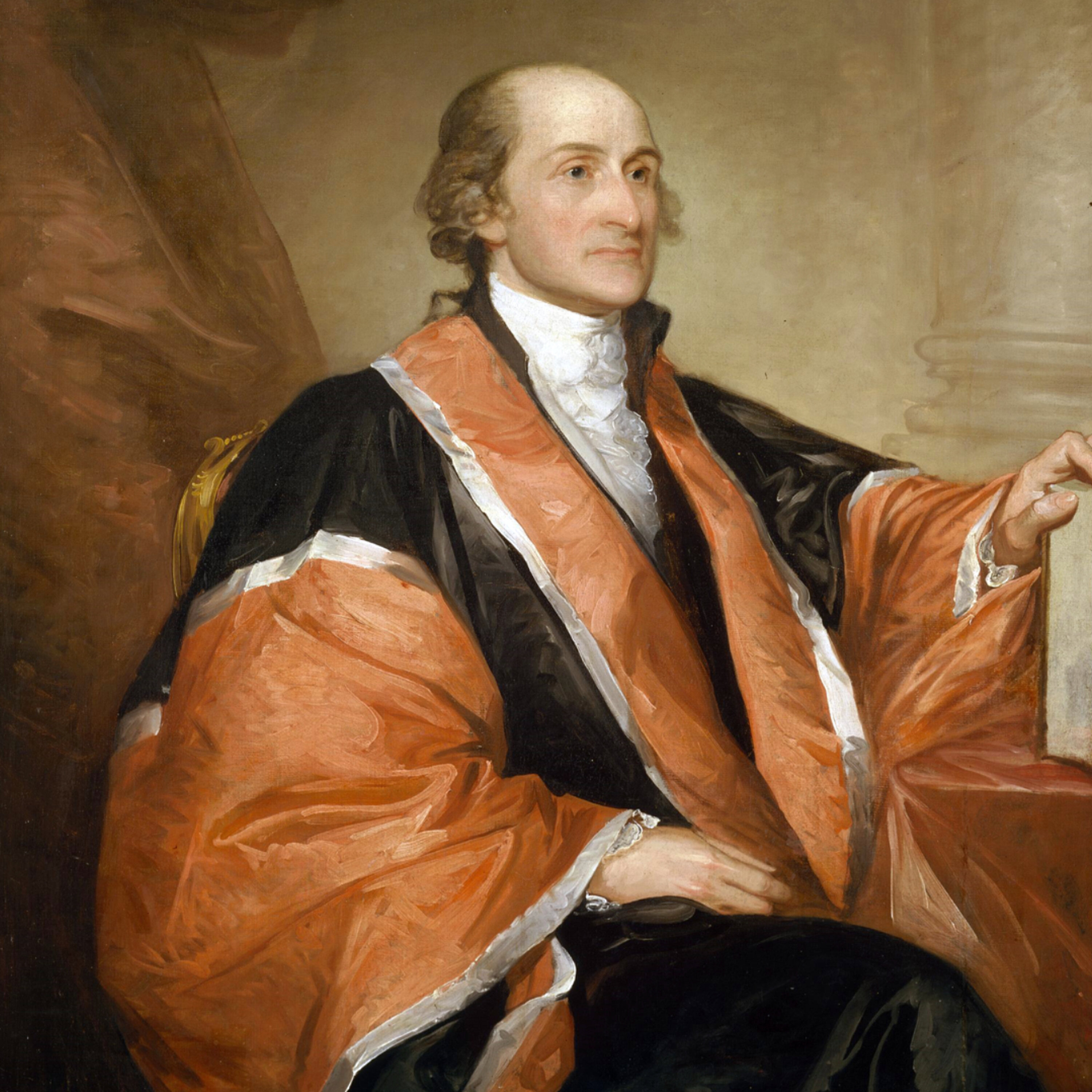
On this episode of Newt's World. The lives of these men are essential to understanding the American form of government and our ideals of liberty. The Founding Fathers all played key roles in securing American independence from Great Britain and in the creation of the government of the United States of America. Now the Life of John Jay. Jay was born in New York City on December 12, 1745. His grandfather, Augustus Jay, was a French Huguenot who came to America in the 1680s seeking religious freedom. His father, Peter Jay, was a merchant who retired to a farm in Rye, New York shortly after John was born. In his early years he was educated by private tutors and then entered King's College in the summer of 1760. King's College became Princeton much years later. After graduating in 1764, Jay became a law clerk in the office of Benjamin Kassim. After his admission to the bar in 1768, Jay established a legal practice with Robert R. Livingston Jr. And in 1771 he opened his own law firm. In April of 1774, Jay married Sarah Livingston the daughter of new jersey governor william livingston. And In May of 1774, Jay entered New york politics, and he never returned to his law practice. Jay initially wanted reconciliation with britain. He advocated for a peaceful resolution. Jay, as a member of the first continental congress, Wrote an address to the people of Great Britain on October 21, 1774, outlining the grievances that the colonies had, but also hoping for a peaceful resolution. It's important to remember that as the pattern builds towards revolution, that, in fact, there are a lot of people wrestling with themselves. Do we really have to do this? And jay was one of those people. He wrote, quote, in almost every age, in repeated conflicts, in long and bloody wars as well, civil as foreign, against many and powerful nations, against the open assaults of enemies and the more dangerous treachery of friends. Have the inhabitants of your island, your great and glorious ancestors, maintained their independence and transmitted the rights of men and the blessings of liberty to you, their posterity. Be not surprised, therefore, the we who are descended from the same common ancestors, the we whose forefathers participated in all the rights, the liberties and the constitution you so justly boast of, and who have carefully conveyed the same fair inheritance to us, Guaranteed by the plighted faith of government and the most solemn compacts with british sovereigns, should refuse to surrender them to men who found their claims on no principles of reason and who prosecute them with a design that by having their lives and property in their power, they may, with the greater facility, enslave you. Because america is now the object of universal attention, it has at length become very serious. This unhappy country is not even oppressed, but abused and misrepresented. And the duty we owe to ourselves and posterity, to your interest and the general welfare of the british empire, Leads to address you on this very important subject. Know, then, that we consider ourselves and do insist that we are and ought to be as free as our fellow subjects in Britain, and that no power on earth has a right to take our property from us without our consent. That we claim all the benefits secured to the subject by the english constitution, and particularly that inestimable one of trial by jury, that we hold it essential to english liberty that no man be condemned, unheard or punished for supposed offenses without having an opportunity of making his defense. That we think the legislature of great Britain is not authorized by the constitution to establish a religion fraught with sanguinary and impious tenets or to erect an arbitrary form of government in any quarter of the globe. These rights we, as well as you deem Sacred, and yet sacred as they are, they have, with many others, been repeatedly and flagrantly violated. Jay contributed to the early draft of the Olive Branch petition, which the Second Continental Congress wrote to King George III in 1774 as a last attempt to reconcile with Britain before going to war. Note just the term olive branch petition. These are colonials who really want to remain British. They really want to avoid war. They really want to have the king respond so they can be loyal to the king. Furthermore, Jay was one of the lead authors of the New York State Constitution, which replaced the Colonial Royal charter notice step by step. Reluctantly, he moves from offering total support to Britain, signing an olive branch petition and now writing notice, not New York Colony, New York State Constitution. Shortly after the ratification of the New York State Constitution on May 8, 1777, the New York Provincial Congress elected Jay to the Chief justice of the New York Supreme Court of Judicature, where he served for two years. During his time as Chief Justice, New York was still under English rule. Jay wrote to Governor Morris of his time as Chief justice, quote, I am now engaged in the most disagreeable part of my duty trying criminals. They multiply exceedingly. Robberies become frequent. The woods afford them shelter, and the Tories food. Punishment must of course, become certain and mercy dormant. A harsh system repugnant to my feelings, but nevertheless necessary. So Jay is torn because on the one hand, he really wants to be a nice guy. He's really tried all the way through to appease Great Britain, to appease the King. But the reality was they're now in a real war and that they're in a period where there's more and more dissolution of society. There are more and more criminals. And that many of those criminals found themselves sheltered by the Tories, who of course were pro king. And he saw some of the criminals as being their allies against the rebels who were pro American. And so Jay finds himself, on the one hand, he doesn't really want to put these people in jail, but on the other hand, if he doesn't, the whole system is going to fall apart. He's very conflicted because one form of justice requires punishing them. But at the same time, their very existence is an illustration of the conflict, the virtual civil war that is now broken loose. And remember that about 20% of Americans remained loyal to the King. There wasn't unanimity. Best estimate, I think, is about 40% were in fact committed to the revolution. At least 20% were committed to the king. And about another 40%, frankly, just wanted to go about their life and stay out of it. So it wasn't any kind of unanimous automatic hip, hip, hooray. And Jay is trying to balance justice, what he really believes in, with necessity, which he accepts to be true. Now he's taken out of the court, and from 1779 to 1782, he serves as the ambassador to Spain. Remember, by this stage, he's the ambassador for the United States. And so he has broken decisively with England. He was sent to Spain to convince the Spanish government to recognize America as a separate nation without any success. Spain did not want to risk any kind of relationship until it became evident that Britain and the United States were going to sign a treaty and recognize U.S. independence. Spain was very vulnerable. The blockade by the British navy, and they didn't want to get into a fight directly with England if they could avoid it. Jay is continuing to think about America even when he's in Spain. And on May 10, 1785, he wrote to John Lowell in his vision for a group of United States. It is my first wish to see the United States assume and merit the character of one great nation whose territory is divided into different states merely for more convenient government and more easy and prompt administration of justice, just as our several states are divided into counties and townships for the like purpose. Now, Jay realized that we had this balance. We couldn't stay 13 separate small states without having the French, the British, the Spanish, and others trying to manipulate us. On the other hand, there's a real challenge. If you build a government strong enough to stop foreigners from exploiting you, does it become so strong that the government itself exploits you? And Jay realized, based upon the spirit of the laws, a book written by Montesquieu, a French theoretician, about 40 years earlier, that the best way to preserve freedom was, was to have three different and separate branches of government. On August 18, 1786, he wrote Thomas Jefferson. I have long sought and become daily more convinced that the construction of our federal government is fundamentally wrong to vest legislative, judicial, and executive powers in one and the same body of men. And that too, in a body daily changing its members, can never be wise. In my opinion, these three great departments of sovereignty should be forever separated and so distributed as to serve as checks on each other. Now, that was clearly Montesquieu's model, and it's one which the founding fathers gradually all come to agree is the right 1. On January 7, 1787, Jay wrote to George Washington, quote, let Congress legislate. Let others execute. Let others judge. In other words, clear division of power. Between the three branches, Something which, remember, we're still fighting over. I mean, you have judges telling the chief executive what he can and can't do. You have congress and several fights with the executive branch and the judges. And that is by design. The founding fathers wanted a government strong enough to protect us from foreigners and a government that was weak enough that it could not, in fact, enslave us. And that's the model we're still wrestling with.
- [12:30]
Better Picks Advertiser 2
Not everybody can be good at fantasy football and at better. We understand that. That's why we're giving away a free $10 just for signing up. Download the better app, pick more or less on player stats, watch the games and win some cash. It's that simple. Better picks is available in 33 states, including Texas, California and Georgia. Download the better app today. That's better. B e t r and get a free $10. No deposit necessary. Must be 21 or older. In a jurisdiction where better picks operates. Terms and conditions apply. Better picks. Sports just got better.
- [13:07]
Newt Gingrich
So on January 27, 1786, while the government was still under the articles of confederation, which had clearly failed, Jay wrote to Washington warning him that the population, quote, will be led by the insecurity of property, the losing of confidence in their rulers, and the one of public faith and rectitude to consider the charms of liberty imaginary and delusive. In other words, if they can't get government to work, if they can't make life better, if they can't find a way to solve problems of inflation and other things, people are just going to give up on self government. Oh. On August 15, 1786, Washington responded to Jay writing, quote your sentiments that our affairs are drawing rapidly to a crisis accord with my own. Now, these are the guys who just won the revolutionary war. In Washington's case, he'd spent eight years in the field, only going back home to mount Vernon one time in eight years. And they were looking at their great achievement of getting free from Britain gradually disintegrating because they don't have a common government and a common set of rules. Continental congress was incapable of running things. And so they met in Philadelphia, and what was really a coup d', etat, they were supposed to go and fix the articles of confederation. Instead, they just dumped them and they wrote the constitution of the United States. Now, the constitution, in order to become real, had to go out and be ratified by the people. And in order to convince the people, articles had to be written. The most famous collection, I think the most famous and powerful pamphlets in political history are The Federalist papers. There are 85 of them. They are remarkable. And for anybody who truly wants to understand American government, there is no better starting point. Jay wrote five of them. Numbers 2, 3, 4, 5 and 64. His first paper, Federalist no. 1, stressed the importance of government. Jay wrote, nothing is more certain than the indispensable necessity of government. And it is equally undeniable that whenever and however it is instituted, the people must cede to it some of their natural rights in order to vest it with requisite powers. In his fourth paper, Jay wrote of the need to be united, writing, leave America divided into 13 or if you please, into three or four independent governments. What armies could they raise and pay? What fleets could they ever hope to have? If one was attacked, would the others fly to its succor and spend their blood and money in its defense? Would there be no danger of their being flattered into neutrality by specious promises or seduced by a too great fondness for peace? He's truly trying to lay it out the way it really is in a way that's remarkable. Now, despite all this work by Jay, there was a very absurd false rumor about Jay's opposition to the Constitution. And this is important because the constitution is going to be adopted both in popular votes and in legislative votes all across the country. The rumor first surfaced on November 24, 1787, when the Philadelphia Independent Gazetteer reported that a non named source, and we're certainly familiar with this model, an unnamed source said, quote, his excellency John Jay, a gentleman of the first rate abilities joined to a good heart, who at first was carried away with the new plan of government, is now very decidedly against it and says it is as deep and wicked a conspiracy as has ever been invented in the darkest ages against the liberties of a free people. In New York it goes by the name of the gilded trap, and very properly. For when we find men of the first abilities and best intentions at first taken with it, how very artfully they must be drawn up and glossed over. And who will then wonder that general Washington or anybody else could have signed it in convention. The governor of New York is very active against it and will not call the assembly, who in that case will not meet this some months. In the meantime, the people there will have time to think for themselves on this important subject. This is clearly a report designed to weaken the support for the constitution. It was quickly reprinted in papers all across the colonies. In response, Washington wrote, it is very unlikely, therefore, that a man of his knowledge and foresight should turn on both sides of a question in so short a space. I am anxious, however, to know the foundation of any of this. Madison, in response to this, said the report, quote, is an arrant forgery, and warned Washington that tricks of this sort are not unknown with the enemies of the Constitution. And I think we today have no idea how intense, how passionate, and how real the fight was over whether or not to adopt the Constitution. Once Jay heard of this, he wrote to John Vaughan on December 1, 1787, which was printed in the Pennsylvania Packet on December 7. Dear Sir, I thank you for your obliging letter of the 24th Alderman, enclosing a paragraph respecting me in Mr. Oswald's paper the same date. You have my authority to deny the change of sentiments it imputes to me, and to declare that in my opinion it is advisable for the people of America to adopt the Constitution proposed by the late convention. If you should think it expedient to publish this letter, I have no objections to its being done. Bail he responded, and in 1788 he wrote a pamphlet called An Address to the People of the State of New York on the Subject of the Constitution Agreed upon at Philadelphia, which Hamilton cited in Federalist number 85. Ben Franklin suggested that Jay put his name on the pamphlet as it would add weight to the document, but Jay did not take this suggestion, and the address appeared as an anonymous pamphlet. However, in a June 19, 1788 letter, his wife, Sarah Livingston, wrote that Jay's well known style gave him away, and on June 8, 1788, Washington sent Madison a copywriting. It is written with much good sense and moderation. I conjecture but upon no certain ground that Mr. J. Is the author of it. He sent it to me some time ago, since which I have received two or three more copies. The address summarized his arguments for the Constitution, the need for different branches of government, and dangers of government vested solely in one man or one body of men. Like men to whom the experience of other ages and countries are taught wisdom, they not only determined that it should be erected by and depend on the people, but remembering the many instances in which governments vested solely in one man or one body of men had degenerated into tyrannies, they judged it most prudent that the three great branches of power should be committed to different hands, and therefore that the executive should be separated from the legislative and the judicial from both. Thus part of the property of their work is easily seen and understood, and therefore is thus far almost universally approved. For no one man or thing under the sun has ever yet pleased everybody. The next question was, what particular power should be given to these three branches. Here the different views and interests of the different states, as well as the different abstract opinions of their members on such points interposed many difficulties. On Sunday, April 13, 1788, a day after Jay's address was supposed to be published as a prank, a medical student waved a dismembered limit of some boys below a window of the New York hospital. This led to the discovery of dismembered corpses inside the building, pointing to grave robbing. A riot ensued, forcing physicians and students from the hospital to take refuge in the city jail. Hamilton Governor George Clinton, Mayor James Duane, and a small group of militia tried to stop the rioters from attacking the jail, but were unsuccessful. By that afternoon, the jail was still under siege, and John Jay and Matthew Clarkson, armed with swords, marched towards the jail with 50 militiamen. Jay was struck in the head with a stone and seriously injured, and according to a letter from Jay's wife to his mother, Jay was carried home for emergency medical attention. However, he recovered.
- [21:13]
Better Picks Advertiser 1
Do you like free money? Well, today's your lucky day. Better Picks is offering a free $10 just for signing up. Download the Better App, pick more or less on your favorite player's stats, watch the games, and win some cash. It's that simple. Better picks available in 33 states, including Texas, California, and Georgia. Download the Better App today. That's better B E T R and get a free $10. No deposit necessary. Must be 21 or older in a jurisdiction where Better Picks operates. Terms and conditions apply. Better Picks Sports just got better.
- [21:51]
Newt Gingrich
On January 31, 1788, New York State Senator Egbert Benson proposed the state legislature that the delegates to the ratifying convention be chosen the same number as the state assemblyman, by all the free male citizens of the age of 21 years and upwards, and they meet in Poughkeepsie the third Thursday of June. Despite initial pushback from Governor George Clinton, both houses passed the resolution setting elections for delegates for the end of April. Almost immediately, Jay's name started appearing on list of potential candidates. On February 16, 1788, someone named, quote, a federalist, included Jay on his list of candidates. On February 20, he was again proposed, with the writer saying of Jay, from his long services abroad and at home in the nature of his present office as Minister of Foreign affairs, he must be supposed to possess the best information of any man in the United States on our relative situation with foreign nations. A few weeks later, an independent elector and a citizen included Jay on their proposed List of candidates. On April 9, 1788, Thomas Randall, a prominent New York merchant, put Jay in a more formal federal ticket for New York city and county. On behalf of a number of your fellow citizens. Jay's name was included on a nine man slate adopted at a meeting of a large number of respectable mechanics and tradesmen which assembled at Van Waters tavern. Jay, in a March 24, 1788 letter to William Bingham, said that the election would be the most contested of any we have had since the revolution. That didn't prove to be correct. The anti federalists did not enter a slate, though some votes were cast for their candidates. 2,836 ballots were cast, the largest number that had been recorded in the New York City election at the time, J1 with 2,735. Now, as an example of respect and popularity, let me repeat that number. Out of 2836 votes, he got 2,735. That's an amazing number. Somebody's run for office, I have to tell you. I wish once in my life I could have had that margin. Four days after the convention began, Jay wrote to his wife. The proceedings and debates have been temperate and inoffensive to either party. Though the opposition to the proposed constitution appears formidable, the more so from numbers and other considerations. Jay's appearance on the floor of the convention caught the eye of many. A correspondent for the New York Daily Advertiser wrote on June 21, 1788, quote, after the Chancellor had concluded, Mr. J arose commanding pleasure and satisfaction, and no doubt he spoke convincingly on the points raised. He has the most peculiar knack of expressing himself I ever heard. Fancy, passion. In short, everything that makes an order. He is stranger to you and yet none who hear but are pleased with him and captivated beyond expression. One general at the convention wrote to his friend in Connecticut that he, quote, found J's reasoning to be weighty as gold, polished as silver and strong as Steel. On June 26, John Williams, an upstate delegate, proposed a resolution that would deny Congress the power to impose an excise tax on products grown or manufactured in the United States. The argument for the resolution, according to Jay, were, quote, non matured and quote, half baked. And Jay suggested they should go home to cut grass rather than take up matters by halves. It is a non. Jay meant it, or was just trying to stall for time. Governor Clinton, the convention's presiding officer, called Jay's bluff, asking why Jay didn't move to adjourn. And Jay responded that Clinton should spend time clarifying their position. The next day on July 1st, Jay got up and spoke his position against the resolution. According to Francis Childs notes of the New York ratification convention debates. And this gives you some feeling for Jay, who's really and intellectual argues in a very rational, methodical way. Quote, John Jay rose and said that he would confine himself to a few remarks as the question had been pretty fully debated. He began with a description of the general characteristics of a government proper for the United States. It had, he said, been justly laid down that a government which was to accomplish national purposes should command the national resources. Here a question had been raised. Would it be proper that the state governments should limit the powers of the general government relative to its supplies? Would it be right or politic that the sovereign power of a nation should depend for support on the mere will of the several members of that nation? That the interest of a park should take place of that of the whole? Or that the partial views of one of the members should interfere with and defeat the views of all? He said that after the most mature reflection he could see no possible impropriety in the general government having access to all the resources of the country with respect to direct taxes. It appeared to him that the proposed amendment would involve great difficulties. Suppose a state should refuse to comply. Would not the same motives, the same reasons which produce the non compliance induce such state to resist the imposing and collecting of the tax? Would not a number of states in similar circumstances be act to unite to give their resistance weight? They could not all be forced. It's interesting if you think about it. We're currently having a fight over things like can the federal government declare that it's going after illegal immigrants, or can a city or state decide that they can by themselves declare sanctuary? And of course, all the way to the founding fathers was no, of course not. Once you've made a federal decision, no state or local community could interpose itself between the federal government and the application of law. On July 4, 1788, Jay wrote John Adams that despite, quote, the many amendments proposed by the opposition, we proceed with much temper and moderation. I am not without hopes of an accommodation, although my expectations of it are not very sanguine. He then wrote Washington the same day, quote, the Constitution constantly gains advocates among the people and its enemies in the convention seem to be much embarrassed. By July 8, the delegates finished their explanation of the Constitution and Jay wrote to Washington, quote, the ground of rejected seemed to be entirely deserted. By July 10, 55amendments were proposed in the categories explanatory, conditional and recommendatory. A 14 man committee was appointed with John Jay as a leader. Although what happened in this committee was never in any official reports, the New York Daily Advertiser did write, quote, when the committee met, Mr. Jay declared that the word conditional should be erased before there should be any decision on the merits of the amendment. This occasioned about an hour's debate and the antis determining not to give up that point. The committee was dissolved without affecting anything. According to Jay, a conditional ratification amounted to a virtual and total rejection of the constitution and declared that they could not consult with them at all if they insisted upon that point. According to the New York Daily Advertiser, both parties were firm and the committee ended without reaching any agreement. That afternoon Jay reported the convention that quote, no plan of conciliation has been formed and no measure taken. He then blamed the anti federalists for quote, adhering rigidly to the principle of conditional adoption, which is inadmissible and absurd. By July 23, after days of heated arguments, Jay wrote Washington at the convention by a vote of 31 to 29, adopted the motion to strike out the words on condition and substitute in full confidence. Though he cautioned Washington that the opposition planned to rally their forces to regain that ground. Now think about this. The constitution of the United States in what is one of its most important states is surviving by a vote of 3,129. I mean, for anybody who thinks that this was automatic or a done deal or easy, the work of Jay and others pulled off something which easily could have failed. On July 24, Jay took to the floor to express the hope the unanimous agreement could be reached for second convention saying we are now one people, all pledged for amendments. On July 25, Jay proposed an amendment barring all except natural born citizens from eligibility as president, vice president or members of either house of congress members. This amendment was adopted by the majority, but like many amendments that the New York convention proposed, never was incorporated into the Constitution. In 1789, the Constitution having been adopted, John Jay became the first Chief justice of the supreme court under Washington. He's best known for the case of Chisholm vs. Georgia, the first significant case of the Supreme Court. In 1792, Alexander Chisholm, the executor of Robert Farquhar's estate, attempted to sue the state of Georgia over payments due to him for goods that Robert Farquhar had supplied Georgia during the revolutionary war. Georgia refused to appeal, claiming that as a sovereign state it could not be sued without consenting to the suit. In a 4 to 1 decision, the court Ruled in favor of Chisholm, With Chief justice John Jay and justices John Blair, James Wilson and William Cushing in the majority, the court ruled that Georgia did not have sovereign immunity and could be sued. In response to this ruling, Congress proposed the 11th Amendment, which was ratified in 1795, which prevented citizens of other states or foreign countries from suing states in federal court. Now Washington sees Jay as more than just a justice. In 1794, at Washington's request, Jay went to England to negotiate a treaty between Britain and the United States. Jay's only bargaining chip was the threat that the United States would join the Danish and Swedish governments in defending their neutral state and resisting the British seizure of their goods. However, Hamilton informed the British that the United States had no intention of joining the supreme with Denmark and Sweden, thus leaving Jay with no leverage. The treaty addressed very few of the United States interest and ultimately granted Britain with more rights. The only thing the United States got was a surrender of the northwestern ports and a commercial treaty of Great Britain that granted the United States most favored nation status. All the other issues, including the Canadian Maine border, compensation for pre revolutionary debts and British seizures of American ships, were to be resolved by arbitration. Jay conceded that the British could seize US Goods bound for France if they paid for them. On November 19, 1794, the treaty was signed. The treaty was controversial and unpopular among Americans, but it still managed to be ratified by the senate on a 20 to 10 vote. On June 24, 1794. While negotiating Jay's treaty, he was elected as governor of New York. Jay left the supreme court to take office and served as governor for six years. While governor, he signed the act for the gradual abolition of slavery. The law made children born to enslaved mothers after July 4, 1779 legally free. However, these children would be required to work for their mothers enslavers until they reached the age of 25 for females and 28 for males. But it was a first major step towards emancipation. In 1801, after 27 years of public service, Jay decided to retire. By that time, Jay acquired 750 acres of land by inheritance. While he was governor, he made renovations to his farmhouse in preparation for retirement. He moved there in 1801 and by that following spring, his wife Sarah died, leaving him a widower with his three youngest children at home. Jay never remarried and stayed there until his death in 1829. You know, John Jay is an example, the kind of person with a wide range of talents who didn't start out in life being anti British, didn't start out in life thinking he was an American, but gradually, over time, not only concluded that independence was necessary, but concluded that that required a sound government that would work and function, that would protect our freedoms both from enemies abroad and from the dangers of tyranny at home. And then he decided he would work in a variety of ways, think about all the different things he did in his career, all the different jobs he held, and he was truly an American citizen and the kind of person who made America possible. In that sense, John Jay deserves far more credit than he normally gets, and he was sort of the co quintessential foundation on which America was built. You can learn more about John Jay on our show page@newtsworld.com Newtsworld is produced by Gingrich360 and iHeartMedia. Our executive producer is Garnzee Sloan and our researcher is Rachel Peterson. The artwork for the show was created by Steve Penley. Special thanks to the team at Gingrich360. If you've been enjoying Newtsworld, I hope you'll go to Apple Podcasts and both rate us with five stars and give us a review so others can learn what it's all about. Right now, listeners of Newtsworld can sign up for my three free weekly columns at Gingrich360.com Newsletter I'm Newt Gingrich. This is Newtsworld.
- [34:57]
Better Picks Advertiser 2
Nothing in life is free except this free $10 that better picks is offering. Download the Better app, pick more or less on player stats, watch the games, and win some cash. It's that simple. Must be 21 or older in a jurisdiction where Better Picks operates. Terms and conditions apply. Better Picks Sports just got better.
- [35:13]
Newt Gingrich
This is an iHeart podcast. Guaranteed Human.