Loading summary
Transcript13 lines
- [00:00]
Newt Gingrich
This is an iHeart podcast, Guaranteed Human.
- [00:08]
Narrator/Host
On this episode of Newts World. The lives of these men are essential to understand the American form of government and our ideals of liberty. The Founding Fathers all played key roles in securing American independence from Great Britain and in the creation of the government.
- [00:23]
Newt Gingrich
Of the United States of America.
- [00:24]
Narrator/Host
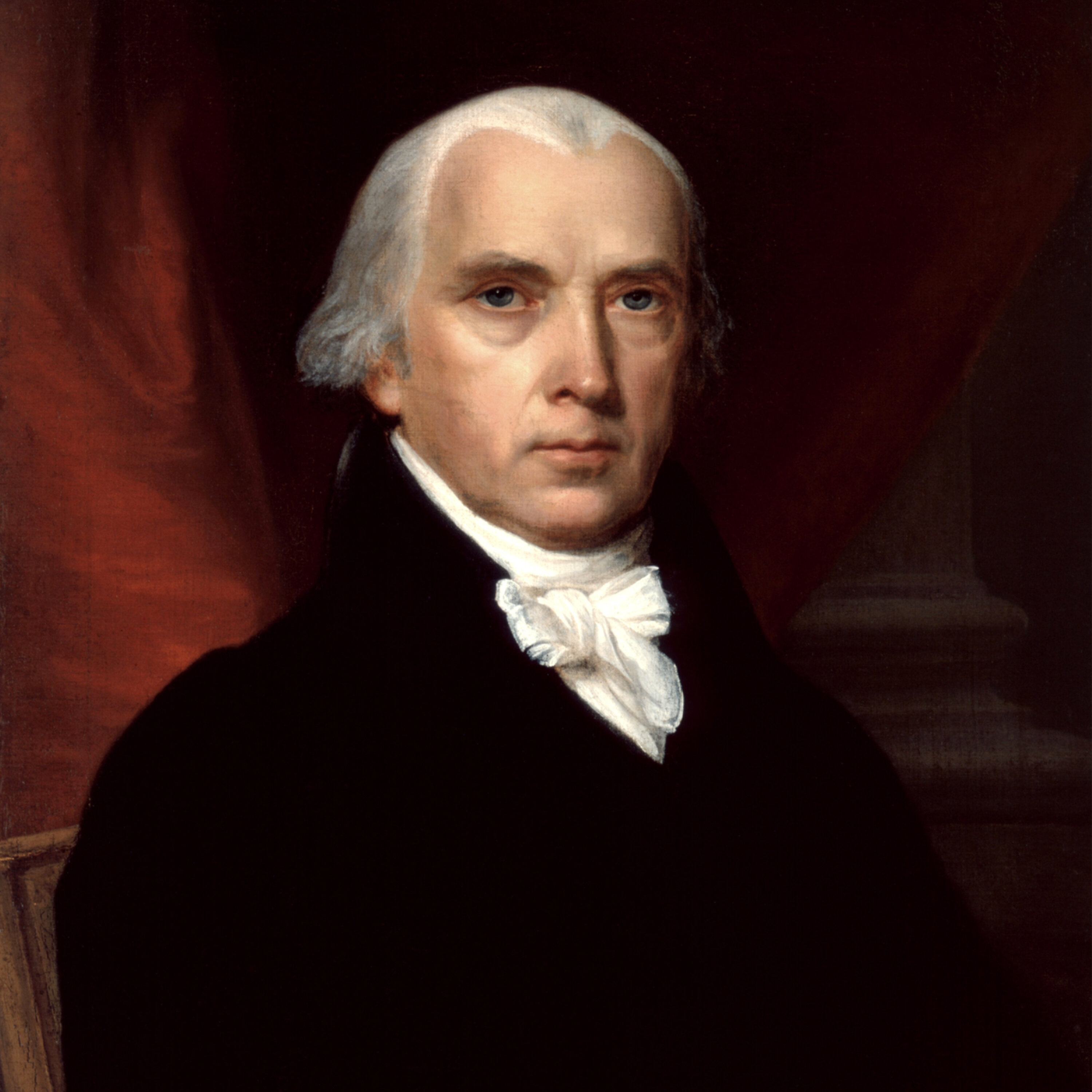
And now the life of James Madison.
- [00:34]
Newt Gingrich
And I have to say, having visited his home, that he's a remarkable figure. He is in some ways one of the most interesting of all the Founding Fathers because he's so complicated, he's so smart. His real contributions are all cerebral. He studied, he read, he thought, he wrote. And over time, he had an enormous impact at every level. Remember, the Democratic Republican Party that he and Jefferson founded still exists as the Democratic Party, the longest surviving political institution in the world today. The Bill of Rights is at the heart of our freedom. And he was the guiding force. In fact, his role in the First Congress was amazing. He literally drafted constitutions, thought about it, it was sort of a hobby. And so he was tremendously prepared to help write the Constitution when the Founding Fathers met in Philadelphia. And I always try to remind people the Federalist Papers are not some stuffy academic document that we read them nowadays, really as sort of policy in a way that is kind of abstract and good for graduate students, but not a hobby for most people. But the Federalist Papers were written as the most important pamphlet in political history. Now they're very complicated, they're long. And Madison wrote some of the most important of the Federalist Papers, convincing people of two different things that they needed a federal government because the individual states would ultimately be gobbled up by France and Britain and Spain. So they had to come together to survive. And at the same time, you could write a Constitution that protected you from your own government. And it's important to remember the Founding Fathers were as worried about domestic repression from the government as they were about foreign dangers to America. And Madison is the person who more than anyone else, balances those two. As he writes at one point, you know, if men were angels, we wouldn't need government. But since men aren't angels, how are we going to govern the governors? And that he constantly thought about protecting us from our own government, something which I would argue is remarkably current today. So how did a sickly, soft spoken man, 5 foot 4 inches and barely 100 pounds, become the father of the Constitution? Washington Irving described him as a withered little applejohn. Madison was born March 16, 1751, the oldest of 12 children, of whom only seven survived to adulthood. His father, James Madison Sr. Had inherited substantial wealth and his mother, Nellie Conway, was the daughter of a tobacco merchant. Because of their wealth, young James Madison was afforded private tutors, including a Scottish teacher named Donald Robertson, who instructed the young boy between the ages of 11 and 16 in mathematics, geography and Latin. And often sickly tout, Madison suffered from what he called sudden attacks. As Madison later wrote that he had, quote, a constitutional tendency to sudden attacks somewhat resembling epilepsy, which suspended all intellectual function. Imagine how frightening that must have been. In the 18th century, he planned to attend the College of William and Mary, where his later friend Thomas Jefferson attended. But he thought that Virginia's humid climate would worsen his attacks, so he opted to go north to the College of New Jersey, which ultimately became Princeton University. In 1771, Madison graduated with high marks in classical languages, mathematics, rhetoric, geography and philosophy. After only attending for two years, he wanted more education, so Madison became the school's first graduate student, studying Hebrew and political philosophy under the university president, John Witherspoon, who later on became a signer of the Declaration of Independence. When he graduated with his graduate degree, Madison, unsure what to do, started in local politics, becoming a member of the Orange County Committee of public safety in 1774. That committee oversaw the local militia in the event of a war of independence against the British. Remember, the Second Amendment rose out of these experiences. It is these Committee of Public Safety who are arming and training militia which enables the Americans to survive when the British try to conquer them. His seizure attacks actually prevented him from joining the military, as on July 28, 1775, at the age of 24, he collapsed during a military drill. But in October 1775, he was commissioned as colonel of the Orange County Militia, serving alongside his father until he was elected as a delegate to the fifth Virginia Convention. Madison, in the most important friendship of his life, met Jefferson in the fall of 1776, when they both were members of the Virginia House of Delegates. Hard to imagine two people who were different. Jefferson was 6 foot 2 and described as straight as a gun barrel. Madison was 5 foot 4 inches and barely 100 pounds. Imagine the two of them hanging out together. But what brought them together was their minds. Jefferson was described as quick witted and Madison was painfully shy and reserved. But Madison thought all the time and Madison could hold his own with Jefferson. The pair connected and a friendship began which lasted for decades. In 1777, Madison lost his seat in the House of Delegates because he refused to participate in the long standing Virginia custom of treating voters to whiskey because he felt it was the same as buying votes. In other words, back then, you showed up annually at the polling place and you got free liquor, and the candidate who gave away the most free liquor got elected. Now, Madison was not alone. Washington, when he first ran, refused to buy any alcohol because he was a military hero, very famous. And he came in last because all the local neighbors said, wait a second, if you're not going to buy me a drink, why am I going to vote for you? The following year, Washington bought more liquor for the voters than anybody else in that particular race. So Madison was faced with trying to deal with a country whose patterns were, shall we say, a little different than Madison would have liked. But despite all that, in 1778, Madison was elected to the Virginia Governor's eight member Council of State. When Jefferson was elected Governor of Virginia in 1779, Madison, as a member of the Council of State, worked closely with him, talking daily and offering his advice. And remember, this is in the middle of a War. In 1780, at the age of 29, Madison became the youngest member of the Continental Congress. At the time, Jefferson was minister to France and did not attend the convention, but he frequently sent Madison books and letters. Madison supported efforts to strengthen the power of the federal government. He knew that the Continental Congress system, the Articles of Confederation, simply wasn't work. He made several unsuccessful attempts to compromise with delegates who wanted strong state governments. He kept trying to convince him, you, you can't have strong state governments and survive because these foreign powers are going to pick us off one by one and gradually subvert all of North America. Madison took detailed notes on not only who was present every day, but exactly what was said and by who. Madison avoided any long absences, did not miss a single day of debate. Later writing, it happened also that I was not absent a single day, no more than a casual fraction of an hour in any day. So I could not have lost a single speech unless a very short one. These notes are one of the few things that historians have from this time, as delegates were forbidden from talking about anything in the proceedings in fear of leaking it to the public. The opposite of modern transparency. And the notes themselves were not published until after he died in 1784. Madison returns to Montpelier to study law and to attempt an unsuccessful career in land speculation. He was a genuine intellectual. He wasn't the kind of guy who was going to be very good at going out and figuring out the right places to buy land and then holding out until he got the price he wanted. It didn't interest him. He wanted to read books, he wanted to think. He wanted to be part of the life of the mind. He then served again in the Virginia House of delegates from 1784 to 1786, while he helped to ratify Jefferson's the Statute of Virginia for Religious Freedom. At the time, Jefferson was serving as Minister of France and was unable to advocate for his statute. This was truly a great breakthrough moment. Madison wrote to the General assembly of the Commonwealth of Virginia on June 20, 1785. And I'm quoting this because it's so important and such a key break in the development of religious liberty. The religion then of every man must be left to the conviction and conscience of every man. And it is the right of every man to exercise it, as these may dictate. This right is in its nature an unalienable right. It is unalienable because the opinions of men, depending only on the evidence contemplated by their own minds, cannot follow the dictates of other men. It is unalienable also because what is here, a right towards men is a duty towards the Creator. Now, remember, Jefferson and Madison are arguing for your right of conscience in a time when virtually every government had an official religion. And, for example, the British, for a very long period of time, persecuted priests because they represented an alien Catholic religion based in Rome and they did not represent the Church of England. Conversely, there were Catholic countries which would prosecute Protestants because they weren't obedient to the dominant religion. So this whole notion that your conscience, not the government's rules, are what will define religion was an enormous breakthrough and a great expansion of human freedom. Now, Madison kept working on how do we get to a strong enough government? And in Preparation for the 1787 Constitutional Convention, Madison drafted what would later be known as the Virginia plan. He spent 36 months. Think about that. Three years in the library studying political philosophy and past attempts at forming government. The Virginia Plan outlined a government consisting of three branches with checks and balances. This was really based on the work of a French theoretician, Montesquieu, who had come up with this notion that you could maximize freedom by balancing power between three different elements. If I could quote from the time, quote, resolved, that as the opinion of this committee, that a national government ought to be established, consisting of a supreme legislative, judiciary and executive. And of course, those were the building blocks of the U.S. constitution. And we today work within the framework that Madison had defined. He's often referred to as the Father of the Constitution, but he argued it was a team effort. Writing in a letter to William Cogswell on March 10, 1834, you give me a credit to which I have no claim in calling me the writer of the Constitution of the United States. This was not like the fabled goddess of wisdom, the offspring of a single brain, it ought to be regarded as the work of many heads and many hands. Now, that sense, I think, was sincere on Madison's part. He realized something we sometimes forget in the egocentric Washington of today, that it takes teams for a free society to govern itself. It takes teams to get things done. And Ronald Reagan used to have a little sign on his desk that said, it's amazing what you can get done if you don't mind who gets the credit. I think Madison thoroughly understood that principle. Think advertising on TikTok isn't for your business. Think again.
- [12:54]
Eve or Anam (Co-founders of Alinea)
With TikTok ads, we went from 250,000 downloads to over a million downloads in less less than a year. I'm Eve, I'm Anam, and we're the co founders of Alinea. Alinea Invest is an investing app for Gen z. We run 50 new ads per week with three variations thanks to TikTok Smart plus campaigns. If you're not advertising on TikTok, you're missing out.
- [13:14]
Newt Gingrich
Drive more app downloads only on TikTok. Head over to get started.TikTok.com TikTok ads. Once the Constitution was presented to the states for ratification, Madison, along with Jefferson and Jay, published a series of newspaper essays, and Madison, Jay and Hamilton wrote the Federalist Papers. Writing under the pseudonym Publius, Madison authored 29 of the essays published between October 1787 and May 1788. In his 29 essays, Madison argued the case for a strong central government with checks and balances. And I want to emphasize this. The Founding Fathers were as concerned about government being too powerful as they were concerned about government being too weak. And they wanted to protect you from the very government that they'd set up to protect the nation. In Federalist paper number 51, Madison wrote, and this is the very famous quote, if men were angels, no government would be necessary. If angels were to govern men, neither external nor internal controls in government would be necessary. In framing a government which is to be administered by men over men, the great difficulty lies in this. You must first enable the government to control the governed and in the next place oblige it to control itself. And I would argue that that is the central crisis of the American system today. There is none of the sense of balance that Madison and Jefferson believed in so deeply. After the ratification of the Constitution, Madison attempted to run for the Senate. But Patrick Henry, who had been opposed to the constitution and wanted a strong Virginia, successfully worked against it. Instead, Madison won the election to the U.S. house of Representatives in 1789, ironically over James Monroe, who later on would become president following Madison. Madison served in the U.S. house until 1797, at a time of enormous initial creation of all the principles of the house. So he's there as somebody very widely respected, very well known, and at first he doesn't want a Bill of Rights. He argues that, quote, the government can only exert the power specified by the Constitution. But his friend Jefferson was adamantly in favor of a bill of rights, thought the Constitution was too strong and would become a danger to freedom. Jefferson's view was spreading throughout the states, and there was a real danger that the Constitution could only be ratified with a bill of rights. So Madison, accepting reality, compiles a list of 19 proposals out of hundreds of suggestions they got from the state's ratification debates. In his notes for speech in Congress, written around June 1789, Madison outlined his reasons for urging the amendments. These included, first, to prove that federalists are the friends to liberty, second, to remove any remaining worries, third, to bring in North Carolina and Rhode island, and fourth, to improve the Constitution. Notice the practicality. It's North Carolina and Rhode island that won't come in. Therefore you have to have some kind of compromise. In these notes, Madison wrote that the Bill of rights was useful, not essential. And that's because he actually thought the constitution that he had helped draft already limited government. But people like Jefferson wanted a little extra guarantee, if you will, that even a bad government would be restricted. And most of the time, the supreme court has interpreted the Bill of rights to, in fact, restrict government. The Bill of Rights was the rights of individuals against government. Something we tend to forget that our founding fathers were as much afraid of strong central government as they felt the need to have government strong enough to defend us from foreigners. The congress looked at the 19 proposals, ultimately adopted 12 of them as amendments. On October 2, 1789, President George Washington sent copies of these 12amendments to states. And by December 15, 1791, 3/4 of states ratified 10 of them, and they became what we call the Bill of rights. While in the house, Representatives Madison worked with president Washington and Thomas Jefferson. But in 1791 and 1792, Madison disagreed with secretary of treasury Hamilton's proposal to establish a national bank. He further broke with the federalist party over the support of Great Britain during its war with France. Remember, we'd Just been fighting with Britain a decade earlier for our freedom, and here we were now siding with Britain against the French Revolution. Madison, with Jefferson and some anti Federalists, founded the Democratic Republican Party. Madison spoke often on the idea of political parties. In a speech to the Constitutional Convention on the right of suffrage in August 1787, he said, quote, no free country has ever been without parties, which are a natural offspring of freedom. A generation later, in a June 25, 1824 letter to Henry Lee, he wrote, the Constitution itself, whether written or prescriptive, influenced as its exposition and administration will be by those causes, must be an unfailing source of party distinctions and the very peculiarity which gives preeminent value to that of the United States. The partition of power between different governments, as well as between different departments of government, opens a new door for controversies in parties. So Madison understands the reality that in a free society, people will organize themselves into parties. And his study of political systems over the ages had convinced him that it was almost a natural evolution, something which Washington wished would not have happened. But in fact, Madison knew it would inevitably happen. In 1799, Madison returned to the Virginia House of Delegates, where he campaigned for Thomas Jefferson to be the third president of the United States. And when Jefferson won, Madison became Secretary of State and stayed there until his own election to the presidency in 1808. As Secretary of State, Madison helped to persuade Congress to ratify and fund the Louisiana Purchase, which doubled the size of the country. Look at a map sometime and realize that when the French decided they couldn't defend their control of what had been Spanish territory, starting with New Orleans, and that they would sell the United States, the Mississippi and all of its tributaries, which includes the Missouri, they were literally for $15 million, giving up half of a continent. And it's an enormous moment. And Madison was one of the people who convinced Congress to pay for it. In a July 29, 1803 letter to Robert Livingston, Madison wrote, it will be of great importance to take the regulation and settlement of that territory out of other hands, into those the United States will be able to manage both for the general interest and conveniency. Despite their efforts, Jefferson and Madison could not convince the Spanish to sell West Florida. Had they not bought the Louisiana Purchase, and had either the French or the Spanish or some other country maintained it, the United States would have been truncated, stopping at the Mississippi River. That's how big a decision it was. As it is, they went all the way to the Pacific. In line with what Washington had done. Thomas Jefferson refused to to run for A third term, endorsing Madison instead. The Federalist Party candidate, Charles Coatsworth Pinckney unsuccessfully ran for president in the election of 1804, losing to Jefferson almost immediately. Anti Madison newspapers published across the country with cartoons ridiculing Madison's small stature and Jefferson's embargo of all trade with England and France. The Federalist Party charged with that. Madison supported the embargo to build up domestic manufacturing at the expense of foreign trade. One critic asked, why is the embargo like sickness? Because it weakens us. It was not just the Federalist Party that was against Madison. A small group of Democratic Republicans were also against Madison as a candidate. Fearing that Madison's quiet nature meant he was a Hamiltonian Federalist in disguise. Jefferson stood up for his friend and convinced some members of the Democratic Republican party to vote for Madison. George Clinton, Jefferson's vice president, was among these, and he, after accepting the vice presidential nomination with Madison, announced his own candidacy for president. But Madison won by a landslide of 122 electoral votes against Pickney's 47. Clinton managed to squeeze six electoral votes from his home state. Madison carried 12 states to pink these five, which means, of course, four of the first five presidents were in fact from the state of Virginia. After Madison was elected, but before Jefferson left office, Congress passed the Non Intercourse act of 1809, replacing Jefferson's embargo. This allowed world trade, except for Britain and France, to resume. The bill also said that if England and France removed their trade restrictions, the President could resume trade. However, when neither country responded to the request to remove restrictions, Congress passed Mason's bill number two, a bill that removed their trade restrictions for three months, stating that if just one of them removed their restrictions on American trade by March 3, 1811, and the other one failed to do so within three months, the president would reinstate the restrictions on the other country. France decided to remove their restrictions through the cadoret letter of August 1810, leading Madison to implement Macon's Bill no. 2 in two stages, first in November of 1810 and then in March 1811. The British insisted that American ships would continue to be seized until France lifted their restriction on British trade, thus treating US Exports as part of their war strategy. Congress responded by voting for military preparations and in April 1812, a 90 day embargo. Madison came before Congress with his list of complaints against the British, including the arming of Indians and trade restrictions. The House voted for war on June 4, 1812. However, the Senate debated for more than two weeks and would not vote for war until June 17. For Madison, this issue of war provided the opportunity to seize Canada and drive the Spanish from West Florida, which they unsuccessfully tried to obtain during the Jefferson administration. Madison and the pro war members wanted a land invasion of Canada. Their plan was to separate Upper Canada around modern day Ontario from the northwest part, cutting off the pro British Indian tribes from British colonies which supported them. This plan ended in a disaster and by the fall of 1812, one American force surrendered at Detroit, another was defeated near Niagara Falls, and a third never made it across the Niagara River. In just a few months, much of the Northwest territory fell to British forces. In the spring of 1813, things were looking up when Commodore Oliver Hazard Perry defeated a British fleet on the southwestern tip of of Lake Erie, followed by a sacking of the Canadian capital of York, which is the present day Toronto. This allowed for Madison to send a force commanded by future president William Henry Harrison against the Native American leader Tecumseh at the Battle of the Thames in western Ontario. They beat the Indians badly and of course that set the stage for Harrison to become a hero and eventually President. However, things went back against the United States in late spring 1814 as the British, who had now defeated Napoleon, shifted their resources against the Americans and went on the offensive. British troops raided American ports from Georgia to Maine and they occupied half of Maine. British troops then targeted the nation's capital. In Washington D.C. the American government fell with British troops torching the White House and many other federal buildings in retaliation for burning the Canadian Parliament buildings the year earlier. In fact, in my entire congressional career I kept going up and down a very curvy stone stairway which is called the British Stairway because that's what they ran up with the torches in order to burn down the Capitol. The British were stalled in Baltimore, they were unable to get past Fort McHenry and actually it was a great ironic moment. They had taken Francis Scott Key on board the British ship and were holding him because they thought he knew some secrets and they didn't want him to reveal them in terms of where the British were going to land. So he's watching the night long battle in which the British try to bombard Fort McHenry and force it to surrender. Francis Scott Key writes a poem, the Star Spangled Banner. It's attached to a British drinking song and becomes the national anthem, but it's based on real history, which is this night where he really could see the Star Spangled Banner still waving. Despite all the effort of the British bombardment, however, the British then turned their sights to New Orleans and wanted to use that city in the coming peace negotiations. They thought if they could seize New Orleans, that would give them a bargaining chip. About 6,000 British soldiers moved against the city. These were professional soldiers who had done very well on the peninsula campaign, had stood up against the French army. By any reasonable projection, they were going to win. New Orleans was protected by 4,000American soldiers commanded by Andrew Jackson, and with new Orleans citizens rallying to the cause. Now, this was one of those cases where the British didn't understand that Americans had lived a lifetime with rifles. Because the Americans almost universally had been involved in hunting and because they had rifles which fired much longer than muskets, and because they were basically protecting themselves behind cotton bales, the British were just going to get slaughtered. And they didn't get it as something they would never have done against Napoleon. They charged across the field because they had contempt for the Americans. Of the 6,000 British soldiers, about 2,000 died within a few minutes. The remaining British soldiers were demoralized, Threw down their weapons, and surrendered immediately. For 2,000 British dead, about 70Americans died. However, the peace treaty had already been made about two weeks earlier, but because of communications, nobody knew it. So what happened was, in an unnecessary battle, the British were both defeated and lost a number of very fine soldiers. The Americans won a great victory, and frankly, from the standpoint of American history, it is winning in New Orleans the that launches Andrew Jackson into a career which becomes one of the most powerful in the first half of the 19th century at changing America and creating a more populous nation. While the war ultimately failed, the few victories did return Madison to a high point of popularity around the country. Throughout the war, many new england merchants ignored trade embargoes, Traded freely with both France and Britain during the War of 1812, and some Federalists talked about seceding from the union. As far as they were concerned, their future was in the atlantic ocean dealing with the British, not dealing with Washington, D.C. and Virginians. However, the federalists ultimately understood that the country was going to survive. And many Americans came to the conclusion that the federalists were sort of traitors or unpatriotic. There was already a party that had been weakened by Jefferson and Madison, and it collapsed after this effort to talk about secession. You know, during Madison's presidency of the War of 1812, international affairs took up a lot of his time. But the one domestic issue the country dealt with was the rechartering of the bank of the United states, whose charter was set to expire in 1812. Remember, the charter of the original bank had been Alexander Hamilton's great effort to create a national financial system that would enable the economy to grow. Now the rechartering of the bank had three different camps in Congress. Democratic Republicans who thought the bank was unconstitutional, State backing interests that were tired of having a federal bank and anti British Federalist who objected to stock in the bank held by Britons. So The War of 1812 started without a national bank that could support war loans. In 1816, with Madison's support, which was a switch from his opposition against Hamilton a Generation earlier, the second bank was chartered with a 20 year term. Critics of Madison claimed that his support of a national bank revealed he was really a Federalist. And it's interesting that Madison, I think partly because of his style, being quiet, being studious, being intellectual, he didn't feel like the kind of populist that Jefferson and the Jeffersonians were the most comfortable with. But in fact he was probably their best thinker as a Jeffersonian. Madison's nomination for second term came 15 days before the announcement of the War of 1812. Madison won the endorsement of Congress, but about one third of the Democratic Republican legislators boycotted the nominating caucus altogether. For second place the caucus chose John Langdon of New Hampshire. However, Langdon declined and they then chose Eldridge Geary, the signer of the Declaration of Independence. Remember, it is Elbridge Gehry who ultimately draws a map in 1812 in Massachusetts which had a congressional district that looked really weird and somebody said that looks like a salamander. And somebody said no, no, that's a gerrymander. And that's where the term gerrymander comes from. A group of New York Democratic Republicans who participated in the boycott supported DeWitt Clinton, the nephew of former Vice President George Clinton who had died during Madison's term. They were hoping to form a coalition opposed to Madison for not moving decisively towards war and American citizens who wanted almost anyone in office but Madison. These Democratic Republicans met with the Federalist Party to discuss a unification strategy. And Clinton was nominated for president for the Federalist Party with Jared Ingersoll for Vice president. Clinton, who unlike Madison, was only a New York mayor and had no national claim, chose to tailor their election against Madison saying, quote, one thing to war Democratic Republicans, another to peace Democratic Republicans and something else again to anti war Federalists. Their message actually turned Federalist John Quincy Adams against his party and he decided to endorse Madison. Madison easily won, carrying 128 electoral votes to Clinton's 89. Madison chose not to run for a third time, which reinforced George Washington's precedent and in fact, up until Franklin Delano Roosevelt, nobody would run beyond two terms. Madison goes back home to his plantation, Montpelier, to live out the rest of his life. While he was retired, he was a real strong supporter of Jefferson's University of Virginia, serving on its board, succeeding Jefferson as head of the university in 1826. Three years later, Madison served again as a delegate at the Virginia Constitutional Convention, negotiating compromises between the large slaveholding plantations and Western farmers. While delegate, he denounced the right of states to declare federal laws unconstitutional when they went against state interest. He was also a founding member of the American Colonization Society, which favored the gradual abolition of slavery and resetting slaves and free blacks back to Africa. On June 28, 1836, after being bed bound for chronic rheumatism and liver dysfunction for six months, Madison died. His family hoped he would make it to the 4th of July because he wanted him to die on that day. Like President Jefferson, President Adams, and President Monroe, all of whom had managed to die on our national holiday. I think it's important to recognize that Madison shapes so much of our politics. He shapes the Constitution. He shapes the Bill of Rights. He really shapes the way the house functions as an institution. He is a perennial figure who over a period of almost 40 years, is decisively involved in creating the America that we know live in. And I think that Madison in that sense clearly is an immortal.
- [34:18]
Narrator/Host
Thank you for listening to Founding Fathers Week on Newts World. You can learn more about James Madison on our show page@newtsworld.com Newts World is produced by Gingrich360 and iHeartMedia. Our executive producer is Garnesey Sloan and.
- [34:33]
Newt Gingrich
Our researcher is Rachel Peterson.
- [34:36]
Narrator/Host
The artwork for the show was created by Steve Pendley.
- [34:40]
Newt Gingrich
Special thanks to the team at Gingrich 360.
- [34:43]
Narrator/Host
If you've been enjoying Newts World, I hope you'll go to Apple Podcast and both rate us with five stars and give us a review so others can learn what it's all about. Right now, listeners of Newts World can sign up for my three free weekly columns at Gingrich360.com news newsletter. I'm Newt Gingrich. This is New Twirl.
- [35:17]
Newt Gingrich
This is an iHeart podcast. Guaranteed Human.