Loading summary
Transcript61 lines
- [00:00]
Elon Berman
This is an iHeart podcast. Guaranteed Human.
- [00:05]
Grainger/Sofi Commercial Announcer
If you're the purchasing manager at a manufacturing plant, you know having a trusted partner makes all the difference. That's why hands down, you count on Grainger for auto reordering. With on time restocks, your team will have the cut resistant gloves they need at the start of their shift and you can end your day knowing they've got safety well in hand. Call 1-800-GRAINGER click granger.com or just stop by Grainger for the ones who get it done.
- [00:35]
Elon Berman
High interest debt is one of the toughest opponents you'll face unless you power up with a Sofi personal loan. A Sofi personal loan could repackage your.
- [00:43]
Grainger/Sofi Commercial Announcer
Bad debt into one low fixed rate monthly payment.
- [00:46]
Elon Berman
It's even got superspeed since you could get the funds as soon as the same day you sign. Visit sofi.compower to learn more.
- [00:55]
Grainger/Sofi Commercial Announcer
That's s o f I.com P-O-W-E-R loans originated by SoFi Bank NA member FDIC.
- [01:01]
Elon Berman
Terms and conditions apply.
- [01:02]
Grainger/Sofi Commercial Announcer
MLS 696891 if you're the purchasing manager at a manufacturing plant, you know having a trusted partner makes all the difference. That's why hands down, you count on Grainger for auto reordering. With on time restocks, your team will have the cut resistant gloves they need at the start of their shift and you can end your day knowing they've got safety well in hand. Call 1-800-granger. Click granger.com or just stop by Granger for the ones who get it done.
- [01:39]
Newt Gingrich
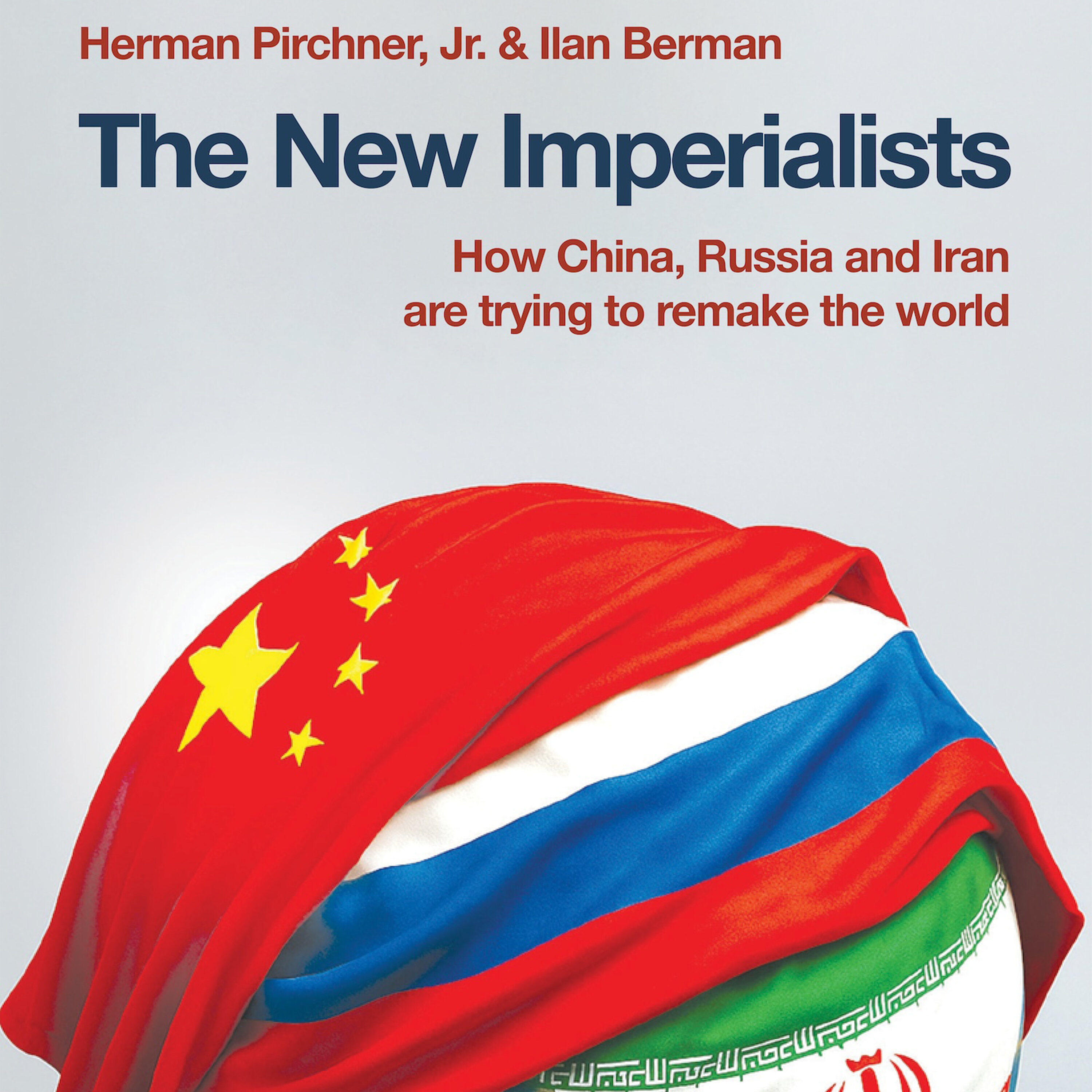
On this episode of Newts World. In their new book, the New Imperialist, Herman Perchoner and Elon Berman deliver eye opening details of how three major global players, Russia, China and Iran are working with each other and with key allies such as North Korea and Venezuela to unseat the US As a global leader. The challenge is profound and requires both leadership and action. From Washington President Trump acted decisively to capture and arrest Venezuelan President Nicolas Maduro and his wife Celia Flores at their residence in Caracas on January 3rd and bring them to justice in the United States. I am really pleased to welcome both of my guests, good friends and extraordinary scholars, Herman Perchner and Elon Berman from the American Foreign Policy Council, a non profit public policy organization headquartered in Washington, D.C. Herman and Elon, welcome and thank you for joining me on New Tor.
- [03:01]
Herman Perchner
Pleasure to be with you as always.
- [03:03]
Elon Berman
Thanks so much for having us.
- [03:05]
Newt Gingrich
We ought to start, I think, working our way back into the thesis of your book with the most recent events in Venezuela, because for a very long time, as you know, Venezuela was a very prosperous, very stable country. Then Hugo Chavez came along, and at his death, he was followed by Maduro. And suddenly you're in a different world, both in domestic terms and in terms of their international behavior. Can you two sort of give us an overview of what was at stake in Venezuela and what Trump's actions mean?
- [03:40]
Herman Perchner
Ilan, you've had a good conversation on this recently. Why don't you start?
- [03:44]
Elon Berman
I did. And so I think the background here and sort of the way it ties into that larger frame is that Venezuela isn't always talked about in the same breath as Russia, China, Iran, but it's a very important supporting player because precisely as a result of that reorientation of the country that Chavez did when he came into office in 2003, and then the rapid expansion of his personal ties, including most notably with the Iranian president at the time, Mahmoud Ahmadinejad, when he was elected in 2005, Venezuela has really positioned itself as a beachhead for this anti American axis in the Western Hemisphere. And that played, I think, a big role in the context of what the Trump administration was thinking. There is a conversation to be had about Venezuela's role in drugs, Venezuela's role in the illicit economy. But the name of the game here, I think, is an expanded version of homeland defense. The Trump administration, in its national security strategy late last year, outlined that the Western Hemisphere is most important in its calculations because of homeland security reasons, and also made very clear that the administration is prepared to take a more activist role in the region to prevent crime, prevent drug smuggling, and prevent the activities of illicit actors and strategic adversaries. And Venezuela over the last 20, 25 years has really become a hub for that. So it's a very logical place for the administration to start having.
- [05:18]
Newt Gingrich
Marco Rubio is sort of perfect if you're trying to develop a Western Hemisphere strategy. His parents both came from Cuba. He, of course, grew up in Miami politics. He thoroughly understands the region. To what extent, in that sense, was the replacement of Maduro a geopolitical event vastly bigger than either oil or the drug deals, that there was something between Russia, Iran, China that was really growing into a tremendous danger that really had not been very much described in the American media, although people on Capitol Hill have been having hearings and have been warning about it? To what degree does the Trump decision to go after Maduro actually throw down a gauntlet to both of our biggest international competitors, Russia and China?
- [06:21]
Herman Perchner
There were lingering thoughts in Beijing and Moscow that it's Taco Trump. Trump always chickens out. And though they received some pause after the bombing of Iran, the fact that he was able to act decisively I think will force a recalculation in both Beijing and MoSC. In terms of the Ukraine war, in terms of further Chinese action against Taiwan, I think that's the biggest impact. Of course, there'll be resistance inside of Venezuela that will be stoked by those actors, and we have to see how things play out over the next few months. But in the short term, it gives pause to our enemies in terms of what Trump may do next, and that makes American diplomacy stronger.
- [07:10]
Newt Gingrich
The Chavez Maduro machine is pretty big and is pretty ruthless and has driven 8 million people into leaving the country with about 29 and a half left, I think. To what extent do you think the underlying patterns of the Maduro dictatorship will survive partially by lying, will survive the Trump approach of trying to intimidate them but not occupy them?
- [07:43]
Elon Berman
Well, I think it remains to be seen precisely because, as you point out, this is a large edifice. This isn't just one leader or a small cadre of people. This is a state that has been structured and wired for this sort of anti American cooperation with Russia, with China, with Iran. And so Secretary of State Marco Rubio over the weekend on Meet the Press, when he was asked about how the administration was thinking about Venezuela, he made clear that he thinks, and the president thinks, that this is much more of a criminal enterprise than it is a state. But those same rules attach now. If you tackle a criminal enterprise and you simply remove the head, the boss, the don, whoever it is, and the enterprise remains intact, it can still do nefarious things. So the real challenge, as I see it, for the administration in the weeks ahead is look at Venezuela not simply as a leadership replacement strategy, but also understand that it's the regime itself that was facilitating cooperation, facilitating tech and energy transfers, facilitating passports for terrorist elements, for elements of Iran's clerical army, things like that are deeply entrenched in the system. And our success is going to be measured by whether or not we can reap that out as well.
- [09:01]
Herman Perchner
The question is, how successful will the Trump administration's negotiations with Maduro's number two be? I think the sentiment is if the foreign actors, the Cuban military troops, are kicked out, if oil is resumed to production and American interest in the oil companies are reinstated, maybe you can deal with elements of that regime. But as Elon said, it's not clear how this will play out at this point.
- [09:30]
Newt Gingrich
Yeah. I have to ask you Also, Herman, given your extraordinary knowledge of Russia, were you surprised at their effort at reflagging the tanker and then running a bluff with the submarine and then collapsing so decisively?
- [09:46]
Herman Perchner
Well, when Russians are on the ropes, especially kgb, they try to be even more threatening right before they cave. And I think the massive missile attack on Kiev last night and Lviv, sending the submarine to shadow the tanker, these are all signs of pressure being felt in Moscow. An interesting question is though, what is on that tanker, this rusted out tanker, that justified the deployment of a nuclear submarine? And I think it'll be very interesting to know what they were carrying and what our people found now that the tanker has been mortared and is under American control.
- [10:28]
Newt Gingrich
I'm assuming because the Russians have had a military advisory group in Venezuela, I'm assuming that forcing them out would be one of the early goals of the Trump administration.
- [10:41]
Elon Berman
I think so, and I think even more so than the Russians. I mean, that's certainly a goal, but precisely because, as you know, personnel is policy. One of the issues that Marco Rubio, the current Secretary of State, when he was still a senator, was very focused on was the connection between the Venezuelan regime and Iranian penetration into the Americas. So there's concern about Russia, certainly, but I think there's a generalized sense, if I can sort of impute from my conversations, there's a generalized sense that Iran is the more immediately active actor because Iran is moving around in Latin America not just as a state, but also through its proxies, groups like Hezbollah, which are leveraging the very robust Lebanese diaspora communities that exist across the Americas. And so Russia is certainly a focus, but I think Iran is a more urgent one.
- [11:33]
Newt Gingrich
I read a report that the Iranians actually had a recent agreement to build a factory for drones that could have reached South Florida. That struck me both as really unwise on the part of Venezuela, but I mean, that would have been a genuine threat if they had been able to complete that.
- [11:52]
Elon Berman
And by the way, I think it bears noting because not nearly enough people know this. It's sort of been memory hold and we don't really talk about it anymore. But between 2005 and the end of last decade, there were no fewer and probably more than three Iranian inspired sponsored attacks originating in Latin America that attempted to carry out terrorism in the US homeland. There was a Iranian inspired plot in 2007 to mobilize a Guyanese national to blow up the fuel tanks underneath JFK airport in New York. There was that famous attempted assassination by the irgc working through proxies of The Saudi ambassador to the United States at the time at the restaurant Cafe Milano here in town. And the same year, there was an attempt that was thankfully thwarted by Iranian and Venezuelan diplomats working jointly to carry out cyber attacks on critical infrastructure nodes in the United States. These were all thwarted, these were all apprehended. But it really gives you a flavor of the fact that Iran at least thinks about Latin America not just as a area of economic opportunity, but as a potential staging ground. If you're an H vac technician and a call comes in, Grainger knows that you need a partner that helps you find the right product fast and hassle free. And you know that when the first problem of the day is a clanking blower motor, there's no need to break a sweat. With Grainger's easy to use website and product details, you're confident you'll soon have everything humming right along. Call 1-800-granger. Click granger.com or just stop by Granger for the ones who get it done.
- [13:52]
Newt Gingrich
Before we get on further on around, which I want to do. If you looked at how decisively we penetrated Venezuelan airspace and then you look back at how decisively we penetrated the Iranian airspace, don't the Russians and the Chinese have to have a sort of crisis of confidence in their weapon systems that they may literally be a generation out of sync with what we're capable of?
- [14:23]
Herman Perchner
Well, I think Russian arms sales are not in a bullish position worldwide because everybody's noted the problems. An interesting fact came my attention recently. In three days, the Ukraine Russian war will have gone on longer than the Great Patriotic War, which is the Soviet Union's name for World War II. In World War II, in that period of time, they went from Operation Barbarossa to the Brandenburg Gate. And what have they done against little Ukraine, 1% of the territory in the last year. So Russian arms are not seen to be up to snuff, and Russia militarily is seen to be a bit of a paper tiger.
- [15:09]
Newt Gingrich
Now, to what extent does the dominance of the American air systems have to give Xi Jinping some caution about trying to cross the Straits of Taiwan?
- [15:24]
Herman Perchner
Well, I think the lessons of American air defense and Ukrainian drones are causing a rethink in Beijing. But I do note, as we've documented in the book, that Beijing has become ever more aggressive in dealing with Taiwan in terms of invading their defense zone, their airspace. The number of incursions continue to go up dramatically and some people are thinking a blockade of Taiwan may be possible. But again, these recent activities by the Trump administration will cause a rethinking and we'll see how that affects actual activity.
- [16:06]
Newt Gingrich
I actually thought the recent two day exercise was virtually everything they would have to do to set the stage for an attack. On the other hand, at some level that must occur to them that if we could achieve the same level of dominance over the Taiwan area that we've now achieved over Iran and Venezuela, that the second day of the attack might be really bad. But let me go to your point, which I think is at the heart of this book. And I also want to ask you, before we get totally into the book, you have a brand new publication that you are developing that I think people need to be aware of, and it's part of the extraordinary work that you do at the American Foreign Policy Council. Could you describe your new publication, why you're doing it, why people might want to subscribe and be part of it?
- [16:59]
Elon Berman
This is all me because I'm heading up the project, but thank you for the advance promotion. Always good to get the word out. The idea that we had, and we've been gestating this for a couple of years, is the fact that as the American political environment and as American thought on national security and foreign policy unfortunately becomes more and more partisan, it also becomes more and more siloed. People read the publications that agree with them. You get confirmation bias. People don't read as widely as they should. And people in positions of power aren't really hearing the compelling arguments that they need in order to make decisions properly. And so out of that was born this idea of planting a flag and launching a new journal, a new quarterly journal of ideas that would look at the foreign policy and national security space and talk about it in the context, talk about emerging issues and really consequential global trends in a way that really unifies a lot of the voices and really brings out a lot of the voices that aren't as loud or as prominent as they should be right now, and talking about how regions are connected globally, what trend lines are consequential for decision makers in Washington. And so the publication is called Statecraft and Strategy. The first issue comes out in March, in the spring. And it's going to feature not just a collection of articles on a specific theme. The first issue is going to cover counterterrorism strategy, but it also features decision makers and statesman interviews. Like with yourself.
- [18:33]
Newt Gingrich
Right.
- [18:34]
Elon Berman
Thank you for sort of sitting with me for that first interview. But also something that frankly isn't really captured in the way the Congress in particular is interacting with the world, which is, if you've noticed, Congress tends to travel. I mean, they still do congressional delegations, but they tend to travel less than they did when you were in the chamber. And as a result, a lot of the insights that they would otherwise get from on the ground, where it actually matters, are really lost. So one of the features that we've developed in the Journal, which I think will really be super interesting for people in positions of power, is a global perspective where you have contributions from officials or from leading subject matter experts in various regions, whether it's Asia, the Middle east or Europe, essentially talking about ground level insights, whether it's from Warsaw, Poland, or from Tel Aviv, Israel, or wherever it is what they're seeing that is missing in the larger discussion.
- [19:28]
Newt Gingrich
You have a new book, the New Imperialist, which is essentially arguing that there's a network of people who are trying to reorganize the world into an anti democracy, anti freedom, authoritarian collective. It's a collective looting organization that doesn't fit normal political science models. At the same time, you now have this brand new publication coming up. To what extent will your new publication be informed by or shaped by this global sense of the competition between free societies and these new imperialists?
- [20:12]
Elon Berman
I think that's precisely the sweet spot. One of the things that we wrestle with a lot at the American Foreign Policy Council is the fact that we're looking at different portfolios. Herman, he's been to Russia more times than Russians at this point. I spend a lot of time in the Middle east and in Africa. But the extent to which there's connected tissue between these different regions and having a global view of these different conflicts, whether it's Chinese intentions against Taiwan or Russian predation on Ukraine, we'll have to wait and see what happens with Iran. But the Islamic Republic traditionally has thought of itself as the geopolitical center of gravity in the Middle East. How these countries move around in their respective regions has bearing on what the other players do as well. So I think it's very useful to have that 60,000 foot perspective where we're actually looking at everything that's moving around. And so I think the Journal is going to try very hard to bring that out.
- [21:08]
Newt Gingrich
And I think you're onto something if you think of them as sort of the next wave of imperialism, but in a tricky kind of area. Talk to me about how you see what Trump is trying to achieve in Greenland, because in some ways it has a little sense of imperialism itself.
- [21:29]
Herman Perchner
I think Greenland ties very much into our theme in the New imperialist, because Russia has claims not just to the former Soviet states, but to territory that belongs to Sweden, Norway, Finland, and of course, Denmark, which has control over Greenland. And I think that we've as little known that Russia claims 300,000 square miles that rightly belong to the Danish economic zone or Greenland economic zone. So Greenland ties into the imperial ambitions in Russia. And that's a point that I think we have not stressed enough. Greenland is necessary to American defense. It's very valuable for rare earths and everything else. But most importantly, it's central to protecting American interest in the Arctic and protecting defense of the homeland.
- [22:28]
Elon Berman
Two tiny additions here. First of all, it's useful to remember that this isn't a Trump project, that this has been a project that's been floated before. President Trump made it an issue something like half a dozen times by various presidents and various administrations, because the strategic logic of a widened American stake in Greenland makes sense. And it makes sense across administrations as an early warning outpost, as an ability to have an expanded sphere of hemispheric defense. And that's why, frankly, the Greenland issue is coming up right now, because as the administration focuses on the Western Hemisphere more and more in its expansive view, it sees Greenland as part of that. Now, the second point is a note of caution, because this is a Danish territory right now, the implications for transatlantic relations of a greater, a more forceful American claim to Greenland becomes enormously disruptive for Europe. And my hope is that the administration navigates this very judiciously because there's a lot to preserve in the transatlantic relationship, despite all of the demerits that the White House rightly highlights.
- [23:36]
Herman Perchner
Just a quick add on to that. In 1917, the US bought the Virgin Islands from Denmark. It was a sale, and we tried to buy Greenland at the same time. And there were efforts after World War II. So no matter the decade or the administration, Greenland has been seen central to American interest. And it's more so now than ever before because of technological advances that make makes forward defense more necessary.
- [24:04]
Newt Gingrich
Does that also relate to controlling exploitation of Arctic resources and the potential increase in the Arctic being an ocean wave, it's dramatically shorter to go from China to Europe by way of the Arctic rather than going around in the way we currently do. To what extent is it a very serious economic problem?
- [24:27]
Herman Perchner
Absolutely. China now builds more icebreakers than the US And Canada combined, and they plan to be a power there. Russia's investment in military assets along the Arctic coast and icebreakers is also substantial. And we are behind the curve in dealing with both the defense and economic ramifications of their activity in the Arctic. We're behind the curve. We're paying attention now.
- [25:05]
Grainger/Sofi Commercial Announcer
If you're the purchasing manager at a manufacturing plant, you know having a trusted partner makes all the difference. That's why, hands down, you count on Grainger for auto reordering. With on time restocks, your team will have the cut resistant gloves they need at the start of their shift and you can end your day knowing they've got safety well in hand. Call 1-800-GRAINGER click granger.com or just stop by Grainger for the ones who get it done.
- [25:34]
Elon Berman
With Cargurus Discover, you can skip the filters and describe what you're looking for in your own words. Simply type what you want and Cargurus Discover instantly surfaces real listings that match your exact needs.
- [25:46]
Newt Gingrich
It's no wonder Cargurus is the number.
- [25:48]
Elon Berman
One most visited car shopping site according to SimilarWeb's estimated traffic data. Buy or sell your next car today with CarGurus@CarGurus.com Go to CarGurus.com to make sure your big deal is the best deal.
- [26:01]
Grainger/Sofi Commercial Announcer
That's C-A-R G U R U S.com CarGurus.com.
- [26:11]
Newt Gingrich
The number of places where the Trump administration is trying to fill the gap that had been left by a generation of neglect. I mean, not just the Biden administration, but a long period where the bureaucracies had just tolerated decay. There's an astonishing amount of work underway trying to sort all this stuff out. I find I have to spend about three hours a day just trying to figure out what's going on. I mean, I've never seen anything like it.
- [26:38]
Elon Berman
Well, there's certainly a lot going on. And to the point of the conversation we were having earlier, it's not that there's a lot going on and it's not connected. We try to draw this out in the book to the extent that we can, but the type of activity that you see China carrying out in the Indo Pacific, the type of activity that you see Russia engaging in, in terms of influence, in terms of political meddling in Europe, these all have bearings on one another. They're essentially stress testing strategies that might work in other theaters. And that's why you see this very ominous convergence. There's another thing which I think is really important. It's what's sort of the driving engine behind the type of cooperation between Russia, China and Iran that you're seeing. And it's why Newt, it's why you're spending so much time focusing on sort of what's happening globally. It's because these imperial drives are, at least for the moment, they're complementary. Nothing that China does in the Indo Pacific is really going to keep the Iranian ayatollahs up at night. Nothing that Iran, if it survives the current bout of protest that Iran does in the Strait of Hormuz, is necessarily going to be fundamentally destabilizing to Russia. Now, these things may change. There are areas of contestation, famously Russia and China. I would argue, right late at night, if they had enough to drink. Russian and Chinese officials would disagree over the disposition of the Russian Far East. They would disagree over the disposition of Central Asia. But those are battles for another time. Right now, there's much more commonality and convergence than there is divergence. And that's why you're seeing all this interplay on a bilateral or trilateral level on military exercises and economic coordination and disinformation and many other fields besides.
- [28:15]
Newt Gingrich
Given all that, you know, when you talk about the new imperialists, and then it's clear they have some kind of broad coalition. But we were actually pretty brilliant coming out of World War II. We actually established institutions that did a lot to balance the Soviet Union and contain it. Do you sense any level of coordinated planning at sort of that level between these countries?
- [28:44]
Herman Perchner
I think certainly it's true between Russia and China at this point. They've concluded numerous agreements and we have no idea what the secret protocols are. But there increased weapons sales, China's very aggressive support of Russia and the war against Ukraine, the question of working together with Iran to avoid sanctions, coordination of information warfare, all that is gradually, I think, being formalized as opposed to something that began as ad hoc operations.
- [29:20]
Elon Berman
And the flip side of that is, in between the United States and America's allies in the west, there's less cooperation than is desired. There's less attention. And I was struck. I was recently in Lithuania and I got a briefing by the NATO forward deployed commanders there. And they told me an astounding figure. They said that as of right now, if there was another sort of an expansion of the conflict Beyond Ukraine to NATO's eastern flank, it would take the alliance in extremists 45 days to bring battlefield kit from the west of Europe to the east of Europe. Obviously, this is an unacceptable position. We're rounding on the fourth anniversary of the war. We're about to enter the Ukraine war's fifth year. And the fact that this is still the state of play and Europe is now mobilizing to do better but it's still going to take a year or two to widen tunnels, to harden roads, to sort of to build infrastructure, and it's going to cost a lot of money. The fact that we're still in this state of disarray right now speaks volumes about the lack of seriousness that at least some countries still have towards this broader conflict. And frankly, it's emboldening. If you're Vladimir Putin and you look at European mobilization, you may think that despite all of your current difficulties in Ukraine, you may think that there isn't really enough muscle or enough, even more importantly, enough political will to stand against you.
- [30:45]
Newt Gingrich
I think there's a very real danger that somebody told me the other day that if you look at their main battle, tank production, far more goes against Finland and Poland than against Ukraine. He has not drawn down his capabilities against the west, but he's been using other aspects of the Soviet military or the Russian military to go against Ukraine and has not mobilized all the stuff he could do if he was willing to back off from threatening Finland and the Balkan states and Poland. I don't know how accurate that is.
- [31:23]
Herman Perchner
Well, part of the reason there are not so many tanks on the front with Ukraine is Ukrainians have been knocking them out with drones. There hasn't been a successful tank attack, regardless of numbers. And at the beginning, there were a lot of numbers against Ukraine. Ukrainian drones are knocking them out. So I think that's the big lesson there. Having said that, you have still in Russian circles some very disturbing ideas. What if the Russian army went 10 km into any or several of the Baltic states? We're not capable of stopping that advance. And do we go to war over that? And if we don't protect the territorial integrity of the Baltic states, what happens to NATO and how does it escalate? There are other scenarios where limited use is limited. Russian military activity is used against NATO partners with expectation that NATO's not ready for war.
- [32:23]
Elon Berman
Just to add one thing there, because I think that's absolutely right. NATO is not ready for war. And NATO's especially not ready for the new type of war that the Russians are waging. Because NATO was built around the idea of conventional war fighting and collective defense. NATO has not yet developed a serious doctrine that works across domains to deal with the type of hybrid warfare and gray zone warfare that the Russians are employing. Because this is Russian aggression below the threshold of escalation. These are sabotage operations. These are Internet shutdowns. These are the targeting of electrical infrastructure, things that NATO, at least conventionally, has not been postured to deal with cyber attacks, disinformation. And so NATO really needs to develop a new doctrine because it has a new mission. It has a new mission to create alliance solidarity and reassure its members. There's not this one trigger that's really going to kick off a land war in Europe. That's not how the Russians are playing these days. And so NATO has to figure out what the new groove is.
- [33:28]
Newt Gingrich
Yeah, we sort of have a permanent cold war underway that involves a lot of things we're not used to. You mentioned cyber attacks and shutdowns. I was very struck in the last couple days. The Iranian Internet system came down not because of outside interference, but because the dictatorship wanted to stop people from coordinating their demonstrations. How serious is the current level of demonstration in Iran and what should we do? Is it practical for us to try to help the people of Iran take their country back? And would the value be worth the risk that might be involved?
- [34:14]
Elon Berman
I think so. And I think there needs to be a little bit of sort of unpacking of this because back in the summer of 2009, when Iranian President Mahmoud Ahmadi Nijad fraudulently won a second term in office. Right, fraudulently. Because there were precincts that reported over 100% turnout. So the Iranian people mobilized and there were millions of Iranians that were out in the street and they used the Internet very extensively in order to coordinate the regime at that time was caught flat footed. But in the weeks and months that followed, they went online and throttled the green movement online. And then the regime stayed online. They built this vast infrastructure of control, by the way, through partnership with Chinese companies like zte, for example. That has given the regime a real ability to turn the Internet on and off, to do extensive surveillance of Internet activities, to essentially curate the online reality for its citizenry. That's coming into effect now. By the way, this isn't the first time in the last couple of years we've seen the Iranians shut down the Internet themselves in response to the Woman Life Freedom movement that broke out in 2022. They're doing it again now because the goal here is, as we're recording this, there are protests in the streets in places like Tabriz and Isfahan. But the regime's goal is to make sure that these protests don't link up, that these protesters in one place don't coordinate with others. And that requires shutting down the way that they're communicating. And that's sort of where the focus is in terms of what we can do about it. Frankly, I think There are a couple of things immediately. The first is to incentivize Elon Musk and Starlink to really play a larger role, because to his great credit, he's already begun talking about this. But in the context of Ukraine, also in the context of the Gaza war, we've seen how Starlink has the ability to bring connectivity to denied environments. And so using Starlink not just as a commercial tool, but as a geopolitical tool for American objectives is, I think, very logical. It has a lot of potential. And so my hope is that the administration leans into that. And the second thing is that I think the administration needs to think about how we, the United States, communicates with the Iranian people ourselves. Because as part of the administration's focus on dismantling inefficient and bloated agencies, there's also been a lot of change that's happened to the US Agency for Global Media, which is the main agency that oversees Voice of America and grantee agencies like Radio Free Europe. The unfortunate side effect of that is that our voice has really gotten constricted, has grown smaller in places, including in Iran. Right now, Voice of America Persian does one hour of television broadcasting and six hours of digital broadcasting to Iran. And it's not clear that they're in a position to really scale up. And then there's all sorts of things that the administration can do to articulate a more fulsome support for the Iranian protesters and for their will for political gains. But it also requires us to really reinvigorate the way we talk to them, because they're listening, but we're not really talking.
- [37:24]
Newt Gingrich
Let me just say I think this conversation is a good example of why your book matters, the New Imperialist, and also why your new publication is going to matter, because you are, I think, going to bring some key big ideas into play in a way which we really need in this very dramatically different world. Herman and Elon, I want to thank you for joining me. I'm a very big fan of the American Foreign Policy Council. You do amazing work. Your network of contacts is extraordinary. And your new book, the New Imperialist, is available now on Amazon and in bookstores everywhere. So our listeners, by the way, can also follow the work you're doing at the American Foreign Policy council by visiting afpc.org so let me thank both of you again for joining me.
- [38:14]
Herman Perchner
Pleasure to be with you.
- [38:15]
Elon Berman
Thank you so much for having us.
- [38:20]
Newt Gingrich
Thank you to my guests, Herman Perchner and Elon Berman. New Twirl is produced by Ginger360 and iHeartMedia. Our executive producer is Garnz Sloan. Our researcher is Rachel Peterson. The artwork for the show was created by Steve Penley. Special thanks to the team at Gingrich360. If you've been enjoying new TRO, I hope you'll go to Apple Podcast and both rate us with five stars and give us a review so others can learn what it's all about. Join me on substack@gingrich360.net I'm Newt Gingrich. This is Newt's World. This is an iHeart podcast.
- [39:14]
Elon Berman
Guaranteed Human.