Loading summary
Transcript50 lines
- [00:00]
Chris Brickler
This is an iHeart podcast.
- [00:02]
Public Podcast Advertiser
Guaranteed Human support for the show comes from Public, the investing platform for those who take it seriously. On Public you can build a multi asset portfolio of stocks, bonds, options, crypto and now generated assets which allow you to turn any idea into an investable index with AI. It all starts with your prompt. From renewable energy companies with high free cash flow to semiconductor suppliers growing revenue over 20% year over year, you can literally type any prompt and put the AI to work. It screens thousands of stocks, builds a one of a kind index and lets you back test it against the S&P 500. Then you can invest in a few clicks. Generated assets are like ETFs with infinite possibilities, completely customizable and based on your thesis, not someone else's. Go to public.com podcast and earn an uncapped 1% bonus when you transfer your portfolio. That's public.com podcast paid for by Public Investing Brokerage Services by Open to the Public Investing Inc. Member FINRA and SIPC Advisory Services by Public Advisors llc. SEC Registered Advisor. Generated Assets is an interactive analysis tool. Output is for informational purposes only and is not an investment recommendation or advice. Complete disclosures available at public.com disclosures well.
- [01:06]
Chris Brickler
The holidays have come and gone once again, but if you've forgotten to get that special someone in your life a gift, well, Mint Mobile is extending their holiday offer of half off unlimited wireless.
- [01:16]
Public Podcast Advertiser
So here's the idea.
- [01:17]
Chris Brickler
You get it now, you call it.
- [01:19]
Public Podcast Advertiser
An early present for next year.
- [01:20]
Chris Brickler
What do you have to lose? Give it a try@mintmobile.com Switch limited time.
- [01:25]
Cindy Crawford
50% off regular price for new customers. Upfront payment required $45 for 3 months, $90 for 6 month or $180 for 12 month plan. Taxes and fees. Extra speeds may slow after 50 gigabytes per month when network is busy. See Terms Foreign.
- [01:40]
Newt Gingrich
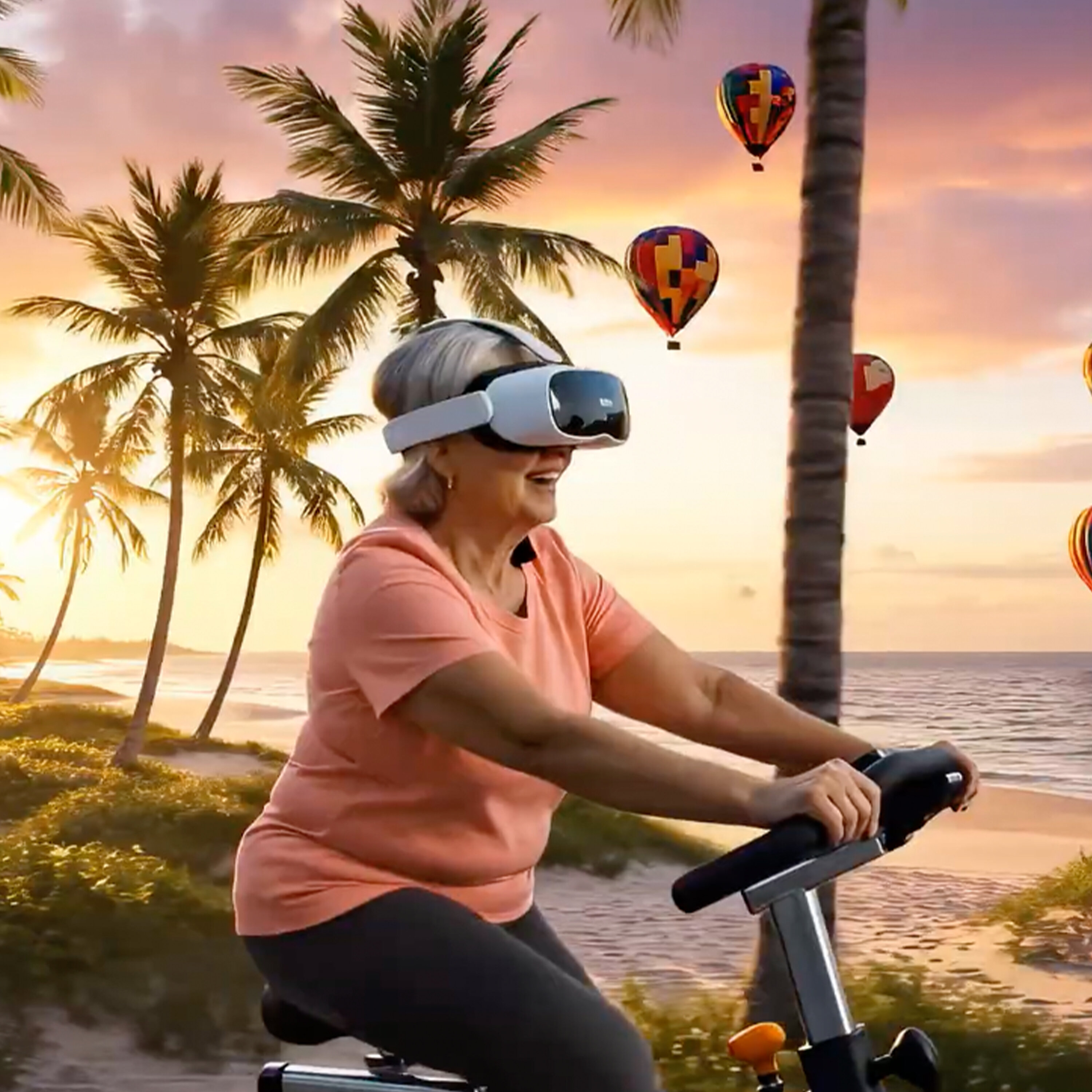
This episode of New Tror. I am always amazed when you have someone with an entrepreneurial mindset approach a problem with a new point of view. My guest today saw that our aging population sometimes encounters challenges with mobility, isolation and loneliness, and he set out to find a way to address those issues using technology, in this case, virtual reality. I'm really pleased to welcome my guest, Chris Brickler. He is the co founder and CEO of Mind Immersive, a national health and wellness company providing virtual reality solutions to the dramatically growing senior market. The company has curated a vast library of VR content and creates original programming designed for both recreational and therapeutic effects. In addition, Mind Immersive is working with leading universities and researchers to Study the potential health benefits of VR for our dynamic and aging population. Chris, welcome and thank you for joining me on Newt's World.
- [02:58]
Chris Brickler
Oh, thank you so much, Newt. Very exciting to be here today.
- [03:01]
Newt Gingrich
Look, before we get into healthcare and virtual reality, which I am very interested in, take us back. What did your early career look like and how did that lead you to where you are today?
- [03:12]
Chris Brickler
Yeah, you know, so I've 30 years or so in industry experience. I kind of start off with my early history. When I was 13 or 14 years old, the AT&T breakup, the Ma Bell breakup happened as you all remember. And my mom was an executive of major telecom company that gained a lot in that change. And I was a weird kid at 13, 14 reading this long document on anti monopoly, those type of things. But it got me very interested in technology and telecommunications. So when I came out of College in the 90s at University of Texas, I had been on a program that really brought in the first graphic Internet tools to the university with a couple of real thought leaders at the business school. What I learned there, Newt, was that this way that we could absorb and transact and interact with data was going to change forever. And that was 1992, 93 timeframe. So I dedicated my sort of career coming out of the gate into this first wave of Internet technology. And then I got a job at gte, which became Verizon. And we built at that time one of the largest Internet backbone networks in the United States. And now that's part of the Verizon infrastructure. I also went to London for three years with British Telecom. I was hired to basically run the global Internet operations for bt. As a very young person living in London and traveling all over Europe and putting together deals that made sense for how we put together a safe, secure Internet backbone for the NATO alliance. Essentially after that I spent 10 years in LA and I ran a production business. A very creative wanted to start creating more ones and zeros versus building the networks for the ones and zeros. And that was very exciting. And then after a couple of stints in Silicon Valley and understanding sort of the technology behind video streaming and all these sort of SaaS based technologies, I came up with this idea after Oculus was acquired by Facebook in San Francisco. I had some good friends on the inside and I sort of understood what this was all happening. And this was a new way, virtual reality, a new way for humans to again absorb, interact, commerce, transact, talk to the loved ones. You know, anything you can imagine. This new sort of spatial computing I saw in 2015, 2016 changed my career trajectory for, for yet another time. And I saw this VR technology new. I wasn't interested in the teenage gaming and sort of the pastime, sort of effects of keeping our teenagers more glued to a screen. I was actually more interested in how this technology could help humanity. And my grandfather had a bout with dementia as well as other folks in my family. And I just saw that this technology might work as a way to help in the sort of area of dementia care. And that was the first thesis of Mind Immersive as we know it today in 2016. And now we've gone from eight to nine years fast forward in R and D to develop and understand how this can really help the lives of so many more older adults and veterans.
- [06:10]
Newt Gingrich
It seems to me that this is an example of synergistic development in that you have three or four different siloed technologies that come together to give you a capacity very different than if you just look at the individual technologies. So you have better and better, for example, capacity in terms of the visuals, in terms of how much information you can send. I was at what was then Facebook looking at virtual reality and they had this heavy headset, but it worked in the sense that at one point they had me standing on the edge of a 60 story building looking straight down. Even though you knew you were in a room, you felt like you run a 60 story building. And there's so many different visual technologies, understanding of how your brain processes all these things had to come together. Could you just talk for a minute about all the different technologies that had to mature into this synergistic effect?
- [07:12]
Chris Brickler
It's a great question. You know, I think I saw that same demo when you're on top of the building and you look down and your legs buckle. I think what I learned from some of those examples was that if you could pull somebody out of their four walls of their environment and getting sort of into the sort of health care of aging adults, you know, what we've learned is that we can pull these folks out of their four walls, which are not always the most exciting four walls and they get very mundane and non motivating. And if we can take somebody out and reposition their brain into a music concert where they're hearing the performer play Fly Me to the Moon, right? Or a museum tour in Houston Celebrating the 50th anniversary of Apollo, you've got so many, you can lift that person out of their existence into a place that reconnects their consciousness with music, with art, with travel. We Offer people the opportunity to become less mobile, to still stay active from a travel point of view. Go swim with dolphins, let's take a trip to the International Space Station. So getting people out of those four walls was our job number one over the first course of our business. And I think then, to answer your question, there's other technologies that have come into our sort of sphere in terms of developing this into a real healthc solutions. So obviously when you think about AI and all the things we're doing in AI and that might be a whole other conversation here, but that's a big technology that is impacting what we're doing in spatial computing to another level. And it's really exciting when we think about AI for good.
- [08:42]
Newt Gingrich
Chris, when you talk about the ability to measure the elasticity and the memory of people, is that coming from actually interfacing with the headset or what's actually happening?
- [08:54]
Chris Brickler
So as we put this solution out into the field, out into the healthcare institutions, out into the home of veterans, what we have is a unique platform to capture data that includes physical movement, includes eye movement, includes other things in terms of how people react to the content that's being presented to them. And what we're able to do is using the hardware and using the AI technology with mind is build a fairly substantial data set that can be then passed on to the caregiving organization to say, hey, George has really experienced a better mood over the last 10 weeks and report that back or George is not making enough headway on his shoulder rehab. We need him to do more exercises on mind around catching butterflies in a meadow. That's the type of data that we think is going to be extremely valuable to the healthcare institutions that are trying to keep these folks healthy, happier and living longer.
- [09:54]
Newt Gingrich
Let me ask you two questions about that. One, I was fortunate. Last week I went to a lunch or a dinner rather with the European Space Agency and they had a astronaut, a woman from Europe who had spent about a year in space total. And we were chatting afterwards about the challenges if we move towards space stations that normal people go to, because there are a lot of things to learn. And so I asked her about the concept of building a mock up of a space station. And she said, you know what would really work better would be to develop a virtual reality space station so you could actually be experiencing it. And I thought that was a fascinating concept and it led me to this question, and you may already be doing this. If we could build a virtual reality trip to the moon either by going back to the original series or by looking forward to the very near future so that virtually anybody who wanted to, who had the right equipment, could download it. So literally the next generation of young Americans could experience the potential they have if they do their homework and they learn and they study to do things that used to be science fiction. I mean, does that strike you as plausible, 100% plausible?
- [11:17]
Chris Brickler
Yeah. I think what we're uncovering in this journey that we're on is that there's so many different simulations that we can do to provide folks that would never have the opportunity to do something like this, to do an experience like this. And one thing I can talk to specifically is we do have an experience that we have worked on with National Geographic that takes people to the International Space Station, lets them look down at Mother Earth in ways that they've never seen. And it is really emotional for a lot of these folks. Other things new that we create Things like Route 66 A Road to Remember. Now, I don't know if you ever went on that trip or not. A lot of people in your age group that have done that and it's been very exciting and they probably won't ever do it again. Well, guess what? We now have a original series on the mind network called Route 66 A Road to Remember. And what we do is allow people to visit all the iconic spots and memories along that way. Now, if you never get a chance to do it, this is a good chance to do it. But if you have done it and possibly have dementia in later years, what we know is this experience can unlock memories. Like we've never seen any technology unlock memories. And that's sort of where we're heading with these experiences. We want to be very intentional about what we create, what we can do. To answer your question about a trip to the moon, that's absolutely possible.
- [12:33]
Newt Gingrich
I'd love to get you with Jared Isaacman who is the new administrator. He's an entrepreneur himself. He actually paid to go into space, became the first civilian to ever do a spacewalk. And I think he would love to partner in a series of NASA activities that could be made available to everybody.
- [13:02]
Public Podcast Advertiser
Support for the show comes from Public, the investing platform for those who take it seriously. On public, you can build a multi asset portfolio of stocks, bonds, options, crypto and now generated assets which allow you to turn any idea into an investable index. With AI, it all starts with your prompt. From renewable energy companies with high free cash flow to semiconductor suppliers growing revenue over 20% year over year, you can literally type any prompt and put the AI to work. It screens thousands of stocks, builds a one of a kind index, and lets you back test it against the S&P 500. Then you can invest in a few clicks. Generated assets are like ETFs with infinite possibilities, completely customizable and based on your thesis, not someone else's goal. Go to public.com podcast and earn an uncapped 1% bonus when you transfer your portfolio. That's public.com podcast paid for by Public Investing Brokerage Services by Open to the Public Investing Inc. Member FINRA and SIPC Advisory Services by Public Advisors, llc. SEC Registered Advisor Generated Assets is an interactive analysis tool. Output is for informational purposes only and is not an investment recommendation or advice. Complete Disclosures available at public.comdisclosures hi, I'm.
- [14:04]
Cindy Crawford
Cindy Crawford and I'm the founder of Meaningful Beauty. Well I don't know about you but like I never liked being told oh wow, you look so good for your age. Like why even bother saying that? Why don't you just say you look great at any age, Every age. That's what Meaningful Beauty is all about. We create products that make you feel confident in your skin at the age you are now. Meaningful Beauty. Beautiful skin at every age. Learn more@meaningful beauty.com.
- [14:46]
Newt Gingrich
You took all of this, which is in itself exciting, and you decided that you had a passion like using it to help seniors. Talk us through that, right?
- [14:57]
Chris Brickler
Well, so again when I was looking at virtual reality in 201516 with the Oculus platform and seeing the target around gaming and teenagers, when the birds fly south, I always fly north. Just as sort of a entrepreneurial aspect aspect of who I am. When I saw that I started looking at the aging population and when you look and start doing research on this, it's a very big problem that our country is going to face. When we think about in six years from today we will have more people that are 65 or older in the United States than 18 or younger. And what that creates Newt, is a massive gap in care with fewer caregivers and more older adults that are requiring more attention across physical health, occupational cognitive health, certainly emotional health and mental health. And what we do know is that this device can help on all of those fronts. So when we think about the aging population and the stress that that's going to cause onto our healthcare infrastructure, we're on a purpose driven, passionate mind to bring this into the infrastructure of shared communities in clinic where there's multiple older adults and veterans and also to the home of these folks. But we've Never seen a technology that can captivate an individual, provide engagement and help solve some of the loneliness problem that we have in America, which is really leading to a mental health crisis. We have so many older adults that are not just older, but they're also lonely. We have a way that we can help fix that.
- [16:27]
Newt Gingrich
Your co founder had a huge amount of experience dealing with skilled nursing. How much did that fit into this?
- [16:37]
Chris Brickler
My co founder is a gentleman by the name of Sean Waiora in Dallas and were involved in a lot of businesses in the 90s and early 2000s. He was managing a skilled nursing operation of about 100 or so locations in Texas. And one of the things that they were doing in 201516 timeframe was using music with ipods to stimulate memory and dementia care and stimulate engagement and ultimately change behaviors, change eating patterns and wake these folks up through the use of music. And it was just one of the most beautiful projects that I've seen in a long time in my career, certainly my life. And then I had also seen what we can do in virtual reality. I'm like, Sean, we should probably put our heads together and think about how a VR product could really help humanity in this area of dementia care. And that's really how we got it started. Newt and that was 2016. I moved from San Francisco to Dallas, Texas to start this company and we've been really excited about where things are going for the last eight years.
- [17:33]
Newt Gingrich
What is your current state of development and implementation?
- [17:38]
Chris Brickler
So we are operating in probably 45 states or so. We've got the largest network built in the United States as it relates to headsets in commercial locations, that is senior living communities, skilled nursing communities, rehabilitation facilities that care for older people. We also have the largest network of that's been built into the va, into the national association of State Veteran Homes. So I grew up as a Navy brat myself. I was born essentially in the Philippines. My dad was sailing the South China Sea. I got a sort of first hand take of growing up in that world of what international opportunities exist for our veterans and then also seeing the reverse effect on the downside of our veterans. So I've had a big heart and passion in my own life of wanting to help take care of veterans with this technology. So now we've built the largest network in, inside the VA and outside into these national state veteran homes. Couldn't be more thrilled about how large and expansive the network has become because every time we put a headset out there, it just reaches people's lives and improves their daily health, their daily mood, it helps to reduce their anxiety, their stress. And when we have all the clinical information that we've done with the VA supporting this, this is a really beautiful sort of birthing of this technology into a demography of need.
- [19:00]
Newt Gingrich
You're developing with the CTA Foundation a system called the Great American Elder Verse. Explain that, it's intriguing.
- [19:09]
Chris Brickler
Yeah. So the CTA organization, the consumer technology group out of Washington D.C. also runs the CES conference in Las Vegas, the largest tech conference in the world. We've created a partnership about three years ago to where we're now allowing high net worth donors that feel compelled and compassionate about our older adults to be able to donate through this foundation with the tta. And what that is allowing us to do is reach underserved senior communities throughout the United States that we've never been able to reach. For instance, there's a group up in New York, the Steven and Alexandra Cohen Foundation. They kicked off the Elderverse last year and we put mine technology into 60 underserved senior communities, skilled nursing communities in the New York tri state area. So between New Jersey to Brooklyn to Harlem to New York and Connecticut, those are the areas that we're now giving this technology. And it really warms our heart as a company because this is part of our purpose, is to bring this technology to all older adults, not just the economic class that have the money to afford this.
- [20:20]
Newt Gingrich
This is really remarkable. You're sort of spreading across the whole country. How many states would you guess you have people currently using your technology?
- [20:30]
Chris Brickler
We're in about 45 states today. And I think with Canada and Australia and Great Britain, we're growing the network pretty substantially. Just as an example, we run about 25 physical therapy occupational therapy clinics. At the end of 2024, fast, about 13, 14 months, we're now in a deal to bring that to 500 of these communities. So in that particular case, we're looking at how virtual reality technology on the mind platform can help older adults with their physical and occupational therapy and speech and therapy rehabilitation goals. So when you think about a person that might have had a stroke, what's a great tool that could teach somebody how to make a cup of coffee again, or to walk outside their front door and notice that there's danger or situations that they have to process in their mind post stroke? This is an amazing technology for training the brain on how to do basic sort of activities of daily living is where a big focus of ours has and that has now started to grow significantly throughout our territories in the US and Canada.
- [21:49]
Public Podcast Advertiser
Support for the show comes from Public, the investing platform for those who take it seriously. On Public you can build a multi asset portfolio of stocks, bonds, options, crypto and now generated assets which allow you to turn any idea into an investable index with AI. It all starts with your prompt. From renewable energy companies with high free cash flow to semiconductor suppliers growing revenue over 20% year over year, you can literally type any prompt and put the AI to to work. It screens thousands of stocks, builds a one of a kind index and lets you back test it against the S P500. Then you can invest in a few clicks. Generated assets are like ETFs with infinite possibilities, completely customizable and based on your thesis, not someone else's. Go to public.com podcast and earn an uncapped 1% bonus when you transfer your portfolio. That's public.com podcast paid for by Public Investing Brokerage Services by Open to the Public Investing Inc. Member FINRA and SIPC Advisory Services by Public Advisors llc. SEC Registered Advisor. Generated Assets is an interactive analysis tool. Output is for informational purposes only and is not an investment recommendation or advice. Complete Disclosures available at public.comdisclosures Now I'd.
- [22:50]
Cindy Crawford
Like to introduce you to Meaningful Beauty, the famed skincare brand created by iconic supermodel Cindy Crawford. It's her secret to absolutely gorgeous skin. Meaningful Beauty makes powerful and effective skin care simple and it's loved by millions of women. It's formulated for all ages and all skin tones and types and it's designed to work as a complete skin care system leaving your skin feeling soft, smooth and nourished. I recommend starting with Cindy's full regimen which contains all five of her best selling products including the amazing Youth Activating Melon Serum. This next generation serum has the power of Melon Leaf stem cell technology. It's melon leaf stem cells encapsulated for freshness and released onto the skin to support a visible reduction in the appearance of wrinkles. With thousands of glowing five star reviews, why not give it a try? Subscribe today and you can get the Amazing Meaningful Beauty system for just $49.95. That includes our introductory five piece system, free gifts, free shipping and a 60 day money back guarantee. All that available@meaningful beauty.com.
- [23:57]
Newt Gingrich
Given the things you're achieving and the reactions you're getting from seniors, what's been the reaction of the academic world, the universities, the hospitals, the people who study this?
- [24:11]
Chris Brickler
So we've been working quite closely with some of the most respected researchers in immersive technology since the Beginning of our company, these folks have actually been researching this for 20, 25, 30 years. Our three landmark studies that we've done that are helping hospital organizations and healthcare organizations understand the impact of this technology. The three studies that we've done are one is a one year study we've done internally with the va, the Department of Veterans affairs in nine different locations. Another study is one with Stanford that they did for two years. And then we did another study that was sanctioned by center for Medicaid Medicare Services. CMS actually put mind into 35 skilled nursing communities in my home state of Indiana to study over a couple year period the impact on MIND for their older adults at these communities. And what we learned from that study, Newt, is that not 1, 2 or 3 out of 10 of these older adults reported a decrease in isolation. 91% over this huge study with CMS reported a decrease in isolation using MIND. That was a data point that we were not expecting to be that high. And then about 88% of that participant group also suggested that they would recommend mine to their fellow friends and community members, which was a very good score in terms of is the product a good fit for these folks. So yeah, we've been very committed to research, no question about it, through some of the leading organizations in healthcare. And then what that's transpiring to now is healthcare systems across the country now are waking up to this technology and seeing how affordable it is and how scalable it is. And that's our journey now, backing that up with clinical evidence from our buddies that we've done with our partner to making the technology very easy for caregivers. And I think the squad's the limit. I really do. An affordable technology that's going to change a lot of lives over the next few years.
- [26:15]
Newt Gingrich
Let's say an individual wanted to acquire this. Could they or do they have to be part of some kind of caregiving organization?
- [26:24]
Chris Brickler
Yeah. So today we are largely distributing the product into care organizations and that includes long term care communities, skilled nursing rehabilitation communities, the va, what they call the Community Living Centers for Long Term Care. We're in a lot of those organizations now. So now in 2026 we have a new program at the VA that's bringing mind to the homes of US veterans. And in that case, doctors and clinicians can now prescribe MIND for those veterans that are suffering or diagnosed from anxiety, stress, isolation is an indication, depression, cognitive decline, any of those combinations. The doctors can now provide a headset to that veteran living at home. And this is the first time that we've been able as a company to really see the benefit and the impact that this is going to make for home use. And so I'm very excited about that trajectory and just general Newt. It warms our heart and part of our purpose driven mission here is to provide this health to older veterans that are aging, that are all part of this mental health crisis. And we know this technology really can have an impact on mental health.
- [27:37]
Newt Gingrich
Well, it also seems to me that, for example, from a rural health perspective, you could be enormously important to people who are too isolated to normally get to a caregiver on a regular basis. And I just see this is an extraordinarily important breakthrough. What do you think is the next evolution of mind? Do you think that the dealing with senior citizens is such a huge undertaking that that'll probably absorb you for the next decade?
- [28:09]
Chris Brickler
I think Mind is a platform that is going to help a lot of people over the future. We as a small startup have had to focus on a niche and be dominant in that particular niche. The niche that we chose is the aging population. And as we all know, that is the population in our culture that is requiring the most amount of attention into healthcare. We simply don't have the system resources or the caregivers to deal with this. So what we focus on is helping to solve that problem across the board with aging Americans. Now, is the platform available and capable of helping in pediatrics and children's hospitals where we can reduce anxiety or help with stress or help with pain mitigation and management? Absolutely, yes. So I think the platform has a long life to help a lot of people. But in the early stages, we focused on the imminent need of helping this aging population. And when I think about the aging population, I also think about the legions and legions, the millions and millions of older adults that are living at home and they're not in facilities. And this technology I believe as a connected sort of infrastructure, and it's why we've developed a really Incredible partnership with AT&T is so that we can have a connected mind device in the homes of these older adults and these veterans that would be able to solve a lot of problems, keep content fully up to date, and use AI to our fullest advantage here in terms of designing content experiences that are really pertinent to that patient's experience. And then when you get into sort of the AI aspects of this technology on a remote level, we're looking at diagnostics through an entirely different lens. We can now start to track people's range of motion from 1 millimeter to 2 millimeters over three weeks of time. Through exercises, we can start to track cognitive decline or cognitive speed up in terms of neuroplasticity. That's such an exciting frontier with virtual reality. The point is that we will have an entire AI sort of data suite behind this that will then be translated to care plans and to caregivers to help caregivers navigate through difficult situations that they've never dreamed of having to deal with.
- [30:32]
Newt Gingrich
When I think about the totality of what the underlying system you're creating, it seems to me that there's going to be tons of work in an amazing range of areas over the next 10 or 15 years.
- [30:45]
Chris Brickler
I do feel that way. I feel that in my five and a half year relationship with the VA and the VA Immersive and AI Innovative team, that they are so far out in front of most of the commercial healthcare they don't get recognized enough. But I think as we institutionalize this immersive technology into the va, it is going to expand well beyond the VA to other areas of care. But the institutional implications here are extremely powerful. And when we look at the 9.3 million veterans we have in this country that are under VA care, we start to look at a fairly large population segment that really could use the help. The emotional, the physical, the cognitive, all these things that we know this platform can help. We're really happy with where the industry is right now and where our US Government is really pushing this. And I think one of the great things about change in this sort of administration to this administration is the focus on efficient use of technology. And I just can't think of a technology that's more affordable and efficient than something like this.
- [31:55]
Newt Gingrich
Chris, this is a extraordinary set of breakthroughs. It's going to be very attractive to people everywhere in the country, and frankly, I suspect all the way around the world. So if somebody working in an appropriate center hears about this and wants to get involved, what's the process by which they could interface with you and with mind and actually potentially bring your capabilities to their facility?
- [32:21]
Chris Brickler
I would first let folks know that they can learn more@mind immersive.com and we can obviously set up a demo. But the process overall is very simple. We're moving the product into thousands of locations across the country. And when caregivers learn about this technology and the caregiving staff learn about this technology, they're very excited about it. And we have a very simple process to ship the equipment to those communities, train those folks, get them engaged, and then be there for support for years to come. That's a very simple solution that we offer today.
- [32:57]
Newt Gingrich
Well, this has been amazing, Chris. I want to thank you for joining me. The work you're doing to help the lives of our seniors and potentially all Americans is fascinating. Our listeners can learn more about Mind Immersive and the great work you are doing by visiting your website at. Mind that's my N D Immersive. Thank you very much for being here.
- [33:21]
Chris Brickler
Thank you Newt. This has been a great experience. I appreciate it.
- [33:28]
Newt Gingrich
Thank you to my guest, Chris Brickler. New 12 is produced by Gamers360 and iHeartMedia. Our executive producer is Garnzi Sloan. Our researcher is Rachel Peterson. The artwork for the show was created by Steve Penley. Special thanks to the team at Gingrich 360. If you've been enjoying neutral, I hope you'll go to Apple Podcast and both rate us with five stars and give us a review so others can learn what it's all about. Join me on substack@gingrich360.net I'm Newt Gingrich. This is new tool.
- [34:09]
Public Podcast Advertiser
Foreign.
- [34:15]
Cindy Crawford
Doesn't have to be a reset, it can be a moment. Pura's well Being collection is designed to help your home feel softer, calmer and more balanced through scent. Discover fragrances made for everyday ease@pura.com Moods.
- [34:29]
Chris Brickler
This is an I heart podcast.
- [34:32]
Cindy Crawford
Guaranteed human.