Loading summary
Transcript159 lines
- [00:00]
A
This is an iHeart podcast, Guaranteed Human
- [00:04]
B
this July 4th, come celebrate at America's Block Party hosted by America 250. America's Block Party is a can't miss 4th of July concert happening at the Los Angeles Memorial Coliseum.
- [00:14]
A
Experience music, performances by major artists, patriotic tributes and the kickoff to giving 4th, helping to make July 4th the largest day of giving in American history.
- [00:24]
B
It's more than just fireworks.
- [00:26]
A
Join this landmark celebration and get your America's Block Party Tickets now for $17.76 at america250.org LA mom, can I have Lingokids? Dad?
- [00:37]
C
Lingokids, please.
- [00:39]
D
When did we become the Lingokids house?
- [00:41]
E
No idea.
- [00:42]
C
Last week it was Dinosaurs.
- [00:43]
A
This week it's Lingokids.
- [00:45]
C
Why Lingokids?
- [00:46]
F
Because it's the best thing ever.
- [00:47]
C
We can play games with astronauts, wild animals and superheroes.
- [00:51]
G
With more than 4,000 interactive games, songs and shows, LingoKids is the number one entertainment platform for young kids.
- [00:58]
C
So no dinosaurs and dinosaurs, mango cakes. Everything kids love.
- [01:04]
D
Download it for free.
- [01:06]
H
Professional wrestling fans. The action continues every week.
- [01:10]
C
This is total non stop action.
- [01:13]
H
TNA Thursday night impact every week on AMC. For showtimes and more information, visit tnarrestling.com
- [01:21]
G
AI is taking over the Internet. Wrong answers, made up facts. You ask a simple question and get a generated essay. Nobody asked for technology. Trying to decide for you and still getting it wrong. The Internet didn't used to be this way. When you just want to search anything online and find what you need, StartPage is the private search engine that keeps it simple. Real links, less noise. And we don't keep track of what you asked. Try startpage@startpage.com that's startpage.com.
- [01:54]
F
Welcome to Newts World Podcast on the iHeart Podcast Network. Two big events in Georgia. Rick Jackson won the governor's runoff and will be the Republican nominee. And I believe Jackson will win the general election. He's an entrepreneur. He was a foster child and has since, as he became successful, helped over 700 foster children. He's a remarkable entrepreneur and I think will turn out to be a very dynamic governor for Georgia. At the same time, on the same evening, Mike Collins, Congressman, won the Georgia Republican primary Senate runoff. Collins beat Dooley in the Republican primary and is now set to run against Ossoff. Doubly interesting because Collins had been endorsed by Trump and Dooley had been endorsed by Governor Kemp. But Collins won by almost 56 to 44. The fact is that this is going to be a very interesting race. Senator Ossoff is on defense. He's already frightened. He issued the following statement, which I think is just such a smear campaign. I've actually put stuff on X beginning to repudiate Ossoff because he clearly cannot run on his record, which is very radical. And Ossoff's initial comment after Collins was picked was, quote, donald Trump's hand picked candidate Mike Collins is a notorious bigot, anti Semite and extremist, currently under federal investigation for the illegal use of tax dollars. Collins, who is only a congressman because his daddy was a congressman, voted to double health insurance premiums for more than a million Georgians for the Iran war and for the Trump tariffs. And you're going to see, I think Ossoff run a very personally nasty campaign because he doesn't have any issues he can fight on. He's way too radical for Georgia and he has to hide that. But he is a favorite of liberal Democrats and radical Democrats across the country. So he's going to have a pretty good bit of money and it's going to be quite a race. On another issue, the current acting labor secretary is pressuring the states and territories to tackle unemployment insurance fraud. There's an amazing amount of fraud involved in unemployment insurance. And New York, for example, loses an estimated $2 million a day to fraud and improper payments. Illinois pays out more than $320 million in taxpayer funds, one of the highest improper payment rates in the nation. About 14% of every of the payments made in Illinois are improper. Coming up, Augustus Tirico, CEO of Rainmaker Technology Corporation, joins me to discuss cloud seeding. Do we now have the technology to increase rainfall to combat droughts? That's next.
- [04:53]
B
This July 4th, come celebrate at America's Block Party hosted by America 250. America's Block Party is a can't miss 4th of July concert happening at the Los Angeles Memorial Coliseum.
- [05:03]
A
Experience music, performances by major artists, patriotic tributes and the kickoff to giving 4th, helping to make July 4th the largest day of giving in American history.
- [05:13]
B
It's more than just fireworks.
- [05:14]
A
Join this landmark celebration and get your America's Block Party Tickets now for $17.76 at america250.org Louisiana with my mom and
- [05:25]
E
dad living in Orange county, when we bring my five and seven year old to visit, we are sometimes in for a two hour drive that could feel like 10.
- [05:32]
F
Oh.
- [05:32]
D
As an avid camper, I know all about this. We'll pack up the RV and know this is either gonna be the trip of a lifetime or a complete disaster.
- [05:40]
E
Which is why we load up the iPads with Lingokids before we even pull out of the driveway.
- [05:45]
D
It's what dreams are made of. Lingokids keeps kids engaged and quiet with over 4000 interactive games, songs and shows that kids simply cannot get enough of.
- [05:54]
E
You can pack whatever you think you'll need, but Lingokids is the only entertainment you'll need for a stress free car ride.
- [06:00]
D
Or really any ride, plane, train, hovercraft, whatever.
- [06:04]
E
Download Lingokids for free today or unlock
- [06:07]
D
even more amazing content with LingoKids.
- [06:10]
E
Plus choose the yearly plan and save up to 60%. Search LingoKids in the App Store or
- [06:15]
D
Google Play LingoKids everything kids love Professional wrestling fans.
- [06:20]
H
The action continues every week.
- [06:24]
C
This is total non stop action.
- [06:26]
H
TNA Thursday night impact every week on AMC. For showtimes and more information visit TNA
- [06:32]
G
wrestling.com they track, they target, that hotel, those shoes, your searches, your clicks. Every time you come back, prices can change. When websites know you want something, look again and all of a sudden it costs more and they saw you coming. Start Page the private search engine helps keep what you look up online from becoming a price tag. Nothing saved, nothing to use against you. What you search for is your business. Try StartPage, the private search engine@startpage.com that's startpage.com.
- [07:09]
F
I'm really pleased to welcome my guest, Augustus Durico, CEO of Rainmaker Technology Corporation. Augustus and his team are using drones to seed clouds to enhance snowfall and create water supplies. This method gained attention amid increasing droughts and water shortages nationwide. He discusses how it works, the science behind it, and whether cloud seeding can be vital for America's water future. Augustus, welcome and thank you for joining me on Newt's World.
- [07:42]
C
Thank you so much Newt. I appreciate you making the time despite the very busy week in Switzerland and with your birthday.
- [07:48]
F
Yeah, well thank you. Before we go into the technology though, you're one of the youngest CEOs working in climate and water technology. How did you get interested in this problem in the first place?
- [08:00]
C
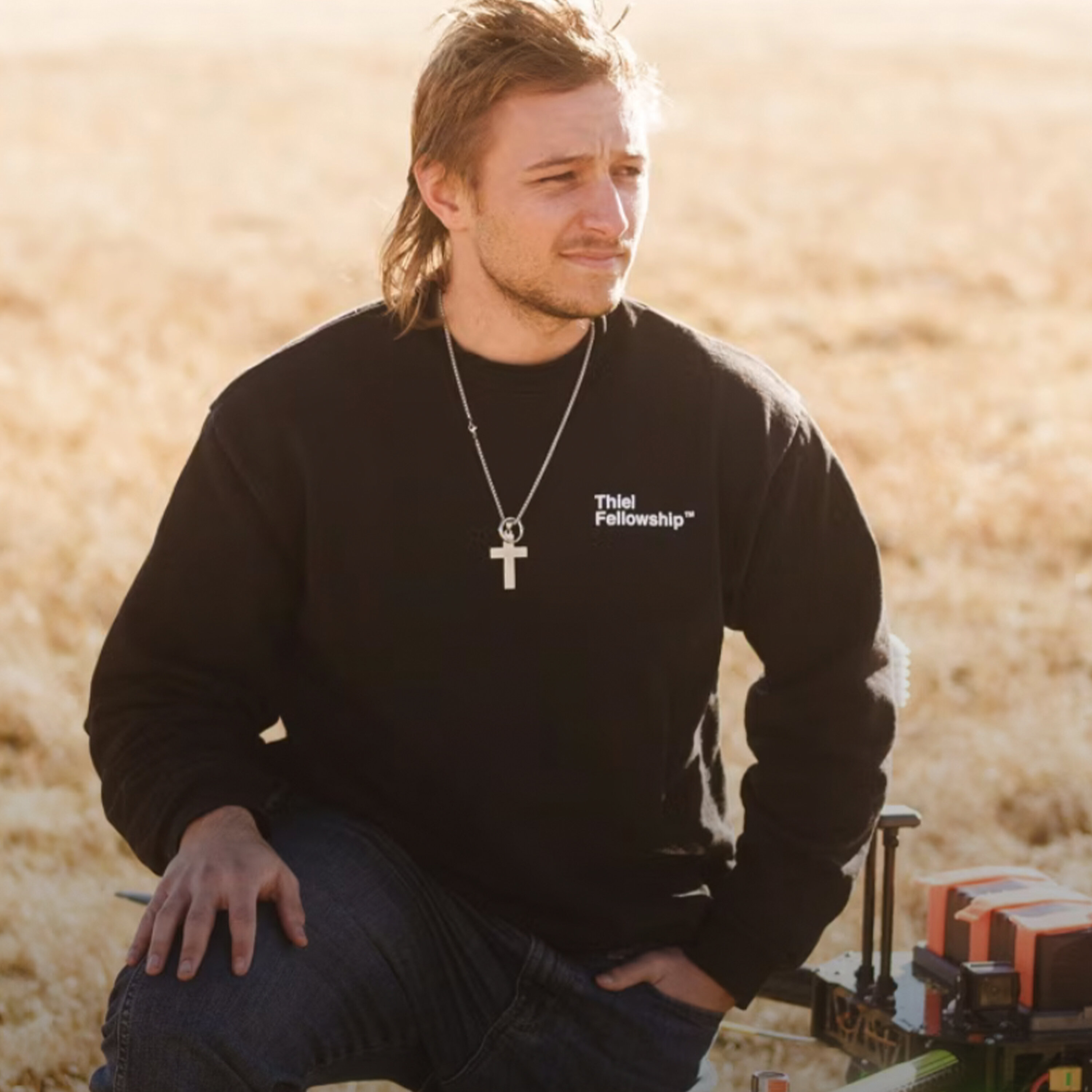
It was rather circuitous. The long story short is I was studying physics at UC Berkeley and during the pandemic I moved from Berkeley to Texas. While I was there, I started a groundwater well drilling business with someone I met at the gym and as I worked in that industry after I dropped out of college, got the Thiel Fellowship to build up that business, I realized that the American water table is posed which way to Sunday. No matter what you do in the current regime and the status quo, there's not enough water for our ecosystems like the Colorado and the Great Salt Lake, there's not enough for 100-year-old farms, either in surface water reservoirs or groundwater aquifers. You look at the Ogallala, the San Joaquin Valley, there's residences and developments like the Rio Verde development in Phoenix, where they're turning water off from the utility into homes that have already been purchased with occupants because they don't have enough water to go around. And so after I built up that groundwater monitoring company, I realized all the conservation we can do is great, and we should. But if you don't produce more supply, if you don't approach the problem of water scarcity with an abundance mindset and an inclination to new technologies, new modes of production, you're going to get something far worse than the Dust bowl over a far greater region of the United States. So I thought I would start a desal company. That was the obvious way to make more water, but it's not of particular use in places like Zurich or Geneva or Colorado or Utah. And so I wanted to make more water for the Interior. And it turns out, actually Secretary Udall, the Department of Interior secretary, he had something called Project Skywater, and he would go and pound the podium in the House advocating for more cloud seeding. But the issue with it was, even though it sounded so exciting, exciting, even though the technology's existed since 1946 when GE invented it, nobody in the past has ever been able to prove how much of the rain or how much of the snow is man made. Because if I fly a plane into a cloud and sprinkle some magic beans and then it snows, what's the counterfactual? Who's to say that that was man made snow? And that was true. And that's why we haven't seen cloud seeding at scale for the last many decades. But some researchers across American universities and national Labs back in 2017 proved with the right kind of radar, with the right kind of satellites, you can differentiate between man made natural precipitation and then actually prove to your customer, be it a government, a ski resort, a utility, a farmer, how many gallons you delivered to them. And once I met those professors and realized you can measure your effect, I decided to start Rainmaker. Because those researchers solved the fundamental bottleneck in cloud seeding and the fundamental bottleneck to making this a ubiquitous infrastructure scale source of water.
- [10:37]
F
If you have a cloud up there and you seed it so it rains over my neighbor's property, does that then mean there's no water left when it gets to my property?
- [10:50]
C
It's a classic question. We get that one all the time. So what you're angling at is directionally correct. Right. There's a finite amount of water in the atmosphere at any given moment. But less than 10% of all of the water that goes over the United States atmosphere precipitates over it. The rest is recycled by the oceans. It evaporates away or precipitates over the Atlantic and Pacific before or rather than precipitating in productive basins. And so we're a ways away still from seeding every cloud that would have otherwise precipitated over the ocean. And that's purely positive sum. And so we have the ability to target those clouds that would otherwise never naturally precipitate and do positive some seeding. And then candidly, in the future, I think probably two decades or so away from now, there will be large practices of cloud water rights litigators and California and Texas.
- [11:43]
F
This is exactly like the whole west with water rights for rivers and for aqueducts. And there's a whole industry of lawyers and systems set up. But let me go back and make sure I understand. So you're saying at one level you can identify clouds which probably will not rain before they get to the ocean, and therefore you're simply having the rain land on ground rather than having it go on into the ocean. Do we have any idea environmentally what that does to the ocean, not receiving fresh water?
- [12:20]
C
Well, the beauty of it is the ocean still receives the water, right? The water cycle still ends terminally with the oceans. This stuff runs off in rivers and streams or evaporates away. Also, for what it's worth to not only accounting for the fact that the water still makes it to the ocean at some point. The oceans are so big. Elon has said before, right, like our planet shouldn't be called Earth, it should be called water. The saltwater oceans will not become any more saline because of cloud seeding.
- [12:47]
F
What percent of total water on the planet is fresh water and what percent of saline?
- [12:56]
C
I don't want to perjure myself. I think it's well above 95% that saline if you accommodate the surface water, glaciers and atmospheric water. I know that the amount of water in the atmosphere, I think it's less than like 0.5% of all of the water on the planet at any given point, but what's neat about it is the atmospheric water resources, the atmospheric reservoirs that we have that we don't tap into, they're replenished wholly by evaporation from the oceans every eight to ten days. And so unlike a groundwater aquifer that you draw down from and is never really refilled. The atmospheric reservoirs that we have are being replenished constantly.
- [13:34]
F
That's wild. And actually, I think it's an interesting way to put it that you have atmospheric aquifers and underground aquifers. So I'm curious, cloud seeding goes back all the way to the 1940s, and people have been trying to figure out how to do this. What has happened to change technologically the ability to do it?
- [13:55]
C
Yeah, we're the first and only company to repeatedly and unambiguously prove that the precipitation is man made. And that is the fundamental innovation. So whereas Irving Langmuir and Bernard Vonnegut and Vincent Schaeffer, the inventors of cloud seeding, they didn't have the radar technology or the microwave satellite sensors required to measure precipitation in real time and measure glaciation of the cloud in real time. And so what these much more sensitive digitized sensors enable us to do is differentiate between man made and natural precipitation. If you fly in a specific pattern and you only see precipitation in your flight track, whether it's a zigzag or we could do your initials, then you can say beyond a shadow of a doubt, you only only have glaciated this region that you flew in. You only see precipitation in that region. Therefore it's unambiguously, or at least beyond plausible deniability, man made. That's important. Then the drones rather than manned aircraft, they reduce the cost per volume of water produced relative to manned aircraft flight. They give you more flexibility in what clouds and what conditions, what mountain ranges you can fly in. And then lastly, the data side. Right. I'm not the most AI maximalist sort. Personally, I have a litany of problems with some of the labs and how they're run. But if you're collecting all this proprietary data and you can run really advanced weather models, you can not just guess haphazardly which cloud to seed to optimize your yield, but you can run a simulation and say, okay, how do I get the most possible water on the ground? Well, these conditions in this cloud, rather than clouds, two, three, et cetera, will give us the most additional snowpack on the ground. So it's the remote sensing, the drones, and then the artificial intelligence and data.
- [15:42]
F
I get the sense just from general media that we may be in the greatest drought since the 1930s on a nationwide basis. It's not just like a California droughter in Arizona. Is that accurate? Is it really that significant a decline
- [16:00]
C
moisture since the Dust Bowl? This Is as bad as it's been. The Colorado river, it has about half the flows through Lee's ferry that it was measured to have in 1922. The Great Salt lake is in a deficit of about 20 million acre feet. The Ogallala aquifer is critically depleted, and there's no obvious solution as to how to refill it. And that's what feeds all of America's breadbasket. In the Midwest, the drought is really severe. And the most nefarious thing about it is if the aquifers are sufficiently depleted, the groundwater aquifers, then the pressure from the water that was previously there, that is no longer there, the pressure is gone. The sediment compresses. You permanently lose carrying capacity and the ability to irrigate. The American Midwest, how close are we
- [16:46]
F
in danger of some of the major aquifers literally having that kind of a hollowed out well?
- [16:52]
C
If you look across the San Joaquin valley of California, there's farmers whose homes are falling into the earth because of how much the pressure has been reduced. If you look at ground water curtailment across western states, it's already underway. I don't think that until the mid-2040s will you have totally depleted something like the Ogallala or the trinity aquifer in Texas. But the rate of consumption is only going up. The rate of additional supply provided is going down because of natural precipitation rates. And so we have to make more if we want to accommodate our previous quality of life, Let alone any economic growth in the American west.
- [17:30]
F
The way it works, water falls somewhere upstream from the aquifer, percolates down to the aquifer, and then usually runs almost like a river. But if it's not falling upstream, you're not refilling it, or if you're taking it out too rapidly, you're not filling it. I mean, doesn't this suggest that the whole core of both agriculture and industry in large parts of the country are built on very unstable equations?
- [18:06]
C
Well, it depends, I think, on your understanding of man's disposition. Right. I don't think that by any account, it was reasonable for a lot of the first colonists to try to find a better life in the untamed wilderness of New England or Roanoke. I don't think it made any sense for the pioneers to try to move west and to ground it specifically in the context of water. Look at Las Vegas, look at the central valley of California. Those were wastelands at the turn of the 19th century. But because of American engineering and very deliberate, concerted cooperation from the different Interests, private and public. We were able to create the Hoover Dam, one of the most spectacular pieces of infrastructure in human history. We were able to create the California Central Water Project and then turn these places that were a mix of wasteland, desert, and swamp into some of the most arable and productive regions of the country. Places that had a carrying capacity for millions more people than they otherwise would. And so I think that the unstable equations you mentioned before, if we were in the Stone Age, if we were not able to innovate and do more with less and produce more than. Yeah, the American west is largely uninhabitable, but because of spectacular engineers and technicians of the past, and hopefully the future with cloud seeding, I think we'll be able to make the American west even more habitable than it has been in the past.
- [19:29]
F
So as you look at your own projections, how big a contribution do you think cloud seeding can make to increase water availability across the West?
- [19:42]
C
So the Colorado river basin gets about 93 million. Are you familiar with an acre foot, by the way?
- [19:48]
F
Why don't you describe it?
- [19:50]
C
So it's a beautiful consequence of the imperial system of measurement and units. And so if you cover one acre of land a foot deep in water, it's about 325,851 gallons. That's like two Olympic swimming pools, give or take. The Colorado river basin gets about 93 million acre feet in precipitation each year. If you only were to enhance precipitation by about 10% and you were to do so over regions with very high effective precipitation, meaning not too much of it evaporated before it reached the rivers, if you were only to enhance precipitation over the whole basin, 10%, you could double the flow of the Colorado River. And I think that if you look at the available water above us, there's far more than 10% additionally precipitable water above. And so my aspiration is. And it's very aggressive. And maybe I take a lesson out of Elon's playbook and deliver the impossible, but do it late. My aspiration would be, and I think the physics would bear out to show you. You could double the flow of the Colorado river by 2031, and you could stop the eridification of the Great Salt Lake by 2030. That's the sort of scale that I'm talking about.
- [21:00]
F
Wow. When we come back, we'll examine Rainmaker's technology, why Augustus chose drones over airplanes, how the company seeds clouds, and how they address safety and effectiveness questions.
- [21:13]
B
This July 4th, come celebrate at America's Block Party. Hosted by America 250, America's Block Party is a can't miss 4th of July concert happening at the Los Angeles Memorial Coliseum.
- [21:23]
A
Experience music, performances by major artists, patriotic tributes and the kickoff to giving 4th, helping to make July 4th the largest day of giving in American history.
- [21:33]
B
It's more than just just fireworks.
- [21:35]
A
Join this landmark celebration and get your America's Block Party Tickets now for $17.76 at america250.org LA with my mom and
- [21:45]
E
dad living in Orange county, when we bring my five and seven year old to visit, we are sometimes in for a two hour drive that could feel like 10.
- [21:52]
D
Oh, as an avid camper, I know all about this. We'll pack up the RV and know this is either going to be the trip of a lifetime or a complete disaster.
- [22:01]
E
Which is why we load up the iPads with Lingokids before we even pull out of the driveway.
- [22:05]
D
It's what dreams are made of. Lingokids keeps kids engaged and quiet with over 4000 interactive games, songs and shows that kids simply cannot get enough of.
- [22:14]
E
You can pack whatever you think you'll need, but Lingokids is the only entertainment you'll need for a stress free car
- [22:20]
D
ride or really any ride, plane, train, hovercraft, whatever.
- [22:25]
E
Download Lingokids for free today or unlock
- [22:28]
D
even more amazing content with LingoKids.
- [22:30]
E
Plus choose the yearly plan and save up to 60%. Search LingoKids in the App Store or
- [22:35]
D
Google Play LingoKids everything kids love Professional wrestling fans.
- [22:41]
H
The action continues every week. Watch CNA Thursday Night Impact every week on amc.
- [22:49]
C
It is like electricity blowing through your veins.
- [22:52]
H
Go miss the adrenaline, the drama and the total non stop action.
- [22:56]
C
No one can ever be as good as this right here.
- [23:00]
H
Don't miss the action of TNA Thursday Night Impact every week on AMC. For showtimes and more information visit tnarrestling.com
- [23:09]
G
they track, they target, that hotel, those shoes, your searches, your clicks. Every time you come back. Prices can change. When websites know you want something, look again and all of a sudden it costs more and they saw you coming. Startpage, the private search engine, helps keep what you look up online from becoming a price tag. Nothing saved, nothing to use against you. What you search for is your business. Try StartPage, the private search engine@startpage.com that's startpage.com.
- [23:44]
F
As I understand it, Rainmaker is currently the only US company using drones rather than airplanes for cloud seeding. Why did you decide to take such a different approach?
- [23:58]
C
Well, you know, I think that there were some price and techno Economic reasons. And then there were also some safety reasons on the safety piece. We're making more snow and cold rain in the thick of the winter in mountainous regimes like the Rockies. Right. If you're a pilot, if you're IFR certified even you don't want to fly 2000ft above the tops of mountains in the Rockies in atmospheric rivers during snowstorms like that's very dangerous, especially when icing can cause you to lose lift. In fact, many clouds eating pilots of the last century have died across the Sierras and the Rockies because of how severe this condition is that they have to fly through. And so if only for the sake of the safety of our operators, drones seem preferable. But then also a plane capable of doing a cloud seeding mission, that's anywhere from 2 to $10 million depending on how much you instrumented out. Our drones cost orders of magnitude less, like three orders of magnitude less. And then whereas the plane costs thousands of dollars per flight hour because of the pilot and gas and so on, our drone we just have to recharge the battery and so we can fly in more severe conditions more safely to get higher yields of water for lower cost. That is why we chose to use drones rather than manned aircraft. And to give credit where credit is due. China has really catalyzed us to action in the drone space. We build our own drones in the United States, in Utah. But it was with a lot of inspiration from DJI and the vehicles that they built that we were able to design a vehicle capable of doing what ours does.
- [25:37]
F
Do you make your vehicles in the U.S. we do.
- [25:40]
C
I believe so. So ardently and actually I'd be curious for your perspective on re industrialization versus the service and financial economy we have now. But I'm so ardently in favor of re industrializing the United States and perhaps policies that wouldn't really fly back in the Reagan admin. To manufacture more drones in America, we manufacture drones radar in the United States so that we can measure the clouds better. We do all of our material science work in Los Angeles as well. We're going to scale production to the tune of thousands of drones per year by the beginning of 2027.
- [26:15]
F
Is it three times more expensive for the vehicle? And then you also save money on the operating cost.
- [26:22]
C
Yes, it's three orders of magnitude.
- [26:24]
F
Three orders of magnitude. Okay. Yeah, that's a lot.
- [26:28]
C
Yeah. But the real unit that matters isn't how much the hardware costs, it's how much the water costs. So with a plane based system, the lowest you could Ever drive the cost of an acre foot down is probably like $100 to $50. In the case of drone based operations, we're still producing water for about $200 an acre foot right now. I think that we can drive that down to in the limit, about A$60.
- [26:54]
F
Does $1.60 begin to make you competitive with traditional methods of getting water?
- [27:00]
C
$1.60 would fundamentally change the water market across the United States. Some of the cheapest water that you see is about $50 an acre foot. We're pricing competitively there now. But in terms of Rainmaker's ambition, what I'm interested in is a more abundant, more lush, more green western United States with more arable land and agricultural and hydroelectric production than ever before. And the only way to unlock the latent demand for all of those things, similarly again to SpaceX is if Elon needs to get to Mars and you need to reduce the cost of a kilogram to orbit. We want to green the American west and we need to reduce the cost of an acre foot on the ground.
- [27:40]
F
You use, as I understand it, you basically use silver iodide as the seed that you drop in. Is there any health side effect of doing that?
- [27:52]
C
Another canonical question. I was with the Idaho Water Users association about a week or two ago and they asked what material do you use? And we said glyphosate. And they appreciated that. We do, not, to be clear, use glyphosate. We use silver iodide in our commercial operations. And although cloud seeding took 70 years for anybody to prove that it worked, we do have the luxury of 70 years of data collected on the safety and toxicology of seeding with silver iodide. And we know that beyond a shadow of a doubt that the concentrations used are so de minimis low over such a large area that they don't have adverse ecological, agricultural or human health consequences. And to ground that in a number, the most sensitive freshwater biota in the American west, they start to have respiratory problems. At about 100 parts per billion of silver iodide concentration in the water, after decades of cloud seeding, the highest increase in concentration we've seen is 8 parts per trillion. So about a million times less than the most sensitive threshold, say, parts per trillion. Correct.
- [28:59]
F
I mean, just the lab capability of finding something at that level of dilution. It's pretty amazing.
- [29:05]
C
It is, it is. It's mostly because of the big mining companies that we have that kind of tech now.
- [29:11]
F
Coming up, we'll explore the future of weather modification, why states are investing more in cloud seeding and if technologies like rainmakers could be a key to solving America's water issues.
- [29:22]
B
This July 4th, come celebrate at America's Block Party. Hosted by America 250. America's Block Party is a can't miss 4th of July concert happening at the Los Angeles Memorial Coliseum.
- [29:32]
A
Experience music, performances by major artists, patriotic tributes and the kickoff to giving 4th, helping to make July 4th the largest day of giving in American history.
- [29:42]
B
It's more than just fireworks.
- [29:44]
A
Join this landmark celebration and get your America's Block Party Tickets now for $17.76 at america250.org LA mom, can I have Lingo Kids?
- [29:55]
C
Dad, Lingo Kids, please.
- [29:57]
D
When did we become the Lingokids house?
- [29:59]
E
No idea.
- [30:00]
A
Last week it was dinosaurs. This week it's Lingo Kids.
- [30:03]
D
Why Lingokids?
- [30:04]
F
Because it's the best thing ever.
- [30:05]
C
We can play games with astronauts, wild animals and superheroes.
- [30:09]
G
With more than 4,000 interactive games, songs and shows, LingoKids is the number one entertainment platform for young kids.
- [30:16]
C
So no dinosaurs and dinosaurs.
- [30:19]
F
Lingokids.
- [30:21]
C
Everything kids love, download it for free.
- [30:24]
H
Professional wrestling fans, the action continues every week.
- [30:27]
F
You got it coming.
- [30:29]
C
This is total non stop action.
- [30:31]
H
TNA Thursday night is Impact every week on AMC. For showtimes and more information, visit tna
- [30:37]
G
wrestling.com your 2am Questions are nobody's business. Not the symptoms you're scared to tell your doctor. Not the money worries, not the things you'd rather keep private. Right now, companies are using what you look up online to track, target, and make a fortune off your secrets. Startpage keeps your curiosity private. It's the private search engine that helps you find what you need without the spying and without the noise. Nobody in your business. No saved search history. Try startpage@startpage.com that's startpage.com.
- [31:14]
F
How do you see this whole business evolving from where it is right now?
- [31:21]
C
Have you read the Dune series by chance? Newt?
- [31:24]
F
The novels?
- [31:25]
C
Yeah, the novels, yeah. So I think that that sort of terraforming aspiration is what I'm interested in. Maybe apart from you and Elon need to talk perhaps at some point.
- [31:38]
F
Yeah, he wants to do terraforming. It's just the fourth planet instead of the third planet.
- [31:44]
C
Yeah, exactly. And so my thinking is, if we draw inspiration from the Bureau of Reclamation and building the Hoover Dam, if we draw inspiration from the California Central Water Project. Actually, if we draw inspiration from the CCP's current weather modification program, where they're greening Inner Mongolia by making it rain more and planting trees. Rainmaker stands to be or at least I hope and will work tirelessly to ensure that it is the company responsible first for mitigating water scarcity in the American west, but then secondly for greening millions of acres that previously were uninhabitable or not arable. And I think that comes in the form of making more snow, making more rain, and then also additional technologies to change the chemistry of soil to make it more conducive to bacterial growth or grass growth that will make it use the water better and allow less to evaporate away in the limit. I think, you know, we have something approximating a thermostat that we can tune the weather around us with. We're a long way away from that. And much could be said as to whether that evokes imagery of the Tower of Babel. But I don't think that aspiring to tend better to the creation we've inherited is necessarily a bad thing, as long as we do it with some caution and a stewardly disposition.
- [33:04]
F
One of these I was surprised by is that state governments are increasingly willing to invest in trying to precipitate more rain. Do you see that as a trend that's going to increase?
- [33:16]
C
Absolutely. I think that municipalities across the American west, increasingly even in Appalachia, state governments, perhaps the federal government, utilities, hyperscaler data centers that are trying to offset their water consumption, farming collectives, ski resorts, international governments, absolutely. They are all increasingly investing in cloud seeding because it has for the first time ever been proven to work. And it's a strange market because most people are unfamiliar with even the idea that you could buy weather modification as a service. But if you look at the Saudi Arabian annual budget for weather modification, it's about $300 million per year U.S. if you look at the state of Utah, it's nearly $10 million per year. Then between Colorado, California, Nevada, New Mexico, which recently just appropriated money for the first time, they're all spending more and more on cloud seeding to enhance water supply because it's the only way for these interior states to produce more water since they don't have desal available.
- [34:19]
F
Doesn't this potentially have a huge implication for arid places like the Chilean desert or the Middle East?
- [34:28]
C
We have customers in the Levant already. We're making more water for arid countries out there in the Middle east. And I think we'll expand even further come this upcoming winter. So yes, now it's worth flagging that as miraculous and sci fi as it seems to be able to modify the weather at all, cloud seeding has some really Fundamental physical constraints. If you have no cloud in the sky, then you will not get more precipitation.
- [34:57]
F
Right?
- [34:58]
C
Brutal. Catch 22, Sahara Desert, non starter. If the clouds are too warm and the silver iodide you release can't freeze the small droplets into bigger snowflakes, you'll also get no additional precipitation. And so though the incremental additional water we can make in, say, the Hedges Mountains of Saudi Arabia or in the Andes of Latin America, although that's very useful some places, we will not be able to serve with this technology despite the demand for it.
- [35:26]
F
If you have areas that have clouds but no rain, you can have an impact. If you have areas with no clouds, you can't make an impact. Is that a simple way to sort of put it together? Bingo. Yes. Let's say we come back together, which would be fun. We'll make a note of this 10 years from now and we're talking with you about Rainmaker, what it's achieved and what it's like. What would your hope be for Rainmaker 10 years from now?
- [35:56]
C
10 years from now? It's already been a forecast 5, but I'll indulge 10. My hope would be that the American west has multiples more water than it has in our recorded history, than it ever has in our recorded history, and that Rainmaker is responsible for producing that by making more snow, by making more rain. And then really the two piece de la resistance is of weather modification, if you will, are modifying the trajectory of the jet stream so that you can increase the amount of clouds that make it over the west and reducing the severity of hurricanes, both of which were attempted in the 60s, both unsuccessful. But I think that we can have Arizona resemble something more like Ohio if you figure out the limit of this physics and maybe we could pull it off in as soon as 10 years
- [36:45]
F
since I have a place in Florida on hurricanes, actually, you're doing the reverse. You actually would like the clouds to drop the rain earlier in the ocean before it gets to land. I think you'll find Florida may be very interested in funding those experiments because the difference in home damage alone will more than pay for the experiment.
- [37:07]
C
Perhaps. Perhaps. Now that said, though, they did ban weather modification and make it a felony actually in Florida. In Florida and Louisiana. They did, yes.
- [37:17]
F
Well, talk to them not about weather, but about hurricanes.
- [37:20]
C
Okay, that I will.
- [37:22]
F
Hurricanes are a different problem. Just a thought. It's just a crazy thought. Listen, Augustus, I want to thank you for joining me today. Listeners can learn more about what you're doing@rainmaker.com and I think there's a pretty good chance you're going to really make history.
- [37:38]
C
Thank you. That's the plan, sir.
- [37:39]
F
I hope to thank you to my guest, Augustus Dirico. New2World is produced by Gingrich 360 and iHeartMedia. Our executive producer is Garnesy Sloan. Our researcher is Rachel Peterson. Special thanks to the team at Gingrich360. If you've been enjoying Newts World, I hope you'll go to Apple Podcasts and both rate us with five stars and give us a review so others can learn what it's all about. Join me on substack@gingrich360.net I'm Newt Gingrich. This is New Swirl.
- [38:17]
B
This July 4th, come celebrate at America's Block Party. Hosted by America 250. America's Block Party is a can't miss 4th of July concert happening at the Los Angeles Memorial Coliseum.
- [38:26]
A
Experience music, performances by major artists, patriotic tributes and the kickoff to giving 4th, helping to make July 4th the largest day of giving in American history.
- [38:36]
B
It's more than just fireworks.
- [38:38]
A
Join this landmark celebration and get your America's Block party tickets now for $17.76 at america250.org LA with my mom and
- [38:48]
E
dad living in Orange county, when we bring my five and seven year old to visit, we are sometimes in for a two hour drive that could feel like 10.
- [38:55]
D
Oh, as an avid camper, I know all about this. We'll pack up the RV and know this is either going to be the trip of a lifetime or a complete, complete disaster.
- [39:03]
E
Which is why we load up the iPads with Lingokids before we even pull out of the driveway.
- [39:08]
D
It's what dreams are made of. Lingokids keeps kids engaged and quiet with over 4, 000 interactive games, songs and shows that kids simply cannot get enough of.
- [39:17]
E
You can pack whatever you think you'll need, but Lingokids is the only entertainment you'll need for a stress free car ride.
- [39:23]
D
Or really any ride. Plane, train, hovercraft, whatever.
- [39:28]
E
Download Lingokids for free today or unlock
- [39:31]
D
even more amazing content with LingoKids.
- [39:33]
E
Plus choose the yearly plan and save up to 60%. Search LingoKids in the App Store or Google.
- [39:38]
D
Play Lingokids everything kids love.
- [39:42]
H
Professional wrestling fans. The action continues every week.
- [39:46]
F
You gotta go.
- [39:47]
C
This is total non stop action.
- [39:49]
H
TNA Thursday night impact every week on AMC. For showtimes and more information visit TNA.
- [39:57]
G
Your 2am Questions are nobody's business. Not the symptoms you're scared to tell your doctor not the money worries, not the things you'd rather keep private. Right now, companies are using what you look up online to track, target and make a fortune off your secrets. Startpage keeps your curiosity private. It's the private search engine that helps you find what you need without the spying and without the noise. Nobody in your business. No saved search history. Try startpage@startpage.com. that's startpage.com.
- [40:27]
A
this is an iHeart podcast. Guaranteed Human.