← Next Comes What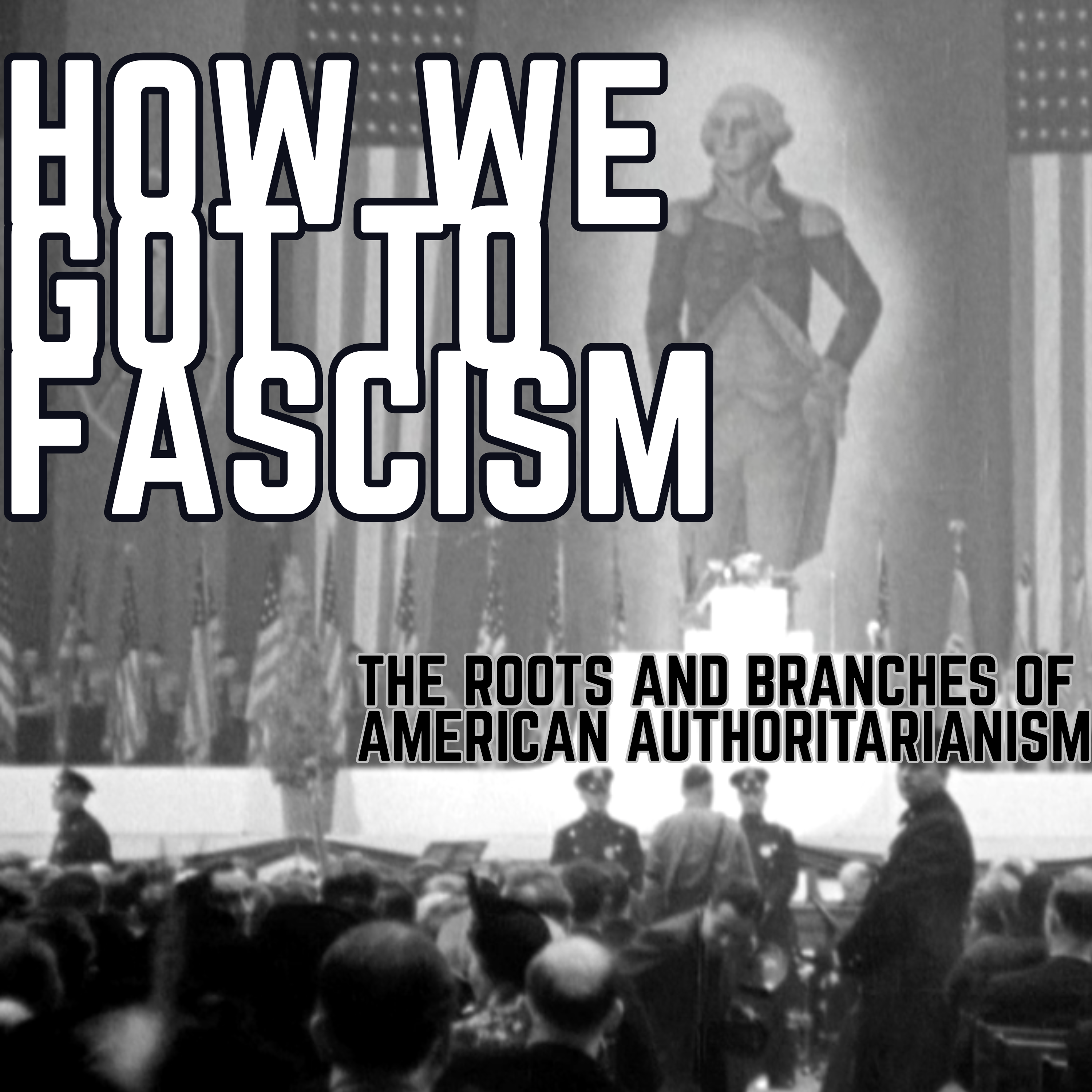
Next Comes What
How We Got to Fascism
00:29:11
What history best explains the authoritarianism surging in the U.S. today? Read the post that inspired this episode: Subscribe to Andrea Pitzer’s Degenerate Art newsletter to support Next Comes What and get Andrea's posts first: Watch this...
Loading summary
Transcript79 lines
- [00:00]
A
You're listening to Next comes what from Degenerate Art. This is Andrea Pitzer. How did we get where we are right now with masked men sweeping people off the streets? Answering that question is an important step toward figuring out how to get the country out of the hole it's in right now. 600 million taxpayer FEMA dollars being used to now open more concentration camps and ice burning through. $8.4 million a day to illegally detain people. How much does it cost for fascism? How the taxpayers have to pay for a fascist country? Trying to understand the mechanisms by which institutions and guardrails meant to protect democracy have largely caved to corruption and demagoguery can be a fraught area.
- [00:49]
B
They want transgender for everybody. Everybody transgender.
- [00:53]
A
When people talk about Hitler or refer to extremists active in the US Today as the American Taliban, it can underline a tendency to see authority authoritarianism as something foreign or even exotic that has somehow infiltrated the country like an invasive species.
- [01:12]
B
You know, I'm going to see Putin. I'm going to Russia on Friday.
- [01:16]
A
The truth is that the United States has a long history of doing horrific stuff.
- [01:21]
B
You think our country's so innocent, but.
- [01:24]
A
Is what's happening just the outgrowth of that prior American history, Native genocide, slavery, Jim Crow, racism, and the rest, or are we actually caught in a global tide that's repeating the fascist and authoritarian movements of the 20th century?
- [01:41]
B
I think we need a ballroom, and that's happening. It's going to be a beautiful ballroom.
- [01:46]
A
Today. I want to look at domestic and international roots of the downward spiral in the US Today and make an argument that we need to see the current crisis through both international and domestic lenses in order to understand it and to dismantle the machinery that's currently in motion. When I was a freshman, Kurt Vonnegut came to my university to give a lecture on storytelling.
- [02:16]
B
We are so seldom told the truth. And Hamlet in Hamlet, Shakespeare tells us we don't know enough about life to know what the good news is and the bad news is. And we respond to that. Thank you, Bill.
- [02:35]
A
One of the things I remember from that talk is him saying that if you have a villain in your story, whatever you do, never explain how he got that way.
- [02:45]
B
What could be a more empty piece of information?
- [02:52]
A
What Vonnegut said later but didn't mention that day, as far as I remember, is that he himself had never written a character as a villain.
- [03:01]
B
We pretend to know what the good news is and what the bad news is. And you think about our training in this matter, all we do is echo the feelings of people around us.
- [03:10]
A
He had no villains in his story, which is not to say that he didn't write about evil and the horrific things that humans can do.
- [03:20]
B
In Slaughterhouse 5, the scene that meant the most to me was the scene I actually lived through, which was the burning of Bo after they were brought out of the cellars of Dresden.
- [03:31]
A
Those issues were at the core of his novels. But he noted later in his life that society can be a villain just the way a mother can be. And waking up most days. It's a grim moment when I remember that the US has become the super villain on the global slate.
- [03:52]
B
Ukraine and its European allies are concerned that Presidents Putin and Trump will use their meeting to decide territorial concessions that participation. President Zelenskyy has repeatedly rejected any peace plan that involves ceding land to Russia.
- [04:07]
A
Not only the bad guy in pre existing ways that we knew about, but now also in altogether new ones. And maybe it doesn't make for a good Kurt Vonnegut novel.
- [04:18]
B
Don't put anything in a story that does not either reveal character or advance the action.
- [04:25]
A
But I think it's critical for us to figure out in the real world the origin story of the US As a villain. So if we want to look at both the domestic and the global roots of what's going on in the country, there are those who say that to look to history, like slavery, the U.S. civil War, or Jim Crow as a fundamental driver of what's happening in this historical moment is a mistake. Looking at history they offer runs the risk of ignoring day to day realities that we experience today, which can look very different than the lives lived by enslaved Africans centuries ago in the US and that what's happening today may operate subject to other power differentials. But it's hard to avoid those comparisons when we're resurrecting some very grim moments from our history. Every day we see kidnappings on the.
- [05:26]
B
Street about the ICE raids that we're seeing. And I want to make a comparison. And that is when I talk with my students about the Fugitive slave Act in 1850 and how it pushed the nation closer to the brink of civil war because they began snatching people out of communities, people who had lived in communities or people who had escaped slavery. And you know, my students are like, oh, so these people who came out against the Fugitive Slave act were all abolitionists? And I said, no, these are people who could not countenance the idea of their neighbors being taken from them.
- [05:59]
A
We see sitting legislators threatened or even Arrested.
- [06:02]
B
We're also following a bomb threat at a Hotel in St. Charles. This is where Texas Democrats are staying. As the standoff escalates over redistricting, we.
- [06:11]
A
See the removal of people of color from positions of leadership in government or even academia.
- [06:16]
B
It just feels like a microscope is now on. Like black people.
- [06:19]
A
Much of what Trump is doing seems aimed at rolling back the historical clock for the express purposes of removing power and agency from not only political opponents, but but also people he sees as actually less than human. It's also hard not to think of decades of American history when the President of the United States directly targets Washington.
- [06:41]
B
D.C. you've got to deal with his record. His record is that if people are violent and disobey the law and assault law enforcement and are supportive of him, that's fine. But on some others that he claims out of control, he's going to send out the National Guard. Well, why didn't he send it out? January 6th.
- [07:00]
A
The city has been majority minority for more than 60 years. It is a city long known as Chocolate City due to the presence of black Americans and the defining role that heritage has played in the city. Going much further back, my great, great.
- [07:16]
B
Grandfather, I think, was known as the black mayor of Georgetown. His name was Charles Turner. He and his twin brother were freed. He eventually becomes a homeowner in Georgetown, multiple homes, works for the federal government, is the leader of the Republican Party here in. Well, Lincoln was a Republican. You know, when we talk about, you know, the American dream, I mean, this is really the fulfillment of it.
- [07:40]
A
The District only acquired home rule in my lifetime, and now it's under threat. I think I speak for all Americans. We don't believe or believe it's legal to use the American military against American citizens on American soil. President Trump has attacked the city repeatedly and has expressed racist animus against black Americans for half a century.
- [08:02]
B
A well educated black has a tremendous advantage over a well educated white. A black may think that they don't really have the advantage. If I was starting off today, I would love to be a well educated black.
- [08:13]
A
Perhaps most famously lying about the criminality of the Central Park Five who were wrongfully convicted and imprisoned and continuing to lie long after they'd been exonerated.
- [08:25]
B
Donald Trump has never apologized for that moment. Placing a full page ad in the New York Times. So if we start with the man that we've known for the better part of seven decades, this is a man who has consistently scapegoated black and brown people to either gain celebrity or political capital.
- [08:46]
A
The U.S. senate currently has bills pending intended to repeal D.C. council votes meant to manage crime in the city. City. That by itself is an egregious action, but Trump is leapfrogging it entirely by seizing control of the D.C. police Department and bringing in the National Guard, all while violent crime rates are the lowest they've been in the city for more than 30 years.
- [09:11]
B
And listening to the press conference on my way over here, every city that he named, Chicago, Oakland, Baltimore, who by the way, Baltimore's crime is down 50%. All of them are black cities.
- [09:23]
A
Dozens of other actions Trump has taken just this year show an attempt to roll back the gains of the civil rights movement for everybody that has benefited from that movement.
- [09:32]
B
Well, the Civil Rights Division was created in 1957 by a civil Rights act passed by the Congress after Brown versus Board after the Montgomery bus boycott with the very specific intent of enforcing the then civil rights laws. Its mission is clear. Its mission is to protect those who've been historically locked out and left out in this nation. And what we see is an effort to flip that entire mission on its head.
- [10:02]
A
These actions are deeply rooted in American history, along with the worst of our domestic history. I would argue that what we're seeing rise in America today also relies on 20th century fascism, both the formal models of it that Italy endured and that the Nazis embraced.
- [10:20]
B
While Mussolini was forging the first fascist.
- [10:22]
A
State in Italy, back here in Germany.
- [10:24]
B
Hitler was taking notes. Once out of prison, he played on many of the same themes as Mussolini. Rousing a disillusioned workforce, reviving a struggling.
- [10:33]
A
Economy and fixing what was considered a weak government and its bastard stepchildren around the world that followed in their wake. And in America today, I see an emphasis on corporatism that ultimately gives way to government pinning business interests under its thumb as some kind of squirming co conspirator.
- [10:54]
B
See, these are very religious people and their religion is greed. And they worship on the altar of money.
- [11:14]
A
We saw billionaires racing to pay for Trump's inauguration in January.
- [11:19]
B
This was remarkable to see. Not necessarily surprising, but remarkable. The CEOs of Google, Meta, Apple, Tesla, all on the stage during the inauguration.
- [11:28]
A
We saw Tim Cook in what appeared to be a blunt trade of a gold trinket in exchange for protecting Apple from Trump's punitive orders. Congratulations. Traditionally, in America, during my lifetime, the super wealthy have had a tremendous hand in shaping the country and typically appear to be able to buy politicians.
- [11:53]
B
Thank you again. Thank you again.
- [11:55]
A
Don't forget, but we may now be witnessing the shift to government subjugation more along the lines of contemporary Russian authoritarianism, where the oligarchs are kept in line by the threat of punitive policies and actions against them.
- [12:13]
B
Vladimir Putin has engineered a shadow fortune so vast it makes Elon Musk look like a corner shop owner. Officially, this former KGB operative lives on a humble government salary of $140,000 annually. But peek behind this carefully constructed facade and you'll find what may be the first trillionaire in human history. The numbers are simply staggering. Control over $75 trillion in natural resources, influence over more than $505 billion in oligarch wealth, and the ability to direct Russia's economic machinery at his whim.
- [12:45]
A
And having studied the variety of concentration camp systems that rose under fascism, I think that the history and evolution of European authoritarianism of fascism can show us a way to understand what's happening now as well as what's likely to happen next. The International history of 20th century Fascism is relevant today for other reasons, too.
- [13:08]
B
Cousin is under fire for a posted on social media that used language from Nazi Germany, the latest in a series of anti Semitic and authority authoritarian statements from Trump and his campaign.
- [13:18]
A
We hear shout outs to Nazi rhetoric. The Trump campaign tells us this morning that this was a video that was shared by a staffer while the former president was in court, saying that staffer missed the reference. But as of this morning, that video has not been taken down. We see references to Nazi tropes. Former President Donald Trump sparking backlash this morning after a video posted to his social media account seemingly suggests there will be a unified Reich if he wins the 2024 election. I've mentioned before that we see a number of apparat chicks in Trump's machine, as well as fans of what he's doing, engaged in a kind of meta cosplay that openly admires earlier models and strategies of fascism.
- [14:02]
B
America is for Americans and Americans only.
- [14:08]
A
There's a deliberate attempt to return to repressive eras from other times and places. Defense Secretary Pete Hegseth recently made headlines when he shared a CNN video on social media arguing women should not have the right to vote.
- [14:20]
B
I was very grateful to him for doing that. He didn't just repost it, like, oh, here's an interesting thing that these weird people are doing. He reposted it. And he himself said all of Christ for all of life, which is the tagline that we use. So he was in effect reposting it and saying amen.
- [14:38]
A
And I don't think the domestic model is the only one worth considering. For another Reason. Overseas, we see jingoistic nationalism and persecution of immigrants and religious or racial minorities in places like Xinjiang, home to the Uyghurs, a predominantly Muslim Turkic ethnic group whose culture and language are different from China's majority Han population. The government's abuses include an an estimated 1 million arbitrary detentions, an intrusive mass surveillance system. And the Chinese government has also subjected Uyghur and other Turkic Muslim communities to forced labor. We see the state of Assam in India where Muslims are hounded in other ways.
- [15:21]
B
Thousands are being driven out of their homes by the Indian government. Their houses are being bulldozed, they're being forced into camps. Some are even pushed across the border into Bangladesh with no due process.
- [15:35]
A
Or Rohingya Muslims in Myanmar who were rejected as citizens and persecuted in countless other ways. In late 2017, a wave of violence in Myanmar's Rakhine State forced more than 7 lakh Rohingya to flee across the Nap river into neighboring Bangladesh. They joined hundreds of thousands of others who had fled before building what is now world's largest refugee camp. We watched Brexit in the UK demonizing immigrants in an attempt to resist restore national greatness, a deeply self destructive movement. We've seen the rise or expansion of repressive regimes in Turkey, Hungary and elsewhere. There are a number of countries on the brink right now. There's clearly a global return of right wing extremism underway. Having studied the variety of concentration camp systems that rose in the late 19th century, I think that camp history was offers a way to understand what's happening to us right now. That's part of what I was trying to get across in the book too. The first detention sites that had the name concentration camps were run by imperial powers in territories or possessions far away from the capitals. Over a decade later, the decision to intern enemy aliens during World War I brought camps from what was seen as the periphery of power into the heart of empire. This idea of preemptively detaining civilians becomes too convenient to resist. This is an example of a phenomena you've probably heard of, one called the Imperial boomerang. World War I made internment camps the mass preemptive detention of civilians without trial on the basis of identity ubiquitous around the world. From that point forward, camps had been planted in most places around the globe. They were literally on six continents. Local culture and prejudices took over to influence the form that camps would take in each country on the ground. If we imagine these systems as a tree, I think of indigenous forced relocations and genocide as the underground roots of the tree. Early colonial camps are the virtual visible roots coming out of the ground, connecting to the trunk. Those World War I internment camps could be the trunk of the tree and all the camp systems that grew out of that legacy. We could see as the trees, various branches going out in many different directions. But the tree metaphor isn't a perfect model either. Because of course, while fascism was rising.
- [18:16]
B
In Europe in the 1930s, there were these camps all across the country and they looked normal, but it wasn't normal. It was Nazi camp.
- [18:26]
A
It already had its own adherence in the U. S. Enough to fill Madison Square Garden and then some. There's no such thing as foreign fascism. Fascism is always homegrown. Those movements had support in the US that existed at the same time, and that support never really died, even though those movements did change shape.
- [18:49]
B
We have been seeing really ever since Barack Obama first won election in late 2008, a growth in groups on the radical right. In 2008, we went from about 150 so called patriot groups, antigovernment radical groups, to something like 1360 groups in 2012. In the last year though, Donald Trump has added fuel to that fire in a very big way.
- [19:20]
A
And as information and communication could more easily circle the world both publicly and privately, we saw an increase in the networks of collaboration and repression that developed. So if we belabor the tree metaphor just a little bit more, there were cases where graphs were made from one branch to another or branches crisscrossed. The Nazis famously embraced existing US eugenics and racism and applied them in new ways, even as they had their own roots in those same fields. It's called Deadly Creating the Master Race. It starts with the history of eugenics, sterilizing or eliminating people who are deemed undesirable. It really explores from the very beginning the whole concept of eugenics and then how Hitler co opted that idea. As I've mentioned before, after the Chinese revolution, the government of the People's Republic of China adopted adopted the Soviet Gulag model of mass camp detention. Though their approach was also shaped by Chinese culture. And China maintained course on its system long after the Soviet Union had dismantled much of its Gulag architecture.
- [20:30]
B
As the Atlantic reported in 2013, the Laogai camp system didn't exactly go away with Mao. It indeed survived at modern times, providing a handy workforce with minimal costs.
- [20:41]
A
After World War II, when the French and the British were fighting to suppress independence movements in their colonies, they consulted directly with one another on their interrogation, detention and camp models. During the same Cold War period, the US promoted democracy via Overseas programs, some of which did real good.
- [21:01]
B
The CIA had, from its inception in 1947, alighted upon culture as one of the central theaters of the Cold War. It was the secret Maecenas, the crypto patron behind thousands of books, literally. I think its backlist runs to over a thousand publications of books in which it was wholly or partially involved, and scores of magazines, congresses and concerts, art exhibitions and seminars.
- [21:26]
A
Yet our government was often undermining democracy elsewhere or even in the same country in the name of defeating Communists.
- [21:35]
B
What happened was that the Cold War shifted the terms of debate and the United States shifted its support away from social democrats and the idea that democracy and development went hand in hand towards an idea that order and stability and development went hand in hand and began shifting all of its surveillance activities away from fascists, towards communists and towards the left.
- [22:06]
A
The US war on terror after 911 provided a model by which to apply discrimination against whole Muslim communities who were labeled terrorists.
- [22:17]
B
You don't have to make the choice between privacy and security, but certainly there is no need to make the choice between democracy and security.
- [22:25]
A
Well, I. I do think that the way the government is going, that's a choice that they are forcing on people. Our government's rhetoric and tactics were employed by countless bad actors overseas who saw them as convenient justification for what they themselves wanted to do to their own enemies. So there is no hard line separating the domestic from the international. We have to understand our own history to realize the ways in which and the degree to which our country has become a villain. But there's often a tendency to see what's close at hand as normal. Looking at international history, with its foreign settings, can sometimes help us or others to see the degradation of our own system or ideals more clearly. Why did the meeting need to happen in the us? Well, Holly Putin is seeking to evade arrest on war crimes charges. And the Russian leader has an outstanding warrant by the International Criminal Court, also known as the ICC. And that means if he enters any of the 125 member nations, he could be arrested. The warrant, issued in 2023 stems from charges Russians forcefully removed Ukrainian children, including four from this orphanage in Southern Ukraine. The United States is one of a handful of nations who do not recognize the world's highest court, sitting with the likes of countries like Russia, China, India, Turkey, Israel, Saudi Arabia and Iran. Of course, knowledge isn't always sufficient to keep from repeating history. Philippe Sanz testified during George W. Bush's second administration that at Guantanamo and elsewhere, the US Was in the process, process of repeating the Same kind of detainee abuse Britain had used against the IRA.
- [24:18]
B
I come from a country which spent 15 years involved in facing terrorism on the streets. I mean, I grew up in a country where my mother wouldn't let me go shopping on Oxford street because bombs were going off at times on a weekly basis.
- [24:32]
A
He explained that the US Was staining its democracy. And not only that, but the tactic it was embracing doesn't work.
- [24:41]
B
That the experience of the United Kingdom, which moved in the early 1970s to use techniques that were very similar to those that were used on detainee 063, hooding, stress positions, humiliation, and so on and so forth, didn't work. The view is taken in the United Kingdom that it extended the conflict with the IRA Pro probably by between 15 and 20 years.
- [25:06]
A
In a similar vein, after the October 7 massacre in Israel, in perhaps his only moment of crystalline insight and honesty in what followed, President Biden warned Prime Minister Netanyahu that he was on the brink of repeating the U.S. s vengeful crusade after 9 11. I caution this. While you feel that rage, don't because consumed by it. Just because a national leader doesn't heed the warnings of lessons from another country's history doesn't mean that we, with our own power, can't act on that knowledge ourselves. Being aware of both domestic and global history gives us twin traditions to tap into in looking for ways to fight what's happening. We as the people of D.C. have the ability to make. To, like, change the course of history in this moment that we're in right now, because when they come at us, we're going to be ready. What Trump is doing right now with the National Guard, he is doing because he is underwater, because he is desperate. All these domestic and international influences came together to bring him to power, to make him perhaps the most powerful human ever to exist. Yet he is plagued by increasing disapproval because he's doing the very things that he ran on. All of which is to say that despite the threat to democracy, despite the unprecedented power Trump has been allowed to accumulate, he is desperate because he is learning that despite the most ardent part of his base, most Americans are not as monstrous as he is. And we still have the ability to take him down. The more we highlight his abuses and cruelty, the worse his ratings become. He appealed to historical fissures and prejudices here at home in the U.S. but when we show the reality of the people he has labeled as targets doesn't match his words, people begin to perceive the material realities that we can use to escape from this trap. We're living through grim days, but it is far from hopeless. Most of us still have tremendous freedom to act. And as Kurt Vonnegut also said, it seems to me that it's no more trouble to be virtuous than to be vicious. I'm critical, but not a pessimist.
- [27:43]
B
People who have no interest in our society annoy me.
- [27:47]
A
To that I would add that I'm a realist, but I'm not a doomer. Understanding what's happening as the centuries long unfolding of domestic forces and global movements can help to reframe the task of getting the country on a better track. If we are not responsible or really even capable of tackling the entirety of that job every day of fixing a global trend or bucking the weight of American history, it frees us up to focus on one or two places close to home where we could make some kind of a difference. American history and world history alike are filled with people who have done just that. And that's it. Thanks for listening to Next Comes what? Please share this with anyone who's looking for ways to help each other survive this mess. To support this podcast, Please subscribe@Andreapitzer.com and.
- [28:49]
B
Consider giving Next Comes what?
- [28:51]
A
A five star review where you get your podcasts. Thank you for listening and thank you for watching. If you do have the means, I encourage you to become a paid subscriber and you can do that@Andreapitzer.com and just go to the newsletter link which is in the first paragraph of the home page and you can sign up from there.