← No Bullsh!t Leadership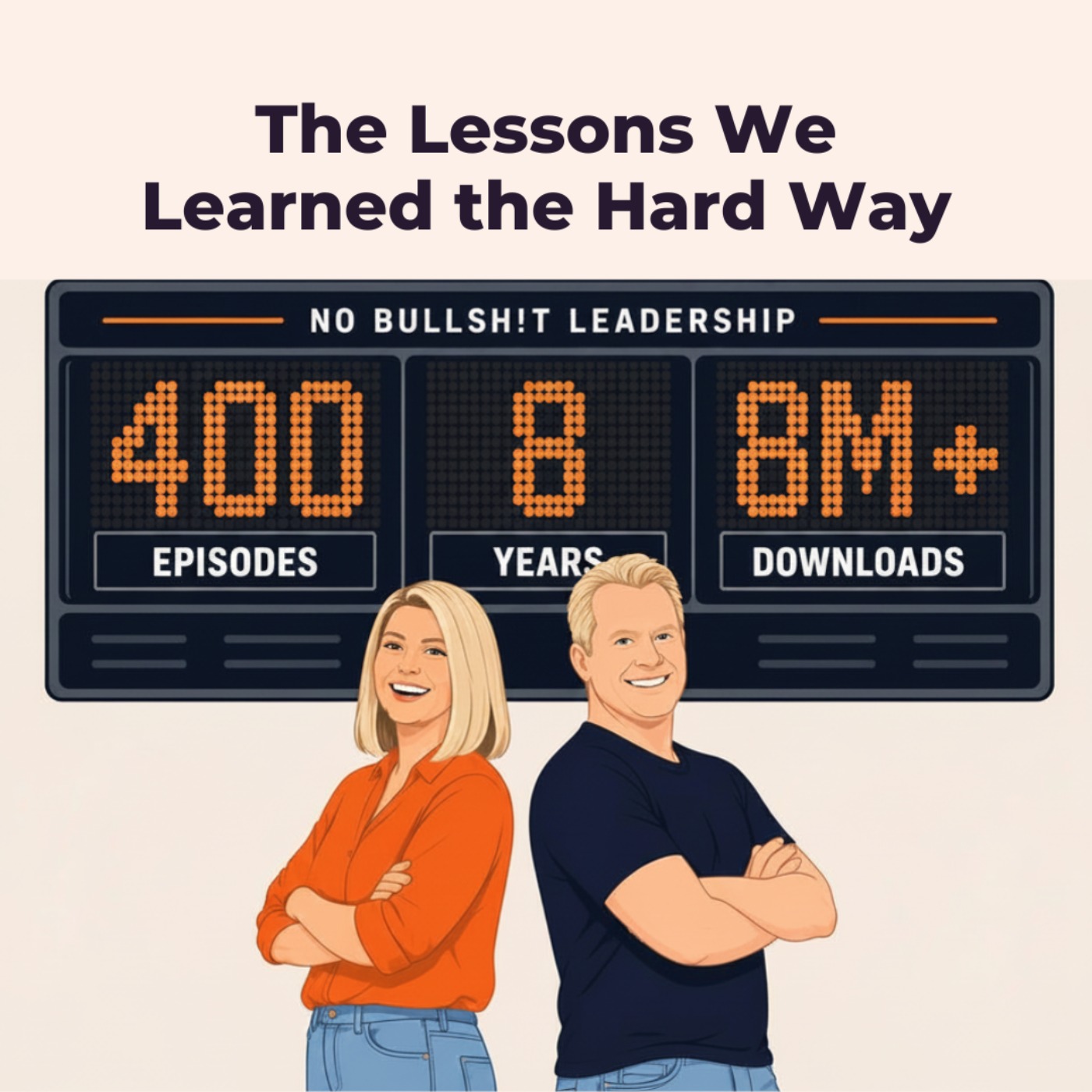
Loading summary
Transcript79 lines
- [00:00]
A
When you start something new, whether it's a business, a project or a podcast, there's always that moment of doubt. Is this the right move? Is it actually going to work? Look, I've been there. And while the uncertainty never fully goes away, having the right systems in place makes a big difference. That's where Shopify comes in. Shopify is the commerce platform behind millions of businesses around the world and it powers 10% of all E commerce in the US from established brands to people just getting started. It's time to turn those what ifs into with Shopify today. Sign up for your $1 per month trial today at shopify.com leadership. Go to shopify.com leadership that's shopify.com leadership After 400 episodes in almost eight years, we're pulling back the curtain on what it really takes to build something that lasts. We're talking about the wins, the failures, the decisions we got wrong and the lessons we've never shared publicly before. From burnout and business mistakes to working as a father daughter team, this episode goes behind the scenes of no Bullshit Leadership and give you the hard earned lessons to help you in your own leadership and business.
- [01:18]
B
Welcome to the no Bullshit Leadership Podcast. In a world where knowledge has become a commodity, this podcast is designed to give you something to the experience of a successful CEO who has already walked the path. So join your host, Martin Moore, who will unlock and bring to life your own leadership experiences and accelerate your journey to leadership excellence.
- [01:41]
A
Hey there and welcome to episode 400 of the no Bullshit Leadership Podcast. This week's episode, 8 years, 400 episodes and the lessons we learned the hard way. What does it actually take to build a top ranked leadership podcast from scratch and and keep it going for 400 weeks in a row? Eight years ago, Emma convinced me to walk away from my role as CEO of a multi billion dollar business to build a micro startup with a simple premise. Give away your very best insights for free on the podcast and trust that the impact will follow. Our purpose became to improve the quality of leaders globally. What followed was 400 episodes, or 570 if you include the short Monday episodes. Eight million downloads, a global audience and more lessons than either of us ever expected. About burnout, about money, about the milestones that don't deliver what you think they will and about what it actually takes to build something that lasts. In this episode, Em and I go behind the scenes of your CEO mentor and this podcast for the first time. Sharing what we got wrong, what we do differently and the moments that meant more than any revenue milestone ever did. So let's get into it. Congratulations. End 400 episodes of no Bullshit Leadership. What a milestone.
- [03:07]
B
Well, the congratulations is to you, Marty, because I have absolutely no bloody idea how you have kept coming up with such incredible content week after week after week after week. You're amazing.
- [03:20]
A
Oh, thanks. We're going to talk a little bit about that today, because even I get writer's block. But the podcast was the basis for starting our business. And when you talk me out of my corporate career to join you in this micro, the first thing we led with was the podcast. And I'll never forget you telling me at the time, dad, we've got to give away your very best shit for free.
- [03:40]
B
Yeah, well, I mean, it worked, right? So thankfully, there is that. It actually didn't take too much convincing once you understood my strategy behind it. But, yeah, it's. Look, it's absolutely the best thing we ever did. We absolutely love this podcast.
- [03:56]
A
Oh, totally, totally. And look, 400 episodes and eight years later, we've both learned a few things over that time. And this episode's going to get to the good, the bad, and the ugly of being in the business of leadership.
- [04:07]
B
Yeah. There have been so many lessons. We've got a bunch to explore. And I remember when I was coming up with my thoughts for this episode, there were so many things that I haven't included. Like, it was actually difficult, difficult to whittle down this list. So. I don't know, Marty, we've. We've brought it down to five principles that we're going to discuss in a little bit of depth so that people just get a, I guess, a real feel for what happens behind the scenes here and the things we've done well, the things that we could have changed and more on our direction moving forward as well.
- [04:41]
A
Yeah, fantastic. And. Well, look, why don't you tee off?
- [04:44]
B
So the first one that I want to go through is that loving the work won't save you from burnout. Creative intensity, it still has a cost. You hear people say all the time, you know, do what you love and you'll never work a day in your life. And I just don't. I don't subscribe to that. Honestly, this is. This is something that I feel like I can speak pretty authentically to because it's happened to me a few times in the business. I. I'd say there's been about three times where I've got to the point where I genuinely wasn't getting joy out of the work anymore. And that's what's interesting about burnout is that it doesn't always look dramatic. There wasn't some big breakdown moment where I said, that's it, I can't do it anymore. For me, it was more just like the wind stopped landing. Something good would happen, something that I would normally be really excited about, or an idea someone would come up with. And I just couldn't get around it. I just felt completely blase about it. Obviously, there's the physical exhaustion. So just being really mentally flat, couldn't focus, you know, really just like my brain had checked out, you know, even though I was still showing up, I was just going through the motions. And so that's one of the biggest lessons that I want to take from, from, you know, this section is that creative intensity has a cost. Even when you love what you do, which I obviously do. The volume, the pressure, the consistency required to run a business like this will catch up to you if you're not managing it deliber deliberately. So it's not a question of if for me, it's a question of when and then whether you catch it early enough to do something about it before it takes you out completely.
- [06:27]
A
Yeah, totally.
- [06:27]
B
Marty, I know you suffered with this towards the end of your US stint. Can you talk a little bit about your creative burnout? Because it's different for us. I'm running the business and you're actually having to come up with original content and work with people every single day. How did that creative burnout show up for you?
- [06:46]
A
Well, I think to give you an idea of what it's like, just imagine if you had to come up with a unique topic that advances the conversation on leadership every single week for eight years. I mean, when I started.
- [06:57]
B
That's so tough.
- [06:58]
A
I know. How many episode ideas did I have on the chalkboard? Like 20.
- [07:02]
B
Yeah, 20.
- [07:03]
A
Not even six months worth, I don't think. And true to the no bullshit leadership promise, every episode has to be practical, it has to be immediately implementable, and it has to be useful. So I never take for granted the time that our audience spends listening to our content. So with so many demands on the time, so many options for where to spend your attention, we greatly respect every minute that a leader spends engaging with our podcast to try to learn to be a better leader.
- [07:29]
B
Yeah.
- [07:30]
A
And for me, behind every 20 minute episode is somewhere between 10 and 12 hours of work. You know, research, scripting, recording, creating the collateral that accompanies each episode. It's a pretty serious commitment on my time in any given week. And this is our free product. That's not to mention all the paid work that I do. So I've got to say, creatively, it can be really challenging to keep coming up with new ideas all the time and presenting them in a way that hits the mark for our audience. We decided early on not to take the easy way out and do a whole bunch of interviews where someone else provides their ip. And it gives our podcasts a level of consistency and integrity I think that very few have. The flip side, of course, is that it's harder to make it interesting week in and week out. I'm very sure there are people out there who, when they hear my voice, they just cringe now. You know, there have been times when I've been completely devoid of ideas and energy for next week's podcast episode. You know, for the last 20 years of my corporate career, I did very little of the detailed individual contributor work. I was leading large teams and other people were delivering results. So getting back into the slot for delivering content on a hard deadline twice a week was foreign to me at the time. And there are still days when I go, oh, far out. What the hell can I talk about now?
- [08:49]
B
And you do it so beautifully, Marty, because you never go to me, you know, I can't think of anything. Or there's very rare times where you'll say, okay, I'm thinking about this. This topic or this topic. You know, where would you lean? What do you think people in our community would be more interested in? There are some times when we go back and forth on stuff. You really do take the creative brunt of that, and it is quite amazing what you can do with it. So, yeah, I think the creative burnout is real, and we have had to learn over these eight years how to recognize when that's happening and then obviously do something about it so that it doesn't impact the business.
- [09:27]
A
Oh, totally. I mean, even the simple things, like some days I know I'm just not on, and I'll have on my schedule that I'm going to script a podcast episode and I'm just not on. So I just drop it and say, that's going to wait till tomorrow because it's going to be better if it does.
- [09:40]
B
And it'll take you half the time.
- [09:43]
A
Exactly. Exactly.
- [09:44]
B
All right, I'm going to go on to lesson number two. So the lesson. This one's a really interesting one because one of the things that people ask us about more than anything else is how you and I actually work together. So this one is all about clarity of roles and harmony in relationships. I think there's a certain sense of, I guess, curiosity about whether a father daughter business partnership can really function well. And the honest answer for us is yes, but not because we agree on everything. It's probably more because we don't. And I think some of the best partnerships are built on defined tension, not agreement. So we're not just yes men to each other. When two people in a business agree all the time, that is not alignment. That's a blind spot waiting to happen. So what we have is really clear accountabilities and ownership. Who owns what, how decisions actually get made, and where we push back on each other and why that friction is actually useful. Because, you know, alignment isn't sameness, it's clarity.
- [10:47]
A
Could not have said that better myself, Em. And one thing I will say very, very interesting. One of the very few interviews we've done on this podcast was with Patrick Lencioni. I remember him talking about working with his family as he does in his business. And we had a great conversation about the difference between just having a family style culture and working with people who are all in. And you and I are all in on this business, and that's why it works and why everything that we do is not governed by father daughter dynamics and relationship, you know, nuances from the past. You were actually a pretty well behaved teenager, despite what everyone says about you. But it did, it did find us a little while before we found our rhythm with how we work together. So when we started, you recall, we didn't have a clear CEO role because our demarcation was just so obvious. I was doing content, you were doing marketing, and that was really it. But it wasn't long before you realized that someone had to take the running on the core business decisions, and that was you. So contrary to what most people might think, you are the chief executive of your CEO mentor and I'm just the content guy. Or as you say, just talent. Yeah, that's. It's a bit of a stretch, but yes, I'm the talent. That's sort of interesting given my background as chief executive of a multibillion dollar corporation. But it's the right way to separate our accountabilities in this business.
- [12:12]
B
Yeah, well, I've got to say, stepping into the CEO role here was not something that I had a roadmap for. Obviously, I hadn't been a CEO before, and on top of that, one of the people that I was leading was my dad, someone who had actually been a CEO at a scale Most people never get near. So there was definitely a period of figuring out, like, what that actually meant in pract. It wasn't like I was handed a title and suddenly felt the authority rushing through my veins that came with it. It was definitely more gradual than that. So, you know, taking the running on decisions, backing myself when I had a different view, and learning that leading you didn't mean overriding you, it meant being clear about where the accountability sat and having the confidence to own it. I would say we work together pretty seamlessly. I do have the odd childish spat every now and then, but, you know, you really have a huge amount of trust in me. Is ever fatal. But I do still feel a lot of pressure to get it right because I don't want to disappoint you and screw up your legacy. I was the one that convinced you to leave your job. So I've got this chip on my shoulder which I use for good. You know, that is something that really drives me. It's not the pressure that you put on me, it's the pressure that I put on myself to do a really amazing job with this business.
- [13:31]
A
Yeah, it's interesting because I really see that pressure on you as much as I try not to put it on. But then again, I don't step in and relieve you of that pressure because it's driving you for being a much better CEO. So I'm letting you wear the brunt of it. Don't you worry about that. We're very different in the way we work, and I think each of us brings our own strengths. So you are highly innovative, always looking for new ways to do things and new ways to add value. I am so much more conservative in business and try to focus on the simple things that make a difference because I'm all about risk management, and I think that's a really good balance to have in a relationship like ours.
- [14:03]
B
Yeah, I hate to say it, but I think those style differences are actually probably what makes us work. Because if I'm honest, left to my own devices, I would probably be constantly chasing new things. Maybe not now, but, you know, maybe four years ago. Say, you know, I, I, I absolutely love creating and innovating and thinking about how can we deliver better experiences to our community. And that can sometimes take my eye off the main game. So I think without your conservatism as a counterweight, we'd likely be pulling in a bunch of different directions and not executing any of them particularly well. Yeah, I think equally I bring an energy and a willingness to experiment that stops us from just doing what we've always done, because either it's worked before or maybe I've seen someone else in our industry do it. I'm very much like, blinders on. We just do what we think is the right thing to do, but neither of us has the full picture on our own. The combination is genuinely better than either of us individually, and I think that's only possible because we know exactly where our lanes are. And, yeah, we're just. We're not competing with each other. We complement each other.
- [15:16]
A
Yeah, I think it's absolutely right. Of course, given the fact that you're so keen to sell me for many things, if I didn't pull you back, I'd be booked for 219hours of client work every week. So I've got. I've got to draw the line somewhere.
- [15:29]
B
It's not my fault that people want you, Marty. All right, that's. That was the whole point of me running this business.
- [15:35]
A
I know.
- [15:36]
B
All right, let's go on to lesson number three. Lesson number three is question everything, especially what's working. Success is actually where the danger lives, I think, here, because when something is working, your natural instinct is to protect it, to optimize it, to keep doing more of it. And for a lot of the time, I do think doing more of what is working is a really good motto, but I think that's usually when you stop asking the harder questions. A lot of businesses that plateau, they aren't usually the ones that failed at things, they're the ones that got really good at something and they just kept doing it even as the market moved or better opportunities emerged because they just couldn't bring themselves to challenge what was already working. So for us, that means constantly reviewing the data, rethinking how we deliver, and genuinely asking whether something should still exist, not just how we can do it better. And this has been a really big lesson for me this year.
- [16:33]
A
It has, yeah. And look, we've tried a bunch of stuff over the years. I'd say, all things being equal, the majority of it has worked, but we've still had a few epic fails. I think one of the good things about both of us is we don't get too carried away with our successes and we don't get too despondent when we fail. We realize that both of these things are going to be part of a thriving business and you can't have one without the other, genuinely. So, like I used to say when I went skiing with my mates back in the day, if you never fall over. You're just not skiing hard enough.
- [17:02]
B
Yeah, absolutely. And Marty, I'd like to just go through a few examples from our business, because I think this is way more useful than just talking about it in theory. So when we talk about, you know, wins and losses and what's working and what's not, the podcast is our clearest win. And I think what made it work wasn't luck. It was a deliberate choice to do something different. So as you mentioned, not an interview show. It's original thought. Short episodes packed with value. The format was the decision and the consistency behind it was a commitment. Over 8 million downloads and still growing. That's the proof point that tells me that we got that one right. Okay, so that's the podcast.
- [17:37]
A
It isn't just a put those 8 million downloads in context. We don't see it as a vanity metric. So in the world of social media, you know, you can put an Instagram reel up and get 10 million views, you know, quite often. We've done that a few times, but this is really about 8 million opportunities for a leader to learn something that takes them in a different direction, that lets them do something different, the way they lead their teams and to become a better leader. And that's completely different. Having someone like your real.
- [18:05]
B
Yeah, 100%. And we have every single week we've got a podcast spreadsheet we call, call it potty spready in our Google Drive.
- [18:14]
A
My favorite Twitter.
- [18:15]
B
We put the numbers in. And so, yeah, it's, it's amazing. We actually take the time every single week to go, okay, that's how many people we were able to reach this week. Let's keep going. You know, it makes us feel really good. Okay. The second one is leadership beyond the theory. So this is our nine week leadership program. It's the other one that I'm really proud of. Every cohort gets bigger, and over 25% of each cohort now comes from referrals. So not marketing, not ads. Although obviously we do, you know, heaps of marketing and a lot of ads. But the referrals is the thing that means the most to me. This is what tells me that what we're doing is the right thing. Because someone does our program, they get a result, they go back to their organization and say, hey, we need to get our leaders through this. And that is a signal that something has genuinely hit. Like, you can't manufacture that. You can't. I suppose you can pay people for referrals, but it wouldn't be a very profitable Business. So those are. Those are kind of two of the things that I think we've done incredibly well over the eight years.
- [19:13]
A
Funnily enough. The first two things we did.
- [19:16]
B
Yeah, the first two things we did. Yeah, exactly. Something in that. Right. The misstep. So I tried Evergreen courses a couple of years ago. So shorter, cheaper, more accessible courses that I thought people wanted. And if I'm really honest, I was just a little bit bored of the marketing of Leadership beyond the Theory. And I was just distracting myself. I took my eye off what was actually working, and I chased something that pulled me away from Leadership beyond the Theory. They did not land the way that I hoped. We had a big gaping hole in our P and L that year, and in hindsight, it was a shiny object that I should not have been following. But, hey, lesson learned.
- [19:55]
A
Yeah, that's okay. We lived through that one. That was good.
- [19:58]
B
And this last one, this one that I want to talk about, this is really question everything, especially when it's working, because this program is working. So the Business Accelerator program, it's a program that we run for CEOs, and it is genuinely one of my favorite programs that we run.
- [20:15]
A
Mine, too, without a doubt. Absolutely.
- [20:17]
B
Yeah. Just the relationships, the depth, getting right inside someone's business and helping them move forward. Like, I love it, and I know you do, too, but the reality is that it's not our most profitable product by far. We completely go above and beyond for delivery, which means it costs us more to run than we really account for properly. And a couple of weeks ago, I made the really hard decision to pause it. So, you know, obviously we keep our current clients, but we're not taking on anyone new. And it honestly felt like killing off one of my favorite characters on a TV show. Like, remember when Glenn got killed off Walking Dead and I stopped Ned Stark
- [20:55]
A
at the end of season one of Game of Thrones?
- [20:58]
B
I know. That's exactly. And it was emotional for me. I was down. I had the blues for a couple of weeks. But when I strip the emotion out of it and ask the real question, is this going to help us achieve our goal of helping more and more people as this AI Era rolls out? Which is obviously, as you guys know, I talk a lot about AI that's one of my key focuses this year. The answer is no. And we've got other projects that need our time and our focus to execute really well, and those deserve the space. So that's what questioning everything actually looks like in practice. It's not just the stuff that isn't working. Sometimes it's the things that you love the most most. And so, yeah, I think the key point here is, like, most businesses plateau because they protect what used to work. The discipline that I've learned over the last eight years is being willing to look at your best performing your most loved things and your shitty ones and just still ask the hard questions of everything, even if the answer hurts. Like it did for me with the business accelerator program.
- [21:55]
A
For sure. I think we came to that conclusion at roughly the same time, but I think I was sort of pushing.
- [22:00]
B
No, you were sooner. You were sooner. You knew it was dead. And I just kept trying to resuscitate it.
- [22:06]
A
Yeah, it's. It's okay. But for that amount of our focus, the percentage of time it takes from us, we need to have much, much greater impact than that. Even though that's. It's the work we love the most.
- [22:16]
B
Yeah, it's. It's tough one. But hey, we're talking about lessons on this episode. And that is. That's one that's hit me hard for sure. Okay. Number four, Global sounds sexy, but it's operationally hard. And I will live and die by the fact that the distance amplifies every weakness.
- [22:35]
A
Yep.
- [22:36]
B
I think there's just this idea that going global is the ultimate sign that you've made it. And in some ways, for us, like it, it is. You know, 8 million. Over 8 million podcast downloads, listeners in almost every country. A book published in the U.S. market, Wall Street Journal, bestseller, yada, yada, like, that's real. Right. But what nobody tells you is that distance amplifies every weakness in your operation. And we got to deal with that firsthand. When you moved to Boston, what, probably five years ago now?
- [23:06]
A
Yeah, 2024. 2021. Yeah. For four years. Yeah.
- [23:10]
B
Yeah. So I think, you know, working across countries, time zones, and context means that the things that we could once fix with, like, a really quick conversation, like, they just started taking half a day. The communication, it has to be so much tighter. Our standards had to be so much more explicit. And the alignment that I think I took for granted when I was in, you know, we. I live in Sydney, you live in Brisbane, so we're not exactly, you know, neighbors, but just that, that ability to be able to work together when we needed to and talk immediately if we needed to, like, you had to engineer those opportunities deliberately. And I found that really difficult.
- [23:56]
A
Yeah.
- [23:57]
B
There's also a tension that I sit with personally, which is that I genuinely believe in the power of in person connection. I think we're seeing that a lot now with. With the rise of AI, but for performance, for relationship, for that kind of energy that moves things forward quickly. The reality of running a global business is you just don't always get that, and so you have to figure out how to maintain the standard anyway. And I struggled with that, to be honest.
- [24:23]
A
Well, for sure. And you need a big engine to drive a global business, which is why, you know, it doesn't lend itself to micro businesses like ours. I mean, still, what a fantastic adventure the US Experience was. It was not the most profitable move we've ever made, but it was awesome. And the decision to publish the book over there was excellent because it gave us global reach. Trying to grow into a market like the US Though, just in terms of marketing penetration, it's difficult. Like, it's a big market. And even with a globally successful podcast, it was a tricky proposition. So one thing we did learn is that Americans still hate naughty words. Now, given that most of my speaking was in the corporate market, I was completely blindsided by how many companies balked at the idea of someone being invited to speak at their conference who used the word bullshit. And even though I'd say, hey, Look, I do PG13 speeches, I don't swear from the stage. Don't you worry. It was amazing how many clients said no to my bureau agents because the fact that my LinkedIn profile and the podcast had the word bullshit in the them. So now the majority of our podcast listeners are in the U.S. which is ironic, with Australia a close second.
- [25:33]
B
Yeah, our clients are spread across Australia in the US Primarily. Those time zones are quite decent. And we've got a growing group in the UK and Europe, which is a little bit trickier. Obviously.
- [25:44]
A
It is. Yeah.
- [25:45]
B
I think working across the time zones is manageable once you find your rhythm and you can kind of figure out, okay, the windows that work, and you get more disciplined in your communication and it becomes normal. When you were living in the US that was a different experience for me because it was like, I just really missed you, to be honest. We went from being, you know, a phone call or a text away from each other, which is what we are now. And you got to remember, like, I. You and I lived together when I was, whatever it was, 13 to 18. So we're used to just being in constant contact to being in completely separate worlds. So when I was working, you're asleep when you're in your day. I was winding down, and. And what I noticed was that we almost stopped building the business Together, we were just doing our own thing in our own silos and then catching up when the time zones allowed. And I think that might sound more personal than operational, but I actually think it is operational because so much of what makes our partnership work is the informal stuff, the quick conversations, the gut checks, the ability to think out loud with someone who knows the business as well as you do. When you lose that, that you really feel it in the work and the relationship. And I'm sure anyone who is working in a dispersed team or a global team can. Can lock into what I'm feeling right now. The lesson. For me, it wasn't just about tightening the communication process. It was about recognizing that proximity has real value. And then when you can't have that, you have to be incredibly intentional about replacing what it gives you. Otherwise, you're not, you know, we're not really business partners. We're just running parallel business units and hoping that they stay aligned. So that's. That was, you know, one of my biggest lessons for sure, about proximity and how we push this business forward, because I think it did plateau for a little while in that sense, because we were just getting through the work rather than building.
- [27:41]
A
Yes, I think that's absolutely right, Em. I completely agree with you. So, yeah, why don't you go on to the final one? Milestones don't give you what you think they would.
- [27:52]
B
Yeah, Marty. I think every founder has a version of this story. The milestone that was supposed to mean everything, and then it didn't. You know, you've heard that story a hundred times, but you almost have to experience it, I think, to actually understand the reality of it. So for me, it was. It was revenue, I thought, you know, way back when, when we hit a million dollars, I was like, you know what? I'm gonna go out and buy this Chanel watch. When we hit a million dollars that I love like that, you know, I'm just gonna. Going to feel so good when I do that. I just thought a switch would flick and I would have this moment of like, yes, we're a real business. We made it. And I just didn't. I didn't feel anything. Like there was a beat of satisfaction. And. Yeah, then almost immediately, my brain moved to the next thing. And then the same thing that we hit when we hit 2 million happened again, and the goalpost just kept moving, and the feeling that I was chasing it just never arrived. And so on and so forth, year after year after year. And. And I really just think that's worth saying out loud because A lot of people are running hard towards a number, thinking that it's going to give them something. This isn't just business owners. This is, you know, Your salary is 100 grand and then it's 200 grand and then 300 grand and it's 400 grand and then it's 800K. And you're still, you know, you're not. You never feel that. That rush that you think you'll feel. You never feel that satisfaction that you think you'll feel. And for me, it was like, you know, I was probably searching for a sense of legitimacy or security or proof that I'd actually done it. But yeah, it just, it. I didn't get that feeling from what I thought I would. And yeah, not, not in any kind of lasting way.
- [29:38]
A
Yeah, I, I get that. M. And look, to be fair, right at the very start of our business, we use the mantra income follows impact. And we always knew that if we had a really big impact in the world, we'd make money and vice versa. If we didn't, we wouldn't. So to that extent, we absolutely got that right. But what's the right amount of money to make when you're having so much impact on a global basis? In my head, if our business generated over 20 million a year, I think that would be relatively meager compensation for the impact we're having when I look at what people make in the corporate world. But there's still only so much we can do with the resource constraints of a personal brand business. There's only one of me. There's only so much I can do in a productive, revenue generating sense. So, of course, the very worst use of my time is speaking, which is why we've scaled that back in the last 12 or 18 months or so.
- [30:26]
B
Yeah, look, I do take responsibility for talking you into joining one of the most crowded markets on the planet. Leadership development, personal branding and podcasting, especially with AI, it's just going bloody crazy. There are zero barriers to entry. Millions of people doing it. So look, if we're measuring against the competition we walked into, maybe the revenue milestones deserve a little bit more credit than I'm giving them. But what I'm saying is like, the feeling isn't there, you know, and that was it. I was just surprised by that as the years went on. The. The things that actually make me feel good are not the things that I thought I would when I started the business. It's not the numbers, it's the moments. So we did a live event a few years ago. And a leader who'd been through Leadership beyond the Theory came up to us afterwards. And he was emotional, like he was genuinely in tears. And he told us that he and his partner had both been made redundant a while back, and that the program, the podcast, and everything that we'd put into the world had given them the confidence and the tools to go and back themselves and go after better roles. And they actually did. And they are now absolutely living their best lives. And just standing there listening to that, I felt more than I ever did hitting a revenue milestone. And then there were the emails in the dm. We get them weekly. And even last week, I was reading a message from someone who was saying that through listening to our podcast, they had taken some great things. They had then gone on to do Leadership beyond the Theory. And they said my family wouldn't be where they are today. My life would look completely different. I'd still be wondering how to move my life forward and reach my potential. When you hear that kind of stuff, when you understand that something that you've built, guilt genuinely change the trajectory of someone's life, that's what lands. Not the money in the bank, not when I log into nab. I don't care about that stuff. But the feelings that I get when I read those things and when people tell us, that's the impact that I didn't expect that we do get. Of course, I still read every email, every DM that gives feedback on our content that. That really we can make more of what people are loving and less of the boring ones. Marty.
- [32:46]
A
And I don't mind seeing the trolls either, because we do get the occasional troll on social media. And. And as I said at the start, the first time we got trolled, I called you up joyfully and said, we're obviously doing the right thing because we've really pissed someone off enough to get them off their ass and to make a comment on one of our posts. We are winning. This is going great. We're right on track. Exactly.
- [33:05]
B
Yeah, we've made it 100%. So I don't know, somewhere along the way, that shift happened for me from chasing the revenue goals and proving that I'd build a serious business. You know, what people thought of me to really just chasing those impact goals. And honestly, I think that's made us better at both, you know, because, like, when the why is so clear, the work has a different quality to it. And that's really what we've been chasing, you know, for quite a few years now.
- [33:34]
A
Yeah, exactly. And I think I've been at my best when I've been right in that zone, and I haven't been at my best when I've let myself drift away from it. So I think that's. That's definitely the key point, Em. And I think we always had that goal of having maximum impact in the world. But having said that, I'm probably a little more impact driven than you, just based purely on our respective ages. So I'm at the twilight of my career, clearly.
- [33:56]
B
I'm building. I'm still building.
- [33:58]
A
I know you're going nuts. And I still want to make as much of a mark on the world as I possibly can before I pack it in or before life packs me in.
- [34:05]
B
In.
- [34:06]
A
You obviously have a lot longer Runway. And you also have to think about my beautiful granddaughter Florence, who's only three years old. And this is why having impact is critical. And we know that that's what leads to the financial rewards that come through. But you only go into business for two reasons. To make money and have fun. We're still having fun and still making great money. But how do you balance everything? I mean, it's really hard. We could make more money by being less personalized in the products we deliver, but with the future of AI, personalization and connectedness are going to be the differentiator between us and the robots.
- [34:42]
B
Yeah, I couldn't agree more. I think it's just striking, that perfect balance between real human connection and then also moving with the times of AI so that people have what they need at their fingertips. We're actually having a lot of fun building an AI product at the moment that hopefully we'll be able to share more information, more info with you guys on the podcast soon. But I think it's going to be a daily companion for every single person who listens to this podcast. So, super excited about that.
- [35:09]
A
Yeah, sounds. Sounds awesome. And I actually know what that is too, Em, so I'm.
- [35:14]
B
For once, you're in the loop.
- [35:16]
A
I'm skeptical because I think the slop that AI writes is absolutely heinous. And even though I use it for research and stuff enough, I can't stand the writing. I have to throw it away and rewrite again. But this is only a point in time, right? It's only because it's immature. In a year and two years, it's going to be so much better. And once you've got it trained on all of the, you know, hundreds and hundreds and hundreds of hours of content we've got out there, it's going to be pretty spectacular.
- [35:41]
B
Yeah, I'm bullish on AI. Anyone who's in any of our programs, we're just always doing, you know, extra bonus sessions and extra bits and pieces around AI because I'm a practitioner. But I also want to make sure that, that the leaders in our community are the ones who are keeping their jobs, getting better jobs, feeling really confident as we go into this AI. I don't even know what to call it. Revolution era, I don't know.
- [36:07]
A
But definitely revolution. There's no doubt about it.
- [36:09]
B
Yeah.
- [36:10]
A
All right, so that brings us to the end of episode 400. 400 episodes in. If you're listening to this and you've got any value at all from a no Bullshit Leadership episode, could I please ask you to leave us a rating or subscribe to the podcast or follow us on Spotify, whatever your favorite platform, so that we can reach even more leaders. As you know from this episode, we are all about impact. I'm really looking forward to next week's episode. Consistent leaders get better results. Until then, I know you'll take every opportunity you can to be a no Bullshit Leader.