Loading summary
Transcript3 lines
- [00:00]
A
When we started this podcast, we had to figure out a lot of it on our own, which was pretty daunting at times. When you're starting off with something new, it seems like your to do list just keeps growing and it can begin to consume every waking moment. Finding the right tool that helps you out and simplifies everything can be a game changer for millions of businesses. That tool is Shopify. Shopify is the commerce platform behind 10% of all e commerce in the US from household names to brands that are just getting started. Shopify is also packed with helpful AI tools that write product descriptions, page headlines, and even enhance your product photography. Get the word out like you have a marketing team behind you. If you're ready to sell, you're ready for Shopify. Turn your big business idea into With Shopify, sign up for your $1 per month trial and start selling today@shopify.com selling leadership go to shopify.com leadership hey there and welcome to episode 372 of the no Bullshit Leadership Podcast. This week's episode Has AI Already Made Consultants Redundant?
- [01:07]
B
Welcome to the no Bullshit Leadership Podcast. In a world where knowledge has become a commodity, this podcast is designed to give you something more access to the experience of a success, successful CEO who has already walked the path. So join your host, Martin Moore, who will unlock and bring to life your own leadership experiences and accelerate your journey to leadership excellence.
- [01:30]
A
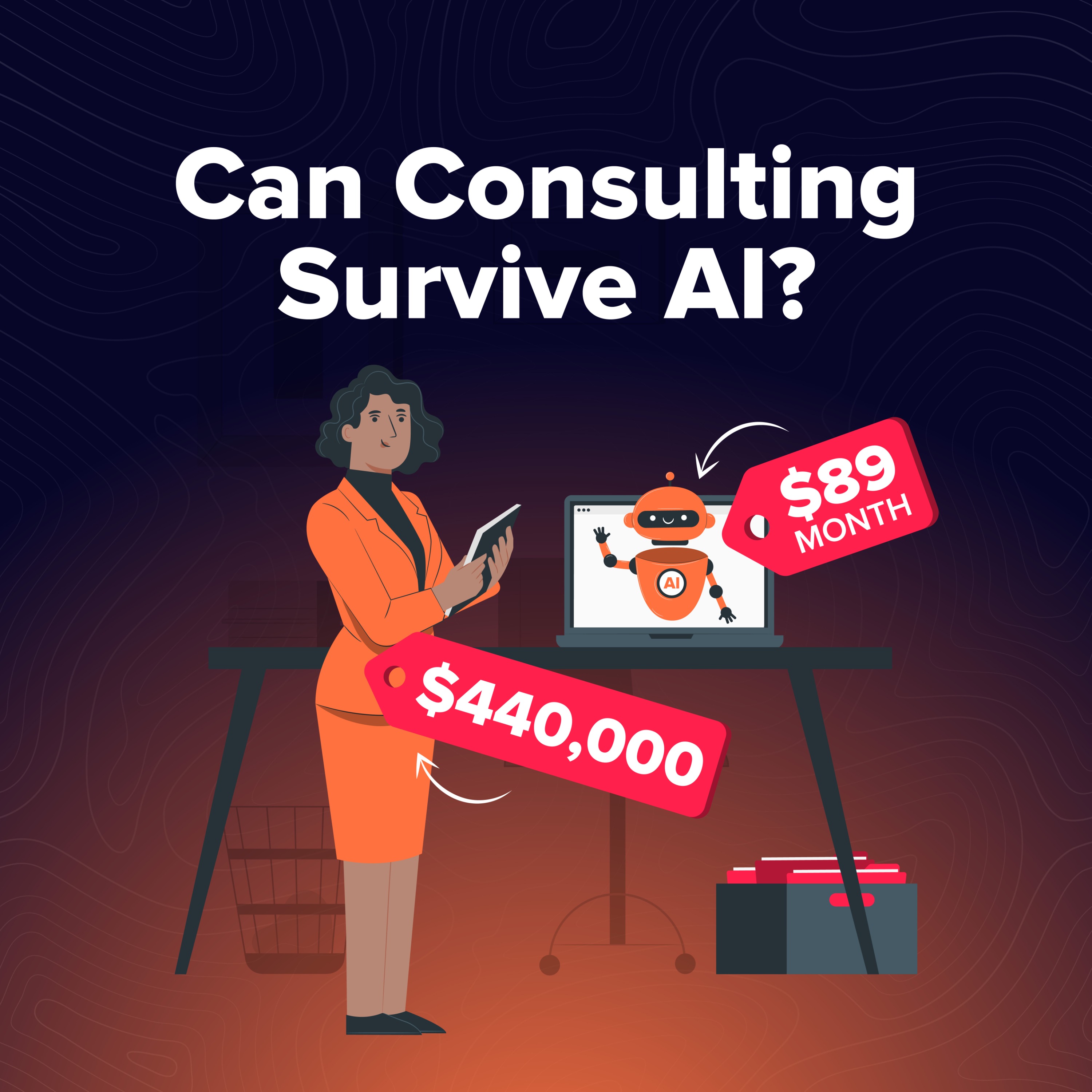
Of all the industries that are on the chalkboard for major disruption by AI, the consulting sector must be high up in the batting order, along with accounting and legal firms. So wouldn't you think that right now consulting firms would be keener than ever to demonstrate their value and extend their longevity? Anything they could do to prolong the mystique that surrounds what they do would probably be worthwhile, right? Imagine my surprise then to read about the report that Deloitte submitted with a straight face, apparently to the Australian Federal Government Department, which had been largely generated by AI. There it was in all its glory, resplendent with phantom references, typos and AI hallucinations. And they charged the client $440,000, a sum of money which no doubt quickly succumbed to the gravitational pull of the partner's bonus pool. All courtesy of the Australian taxpayer. Let's face it, when you hire a consulting firm from the big end of town, you expect to be buying high end analytical skills and a level of process discipline that ensures the highest quality of output. I'm not one to delight in others misfortune and you probably know me by now. I Don't jump on collective outrage, but this public relations nightmare may be a distant early warning for the consulting industry. The shape of things to come in an AI driven world. If nothing else, it begs the question, do we still need consultants? If consultants are just using the same AI tools that, despite their obvious drawbacks, are available to all of us? I'll start with a quick recap on the Deloitte situation. Then I'm going to explore a really interesting article from the Economist, and I'll finish with my bold predictions. Three areas where consultants will stay ahead of the AI game and three areas where they're likely to be under threat. So let's get into it. I don't like to be critical of anyone based purely on what turns up in the media. I'm acutely aware of the fact that I'm not in their shoes, and I've been on the wrong end of media reports often enough in the past to know how prone they are to basic factual errors. But in this case, neither Deloitte nor their hapless clients are disputing the facts. Even the most generous interpretation of the evidence casts Deloitte in an incredibly unfavourable light. Not to mention the breathtaking incompetence of the government department that commissioned the report and then greenlit the next phase of the Deloitte engagement after being fed the tripe that was the initial report. The Australian Financial Review produced a number of excellent articles analysing the Deloitte train wreck. I'm not going to go into them here, but we'll leave a link in the show notes for those of you who can get behind the AFR paywall. There's a range of interesting angles and the sub editors seem to have had a lot of fun coming up with the headlines. Deloitte to Refund Government admits using AI in 440k report the cautionary lessons of Deloitte's AI sloppiness Deloitte blamed transcription issue for flawed AI report and my favorite AI scandal not enough to stop Canberra's addiction to Deloitte. Now, I must say the commentary on this is slightly disheartening. There are all sorts of experts coming out with helpful tips on how we should adapt our approach to AI. Based on this cautionary tale from Deloitte, there seems to be a focus on regulating how AI is used. Now, by that I mean small R regulating as in establishing corporate rules for AI. This includes being upfront about how and where AI is being used. Can keeping a human in the loop and having better fact Checking processes. Well, okay, but for me, this misses the point. One of the AFR articles I just cited suggests that the consulting industry is going to remain relevant because there's no replacement for human cognition. Hmm. Okay, well, that's interesting. One of the main selling points for consultants in the past has been their ability to leverage data sources and knowledge from their global client footprint that a single firm can't acquire on its own. It looks suspiciously to me as though AI is already leveling this playing field. For example, how much did Deloitte's consultants rely on their own smarts? How much did they rely on the accumulated wisdom of their global knowledge base? How much did they rely on the IP of their internal processes? How much did they rely on their boilerplate solutions? How much did they rely on the information in front of them, the customer's actual context? And how much did they simply subcontract their work to Claude and Chad. That's Chad GPT. Of course, now it's true, as we stand here today, there's no replacement for human cognition. But armed with the right data, companies are going to be able to lean more heavily on the cognition of their own people. Why pay a middleman to prompt an AI GPT when you can do it just as effectively yourself? For free Consulting has long been a bellwether for corporate health and economic confidence. It signals availability of capital, companies appetite for growth, and a willingness to invest in strategic change across all sectors of the economy. And even in lean times, when consulting spend appears to contract, there are still plenty of companies hiring consultants to help them cut costs, restructure, and even improve operating efficiencies. The irony of this one isn't lost on me. Some companies spare no expense in the quest for a lower cost base. But in the last 12 months or so, some of the top consulting firms in the most lucrative markets have been shedding staff and slowing their talent pipeline by drastically reducing graduate intakes. We're probably not going to see the impact of this in their financial results for another year or two, but it's. It's clear that the decline has commenced long before the Deloitte debacle became public. An interesting article appeared in the Economist looking at the erosion at the very peak of the consulting business. It was titled How McKinsey Lost Its Edge. The article makes a number of points about the decline in McKinsey's business model, much of which has nothing to do with AI. But the conclusion the author makes on AI towards the end of the article is foreboding. Here's a slightly modified quote from that article. Eventually, the AI revolution may come for McKinsey as well. Strategy projects combine deep cogitation with a good deal of grunt work. Consultants must comb through spreadsheets and Prepare reams of PowerPoint slides in order to make their recommendations look as robust as possible. Before long, a bot may be able to do a good chunk of that. After all, plenty of consultants already sound like a bot. Classic economist writing. I love that. At first, that may be advantageous for McKinsey. McKinsey's technology chief says that AI will make its teams faster and better. Sooner or later, though, clients may start to wonder why they are paying such enormous sums when much of the work is being done by technology that they could use themselves. I think that the slowdown at the premium end of the consulting market is the canary in the coal mine, and the consequences will be far reaching. Many top leaders in industry were shaped by their early consulting roles. Having done this myself, I can speak really highly for the rapid growth that a stint in the consulting firm can produce. And in fact, many of the world's top executives are alumni of the MBB firms. That's McKinsey, Bain, and BCG. At the time the article was published, 36 CEOs of Fortune 500 companies came from the MBBs. So what happens when that talent pipeline dries up? Today's partners were once consultants, plucked from the best universities in the land. They learned their trade from their peers. They became engagement managers and associate partners before they got the keys to the executive washroom. However, if the future is a world where AI does the low end repetitive grunt work, how do people learn the ropes so that they can ascend to a level where human cognition still has currency? And if the top consulting firms don't have this development pipeline, will their senior people provide sufficient value to justify their astronomical fees? Where are consultants still likely to offer value for money? Well, I produced an episode about consultants around three years ago now. It was episode 220 management consultants are they Worth It? And I'll leave a link to that in the show. Notes this was obviously before Generative AI, in a long forgotten time, before Claude and Chad were even born. This was a bumper episode where I covered a massive amount of ground. Having reviewed it this week, I can confidently say that it's a complete guide how to understand and engage the different types of consultants. Part of it was a breakdown of the consulting market with an overview of which consulting firms do what type of work. The market has a number of tiers. The mbbs are the Pinnacle in terms of both capability and price, then you've got the big four, of which Deloitte has one. You've got Deloitte EY, KPMG and PwC. There are the consultants that are more technology oriented firms like Accenture and Fujitsu and IBM. There are highly specialised firms like those that do economic modelling and forecasting. And then there are the millions of small consulting companies where the individual is the company. I explored the three compelling reasons why you might consider hiring a consultant. The first is a lack of capability. The second is a lack of capacity. And the third is a lack of independence. If you lack capability, particularly in an area that's either a one off requirement or in an area that isn't part of your core expertise, consultants can be highly valuable. They don't just bring extra smarts, they also bring access to the intellectual property that they've acquired by working with other clients like you in many different industries and markets. Used wisely, this is a really good reason for bringing in a consultant. It's fair to say that AI is making this particular value proposition a lot less compelling. If you lack capacity, this can offer the opportunity to scale without having to increase your underlying cost base. The ability to flex your capacity with capable resources who can focus on a specific task for a finite period can be a really effective way to solve a problem as long as there's a clear path to value delivery at the end of it. In a world where AI dominates, this is going to remain a potentially effective investment. And thirdly, if you're looking for an independent opinion, consulting firms can still bring that to the table. Bearing in mind, of course, that many consultants just feel the direction of the prevailing winds and and tell their clients exactly what they want to hear. Aside from that, independent advice can be extremely useful for things like financial audits, where a board or investor community needs to have confidence on the numbers being produced by management. Independent peer review of major investment proposals is another great way to use expert consultants to provide independent advice. Boards love to appoint independent consultants to report directly to them and and give feedback on what's going on in the parts of the company that they can't necessarily see. They provide a level of comfort that management is actually behaving themselves. All right, where are we? I think that AI is clearly going to erode that value proposition for using consultants to bring an injection of capability. Much of this work is going to be driven internally soon enough because the type of knowledge that the top firms used to call IP will be truly commoditised. But the use of consults for other reasons, to augment internal capacity and to provide independent scrutiny of management will probably survive the pressure of AI, at least for now. In episode 220, I gave my top 10 traps for young players. I'm not going to go into those here, but I'd highly recommend you review those before you consider engaging a consultant. It could save your company a shit ton of cash. In fact, it'd probably make that $440,000 Deloitte haul from the federal government seem like chump change if you get a consultant engagement wrong. Instead of that, I want to give you my top three areas where I think consultants are still going to hold their value, and three areas where their value may already be under threat from AI. Lets start with three areas where I suspect that hiring a consultant will still potentially pay dividends. The first area is operational efficiency. When you want to drive operational improvement, as I've done on several occasions in the past, you need experts from outside to come in and place some scrutiny over what your people are doing, to watch the people work and to talk to them about what they do on a daily basis to work out how much of the current inefficiency is attributable to genuine obstacles and how much is just an excuse to cling onto the status quo. You need humans to do this type of work, at least as it stands today. The second area where consulting is still going to thrive is digital disruption and technology integration. Now, ironically, the same consultants that face being disrupted by AI will be the ones who guide their clients organizations on how to implement it. When it comes to digitization, it's a complex ecosystem of people, processes, systems and politics. This is a space where external advice from smart people is still going to be required in order to build effective change management strategies. I think this type of advisory work is also pretty safe for the moment. And the third is when you need a comfort blanket. There are still many boards, particularly enlisted companies, that want the comfort of a big brand to help them justify the really big decisions. Whether it's engaging Heideggen Struggles or another one of the shrek firms to conduct a search for a key executive role or a McKinsey team to help develop your strategy, the comfort blanket of a big brand to support management actions is sometimes as much an insurance policy as anything else. It reminds me of the incredibly effective marketing campaign that IBM ran in the 1980s targeting chief information officers and chief technology officers. The tagline was no one's ever been fired for buying IBM. Now let's take a Look at the three areas where hiring a consultant is likely to lose its lustre as AI becomes more ubiquitous. The first is audit and compliance. The vast amounts of manual labor that are currently required to undertake financial audits is likely to be shifted to AI. Not only will this remove a lot of work traditionally given to consultants who undertake this compliance work, typically the Big four, but it's also going to reduce dependence on offshoring. The concept of having 100 qualified accountants in an office in Manila, even with the cost advantage of labour arbitrage, will begin to look less attractive as AI learns how to crunch the numbers. The second area where consulting is going to be in decline is capital efficiency and investment analysis. When I think about what goes into a really good investment analysis and decision making process, it's fundamentally about financial hurdles, assumptions and risks. Leaving aside the product strategy and competitive elements, there isn't much that AI won't be able to replace. Analyzing historical data to provide accurate risk assessments. Trawling through assumptions to price their impact and give an assessment of their robustness. Applying investment rules and modeling financial return profiles and comparing multiple potential investments to rank their attractiveness. What used to require highly skilled analysts will be easily built into an AI agent. And finally, strategy. Strategy development has always been a bit of a black art. Companies bring in the consultants who live at the top end of the gene pool to help them do this work. But in reality, a lot of this effort is completely wasted. Consultants start with templates and yes, they look at your market position and bring a lot of intelligence to the table. But you already have a lot of this data available to you and working out how to get AI to interpret it will be a key job that executives need to contemplate themselves in the very near future. The fact that most strategies defy sensible execution should already be sounding alarm bells for most companies. And notwithstanding the point I made earlier about the desire for a well known consulting brand to provide a comfort blanket, strategy can be driven by management teams internally with the help of AI. Lets face it, the most sophisticated strategists like McKinsey may help you to conduct war game simulations to replicate competitive forces, but with AI, you'll be able to run a thousand what if scenarios in a matter of seconds. I think that strategy, the linchpin of the premium consulting firms, is definitely under threat from AI. In summary, I think the consulting industry is actually the canary in the coal mine. There will almost certainly be a need for consultants in certain areas well into the future, but some of the highest margin resource intensive work will no doubt be subcontracted to AI as with many industries, the toughest question is going to be what happens to the people who used to do this work? Well, the very best used to ascend through the hierarchy to become partners. But what happens when you can no longer grow people from within because the entry level work no longer exists? Does this erode the foundations of the consulting skyscraper? One thing's for certain. Management teams are going to have to be much more astute about what they are actually buying from consultants. Maybe government departments can get away with this type of mismanagement. But now the world is becoming more attuned to the shortcuts the consultants are taking. Hiring a consultant who borrows your watch to tell you the time used to be almost a business cliche, but in the future it could be a career limiting move. Alright, so that brings us to the end of episode 372. I really hope you enjoyed it. But as I'm sure you know, listening is easy, leading is hard. That's why we created Leadership beyond the Theory, our flagship program that turns insight into action and action into results. This is where we unlock the secrets of elite leadership performance so that you can deliver with or without AI I'm really looking forward to next week's episode tenure or performance. What should you reward until then? I know you'll take every opportunity you can to be a no bullshit leader.