← No Bullsh!t Leadership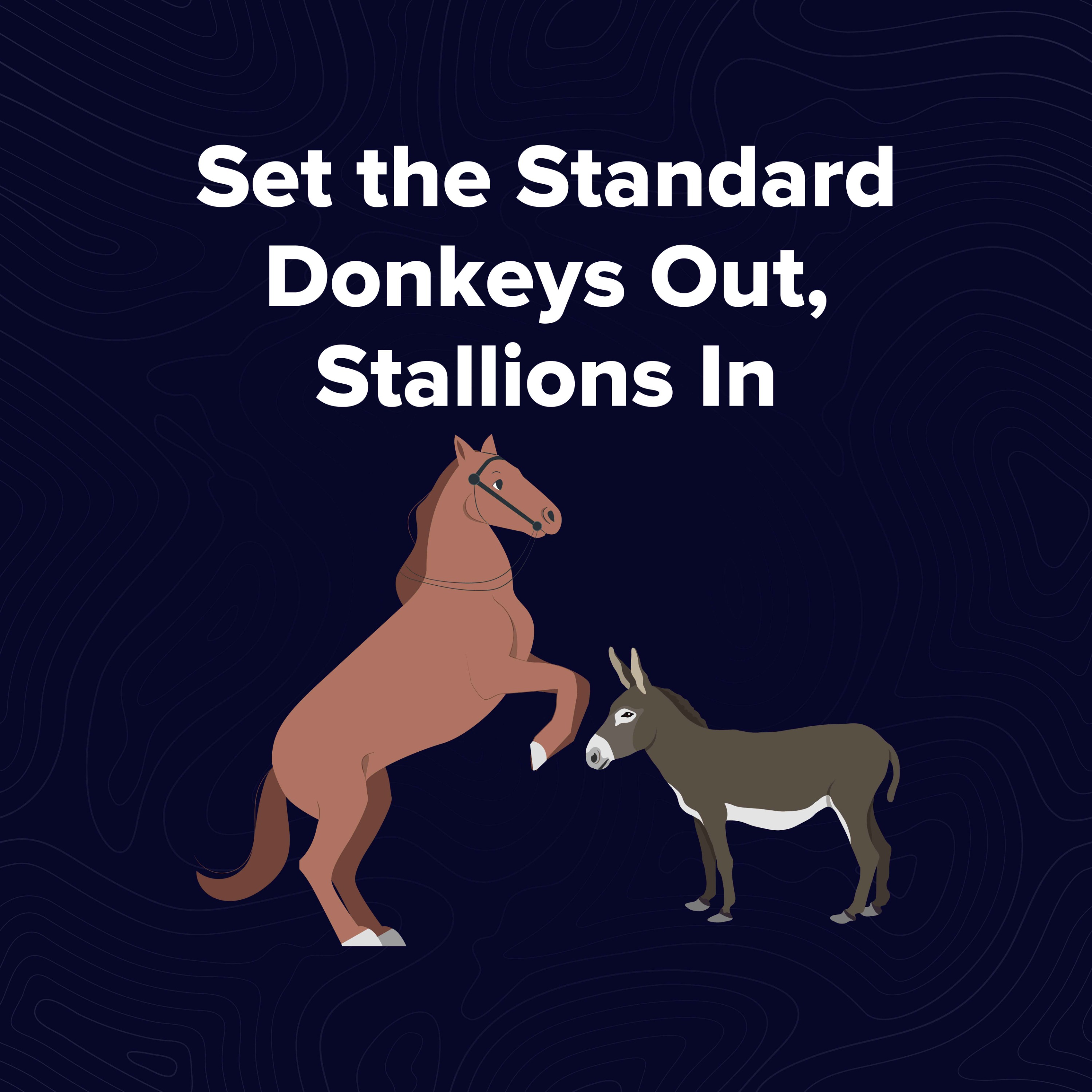
No Bullsh!t Leadership
The Real Reason Your Team Underperforms: It's Easier To Rein In a Stallion Than To Flog a Donkey
00:18:09
Loading summary
Transcript4 lines
- [00:01]
A
Hey, no bullshit Leaders. Quick heads up. Doors are now open for leadership beyond the theory. If you've ever wished you had a better boss, this is your chance to be that boss. Over nine weeks, you'll learn how to cut the busy work, lead with confidence, and handle the tough conversations like a pro. No fluff, no theory, no bs, just practical tools from Marty, who's the former CEO of a multi billion dollar business. He's done it all at the highest level and had to learn by trial and error to get there. Enrollment's now open, but spots are limited, so head to leadershipbeyondthetheory.com and grab yours today. I can't wait to see you in there.
- [00:39]
B
When we started this podcast, we had to figure out a lot of it on our own, which was pretty daunting at times. When you're starting off with something new, it seems like your to do list just keeps growing and it can begin to consume every waking moment. Finding the right tool that helps you out and simplifies everything can be a game changer for millions of businesses. That tool is Shopify. Shopify is the commerce platform behind 10% of all e commerce in the US from household names to brands that are just getting started. Shopify is also packed with helpful AI tools that write product descriptions, page headlines, and even enhance your product photography. Get the word out like you have a marketing team behind you. If you're ready to sell, you're ready for Shopify. Turn your big business idea into With Shopify, sign up for your $1 per month trial and start selling today at shopify.com leadership. Go to shopify.com leadership hey there and welcome to episode 367 of the no Bullshit Leadership Podcast. This week's episode it's a lot easier to rein in a stallion than it is to flog a donkey.
- [01:46]
A
Welcome to the no Bullshit Leadership Podcast. In a world where knowledge has become a commodity, this podcast is designed to give you something more access to the experience of a successful CEO who has already walked the path. So join your host, Martin Moore, who will unlock and bring to life your own leadership experiences and accelerate your journey to leadership excellence.
- [02:09]
B
Now, that colorful expression gives you pretty much everything you need to know about talent management and team performance, but it's advice that is rarely heeded by leaders. We spend an inordinate amount of time trying to get people to reach a level of performance that they simply have no interest in achieving. It sucks our time, our energy, and our will, and it makes every day feel a hell of a lot harder than it should be. Today I'm going to make a case for building talent and creating a team where people are expected to meet the minimum acceptable standard. Or if they don't want to find a less demanding job somewhere else. I'll start by recapping my experience of individual and team performance. I'll delve into why we often turn a blind eye to our worst performers. And I'll finish with my top five reasons why you should be absolutely fanatical about building team capability. So let's get into it. I'm going to tee off pretty hard here. There's only one basis on which you should differentiate your merit. It comes down to two simple how well does a person behave because behaviours are important, and how well does the person perform? When I say it's a lot easier to rein in a stallion than it is to flog a donkey, how does that land for you? You may have the odd stallion in your team already and you're probably going to have at least one donkey. And beyond that, you'll have a whole lot of workhorses. And we love our workhorses. But the more stallions you have, the more likely it is that you'll be able to achieve the exceptional performance that remains stubbornly elusive in most teams. What I'm going to talk about today only applies if you are committed to optimizing team performance. Now, I know you all think you're committed to performance, but are you really? Are you prepared to do what it takes to achieve it? Because it's hard. Lots of leaders wish they had a high performing team. Some lie to themselves and to the people around them and say they have a high performing team. And a few leaders genuinely do the work that's going to build a high performing team. In episode 355, the new rules for Building a High Performing Team, I take quite a detailed look at the ingredients of what a high performing team is. And it all starts with high performing individuals. If you don't do the work to put the right people in the right seats, the team's going to end up being inevitably mediocre. So more than anything else, this requires you to deal with the bottom end of your team. The quality of your team is not set by your strongest performer, it's set by your weakest performer. So you have to lift that low water mark to the highest level possible. Not everyone's going to be a star, we know that. But arguably the biggest determinant of team performance is where you set that minimum acceptable standard. As a leader, you get to set the tone, the pace and the standard for your team. And this starts at the top. If the CEO of your business or even your direct boss aren't driven to improve the performance gene pool, that's okay, because in your team, you are the top. You just have to create an island of excellence in your team. Let's make sure we have a clear understanding of what I mean when I talk about stallions and donkeys. A stallion is rare talent, the sort of high performing individual who makes everyone else around them take notice. This often means they're going to benefit from a halo effect. Everyone's going to assume that since they're incredibly talented at one thing, that this is going to carry through to everything else that they do, which, as we know, is not always the case. But to balance that halo effect, anyone who stands out as being a star is also going to draw some political attacks more often than not. Now, the first thing about someone who you suspect might be a stallion is to consider their performance in a holistic way. They might be a genius lawyer or a brilliant engineer, but can they perform across a range of disciplines? A deep subject matter expert isn't necessarily a stallion. From there, it's important to assess their behaviours. If their behaviours are poor, you don't have a stallion. You may just have a talented jerk. Finally, do they exhibit the attributes of a leader who will grow? And the sorts of things you can observe quite readily. The willingness to tackle tougher and tougher challenges. An ability to anticipate and avoid obstacles. Openness to ideas and improvements that are submitted by others. Preparedness to take calculated risks in order to accelerate progress. The ability to learn from their mistakes and not repeat them. And the willingness to put team results ahead of their own. A donkey is quite the opposite. They don't learn from their mistakes. They take longer than their peers to finish work. They can't set priorities. They use a lot of their manager's time. That's you. They resist productivity improvements and they externalise their problems. They blame others and they make excuses. Now, ultimately, donkeys have neither the drive nor the desire to perform. They might say they do, but they don't. And as a leader, you have to watch their feet, not their lips. Donkeys aren't just a harmless exception that everyone sees as a compassionate charity case. They're the ones who set that minimum acceptable standard for your team. Everyone calibrates their own expectations off the worst performer benchmark. We have a natural tendency to turn a blind eye to poor performers. Why? Because if we actually admitted the impact a donkey has on the team, we'd be forced to do the hard work of leadership. We'd have to manage them to either meet the standard or find a more suitable role somewhere else, up or out. So it's important to understand some of the dynamics that are going to entice you to accept the status quo and spend your time flogging donkeys. There are individual factors that come into play. The first of these is that it's really easy to paint yourself into a corner with artificial constraints. When you come in to lead a new team, you subconsciously say to yourself, well, I've got what I've got and I've got to make the best of it. You may not feel as though you're unconstrained in your ability to deal with performance issues. You might think that since these people are still there, they must be okay. Clearly this is not the case. It's much more likely that the leader before you was just too weak to improve performance by building team capability. Which means it's very likely you've inherited a mediocre team. And this is all the more reason to attack the capability building exercise with real gusto. The second individual factor is that we're taught to be nice. We're conditioned to help those who can't help themselves, to give everyone a chance. And this is absolutely right. But it's easy to lose sight of one factor. Everyone makes their own choices about how they behave and perform. You absolutely need to support and empower every single individual to give them clarity of objectives, to give them decision making autonomy, to give them the freedom to act within clear guardrails. But if you empower and support them fully, then they have to meet you halfway. They have to have both the attitude and the competence to do what they're being paid to do. I totally get that you're trying to be a compassionate and caring leader. But if you don't recognise the part that the individual's own choices play in their day to day performance, compassion and caring will quickly become mollycoddling and permissiveness. Which is fine as long as you're happy to entertain the decline in performance. But you'll find yourself spending your days flogging donkeys. We also subconsciously tolerate poor performers because we make a host of garden variety rationalisations. Here's a few of the more common ones you can probably check off. I can't do anything about Marty because performance management is really time consuming and I'm already flat out. If we move Marty on, we may not find Anyone as good. Marty would be fine if he had more support, but I don't really have time to give him the extra support right now, so it's sort of my fault. Or even the vain hope that maybe Marty will improve then. There are cultural factors. We've been taught that the best leaders put people before prophets. Now I debunked this Myth in episode 215 results or people, which is more important. But this notion clings stubbornly to many leaders psyches. They say things like not everyone's going to be a star, which is absolutely true. And they also say everyone has a place, which is absolutely not not true. Every great leader has high levels of empathy, but only weak leaders allow this to degenerate into sympathy, which penalises the whole team. We can also see some emerging societal factors. The whole performance space has been muddied with the normalization of mental health issues. I took this on in an episode over three years ago, episode 185 the mental health Minefield. This issue seems to be continually evolving and it can't help but impinge upon your decision making processes. In Australia, for example, the number of young adults who reported some form of severe psychological distress grew by almost 60% between 2017 and 2020. The World Health Organisation also found that there was a global increase of around 25% in anxiety and depression in the first year of the pandemic alone. I suspect that coming out of the back end of COVID this number was even higher. So of course, what do governments do? They tend to respond with more regulations, more schemes and more funding. For example, spending on Australia's National Disability insurance scheme or NDIS, has increased from its initial seven year budget allocation of $19 billion to an annual commitment to of more than double that number. 2026 is projected to be $47 billion on the NDIS scheme alone. This affects how the regulatory environment is framed as well. In Western countries, the spider's web of laws and regulations designed to protect workers rights is becoming more and more complex and unwieldy. And this makes it harder to lead for real performance. Anyone with a mental health disorder can claim that they have a workplace related injury simply because their boss has asked them to do their job. You all know what I'm talking about here. Now, I'm not saying for a moment that we shouldn't be sensitive to and compassionate towards those with mental health disorders. We absolutely should. But all of this sits in the back of your mind, your own individual belief system, your natural tendency to rationalize, and the cultural and societal factors. They all weigh on you whenever you have to make those crucial micro decisions. Will I deal with this performance issue or will I just keep flogging the donkey? Because from where I sit, that just seems a whole lot easier. Today I'm not going to give you a How to Guide. The how is a set of fundamental leadership disciplines which, when you apply them expertly, can bring out the best in your people and drive real performance. And there's no silver bullet for this. If you really want to work out how to nurture talent, build superior team capability and achieve extraordinary results, well, you'll need to join us for our Leadership beyond the Theory program. Doors are open now for our last global cohort of 2025, which kicks off at the end of this month. You can go to leadershipbeyondthetheory.com to get some more information. What I am going to give you today is my top five Reasons for adopting the expression It's a hell of a lot easier to rein in a stallion than it is to flog a donkey and use this as your guiding mantra. This is the compelling set of psychological and emotional cues that are going to push you to act differently when you're faced with that daily choice. So the first reason is flogging donkeys is time consuming. Lots of leaders report facing burnout right now. If you choose to flog a donkey, you're going to spend an inordinate amount of time trying to over function for that individual. You'll dip down and do their work for them in order to complete or correct it. You'll give them a lot of your additional time and support and when they make the inevitable cock ups, you're going to step in to fix them. You'll also spend loads of time explaining to everyone else why this is okay. Second reason is stallions deliver exponentially more. Let's face it, stallions are way harder to lead than donkeys. They're smart, they're strong willed and they're driven. So if you're at all insecure, they can be quite scary to lead. When I was running CS Energy, I used to say that on any given day at least half my direct reports thought they could do a better job running the company than I was doing. And that is exactly what I wanted. Because what they produce is an order of magnitude more valuable than your average donkey. You just have to be strong enough to rein them in when they need it. The third reason, performance is about optimizing the resources that you've been allocated to lead most effectively. You should be spending 80% of your time with your top performers, you have to put your energy where it's going to repay you the most. If you could just get 10% more from your stallions, you can put the donkeys out to pasture and you won't even need to replace them. But as long as you have donkeys on your team, the squeaky wheel is going to get the oil and that's where your attention is going to go. The fourth reason is your workhorses hate working with donkeys. Now, it's funny, in my experience, the stallions are less concerned with the donkeys than the workhorses are. Stallions are focused on how to improve themselves. They're off busy trying to lead the team to get better performance. But the workhorses feel really slighted by the fact that you tolerate the donkeys and don't manage team performance. They're more likely to have to pick up any additional workload that the donkeys choose not to deliver. So you're often going to see a churn in the middle layers of your team more than even in your stallions, who have an upward focus. You end up with a high turnover in all the wrong places. And your donkeys, well, they're going to stay forever. The fifth and final reason is that you can start to focus on the next level. As long as you're buried in the detail, you're going to be focused on the wrong things. Your objective should be to perform your current role brilliantly while maintaining an eye on the next level up. When you flog a donkey, though, you're doomed to do an average job while being constantly drawn down into the level below. And in doing so, you effectively make yourself unpromotable. Stallions, donkeys, workhorses. Look, I don't use these terms to be in any way demeaning, and I understand the dangers of pigeonholing people, but they are a graphic and memorable way to think about your talent. As long as you're ruled by the subconscious programming that leads you to tolerate poor performance, your team and your career are going nowhere. But as soon as you adopt the mantra, you'll see how much better your life becomes. When you take the advice to heart. I spent a lot of years doing this myself and mentoring the leaders below me to do the same. And I've got to tell you, never once did I have a conversation with a leader who regretted their decision to remove someone who wasn't interested in doing the job and to replace them with someone who was. Alright, so that brings us to the end of episode 367 I really hope you enjoyed it. But as I'm sure you know, listening is easy, leading is hard. That's why we created Leadership beyond the Theory, our flagship program that turns insight into action and action into results. This is where we unlock the secrets of elite leadership performance. So don't let your career stagnate for another six months. Join us for our upcoming cohort of Leadership beyond the Theory. I'm looking forward to next week's episode. No more spin. Getting the real story from your people. Until then, I know you'll take every opportunity you can to be a no bullshit.