Podcast
Nourished Brain Podcast
Hosted by Sarah Thomsen Ferreira · EN
The Nourished Brain Podcast is your trusted source for understanding the science-backed connection between nutrition, mental health, and brain function. Hosted by integrative and functional dietitian Sarah Ferreira, MS, MPH, RD, IFNCP, each episode dives into the field of nutritional neuroscience and explores how nutrition affects mood, cognition, and emotional well-being.
Through expert interviews and evidence-based strategies, episodes focus on practical ways to support brain health at every stage of life.
10episodes
Episodes
Newest firstAll episodes
{Research Brief} Nonlinear Dose–Response Relationship Between Dietary Inflammatory Index and Risk of Depression: A Systematic Review and Meta-Analysis
Nov 2400:09:53Tap to summarizeIn this episode of The Nourished Brain, I break down a new systematic review and meta-analysis titled “Nonlinear Dose–Response Relationship Between Dietary Inflammatory Index and Risk of Depression: A Systematic Review and Meta-Analysis”I explore:• Why chronic low-grade inflammation is now considered a key driver of mental health conditions• The meta-analysis findings showing that higher DII scores are associated with increased depressive symptoms• How anti-inflammatory patterns like the Mediterranean diet may support better brain health• Key limitations of the review, including reliance on observational data and self-reported diet measuresTune in to learn how your daily food choices may influence systemic inflammation—and ultimately, your mood and mental well-being. ---------Yu L, Bian L, Ren L, Wei W, Zhang H, Miao M. Nonlinear dose-response relationship between dietary inflammatory index and risk of depression: a systematic review and meta-analysis. Front Nutr. 2025 Sep 12;12:1645789.---------💡 Have a question you’d like me to cover on the podcast? Or interested in joining as a guest? Looking for a speaker for your event, workshop, or conference? Send me a message at nourishedbrainpodcast@gmail.com.🌱 Want to explore 1:1 nutrition therapy?Learn more here: foodandmoodnutritiontherapy.com.🧠 Stay up to date on the latest nutrition research for brain and mental health. Subscribe to the Brain Food Digest: brainfooddigest.beehiiv.com.
Transcribe →{Research Brief} How the Mediterranean and MIND Diets CAN IMPACT Cognitive Aging: Insights from a 60-Month Study
Nov 1800:09:06Tap to summarizeIn this episode, I break down a 2025 paper published in Scientific Reports titled “The long-term neuroprotective effect of MIND and Mediterranean diet on patients with Alzheimer’s disease” by Liu and colleagues. Over a 60-month observational period, researchers explored how two well-studied dietary patterns—the Mediterranean diet and the MIND diet—relate to changes in cognitive performance, and whether these relationships differ based on APOE-ε4 status.I unpack what each diet actually emphasizes, what APOE-ε4 means for brain health, and how nutrition recommendations were personalized for carriers versus non-carriers. You’ll hear how omega-3 fatty acids, polyphenols, and antioxidant-rich foods may provide added value for people genetically at higher risk of cognitive decline.Finally, I dig into the reported beta-coefficients linking both diets with cognitive trajectories on the MoCA and MMSE, highlighting how even modest long-term dietary differences can translate into meaningful brain-health outcomes.Reference: Liu X, Yang B, Liu Q, Gao M, Luo M. The long-term neuroprotective effect of MIND and Mediterranean diet on patients with Alzheimer's disease. Sci Rep. 2025 Sep 24;15(1):32725. doi: 10.1038/s41598-025-17055-5.---------💡 Have a question you’d like me to cover on the podcast? Or interested in joining as a guest? Looking for a speaker for your event, workshop, or conference? Send me a message at nourishedbrainpodcast@gmail.com.🌱 Want to explore 1:1 nutrition therapy?Learn more here: foodandmoodnutritiontherapy.com.🧠 Stay up to date on the latest nutrition research for brain and mental health. Subscribe to the Brain Food Digest: brainfooddigest.beehiiv.com.
Transcribe →
How Caffeine Shapes Your Brain — Focus, Fatigue, and Long-Term Brain Health
Nov 100:11:40Tap to summarizeCaffeine — it’s the world’s favorite stimulant and a daily ritual for millions. But what does it really do to your brain? In this episode of The Nourished Brain Podcast, we unpack the science behind caffeine’s short- and long-term effects on focus, mood, sleep, and brain health.Learn how caffeine interacts with adenosine, the molecule that builds sleep pressure, and why older adults metabolize caffeine more slowly, leading to longer-lasting effects. We’ll also explore the latest research showing that moderate coffee and tea intake may lower the risk of Alzheimer’s and depression — but that too much can backfire on mood and sleep.🔍 You’ll discover:How caffeine really boosts alertness — and why that 3pm cup might keep you up at nightThe role of genetics, age, and kidney function in how your body clears caffeineWhat large meta-analyses reveal about coffee and tea’s protective effects on cognitive declineWhy caffeine’s effect on mood is bidirectional — and how to find your personal sweet spotWhether you’re a latte lover or trying to cut back, this episode helps you understand how caffeine impacts your brain — for better and for worse.---------💡 Have a question you’d like me to cover on the podcast? Or interested in joining as a guest? Looking for a speaker for your event, workshop, or conference? Send me a message at nourishedbrainpodcast@gmail.com.🌱 Want to explore 1:1 nutrition therapy?Learn more here: foodandmoodnutritiontherapy.com.🧠 Stay up to date on the latest nutrition research for brain and mental health. Subscribe to the Brain Food Digest: brainfooddigest.beehiiv.com.
Transcribe →Magnesium for Mental Clarity: Understanding the Nutrient You’re Probably Missing
Oct 2100:14:32Tap to summarizeFeeling mentally drained or on edge? Your brain might be craving magnesium — one of the most powerful, calming minerals for the mind.In this episode, we dive into how magnesium supports focus, stress resilience, and long-term brain health. You’ll learn:• Why 60–70% of adults don’t get enough magnesium• How modern diets and soil depletion make deficiency common• The best food sources — from pumpkin seeds to amaranth• The forms of magnesium that really reach the brain (including L-threonate)• Who should use caution with supplementsExplore the science behind magnesium and discover how it helps your brain stay resilient under stress.ReferencesVink R, Nechifor M. Magnesium in the Central Nervous System. University of Adelaide Press; 2011.Slutsky I et al. Enhancement of learning and memory by elevating brain magnesium. Neuron. 2010;65(2):165-177.Workinger J L et al. Challenges in the diagnosis of magnesium status. Nutrients. 2018;10(9):1202.Schwalfenberg G K, Genuis S J. The importance of magnesium in clinical healthcare. Nutrients. 2017;9(12):1293.Sun Q, Weinger JG, Mao F, Liu G. Regulation of structural and functional synapse density by L-threonate through modulation of intraneuronal magnesium concentration. Neuropharmacology. 2016 Sep;108:426-39. Li W, Yu J, Liu Y, Huang X, Abumaria N, Zhu Y, Huang X, Xiong W, Ren C, Liu XG, Chui D, Liu G. Elevation of brain magnesium prevents synaptic loss and reverses cognitive deficits in Alzheimer's disease mouse model. Mol Brain. 2014 Sep 13;7:65.Zhang C, Hu Q, Li S, Dai F, Qian W, Hewlings S, Yan T, Wang Y. A Magtein®, Magnesium L-Threonate, -Based Formula Improves Brain Cognitive Functions in Healthy Chinese Adults. Nutrients. 2022 Dec 8;14(24):5235.Hausenblas HA, Lynch T, Hooper S, Shrestha A, Rosendale D, Gu J. Magnesium-L-threonate improves sleep quality and daytime functioning in adults with self-reported sleep problems: A randomized controlled trial. Sleep Med X. 2024 Aug 17;8:100121. Volpe S L. Magnesium in disease prevention and overall health. Nutrition Reviews. 2013;71(2):79-85.------💡 Have a question you’d like me to cover on the podcast? Or interested in joining as a guest? Looking for a speaker for your event, workshop, or conference? Send me a message at nourishedbrainpodcast@gmail.com.🌱 Want to explore 1:1 nutrition therapy?Learn more here: foodandmoodnutritiontherapy.com.🧠 Stay up to date on the latest nutrition research for brain and mental health. Subscribe to the Brain Food Digest: brainfooddigest.beehiiv.com.
Transcribe →Your Pumpkin Spice Upgrade: The Brain Health Benefits of Fall Flavors
Oct 700:12:06Tap to summarizeDid you know that your spice rack could offer brain-protective benefits?In this episode of The Nourished Brain Podcast, I explore the science behind cozy fall spices cinnamon, turmeric, ginger, and cardamom — and how they could boost overall brain health.You’ll also hear practical ways to use them in your daily routine...just in case you're not already getting enough of that pumpkin spice blend in!🎧 Tune in and learn how to turn your favorite fall flavors into brain-supportive allies.-----ReferencesKesse-Guyot, E., et al. (2020). Flavonoid intake and cognitive decline: A systematic review and meta-analysis. Nutrients, 12(2), 556. PubMedShukla, R., et al. (2022). Neuroprotective potential of Indian kitchen spices: From kitchen to clinic. Frontiers in Pharmacology, 13, 1010405. PubMedRanjbar, E., et al. (2023). Cinnamon supplementation improves cognitive function in healthy adults. Nutritional Neuroscience. PubMedVallianou, N., et al. (2019). Cinnamon and its effect on glucose metabolism and insulin sensitivity. Nutrients, 11(8), 1857. PubMedLopresti, A. L., et al. (2014). Curcumin for the treatment of major depression: A randomized, double-blind, placebo-controlled study. J Affect Disord, 167, 368–375. PubMedCox, K. H. M., et al. (2015). Curcumin supplementation improves cognitive function: A randomized, double-blind, placebo-controlled trial. Am J Geriatr Psychiatry, 23(12), 1077–1085. PubMedRahmani, S., et al. (2014). Effects of ginger on cognitive function in middle-aged healthy women. Evid Based Complement Alternat Med, 2014, 806307. PubMedPaul, S., et al. (2020). 1,8-cineole-rich extract of small cardamom seeds prevents Alzheimer’s-like pathology. J Food Biochem, 44(11): e13455. PubMedGomaa, M. S., et al. (2019). Cardamom alleviates Alzheimer’s disease-like changes in rats via antioxidant and anti-inflammatory mechanisms. Biomed Pharmacother, 111, 1086–1094. PubMed------💡 Have a question you’d like me to cover on the podcast? Or interested in joining as a guest? Looking for a speaker for your event, workshop, or conference? Send me a message at nourishedbrainpodcast@gmail.com.🌱 Want to explore 1:1 nutrition therapy?Learn more here: foodandmoodnutritiontherapy.com.🧠 Stay up to date on the latest nutrition research for brain and mental health. Subscribe to the Brain Food Digest: brainfooddigest.beehiiv.com.#TheNourishedBrainPodcast #BrainHealth #NutritionPodcast #MentalHealthNutrition #CognitiveHealth #NeuroNutrition #FoodAsMedicine #MindfulEating #FallRecipes #SpicesForBrainHealth #CinnamonBenefits #TurmericBenefits #GingerForFocus #AntiInflammatoryDiet #BrainFood #EatForClarity #FunctionalNutrition #MoodAndMemory #HealthyMindHealthyBody
Transcribe →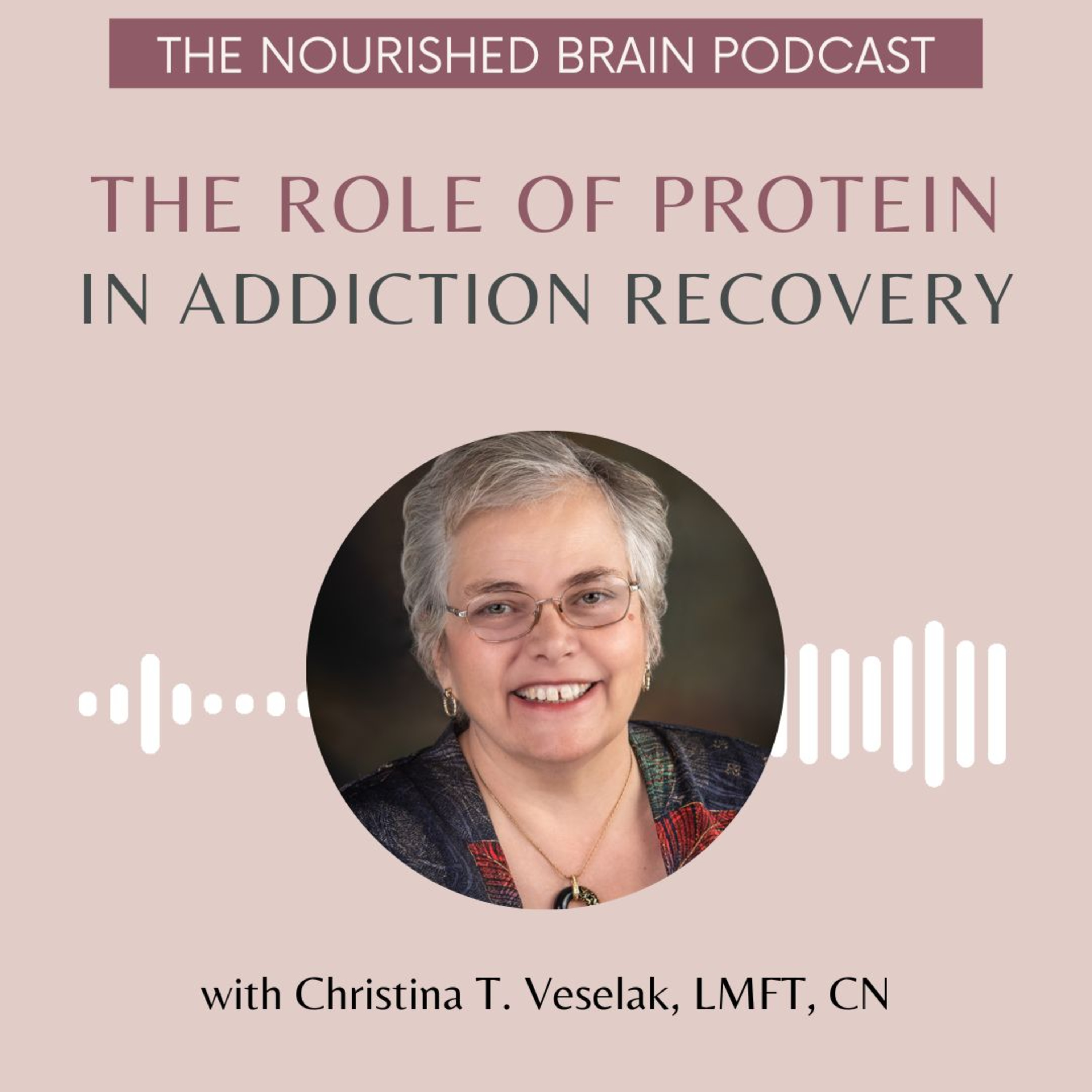
The Role of Protein in Addiction Recovery with Christina Veselak, LMFT, CN
Sep 3000:59:48Tap to summarizeIn this episode, I speak with Christina Veselak, LMFT, CN to explore the vital role of adequate protein intake in recovery. Christina shares her perspective on how protein influences focus, energy, and emotional stability, and why it’s especially important in the journey of addiction recovery and overall nutritional healing.Tune in to discover how prioritizing protein can help restore balance, strengthen recovery, and support long-term brain and mental health.----------Timestamps:0:00 - Introduction & Guest Background3:02 - Christina's Personal Journey to Nutritional Psychiatry10:14 - Working with "Treatment Failures" & The Protein Discovery15:26 - Foundational Nutrition Protocol19:40 - Amino Acids & Brain Neurochemistry27:03 - Theanine and Caffeine Research for ADHD30:08 - Safety, Dosing & Contraindications36:40 - Book Resources & Additional Reading41:31 - Missing Meals: The #1 Relapse Trigger47:43 - Client Story: Application of Principles52:35 - The Five-Star Pro-Recovery Diet56:03 - Message of Hope----------Resources Discussed:Academy for Addiction and Mental Health NutritionEAT!: A Guide to Radiant Recovery Using Food and Amino Acids to Repair the Addicted Brain and Reduce CravingsThe Mood Cure: The 4-Step Program to Take Charge of Your Emotions--TodayAs an Amazon Associate, I earn from qualifying purchases. This means that if you click on a product link and make a purchase, I may receive a small commission at no extra cost to you.----------Disclaimer: This podcast is for educational purposes only and is not intended to diagnose, treat, cure, or prevent any disease. The information shared is meant to inform and empower listeners but should not replace professional medical advice. Always consult with a qualified healthcare provider for personalized care and treatment.
Transcribe →Feed Your Mindset: Self-Reflection for Brain-Healthy Eating
Sep 2300:03:37Tap to summarizeWhat if the secret to better focus, memory, and mood started with the way that you think about how you eat? In this episode, I explore 'big picture' how to prompt yourself for brain-healthy eating—using small mindset shifts and practical cues to guide your food choices without stress or restriction. 💡 Have a question you’d like me to cover on the podcast? Or interested in joining as a guest? Looking for a speaker for your event, workshop, or conference? Send me a message at nourishedbrainpodcast@gmail.com.🌱 Want to explore 1:1 nutrition therapy?Learn more here: foodandmoodnutritiontherapy.com.🧠 Stay up to date on the latest nutrition research for brain and mental health. Subscribe to the Brain Food Digest: brainfooddigest.beehiiv.com.
Transcribe →
Brief Research Review: Adherence to the Mediterranean Diet and Its Association with Cognitive Function in Children and Adolescents
Aug 1300:11:31Tap to summarizeDoes the Mediterranean Diet impact the cognitive abilities of children and adolescents? In this brief research review, I summarize highlights of a recent publication featured in the Brain Food Digest newsletter.-------------------------Join other readers exploring the science of brain health. Subscribe to the Brain Food Digest:https://brainfooddigest.beehiiv.com--------------------------Citation: García-Pérez-de-Sevilla G, Zapata-Lamana R. Adherence to the Mediterranean Diet and Its Association with Cognitive Function in Children and Adolescents: A Systematic Review of Observational Studies. Children (Basel). 2025 Jun 17;12(6):789.
Transcribe →
Brief Research Review: Food addiction severity is associated with decreased functional connectivity and responses to palatable food pictures in brain areas involved in emotion and cognitive control
Aug 4, 202500:09:58Tap to summarizeInterested in learning more about what food addiction could 'look like' in the brain? In this brief research review, I summarize highlights of a recent publication featured in the Brain Food Digest newsletter.-------------------------Join other readers exploring the science of brain health. Subscribe to the Brain Food Digest:https://brainfooddigest.beehiiv.com--------------------------Citation: Coquery N, Som M, Serrand Y, Guittière MO, Bannier E, Lainé F, Constant A, Moirand R, Stice E, Val-Laillet D, Thibault R. Food addiction severity is associated with decreased functional connectivity and responses to palatable food pictures in brain areas involved in emotion and cognitive control. Clin Nutr. 2025 Aug;51:115-125. doi: 10.1016/j.clnu.2025.06.001. Epub 2025 Jun 6.
Transcribe →
Brief Review: Role of Flavonoids in Protecting Against Neurodegenerative Diseases—Possible Mechanisms of Action
Jul 23, 202500:06:44Tap to summarizeLooking for natural ways to support brain health and protect against cognitive decline? In this brief research review, I summarize highlights of a recent publication featured in the Brain Food Digest newsletter. Join other readers exploring the science of brain health. Subscribe to the Brain Food Digest:https://brainfooddigest.beehiiv.comCitation: Rębas E. Role of Flavonoids in Protecting Against Neurodegenerative Diseases-Possible Mechanisms of Action. Int J Mol Sci. 2025 May 16;26(10):4763.Newsletter subscription link: https://brainfooddigest.beehiiv.com/
Transcribe →