← NPR's Book of the Day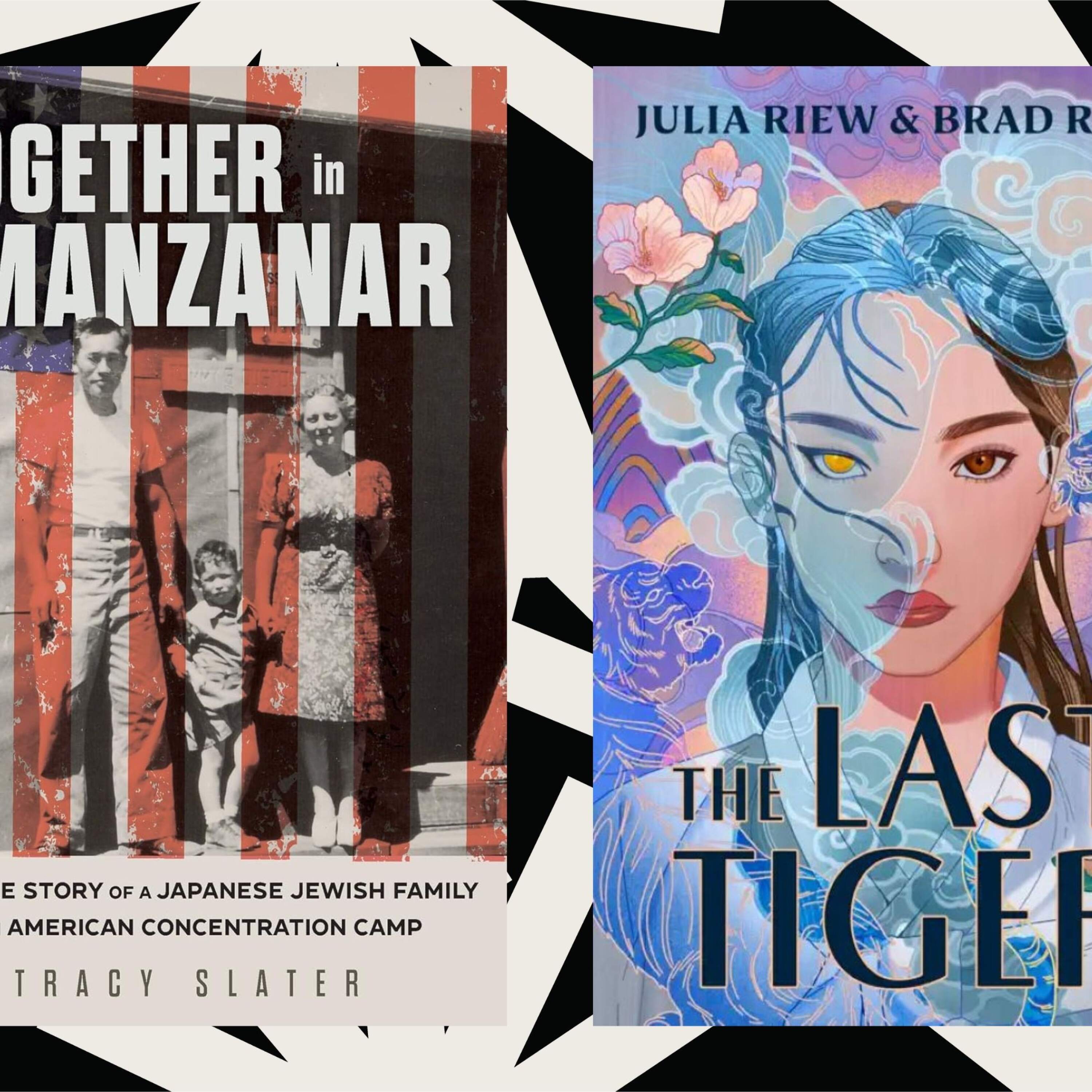
NPR's Book of the Day
2 new books were inspired by dark moments in Japanese and Japanese American history
00:17:02
Loading summary
Transcript47 lines
- [00:02]
Andrew Limbong
Hey, it's NPR's Book of the Day. I'm Andrew Limbong. Today we're bringing you two extremely different books inspired by a similar time in world history. In a bit, a fantasy romance novel inspired by the Japanese occupation of Korea up until the end of World War II. But first, in the 1940s, the United States government was detaining people of Japanese descent in camps. When I first learned about these camps in school, they were called internment camps. In the title of her new book, writer Tracy Slater uses a much more direct name. The book is called Together in Manzanar, the True Story of a Japanese Jewish Family in an American Concentration Camp. And in the book, she writes about a real mom who was not Japanese who made the decision to follow her three year old Japanese son into one of these camps. After the break, Slater tells NPR Sascha Pfeiffer what life was like inside, but also about the conflicted feelings this mom had. After all was said and done.
- [00:59]
Amazon Ad
This message comes from Amazon. When you're on hold with a doctor's office or pharmacy and the operator says your call is very important to us after the 10th time, well, suddenly your call doesn't seem very important to them at all. Amazon One Medical has 24. 7 Virtual Care and Amazon Pharmacy delivers meds right to you fast without any horrible hold music. Thanks to Amazon Healthcare just got less painful.
- [01:24]
Square Ad
This message comes from Square. Your favorite neighborhood spots are using Square to do everything from covering cash flow gaps to expanding to new locations. Wherever your business is growing, Square meets you there. Go to square.com go NPR to learn more.
- [01:43]
Sascha Pfeiffer
Picture this situation. You're a parent raising a toddler and one day you're told your child must be sent to a detention camp without you. The that's the real life decision at the center of a new book based in the early 1940s. Japan had recently attacked Pearl Harbor. In response, the US government began rounding up everyone of Japanese descent on the West Coast. The new book Together in Manzanar, the True Story of a Japanese Jewish Family in an American Concentration Camp captures the hysteria and pain of that era. Author Tracy Slater writes about a mother forced to decide whether to go to a camp for with her three year old Japanese American son or remain with her other child who was white.
- [02:29]
Tracy Slater
I think Elaine felt like she had nowhere to turn. She knew that there was no keeping Tommy out of Manzanar. The chances that she would find some way out of this dilemma that she was in was not possible.
- [02:44]
Sascha Pfeiffer
Slater explained to me why that mother, Elaine Buckman Yoneda chose to stay with her son Tommy and, and leave her daughter behind.
- [02:51]
Tracy Slater
I think she knew logistically that she could not let the army take her 3 year old son to Manzanar without her because first of all, I think she could not imagine being without him. And second of all, he was pretty ill from the time he was born and she spent much of his three years in and out of hospitals with him. So I think she knew that he was a really vulnerable child and couldn't imagine sending him to detention in a desert without her.
- [03:25]
Sascha Pfeiffer
And Elaine's husband Carl was a US citizen born in the us but that didn't spare him from being rounded up because he was of Japanese descent. So the US was in a pretty unforgiving state of mind.
- [03:37]
Tracy Slater
Yes, the US mandated that anybody with, in the words of one official, even one drop of Japanese blood, regardless of citizenship status, regardless of age, regardless of health status, must be rounded up and sent to camp.
- [03:56]
Sascha Pfeiffer
But what about Elaine's son? This is a three year old boy. What threat could a kid pose? Why require children to go as well?
- [04:04]
Tracy Slater
There never was any explanation beyond that, and I'm paraphrasing here somewhat, the Japanese race is an enemy race and no matter where a Japanese person is born or who they are or how old they are, they're a threat and they need to be removed. It's really hard to imagine that this went over, but it did. And it resulted in 120,000 Japanese Americans, about two thirds of whom were American citizens, being incarcerated in concentration camps.
- [04:42]
Sascha Pfeiffer
Would you give an overview of what life in these camps was like?
- [04:46]
Tracy Slater
It was very, very desolate and very, very unfit for habitation. There was a sewer ditch that ran along a set of barracks and some portable toilets that were pulled back and forth between barracks for people to use and then emptied into the ditch. There was no privacy. When toilets were finally built, there could be families of 10 or more squished into these barrack room, sometimes another family. There was one sort of heating, I think it was like a stove, and then one sort of naked light bulb. The food frequently made people ill because it spoiled.
- [05:27]
Sascha Pfeiffer
The camps eventually close. Elaine and Carl were angry about what happened and they campaigned for reparations for prisoners. But as they got older, they had mixed feelings about whether they were too compliant, whether they should have pushed back harder.
- [05:40]
Tracy Slater
I think it was understandably hard for them to make peace with some of the choices that they made, given that there were no good choices at the moment. I think looking back many years after the war, knowing that the Allies would eventually be successful. It may have looked a little different, this choice that they made, that in order to support the Allied war effort and in order to maintain their connection to the leftist community in the United States at the time, which firmly believed and was very clear that the fight against the Axis had to take precedent over everything. And you criticizing the American government was only going to hurt that fight.
- [06:29]
Sascha Pfeiffer
Tracey, you're originally from the Boston area, but for years you lived in Japan with your husband, who's Japanese like Elaine's husband, and you are Jewish like Elaine. I assume you saw parallels between yourself and Elaine, and I'm wondering if you did and why you wanted to write about her and her family.
- [06:47]
Tracy Slater
I did see a lot of parallels between myself and Elaine. I wanted to write about her partly because of that, but also because in many ways I gave up a lot of my life for my marriage and that I moved from Boston to Japan to be with my husband. And Elaine gave up a lot as well because of her marriage. Things with way higher stakes going into Manzanar and all that she endured during that period of history. And that just made her absolutely fascinating to me.
- [07:21]
Sascha Pfeiffer
What has creating this book and all the history you studied along the way to make this book made you think about what's happening in the US Today when it comes to immigrants and immigration?
- [07:31]
Tracy Slater
You know, I think that through this is the true story of an American family that gets swept up in an inflection point in our history. And there's a lot of ways in which that is similar to an inflection point that a lot of people feel we're in now. And when the concept of the forced removal and incarceration was first being discussed, it was discussed as a policy to handle Japanese immigrants. Now that the country was at war with Japan, what were we going to do about the people who had immigrated from Japan and set up families here? And it very quickly morphed into a discussion of incarcerating the entire Japanese American community. So I think as a nation, we need to be really careful with what's happening now and with the potential that it could lead us even further into a darker chapter.
- [08:28]
Sascha Pfeiffer
Tracy Slater is the author of Together in the True Story of a Japanese Jewish Family in an American Concentration Camp. It was published this month. Tracy, thank you.
- [08:38]
Tracy Slater
Thank you so much.
- [08:46]
Square Ad
This message comes from Amazon Pharmacy. Ever been so sick that thinking of going to the pharmacy made you more sick? With Amazon Pharmacy meds are delivered fast right to your door. You just have to make it to your door. Amazon health care just got less painful. This message comes from Carvana. Why spend time wondering what your car is worth? Instantly track its value on Carvana Value Tracker, answer a few quick questions, and stay up to speed on your car's value. Track your car's value@carvana.com while the US.
- [09:21]
Andrew Limbong
Was detaining Japanese people, Japan was working on its own efforts to erase the culture of Koreans. Authors and siblings Julia and Brad Rue took that brutal history and turned it into a young adult fantasy novel rich with forbidden love. Here's npr. Scott Simon, talking with Julia.
- [09:38]
Scott Simon
The Last Tiger is a new novel for young readers that's both a fantasy and a parable inspired by terrible events. Julia and Brad Rue, sister and brother, remember stories they heard from their grandparents about the Japanese occupation of Korea that lasted from 1910 to 1945. Their book is set in a fantasy land, the occupied Tiger Kingdom. The people have been subjugated and tigers all but extinguished by the invading Dragon Empire. Two young people, Eunji and Sung, from separate social spheres are thrown together, whether they like it or not. Julia Rue, a composer and playwright, joins us from our studios in New York. Thanks so much for being with us.
- [10:22]
Julia Rue
Hi. Thanks so much for having me.
- [10:24]
Scott Simon
What kind of stories did you hear from your grandparents?
- [10:28]
Julia Rue
So growing up, our grandparents were both pretty avid storytellers. Every time we'd visit them, they would tell these amazing, very colorful stories about their past. Our grandmother came from a really prominent family in Korea, and our grandfather was on the absolute opposite end. And one of their favorite stories to tell was this story about their forbidden romance. They were forbidden by their parents from seeing each other, mostly by my grandmother's parents. But they would find ways to secretly communicate and to sneak out and go on these secret dates. It really wasn't until my grandfather passed away in 2020 that we got sort of a really full, comprehensive story. My grandmother ended up writing down like 50 pages of memories from her life with my grandpa. And I actually ended up finding this email from my grandfather where he had also detailed his forbidden romance with my grandmother way back when I was in high school. And at the end he'd written, will you turn this into a fictional story? So after pouring through our grandmother's memoir journal and reading through this email from my grandfather, we were just so inspired to share their story with the world in a new and fresh way.
- [11:46]
Scott Simon
Tell us about the state of this kingdom you've created in this novel for young readers. Why does the dragon regime consider tigers so dangerous?
- [11:54]
Julia Rue
This is really inspired by true events during the Japanese occupation of Korea. There was A very clear effort on the Japanese Empire to eliminate Korean culture. That manifested in banning the Korean language, Korean businesses, Korean clothing. And they started hunting down the Korean tigers, which are Korea's national animal, and they actually drove them to extinction. So in our novel, these tigers are really magical manifestations of Korean culture. I think that culture is really the heart and courage and the hope of a people. And so if you can crush someone's culture and if you can erase their history and. And erase their collective memory, that is when you weaken a people. And so for us, in our story, the Dragon Empire is doing this to the tiger colonies, just as Japan did to Korea. But there's sort of this more magical spin that we've taken to present this in an accessible and lively and whimsical fantasy world.
- [13:10]
Scott Simon
Let me ask you about your characters, Eunji and Sung, because they're both born, in a sense, into a life they're expected to live, aren't they, in which there's not much freedom, although one is much more comfortable than the other.
- [13:26]
Julia Rue
Yeah. Yeah. So Sung and Eunji, they are directly inspired by our grandparents. Sung is. He's a servant and he's yearning for freedom. Eunji is this noble girl who is seeking to escape her destiny. It seems like they come from these opposite worlds where Eunji has everything and Sung has nothing. But in reality, Eunji is very, very trapped in her situation. She's got her entire life essentially laid out for her. And Sung, on the other hand, while he feels like he cannot rise above his stature, he has this loving family and this support and a bit of freedom. They each have something that the other is longing for. And through that, they sort of enter into this reluctant collaboration where they are simultaneously rebelling against the forces that are trapping them. Outside forces end up separating them, which is actually something that happened to my grandparents. Outside forces physically separated them. And in real life, our grandparents found each other again. And in the book, Sang and Eunji also find each other again. But I won't spoil exactly how that happens.
- [14:35]
Scott Simon
You have written this. This novel, the Last Tiger, with your brother Brad Rue. What's that kind of partnership like?
- [14:44]
Julia Rue
So people ask us this all the time. It's funny because a lot of people are often. Often say, I could never write a book with my sibling. We would argue so much, and we, you know. But Brad and I, while we definitely had disagreements, I think there's something really special about this. This story is a family story, and the two of us, as siblings, understand each other's brains sort of on another level. Brad really specializes in history and. And spirituality and sort of these deep, resonating emotional moments and description. And for me, with my background in theater, I specialize in plot and character and dialogue and action. And there's also. There's no pretense. There's no sort of ego or sugarcoating. We really are able to be very fully honest with each other, and we just honestly had so much fun with it. Brad and I have been collaborating since I was literally born. We used to play storytelling games when I was growing up. He would tell stories. I would jump on the bed and I'd say, oh, and then this happens. And he'd say, and then this happens. And I would say, and this happens. And that's pretty much exactly how we ended up writing the book.
- [15:55]
Scott Simon
You've been doing this a long time then, haven't you?
- [15:58]
Julia Rue
He is my oldest collaborator.
- [16:01]
Scott Simon
August 15th will be the 80th year since the liberation of Korea from Japan. What are your hopes for Korea today? The country is not occupied, but divided, and a cruel regime prevails in the North.
- [16:19]
Julia Rue
I think we are living in a really interesting moment right now, really. In the last 10 years, Korea has exploded in terms of media representation and in terms of excitement about Korea. We just saw on Netflix, K Pop Demon Hunters is the number one movie. It's been really interesting. As a Korean American, Brad and I grew up really far away from our homeland. We grew up in St. Louis, Missouri, where we really didn't know many other Koreans. We weren't reading novels that were about Korean people. I think growing up, I didn't even know that stories could be about Korean people because of the context in which we were living. And now things are really, really different. And so I think as authors, our place in this is sharing our story, which is a story about how to find hope when hope is lost and how to find hope amongst the people that are around us. And so the way that we really want to contribute to the time is by sharing stories. And that's what we're doing now, and that's what we'll continue to do.
- [17:30]
Scott Simon
Julia Rue, her new novel written with her brother Brad Roo, the Last Tiger. Thank you so much for being with us.
- [17:37]
Julia Rue
Thank you so much for having me.
- [17:40]
Andrew Limbong
That's it for this week on NPR's Book of the Day. Let us know what you think. You can write to us at Book of the day@nkeart.org I'm Andrew Limbong. The podcast is produced by Chloe Weiner and edited by Megan Sullivan. Our founding editor is Petra Mayer. The show elements for this week were produced and edited by Todd Muntz, emiko Tamagawa, Ed McNulty, Michael Radcliffe, Jacob Fenston, Martin Patience, Adriana Gallardo, Ali Schweitzer, Claire Marashima and Andrew Craig. Yolanda Sanguini is our executive producer. Thank you for listening.
- [18:20]
Amazon Ad
This message comes from Warby Parker prescription eyewear that's expertly crafted and unexpectedly affordable. Glasses designed in house from premium materials starting at just $95, including prescription lenses. Stop by a Warby Parker store near you.
- [18:35]
Sascha Pfeiffer
Congress has approved a White House request to eliminate federal funding for public media. NPR remains committed. Our mission of informing the public, increasing your understanding of the world and enriching everyday life. But without federal funding, we are relying on your support now more than ever. Please give today@donate.NPR.org this summer on Planet.
- [19:00]
Square Ad
Money Summer School, we're learning about political economy. We're getting into the nitty gritty of what government does with things like trade, taxes, immigration and healthcare.
- [19:09]
Tracy Slater
So politics and economics, which are taught.
- [19:12]
Sascha Pfeiffer
Separately, they shouldn't be separated at all. I think you have to understand one.
- [19:15]
Julia Rue
To really appreciate the other.
- [19:16]
Square Ad
So what is the right amount of government in our lives? Tune into Planet Money Summer School from npr, wherever you get your podcasts.