← NPR's Book of the Day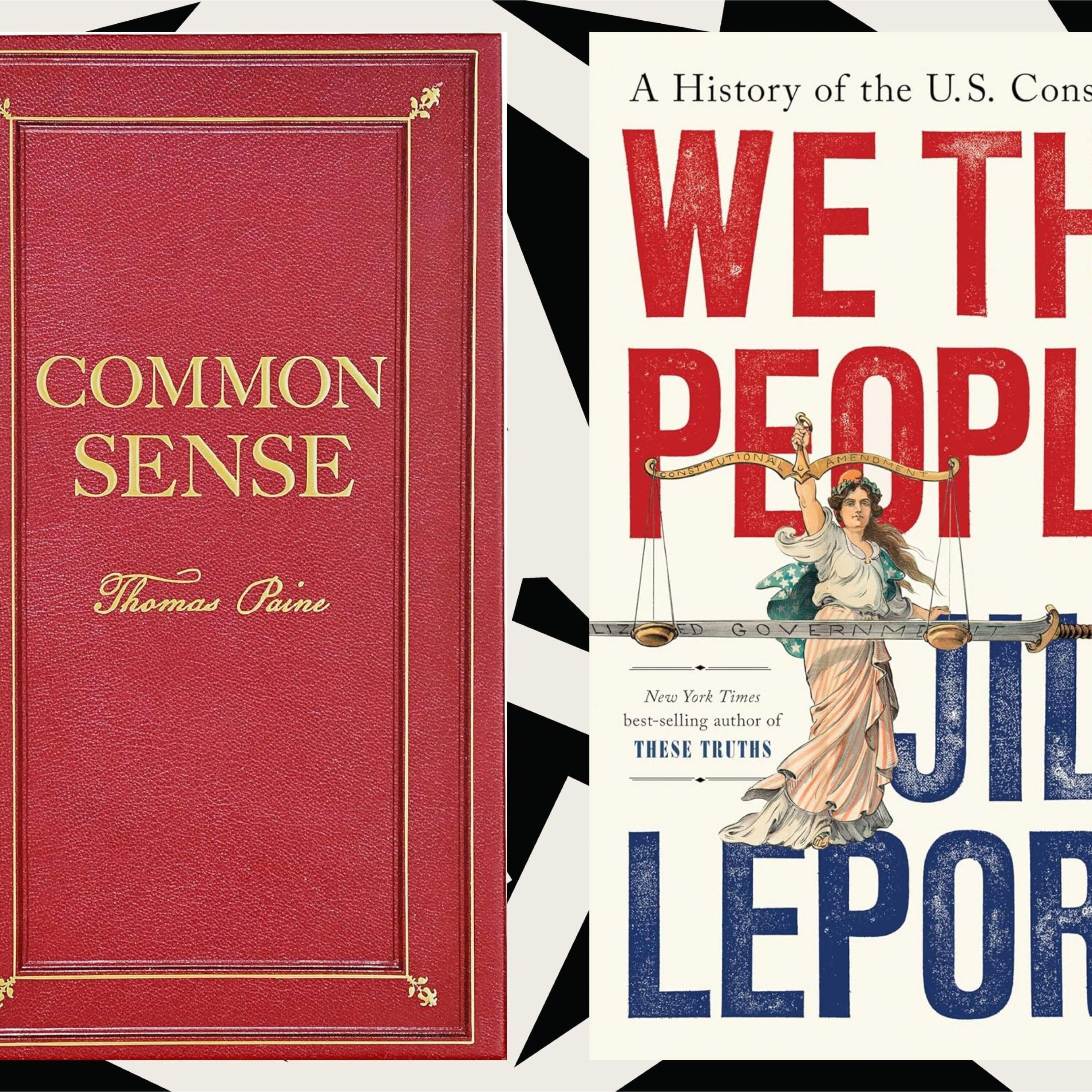
Loading summary
Transcript43 lines
- [00:02]
A
Hey, it's NPR's Book of the Day. I'm Andrew Limbong. Like a lot of folks in this country, we are gearing up for America's semiquincentennial that is America's 250th anniversary. So put on your semi quincentennial party hats and get ready to hear about some American history. In a bit, the writer Jill Lepore and her exploration into the US Constitution. But first, we're going to talk about a different old text, Thomas Paine's Common Sense. You probably know of it, but how much do you really know about it? Historian Norris Lanimski gives a little refresher on it to NPR's Sarah McCammon and also pitches an argument as to why the text is still relevant today.
- [00:46]
B
This message comes from Schwab at Schwab. How you invest is your choice, not theirs. That's why when it comes to managing your wealth, Schwab gives you more choices. You can invest and trade on your own, plus get advice and more comprehensive wealth solutions to help meet your unique needs. With award winning service, low costs and transparent advice, you can manage your wealth your way at Schwab. Visit schwab.com to learn more.
- [01:14]
C
A Government of Our Own is Our Natural Right this was the heart of Thomas Paine's argument in Common Sense, which was published 250 years ago today. That statement might sound exactly like common sense to us now, but at the time it was a pretty radical idea. As battles were breaking out between the British and the American colonists, Paine made an impassioned case to separate from Britain and declare independence seven months later, on July 4, 1776. That is exactly what happened, of course. To help us understand Paine's enduring influence, we're joined now by Nora Sloanemski, director of the Thomas Paine Institute at Iona University. Welcome to All Things Considered.
- [01:58]
D
Hi Sarah, thanks so much for having me.
- [02:00]
C
Okay, for those of us who may not have read Common Sense for a very long time, maybe back in high school or college, can you just remind us what were some of Thomas Paine's core arguments for independence?
- [02:12]
D
Sure. So common sense really moves the needle in the lead up to independence, and it's got a pretty direct and straightforward premise, and that is to declare independence. And it's really driven by the belief that monarchy is not a system of government that people should live under. He's very clearly stating that a republic is the best thing for the people of North America. And he makes his argument very, very clearly throughout the text that monarchy bad Republic. Good.
- [02:44]
C
A lot of these ideas around the American Revolution, ideas of independence, equality, liberty, democracy, those are sort of baked into the way Americans think about themselves today. But I mean, that wasn't the case at the time, right? I mean, how would people at the time of the public, of Common sense have thought about this idea of American independence from Britain?
- [03:07]
D
So certainly you have communities and groups of people in the late 18th century in North America, particularly specifically in colonial North America, who identify with what we now call the Patriot cause, right? They're increasingly concerned, suspicious, disappointed with being part of the British Empire. And then you have other groups who are deeply committed to the British Empire as an institution and also essentially as like a culture and a cause that they really believe in. And then you have a whole, broadly, let's say third kind of group or groups of people who don't really have strong feelings one way or the other. And what Paine's able to do, which is pretty extraordinary, is he's able to view all those different disparate voices and perspectives as one. And he really does see the potential for a unified nation in these. Amidst these different groups. Paine is deeply, deeply opposed to hereditary power, right? To monarchy, to what we. To autocracy. Right. And he is able to communicate that really effectively to all these different groups, to that position.
- [04:21]
C
I just want to talk a little bit about the logistics of how he got his ideas out into the general public. How widely was Common Sense distributed and what was it? I mean, we're talking about a pamphlet here, but what did that mean at this time?
- [04:36]
D
The best way I think you can explain how Common Sense gets out there into the world is. Payne is not all that dissimilar from a social media influencer today. Pamphlets are short, relatively speaking, and his was particularly concise and readable. And the other really cool part of it is that in addition to that discussion that people would have, having physically read the book, they're also talking about it in taverns or coffee houses or, you know, around the sort of 18th century version of the water cooler. And it's those verbal conversations about what's happening in Common Sense that really help to expand its reach as much as that print circulation.
- [05:19]
C
You just compared the pamphlet Common Sense in a way to something that goes viral on social media. You know, today we live in an oversaturated media landscape and it's kind of hard to imagine a single piece of writing or content capturing the public attention in this way. I mean, do you think that there is any sort of modern day parallel?
- [05:42]
D
I Do think it's possible for someone like Payne to capture that kind of audience today? We think of our current moment as especially the incredible benefits and blessings that things like social media bring to our lives. Right. This incredible ability to connect across time and space and the communities that it can foster. We also have a lot of challenges that come from those wide ranging reaches and those wide ranging conversations. But the question of echo chambers or silos or different communities listening to very specific sources for their information and not necessarily listening to other sources for their information, that's not really a new problem. And it's actually one that Payne himself was very, very aware of. And part of how he addressed that concern, it's a valid one. Right. Is by being very upfront and very transparent about his position. He was a good faith writer and I think that's why multiple publics found him so persuasive. He was deeply informed, deeply knowledgeable. He was a true expert in his craft. And he communicated very clearly and accessibly, but also was advocating for this very specific agenda which was to separate from Britain and to avoid at all costs the threat of monarchy. That is a position that he was taking. It's a persuasive one. And he was very clear about that angle. And what I think really helps people connect is that transparency about where you're coming from. And I think that is why he was able to capture such an audience. And I think people today respond, would respond to that and do respond to that in a similar fashion.
- [07:25]
C
What do you see as the lasting impact of Thomas Paine and common sense?
- [07:30]
D
For me, and this is as a historian, but also as someone who is actively participating in life in the United States in 2026. Where I see pain speaking most clearly to our present day experiences is the importance of how learning and knowledge and being an informed citizen is central to the sort of democratic experiment.
- [07:55]
A
Right.
- [07:55]
D
And how vital that is to sort of the civic life in the United States that we have and his deep appreciation for that civic life. I think that can look very different depending on your perspective and where you stand. But you see it across aspects of the political spectrum, across different positionalities, different communities, different backgrounds, that that value really holds firm. And I think it can get sort of maybe lost in the noise sometimes, but it's very much there.
- [08:26]
C
That's history Professor Nora Slinimski, director of the Thomas Paine Institute at Iona University. Thank you so much.
- [08:33]
D
Thank you so much, Sarah. It was a pleasure to talk with you.
- [08:36]
E
Support for NPR and the following message come from Homeserve Owning a home is full of surprises, and when something breaks, it can feel like the whole day unravels. HomeServe is ready to help, bringing peace of mind to four and a half million homeowners nationwide. Plans start at just $4.99 a month. Sign up today@homeserve.com not available everywhere. Most plans range between $4.99 to $11.99 a month. Your first year terms apply on covered repairs.
- [09:08]
A
Is the US Constitution a living, breathing document or is it set in stone? That's a debate we've been having in this country for hundreds of years now. And in a lot of ways, it's the question at the heart of our legal system. Jill Lepore's book We the People is a historical look at that question. Here's npr.
- [09:26]
F
Steve inskeep, the writer Jill Lepore wrote a history of the United States called these Truths. Now she's gone through the same history again for a book on the Constitution. She focuses on fights to amend or reinterpret our basic law long after it was drafted in 1787.
- [09:43]
G
I just really love the agitation of it all.
- [09:45]
F
The book we the People covers a lot of history. I asked Jill Lepore about one period that feels relevant now. In the early 1900s, Americans confronted a growing industrial economy, income inequality and mass immigration. They responded with constitutional amendments, from women's voting rights to an income tax. And a powerful president, Woodrow Wilson, reinterpreted the document.
- [10:08]
G
Wilson had, in fact, been a constitutional scholar. He advocated what came to be called and is still often called living constitutionalism.
- [10:18]
F
Among other things, Wilson signed into law the creation of an independent Federal Reserve, setting aside claims that the Constitution did not allow it. That is the very same Fed whose independence President Trump is challenging Now. Lepore says Wilson's idea of a living Constitution and differed from the framer's idea of the Constitution as a machine.
- [10:39]
G
So when they talked about checks and balances, you know, they're picturing weights on strings balancing one another. And Wilson, he wanted to move beyond that notion. And he argued that the Constitution is an organism, a living thing that has to be allowed to grow naturally. And that remains in many ways a debate that Americans still have about the very nature of the Constitution.
- [11:04]
F
Woodrow Wilson, I have noticed, still bothers modern day conservatives. I want to play a bit of a recent interview with John Yoo, who's a conservative legal scholar, talking about that. Let's listen.
- [11:14]
H
People like Woodrow Wilson, who I think is in many ways the godfather of this idea, thought that there were scientific answers to public policy that you could get things exactly right. And so that politics were a dirty, messy business. And the last thing you would want than if you created a Federal Trade Commission or the Federal Reserve, probably the most powerful of our independent agencies is to allow a president elected at the head of a party to govern what it does.
- [11:40]
F
What was it that Wilson and some of his successors, like Franklin Roosevelt, were doing to the government and to society?
- [11:46]
G
Well, I think we just need to maybe pause for a moment to say that the left has also disavowed Wilson, True, for his racism, Wilson was a Southerner who segregated the civil service. So Wilson, and of course later fdr, but a number of Republicans in between, were all involved in fortifying the federal government to steer the United States through the turn to a modern industrial economy and to try to find ways to adjust the U.S. constitution to keep pace with what these developments meant for ordinary people. One of the things I found really kind of fun in working on this book was so you can find all the arguments that a John Yoo is making now. You can find those in the 1920s and 1930s.
- [12:32]
F
What was the effect on society that it was decided for that time that it was legal and constitutional, upheld by the Supreme Court, incidentally, to have independent agencies, technocrats, people trying by their lights to apply the best solutions to various economic problems with at least some insulation from directly elected officials?
- [12:52]
G
Well, you get the buffering of the forces of the market. You get an insulation against the worst excesses of monopoly. By the time you get to the 1930s, democracies all over the world are collapsing. They're kind of going in either direction towards communism or towards fascism, a kind of state controlled economy. And FDR finds a way to a kind of compromised position to adjust the strictures within the Constitution to both protect the free market and also protect against the worst excesses of a free market.
- [13:30]
F
In listening to you, I think you're saying that Franklin Roosevelt and some other presidents had an idea to respond to an ever larger and more powerful and more complicated economy with a more active government that was supposed to engage in the economy, but not be under the hands of a dictator, as was happening in other countries around the world. Was that the idea that we are now to some extent challenging?
- [13:57]
G
Yes. I mean, FDR's agenda and his accomplishments are depicted by extremists as extreme for the purpose of demonizing the New Deal. That was the case in the 1930s. It was unsuccessful then. I think it will ultimately be unsuccessful now because the kinds of benefits that accrue to societies as a whole. In having an active federal government, the more those provisions are dismantled and withdrawn from ordinary Americans, the more visible they become and their absence becomes more painful.
- [14:30]
F
What excites you when you go back to this era of people pushing for reform, pushing for changes to the Constitution or to its meaning?
- [14:38]
G
It's just a much bigger, more colorful, wildly interesting canvas of constitutional history that makes me feel quite a bit better about a sense of possibility moving forward. I think to the degree that we kind of narrow our vision and look through a very, very tiny, tiny lens, like a little monocle, we feel kind of trapped in a very polarized, very stuck politics and very kind of stuck era of constitutionalism. But if you widen that out and look at the whole of American history in that broad canvas with teeming actors with all kinds of loud opinions and silent protests and non violent action and everything else, and in between, it's a kind of glorious history.
- [15:23]
F
You also, by taking this wide lens, make me think about unintended consequences. People push for a change and it turns out that whatever they thought would happen is not what happened.
- [15:34]
G
Yeah, absolutely. Sometimes people have been asking. Your book seems to be just celebrating amendment for its own sake. Actually, a lot of amendment ideas are really terrible ideas, and some of them, once put in place, turn out to not have the effect that was hoped for or they're betrayed or they're defied. I mean, we're looking right now and we're in a moment right now where the birthright citizenship clause of the 14th Amendment the Trump administration is insisting doesn't mean what it says. So, you know, there are very difficult constitutional battles ahead, but there's a lot to be learned from the way those battles were waged in the past.
- [16:09]
F
Jill Lepore is the author of we the People, a history of the U.S. constitution. Such a pleasure to talk with you again, Jill.
- [16:15]
G
Oh, thanks so much, Steve.
- [16:18]
A
And that's it for this week on NPR's Book of the Day. Let us know what you think. You can write to us@bookoftheday npr.org I'm Andrew Limbong. The podcast is produced by Chloe Weiner and Ivy Buck and edited by Megan Sullivan. Our founding editor is Petra Mayor. The show elements for this week were produced and edited by Justine Kenan, Gabriel Sanchez, Elena Burnett, Adriana Gallardo, Julia de Brock, Samantha Balaban, Melissa Gray, Avery Keatley, Sarah Robbins, Olivia Hampton, and Ben Abrams. Yolanda Sanguini is our executive producer. Thanks for listening.
- [16:59]
B
This message comes from NPR sponsor 1Password. Anyone else feel like 99% of your emails and texts are password reset codes trusted by millions of users and over 175,000 businesses. 1Password lets you skip the resets and sign in securely. With strong, unique passwords that auto fill across all your devices, you can safely share logins, store cards and files. And finally, stop using your pet's name as a password. Try it free for two weeks at 1Password.com NPR this message comes from Capella University.
- [17:36]
E
That spark you feel? That's your drive. For more Capella University's flexpath Learning format lets you earn your degree at your pace without putting life on pause. Learn more@capella.edu. this message comes from Bombas. When you're playing sports, you're focused. Your socks should be, too. Bombas engineers socks to fight sweat and cushion impact for every sport. Visit bombas.com NPR and use code NPR for 20% off your first purchase.