← NPR's Book of the Day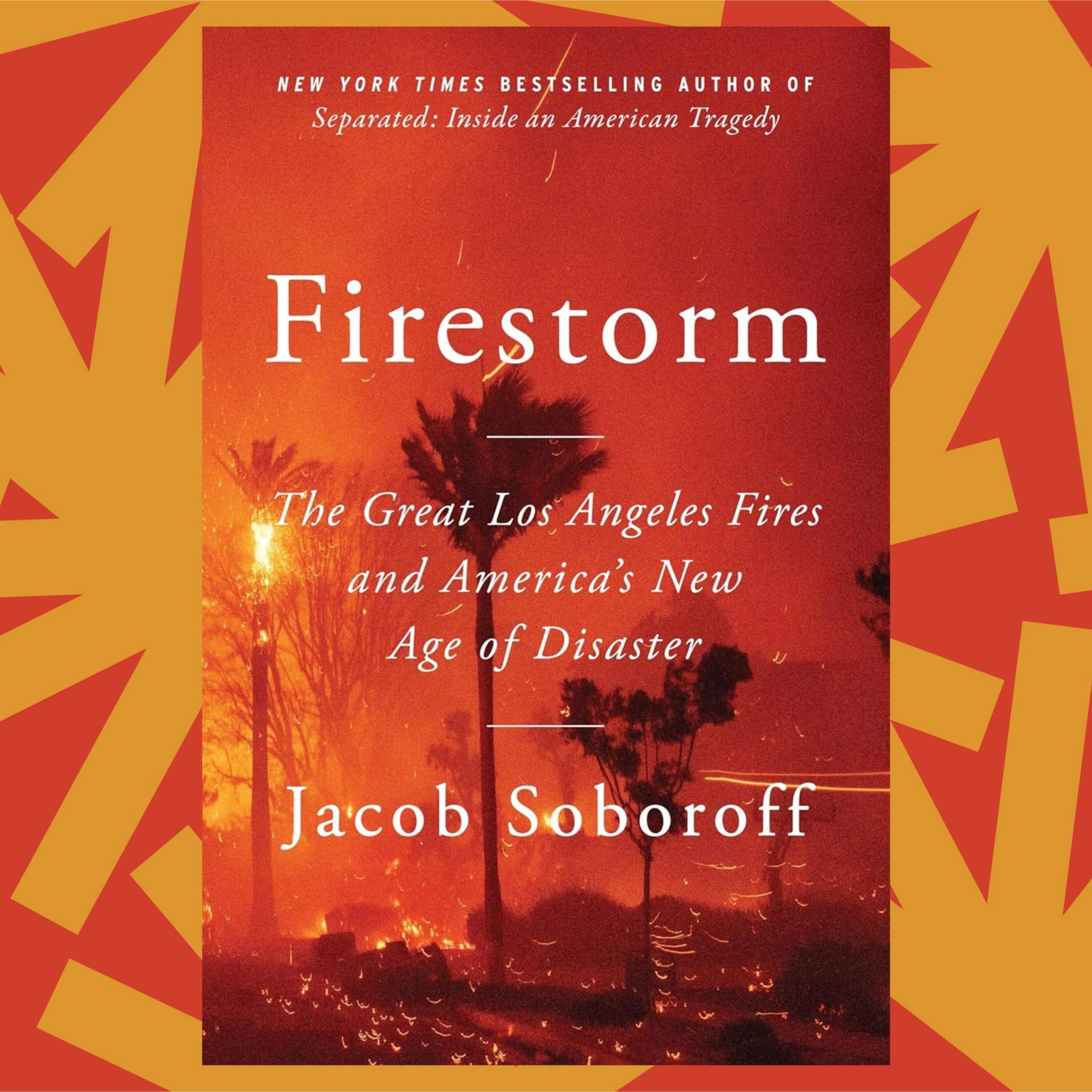
NPR's Book of the Day
'Firestorm' tells journalistic – and personal – story of the LA wildfires
00:10:43
Loading summary
Transcript32 lines
- [00:02]
Andrew Limbong
Hey, it's NPR's Book of the Day. I'm Andrew Limbong. It's been a little over a year now since a series of wildfires in Los Angeles killed people and destroyed homes. And as we look back now on what happened then and talk about how to rebuild, I think it's important to have an account of what actually happened and what could have been done to prevent it and what couldn't. Jacob Soboroff is a correspondent for msnow. And he was there on the ground as it was happening. And he wasn't a stranger to the area. He was reporting on his childhood home. He was watching the place where he grew up burned down. His book about the fires is titled Firestorm the Great Los Angeles Fires and America's New Age of Disaster. And he talked to Here and Now's Peter o' Doubt about being that close to the story, but also the politics of disaster. That's coming up.
- [00:53]
NPR Sponsor Announcer
This message comes from Prolon. Feeling heavy and depleted after the holidays, Prolon's five day Fasting mimicking diet aims to make it easy to reset your body habits and energy heading into the new year. Developed at USC's Longevity Institute, the goal of Prolon's nutrition program is to rejuvenate you from within by working at the cellular level to support fat loss, glowing skin and Sharper Focus. Get 15% off, plus a bonus gift when you subscribe@ProlonLife.com NPR.
- [01:25]
Peter O'Dowd
All this week, we've been remembering the fires that devastated Los Angeles. It's a story that journalist Jacob Soboroff knows all about. When ferocious winds whipped up the fires in early January last year, he was a correspondent for NBC News. He spent days covered in soot at the scene.
- [01:42]
Jacob Soboroff
This is an absolutely devastating, catastrophic. I am not being hyperbolic when I say situations. I was born and raised in this neighborhood, literally three blocks down that way on Frontera. And I have to tell you, I drove around here earlier this morning and houses everywhere you look have burned down.
- [02:00]
Peter O'Dowd
His new book is called Firestorm. It's a personal account of the catastrophe and the political firestorm that followed. Jacob Soborough is in our studios in New York. Jacob, welcome.
- [02:11]
Jacob Soboroff
It's so good to be here. Thanks for having me.
- [02:13]
Peter O'Dowd
You know, a year ago today, you were out there. You were watching your hometown burned down. What's it like for you to hear those clips of your reporting from the Palisades?
- [02:24]
Jacob Soboroff
It raises the hair on my arms and gives me a chill down my spine. Honestly, it brings me back to that moment of standing there watching as I tried to report on national television, watching my childhood home that I grew up in incinerated as if it had been struck by a ballistic missile.
- [02:41]
Peter O'Dowd
You know, Jacob, I'm curious. As a journalist, I don't think we are prepared for the story of our lifetime to sort of be about us, or not necessarily about us, but at least sort of touch our lives in this way. Were you prepared for.
- [02:55]
Andrew Limbong
For that?
- [02:55]
Jacob Soboroff
No, no way. You know, I have always brought as much of myself to the reporting as I possibly can. I believe, obviously, in fair and honest reporting. But the idea that I could be somehow neutral and sort of put in a bag who I really am has never been a strong suit of mine. Here it was. I didn't even really have an option to do that.
- [03:16]
Peter O'Dowd
Yeah, well, like you, Ms. Now anchor Katie Tur grew up in the Palisades. She flew out there to report from the scene. And we have a little sound of the two of you touring her childhood home, which had been completely destroyed.
- [03:30]
Jacob Soboroff
Was that your front door? Yeah.
- [03:32]
Peter O'Dowd
And this was the.
- [03:34]
Jacob Soboroff
This was the living room. We put a Christmas tree in this corner right here. And behind that was a bathroom that my dad set up a dark room for me in because I loved photography.
- [03:46]
Peter O'Dowd
I mean, the sirens, you can hear them, they're right behind you. This was a crisis unfolding right before you. But, Jacob, you weren't just reporting the news for your audience around the world. You were also, I see, getting text messages from your friends and your family asking you to check on their homes because you were frankly, the only one who could tell them if it had burned down or not. Katie Miller, Stephen Miller's wife, Trump's associate aide, asked you to do that for his family's house as well, which you.
- [04:12]
Jacob Soboroff
Did in the sense, the same sense that I couldn't believe what I was seeing with my own eyes. I couldn't believe what I was hearing when Katie Miller got in touch with me. And in fact, before she texted me, just like so many friends and family members, I checked on my brother's house. I checked on the guy who I drove in high school carpool, his mother's house. When Katie Miller actually caught me on the phone, I was about to go live on a special report for Lester Holt on NBC, and I told her I had to call her back. I was surprised that she had called because we had sort of an adversarial journalist source relationship during the immigration coverage during the first Trump term, and I hadn't heard from her. After I wrote my first book, Separated, about the separation crisis, she sort of cut me off. But before I could even call her back, she texted me and asked me to go check on. What I did not know at the time was Stephen Miller's parents house. They too had lived in the Palisade. And I did like for everybody else, I checked on the Miller's house, it had burned down. And you know what I thought was an exercise in finding common humanity between all of us sort of unfortunately soon dissipated because her direct boss at the time, Elon Musk, who had been appointed by President Elect Trump at the time, both of them started pouring rhetorical fuel on the very real flames of the fire by spreading mis and disinformation. And it was just a part of the story to me that this is a story about people. You'll meet many of them, but it's also a story about politics and how politics is a part of the new age of disaster that we have as well.
- [05:33]
Peter O'Dowd
In some way, the politics were its own firestorm. Let's listen to another clip of your interview with Governor Gavin Newsom on Meet the Press. This was January 12th.
- [05:40]
Jacob Soboroff
You've also called for an independent investigation into the issues around water supply that we've seen. What are the questions that you're hoping to answer? The same ones you're asking. Same ones that people when I'm in the streets are asking, yelling about what the hell happened? What happened to the water?
- [05:53]
Peter O'Dowd
Jacob? The water did run dry in the hydrants, but the question of why is what became really political? What can you say about that? Like why was there a problem with the water?
- [06:03]
Jacob Soboroff
Here's the reality. The hydrants ran dry in both the Palisades and in Altadena. Water pressure was low to no pressure on opposite sides of Los Angeles county, an absolutely massive place, the most populous county in the United States. We're talking about dozens of miles apart, these two communities in the Palisades. The theory, some might call it a conspiracy theory, was that the hundred 117 million gallon Santa Ynez Reservoir was empty at the time of the fires. And the Water and Power department and firefighters even have said to me, and they said directly to Elon Musk at the time, that it wasn't the proximate cause of the low pressure. It was the amount of water that was being flowed into the hydrants because they were needed everywhere. 16,000 structures were destroyed over an area three times the size of Manhattan. I don't know another direct cause to the low and no pressure that has been, you know, vetted and confirmed other than what you Hear from both firefighters and water, civil engineers and leaders in Los Angeles, which was there was so much water necessary during this firestorm that it wasn't possible to keep the pressure up, whether it was in the Palisades.
- [07:11]
Peter O'Dowd
Or in Altadena, which does make one wonder why this fire was so bad, and whether any amount of water or more firefighting resources, which also became a point of contention, as you know, whether that would have done anything to stop this firestorm.
- [07:26]
Jacob Soboroff
It's why I start the book with a quote from the academic, the author, the intellectual, Mike Davis, who in 1998, in his book Ecology of Fear, essentially asked that same question. He presented the case in Malibu that the experts were saying, there's no amount of firefighters that would have stopped the wildland blazes that were happening in the hills above that coastal enclave at the time. And decades later, the same sort of story played out just down the road, so to speak, just down Pacific Coast Highway. The reality of the new age of disaster that we are living in is that these are unavoidable catastrophes at this point. And unless we understand that changes in the way we live, that our infrastructure falling apart, that the global climate emergency and that the politics of misinformation and disinformation are all sort of converging to create this conflagration, excuse the expression, that's resulting in communities like Lahaina or the Campfire in Paradise, we'll never be able to move forward with a way to understand that this is the shared reality that we live in today.
- [08:26]
Peter O'Dowd
You know, before we let you go, I do want to ask how you're doing. You wrote this book incredibly quickly, but you were also, I know, exposed to incredibly dangerous conditions. You inhaled, you know, who knows how much smoke and toxic chemicals in the days that you covered this fire. You even write about a firefighter, Eric Mendoza, who collapsed once he finally got home because, as he said, his lungs would not expand. Are you okay?
- [08:50]
Jacob Soboroff
Thank you for asking. Yeah, I feel fine. And the people to really ask that question to and about are people like Nick Schuller, the Cal fire deputy chief, who said to me this was the one fire he believed that he might get cancer from actually fighting a thousand electric car batteries, one senior emergency management official told me, exploded during the fires. I heard them myself. That's part of what's in the ground and what's in the lungs of the people who were there. And so I think a lot about them. I think a lot about people more than anything. And it's a story, you know, this is sad and tragic what we're discussing, but it also makes me hopeful to have gotten to know those people, including other people who I'm concerned about, too, like Kate Hennigan, the JPL engineer. Hundreds of her colleagues lost their home at Jet Propulsion Laboratory in the fires in Altadena. Herb and Loida Wilson, who I met, the UPS employees on McNally Avenue, Albino Fuentes, the Cafe Vida server in the Palisades. I mean, all of these people have individual stories to tell. And I hope in getting to connect with them, which I know was one of the great blessings of my life in doing this project, we can all sort of begin the process of healing and think about what all of us have gone through together.
- [09:57]
Peter O'Dowd
Well, to that point, Jacob, how is the recovery going? If you were to walk around the Pacific Palisades or Altadena, what does it look like today, one year later, a.
- [10:06]
Jacob Soboroff
Big hopscotch of a construction site? And, you know, I think these events often expose the fissures that are underneath our society. One of them is the unaffordability crisis in Los Angeles. Many of the people who are trying to get back to their homes are not able to afford it. 40% of the lots, according to a study that I just read, are being sold to corporate investors and not to Californians, not to Angelenos. The recovery, you know, 16,000 structures, as I mentioned, were destroyed. We're not even at a fraction of that in terms of having permits to be built and not even a fraction of that fraction in terms of the houses are back up today. It's a year. It's a short time, some might argue, in the span of disasters like this. But it's a lifetime for the people that experience this. And many of them may not end up returning to Los Angeles or at least to the communities that burned in the great Los Angeles fires.
- [10:55]
Peter O'Dowd
Jacob Soboroff's new book is called Firestorm the Great Los Angeles Fires and America's New Age of Disaster. Jacob, thank you so much for taking the time to speak with us.
- [11:03]
Jacob Soboroff
We appreciate it is my pleasure.
- [11:16]
NPR Sponsor Announcer
This message comes From NPR sponsor, 1Password. Anyone else feel like 99% of your emails and texts are password reset codes trusted by millions of users and over 175,000 businesses? 1Password lets you skip the resets and sign in securely with strong, unique passwords that autofill across all your devices. You can safely share logins, store cards and files. And finally, stop using your pet's name as a password. Try it free for two weeks at 1Password com NPR this message comes from.
- [11:52]
Sony Pictures Classics with the Coral, directed by Nicholas Hittner, written by Alan Bennett, starring Ralph Fiennes as a choirmaster in 1916. Yorkshire making music as war rages on. Now playing only in theaters.
- [12:05]
This message comes from NPR sponsor Capella University. Interested in a quality online education. Capella is accredited by the Higher Learning Commission. A different future is closer than you think with Capella University. Learn more at Capella. Eduardo.