← NPR's Book of the Day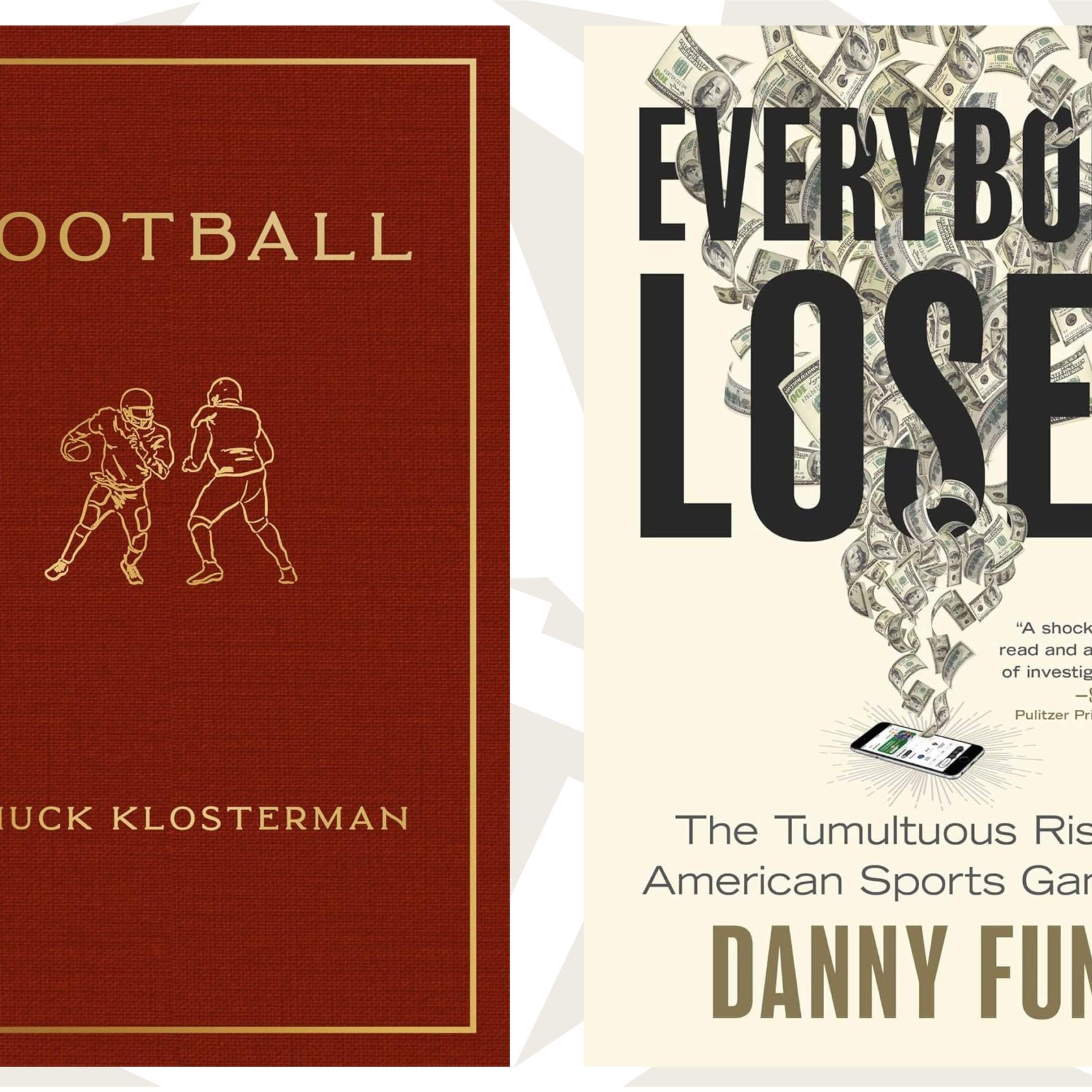
NPR's Book of the Day
'Football' and 'Everybody Loses' examine changes to America’s most popular sport
00:16:46
Loading summary
Transcript51 lines
- [00:02]
A
Hey, it's NPR's Book of the Day. I'm Andrew Limbong. Football season is over. Congratulations to the Seattle Seahawks. But that just means one thing. Football season is set to ramp up again in just a few months because in America, football is an ever present concern, whether we're talking professional college, high school, Pee Wee popcorn or whatever. So today we're going to look at two books exploring the sport. In a bit, we'll talk about how the explosion in gambling has influenced the economy of football. But first, a book simply titled Football. It's by cultural critic Chuck Klosterman, who argues that football is one of the closest things we have left to a monoculture. How did it get there? And how long can it claim that top spot? He talks about all that with NPR's Juana Summers. After the break.
- [00:49]
B
This message comes from BetterHelp. February is full of flowers, candy and lots of relationship talk. It can feel like everyone has it all together in their love lives, but the truth is they're still figuring it out. And whether you're married, dating or prioritizing being single, just remember you're right on time. Therapy can take the pressure off and help you feel lighter. Just a little outside perspective from a professional can lead to new understanding and a lot of progress. Visit betterhelp.com NPR for 10% off. This message comes from NPR sponsor Shopify. No idea where to sell? Shopify puts you in control of every sales channel. It is the commerce platform revolutionizing millions of businesses worldwide. Whether you're a garage entrepreneur or IPO ready, Shopify is the only tool you need to start, run and grow your business without the struggle. Once you've reached your audience, Shopify has the Internet's best converting checkout to help you turn them from browsers to buyers. Go to Shopify.com NPR to take your business to the next level.
- [01:51]
C
Today, it's the day after Thanksgiving, 1984. College football is on TV. The defending national champions, the University of Miami Hurricanes, lead the Boston College Eagles by four points late in an absolute shootout of a game.
- [02:05]
D
There's only six seconds left, but I hear Brent Musburger's voice in the other rooms, three wide receivers out to the right. So I walk in and, you know, I say to ask my dad what's happening? And he's like, oh, Boston College, they played hard, but this is over.
- [02:19]
C
Boston College has the ball, but only has time for one last desperation play. Quarterback Doug Flutie tells all his receivers to just run and heaves a Hail Mary pass into the end Zone caught by Boston College.
- [02:32]
D
I don't believe it. It's a touchdown. And then my dad, in a very kind of strange way, you know, with his odd demeanor, was like, well, there you go. It's like, I gave up and he didn't. That's why he's who he is and I'm who I am.
- [02:45]
C
Yes, this was a weirdly dark moment for a young Chuck Klosterman, and yet it was one of the moments that he recounted to me as formative for his ongoing obsession with the sport of American football.
- [02:56]
D
I do believe, despite a lot of evidence to the contrary, that on balance, football is good for the United States, but not necessarily because it was good for me.
- [03:07]
C
After making a career as a music and overall pop culture critic, Chuck Klosterman can't stop watching and thinking critically about the sport, why it became so dominant, dominant in American culture, and why, decades from now, it will lose its popularity in favor of whatever we have by that point in history. So he wrote a book. It's called Football.
- [03:27]
D
I had always wanted to do a sports book at some point over time, it became very clear to me that the sport had to be football. In this country, people care about football not just more than the other sports, more than all the other sports combined. If somebody were to ask me, I'm trying to understand life in the US from 1950 to 2000, and I want to do it through some sort of vehicle or vessel. This is the one.
- [03:54]
C
One of the points that you have made in the book that other writers have made as well, is that football and TV have grown up together and are responsible for each other's growth. In fact, you write in the book that football is the best television product ever produced. Say more about that.
- [04:08]
D
So football is invented in the years after the Civil war, in the 19th century as this college sport. The idea being, because we're no longer going to be involved in wars, we need something to make men tough. And then it intersects in the 1950s with the rise of television. The way football comes across on tv, it's intense moments of kinetic action with these gaps of time in between, which in theory should be detrimental, actually create the perfect passive watching experience. Even if someone disagrees with this, there's a lot of evidence that suggests that, well, something's going on because there wouldn't be such an overwhelming dominance of television's and football's popularity when married together like this.
- [04:56]
C
Another key point in your book that I want to get into is this idea that football is a sport of executive control. That's governed by all these rules and sets plays. There's a guy on the sidelines or in the box calling the shots. And do you think this is key to the sports appeal?
- [05:11]
D
The controlled world of football is the key to, in many ways, the degree to which people can relate to it, because society in many ways operates the same way. American society is very much like this. We believe that we have a lot of freedom and that we are in a position to make our own choices and sort of have control over who we are. And yet that's probably not true. And it's kind of an illusion. And, you know, and football works the same way. The fact that, like, plays come from the press box and are sent down to the sideline and then are sent into the quarterback, you know, through a radio, you know, and then he uses the information he gets in the radio to look at his wristband and unlock the Byzantine code of the play. And then the quarterback delivers this to the other 10 guys. It's like. It is the most managerial scenario you can imagine in the sport. There's not really any sport like this where.
- [06:03]
C
But at the same time, couldn't one make the argument that some of the most exciting and celebrated moments of the game, or when players take matters into their own hands, where the best laid plans of both sides of the game, they kind of fall apart and you see, like a quarterback under pressure who escapes the pocket scrambles, somehow finds a receiver, takes it into his own hands. That's what gets people on their feet, right?
- [06:20]
D
Absolutely. Those little glimmers of extemporaneous action do have, like, this immense payoff. Patrick Mahomes often operates in a very confined world where he is technically instructed to do a very specific thing with very specific timing. The same way every time.
- [06:41]
C
As a Chiefs fan, I am quite familiar with this.
- [06:43]
E
Yes.
- [06:43]
D
And then sometimes he breaks free from this. Correct. And there's this. And it seems incredible. It doesn't seem possible, but it is possible. And it's heightened by the limitations that he's sort of shackled with by the sport he plays.
- [06:55]
C
Look, I don't have to tell you this, but football has come under a lot of heavy scrutiny recently. We know that it can lead to debilitating brain injury for players. And it's such big business in both the NFL in college that a whole lot of money gets thrown around at the expense of the consumer or taxpayer. And yet you argue it's still a net positive for society, right?
- [07:16]
A
Yeah.
- [07:16]
D
And it's. But it's close. I think that There are things that football specifically allows us to tap into that help us understand the other part of the world we live in and that we have to in some way consider, you know, does the value of something's entertainment alone creates some justification for its existence? You know, it's so kind of imbued in things that should normally have no relationship to football or sports in general. There's gotta be meaning in that, right?
- [07:48]
C
And of course, nothing lasts forever. Do you believe that these same trends that we've sort of talked about, about affordability, injury concerns and what have you will eventually lead to football's decline in popularity?
- [07:58]
D
Well, you know, I've given a lot of interviews about this book now and that really is the section of the book that people focus on the most. This idea that late in the book I kind of argue what I think is going to happen to football in 60 or 70 years. There are economic issues, particularly with television advertising. Some of these things that as they balloon to even greater and greater heights, where the amount of money is so great that the NFL can only continue expanding, it does become fragile, to be honest. There were signs of this during COVID They still got to play these NFL games. The Big ten doesn't have classes, but they still got to try to have these football games. It's not that football is too big to fail, football is too big to stop. And at some point it's going to.
- [08:49]
C
Will that reality make you sad?
- [08:51]
D
Well, I hope I'm wrong about it. It kind of does. Would like the, I mean, I would love the idea that when I'm, when I'm in the old folks home or whatever, I can still watch football on the weekends and still have the same relationship with the game and my friends and my family and stuff that I do now. I don't think that's going to happen now. There's many people, you can make many arguments against that. I mean the main argument on the other side is that hasn't happened with anything else in the history of the world.
- [09:21]
C
We've been speaking with Chuck Klosterman. His new book is Football. Thank you.
- [09:26]
D
Thanks a lot.
- [09:32]
B
Support for this podcast and the following message come from Strawberry me. If you could go back and talk to your younger self, would you tell yourself that you have a job that truly makes you happy? Many people are stuck in jobs they've outgrown or never really wanted. A career coach from Strawberry Me can help you move on to something you actually love. Benefit from having a dedicated coach in your Corner and get 50% off your first coaching session at Strawberry Me NPR.
- [10:02]
A
If you listen to any sports podcasts or watch any sports content on TV or on YouTube, you know how rampant sports betting is. Danny Funt has been covering the sports betting industry for years now, and to give you a sense of how it's going, his new book is titled Everybody the Tumultuous Rise of American Sports Gambling. He spoke to NPR's A. Martinez about the book a few weeks ago. Just ahead of the college football championship game.
- [10:28]
F
Here's a Tonight, sports fans will gather to watch the 2026 College Football Playoff national championship between the Indiana Hoosiers and the Miami Hurricanes. And it's safe to say that some will even wager some bucks, perhaps lots of bucks, on the game. A 2018 Supreme Court decision opened the floodgates to legalize sports betting in the United States, and since then, the industry has pretty much grown to be ubiquitous in sp. Journalist Danny Funt has been covering this for outlets such as the Washington Post and the New Yorker. His new book is Everybody the Tumultuous Rise of American Sports Gambling. And I wanted to hear more about it. So we started our conversation by talking about the professional sports leagues who were once opposed to gaming and are now among the industry's chief champions.
- [11:15]
E
What I found out was the gambling industry commissioned studies from Nielsen, the company that measures TV audiences and other media consumption over time. They commissioned more than a million dollars worth of studies to show just how rabid gamblers are at not only watching sports, but just consuming everything they can about sports and how much money that could generate for the leagues. In the case of the NFL, the most popular sport to bet on, that Nielsen analysis found that every year the league would stand to make about $2.3 billion from legalization of sports betting. And despite a century of saying this was an existential threat to sports, the money just proved too good to pass up.
- [12:02]
B
Yeah.
- [12:03]
F
Now, okay, if we were to break down the economy of sports, the things that create revenue in sports tickets, merchandise, food, anything else, how much does gaming figure into that pie?
- [12:14]
E
In a direct sense, as far as all these sponsorships you hear about or ads on the court or in the bleachers or wherever, I think that's a relatively marginal amount. What does move the needle is what it does for TV viewership, which is the main money maker for the leagues. Nielsen found, after a fairly robust survey, that gamblers watch more than twice as many games as conventional fans.
- [12:42]
F
So, Danny, explain live betting, because I think for most people that maybe have placed a bet once or Twice in their life, maybe with a friend, you know, it's this team will beat this team by X amount of points, and that's where it ends. But what do you mean by live betting during the game?
- [12:58]
E
The idea that you can bet by the second on something every minute of the day is a true game changer. And the industry has perfected, carving up games into thousands of betting opportunities. The leagues, by the way, have made a fortune selling live data that enables that sort of minute by minute in game betting.
- [13:22]
F
Yeah, and so this live betting in games leads to prop bets. So explain the concept of prop bets and how that can get lots of people, including the players, into trouble.
- [13:33]
E
Prop is short for proposition. And the idea is beyond who wins or loses. Like, will the quarterback throw for three touchdowns? Will the center fielder hit a home run? On and on. I spoke with a former executive at DraftKings who said they never imagined that prop betting would amount to more than half of their revenue and that for a lot of their younger customers, that's all they bet on. But also, if you're betting on an individual's performance, as you were alluding to, there's so many opportunities nowadays for a player, a coach, a referee to fix the outcome of a prop. And as we're finding, the leagues just can't possibly police that. It's just too much ground to cover.
- [14:17]
F
Yeah, trying to get a team to win or lose is more than just one player. But, I mean, yeah, athletes do have a lot of control over particular prop bets. The Cleveland Guardians had a couple of pitchers this past baseball season who are now federally indicted for a scheme of sharing information on the pitches they would throw. With gamblers.
- [14:37]
E
It's hard to believe that literally, will the next pitch be a ball or a strike, or will it be above or below a certain speed is something you can not just bet on, but bet a lot of money on.
- [14:48]
F
Danny, tell us about the VIP services people who use the betting service can access and everything that goes with it.
- [14:53]
E
This had to be the most shocking chapter. I had no idea how huge a piece of the business VIPs are. Just 2 or 3% of customers make up 60 or 70% of sportsbook revenue. I learned these are people who are betting tens of thousands of dollars on a weekly or monthly basis, at minimum, sometimes much, much more than that. And because they're so valuable, sportsbooks lavish them with the most unbelievable perks imaginable. Throwing out the first pitch at a baseball game, playing pickup on an NBA court, meeting retired legends in a suite during the game, you name it, they'll do anything they can to keep those customers loyal as long as they keep losing at these staggering rates. I found as soon as they pull back a little bit or take a break, all of those perks go away.
- [15:50]
F
How much do these companies actually care that maybe a lot of their customers are going through gambling addictions?
- [15:57]
E
One person who's very high up at one of the top sportsbooks told me that anything beyond the lowest common denominator when it comes to player protections, customer protections is seen as, as they put it, a competitive disadvantage. A lot of times when it comes to those VIP customers, they think if we intervene to cut them off or ask them, hey, are you is your betting out of control? They're just going to go to one of our rivals. So all we're going to do is lose market share.
- [16:28]
F
You know, when I used to watch and listen to gambling advice shows, the hosts were always these old guys that had been around a long time. But what I'm seeing lately, Danny, is teenagers on TikTok, on social media, giving gambling advice. I mean, is that where this is going?
- [16:45]
E
Absolutely. I spoke with one of the foremost experts in youth gambling problems, a man named Jeffrey Derevensky, and one thing he pointed out is that this is a progressive disorder, and so we don't really know what we're in for. But he was seeing so many people develop gambling problems who get started with sports betting at a young age, partly because it's presented to the public as this innocent, harmless thing that everyone does nowadays if they watch sports. And he just can't imagine where this is all heading and the addiction problem that the country is going to have to reconcile in the coming years.
- [17:24]
F
Danny Font. His new book is Everybody Loses the Tumultuous Rise of American Sports Gambling. Danny, thanks a lot.
- [17:30]
E
My pleasure. Thank you.
- [17:32]
A
And that's it for this week on NPR's Book of the Day. If you want more, you can sign up for our newsletter@npr.org Newsletter Books I'm Andrew Lynnbaung. The podcast is produced by Chloe Weiner and Ivy Buck and edited by Megan Sullivan. Our founding editor is Petra Maher. The show elements for this week were produced and edited by Shannon Rhodes, Martin Patience, Sarah Handel, Tyler Bartlam, Matt Ozig, Elena Burnett, Andrew Craig Deepharvaz, Lena Muhammad, Vinny Akovino, Patrick Jaron Watananan, Adriana Gallardo, Nia Dumas and Margot Baroline. Yolanda Sanguini is our executive producer. Thanks for listening.
- [18:19]
B
This message comes from Capella University. That spark you feel that's your drive. For more Capella University's flexpath Learning format lets you earn your degree at your pace without putting life on pause. Learn more@capella.edu. this message comes from Midi Health introducing AgeWell Longevity Care designed by women for women. Women can feel overlooked by the healthcare industry, especially when it comes to aging. Midi Health offers personalized services conveniently accessible through telehealth visits and covered by major insurance providers. Your health is worth it. Book your virtual visit today@joinmidi.com that's joinmidi.com this message comes from Rosetta Stone, the trusted leader in language learning. Choose from 25 languages. Receive 50% off a lifetime membership with unlimited access to 25 language courses. For life, visit rosettastone.com NPR.