← NPR's Book of the Day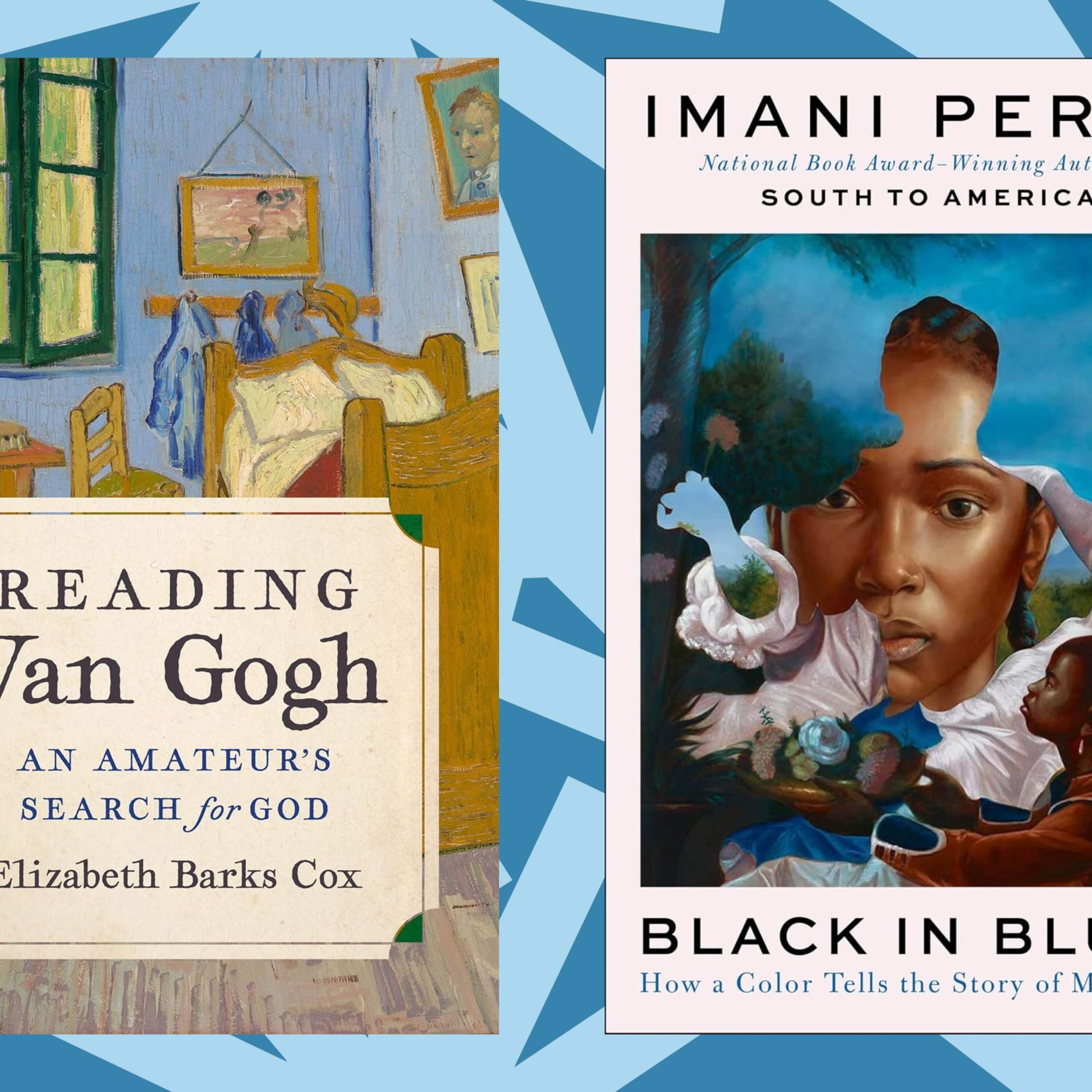
NPR's Book of the Day
For the authors of ‘Reading Van Gogh,’ ‘Black in Blues,’ art opened a door to meaning
00:22:03
Loading summary
Transcript73 lines
- [00:02]
Andrew Limbong
Hey, it's NPR's Book of the Day. I'm Andrew Limbong. If you're listening to this podcast, I assume you have an appreciation for art. I'm going to guess that you've had profound life changing experiences with art, that you've encountered a painting or a song or sure, a book that moved something deep inside you. Today we've got two books featuring authors really digging into art and its histories and finding finding something revelatory in a bit. National Book Award winner Imani Perry talks about the color blue and its influence on black history. But first, Elizabeth Barks Cox has a book out titled Reading Van Gogh An Amateur Search for God. It's a book about looking for something, be it God or meaning, and using the writings of Van Gogh as a guide. And in this interview with Here Now's Lisa Mullins, Cox talks about using Van Gogh's writing to try train her own eyes into not just seeing but experiencing colors the way Van Gogh did. That's up ahead.
- [01:00]
Lisa Mullins
This message comes from Sony Pictures Classics with East of Wall, written and directed by Kate Beecroft. An authentic portrait of female cowgirls and their resilience in the new West. Set in South Dakota's Badlands, it follows a rebellious young rancher who rescues horses and shelters wayward teens while navigating grief, family tensions and the looming loss of her land.
- [01:23]
Scott Tong
Now playing only in theaters, this message comes from dsw. Where'd you get those shoes? Easy. They're from DSW because DSW has the exact right shoes for whatever you're into right now. You know, like the sneakers that make office hours feel like happy hour, the boots that turn grocery aisles into runways, and all the styles that show off the many sides of you from daydreamer to multitasker and everything in between. Because you do it all in really great shoes. Find a shoe for every you at your DSW store or dsw.com we often.
- [01:58]
Elizabeth Barks Cox
Think of Vincent van Gogh as a mad genius and his masterpieces such as the Starry Night as the brilliant expressions of a troubled mind. Author Elizabeth Barks Cox looks well beyond Van Gogh's artwork. She's become consumed by the three volumes of letters he wrote to his brothers, his friends and other painters, and especially about his spirituality. She's so drawn to them. They've inspired her own spiritual journey. Cox has written about that in her latest book, reading Van Gogh An Amateur Search for God. She told us she didn't expect a lot of what she read.
- [02:32]
Imani Perry
What struck me was the depth of his compassion for others within his own life of rejection. And that depth of compassion made him, to me, a kind of hero. He's unlikely role model, maybe, since he was neither saintly nor successful. But in those letters, he revealed an attention toward suffering of people around him, as well as an eye for beauty that surrounded him. And those two qualities struck me. And I forgave him everything else. I mean, I know that he drank, that he was irascible to the community, that drugs, that he was in the asylum, that he cut off part of his ear. But then I got a new view of him in these letters. You might know that in his 20s, he wanted to be a minister because his father was a minister.
- [03:33]
Elizabeth Barks Cox
Right.
- [03:34]
Imani Perry
And he went into seminary. But he hated the way the professors talked about God.
- [03:39]
Elizabeth Barks Cox
What didn't he like?
- [03:40]
Imani Perry
Van Gogh is like a big heart walking around the world. And they were intellectual. He flunked out of seminary, but he begged that committee to send him as a missionary somewhere, anywhere. They sent him to the Borinage district in Belgium, which is a mining community. And I imagine nobody else wanted to go there. When he got there, he realized that the sermons on Sunday were not as important as the attention to everyday needs. And that's his ability to see the suffering in people.
- [04:17]
Elizabeth Barks Cox
In particular, the coal miners in Belgium.
- [04:21]
Imani Perry
The coal miners, right.
- [04:22]
Elizabeth Barks Cox
He got incredibly involved with them and their lives. Enough that it endangered, ultimately, his own health and his own life.
- [04:30]
Imani Perry
Yes, he went down into the mines with them. He would go into their homes when typhoid fever raged through the community. But what he did was he would go back to his apartment and he would look at all that he had. And he never had much because he always lived in poverty. But he had more than they did. So he shared what he had. He gave away his money, his food, his clothes. He gave away his bed, his bed sheets. And finally he just went into the homes with the people. And that's when he was found dying in the corner of a hut. And his father and brother found him there. They took him home. And of course, the church dismissed him for not performing his regular duties. Vincent never loved the church after that, but he continued to love God. And he loved beauty. And he saw both everywhere.
- [05:34]
Elizabeth Barks Cox
So he had, at that point, a bitterness against organized religion. Exactly how much of that do you identify with? Because what we're getting at here is just what an influence Van Gogh, with all his imperfections, was on you and.
- [05:51]
Imani Perry
Still is on you and still is. Well, his letters kind of opened a door for me. I had been writing about that kind of Search. And I tried to bridge the gap between the people I did not understand, did not know, who lived a very different life from me, trying to understand something about their life. And I lived in a homeless shelter for two weeks in New York City and wrote about that. I worked with neglected and abused children for 10 years, and a lot of my forays into trying to understand failed, but so did Van Gogh. And so I loved how he kept trying, and I wanted to keep trying. So he was kind of a teacher to me.
- [06:50]
Elizabeth Barks Cox
Could you make a link between, just as an example, his thought process in a letter, his observations, and then some of your own observations? Because we should say that you developed a practice of reading Van Gogh's letters and then going out on what you call prayer walks. Exactly what was the influence, and was there a direct influence? Would you be thinking of the letter that you read that morning when you went out on.
- [07:17]
Imani Perry
I remember reading about how he saw things and that he experienced color more than seeing it, and I wanted to do that.
- [07:29]
Elizabeth Barks Cox
If I were walking with you, what would I notice you doing? Whether you're talking with somebody, whether you're. You're like, what?
- [07:36]
Imani Perry
Sometimes I am talking to somebody, and when doing that, I'm trying to see the heart of someone's face. Sometimes I'm passing a field that I've seen many times, and I stop and try to see something that's different or see a color that Van Gogh might have seen in terms of an experience rather than just what your eyes can see.
- [08:05]
Elizabeth Barks Cox
It's just interesting to hear you talk about color. And you're being inspired not necessarily by his paintings, which most of us know, but by his words.
- [08:16]
Imani Perry
By his words? Yes. I'm a word person. And so I was just struck with this man who was such a bad boy and such a good soul and had so many problems. And I found myself admiring his perspective. What struck me, too, is the idea. Speaking of Starry Night, you might know this. He painted Starry Night looking through the bars of his asylum. And he did not give us the bars. He just saw the beauty. So I think of someone in that situation of despair and loss who could still see beauty and share it. Maybe I fell a little bit in love with him.
- [09:16]
Elizabeth Barks Cox
I think that sounds quite fine.
- [09:21]
Imani Perry
I fell in love with his generosity of spirit.
- [09:25]
Elizabeth Barks Cox
Your book is called Reading Van Gogh, An Amateur's Search for God. Did Vincent van Gogh, the artist and the writer, has he helped you in your own search for God and your own belief?
- [09:40]
Imani Perry
Yes. He underlined that necessity for compassion, and he did it within his life of so many troubles and so many bad things happening and so many arguments and anger, all of that. But bottom line was a kind of compassion for the world, for the starry night, for the iris, for the sunflowers and for the faces of people. And so that when I look at his paintings now, I see a, a man whose eyes were really opened but who did not fit into the world. And I could see how he probably couldn't fit into the world. And the world doesn't reward that kind of sight. You don't make a lot of money from it. But it certainly brings me joy.
- [10:53]
Elizabeth Barks Cox
It is so nice to talk to you, Elizabeth Cox. Her book is called Reading Van Gogh, An Amateur's Search for God. Thank you so very much.
- [11:03]
Imani Perry
Thank you for having me, Lisa. Wonderful to be with you.
- [11:08]
Lisa Mullins
This message comes from FX's Alien Earth. From creator Noah Hawley and executive producer Ridley Scott comes the first television series inspired by the legendary Alien film franchise. A spaceship crash lands on Earth, Earth, bringing five unique and deadly species more terrifying than anyone could have ever imagined. And a technological advancement marks a new dawn in the race for immortality. FX's alien Earth, all new Tuesdays on FX and Hulu.
- [11:39]
Scott Tong
This message comes from NPR sponsor Shopify. Start selling with Shopify today. Whether you're a garage entrepreneur or IPO ready, Shopify is the only tool you need to start, run and grow your business without the struggle. Go to shopify.com NPR in her book.
- [11:55]
Andrew Limbong
Black in Blues, historian Imani Perry traces the color blue throughout black history. It's a deep book connecting history with art. The book makes meaning out of metaphors. In this interview with Here Now, Scott Tong, she talks about how Americans in general tend to think superficially about colors and how there is something spiritual to find in colors. Here's Scott.
- [12:17]
Imani Perry
We're going to talk about a book whose title is worth processing for a second. Black in Blues. We say these words, black in blue. We might think about black musicians in the blues or the blues as in the emotion. Think about these as we introduce Imani Perry. She's a Harvard professor of women, gender and sexuality and African and African American studies. She has won the National Book Award and her new book is a set of essays on black history, black culture and the color blue. Again, it's Black in Blues. And Imani Perry is here in our Boston studio. Welcome.
- [12:51]
Thank you for having me.
- [12:52]
It's good to have you here. You know, some books make a logical argument. You know, some tell a story of a person, a plot, an event. This Book, to me, is none of those. A set of sensory experiences of a people and a color. The color blue. Those are my words.
- [13:10]
Yes.
- [13:10]
How did this concept come to you?
- [13:12]
At a certain level, it came to me organically. I talk at the beginning about my grandmother. My late grandmother's bedroom having been a blue room with blue curtains and blue bedding and blue prayers written in the corner of the mirror on the vanity. And I talk about it as a portal. So there's a lens of blue through which I was nurtured. But then I also, you know, over the course of a lifetime of studying African American art and culture and literature, the color blue kept appearing. So it almost beckoned me as opposed to having been a choice. And it makes sense to me that that would be the kind of a color around which black life coheres. Because, of course, because of the blues, because it is such an expansive color. It is the color of the waters and the skies, and it gives you a sense of both beauty and suffering. It is beauty and the blues, as it were.
- [14:10]
That kept coming to me as I was reading your book. The Treasure and the Tragedy.
- [14:14]
Yes.
- [14:14]
Simultaneously in the color blue. Let's talk about indigo.
- [14:18]
Yes.
- [14:18]
You write a lot about the indigo. The color, the dye. I mean, it's timeless. I'm sitting here wearing jeans. Right. It is all around us, and it's been around us for so long. What is the essential history you learned about the process?
- [14:33]
Yeah. I mean, indigo is this color. It's a dye that captivated the world. And so I did a lot of research on indigo cultivation in Africa and Asia, and then the way the indigo trade becomes a source of great wealth in the context of the transatlantic slave trade. So, for me, part of the story is the transition from a people who cultivated indigo to people who were being traded for indigo, and then the association between indigo and the enslaved, because what was called Negro cotton was dyed with the color indigo. So people were making indigo, they were wearing indigo, and that was part of how they were racialized. But then it also became something that was continued to be treasured as a source of beauty. And that, to me, was really important, too, that even in the face of degradation, even in the face that people still found beauty.
- [15:24]
Yeah. I want to ask about music.
- [15:26]
Yes.
- [15:26]
You mentioned the blues, and there's a song you referenced early in the book, and I want to play a little bit. We the People who Are Darker Than Blue by Curtis Mayfield.
- [15:37]
We people who are darker than blue this ain't no time for segregating. I'm talking about brown and yellow too high yellow girl can you tell you're just the surface of our dark, deep well, if your mind could really see, you know your color is same as me.
- [16:08]
Pardon me, brother I gather he's not the only person to draw on this phrase. Darker than blue. What does it mean to you?
- [16:17]
It's both hopeful and deeply melancholy. It's that classic Curtis Mayfield orchestral arrangement. Where there's a refusal to turn away from the heartbreak. And yet also there's encouragement. And I think that that's the sense, you know, sort of what's even deeper and darker and beyond blue and the blues. And yet there's still this incredible creative capacity. And it's a way of cueing myself generationally. That's the world I was born into, the 1970s. That's the Sonic landscape.
- [16:50]
Yeah, you and me. As far as music and the blues, there's, of course, the idea of the blue note.
- [16:56]
Yes.
- [16:57]
Which I gather is actually several notes on a scale. And it's at the center of blues and of jazz. Where one of the, you know, any given notes is purposely flat. Right. A half step lower. In between.
- [17:10]
In between.
- [17:12]
Is that a metaphor for something important?
- [17:15]
Yeah, I mean, it's in between. Or it's a worried note. It is a slurred note. Right. It refers to doing something different with relationship to the Western scale. It's not necessarily flat on its own terms, but it's in relation. It's a wonderful metaphor. Because, of course, the blue note provides the foundation for American music. Much in the way that black people provide the foundation for American music. Are seen as the outliers and yet are essential to the story.
- [17:44]
Is there an artist who comes to mind, you know, where the blue note or blue notes, you know, are experienced throughout the music?
- [17:52]
The best example would be Aretha Franklin. Just because her voice is so universally known. And you can hear the way she slides and slurs between notes. It's a beautiful example. And it's also a great example because she comes out out of multiple music traditions. And so it's a sign of how much the blue note is everywhere. You know, she comes out of gospel, she's soul, she's R and B and the like. And so that sound is at the core of this tradition. My doctor said, take it easy.
- [18:41]
A listener might be kind of asking, is it a series of coincidences where blue keeps coming up over time in this book? And I imagine your answer is not exactly.
- [18:51]
No, it's not a series of coincidences, in a sense. You know, I say blue is the world's favorite color. And we looked at my answer for.
- [18:59]
A long time growing up Blue.
- [19:00]
Right. And it's something that is universal. And then there is this story of black people, which in some ways is seen as an outlier in human history or a marginal story. And part of what I'm doing in stitching them together is actually showing you there's actually a connection. There's something fundamentally human about a people who are gathered together, who have very different identities and very different histories, and are gathered together under the banner of empire and the transatlantic slave trade. There's a way in which the story of black people becoming as such has a kind of deep connection to blue because it's a universally human story, even as it is particular. Right. And so I think it's not coincidence. It's actually something that's just human. Right. There's Mitch in the way that indigo. Everybody loved indigo. Right. That there's things that are so deeply human. There's something we learn from even just encountering and attending to them. Yeah.
- [19:56]
Even. As you talk about, I'm thinking mood indigo. And it just takes you to so many places. You know, as I was reading your book, I'm ethnic Chinese, I started thinking about the Chinese people in a different color. Yellow.
- [20:07]
Yes.
- [20:07]
It's the imperial color. The emperor's name is Huang Di, the Yellow Emperor. The name of the mother river in China is Huanghe, the Yellow River. And I bring it up a little bit to think out loud and ask you, do you think we Americans think enough about color and meaning?
- [20:27]
No, we don't think enough about color and meaning. I think because we tend to engage color relatively superficially. You know, there's corporate colors and then there's teams. But I think actually to think about how much the senses are part of a fundamental human experience. Right. So how we engage with color and that can have a spiritual dimension, it can have an emotional dimension. But most of all, it's about what it means to be human. Right. We're not just. We are logical and we're intellectual, but we're emotional, we're spiritual. We have all these different kinds of sensitivities. And there's something about thinking about color because, you know, it's a scientific consideration, it's a spiritual consideration, that it actually allows us to be more fully human. That's part of the reason why I talk about George Washington Carver, who's known as a scientist, but who also developed paint colors, including Egyptian blue and Prussian blue. And he was an artist, and his story is a reminder that human beings are very complicated and complex. And that's something, again, that's about a way for us to pay attention to what it means to be a person, you know, more fully.
- [21:35]
Yeah. Separately. Imani Perry, I want to ask you about this moment in this country.
- [21:39]
Yeah.
- [21:40]
In African American studies and scholarship and writing. You're a professor at Harvard of African Studies at a time, I don't have to tell you this, when diversity programs are threatened or ending university funding in general is wobbly right now. What is the effect of that?
- [21:56]
For me, there's an open question. Right. I mean, certainly we know that there is an attack on African American studies, ethnic studies, women's studies, LGBTQIA studies. And then also and this is a different area, but also the idea of diversity, equity and inclusion initiatives. And that is an effort, I think, to undo the past 50 years of social transformation because all of those gains that were so hard fought in middle 20th century, there's an effort to undo that now. The question of what it means, though, really depends upon us. Of course, there's a lot of alarm and we should be alarmed, but we also have to make decisions about how we're going to live. Is it important for us to learn about these various histories and stories? Is it important for us to be in community with people across a variety of experiences? If it is, then we have to actually demonstrate our values and our daily doings.
- [22:52]
We've been talking to Imani Perry, and her new book is Black in How a Color Tells the Story of My People. Imani Perry, thanks so much.
- [23:02]
Thanks for having me.
- [23:08]
Andrew Limbong
That's it for this week on NPR's Book of the Day. If you want more, you can sign up for our newsletter@npr.org Newsletter Books I'm Andrew Limbong. The podcast is produced by Chloe Weiner and edited by Megan Sullivan. Our founding editor is Petra Mayer. The show elements for this week were produced and edited by Melissa Gray, Gabriel Donatov, Ed McNulty, Michael Radcliffe, Fernando N. Roman, Shannon Rhodes, Amiko Tamagawa and Todd Munt. Yolanda Sanguini is our executive producer. Thanks for listening.
- [23:47]
Lisa Mullins
This message comes from Schwab. Everyone has moments when they could have done better, like cutting their own hair or forgetting sunscreen. So now you look like a tomato. Same goes for where you invest. Level up and invest smarter with Schwab. Get market insights, education and human help when you need it. Learn more@schwab.com this message comes from Mint Mobile.
- [24:10]
Scott Tong
Mint Mobile took what's wrong with wireless and made it right. They offer premium wireless plans for less, and all plans include high speed data, unlimited talk and text, and nationwide coverage. See for yourself@mintmobile.com Switch this message comes from Saatva. Getting quality sleep can improve athletic abilities, increase energy, and boost memory and learning. Saatva mattresses are designed to promote that kind of sleep. Save $200 on $1,000 or more at satva. Com NPR.