← NPR's Book of the Day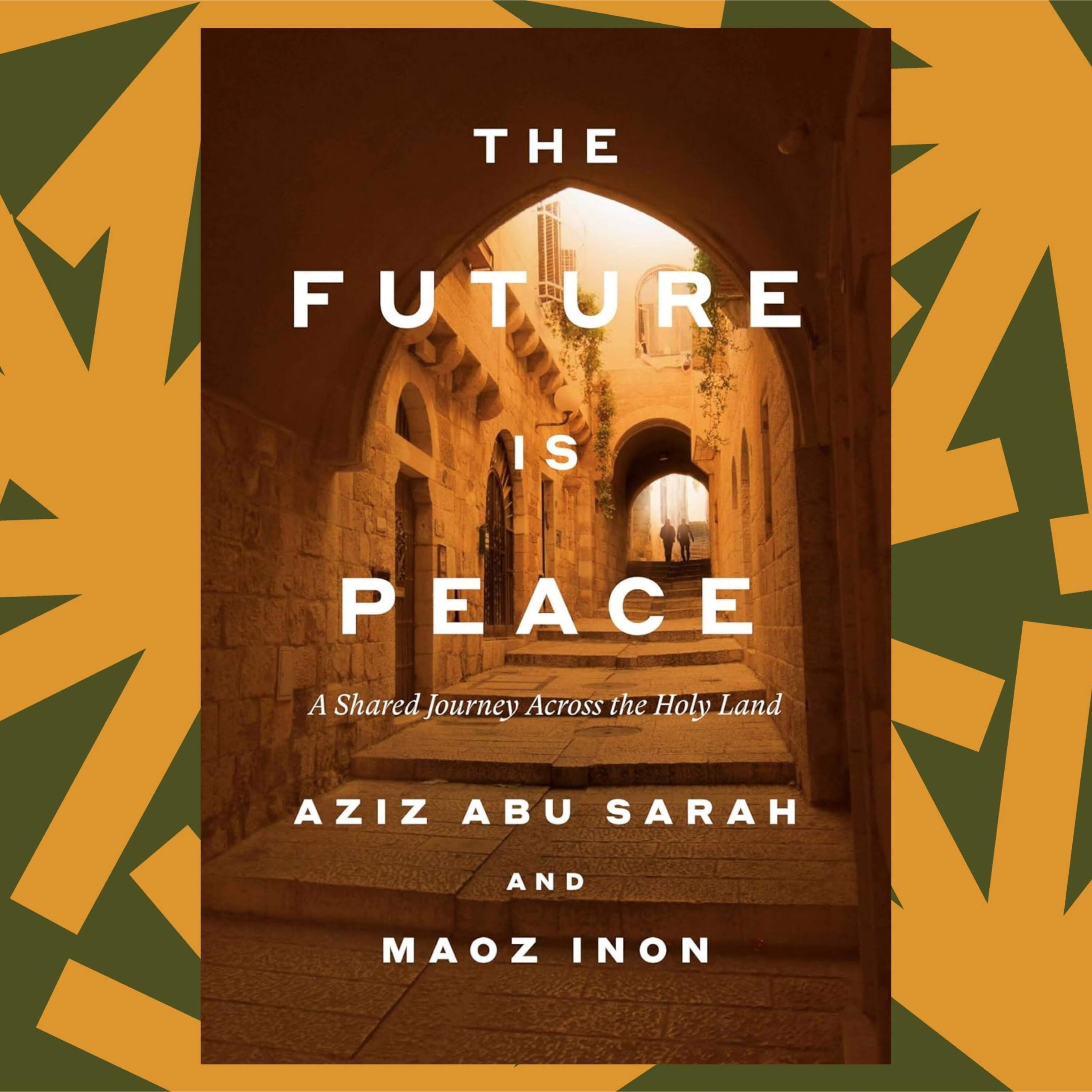
NPR's Book of the Day
In 'The Future is Peace,' tourism paves a way forward for Israelis and Palestinians
00:11:42
Loading summary
Transcript30 lines
- [00:02]
A
Hi, I'm Alyssa Nadworny, and you're listening to Book of the Day. Sometimes a book comes along that makes you question how you think about things. For me, the book was the Future Is Peace. It's written by two peace activists, one Palestinian and the other Israeli. Aziz Abusara and Maoz Inon experienced the killing of close family members during the Gaza war, and they both still want peace. How might this happen? The pair suggests through travel and understanding. They spoke with Here and Now host Indira Lakshmanan.
- [00:35]
B
This message comes from the Arbor Day Foundation. For more than half a century, the Arbor Day foundation and its global network of more than a million inspired individuals, businesses and community leaders have united behind the power of trees to help solve some of the planet's most pressing problems. From Michigan to Madagascar, the Arbor Day foundation is planting trees at the speed of a changing world in communities and forests across the globe. See how you can do your part@arborday.org NPR this message comes from NPR sponsor Carvana. Your time is worth more than a waiting game. Carvana gives you a transparent offer for your car in minutes and picks it up from your door. Sell your car today@carvana.com pickup fees may apply. This message comes from thumbtack Avoiding your unfinished home projects because you're not sure where to start? Thumbtack knows homes so you don't have to don't know the difference between matte, paint, finish and satin or what that clunking sound from your dryer is. With thumbtack, you don't have to be a home pro. You just have to hire one. You can hire top rated pros, see price estimates and read reviews all on the app. Download Today.
- [01:49]
A
How can we resolve the bitter, bloody conflict between Israelis and Palestinians and build bridges to a peaceful Middle east for all its people? That's a dream that Palestinian Aziz Abu Sara and Israeli Maoz Inon have each been working on independently for years. Neither of them is a diplomat or a politician. Both of them work in the travel industry. Both also suffered the horrific loss of close family members killed by the other side. Despite those tragedies, the two men have dedicated their adult lives to bringing Israelis and Palestinians together through tourism to build understanding and a peaceful future. And after the Hamas attacks of October 7, 2023, the pair took an eight day journey across the Holy Land to explore Jews, Muslims and Christians contrasting narratives over the disputed territory. They write about it in their new book, the Future Is Peace. Aziz Abu Sara and Maoz Inon join me in the studio now. Thank you both so much for being here.
- [02:51]
C
Thank you. Thank you.
- [02:52]
D
Thank you for having us.
- [02:54]
A
Maoz, we learn right at the beginning that your parents were murdered in the Hamas attacks of October. Sevent Kibbutz was stormed. They were shot. Their home was burned to the ground. Their bodies were burned beyond recognition. With such a loss, it would have been understandable if you had been angry or called for revenge. But lying in bed, as you mourned, you had a very different reaction. Can you please read to us what you wrote on page 12?
- [03:19]
C
Yes, of course. I could not tell if I was awake or dreaming. But through my tears, I. I could see all of humanity crying with me. Our bodies were wounded and broken from the wall. The ground was stained, rayed with blood. But as our tears fell down our faces and onto our bodies, they healed our wounds and made us whole again. Then our tears washed away the blood from the earth, purifying the ground. And on that ground, I could see a path. The path to peace and reconciliation. I woke up shaking in the dark. I reached for my phone and saw that I had a message. Maoz, I'm so sorry to hear about your parents.
- [04:12]
A
Thank you for sharing that. And I know it's still hard to talk about your parents death. Tell me how that message that Aziz sent you through the darkness really was the beginning of an incredible partnership.
- [04:24]
C
Yes. It was not just a message on messenger. It was a hand. Hand reaching out and saving me from drowning. And what I can only say now is yes, I lost not only my parents. I lost childhood friends. But I want Aziz. I want Aziz as a brother.
- [04:41]
A
And Aziz, when you were a child, your beloved big brother was killed by Israeli forces. You were understandably angry, but you eventually decided to forgive your brother's killers, even though they never asked for your forgiveness.
- [04:54]
D
It took me a few years after Taysir died. All I wanted to do is vengeance. But then, eight years later, I went to study Hebrew. And it was in that Hebrew class I met my Israeli teacher, who was a Jewish woman, who was the first person from the other side who smiled at me, who treated me as equal to the other students, who recognized me as a human being and recognized my Palestinian identity and talked about it. And at that point, I realized that this division of us versus them is a ridiculous one. That it's not Israelis versus Palestinians, but it's rather those of us who believe in justice, equality and peace versus those who don't.
- [05:33]
A
Yet, well, years before you two met, you had both chosen travel as a way to build understanding across cultural divides. Maoz, you opened a hostel in Nazareth, the largest Palestinian city. And Aziz, you run tours through the Holy Land guided by both Israelis and Palestinians. Talk about how the physical act of journeying can foster closer ties and greater understanding.
- [05:59]
C
Yes. It started for me with my own personal journeys that I took with my wife Shlomit. We traveled twice around the world, and the second time was the summer of 2014. We found ourselves staying with a family, indigenous family, in Ecuador. We learned about their lifestyle, their culture, heritage, food. And suddenly we realized that we know so much about indigenous communities all over the world, but we don't have even one Palestinian friend back home. We lived within walls, walls of ignorance. And ignorance is leading to fear, and fear is leading to hate. And hate is the reality we are all living within. So we decided to use tourism as a way to open gates.
- [06:41]
A
Now, Aziz, you also were running these tours led by Israelis and Palestinians together, to give not a single narrative of Holy Land, but contrasting or complementary narratives. And you write in the book that the small exchanges that come from having Israelis and Palestinians work on equal footing have become major acts of peacemaking. Give us an example or two of these small acts.
- [07:05]
D
Yeah. One of them, for example, in one of the elections, Israeli elections, some of our tour guides came to their Palestinian co guides and said, you don't have the right to vote in Israel, but Israeli policies affect your daily life. We will give you our vote. Wow. One of our tour guides, an Israeli Jewish man getting married to his fiance, an Israeli Jewish woman, and they were looking for a rabbi to officiate the wedding. Then the two of them realized our closest friend is not a rabbi, is a Palestinian tour guide. And they asked the Palestinian tour guide to officiate a Jewish wedding for two Israeli Jews. These are the stories that you never hear about that shows that the moment we get to know each other, work with each other, live in this kind of different reality, it changes everything. And we see each other as a partner, as an ally, instead of as an enemy.
- [07:58]
A
And Maoz, you talk about the cost of peacemaking in the book, and you say that in reaching out to the Palestinian community, you risk alienating yourself from your Jewish Israeli friends and neighbors. Can you talk more about that?
- [08:12]
C
Yes. Reaching out and partnering with Palestinians was considered a betray by many of my friends, colleagues, sometimes even family members who say to me publicly, they are the enemy. Normative life of Jewish Israelis. We are segregated in our education system, in our universities. I shared also in the book that in my primary school there was a written on the wall with the Jewish people. People without land came to a land without people. The Palestinian Akba, the Palestinian catastrophe of 48, is totally erased.
- [08:49]
D
I want to add just something to what Maoz said. I think betrayal in a time where there's so much pain, it's very easy for people to see any work together as betrayal. And I understand that with the suffering going in Gaza, I get similar responses to what Maoz gets. How could you do this? And the answer is, together we challenge injustices. Maoza and I are not just talking about peace. We want actions to bring that peace. And that action is partially through learning history.
- [09:21]
A
Well, I want to focus in on that because the two of you write in this book about the importance of understanding one another's narratives. On the one side, how the Palestinians need to understand and believe in the fact of the Holocaust, that 6 million European Jews were killed by the Nazis during World War II, and Israelis need to understand the Nakba, the mass displacement, dispossession of an estimated 750,000 Palestinians during the 1948 Arab Israeli War, and the establishment of the state of Israel. So, Aziz, let's start with you. You write that your own father asked if the Holocaust really happened.
- [10:01]
D
Yeah, my dad came to a peace meeting in which he asked if the Holocaust happened. And it was then that Ram El Hanan, an Israeli who's lost his daughter in a suicide bombing, whose father was in Auschwitz, stood up and told my dad that he would love to bring him to the Holocaust Museum with his dad. And he said, no pressure. You don't need to agree, you don't need to believe. Just come and listen. My dad agreed. But 70 other Palestinians in that gathering also agreed. It was not easy. People cried throughout the day. There were very hard questions and. But it also led to the Israelis coming to us after and saying, you took a very brave step, saying, we want to learn about your history. We want to do the same. Take us to a village that was destroyed in 1948, and we took them with Palestinians from that village. And the same was not easy. But we must have those conversations if we want to have real peace.
- [10:55]
A
And Malz, what about you? Do you worry that too many Israelis, including people you grew up with, ignore or deny the. The Nakba for a fact.
- [11:06]
C
They are ignoring the Nakba. And what we are offering in our shared work and in the future is peace. That we don't necessarily need to agree on the past nor on the present. They are two different realities. And they don't meet in the past and in the present, but they are meeting in the future. And this is why most of our book is focused on shaping and creating this future and reminding us all that we have the agency to change.
- [11:34]
A
Well, let me ask you both a quite difficult question. It's great to talk about peace, but is it possible and not a pipe dream?
- [11:42]
C
History proves that all conflicts end in the end. It doesn't matter if those conflicts took days, weeks, months, years, decades or centuries. History is with us. There are only two relevant questions, when will it happen and how many life will be lost?
- [11:58]
D
I worked in many conflict zones, and Mouse and I have been also doing our own work. We founded Interact, a joint organization to bring that peace. And one of the things we've been focusing on is learning from other places. Here's what the people Northern Ireland did. Here's what the people in South Africa did. Here is history from Egypt and Israel and how they managed to do a peace agreement in every one of those conflicts. If you went to people a month before an agreement has been signed and you ask, do you think it will work? And they'll say exactly what we hear today, it's impossible. And yet every one of them has been solved.
- [12:34]
A
That's Aziz Abu Sara, and we're also speaking with Mao Zinon. They're the authors of the Future's A Shared Journey across the Holy Land. Thank you both so much for coming in.
- [12:45]
D
Thank you. Thank you for having us.
- [12:57]
A
The world changes every hour. So do we. On NPR News now, the podcast that brings the latest headlines in five minutes with new episodes posted at the top of every hour. Clear fact based and ready when you are. Listen to NPR News now on the NPR app or wherever you get your podcasts.
- [13:19]
B
This message comes from US Bank Simplify how you do business with Business Essentials, a powerful combination of no monthly maintenance fee checking and card payment processing. Deposit products are offered by US bank national association member fdic.
- [13:35]
A
This message comes from Jerry. Are you tired of your car insurance rate going up even with a clean driving record? That's why there's Jerry, your proactive insurance assistant. Jerry compares rates side by side from over 50 top insurers and helps you switch with ease. Jerry even tracks market rates and alerts you when it's best to shop. No spam calls, no hidden fees. Drivers who save with Jerry could save over $1,300 a year. Switch with confidence. Download the Jerry app or visit Jerry AI, NPR Today.