← NPR's Book of the Day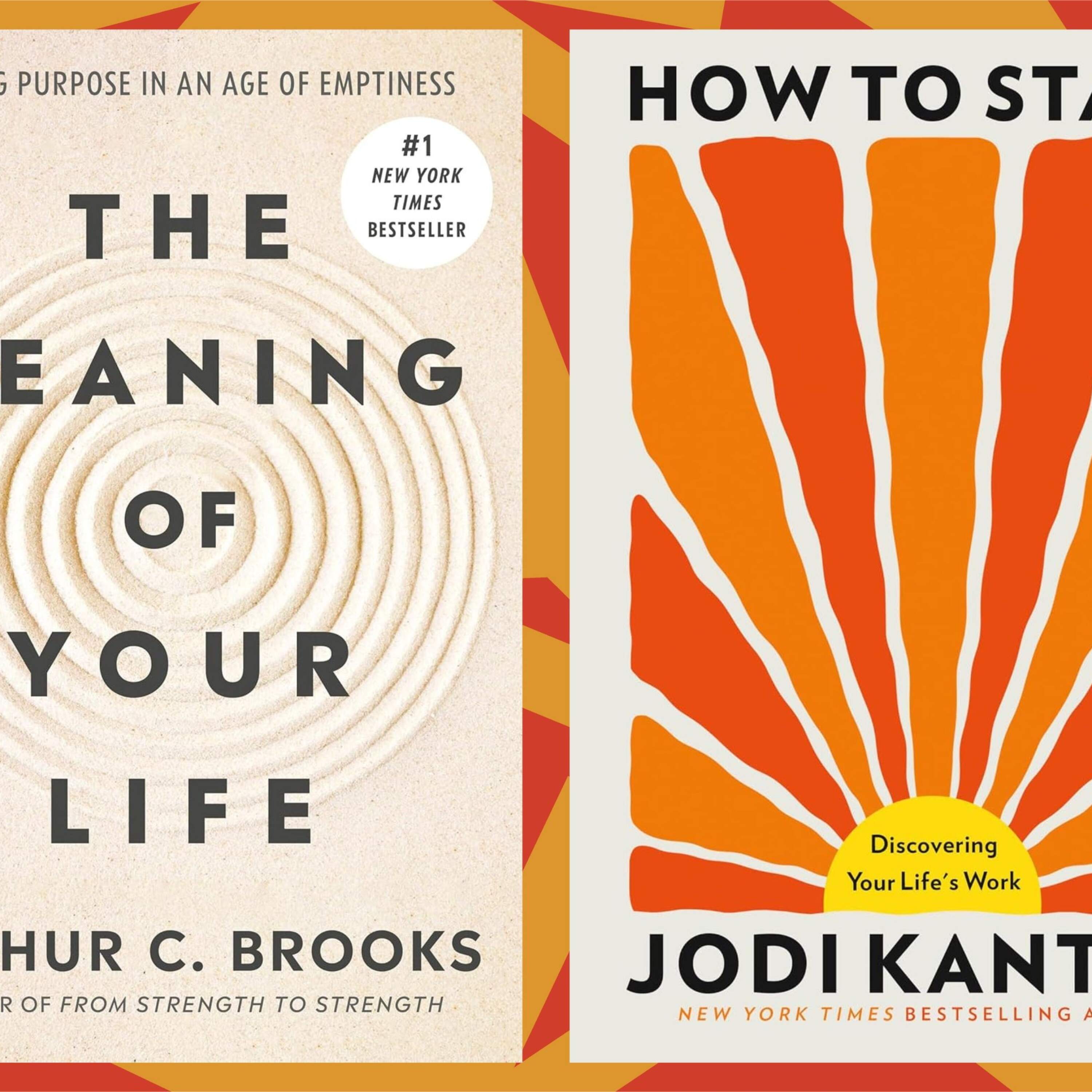
NPR's Book of the Day
Journalist Jodi Kantor and happiness expert Arthur Brooks on how to find purpose
00:20:19
Loading summary
Transcript50 lines
- [00:02]
A
Hello, I'm Alyssa Nadvorney, and you're listening to NPR's Book of the Day. Today, two books to help you live your life. In a minute, we'll hear from the incredible journalist Jodi Kantor, who adapted a graduation speech into a book called how to Start. But first, Arthur Brooks, who studies happiness at Harvard, has a new book about how our ambitions and drive might be getting in the way of finding true joy and in our lives. It's called the Meaning of your Life. Brooke spoke with here and now host Indira Lakshmanan.
- [00:36]
B
This message comes from NPR sponsor Carvana. Your time is worth more than a waiting game. Carvana gives you a transparent offer for your car in minutes and picks it up from your door. Sell your car today@carvana.com Pickup fees may apply.
- [00:52]
C
Ever feel like there's always something new that everyone's talking about? Ever feel like you're always out of the loop? Over at Pop Culture Happy Hour, the roundtable pop culture podcast we've got you every episode. We discuss everything, movies, books, games and shows so you'll never feel like you're missing any part of the conversation. Listen to Pop Culture Happy Hour only from npr, wherever you get your podcasts. What is the meaning of life? It may sound like a lofty, philosophical or even unanswerable question, but we all need meaning in our lives to get up every day and keep going. If you don't have a sense of purpose in your life, it's probably making you feel empty, anxious or depressed. Author, Harvard professor and happiness expert Arthur Brooks wants to help. In his latest book, Brooks argues that our tendency to be strivers working towards measurable goals often gets in the way of finding meaning in our lives. He also believes rapid technological changes have rewired our brains for the worse. Yes, he's talking about our ever present smartphones reducing our ability to find or perceive purpose and satisfaction.
- [01:58]
D
Action.
- [01:59]
C
Arthur Brooks new book is called the Meaning of youf Life and he joins us now from NPR New York Studios. Welcome, Arthur.
- [02:05]
B
Hi, Indira. Great to be with you.
- [02:07]
C
Great to have you. So you've written bestsellers about finding happiness, purpose and success before, including your last book, co authored with Oprah Winfrey. Why this book now? What's new?
- [02:18]
B
Well, I've been studying happiness my whole career for decades, as a matter of fact, and and over the past seven years I've been exclusively dedicated to teaching it to my students at the Harvard Business School and the Harvard Kennedy. And there's a particular crisis that I have seen, especially over the past 10 years. There was a major explosion in depression and anxiety after about 2008. Now, I left academia temporarily at the end of 2008, and when I left academia it was happier than the rest of the world. I mean, the statistics were clear. People went to college, they were having fun, they were making friends, they were falling in love. And when I came back in 2019, it had completely darkened. And what I found was that depression had trip anxiety had doubled, that loneliness had exploded, that addiction was up, that self harm was more common than it had ever been before. And the reason had everything to do with this link. There's an interesting set of statistics that asks, does your life feel meaningless? The best predictor of depression and anxiety for people under 30 is an answer yes to the question my life feels meaningless.
- [03:27]
C
Many of the people you cite in this book, including the great Russian novelist Leo Tolstoy, author, are or were highly ambitious people with the outward trappings of success who nevertheless feel dissatisfaction in their lives. You talk a lot about high achievers, people you call strivers, who are nevertheless unmoored from meaning. It felt to me as if you were talking directly to many of the students you teach at Harvard.
- [03:51]
B
Yeah.
- [03:52]
C
So what is afflicting ambitious young people today?
- [03:56]
B
The culture of engineering, hustle and grind, constant busyness, plus this whole idea that there's a complicated solution to every problem and that's what you need to be in the business of finding. The result of that is that there's been a de emphasis on the meaning rich parts of life, like the humanities, like the arts, like philosophy. And we've been upskilling in areas of study that use our brains in a very asymmetric way, that use our brains only for the how to and what questions, and almost not at all for the why questions of life.
- [04:32]
C
Well, you point to a major distraction in our lives that we're all familiar with, our smartphones.
- [04:37]
B
Right. To understand the real root of the problem gets to a very interesting area of neuroscience today called hemispheric lateralization. The two sides of your brain do different things. The right side of your brain is dedicated to the why questions of life. The mystery, the meaning, love and happiness. What's it all about? The left side of your brain is dedicated to the how to and what questions, the how do I do stuff questions. So ChatGPT is good for improving the left side of your brain, and it's horrible for anything having to do with the right side of your brain. This is one of the reasons that if you use it as a friend or a lover or a therapist, you'll get way more depressed and anxious and lonely. But if you use it to, you know, figure out ordinary stuff in life and then use the time that you have left to go hang out with your friends, life gets better just in general. Indira, Any technology that is a substitute for in real life, socialization is going to hurt your happiness. And so, in our efforts to solve every problem and distract ourselves from encroaching misery in our lives, enter the smartphone, which has made it possible for us to solve the problem of human boredom, which, by the way, illuminates the right hemisphere of the brain and helps us find meaning through mind wandering. We literally need to be bored. Well, we wipe that out and guess what? All day long, 205 times a day on average, we pull up the smartphone to distract ourselves. What we've done is we've sent ourselves over to the left side of our brain and have increasingly neglected the right side of our brain where meaning can be found.
- [06:16]
C
Okay, so in practical terms, if we want to do a digital detox and you're promoting something that might surprise listeners, which is boredom, as a way to help us search for meaning, give us a couple quick tools of how we would do a digital detox and not cut ourselves off from society, society and work, and yet allow ourselves to be away from the infinite scroll and open to boredom. That could help us grow and feel more creative and help us find that meaning you're talking about.
- [06:46]
B
I recommend three things that are based in really the cutting edge studies in this area at this point. Number one is not looking at your phone for the first hour of the day, which means don't have it by the side of your bed. That neurocognitively programs you for the day and very, very positive ways. I recommend going for a walk, and I recommend doing that at least a half hour before dawn. That's called a brahma muhurta in Sanskrit. An ancient Vedic idea that there's special properties of getting up before the dawn. It's interesting because new neuroscience research absolutely backs this up. The best way to start your day is to get up before dawn and ambulate. And you'll wreck it if you've got your devices. So that's part one. Part two is not having your devices during meals. Homo sapiens are evolved to stimulate oxytocin, which is a neuropeptide that functions as a hormone. When we're looking into each other's eyes and putting, I don't know, pieces of yak meat into our mouths, Around a campfire or something. This is like in the late Pleistocene. This is how we knew our kin was, by talking and eating together. But if you're at the dinner table and you have your device on the table, even face down, by the way, it will cut your oxytocin flows, because you'll be thinking about your notifications or if somebody's texted you something you don't really care about, by the way, but it will interrupt the flow of oxytocin that actually comes from the interaction with people in real life. Last is the last hour of the day. And this is really important for the proper functioning of the pineal gland, which produces natural melatonin. It's also really important for your relationships. This is like a marriage saving device. Is putting away your device an hour before you go to sleep. Just those three things, Indira, and you're gonna start feeling your life changing.
- [08:28]
D
Wow.
- [08:28]
C
Okay, I'm gonna have to take up some of this advice. Being someone in the news. The first thing I do in the morning is read the news on my phone. The last thing I do before I go to sleep is read the news to make sure
- [08:40]
B
you gotta stop. I give you permission.
- [08:45]
C
Well, I mean, one of the things that comes through in your book is you talk about the three big questions that we have to ask ourselves. First, why do things happen in my life? Second, why am I moving in this direction? And third, why does my life matter?
- [08:59]
B
These three questions actually correspond to the three macronutrients of meaning. So when I say that's obviously a metaphor. Macronutrients are protein, carbohydrates, and fat, which are the three parts of food. And the macronutrients of meaning are coherence, purpose, and significance. Coherence is, why do things happen the way they do? I gotta have an explanation. You know, some people answer that with religious answers, some people with scientific answers, some people with conspiracy theories. The second is purpose, which is not the same thing as meaning. Purpose is, why am I doing what I'm doing? What are my goals? What's my direction in life? One of the things that we find in experiments on undergraduate students, you can remarkably enhance the happiness vis a vis meaning, which is one component of happiness for undergraduates. By giving them a random goals, like, you know, what are you getting in math? What are you getting in your calculus class? I don't know, B minus. Your goal is B plus. And just that goal suddenly just makes him come alive because that gives him an answer to the question, why am I doing what I'm doing? Just that purpose is so important. And last but not least is the most important of all, which is significance. It's kind of the It's a Wonderful Life question. You know where Jimmy Stewart at the end of that movie is? Actually, the movie is about the fact that he's about to end his life, and then Clarence the angel comes and finds him and shows him how bad everybody else's life would have been if he'd never been born. You need to know that people's lives are better because of you. So if you never even ask these questions, you're just gonna be sitting on the left side of your brain saying, well, I wonder what's in the news and wonder if I. What's happening in my feed, and maybe I should swipe right on this person and maybe I should do some gaming and, oh, there's my job on Zoom. And it's like life in the Matrix. It's not meaningful.
- [10:44]
C
Arthur, in your last chapter, you have suggestions about having a more harmonious, interior life. Would you share a few of those
- [10:52]
B
with Recommend that people actually take a significant break from their devices if they can, and actually do what I call a pilgrimage. Not to find the solutions to problems, but to let the solutions to problems find them. I've literally done this at the most difficult periods of my life. I've walked the Camino de Santiago across northern Spain twice. And it's been tremendously inflecting to me because it became this pause, this parenthesis in my life, and it also walking, walking, walking, walking hundreds of miles. In that particular case, it actually softens you up, up. But there's also kind of virtual versions of this, by which I don't mean online. I mean not necessarily walking. It's taking a space in your own life where your whole goal is to be thinking about these bigger parts of your life, to be listening for the information that actually might reach you, to actually put away the distractions, the constant distractions that are shutting down the right side and opening up the left side. Maybe doing this actually with the closest set of friends. But what we have to do, Indira, is live on purpose. That privilege that we have of distracting ourselves constantly has turned into the curse of feeling like life is meaningless.
- [12:01]
C
Author and Harvard professor Arthur Brooks. His new book is the Meaning of youf Finding Purpose in an Age of Emptiness. Arthur, thank you so much for joining us.
- [12:10]
B
It's my pleasure. Thank you for having me.
- [12:13]
A
In just over 100 pages, journalist Jodi Kantor offers her take on how to discover what you want to do in your life. She focuses on finding what you love and honing. Honing your craft meant originally for recent college grads. I found even for a mid career correspondent, the book inspired me and gave me just a smidge more clarity on how to live a fulfilling life. Kanter spoke about her new book, how to Start with All Things Considered. Host Mary Louise Kelly.
- [12:42]
D
Last year, the journalist Jodi Cantor faced an unenviable assignment. She'd been invited to deliver the commencement address at Columbia University, her alma mater. So a huge honor. But Recall, recall that 2025 had seen Columbia and other campuses convulsed by protests over the war in Gaza. And then President Trump had launched his assault on higher ed, cutting hundreds of millions in federal funding to Columbia. The school, according to Cantor, had an air of doom. So what to say? How to offer hope. What she came up with became the seed for a book advice for launching a career, indeed, launching a life in uncertain times. It's titled how to Start. Jodi Kantor, welcome back to All Things Considered.
- [13:28]
E
Thank you for having me.
- [13:30]
D
So this book was born, as you put it, with an invitation onto a battlefield. Say more about what that felt like you were walking into delivering the commencement address.
- [13:40]
E
Oh, when I got the invitation, my friends were like, call in sick. Don't go. You're gonna get booed. But my response was a little different. Mary Louise I felt like, give me those kids for 15 minutes because I'm a mom and I'm a Columbia alum. And I was just concern about the level of negativity and rancor. And then the students gave me an incredible assignment. They gave me the gift of a very hard question. They said, we chose you because of your career and our entire class. No matter our political differences, we are actually unified in anxiety over one question, which is in this crazy environment, how do we find and start our life's work? And you know, I'd been speaking to students for years, visiting a lot of campuses. And what I understood was that their question was generational. The workplace is changing. It's becoming digitized, applying for a job. People your and my age need a real memo and update on what's going on out there.
- [14:48]
D
You just said you were told they chose you to deliver the commencement address because of your career. And I will fill in by way of backdrop, your career, your day job, as you are a reporter at the New York Times. So I gathered to come up with what you were gonna say at the graduation speech. You started reporting. Let's get to what you came up with. And I realized it's a whole book and I encourage people to read the whole book. But it boils down to two words, just in a few sentences. Talk to me about craft and need. Start with craft. What do you mean by that?
- [15:21]
E
So I want to give young people two things to look for and listen. The workplace is changing. We don't know what the workplace is going to look like in five or 10 years. So we have to work with very durable and time tested materials. Let's start with craft. I looked around my life, I looked around all the people I'd covered over the years and I said to myself, you know what? The really happy and successful people are practicing a craft. They know how to do something that other people don't do. It's skill, it's expertise. I mean, Mary Louise has listened to, you know, all of your radio work over the years. Look at the way a surgeon repairs somebody's body. Look at the way a really expert advertising executive crafts a campaign. You want something like that, that you
- [16:08]
D
skill set a toolbox that, that you have to develop over years that other people don't have.
- [16:14]
E
Exactly. It's a slow accumulation. And the reason you want that is that a, the mastery is like very satisfying and enjoyable. And also it protects you a little bit against the cruelties of the job market. I mean, the employment world is ugly. Any of us can be fired at any time, but your craft can never be taken away from you.
- [16:35]
D
And then the flip side, the other piece is need. Meaning what? Figure out what society is gonna need over the next four or five decades of your primary working life.
- [16:47]
E
Correct. If craft is authority, need is propulsion. Part of the way I came up with need is that I saw this like procession of bad advice over the course of my lifetime, over the thing you quote unquote have to go into. When I was in high school it was learn Japanese. Like the Japanese are going to take over the world economy. And if you don't speak Japanese, you're in trouble. You know, then it was genetics, then it was learn Mandarin and then more recently it's been computer science.
- [17:18]
D
Yeah, coding. You have to know how to code. I still don't know how to code.
- [17:22]
E
Listen, all of these pursuits are great, you know, these are all wonderful things to study, but they're not golden tickets. And you should only do them if you're really passionate about them.
- [17:34]
D
And you invite us toward the end of the book to picture a room. And I loved this image. Like picture ourselves a few years from now walking into a room, just pick up the story there Cause you write it. It could be an art studio. It could be a hospital operating room. I guess for you and me, it was a newsroom. Mm.
- [17:55]
E
Here's why I'm describing the room. Because I see how negative the messages are about work right now, and some of those are true. But the workplace can also be a place of growth and wonder and fellowship and progress and even protection from negative forces in the outside world.
- [18:23]
D
When you describe this room to the young people you're talking to, do you get any pushback with people saying, that must have been nice. But those rooms, they ain't here anymore. They're gone. Like the whole world feels scary. The whole workforce I thought I was prepping for is crumbling. Did you get that pushback, and what would you say?
- [18:42]
E
A little bit. I mean, Mary Louise, I have to be honest with you. When I was a senior at Columbia, I was kicked off the Columbia Daily Spectator. Not only did I think I couldn't succeed.
- [18:57]
D
I'm sorry to laugh, but it turned out okay.
- [19:00]
E
But. But young Jody had actual evidence that she could not succeed as a journalist. Right. And I never could have anticipated the places where work would bring me how much better I would get at journalism. What the. I didn't even really understand that journalism was a craft that you worked at for many, many, many years. And so, having experienced some of those satisfactions for myself, I really, really want them for other people.
- [19:36]
D
Did you send a photo of your Pulitzer to the Columbia student journalism newsroom?
- [19:42]
E
No, but they keep asking me to speak at fundraisers for the Columbia Daily Spectator. So I have decided that the mature Jody should not hold a grudge and, of course, should help student journalists.
- [19:58]
D
The book is how to Start. The author is New York Times investigative reporter Jodi Cantor. Jodi Kantor, thank you.
- [20:05]
E
Thank you so much.
- [20:10]
A
That's it for this week on NPR's Book of the Day. Let us know what you think you can write to us@bookofthedaypr.org I'm Alyssa Nadworny. The podcast is produced by Chloe Weiner and edited by Megan Sullivan. Our founding editor is Petra Mayer. The show elements for this week were produced and edited by Courtney Dorning, Elena Burnett, Karen Zamora, Melissa Gray, Danny Hensel, Todd Mundt, Emiko Tamagawa, Jason Fuller, Dave Blanchard, Lee Hale, Courtney Theofin, and Summer Tamad. Yolanda Sanguini is our executive producer. Thank you for listening.
- [20:59]
B
This message comes from Lisa from Night One. You'll feel the difference. Premium materials that deliver serious comfort and full body Support. Go to Leesa.com for 25% off mattresses, plus get an extra $50 off with promo code NPR.