← NPR's Book of the Day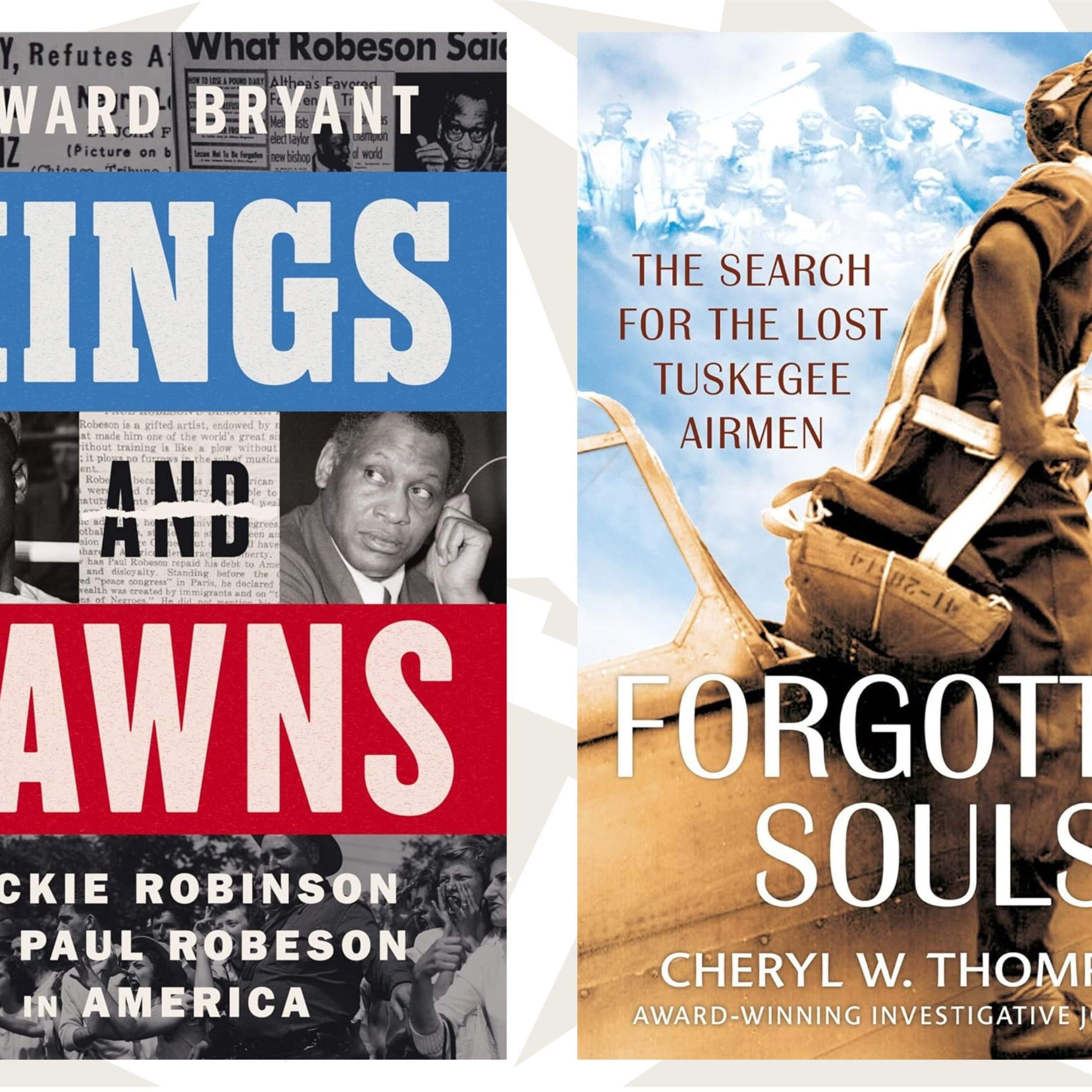
NPR's Book of the Day
Two new books take on lesser-known chapters of WWII and Cold War-era Black history
00:16:45
Loading summary
Transcript55 lines
- [00:02]
A
Hey, it's NPR's Book of the Day. I'm Andrew Limbong. We are currently in Black History Month, and we've got two books for you today that, yeah, you'll probably find them in the history section, but they both make a point of grounding themselves in the present. In a bit, we'll hear about the 27 Tuskegee Airmen who went missing during flights overseas. It's a book of reporting that would not be possible if not for the records and letters passed down from generation to generation. But first, sports writer Howard Bryant has a book out about two civil rights figures who are pitted against each other on the national stage. The book is titled Kings and Jackie Robinson and Paul Robeson in America. And while the book is set in the late 1940s and early 1950s during a period known as the Red Scare, and Robinson and Robeson are both long gone, Brian tells npr Scott Simon, that a critical character in the story is Jackie Robinson's widow, Rachel Robinson, who is still alive today.
- [00:59]
B
Today.
- [01:00]
A
How's that for the past not being all that past? That's after the break.
- [01:05]
C
This message comes from Sony Pictures Classics presenting the President's Cake. A young girl in Iraq has been selected to prepare a cake to celebrate the president's birthday. She sets out on a journey in search of the ingredients. Written and directed by Hasan Hadi, Variety raves. A compassionate, winsome debut packed with an unassuming punch, now playing in select cities.
- [01:29]
D
This message comes from Carvana, who makes buying and financing your next car easy. Thousands of vehicles, terms up front and 100% online, even get it delivered to your door. Buy your car the easy way with Carvana. Delivery fee may apply.
- [01:44]
E
Jackie Robinson and Paul Robeson were both heroes. Robinson, the great athlete who broke baseball's color barrier and inspired millions across America with his courage. Under a hail of hatred, as Count Basie's band sang to me, Jackie Robinson hit that ball.
- [02:04]
F
It went zooming across the left field wall. Yeah, boy.
- [02:08]
E
And Paul Robeson, who'd been a college football star, then played in the NFL while he went to Columbia Law School and would become one of the most admired bass baritone singers in the world.
- [02:20]
G
Old man river at home and river, he must know something.
- [02:29]
E
Both men were mighty advocates for equal rights. Though they never met, they were brought into public disagreement during the period of McCarthyism and what became known as the Red Scare. Howard Bryant, who talks about sports on our show, has a new book, kings and Jackie Robinson and Paul Robeson in America. And Howard joins us now. Thanks so much for being with us.
- [02:52]
G
Thanks for having me, Scott.
- [02:53]
E
Howard, please set the scene for us. July 1949. Why was Jackie Robinson asked to appear before the House UN American Activities Committee?
- [03:02]
G
It was a time when the Cold War was beginning to ramp up to a point where for the next 40 years, where the United States and the Soviet Union were mortal enemies. The great Robeson had given a speech saying that he thought it was unthinkable that the African American community would fight on behalf of the United States or something to that effect when the Soviet Union had lifted up non white people to a state of humanity or a place of humanity. Now, he had never said those words. He had been quoted by the Associated Press. And the response, of course, was extremely vocal against. And the response was to find an African American to counter Robeson's speech. I have to remember that Paul Robeson was one of the most famous, if not the most famous black American in the world at that time. And the House UN American Activities Committee went to Jackie Robinson, who at that time was also the most famous black person in America, to testify against Robeson. I haven't any comment to make except that on that statement, except that if Mr. Robeson actually made sounds very silly to me, but he has a right to his personal views, and if he wants to sound silly when he expresses them in public, that's his business and not mine.
- [04:31]
E
Howard, what was the effect?
- [04:33]
G
The effect was extremely damaging to Robeson. His personal status had been declining anyway. But Jackie's testimony really did turn the rest of the country against Robeson, whatever was left of Robeson's reputation.
- [04:49]
E
I know, I feel compelled to point out, I mean, of course, Jackie Robinson, who had served in the US army, was also briefly court martialed for refusing to move to the back of a bus on an army base in Texas. I mean, he was not a pushover for anyone.
- [05:04]
G
No, and that's the hard thing about this. I think what I was trying to get at in this project was you have these two gigantic figures and both of them were in this position of advocacy for their people. And the most compelling thing I found here was the lengths that both of them felt like they had to go, only to end up really disillusioned by the time they reached the end of their lives because neither one sort of felt as though they accomplished that goal.
- [05:37]
E
I have to ask, in these times, why didn't Paul Robeson denounce the rule of Joseph Stalin, especially after the Soviet Union itself exposed some of the cruelties of Stalin's regime?
- [05:51]
G
I think part of it is Pride. The pride of being a ball player, of being that Robeson believed that the United States had blood on its hands as well. And he said so in his own testimony to Huac in 1956, where you've killed 60 million of my people, and I'm not going to discuss this with you. And I think he felt like there was no. That the motivation of the committee was simply to get him to admit he was wrong about Russia, when what he wanted was for the United States to admit that it had been wrong in what it had done to African Americans, and also out of pain. I think that the Robeson piece of this was very, very painful, too, because he believed in the Soviet experiment like a lot of people did. And I think that in a lot of ways, it was sort of like a man without a. He had believed in this new experiment in Russia just as he had once believed in the experiment in the United States. And both, I think, had sort of betrayed his ideals.
- [06:51]
E
You write today that the US Might be going through a period of retrenchment similar to what we saw in the years of the Red Scare.
- [07:01]
G
Well, that's right. Well, so much of the playbook today feels like the. The second Red Scare. You have the attack on left wing and progressive politics. You have the attack on the arts and the defunding of the arts, the vitriol. The sort of. The language that we hear today is very similar to the language that we were hearing then. And it was fascinating to me how the parallels feel even more and more urgent. You know, what is past is prologue.
- [07:32]
E
Two great men, Jackie Robinson and Paul Robeson, had tough later years, didn't they?
- [07:37]
G
They did. And I think that I felt such compassion in a lot of ways for both of them, for these two great men. Robeson lost everything and had been forgotten in a lot of ways. And there was. And that has translated into today as well. I mean, he is. When I talk to young black kids about Paul Robeson, when I talk to black people about Paul Robeson, my age, they don't know who he is. And when I think about Jackie, it's somewhat similar, even though, of course, he remains an icon and people know the name Jackie Robinson. But what they don't know is that, you know, the disillusionment that he felt. So it's this really sort of bittersweet story. And also inspiring to me, though, of these two people who did everything that the United States had asked of them, and yet both wound up in a. In a very disillusioned place.
- [08:28]
E
Rachel Robinson, bless her still with us 103 years old. Scott maybe we should end with how she sees it.
- [08:35]
G
Rachel Robinson is such an important character in this book and in the story of Jackie Robinson. People need to know that when Jackie, for everything that we talk about today, baseball was tired of Jackie Robinson. The sport could not wait to get rid of him. The Dodgers traded him to the hated giants in 1956 at the end of the season. They were tired of him fighting for civil rights. They were tired of him complaining about the American racial order. If it's not for Rachel Robinson and her charm and her intelligence and her determination to restore Jackie's reputation and her grit, she's the one who brought Jackie back. She's the one who went to the Dodgers. She's the one who went to major League Baseball and said, don't forget this man. And so to me, there's no telling this story of Jackie Robinson and his place in American history right now without Rachel. Rachel is really the one who made it happen.
- [09:36]
E
Howard Bryant, talk to you next week.
- [09:39]
G
My pleasure, Scott. Thank you.
- [09:41]
E
His new book, kings and Jackie Robinson and Paul Robeson in America.
- [09:46]
C
This message comes from Wayfair. The new year is here. Wayfair's huge selection of home decor items makes it easy to elevate your space and find exactly what's right for you. From bedding and mattresses to storage solutions for every room in the house, Wayfair is your one stop shop, get organized, refreshed and back on track this new year. For way less, head to Wayfair.com to shop all things home. That's W A Y F A I R.com Wayfair Wayfair Every style, Every home.
- [10:20]
A
Cheryl W. Thompson is an investigative journalist here at npr, and her book, Forgotten the Search for the Lost Tuskegee Airmen is a result of present day reporting. Talking to people, picking up the phone, she talks to NPR's Aisha Roscoe about the value in showing people that the loved ones they lost long ago are not forgotten. Here's Aisha.
- [10:43]
B
The Tuskegee Airmen are now celebrated as true American heroes. These black men fought in World War II for a country still brutally segregated that treated them as less than full citizens. Later, these men who shattered the color line as combat pilots were awarded some of the nation's highest honors. But some never got to see any tributes. They never made it home. A new book tells the stories of the 27 black airmen who went missing during flights overseas, leaving their families forever changed and still looking for answers. NPR investigative correspondent Cheryl W. Thompson is the author of Forgotten the Search for the Lost Tuskegee Airmen, and she joins us now. Welcome to the program.
- [11:32]
F
Hi, Aisha. Thanks for having me.
- [11:34]
B
First, I want to talk to you about how this book, it really shines a light on the lives of these men. Was there anything that surprised you about their personal lives when you started doing this research?
- [11:46]
F
I think the one thing that surprised me most was really how young they were. But in their, in their letters and in their conversations with relatives, they seem so much older because they had to grow up so quickly. But most of them were fresh out of college. The oldest one was 28. The youngest one I believe was 20. The other was just the kind of lives they led before they went off to war. I don't think any of them were wealthy. They came from all over the country. You know, they were just these typical sort of starry eyed men who just wanted to serve this country and do something good.
- [12:25]
B
Yeah. And I mean, I found it so powerful to hear from some of these pilots in their own words through their letters to their loved ones. And could you read a letter from John Henry Chavis? He was writing to his mother about his soon to be bride who he called Cookie.
- [12:44]
F
Okay, I'm still a very lucky guy. Look at the nice letter I got from her mother. The next time you talk to Cookie, be sure to welcome her to the Chavis family. By the way, when are you going to congratulate me? I'm sure you're happy over my having such a perfect girlfriend.
- [13:06]
B
How did you feel going through these personal effects and like, how did you get this letter?
- [13:10]
F
So I got this letter from Chavis nephew and niece. You know, I got lucky. You know, journalism is a lot about luck, but writing this book was a lot about luck too, because so many of these relatives actually kept or were handed letters, were handed down from other relatives to them and they just, to their credit, they kept them reading that.
- [13:32]
B
Letter from Chavis filled with all of this hope and joy. The other part of the book is that it makes it really sad when you learn of the tragedy of his disappearance on a mission in February 1945. The military blamed engine trouble for Chavis's plane going down. But as the book shows, like, there is often just a lack of clarity about what happened when these pilots went missing. Or was that just a feature or like just the nature of war at that time? Were these type of crashes common?
- [14:09]
F
Well, you know, there was a lot going on because there was a war going on. But I think that the black Pilots were ignored more than others. You know, if they went down in enemy territory, the government said, well, it was, you know, it was too dangerous for us to go and search for them. Okay, fine. But then there's after the war.
- [14:31]
A
Yeah.
- [14:32]
B
I mean, talk to me about the impact on the families. You know, they would get the telegram that their loved ones were mia, and a year later, they would be declared dead. And how did they deal with just the not knowing?
- [14:46]
F
I don't think, and I think I'm safe in saying this for the families I met with and talked to repeatedly. They never got over it. Right, they never got over it because some of them still have siblings and they're in their 90s now. And it destroyed their parents, not only moms, but dads as well, who just, you know, there was one father who just didn't want his son to be in the. And to go off to war.
- [15:12]
B
He didn't want him to go.
- [15:13]
F
He didn't want him to go because.
- [15:14]
B
He knew he didn't want to lose them.
- [15:16]
F
He didn't want to lose them, and he lost them. And for the children. Right. Because some of them had children. The oldest one I found at the time her dad disappeared was 3, and she's now 84. And she has said to me, and I talked to her just the other day because I keep in touch with these families because it's sort of like, you know, when you spend time with these people over years, you just have a relationship. You develop some kind of relationship with them. And she says, you know, I'm still waiting. I'm hoping that one day, you know, somebody will knock on my door and say, we found your dad.
- [15:57]
B
Why do you think this hasn't been talked about more? I mean, I feel like we hear. Not saying that we could ever hear enough about the Tuskegee Airmen, but we. We hear about the honors. We, you know, they, you know, in the State of the Union, they're getting honor at the White House. But why haven't we talked more about those that were lost and their remains were not found? Why. Why have we not talked about that?
- [16:18]
F
That's a good question. That's a. That's a question you should pose to the government and asked them, like, what are you guys doing? Why hasn't this come up? Because, I mean, they were honored, you know, back in. I want to say it was 2007 by the Bush. George W. Bush White House when they got the Congressional Medal of Honor. And so those who were still around, of course, went to the White House and they were very touched by it. The families I got to know, I think would be happy with someone knocking on their door, picking up the phone, saying, you know what? We haven't forgotten about your dad, we haven't forgotten about your brother, we haven't forgotten about your uncle something. But to have crickets is probably the most hurtful thing for them.
- [17:03]
B
That's Sheryl W. Thompson. She's our colleague here at NPR's investigative unit. Her new book is Forgotten the Search for the Lost Tuskegee Airmen. Cheryl, thank you so much.
- [17:15]
F
Thank you, Aisha, for having me.
- [17:18]
A
And that's it for this week on annapair's Book of the Day. Let us know what what you think you can write to us at Book of the day, pr.org I'm Andrew Limbaugh. The podcast is produced by Chloe Weiner and Ivy Buck and edited by Sarah Crawford and Megan Sullivan. Our founding editor is Petra Mayer. The show elements for this week were produced and edited by Melissa Gray, Danny Hensel, Emiko Tamagawa, Todd Muntz, Elena Tork, Ashley Brown, Lena Muhammad, Gabe O', Connor, Jacob Fenston, Ryan Behnken, Ed McNulty. Yolanda Sanguini is our executive producer. Thanks for listening.
- [17:58]
D
This message comes from Capella University. That spark you feel, that's your drive for more. Capella University's flexpath learning format lets you earn your degree at your pace without putting life on pause. Learn more at Capella.
- [18:11]
C
Eduardo this message comes from NPR sponsor netsuite. Every business is asking the same question, how did they make AI work for them? With Netsuite by Oracle, you can put AI to work. Today, NetSuite is the number one AI Cloud ERP, trusted by over 43,000 businesses. It's the unified suite that brings your financials, inventory, commerce, HR and CRM together. If your revenues are at least in the seven figures, get the free business guide Demystifying AI@netuite.com story.
- [18:48]
D
This message comes from BetterHelp. During February, it can feel like everyone has it all together in their love lives, but the truth is most people are still figuring it out. Take the pressure off and feel lighter in therapy. Visit betterhelp.com NPR for 10% off.