← Office Hours with Arthur Brooks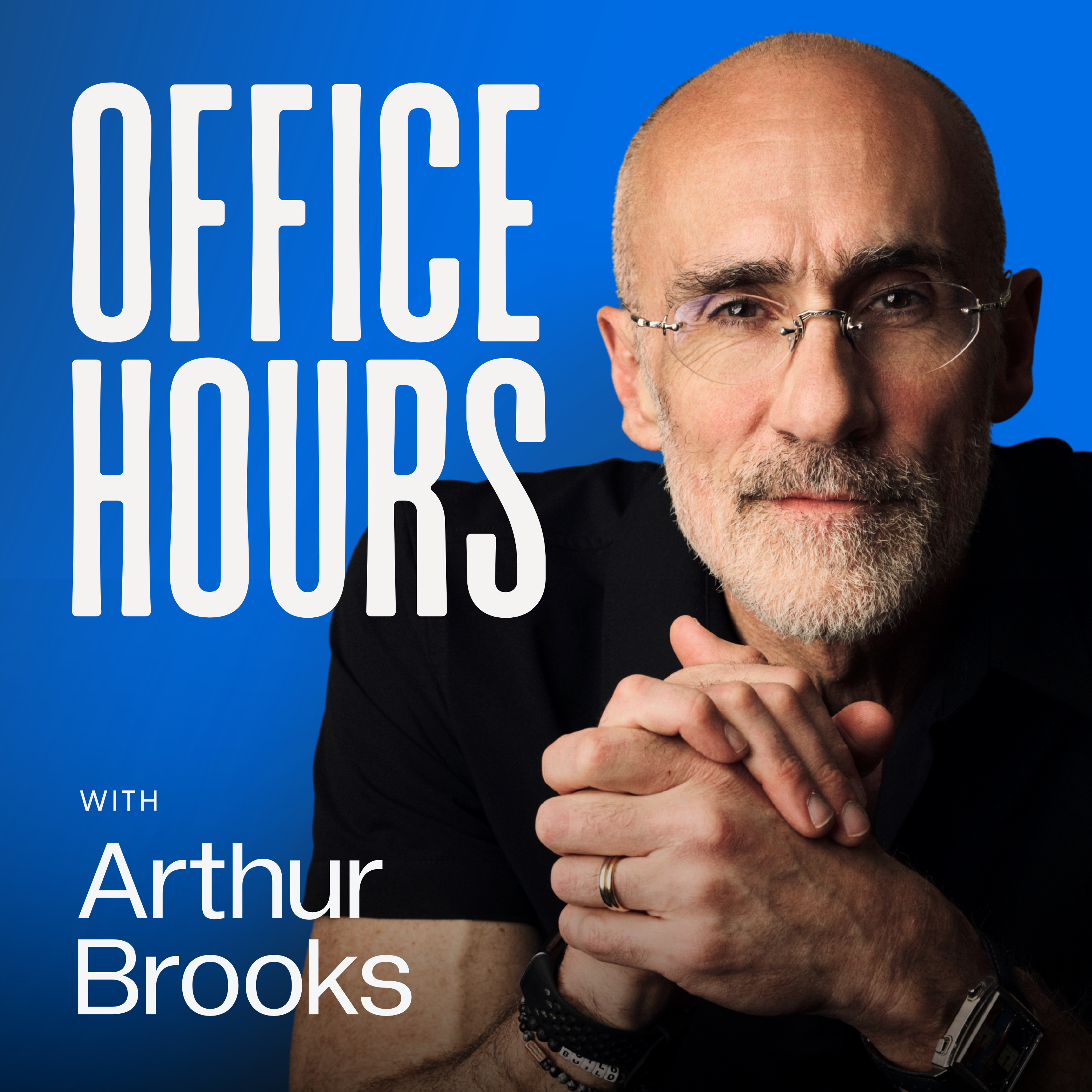
Office Hours with Arthur Brooks
Fame ruined me, but faith saved me: Office Hours meets The Office, with special guest Rainn Wilson
01:07:17
Loading summary
Transcript166 lines
- [00:00]
Arthur Brooks
You've opened the aperture for a lot of people to take spirituality and religion more seriously, notwithstanding their own views. Is that fair?
- [00:07]
Rainn Wilson
Boy, you summarized it so perfectly. This generation, especially in their 20s and 30s, are really wrestling with this mental health epidemic. And I believe very strongly that there are spiritual tools and solutions to help one address imbalance, anxiety, loneliness, disconnection, depression. Ultimately, this is kind of a fracture in the west around religion. And religion is not something that one believes. It's not just like, oh, I believe this. It's what you do. Being a person of faith is shown in your actions, not in, like what you would write down on a piece of paper that you believe about Jesus or Muhammad or the Buddha or, you know, the universe. Worship is in action. Abdul Baha, the son of Bahaullah, says, strive therefore, day by day, that your actions may be beautiful prayers.
- [01:05]
Arthur Brooks
Hi friends, welcome to Office hours. I'm Arthur Brooks. I'm a behavioral scientist dedicated to lifting people up and bringing them together in bonds of happiness and love using science and ideas. This is a show about how you can do that as well. In office hours, I talk about the biggest ideas that are coming out of academia and other places to mix neuroscience, behavioral science, wisdom, traditions, religion, philosophy all together into a formula that we can all use to live better lives and share it with other people. I'm so glad you're with me. The show has been going on now for a few weeks and if you've been watching every episode, thank you. If you're new to this, welcome, please bring your friends and if you like it, please rate and subscribe and hit like and all the things that you do to make the algorithms on all of the platforms like us a little bit better so that we can reach more people. The whole point is expanding the community of people who want to lift people up and bring them together. And that includes you and it includes me. And let's get more people. Also, please write comments. We read the comments. I promise it won't hurt my feelings if you're critical about. I can't promise that I will take them seriously. Also, if you want to write to us directly at office hoursthorbrooks.com, it's right here. If you like this, please check out my new book, the Happiness Files. It's brand new book insights on work and Life is 33 essays that I've written in the Atlantic over the past five years and there were 33 of the most popular essays. So check that out. It might be a good Christmas gift for somebody. We'll make sure that the graphic is displayed right here as well. And if you like those essays, go look at the Atlantic, where I do write a weekly column. Every Thursday morning I have a column called how to Build a Life. All the stuff that I'm talking about in this show, you'll see it written down at about 1200 words a week. And it always has useful ideas so that you can apply these ideas to your life. One quick note about everything that I say and everything that I write, I live these things. As a matter of fact, on my column, I'm always 10 weeks ahead because I'm trying out the things that I'm going to recommend and if they don't work, I don't publish. So I'm trying to eat my own cooking here. During the coronavirus epidemic, when almost everybody was locked down, me included, I thought I could use the time well by experimenting on myself a little bit. That led to a lot of research that I talk about in this show and I write about as well. But it also included some experiments that I did on my health. I was looking for new ways to get multivitamins that were easy to absorb, pre and probiotics, which are great for my health, antioxidants, superfoods. And I made a great discovery during those years. I found AG1. It's an all in one place daily health drink that gives me all the things that I need. And I've been a paying customer ever since. That's why I'm so pleased that AG1 Next Gen is now a sponsor of office hours. So head on over to drink ag1.com arthurbrooks for a free welcome kit, you'll get a bottle of vitamin D and five free starter packs of AG1. That's a $76 value when you subscribe. That's drinkag1.com arthurbrooks to try AG1 today. Now on that subject, I want to talk about today's show. One of the things that's frustrated me as an academic, I teach at Harvard University on a class called Leadership and Happiness. But I'm also an academic researcher and over the years I've published a lot of articles in academic journals and peer reviewed research. And it's great, I love it. But there's a problem with that research, which is that when people write about happiness, the happiness science, they're real long on findings and they tend to be very short on practical applications to people's lives. And even when they're based on experiments where people are living in a different way, where they're Half of the population that's being studied writes gratitude notes, and the other half doesn't. Half of them engages in kind acts and half of them don't, just so that we can compare the happiness benefits that accrue from different behaviors. Even those interventions don't last very long. And so the question is, what practically can I do with the research and how do I make sure that it's sticky? That's a complaint that a lot of people have. Me too, about the academic research. I try to make mine really practical. But actually, there's a whole area of life that amounts to behavioral science interventions in which people are doing the three things that you need to do to make something work, which is to understand things in a new way, to change your life and to share the ideas with others. Remember, is knowledge, habit changing, and teaching. Those are the three things that you need to do. And there's a whole area of life where people learn to see life in a new way. They change their habits and behaviors, and they share with other people, and they try to do it for the rest of their life. What is it? What is it? Is it a new journal? Is it a television program? No, it's called Religion, Religious Faith. It's the perfect design for life, behavioral life change. As a matter of fact. Now, that's not why we do it. I'm a traditionally religious person. I don't practice my religion as a Catholic because I'm trying to get publications, let alone simply trying to have a happier day. On the contrary, I really believe it. But the point is, when we study religious people, we can learn a lot whether you are religious or not, because it's a. The design is life changing. So that's what I want to talk about today. Now, to begin with, I have tons of data that show that when people practice a religion seriously, they tend on average, to be happier people. There's great research from the Pew Research center in Washington, D.C. this is one of the best sources of behavioral science or social science data in the world. As a matter of fact, it's a completely nonpartisan, unbiased source, asking people questions about their lives. And what they find is that highly religious people, people who are deeply committed to the religions, and it doesn't say which ones, not my way is the right way, none of that. They find that people who do, they tend to be closer to their families. And by the way, your results may vary. These are averages. Everybody has a different experience. They tend to be more likely to volunteer and give, get involved in their communities. They tend to be more satisfied with their work and with their lives and all the good things that are happening around them. They tend to notice the good parts of life. So. So what's going on and what can we learn from them? Once again, what can you learn from religious people, even if you're not religious, about the way that they've changed their lives? What are some of the biggest lessons? Now? My natural tendency is to talk to you about my religion as a Catholic, which I love, to which I'm committed. I could talk to you all day about that. But, you know, that's actually not how I learn the most. The way that I learn the most about my own life and the way that I actually become closer to my own religion, believe it or not, is by studying other religion and wisdom traditions, other philosophical traditions than my own. I've had a 13 year very close relationship with his Holiness, the Dalai Lama. Some of you have seen some of the videos that we've actually done. And you know, he's a Tibetan Buddhist. He's not a Catholic. He is the world's most respected religious figure. And I've learned from him about how he sees the world. I have studied Tibetan Buddhism through him and the people surrounding him. I've studied Tibetan Buddhist meditation. And it's made me a better practitioner of the Catholic faith and it's made me a happier person, and it's made me more skilled as a happiness scientist. That was important that it not be my own religion. Specifically that. So that's what I want to do today. I want to introduce you today to a religion with which you might not be super familiar. And that's good, because this is a religion that, believe it or not, has between 5 and 6 million adherents around the world. 175,000 serious practitioners in the United States alone. But you might not know anything about it. You might not even have heard of it. The person we're going to talk to, however, about this religion and how it's practiced and what we can all learn from it in our ordinary lives is somebody you probably do know is the actor Rainn Wilson. If that name doesn't quite ring a bell, this name does. Dwight Schrute. That was his character in the Office. As for my money, the funniest show that's been around for decades, I still watch it in reruns with my kids. Rainn Wilson, AKA Dwight Schrute, is still a comedian and a practicing actor and a close friend of mine, somebody that I pal around with, that we share ideas, that we share scriptures from our Sacred traditions. Rainn is somebody I value very highly. He's a deep thinker. We're going to talk to you about what his faith, the Baha' I faith, has brought to him and how he lives it and what you can learn from it. Today, the Baha' I faith with my friend Rainn Wilson. Rainn Wilson. How are you?
- [10:03]
Rainn Wilson
Arthur Brooks. How are you?
- [10:05]
Arthur Brooks
I'm great. I prefer seeing you in person, but I'll take it any way that we can. We see each other, what, every few months in person?
- [10:11]
Rainn Wilson
Yeah, maybe every four to six months. Exactly.
- [10:14]
Arthur Brooks
And the texts that I get from you and that we exchange about what's on our minds, really valuable to me. Really beautiful. As a matter of fact, I feel like we were separated at birth. Actually.
- [10:25]
Rainn Wilson
There's a little bit of like brothers from another mother kind of aspect to our lives, as strange as that may seem to most viewers slash listeners right now.
- [10:35]
Arthur Brooks
Yeah, yeah, I know. Like a science nerd teaching at Harvard and a comedic actor. But the truth is, as some people may know, but most people probably don't. You and I grew up in the same hometown in Seattle, Washington. Before Seattle was cool.
- [10:49]
Rainn Wilson
Right. We grew up in Seattle in the 70s when it was a mossy, salmon drenched town filled with loggers and plumbers and Boeing. It was a one shop town. There was no Amazon or Microsoft. That was the milieu that brought us these two great nerds, ladies and gentlemen.
- [11:11]
Arthur Brooks
And so many people that you meet who are from Seattle, who are involved in the arts. I mean, I went into classical music and played in orchestras. And you were a bassoon player. Who knows, we may have like come across each other in all state band or something like that.
- [11:24]
Rainn Wilson
Exactly. I was playing the bassoon in the north suburbs and you were playing the French horn down on the west side.
- [11:29]
Arthur Brooks
Yeah, in Queen Anne. On Queen Anne Hill. And in the afternoons we were watching channel 11. Watching Gilligan's island on channel 11. And that was on at 4. And Get Smart was on at 5. You remember that?
- [11:40]
Rainn Wilson
And I remember watching F Troop. Do you remember F Troop?
- [11:43]
Arthur Brooks
I do, I do. That's old school. But your things and what you've written about, and I'm going to talk about that in a second. You were really into Star Trek and Kung Fu. Those were your two shows, right?
- [11:54]
Rainn Wilson
Yeah. You know, I'm gonna drop the name of my book here, Arthur, because I know you're also gonna talk about it a little bit. But one of the chapters of Soulboom, why We Need a Spiritual Revolution is about those two seminal television shows from the 1970s. And because I feel like those shows kind of frame the spiritual conversation, I'm gonna jump right in.
- [12:16]
Arthur Brooks
Sorry, man. I want it, man. Bring it.
- [12:20]
Rainn Wilson
Okay. So when people think about spirituality, because the thesis of the book is that we need a spiritual revolution. We need to rethink how we do world along spiritual terms in order to have wholesale, lasting change. The kind of change that I think that everyone most wants. And it's Kung fu was this beautiful story, for those who haven't seen it, of this Shaolin priest who brought kind of decades of Shaolin Eastern dharmic wisdom with him to the Wild west looking for his brother wandering this kind of racist, angry, violent landscape. And he was always transforming himself and others with kind of an internal recalibration towards peace, towards acceptance, towards forgiveness. And I really saw it as like this spiritual parable. It was a beautiful story. And then Star Trek, to me, even though I think Gene Roddenberry was probably an avowed atheist, to me it's a very spiritual story because humanity has kind of figured out its shit on planet Earth after going through a terrible war. And there's no more war, there's no more poverty, there's no more racism. They're living in harmony with technology and with the planet. And then humanity is allowed to do what it's most inspired to do, which in this case is to seek out new life and new civilizations. So that's a kind of a more global, systemic look at spiritual practice, that if we can find peace, harmony, and balance together as a species on this planet, we can move forward in all kinds of transformative ways.
- [14:04]
Arthur Brooks
Yeah, yeah. A lot of science fiction actually is sub rosa. It's religious. I mean, Star wars has a big religious element. You find the Dune series, all that stuff. I mean, it's got all this religious imagery for sure, and I want to figure out why that was moved. But before we do that, let's talk just quickly about the fact that you referred to your book Soul Boom. You got it. You have it. Can you show the COVID here for a second?
- [14:27]
Rainn Wilson
I can indeed. Look at that.
- [14:28]
Arthur Brooks
Soul Boom, now in paperback. Spiritual Revolution. I have written about it. I've reviewed it, I have read it. I love it, and I recommend it.
- [14:35]
Rainn Wilson
You're blurbed on the COVID He says, folks, Arthur Brooks fan says Rainn Wilson explores the landscape of the world's faiths and suggests a new and thoughtful spiritual path for seekers. If you're hungry to rediscover what makes your existence divine, this book is for you.
- [14:51]
Arthur Brooks
That's right. I stand behind those words. I wrote those words. I can't believe that we have both of our names on the same cover of a book. That makes me happy. Right. That's a great book. And many of our viewers and listeners will know that you also have a podcast of the same name, Soul Boom. And I was on one of the early episodes. It's a wonderful podcast and I've been listening to it ever since. Because you have these wide ranging conversations about the idea not that somebody needs to convert to a particular religion, but that religion is something that could benefit everybody to at least understand and to be tolerant of. In a world that's often very intolerant of the concept of religion, you've opened the aperture for a lot of people to take spirituality and religion more seriously, notwithstanding their own views. Is that fair?
- [15:31]
Rainn Wilson
Boy, you summarized it so perfectly. I would say another aspect that we hit is one of the phrases we put on our social media as we say, spiritual tools for modern problems. And with this mental health epidemic that's affecting young people, because so many of my fans are fans of Dwight from the Office and they're younger, I had an opportunity to reach kind of a younger set. And this generation, especially in their 20s and 30s, are really wrestling with this mental health epidemic. And I have found, personally, and I believe very strongly that there are spiritual tools and solutions to help one address imbalance, anxiety, loneliness, disconnection, depression. And so a lot of the guests, I'll have you, wouldn't necessarily think of them as like spiritual speakers. And they're not. You know, it can be stand up comics or, you know, social media influencers, but they've struggled and they've used some kind of spiritual tools, and through that they've gained some kind of balance.
- [16:37]
Arthur Brooks
Yeah, look at Religion again, I think is sort of the text that you have on this. And it's interesting, by the way, I mean, you mentioned the fact that your career as an actor and the seminal role of Dwight Schrute in the Office is really interesting because that has actually touched a lot of people in ways that I wasn't quite aware of. I mean, I always love the show and I always saw that, but I think I texted you a photo or mentioned to you that I was in a Starbucks someplace and a very young woman barista at Starbuck had a tattoo of your face on her arm. And what it represents, I think what it represents, I talked to her a little bit, is that to be different is beautiful. Right. I mean, this character you had, this quirky, weird character that you had in the office. But that's beautiful. That's beautiful. Why? Because we all have dignity. We all have gifts. And so even that which was supposed to be funny represents something that obviously is coming through in your heart and soul. So let's talk about.
- [17:36]
Rainn Wilson
Yeah. How many Arthur Brooks tattoos are there out there, people?
- [17:39]
Arthur Brooks
I'm gonna say zero. I'm just gonna go right on a limb.
- [17:42]
Rainn Wilson
Send your pictures of your Arthur Brooks tattoos to arthurbrooks gmail.com. okay.
- [17:49]
Arthur Brooks
I think what it is is there's plenty of Stanley Tucci tattoos and that could be mistaken for Arthur Brooks tattoos. There you go.
- [17:55]
Rainn Wilson
There you go.
- [17:56]
Arthur Brooks
Yeah, yeah, yeah, yeah. As a matter of fact, I was in the airport not long ago, and this guy, the TSA guy's, like, oh, I love your show. And I'm like, thank you. And he says, where did you learn so much about Italian food? And I'm like, oh.
- [18:10]
Rainn Wilson
You'Re like Stanley Tucci's older, less handsome brother.
- [18:14]
Arthur Brooks
He's older than me, man. He's older than I am.
- [18:17]
Rainn Wilson
Sorry.
- [18:18]
Arthur Brooks
I'm bummed out now.
- [18:19]
Rainn Wilson
Sorry.
- [18:20]
Arthur Brooks
It's okay. It's okay. Back to the subject at hand. So tell our. I mean, I know this story, but tell our audience a little bit about your misbegotten youth and how it actually led you to a pretty serious consideration of what might be considered an alternative or unusual religion.
- [18:41]
Rainn Wilson
Yes. Well, I would say the most foundational, fundamental story of my life is that of the prodigal son in a way, which was I was raised in this Seattle milieu that we spoke about by kind of bohemian parents who were members of a little known faith called the Baha' I faith.
- [19:06]
Arthur Brooks
Your father was a convert, right?
- [19:08]
Rainn Wilson
Yes, my father converted. It's a funny story. Can I tell you the story?
- [19:13]
Arthur Brooks
I gotta hear it.
- [19:14]
Rainn Wilson
Okay. So my dad moved to Seattle in the 60s, 63, 64, before I was born. And one day, and he was an aspiring artist and painter and writer in bohemian. And he was walking across the street in downtown Seattle, and this kind of crazed looking guy had a book, ripped a page out of the book, put it against my father's chest, and said, this is the word of God for this day. And my dad was like, okay. And the guy just kept walking. And he had the page, and he put it in his pocket. And then he was going through some really hard times and whatnot. And then he found this page, and it was from a Baha' I prayer book. I think I have a Baha' I prayer. It's in the other room and it said Baha' I prayers. And he read this prayer and he had a mystical experience and kind of time stopped, and he had a transformational experience. And he goes, this is the word of God for this day. And so then he went into the very small Seattle Baha' I community in 1963, and maybe there's 23 Baha' is in the entire metropolitan area. And he became a Baha'. I. So I grew up a member of the Baha' I faith. I was very active as a kid and as a youth. We would do prayer gatherings and sing Kumbaya kind of style songs, and we would do service projects and study the Baha' I writings. But, you know, one of the things about the Baha' I faith is that the Baha' I faith embraces all the world's religions. So the Bible reading, studying the Bible is seminal to being a Baha'.
- [20:51]
Arthur Brooks
I.
- [20:51]
Rainn Wilson
The Quran the same way, the Bhagavad Gita, the Dhammapadas of the Buddha. So I grew up with this rich, multi religious kind of education. And the Baha' I fit was very diverse, were Native American Baha' Is and Latin Baha' Is and black Baha', Is, which was amazing. And then I moved to New York City, long story short, to go become an actor. And I, like so many people who's 20, 21 years old, the last thing I wanted to do was deal with God, faith, morality, right and wrong, the soul, life after death, any of those kind of big picture issues. I didn't want to think about that. And mostly I wanted to have sex with my girlfriend, not feel guilty about it. And I wanted to, you know, do sex and drugs and rock and roll and be an actor in New York City. That's what I wanted to do. And not long thereafter, that worked for a while until it stopped. And then a few years later, I.
- [21:53]
Arthur Brooks
It stopped working. You didn't stop doing that, to be clear. It just stopped working.
- [21:57]
Rainn Wilson
It stopped working?
- [21:58]
Arthur Brooks
Yeah, it stopped working. It tends to stop working.
- [22:00]
Rainn Wilson
Yeah, it might work for a year or two, and then it just stops working and the dopamine stops firing and you derive less and less pleasure from it, and it makes your life more and more unmanageable. And so I. I really hit kind of a. A mental health crisis. I started having panic attacks. I was feeling very overwhelmed, disconnected, alienated from my life, my purpose, loneliness, depression, all the kind of mental health keystones. And at the time in the 90s, there were not. There was not the Arthur Brooks podcast, there was not the happiness blog. You know, there's not 10% happier with Dan Harris. There weren't apps and podcasts and self help books. So I did the only thing I knew how to do, which was to start exploring spirituality again. And I dove in to all the world's faiths. I read the Bible from COVID to cover. I read the Quran, I started reading all the holy books. And because I thought that perhaps I had thrown the spiritual baby out with the religious bathwater and that there might be some truth, there might be some balm, some salve in a spiritual re education that could lift me out of my anguish. And indeed, it wasn't instantaneous. It was a very long. It's an ongoing process. It's an arduous one and difficult one. But I'm so glad that I was able to go through that transformation and ultimately I did end up coming back to the Baha' I faith.
- [23:46]
Arthur Brooks
Right. So fill our viewers and listeners in a little bit on the history of the Baha' I faith, because it's not something most people are familiar with in the United States. What is the Baha' I faith? Where did it start? Who was the prophet? How many are there? Who is it? What is this thing?
- [24:04]
Rainn Wilson
Okay, here we go. We're going to do the instant Wikipedia. So the Baha' I faith started in the 19th century in Persia when a Persian nobleman took on the title of Bahaullah. And that title means the glory of God. And Bahaullah proclaimed himself to be the latest prophet. Baha' is used the term manifestations, which I really love, this idea of manifesting God because prophet has kind of an Old Testament, Hebrew Bible kind of connotation. So he was the most recent manifestation of God. So in the Baha' I worldview or universe view, cosmology, there's one God. This God is essentially unknowable, but all loving, all encompassing, encompasses science and beauty and art and creativity, and was there at the inception of the Big Bang. But how does this God want or allow himself, herself itself to be known? It's through these intermediaries. And in the Baha' I faith, Lord Krishna, Abraham, Buddha, Jesus, Moses, Muhammad, and now Bahaullah, they're all manifestations coming from the same source, teaching essentially the same message. If you distill the message down to its core, the message is one of love, harmony, unity, purpose, service to others, et cetera. And so Baha' is are followers of all the world's religions, but we're also followers of Bahaullah. And we believe that Bahaullah has kind of a spiritual blueprint or plan for Kind of this spiritual transformation of humanity. So it works again on a very kung fu level. On a personal level, it's mystical and beautif at the same time. It's transformational on a global scale because humanity is really up against it right now and our old ways of doing things are not really going to work.
- [26:13]
Arthur Brooks
So it's technically an Abrahamic religion, but with many karmic elements to it. Most Hindus will talk about the divine avatars, the avatars of the divine, and people coming from who are manifestations of God itself. And that's a very Baha' I concept as well. Right. Is that fair? And of course, the Zoroastrians today, the Parsis who are in India, particularly in the Gujarat region of India, came from Persia. And there's a very interesting. Many of the ideas of Christianity entered Judaism from the Zoroastrians in Persia during the Babylonian exile. So the Pharisaical tradition of Judaism came from Persia back to Israel, bringing these ideas of Zoroastrianism, which are very, very similar in many ways to the Baha' I faith, entered Christianity. And now many of the ideas of the afterlife, of the saints, of angels, of many of these, of the resurrection of the body after death and all these ideas. And so this is the similarity that actually comes from these traditions which, which are very much tied together.
- [27:26]
Rainn Wilson
Are you saying that Parsees is related to Pharisees?
- [27:29]
Arthur Brooks
I don't know of the actually, if the derivation of the word actually comes from that. But the Parsees are the modern Zoroastrians and the Zoroastrians are the influence on the Jews during the Babylonian exile in Persia in the Pharisaical tradition that went back to Israel during the time of Jesus, who was also. And St. Paul, of course, was a Pharisee.
- [27:51]
Rainn Wilson
Right. And I love the Zoroastrian idea, you know, the Ahura Mazda and there's the fight between good and evil. And the whole idea of an afterlife and a, and a bridge over the afterlife where you take account for your actions, you know, and, you know, the whole idea of like the, the greater jihad, wrestling with yourself and wrestling with your internal darkness and light and fire representing light, became a very Abrahamic idea coming from Zoroastrianism. Yeah.
- [28:24]
Arthur Brooks
Since I've known you and I love you, you've been sending me bits and pieces and things that you've been thinking in your morning prayer. And so I've learned more about it. And recently I wrote a column in the Atlantic about things that I've learned as a non Baha'. I. From the Baha' I faith. And of course I connected you on the Google Doc to make sure I wasn't screwing it up. And you made some incredible edits that. And I want to talk about some of the most salient lessons that I've learned because most of our audience are not Baha', I, but they can benefit from it, just as I have. The first big lesson, and I've learned this from you, but also more from reading, is the idea that if you want to be happy, stop following your own will. Surrender. Surrender to the divine will. And this is, you know, there's a quote from Ba' Ullah, from the Prophet, happy is the man that hath apprehended the purpose of God in whatever he hath reveale from the heaven of his will. In other words, let go. Let go. The divine will is there. Let go. And it's that divine surrender. And you've talked about that. I mean, you've talked about that in the process of recovery from addiction, from recovery from the problems of fame. It's interesting because in this new book that I've got coming out next April, you're featured in the chapter on suffering. And people are like, ah, famous actor, this famous actor, he's got it made. And you're like, like the worst thing that ever happened to me was getting famous. And it was the same thing as addiction, the same thing in these things. And it was the divine surrender. Tell me more about the divine surrender. What does it mean? And how can people who are not Baha' I practitioners or even religious people, how can they use that?
- [30:06]
Rainn Wilson
Well, it's funny, I'm in 12 step recovery and kind of the highest form of prayer in recovery from the, from the AA Big Book especially, which I find to be the most important spiritual, you know, revolution humanity has known in the last 100, 150 years. And it the most, the highest form of prayer is thy will, not mine be done. And this very much aligns with the Baha' I faith and very much aligns with all of the world's greatest great spiritual traditions. And in the Baha' I faith, every day we say a prayer. It's called an obligatory prayer. It's a short prayer, it's three sentences long, and it goes, I bear witness, O my God, that thou has created me to know thee and to worship thee. I testify at this moment to my powerlessness and to thy might, to my poverty and to thy wealth, that there is none other God but Thee. The help in peril, the self subsisting, but the purpose of Life is incorporated in this very succinct prayer. We have been created to know and worship God. Now, at first blush, you can kind of be like, well, what does that mean? No one worship God. That's like, to know God is like, oh, I'm supposed to read more Baha' I books, I guess. And to worship God means I go like this and I put my hands together and I say, oh, God, you're so great. Oh God, thanks for everything you've given me. Thanks for this food and please help my Aunt Sally. But if you dig deeper, what is it to know and worship God? And through all the faith traditions, and especially in the Baha' I faith, you know, in the Quran it says, to know God is to know thyself. Getting to know oneself, getting to know the spiritual aspects of oneself, including one's failings, is also knowing the divine and worshiping God. And the Baha' I faith is, is the creation of art. It's the study of academic ideas around happiness that you can share with the world. It's being of service. In the Baha' I faith, it says work in the spirit of service is worship in the eyes of God. So if you're working in service, that is the same as worship. If you're creating beautiful works of art and works of science that benefit humanity, that is the same as worship. So to know and worship God starts to have a lot of reverberations, you know, on a much deeper level than simply like, I'm going to read the Bible and say my nightly prayers. It's a lifestyle. And I do believe that ultimately this is kind of a fracture in the west around religion. And religion is not something that one believes. It's not just like, oh, I believe this. It's what you do. Being a person of faith is shown in your actions, not in, like, what you would write down on a piece of paper that you believe about Jesus or Muhammad or the Buddha or, you know, the universe. So I, I love this idea that worship is in action. Abdul Baha, the son of Bahaullah, says, strive therefore, day by day, that your actions may be beautiful prayers.
- [33:25]
Arthur Brooks
And you know, of course, this is common to so many wisdom and religious traditions. You know, in my Catholic tradition, Saint Alphonsus Liguori, his most famous work is called Conformity with God's Will. And if you read the Zen in the Art of Archery by Eugene Herigel, the German philosophy professor who studied the way of the bow in Japan for seven years, and his conclusion at the end was the way of the bow is to let the shot take itself. And what this is is of course to surrender, to let go. And everybody, why everybody can do this. We talk about this in the context to you and I as religious people of surrendering to God's will. But the whole point is the surrender, surrender, let go. Stop gripping it so tightly. Surrender, let go of your life. Let go and let your life take its course.
- [34:16]
Rainn Wilson
But do you need to have a belief in a higher power, do you think in order to do that? I think it's hard for a of people and this gets tricky of like what am I surrendering to? Because if you believe that there is a divine will, a divine wind, a creative force out there that's got your back, then it's a little bit easier to let go. I mean, I understand all love, you know, to all of our agnostic and atheist friends that might be listening out there, who might be feeling a little bit skeptical about this right now, what do. What is an agnostic or an atheist necessarily surrender to? Arthur?
- [34:51]
Arthur Brooks
So, and that's a question, of course I've asked the Dalai Lama, because the Dalai Lama is non theistic. Buddhists are fundamentally non theistic. It's the act of surrender itself with the trust that life has its own course, whether or not there is the monotheistic intelligence that you and I believe strongly in or not. The whole point is that the faith that something will guide you, there is a guide, that there is a reason, that there is a reason for our existence and that reason itself will make manifest to you, but only when you stop white knuckling it all the way. I mean, in 12 step recovery, the whole point is stop white knuckling it, man. How many times have you tried to quit drinking? No, you have to say I'm not in control, I'm not in control. I'm just not in control. And the truth is you don't have to be alcoholic to recognize that you're not in control. Right. And it's lesson number one.
- [35:46]
Rainn Wilson
And do you also feel it's that way a little bit with contemporary western culture? Because I see the reverberations of this kind of in Washington D.C. i see it in kind of corporate America.
- [35:58]
Arthur Brooks
You see it in Hollywood all the time for sure, sure.
- [36:01]
Rainn Wilson
Yeah, absolutely.
- [36:02]
Arthur Brooks
If you are stuck on the idols of money and power and pleasure and fame, you're white knuckling it, man. You are, you are because you're worshiping an idol. And ultimately that idol is just a mirror that you're holding up in front of yourself, which means you're worshiping you. And, man, you are not worthy of worship. I love you, brother, but you're not worthy of worship.
- [36:26]
Rainn Wilson
And neither am I. I am worthy of a tattoo.
- [36:30]
Arthur Brooks
It's true. I mean, look, the market has spoken, so let's go on to the next one, because the next one is really important, too. And again, we could talk about this for the whole show, but each one of these. But you mentioned Abdul Baha, which is the son of Ba', Ullah, is the son of the Prophet, and who's way, way more prolific when it comes to writing. So when you look for Baha' I writings, you're gonna find the son's writing. He went on tour and, you know, he wrote books and the whole thing, so. And it's phenomenal stuff. It's great. I mean, it's. I love that whole thing.
- [37:02]
Rainn Wilson
He went on tour, but he did. He went to the United States about 110 years ago, and he spent almost a year in North America traveling and giving talks.
- [37:12]
Arthur Brooks
And he planted the seed that now has almost 200,000 adherents to the Baha' I faith in the United States that started at the end of the 19th century with Abdul Baha. Here's one thing that he said, and you sent me this quote, and it just. He said, men who suffer not attain no perfection. The more a man is chastened, the greater is the harvest of spiritual virtues shown forth by him. In other words, embrace your suffering. If you try to eliminate your suffering, you're going to eliminate your humanness. If you try to avoid your unhappiness, you will have inadvertently avoided your happiness. What do you say?
- [37:54]
Rainn Wilson
Well, again, we're talking about the universality of the world's faith traditions, but this idea is in all of the world's faiths. You know, the Buddha's first teaching, of course, is there is suffering. Life is suffering. Life is dukkha. It's, you know, anxious dissatisfaction. Yeah. With the way life is. And I, Arthur, I wake up every morning in chronic dissatisfaction. I really do. And I have to do work to right the ship. I have to do work in the morning prayer, meditation, and surrender. Yes, surrender to get my sails hoisted with the divine wind behind them in some small measure. I'm not saying, like, oh, I'm some spiritually arrived human being. I just have to achieve a state of kind of balance and normalcy through that work. But, yeah, this is fundamental in the Baha' I faith that I quoted the Imam Ali, who said, you know, to know God is to know thyself. Why is that? Is that like, literally, to know yourself, like in therapy, to like, get, you know, yourself better, it's like maybe a little bit it. But we contain multitudes. We contain the. We're a mirror ball of spiritual qualities of humility and kindness and love and honesty, and the list goes on and on. Compassion. And these are the qualities of the divine that the Divine Source has in plentitudes. And he's all set. So how do we gain greater compassion other than through suffering? How do we gain greater humility other than through suffering? That it is, unfortunately. Unfortunately, it sucks. Thanks God. There's a great deal of tests and difficulties that we undergo that heat the fires upon which we're beaten on the anvil. And this allows for personal transformation. So part of the surrender is an understanding that, you know, I'm going to go off course here a little bit and just share something personal. Which is a dear friend of mine, lives down the street. He's been battling cancer for 15 years. He's going through a really bad phase in his cancer battle. His wife, who's been by his side, got pneumonia, was hospitalized. Three days later was dead. They're both about 50 years old. So she just died like that. He's been battling cancer for 15 years. They've got three kids. I'm not saying this to say a sob story. I don't understand the reasoning behind it. But, oh, what horrific tests we undergo. And we all know people like that. We all know families that have been visited by those kind of tests and difficulties. But in this physical plane, in this human experience, we are spiritual beings having a human experience for 80 or 90 years on this planet. Suffering is how we grow closer to.
- [41:07]
Arthur Brooks
The divine and how we understand our lives. And you've made this point to me. So when I was in this book I'm writing called the Meaning of Life, the Meaning of youf Life, I tell this funny story about you. About you, Arthur.
- [41:24]
Rainn Wilson
I'm sorry, I gotta interrupt here because you totally stole my thunder. Because my next book is literally about the meaning of life.
- [41:31]
Arthur Brooks
But we're gonna go on tour together, Rainn. It's gonna be great. And everybody's gonna love you more. Cause you're funnier than I am.
- [41:39]
Rainn Wilson
That's my only hope, is to make mine funnier than Arthur Brooks. I want to just on the front, like funnier than Arthur Brooks's book on the meaning of life.
- [41:47]
Arthur Brooks
That's not a high bar, but you.
- [41:49]
Rainn Wilson
Know a lot more about the meaning of life than I do. So I've got my work in front of me. I'm sorry I interrupted. Please.
- [41:55]
Arthur Brooks
No. I'm on the same spiritual journey as you are, of course, to find this, because it's not easy. But the story that I tell about you, where you talked about the fact that you had a hard childhood, I mean, you had a difficult childhood. I mean, it's not as if you were abused. It's not as if you were neglected, but your mom took off when you were a baby. Your mom was a hippie who had a goat named angel of the Morning. That is the most Seattle thing ever, right? Yep, it is the most Seattle thing ever. And then. And your parents, your father got remarried and had a very, very tough marriage, et cetera. And then, of course, there was trouble with addiction in your 20s, et cetera. And then, of course, the biggest trial came, which nobody's gonna be able to understand, which is you. You got the hit. You got everything. You were working for. You got fame, you got famous. People were screaming, I love you from moving cars, and it ruined you. It made you completely insane. And it was your faith and the love of holiday, your wife, that brought you back. That brought you back from the brink. But then at the end of this thing, at the end of this thing, it's this really profound thing, because I asked you, I said, so I bet you wish none of this had ever happened. And you're like, no, no, no, no, no, no, no, no, no, no. It all had to happen. And I'm grateful for every moment of suffering. Is that true? Is that true? Or is that just stuff you say?
- [43:09]
Rainn Wilson
Well, am I grateful for every moment of suffering? I wish I was at that spiritual level where I could say that that is true. But I am grateful for the incredible trials by fire that I've undergone. And, yes, people don't understand, you know, when they do a breakdown of, like, what's the most stressful, difficult tests a person can undergo? It's like death of a spouse or a child. Moving can be very stressful. And coming into money is always, like, in the top three. And you never think of that. But at the same time, look at the lottery winners. Look at what happens with lottery winners. But, yeah, so here you have a kind of a weird, imbalanced, abandoned, neglected addict kid wanting to be an actor. And at the center of most actor, I won't say all, but 90 Actors Journeys is like, hey, like me. Pay attention to me.
- [44:18]
Arthur Brooks
Aren't.
- [44:18]
Rainn Wilson
Aren't I funny? What do you think? And all of a sudden, you're right. That came true. Like, people shouting like, I love you. And even now, it goes to the airport. I love you.
- [44:26]
Arthur Brooks
I love you.
- [44:26]
Rainn Wilson
I love you.
- [44:26]
Arthur Brooks
You. I've been there. I've been there walking on the street with you. And people come up to you and say, oh, man. It's like you just. You changed my life with that show.
- [44:33]
Rainn Wilson
Yeah. And all I did is play a nerdy paper salesman. And when.
- [44:38]
Arthur Brooks
Slightly neurodivergent paper salesman. Let's give you full credit.
- [44:41]
Rainn Wilson
Yeah. Yeah. Well said. And when I was in the midst of that, even though I. I had achieved beyond my wildest dreams, you know, Emmy nominations, lots of money, accolades, movie opportunities. It wasn't enough. It wasn't enough. And I spent many years on the office, kind of in active suffering of. With. With envy and wanting more and being disconnected, believing a lot of the hype. You know, frankly, I was an asshole a good deal of the time, and. Well, a good deal of the time. A lot of the time. Ask my wife. We went through a lot of hard times, and it was an extraordinarily bizarre test, let's just put it that way. But I leaned heavily into my faith, into service, into a lot of therapy, and into my marriage. And my wife has been an amazing support and partner through all of this. And ultimately, I'm so glad for the opportunity. I mean, don't get me wrong, people. I am so grateful that I got to play Dwight on this show, that it opened doors for me, that it allowed me to write a book like Soul Boom and meet people like Arthur, and it's opened up so many possibilities for me. And now that I have more balance, more harmony, and, yes, more surrender, I've found a good way forward.
- [46:08]
Arthur Brooks
Yeah, I know you have. And we've had all these incredible adventures together. We spent some time together in the Himalayan foothills with His Holiness the Dalai Lama together. And you brought Holiday. And it was wonderful. It was a wonderful time talking about all these and many other things.
- [46:23]
Rainn Wilson
One of the greatest invites I've ever gotten in my life. Arthur calling and saying, hey, you want to meet the Dalai Lama? I was like, okay, here we go.
- [46:31]
Arthur Brooks
And we did it. It was great. And we had. You actually weren't on the plane with me when we had a little. When we lost an engine over the Himalayas, that was. There was prayer. During that, there was 15 minutes of prayer, and there was a cloud of.
- [46:44]
Rainn Wilson
Smoke coming from the right wing of your airplane.
- [46:47]
Arthur Brooks
Yeah, it wasn't the best.
- [46:48]
Rainn Wilson
Making an emergency landing.
- [46:50]
Arthur Brooks
Exactly. A hard landing in an unanticipated location. It was great. You're the first person I texted when I land, hey, hey, guess what? Guess where I am. Yes. So, couple of things before we finish. There's one point that I want to double click on a little bit that you just made that's really important for people to understand. And then there's one really counterintuitive thing that you've talked about a lot with me that I want people to hear from you as well. The point that you made before is that what stresses people out is the typical stuff. It's like, I ran out of money. I got fired. I got kicked out of school, My company went bankrupt, My spouse died, of course. But there's this one other really, really stressful thing that we see in the data and that you just talked about. It's unbelievably stressful when your dreams come true. It's unbelievably stressful because inevitably you find that you had the wrong dreams. And that's the case study. Rain, here's the case study. There's this thing we talk about, idols and our dreams, our worldly dreams are idols. And most people never confront what it would mean to have these things come true. And the result is that they're like, yeah, it'd be great if I won the lottery. It'd be great if I got famous. It would be great if I were president of the United States. But I'm not, so I'm just gonna. Whatever. I guess I'll go to the park with my kid and be happy. I guess I'll tune into the office and have a good laugh. And it turns out that they're happier than the people on the office and the president of the United States. So here's what I want people to think about a little bit, because they're probably not going to have a hit television show, but they have an idol. And if you know your idol, you have power. I have a game I play with my students called what's my idol? There's four. There's only four. This comes from Aristotle via St. Thomas Aquinas, who was the world's greatest behavioral scientist. He said that people are beguiled by four things. One of four things. You're beguiled by one of these more than the other. Money. Money, power, which is just influence over other people. Pleasure and honor, which is the admiration of strangers or its influence because of its admiration for what you've done or prestige or Internet fame, whatever your thing is. So do you want to play?
- [49:04]
Rainn Wilson
Sure, let's play.
- [49:06]
Arthur Brooks
Let's roll the dice. We're going to find out. And the way that we're going to find Rain's idol, which is going to give Rain. He already knows because we've done this before. But power, because when you know you're idle, you have power. Knowledge is power, because then your prefrontal cortex can manage the limbic system of your brain as opposed to vice versa. And you're going to say, I'm doing that again. I'm doing that again. Everything that you. The. The. The. The science clue shows that every time you do something that you regret a lot later, it's because you were pursuing your idol. So if you know your idol, you're going to save yourself a whole lot of. And you could have. If we had played this, you know, when you were, I don't know, 35 exactly.
- [49:43]
Rainn Wilson
I could have used you then. Where were you?
- [49:45]
Arthur Brooks
I know what I was doing was pursuing my idols.
- [49:48]
Rainn Wilson
Unhappily, you were pursuing your idols of honor and power and prestige.
- [49:55]
Arthur Brooks
Yeah, in my 20s, I was trying to be the world's greatest French horn player and drinking a lot. And, you know, it didn't work. So. Okay, so. Okay, so the way to do this is money, power, pleasure, and fame. And I'm gonna take them one by one with the ones that beguile you the least. And that doesn't mean that you don't have it at all. It just means that you're the most normal person in the world. So if you take away money, it doesn't mean you're poor. It means that you're, like, the most average person in the world. Your needs are met, but you're not extraordinary. Okay, so of these four, what are the ones? What's the one that you would get rid of first? Because you really don't care about it very much.
- [50:29]
Rainn Wilson
Easy. Power.
- [50:30]
Arthur Brooks
Power. And that means that influence other people. Telling people what to do. You don't care, right?
- [50:34]
Rainn Wilson
I don't. I. Yeah, I could give a shit about that.
- [50:37]
Arthur Brooks
And I. By the way, I know you. And I actually know why you hate it when people have power over you. You. You hate it.
- [50:43]
Rainn Wilson
Interesting.
- [50:44]
Arthur Brooks
And. And people actually admire others who have their idol and have been successful in it. That's. That's the reason that people who want to be a dictator, that they admire dictators because if they want power, they admire people with power. Watch. You know? Watch. It's always the same with politicians when they say nice things about. About demagogues and dictators around the world, look out, because that's their idol. Take too. Okay, so we get Rid of that. Okay, you got three left. Money, pleasure and applause. What's next? What do you get rid of next?
- [51:16]
Rainn Wilson
Money.
- [51:17]
Arthur Brooks
Money. And you know, people are watching us like, oh, yeah, Rain Wilson, rich actor, he's going to get rid of money.
- [51:21]
Rainn Wilson
Easy for him to say.
- [51:23]
Arthur Brooks
Yeah. But the truth of the matter is, you know, because you've told me that you figured out that money's fine, but it doesn't really get you what you care about the most as long as you're meeting your basic needs, right?
- [51:38]
Rainn Wilson
Yeah, absolutely. Yeah.
- [51:41]
Arthur Brooks
It's like, you don't want a yacht, do you?
- [51:43]
Rainn Wilson
I don't. I really don't. Look, I mean, look, look where I am. I'm in an old flannel shirt and, you know, I really. Yeah, I don't, I don't care about stuff. It just doesn't, it doesn't resonate for me.
- [51:56]
Arthur Brooks
But now, of course, it's getting harder because there's two left and you're not kicking out those so easily. So which one do you get rid of next? Pleasure or the love of others? By the way, I mean the admiration. I don't mean the love of your wife and your son. I'm talking about the, you know, the admiration, the admiration of strangers, the applause of people, the prestige that you actually. So which one do you get rid of first? Feeling good or the applause?
- [52:24]
Rainn Wilson
I would get rid of. It's a tough choice right now. The road is narrowing. But I would get rid of pleasure.
- [52:30]
Arthur Brooks
Next. And it's because you've. You, you are not in the grip of addiction, that you're not in the grip of addiction.
- [52:37]
Rainn Wilson
That is true. I, I am safely sober right now.
- [52:41]
Arthur Brooks
Safely sober. And a lot of people watching us, by the way. Here's the point. You can be too. You don't have to drink more than. Than is healthy. You don't have to look at pornography. You don't have to do it. You can be free. Free. And that's really important because you can be at some point talking about this in the spirit of happiness and lightness and freedom that you see in Rainn Wilson right now, because that's what it means to be on the other side.
- [53:07]
Rainn Wilson
Happy, joyous and free. That's what they talk about. Because when you're in the grip of an addiction, and basically the opposite of addiction is connection, then. So if you're addicted, you're are disconnected and that can be screen addiction. There's a. The. It can be marijuana. I have a lot of friends dealing with, like, very severe marijuana.
- [53:32]
Arthur Brooks
Cannabis is Extremely addictive. It just is.
- [53:34]
Rainn Wilson
Yeah. And it's the THC. The is incredibly addictive. It's at 60% in contemporary marijuana use when it used to be 3% back. Back in the 70s.
- [53:49]
Arthur Brooks
The ditch weed you were buying in high school in Seattle.
- [53:52]
Rainn Wilson
Yeah, yeah.
- [53:53]
Arthur Brooks
Colombian gold, baby.
- [53:54]
Rainn Wilson
It's a very different. Very different experience these days. But just bring this up. There's all kinds of addictions and things that we use to numb out and to numb our feelings and to disconnect. And even if they have negative repercussions, we keep continue to do them. That's another definition of addiction.
- [54:16]
Arthur Brooks
Yeah. And we will do a show on addiction because it's so critically important. But the key point that Raina's making is the opposite of addiction is connection. 1. Why? Because addiction is a relationship, and it substitutes for human relationships. The reason that you lose connection with other people is because you're crowded out. It's like parking a semi truck in a small parking lot. And there's no more parking spots for your wife. There's no more parking spots for your parents. There's no more parking spots for everybody. You have crowded out the real relationship. And the relationship you have with the addictive substance or behavior is the worst person ever who wants you bored and wants you lonely and is checking every single one of your texts.
- [54:54]
Rainn Wilson
And you talked earlier about the idol. If you're worshiping idols, ultimately you're worshiping yourself. And that's what addiction wants you is kind of like it's self will run riot. Right. It's putting yourself and your needs front and center above anything else.
- [55:12]
Arthur Brooks
So pleasure. Pleasure is out next. And now, of course, we've identified which is. And. And you've talked about that. You've talked about the fact that. Love me. Love me. Yeah, Turn the camera on me. Love me. Why didn't I win an Emmy? How come I can't get better commercials?
- [55:27]
Rainn Wilson
Yeah. When you know, you know, from a psychological standpoint, it's pretty easy. I was kind of an abandoned child, neglected, grew up in a bad marital home environment. So how do I find fulfillment is people laughing at me. I found that I could. Hey, I could make people laugh. And even if I was a class clown and a cut up in. In class, and people would laugh and. And I would just be filled with dopamine, you know, and then I found I could get. I could study it and in theater, in an acting class, and then I could get cast in class plays, and then I could train and become a professional and get paid for It. Are you kidding me? I'm gonna pay my bills and night after night on the theater, make people. People laugh and. And like me, and meet me at the stage door and say, you're awesome. Like, I was on the road. Now, was that all there was to it? No, of course not, Arthur. I wanted to tell great stories. I wanted to use language. I wanted to be an artist. I wanted to make the world a better place. I wanted to make kind of arresting, you know, important pieces of theater and then later television and film. It wasn't just all about me, me, me, but fueling it, driving it, and initially did leave me, did, excuse me, lead me to having my dreams come true, just like you said, where all of a sudden, I'm on a hit TV show and I'm adored by millions, and then I'm in a pickle.
- [56:56]
Arthur Brooks
There's your golden calf. And your golden calf was presented to you on a semi truck and set in your driveway. And you get to study it and look at it and worship it every single day and become as miserable as you possib could. And again, everybody has their idol. By the way, my idols are exactly yours in the same order. It's one of the reasons that luckily we hit it off like a house on fire the first time we met. Why? Because we have these particular similarities. You admire people who have your idol. If your idol is unchecked, you love the people. If you're trying to resist being beguiled by your idols, by people who are going through the same struggles that you are. For sure, I don't care about power and money, but pleasure, kind of. And then this. I want it. I want it. And again, there's a lot of that. It comes from feeling like you get attention and affection when you do extraordinary things as a child, and that wires your brain. And there's a whole lot of neuroscience that talks about the fact that you really get dopamine from the attention of others because of the patterns that have been established in children. But we're not slaves to this. This. We can get beyond this. You have, and so can everybody watching us here. I got one last question here, and this is maybe the most counterintuitive thing about you and your faith, man. Right? I mean, you're a Hollywood actor, and you have a lot of friends that are not religious or who have beliefs and philosophies who I know are quite different than yours. Baha' I is not. Not a hippie scene, man. It's not. You read anything about the Baha' I faith, it's extremely traditional. It is extremely traditional.
- [58:34]
Rainn Wilson
It's rigorous.
- [58:36]
Arthur Brooks
It's rigorous. It's moral. It talks about the fact that there is the difference between right and wrong. And again, we don't have a perfect oracle on it because we have to have humility. And the fact that it's a universalist faith says that my way is not the only way. But the point is there is right and wrong. This whole idea is like, yeah, my way is the right way. And maybe it's not your. No, no, no, no. There's good and there's actual evil and there's bad things that are going on. And you have to know the difference between right and wrong. And that comes fundamentally. This comes from this quote. This quote's from Abid Tarzadeh, who is one of the later prophets. Is One of the 20th century prophets of Baha', I. Right?
- [59:16]
Rainn Wilson
Well, he's a revered scholar of the Baha' I faith. Shall we?
- [59:22]
Arthur Brooks
He talks about trivial or sensational ideologies and cults, which become fashionable for a time. And the whole point is this. Avoid novelty and embrace ancient wisdom. You want to be happier. Again, this is not a religious point necessarily. Stop looking at the new thing. Go back to the old school thing. Go back to the ancient thing. Go back to the stuff that worked. That's a very Baha' I way of thinking. And that's your way of thinking. Tell me more about that, about how you embrace ancient wisdom instead of modern fads.
- [60:01]
Rainn Wilson
Well, I hope to. I think I can get caught up in a few too many modern fads myself. But ultimately, the Baha' I faith breaks it down into some universals. You know, I talk about in Soul Boom, the 10 universals that all religions share. And it's pretty basic stuff. And just like you say, if you anchor your life on these universals, you're going to have a pretty fulfilled life. And that's prayer and meditation. It's surrender to a higher power. It's building community and living and thriving in community. It's being of service to others. It's understanding that this physical world is transitory, it's illusory, and it's over in a flash. It's understanding that trials and suffering and tests are a part of life. And it sucks, but they're another growth opportunity. These are kind of the basics of religious faith. And then there's appreciation of God's beauty in all things, the divine spark, the dharmic wheel, the karmic wisdom in a tree, in the stars, in the creation of the arts, and spreading joy Making others feel joy and happiness and cultivating that in yourself, cultivating these divine qualities in yourself. Everything that I just said is nothing new. It's not Baha'. I. It's not nothing. This has been since the dawn of time. This is what the great spiritual teachers have been bringing us. But that in that somewhere along that is a path that can lead to great rich fulfillment.
- [61:53]
Arthur Brooks
Right? Your conscience and heart tell you what you would have learned in the old school, which is the best school. And when somebody comes along with a new way of seeing life, you should be very suspicious. Not that people are necessarily wrong. Look, I mean, read Soulboom. It's a brand new book, it's really good, but it's based on these ancient ideas. The fact that you were attracted to Star Trek is because it was based on these ancient old school truths of truth, beauty and goodness, of compassion, of love for other people, of right living, of moral living, of a life of discipline. That's the whole point. So go back to the old school when you don't know what to do. Stop looking at the Internet. That and go back and open the old book is what it comes down to. So let me summarize our conversation in four ways. And then I got one more quick question that I want people to know about. Number one, if you want to live like Rain and Arthur. Well, if you want to live like Rain and Arthur. Want to live, yes, the better.
- [62:54]
Rainn Wilson
Thank you.
- [62:55]
Arthur Brooks
Yeah. Surrender. Let go, man. Let go. Let go. Second. Second, stop trying to avoid your suffering. Learn to manage and learn and grow from your suffering. But to eliminate your suffering is a mistake because your suffering is sacred. Third, know your idols. Know your idols. Look, sometimes your dreams are going to come true. But if you don't know your idols, your dreams will manage you and not vice versa. And last but not least, remember, the old school is the best school. Go back to the ancient wisdom to find what you seek, because it's probably there. Is that a fair summation?
- [63:34]
Rainn Wilson
That's beautiful. Wow. And by the way, folks, the Dalai Lama met with us and spoke for a good hour or more and some of his disciples spoke as well. And then Arthur's role was to summarize, and he is the best summarizer in history. And you got up to the microphone and you did your like 6 minute summation of everything the Dalai Lama had said and distilled it into these drops of wisdom. It was absolutely magical to watch.
- [64:05]
Arthur Brooks
Thank you, Ray. I'm a human PowerPoint.
- [64:09]
Rainn Wilson
That's it. That's it.
- [64:12]
Arthur Brooks
So we're dropping this podcast a couple of days before you got a new movie coming out. And I can't wait to see it because you're not just my friend, you're also hilarious. What's the movie tell us about that?
- [64:24]
Rainn Wilson
You're gonna love it. It's really good. It's called Code three, and it's about these emt, you know, ambulance drivers on a night from hell in going through the bowels of the. Of the city trying to do their job. It's hysterical. It's based on the real life experiences of a paramedic who is the co author of the screenplay. So every story in it actually happened to a real paramedic. You can't. The stories are outrageous. It's also incredibly dramatic. And most importantly, Arthur, you know, skewers and highlights the American healthcare system in a way that is astonishing. But it does it through entertainment, through humor. It's not lecturing, but not political.
- [65:11]
Arthur Brooks
It's not a political film. Right?
- [65:12]
Rainn Wilson
It's not a political film. And what you. What we see is that these EMTs, they're making minimum wage and they're in charge of saving our lives. They're the people you call when you call 911 that they want you to help your grandmother or your kid who's fallen or someone that's sick or wounded or in a car accident. And we pay them nothing and we don't respect them. And I think this is a film that's gonna be lauded by folks, frontline workers, healthcare workers, emergency room workers, EMTs, like nobody's business, but it's a lot of fun. Code 3 on September 4th.
- [65:48]
Arthur Brooks
I can't wait to see it. Can't wait to see. The tagline is the best healthcare that minimum wage can buy.
- [65:53]
Rainn Wilson
There it is.
- [65:55]
Arthur Brooks
Can't wait. And for everybody else, go watch the Soul Boom podcast, subscribe to it, follow it on socials. You'll get all kinds of interesting information and great guests, by the way, except for me and by the book. Soul Boom is now out in paperback. Right, right.
- [66:12]
Rainn Wilson
And in a couple years, buy my book on the meaning of life and.
- [66:15]
Arthur Brooks
Then come see me and rain on tour.
- [66:17]
Rainn Wilson
There we go. We gotta do a tour. A meaning of life tour.
- [66:20]
Arthur Brooks
I know.
- [66:21]
Rainn Wilson
Totally, totally.
- [66:22]
Arthur Brooks
No, no, we'll do it. We'll do it.
- [66:23]
Rainn Wilson
Can I have an advanced draft of your book, by the way?
- [66:26]
Arthur Brooks
Oh, yeah, actually, I'm turning in version 4 in one week and I'm going to send you an advanced draft.
- [66:32]
Rainn Wilson
I promise not to steal your stuff.
- [66:35]
Arthur Brooks
It's okay, because your book's coming out later than mine. You can steal all you want. Want.
- [66:39]
Rainn Wilson
I don't. I don't want you to sue me.
- [66:42]
Arthur Brooks
Yeah, right. I'm a very litigious guy.
- [66:44]
Rainn Wilson
You got a lot of tough lawyers.
- [66:46]
Arthur Brooks
Yeah, sure. You know what? Tough. My lawyers are nothing compared to the wisdom of ba.
- [66:52]
Rainn Wilson
There you go.
- [66:52]
Arthur Brooks
Anyway, thank you for doing this. Thank you for sharing this with me. And I love you, brother.
- [66:55]
Rainn Wilson
I love you, too, Arthur. And I'm so glad you're. You're sharing and spreading your wisdom in a podcast format.
- [67:02]
Arthur Brooks
This is.
- [67:02]
Rainn Wilson
This is beautiful. So, so honored to be a part of it.
- [67:05]
Arthur Brooks
Thanks a lot. Enjoy the rest of your day. Peace.
- [67:09]
Rainn Wilson
Thanks.