
Podcast
On Culture
Hosted by Mike Sherman - a podcast of The Embassy substack newsletter - theembassy.substack.com · EN
An Island of Faith, Humanity and Grace For Understanding Our Strange World. We will talk about culture - and the intersection of culture and faith.
theembassy.substack.com
theembassy.substack.com
15episodes
Episodes
Newest firstAll episodes

Me, Myself, and The Algorithm
Nov 200:42:25Tap to summarizeTrey Herweck and I talk about ‘The Algorithm’ - and how we should respond to it.This episode of On Culture is based on the most recent dispatch from The Embassy - Thanks for listening!The Embassy is a reader-supported publication. To receive new posts and support my work, consider becoming a free or paid subscriber. Get full access to The Embassy at theembassy.substack.com/subscribe
Transcribe →
Funerals and Other Expressions of Reality
Oct 1800:39:09Tap to summarizeThis episode discusses the latest dispatch from The Embassy - Funerals and Other Expressions of Reality. Here is an excerpt - I officiated a funeral service for the mother and grandmother of friends of ours recently. I had never met the woman whose life we were remembering and whose absence friends and family were grieving. She was someone who lived within the big gospel story, who had, by all accounts, embodied the reality of this story for those who knew her. I spoke on the passage in John 11 describing the death of Lazarus, the grief of the family, the grief of Jesus as He wept with them - and the promise of the resurrection.Jesus said to her, “I am the resurrection and the life. The one who believes in me will live, even though they die; and whoever lives by believing in me will never die. Do you believe this?”John 11:25-26We Christians believe that Jesus is the resurrection and the life, and that belief in Him is life, even through death - and that those who live this life will, spiritually, never die - not in the old, final, tragic sense. Even though we grieve those we lose, it is our loss we grieve, not theirs. Theirs is the resurrection and, finally, the life that is life eternal.It is a familiar passage of scripture for Christians who are familiar with the gospel accounts of Jesus in the New Testament. The events of this account weigh heavier, no matter how familiar, with the casket holding a loved one a few feet away. That is the thing about funerals, or memorial services, if you prefer. They are the realest of ceremonies. The realest of things has happened. A thing that is somehow shocking while being the most ordinary of things, literally and actually awaiting all of us. The intruder we are apt to pretend isn’t visiting us. But it does visit. And so real things must be said, priorities reexamined, commitments renewed.Real things must be said, but what must be said is not always said and what must be done is not always done. The real things are sometimes not said, and nobody is wiser, or better, or even really comforted in their absence. Some years ago, I attended a funeral for a young man that many people I was close to knew very well. The young man, while remaining a story of redemption and renewal, and while bringing joy into the lives of many, tragically and, for those who knew him well, mysteriously, took his own life. Probably around 500 people attended, and almost all of them, many of them very young, knew that he had taken his own life. But this reality was never mentioned during the service. What hundreds of young people needed was some sort of connection for their young friend who had given into his darkest impulse, to this story of redemption. This was bypassed in favor of a message that, very likely for the sake of some in his immediate family, missed the chance to provide this comfort within the harshest of realities.Forasmuch as it hath pleased Almighty God of his great mercy to take unto himself the soul of our dear brother here departed: we therefore commit his body to the ground; earth to earth, ashes to ashes, dust to dust; in sure and certain hope of the Resurrection to eternal life, through our Lord Jesus Christ; who shall change our vile body, that it may be like unto his glorious body, according to the mighty working, whereby he is able to subdue all things to himself.From ‘At the Burial of the Dead’, Book of Common Prayer ~ 1549Reality, as the saying goes, bats last - not just in death, but in life. And it is the reality that we live in a story that contains death but does not end in death (“Do you believe this?”). We avoid this reality to our own detriment and diminishing.Read the whole article here Get full access to The Embassy at theembassy.substack.com/subscribe
Transcribe →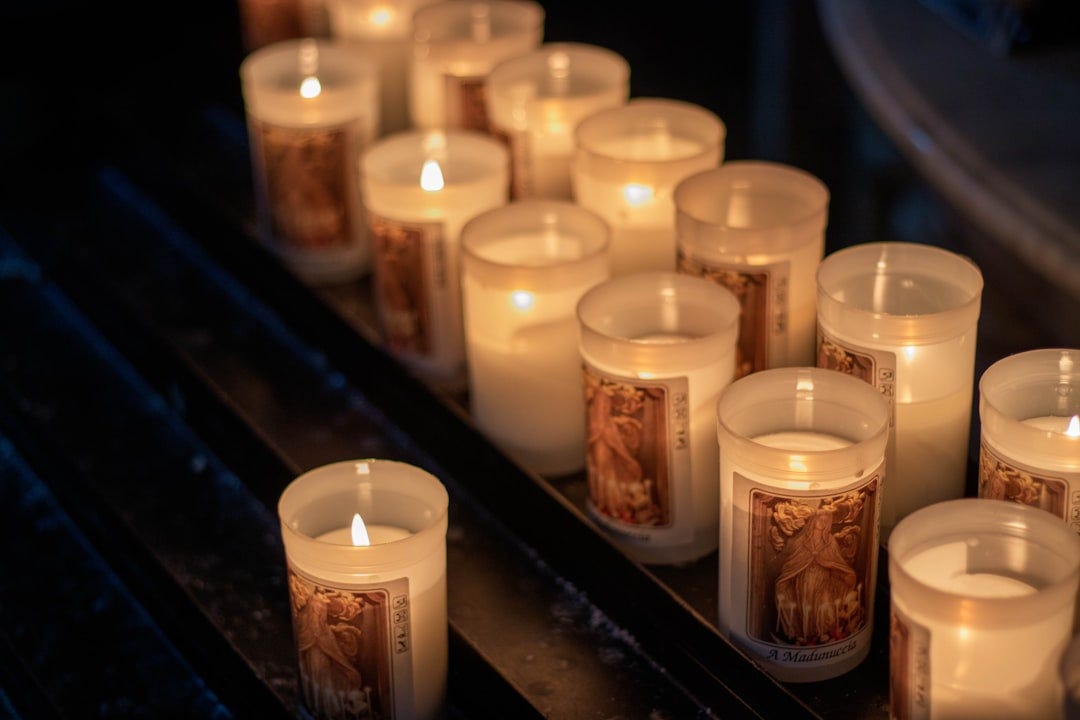
Thoughts and Prayers - On Culture
Sep 2700:43:10Tap to summarizeTrey Herweck and I share our thoughts about thoughts and prayers.This episode of On Culture - Thoughts and Prayers - is based on the article of the same name from The Embassy:Thanks for reading The Embassy! This post is public so feel free to share it.The Embassy is a reader-supported publication. To receive new posts and support my work, consider becoming a free or paid subscriber. Get full access to The Embassy at theembassy.substack.com/subscribe
Transcribe →
Watching From the Sidelines - On Culture
Sep 1300:32:02Tap to summarizeChad Myers and I discuss this piece from The Embassy - Watching From The Sidelines. TakeI may post this again, but I wanted, in light of even more violence that appears to be part of our political divide or cultural wars to repost this piece: Interesting TimesI pray there won’t be many more repostings in the near future.The Embassy is a reader-supported publication. To receive new posts and support my work, consider becoming a free or paid subscriber. Get full access to The Embassy at theembassy.substack.com/subscribe
Transcribe →
Interesting Times
Jul 19, 2025Tap to summarizeTrey Herweck, pastor at Refuge Church in St. Charles, MO, joins me to talk about living in Interesting Times. We are using the most recent article from The Embassy as our jumping off point. Here is an excerpt:ViewAlthough it is often mislabeled as a Chinese curse, “May you live in interesting times” is of English origin. It appears in British diplomatic circles during the late 19th and early 20th centuries. While there is no equivalent Chinese saying, they (at least according to Wikipedia) do have this: “Better to be a dog in times of tranquility than a human in times of chaos”, which is a bit more, well, interesting. At any rate, we live in interesting times, and we understand the impulse to call that a curse. Our times are in turns unpredictable (except when they are all too predictable), anxiety provoking, polarizing, angry, fearful, dark, and at times, violent. It is the last one that is catching us, or most of us, by surprise. This violence seems increasingly to be cast as a moral response to this broken state of affairs.The murder of Brian Thompson, CEO of United Healthcare, on December 4th of last year is perhaps the most prominent recent example of an act of violence which was justified by some as a moral act. After his arrest for the murder, Luigi Mangione’s manifesto was discovered whichindicated that he saw the killing as a direct challenge to the health care industry’s “corruption” and “power games.”“Frankly, these parasites simply had it coming,” the document read.NYT - December 20, 2024Based on the reaction to his arrest, many people, many of these being younger people, agreed - this was, to them, a moral act, an attempt to change the world for the better, ending the corruption of the health care industry.Ending the corruption in government was the stated motivation for the man who beat the husband of former House Speaker Nancy Pelosi with a hammer after breaking into their San Francisco home in 2022. He intended to hold the Speaker hostage to extract government changes. A similar motivation was behind the group that plotted to kidnap Governor Gretchen Whitmer of Michigan. Authorities claimed they hoped to start a civil war to bring down a corrupt government. While no motive has been identified after shots were fired into the Democratic National Committee office in Arizona last fall, a fire set in the New Mexico Republican Party headquarters in March of this year was in response to immigration enforcement.Shortly after a dinner with dozens of friends celebrating the beginning of Passover, Pennsylvania Governor Josh Shapiro and family narrowly escaped the fire destroying their home. The man who has admitted setting the fire cited the treatment of Palestinians in Gaza.A similar motivation was at the heart of the killings of two members of the Israeli Embassy staff in Washington D.C in May and of the man who used fire to injure and kill at a Boulder, Colorado march in support of the Israeli hostages in Gaza.On a different note, Ziz LaSota believes that the threat of artificial intelligence is sufficient to justify violence.She wrote favorably of violence, said she was willing to sacrifice everything to achieve her goals and considered A.I.’s threat to humanity “the most important problem in the world,” she once wrote. Now six people are dead, landing her and several friends and allies, known as the “Zizians,” in jail, awaiting trial.New York Times - July 6, 2025And, of course, two different people on two separate occasions, citing the danger to democracy, attempted to assassinate President Trump.Certainly, there is corruption in health care and government. Many of us are troubled by the at turns absent, then uneven, capricious, and perhaps lawless enforcement of immigration laws. The plight of the Palestinians in Gaza is grievous. It may be true that artificial intelligence poses a threat to humanity. Much of our world is broken. Does this justify violence, specifically lawless violence, in response? And what positive impact does any of this violence have? Far from being a moral statement, lawless violence lacks moral standing, and therefore undermines the cause in the eyes of almost everyone who is not already a true believer. I can’t think of any case where violence caused positive change in any democratic society in my lifetime. It tends to alienate those not already onboard, and shows itself to be part of a statement about the person committing violence more than it is about the injustice of the world. I have mentioned before there were more than 2500 anti-war, anti-government bombings in our country during an 18-month period spanning 1971 and 1972. That is about five per day. Those who are old enough to remember it were not surprised that Richard Nixon was re-elected as President in 1972, winning over 60% of the popular vote and 49 states. This violence for a purpose just does not get you to the purpose. It also identifies the brokenness of the world we live in as something unique to our age instead of something common to all ages. This common brokenness is something we are called to engage and redeem, and that won’t happen by way of violence. We live in a society of political freedom and, therefore, political responsibility. Far from fulfilling this responsibility, these acts of violence are an abdication from it.Bad times, hard times - this is what people keep saying; but let us live well, and times shall be good. We are the times: such as we are, such are the times.Augustine of Hippo, ~ 400 A.D.Read the whole article here.The Embassy is a reader-supported publication. To receive new posts and support my work, consider becoming a free or paid subscriber. Get full access to The Embassy at theembassy.substack.com/subscribe
Transcribe →