← On the Media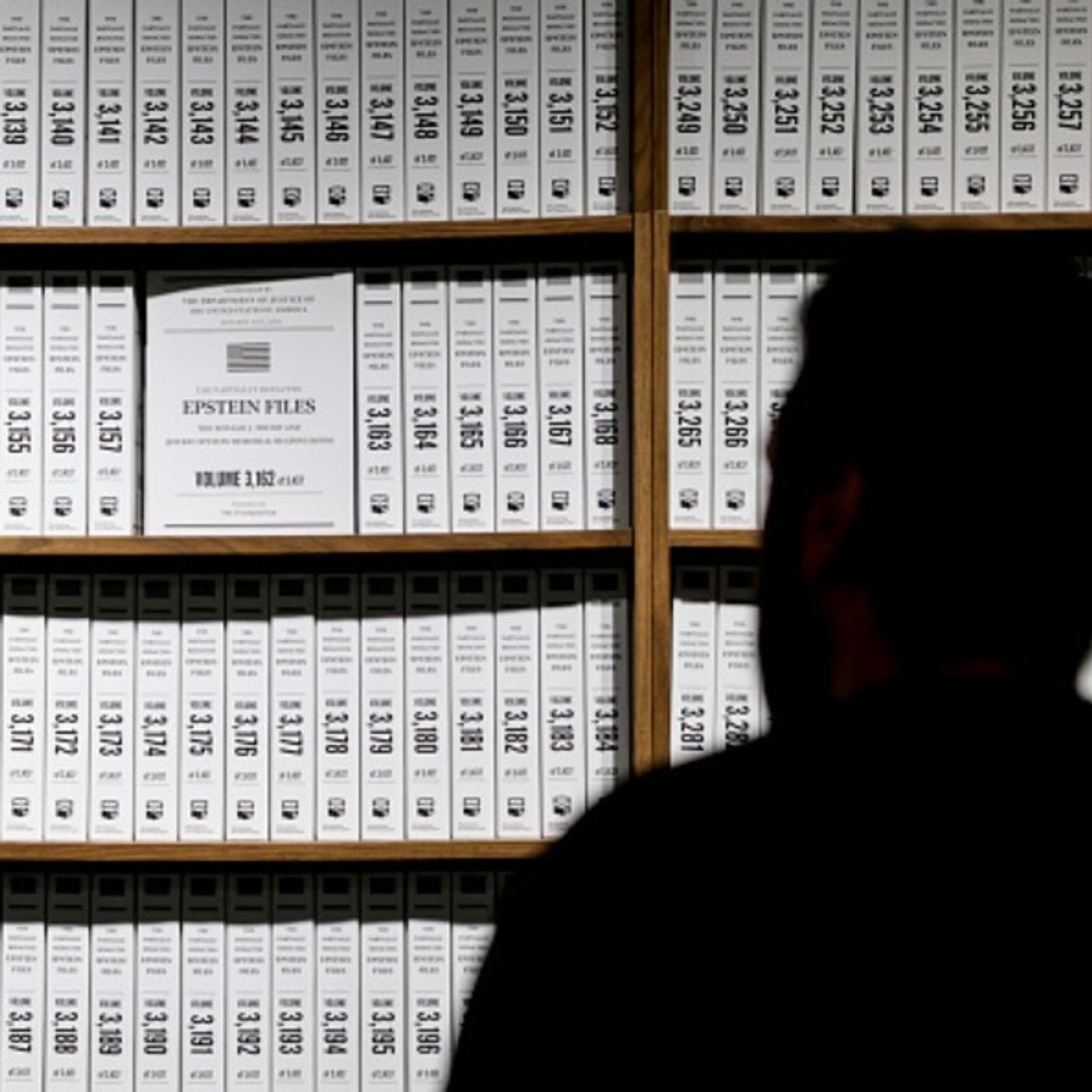
On the Media
A Tour Through the Epstein Files
00:21:08
Inside the Donald J. Trump and Jeffrey Epstein Memorial Reading Room.
Loading summary
Transcript69 lines
- [00:00]
A
On the Media is supported by Progressive Insurance. Do you ever think about switching insurance companies to see if you could save some cash? Progressive makes it easy to see if you could save when you bundle your home in auto policies. Try it@progressive.com Progressive Casualty Insurance Company and affiliates. Potential savings will vary. Not available in all states. This is the on the Media Midweek podcast. I'm Brooke Gladstone. The Justice Department collected more than 6 million pages of the Epstein files and released about 3 million of them under the Epstein Files Transparency Act. I stepped into the cool interior of what had been an art gallery to behold the files, at least those we'd been authorized to see in real life.
- [00:50]
B
In late March, we downloaded all of the Epstein files from the Department of Justice website, printed them out, bound them into volumes and brought them here.
- [01:01]
A
David Garrett is the co founder of the nonprofit the Institute for Primary Facts. He organized this exhibit to shine a spotlight on the decades long relationship between Jeffrey Epstein and Donald Trump, its synergies and synchronicities. The exhibit was open in New York City for several weeks in May.
- [01:22]
B
3.5 million files ends up being about 3,500 volumes of 800 pages each.
- [01:31]
A
They're all in this room.
- [01:32]
B
We couldn't fit them all in here. So we have a few downstairs, but yeah, 17,000 pounds of evidence.
- [01:37]
A
that moment, I was standing in front of a bookcase filled with volumes and stark white binders and I pulled out volume2742 as released by the Department of Justice of the United States. The Donald J. Trump and Jeffrey Epstein Memorial Reading Room, published by the Trumpsonian. I laughed.
- [02:00]
B
So this all started when the Smithsonian took down the exhibits of Trump's impeachments. You know, I kind of lost it a little bit. I mean, I'd been listening to too many podcasts and yelling at the TV for 10 years. But when the Smithsonian decided to bow to the Trump administration and rewrite history, I thought, we need someplace that's going to actually preserve the truth.
- [02:24]
A
I think a lot of people might think that. Wow, it really takes a long time to xerox all those files. We know that it took a long time for Ellsberg to get the Pentagon Papers xeroxed, but that was a walk in the park compared to this.
- [02:41]
B
There were really two problems getting everything printed. The first one was technical. All of these files are heavily redacted. And when you redact a digital file, they go over the redacted material three times with full black. It's completely gone. The problem is that's so much ink that if you put it through a printer, it'll tear the paper. So we had to go through all 3.5 million files and correct each pixel that was 300% black to a format that could be printed. But the bigger problem was really political. The first printer that we sent this project to came back and said, we work with a lot of lawyers. We're really worried that if they find out that we printed this, they're not going to work with us anymore. A second printer, one of their biggest investors was a Trump supporter. We finally found some printers that are super courageous. And we got very lucky.
- [03:33]
A
And the locations, we had a very
- [03:36]
B
bad day when we lost both the printer and our first location on the same day. We literally sat down and said, is this too hard? We probably looked at five different places.
- [03:47]
A
And they turned you down.
- [03:48]
B
Yeah, a bunch of them turned us down. Yeah. And this exhibit, the reason that Donald Trump's name is on it is really for two reasons. One is what he shares with Jeffrey Epstein is dozens and dozens of allegations of sexual assault. They're both convicted felons, so putting their names together really makes sense. Trump's name is cited more than 38,000 times throughout the documents. People can draw their own conclusions from that. But my point is this. He shouldn't be influencing the investigation into these crimes. That is a corrupt act, him slowing that investigation. That's the purpose of having his name on this.
- [04:29]
A
Now, I assume you've looked at a lot of these documents, right?
- [04:32]
B
Too many.
- [04:33]
A
Will you show me one that struck you?
- [04:36]
B
Oh, I. Well, here's what I'll tell you. One time last week, I was giving an interview, and I just pulled a random book off the shelf and started leafing through it to show them that it was real. And it was page after page of little girls with no clothes on. And I had to put the book back and I had to sit down. And so I don't do that anymore. I was here with one of the survivors a couple of days before we opened. We helped her to find the books where she's mentioned, and we pulled them down, and I sat down with her downstairs, and she showed me her name, her address, her birthday, her Social Security
- [05:16]
A
number, things that were supposed to be redacted.
- [05:19]
B
A picture of her driver's license. She was 17 when she did the FBI interview. And so she talked about some of her friends that she had told about it. Those friends names are unredacted. It is criminal, what the Department of Justice has done in causing additional harm to the victims. And survivors and exposing them. I don't know who to see about it when the Department of Justice breaks the law.
- [05:45]
A
He walks us towards the back of the room and to display the famous picture of Trump and Epstein. And Trump's got his hand on his shoulder. They're both smiling. And then there's a pretty extensive timeline. Three actually. One on top of the other on top of the other.
- [06:04]
B
The top one is Jeffrey Epstein, his dozens of allegations of sexual assault, his felony conviction. The bottom timeline is Donald Trump and his dozens of allegations of sexual assault and his felony convictions. And in the middle, you see all these famous photos of them together. We built this timeline to create context so you would know when these photos were taken and all of the allegations of sexual assault by both men. The notes that you see that are tacked to the timeline are all from survivors that have been here over the course of the last few days. They see themselves on the timeline and they asked if they could include themselves.
- [06:46]
A
This one here from Marina Lacerda, Parentheses Minor Victim 1. My first time in Epstein's house, I was only 14 years old. He gained my confidence and groomed me till he was able to rape, abuse, and take my childhood away. Today I am 37 and reclaiming my power. And I encourage every woman not to forget that power is always within love. Marina. This happened to her in 2002. Alongside a profile of Epstein in New York Magazine, Trump said, I've known Jeff for 15 years. Terrific guy, a lot of fun to be with. It's even said that he likes beautiful women as much as I do, and many of them are on the younger side. Same year as Marina's encounter when she was 14.
- [07:37]
B
Yeah, this is in 2005, the same year the federal probe into Epstein started. And Danny writes here that she was trafficked to Epstein in 2004 at 17 years old. Jeffrey used dance, my ballet background and my mom's brain tumor against me to get what he wanted. Demand from the powerful still exists. We have to make it safer.
- [08:00]
A
This is around the same time that Trump wrote that birthday card.
- [08:04]
B
Yeah, she put it on the timeline right above Trump's famous birthday card.
- [08:09]
A
And 2000, the same year, where there's the famous foursome photo of Trump, Melania Epstein and Ghislaine Maxwell photographed together at Mar A Lago. This is when Virginia Jeffrey was recruited at Mar A Lago. She was 16 years old. She became one of the most prominent voices against Epstein. Later, she killed herself Lisa Phillips around the same time, brought by boat from Tortola. She writes in this note on your wall, she met Prince Andrew on the same day Epstein, she writes, abused me.
- [08:46]
B
Yeah. So everything that's happening now with transparency and accountability, as flawed as it is, is because of these amazingly brave women who stood up and refused to go away. The pictures that you see here are them speaking out in front of Congress to get the Epstein files Transparency act passed. And then two of these photos are from the very famous public service announcement advertisement that ran during the super bowl with all of the survivors holding up pictures of themselves the year they met Jeffrey Epstein. After years of being kept apart, we're
- [09:25]
A
standing together, standing, standing together because this girl deserves the truth, because she deserves the truth, because we all deserve the truth. On the timeline, there's a girl, she looks maybe 13 or 14, smiling for her class photo. This was the year she met Epstein, 1991. And she leaves a note. Jess Michaels, raped by Jeffrey Epstein, brought to him by a woman who would go on to work for Epstein for 18 plus years.
- [09:58]
B
So what we have in the middle
- [09:59]
A
is next, David Garrett brings us to a draped box. Inside there are 1400 electric candles.
- [10:09]
B
Each one of those candles represents one of the victims of Jeffrey Epstein. Each one of them is a life.
- [10:16]
A
You found that people looking at it had a tendency to start counting.
- [10:24]
B
Yeah, I think they start counting first to just say how many are there. And some people will stand here for 20 minutes or a half an hour. What we're surrounded by are 3.5 million files. It's the problem with big numbers. How do you know what 3.5 million files looks like? Well, now you can see. But the same thing is true with 1400 victims. How do you know what 1400 little girls looks like? 10 is a volleyball team. 20 is a lacrosse team. 1400 fills a theater downstairs, the walls
- [11:01]
A
are blanketed with so many more handwritten notes. But these are written by the guests.
- [11:08]
B
This was our overflow room originally, where we have some more bookshelves and a few hundred last books. And we created a space down here where people that come through, if they want to call the Department of Justice, they can sit at that table and call and ask, demand that all of the files be released and that they be properly redacted. And then here at this table, people leave notes. We had one corkboard. We thought we'd only need one for the whole time that we were here. There are now maybe 20 cork boards.
- [11:38]
A
Here's one that says, we live in a prison with free monsters. We are not things. All this happened in the quote, best country in the world. Are we great yet?
- [11:51]
B
So a lot of people that come through are survivors of sexual abuse or sexual assault themselves. A lot of women need a moment after seeing the exhibit upstairs and want to express themselves down here. We've seen dozens and dozens of survivors come through this space.
- [12:10]
A
There's one that says, why do men in power keep trying to protect us from imaginary threats and ignoring the real ones? Burn it all down. You call this enterprise a pressure campaign. How so?
- [12:27]
B
A year ago, when the authors of the Epstein Files Transparency act were contemplating that piece of legislation, everybody thought, it'll never pass, it'll never be law. But because these incredibly brave women went to Capitol Hill and demanded that this law be passed because millions and millions of people called their congresspeople. It passed the House with only one no vote. It passed the Senate unanimously and the President signed it. What that means is that if we work together, democracy can still work. That's what I hope we can do. A small part of here, get people excited. We've already done maybe 1500 calls to the Department of Justice. We hope to demand that all the files be released, that they be properly redacted this time, and that there is real transparency that drives towards real accountability.
- [13:21]
A
The Institute for Primary Facts is primarily an anti corruption organization. Is that wrong?
- [13:29]
B
It's a pro democracy. Right. But I think that's the same thing. Corruption is the tool of autocrats to kill democracies.
- [13:36]
A
But primary facts don't seem to have much purchase in the current political climate. People seem to be immune.
- [13:47]
B
I'm not sure if it's the people. I think it might be the medium. You make more money, the more attention you get on social media. The things that get the most attention sometimes aren't true. You just have no idea when you're looking through your phone. So when I say the Institute for Primary Facts, what I'm hoping that we can do is use in real life, use tactile experiences. Get away from your phone and come in and see what we've done here. It's really hard to ignore. You can't scroll past it when you're walking through this room.
- [14:20]
A
So many people are able to tsk, tsk at what happened with Jeffrey Epstein and move on. You clearly can't. Just talking about it made you something that the listeners couldn't see, but really upset. Why can't you pass it by? I have two daughters. How old are yours?
- [14:41]
B
I have a daughter who's 26 and one who's 15. I imagine that I'll have granddaughters someday. There have always been monsters. There have always been monsters. But for 250 years, we have the rule of law. And the rule of law meant that we could feel confident that regardless of who the perpetrator was, we could hold them accountable. And if we could hold them accountable, then there would be a deterrent for people to do it in the future. Well, what is the deterrent now? They've all gotten away with it. I don't think that's providing a safe environment for my daughters and granddaughters. Let's have some real accountability.
- [15:26]
A
Look, I've been a reporter for a long time. I've often told young reporters that it's like water dropping on a stone to change things. You need a billion drops to even slightly redirect the flow. Are your hopes for this reasonable?
- [15:41]
B
Maybe. Even if they're unreasonable, real change is a small group of people trying to do impossible things. That's the only way that change has ever happened. I think that a lot of people are hungry for change. So let's do it.
- [16:00]
A
Thank you so much.
- [16:01]
B
Thank you.
- [16:03]
A
While Garrett was guiding us through the tour, a woman in a long navy dress slipped into the exhibit. He introduced her as Andrea Sterling, an online content creator and also a survivor of one of Epstein's notorious assaults on minors. She agreed to sit down with me downstairs amid the spillover volumes and all those encouraging cork boards and tell me what happened to her.
- [16:29]
C
I was 17, and I recently moved from Colombia, and a friend of mine casually invited me. It was like, hey, you know, I have this gig. There's this rich guy, and I give him massage. There were no details. It was easy for me to accept, too, because she always invited me to very normal events. Barbecues, friends that were our age. Very normal. So when she invited me, it was a little strange, but to be honest with you, I trusted it. He clearly had a technique. Two cleaning ladies opened the door for me and his residence here in New York City. They put me in an office. In the office, you can acknowledge all the pictures. Now that I'm older, I'm like, oh, they did it on purpose for you to feel, like, safe. Like, oh, he's with politicians. What bad can happen? Which is the trap. That's a trap.
- [17:24]
A
You think famous people won't behave that way?
- [17:26]
C
I thought. So I go with the two girls who brought me to the massage room. And quickly I realized that it's not all about a massage. It was not a massage. He just continued, and you're trapped. Some girls freeze. I was kind of fighting on it, but Then froze. And it was a disgrace. It was.
- [17:52]
A
You felt shame. You felt shame.
- [17:54]
C
Unfortunately, that's. It's hard to explain. I don't understand. How did I carry that? That didn't belong to me and didn't belong to any of the girls. So I leave. Whenever I could leave, I stopped talking to the friends that brought me there. But now I understand that there were the victims too. They were minors. They were even younger than me.
- [18:23]
A
So then there's this exhibit of the Epstein files. How did you get here? How did you happen to walk in? You never even made your name public.
- [18:34]
C
No. In 2018 or 19, when I saw him, I recognized him. I didn't want to get involved. I wasn't sure. And I saw a lot of the survivors already talking. And I thought, these girls are so brave. They're already doing it. Something's going to happen, right? And keep on waiting and waiting and waiting. And then I'm like, wait, this is getting darker. I have to step in. I can't. I create content in the cannabis industry, in jewelry and traveling. So I create a lot of like, fun and comedy content. And I felt like a coward. Now I think it's time to step in and be part of the noise. And that's what I'm doing right now. And then they contact us about this amazing project. And I think this is very helpful because helps you understand the magnitude. And these are only half of the files, I call it. These are the vanilla files, even though they're very dark. But I think they gave us the safer files. Imagine the other ones.
- [19:39]
A
I understand that you allowed your name to be used here for the first time.
- [19:46]
C
So I opened up in Latin America, only Telemundo, Univision in the United States, only from here, yesterday in public.
- [19:55]
A
Wow. And so your strongest reaction to this
- [19:59]
C
enterprise was putting my name in the timeline and to see how many people are with us. And they take their time to actually come here and write a note to encourage us to keep going. A lot of survivors, they've been talking since 1996, 1998.
- [20:17]
A
And the shame you mentioned, the shame is gone.
- [20:21]
C
That's why I decided to talk. The shame. You understand, when you're an adult, you've
- [20:27]
A
been an adult for a while, but
- [20:29]
C
it didn't, it didn't hit me until recently. I mean, it has been a process. I did have some therapy prior, worked on some of the things, but what am I going to be ashamed of? I wasn't the 55 year old hiring minors to hire older minors. So the shame is not mine. Yeah,
- [20:52]
A
we're very lucky you walked in.
- [20:54]
C
Oh, no, thank you. I'm very lucky to meet you.
- [21:04]
A
Thanks for listening to the midweek podcast. If you're left wanting more, make sure you follow us on Instagram at onthemedia, where we post videos about some of our favorite interviews of late. The big show comes out on Friday. I'm Brooke Gladstone.