← On the Media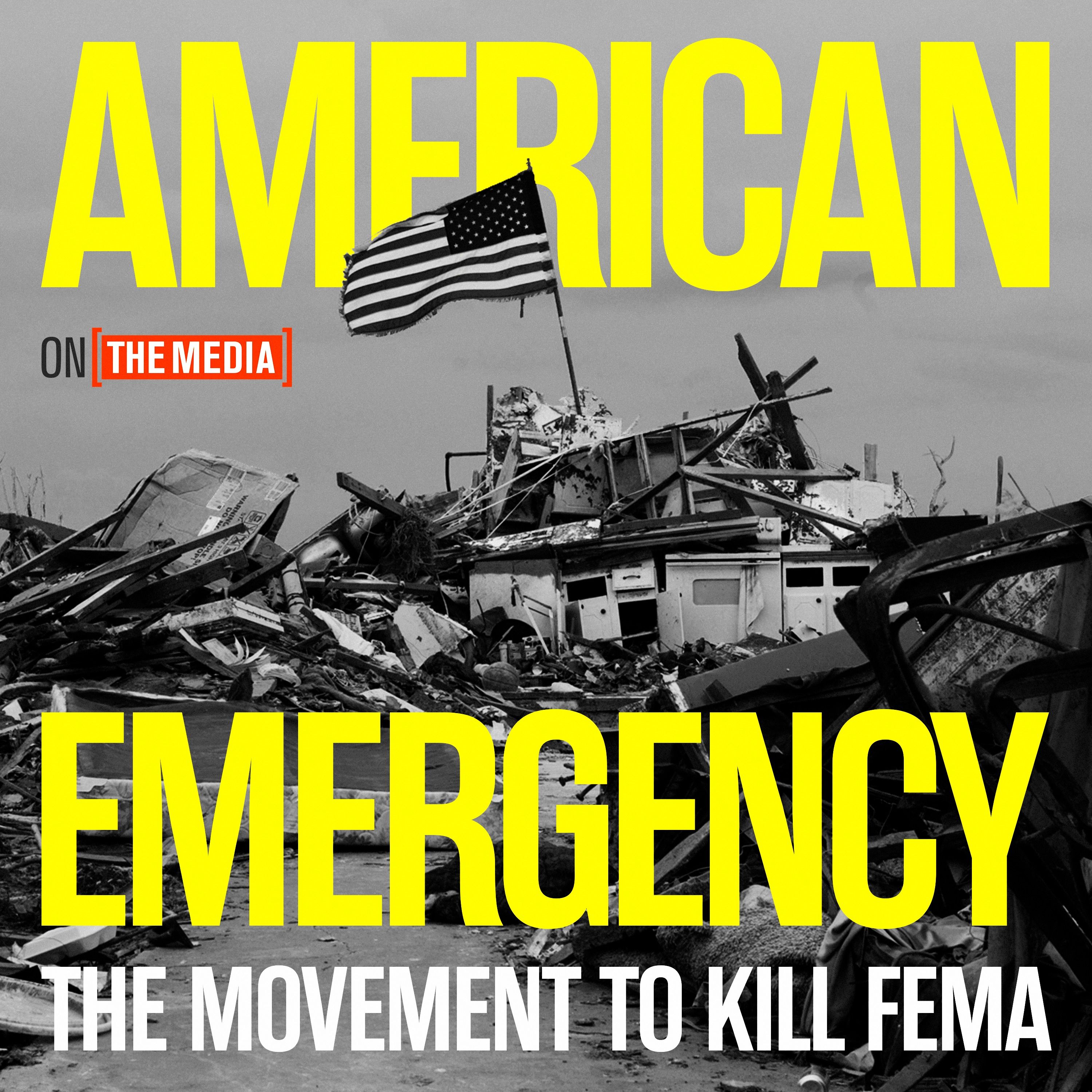
On the Media
American Emergency: The Movement to Kill FEMA
00:52:11
How did the agency tasked with saving Americans become despised, distrusted, and defunded?
Loading summary
Transcript252 lines
- [00:01]
Micah Loewinger
Hey, it's Micah. The new series about FEMA that you're about to hear over the next four episodes of on the Media is the culmination of months of reporting and research from me and the team here. We traveled to North Carolina to meet experts and hurricane survivors. We developed original sources to bring you never before told stories and context that help explain the crisis unfolding at one of America's least understood agencies. None of this would be possible without the support of our listeners. When Congress eliminated federal funding for public media last year, it made listener support an even more important part of the equation. For us to support our show and this kind of ambitious reporting. Go to onthemedia.org donate that's onthemedia.org donate plus when you donate, you can get our brand new on the Media donate jumbo tote bag. It's been a while since we've had a tote bag here on the media, which is kind of crazy considering we're, you know, a public radio show. So we're bringing it back and our new one is bigger than your average run of the mill tote bag. It has on the Media printed on the side. It looks sweet and you can fit a bunch of stuff in there. So please make a donation@onthemedia.org donate to give right now. Thank you so much to everyone who has supported our program. Onto the show. Storms, floods and fires are ever more extreme. And yet the Federal Emergency Management Agency is fighting for its life.
- [01:39]
Brooke Gladstone
I've never been a big fan of FEMA. FEMA's very expensive and it really doesn't get the job done.
- [01:44]
Micah Loewinger
How did the agency tasked with saving America become so despised? FEMA's a disaster.
- [01:50]
Brooke Gladstone
FEMA's a dirty word.
- [01:51]
Micah Loewinger
So distrusted people are waking up in
- [01:53]
Brooke Gladstone
droves to the fema. The FEMA plans to imprison American citizens have generated a lot of interest around
- [01:59]
Micah Loewinger
the country and defunded. We could see the next Katrina level
- [02:03]
Brooke Gladstone
disaster based on the stripping away of
- [02:05]
Micah Loewinger
FEMA that we have seen. Can the agency survive the stories that have been told about it? And can we survive without fema? Whenever there's a disaster, the first thing people say is, where's fema? American Emergency. The Movement to Kill FEMA is a brand new on the Media series. The first episode is coming up right after this Foreign this podcast is brought to you by USA for unhcr. With conflict spreading and global uncertainty rising, the world is at a critical moment for refugee families. Millions have been forced from their homes and humanitarian funding has been cut by nearly a Third, help the UN Refugee agency rush emergency aid this UN Refugee Giving day. Join a life saving movement. Every gift is matched, doubling your impact for families. Donate at UN Refugees from WNYC in New York. This is on the media. I'm Brooke Gladstone. And I'm Micah Loewinger.
- [03:07]
Brooke Gladstone
Micah, this is the week.
- [03:09]
Garrett Graff
Yeah.
- [03:09]
Micah Loewinger
The first episode of a brand new four part series that you and OTM senior producer Eloise Blondio have been reporting out for months. It's about the Federal Emergency Management Agency or fema. And there is a ton of stuff in here that people won't have heard before. I'm exc it. Let's do it. Okay. Thanks, Brooke. Hope you like it.
- [03:34]
Brooke Gladstone
We've come to North Carolina with a simple message for all the people of this region who were hit so hard by Hurricane Helene.
- [03:41]
Micah Loewinger
At the beginning of his second term, amid all the chaos of the incoming administration, President Trump made his first trip to North Carolina.
- [03:49]
Brooke Gladstone
That message is very simple. You are not forgotten any longer. You were treated very badly by the previous administration.
- [03:57]
Micah Loewinger
And before he got on Air Force One, Trump called a press conference on the tarmac and casually dropped this bomb.
- [04:04]
Brooke Gladstone
I'll also be signing an executive order to begin the process of fundamentally reforming and overhauling fema, or maybe getting rid
- [04:11]
Micah Loewinger
of fema, the Federal Emergency Management Agency, the agency that stands between America and climate destruction.
- [04:19]
Brooke Gladstone
I think frankly, FEMA is not good.
- [04:21]
Micah Loewinger
The agency that helps people rebuild after they've lost everything. The agency that, while he was rambling, was providing aid to Californians suffering through the historic LA wildfires, as well as Helene survivors right there in North Carolina. It seemed like with a snap of his fingers, the President would be happy to see FEMA vanish.
- [04:41]
Brooke Gladstone
I think we're going to recommend that FEMA go away.
- [04:45]
Micah Loewinger
I learned that employees at FEMA broke down in tears when they heard the news. Some replayed the President's speech over and over.
- [04:53]
Brooke Gladstone
We're going to recommend that FEMA go away.
- [04:57]
Micah Loewinger
Anxious members of Congress spent the day calling into the agency's headquarters with a barrage of questions. Is the President serious? What happens when the next hurricane hits?
- [05:06]
Brooke Gladstone
If the President came to you and
- [05:08]
Micah Loewinger
said, you're my DHS secretary, do you
- [05:11]
Brooke Gladstone
think I should get rid of fema? What would you say?
- [05:12]
Micah Loewinger
I would say yes. Get rid of FEMA the way it exists today. Kristi Noem, former Secretary of the Department of Homeland Security.
- [05:19]
WNYC Announcer
It has been slow to respond at the federal level.
- [05:22]
Brooke Gladstone
And that is why this entire agency needs to be eliminated as it exists
- [05:27]
Micah Loewinger
today before she got the boot this spring. Noem effectively set fire to FEMA preparedness. Programs were slashed. Unqualified leaders cycled in and out. Billions meant for survivors of storms, wildfires and earthquakes were withheld or denied. Lives hung in the balance. The death toll in Texas, the flooding tragedy. It's up to one dead across six counties. That number includes nearly 30 children. After deadly floodwaters inundated Camp mystic and other parts of Central Texas, the agency's support lines left thousands of calls unanswered. FEMA's top leader at the time couldn't be reached for 24 hours.
- [06:12]
Brooke Gladstone
We live about a mile down the road from Camp mystic and we've already got two little girls who have come down the river and we've gotten to them, but I'm not sure how many else are out there.
- [06:24]
Micah Loewinger
The federal response to this disaster has come under scrutiny.
- [06:28]
Brooke Gladstone
Allegations that FEMA cutbacks meant delays in
- [06:31]
Micah Loewinger
answering people's calls for disaster assistance and aid after the flood. In one telling, the dysfunctional response was Doge's doing. It's true at the start of 2025, no agency was safe from Elon Musk's chainsaw. But that's only part of the story. For many years, fomenting under the surface was a deep seated distrust of fema, which broke through during Hurricane Helene just months before the 2024 presidential election.
- [07:01]
Brooke Gladstone
Kamala spent all her FEMA money, billions of dollars on housing for illegal migrants.
- [07:09]
Micah Loewinger
Some on the right pushing conspiracy theories
- [07:11]
WNYC Announcer
that they're blocking aid and seizing land
- [07:14]
Brooke Gladstone
from people here in North Carolina.
- [07:16]
WNYC Announcer
And that is not true.
- [07:18]
Micah Loewinger
An anti government militia group known as
- [07:20]
WNYC Announcer
Veterans on Patrol is claiming Hurricane Helene was caused by government controlled weather weapons. The group called Hurricane Helene an act of war.
- [07:31]
Micah Loewinger
I knew from my years reporting on far right militias that these groups often showed up after natural disasters to recruit, fundraise and spit shine their public image. But I never understood why they hated FEMA so much. So I started digging into right wing media archives and found that the anti FEMA lore went back decades.
- [07:53]
Brooke Gladstone
People are waking up in droves to the FEMA camps, to the new world order, to the troops on the streets the liberals are starting.
- [08:00]
Micah Loewinger
Alex Jones has made multiple films claiming to have discovered secret prisons operated by fema. And right wing pundit Glenn Beck entertained this stuff when he was still on Fox.
- [08:11]
Brooke Gladstone
If you have any kind of fear that we might be headed towards a totalitarian state, buckle up. There's something going on in our country that is ain't good.
- [08:22]
Micah Loewinger
Over time, these paranoias seeped into the waters of mainstream culture.
- [08:26]
James Lee Witt
Are you familiar with what the Federal Emergency Management Agency's real power is.
- [08:30]
Micah Loewinger
It was a major plot point in the X Files.
- [08:33]
James Lee Witt
FEMA allows the White House to suspend
- [08:35]
Brooke Gladstone
constitutional government upon declaration of a national emergency. Think about that.
- [08:41]
Micah Loewinger
Even with Kristi Noem replaced at DHS by Republican Senator Mark Wayne Mullen, the future of FEMA is still in jeopardy. This week the administration announced that it was patching up some of the NOME era cuts. But agency insiders say that it may take years to build FEMA back up to fighting strength. About a month ago, Trump repeated his antipathy for the agency.
- [09:03]
Brooke Gladstone
I've never been a big fan of fema. I like to keep it local. I like to see governors and neighboring states help each other as opposed to fema. FEMA is
- [09:15]
Micah Loewinger
as I've followed the current day crisis at fema, I've wondered whether it can survive the stories that have been told about it, the misinformation, mismanagement and genuine catastrophes that have made this agency one of the least popular among Americans. But for all its faults, and there are many, it's not clear we can afford to lose it.
- [09:36]
WNYC Announcer
Extreme weather leaving so many across the United States wondering when they'll get a break. In July alone, there were five 1000 year flood events.
- [09:44]
Brooke Gladstone
Extreme heat is becoming a dangerous new normal.
- [09:48]
Micah Loewinger
The record setting storm measured not in
- [09:50]
Brooke Gladstone
inches but in feet of snow.
- [09:52]
Micah Loewinger
Hundreds of thousands are now without power in this freezing weather. The US is experiencing a billion dollar disaster every 10 days on average, compared
- [10:00]
Leo Bosner
to every 82 back in the 1980s.
- [10:07]
Micah Loewinger
Over the next few weeks, we'll explore how the organization tasked with saving America came to be so despised and mythologized for a series we're calling American Emergency, the movement to kill FEMA. We'll hear about FEMA's identity crisis during Hurricane Katrina, how conspiracy theories have fueled violent threats against federal workers, and how a group of anonymous employees are fighting to keep the agency alive under Trump. For this first episode were looking at FEMA's secretive origins and the moment when Americans first learned that the agency was hiding things from us. On December 1, 1974, heavy rain and fog rerouted a passenger plane over Northern Virginia some 50 miles from Washington, D.C. on its descent, the aircraft dropped into the forest below, shearing off the treetops and crashing into the side of Mount Weather. The two pilots were killed first. Lanced by trees that burst through the cockpit, the rest of the aircraft crumbled into pieces. A mangle of shrapnel and the body parts of the 92 passengers and crew members There were no survivors. One woman whose parents were on the flight said it seemed like the mountain had jumped up and bit the plane. News coverage of the day quickly turned to the blame game and the miscommunication from air traffic control amidst a violent storm. But our focus is something that was buried in the reports. When TV crews arrived at the crash site, they discovered, rather ominously, that Mount Weather had already been sealed off on the orders of federal security agents.
- [11:59]
Brooke Gladstone
The quick action was taken because the big jet had landed almost a mile away from a super secret government installation. An underground complex of emergency offices set up for federal officials in the event of nuclear war.
- [12:15]
Micah Loewinger
The crash had inadvertently uncovered a tightly guarded Cold War secret. Inside Mount Weather was a massive covert facility, and somehow that undersells it. Through a tunnel that burrows into the mountain and behind a 34 ton blast door lies a subterranean strangeloveian lair. A freestanding city with a hospital, a crematorium, an emergency power plant and even a broadcasting studio. Everything that the White House and thousands of federal workers would need to run the country underground while millions melted on the surface. I expect your people to save our government. That's what President Dwight eisenhower told the first director of Mount Weather after it was built in 1955. It's still operated by FEMA today. It's actually being renovated as I speak. But Back in the 1950s, Mount Weather was run by FEMA's predecessor, the Federal Civil Defense Administration, the FCDA, which poured billions into making America nuke proof, or at least lulling people into the belief that with enough preparation, they might survive atomic hellfire.
- [13:26]
Brooke Gladstone
Dum dum dum dum dum.
- [13:29]
Micah Loewinger
The FCDA was behind this delightful, if slightly morbid, PSA instructing school children to hide under their desks during bomb drills.
- [13:38]
Brooke Gladstone
There was a turtle by the name of Bert and Bert the turtle was very alert when danger threatened him. He never got hurt. He knew just what to do. He's ducked and cover for adults.
- [13:56]
Micah Loewinger
The FCDA organized Operation Alert, a series of dramatic exercises where millions of people acted out the day of their likely demise, emptying the streets of America's biggest cities.
- [14:09]
Brooke Gladstone
While the sirens wail their grim warning, hundreds of thousands of New Yorkers scurry for shelter against the attack. Riders and drivers taking cover in a realistic drill for a day all Americans pray will never come.
- [14:22]
Micah Loewinger
Operation Alert was also the first time that Mount Weather saw action.
- [14:26]
Brooke Gladstone
As soon as the alert sounded in Washington, President Eisenhower reached for his hat and strode to a waiting limousine to be driven to an emergency base of operations in the mountains outside Washington. Exact location kept secret.
- [14:37]
Micah Loewinger
Kept secret until that terrible plane crash in 1974. Fortunately, nuclear obliteration never came, and Mount Weather was never truly put to use. But there's something ironic and revealing that a single storm brought more death and destruction to the base than 30 years of the Cold War. By the 1970s, it had become clear that the nuclear preparations had done little to protect America from an arguably greater threat. Coming up, if our government could build a secret city, it does kind of make you wonder, what else could they be hiding? This is on the media. Onthemedia is supported by Viking, committed to exploring the world in comfort, offering destination focused small ship experiences on all seven continents, with a shore excursion included in every port and programs designed for cultural enrichment. And every Viking voyage is all inclusive with no children and no casinos. Learn more@viking.com I'm Al Edson, host of Reveal. From central Mexico to the front lines
- [16:14]
Brooke Gladstone
of Ukraine, we were given an order not to take any prisoners from an
- [16:19]
Micah Loewinger
abortion clinic in Florida. A woman was just assaulted to the streets of Chicago. More than 2,000 kilograms of heroin came to Chicago. Reveal is your weekly dose of investigative reporting.
- [16:31]
Brooke Gladstone
Somebody has to say something.
- [16:34]
Micah Loewinger
Subscribe to Reveal wherever you get your podcasts. This is on the Media. I'm Michael Ohinger. To better understand the current day crisis at FEMA and why so many Americans believe wild conspiracy theories about it, I wanted to dive back into the era. It was created when state leaders began to realize that all the focus on Cold war civil defense had left them vulnerable to Mother Nature.
- [17:03]
Garrett Graff
We just didn't have that many nuclear wars, which is great, but we do have a lot of natural disasters.
- [17:10]
Micah Loewinger
Garrett Graff is a journalist and author of a book about the origins of FEMA titled Raven the Story of the US Government's Secret Plan to Save Itself while the Rest of Us Die. Before the agency was created, America's disaster response system was, well, barely a system.
- [17:28]
Garrett Graff
It didn't make sense for every state to be developing its own totally independent ability to respond to a hurricane. Because in any given year, most states don't get hit by a hurricane.
- [17:45]
Micah Loewinger
Which became a big problem in the 60s and 70s when the country was rocked by a series of record breaking disasters.
- [17:52]
Brooke Gladstone
No one knows the full size of the disaster yet in Betsy's wake, there's only darkness, confusion and death. After suffering one of the most serious earthquakes in history, Alaska had to undergo the further ordeal of over 40 severe earth tremors. Imagine being there as the streets reared up around you like the scene of some terrible Biblical retribution. They called her Camille. Born of the sea, she turned like a woman scorned. She screamed and ripped and flooded and killed.
- [18:30]
Micah Loewinger
These big disasters overwhelmed towns and counties and states. The big ones often do. But when they asked for help, the federal government was too disorganized to act quickly or efficiently. Supplying extra ambulances, delivering food and water to survivors, fixing roads and power plants. Each piece of the emergency management process could come from a different office or department. 100 agencies might play a role. Navigating this patchwork of services and jurisdictions was a major pain in the ass for local leaders, especially during a crisis when lives are on the line and every second counts. Like in 1972 when another big storm hit.
- [19:09]
Brooke Gladstone
Many of the people here and others in the path of Hurricane Agnes were completely wiped out. Many of them feel that federal aid is too slow in coming and too little.
- [19:20]
Micah Loewinger
Trump says FEMA should return its responsibilities to the states, which is odd because states often bring in FEMA when they're unable to respond on their own. And anyway, it was the states that asked for FEMA in the first place. In 1978, the National Governors association drew up plans for a streamlined one stop shop for federal emergency response and delivered it to a sympathetic White House.
- [19:45]
Brooke Gladstone
Washington President Carter proposed merging five big federal emergency preparation and disaster relief agencies into one agency as part of his reorganization plan. Civil defense experts say it will provide much needed communication between the state and federal levels.
- [20:02]
Micah Loewinger
In 1979, Jimmy Carter signed an executive order giving life to the Federal Emergency Management Agency. FEMA was a federal Frankenstein, with a dual Cold war civil defense and disaster relief. I wish I could illustrate this moment by playing you like a triumphant speech from President Carter or some colorful news footage. But either that stuff never existed or no one thought it was important enough to archive. Even the earliest employees at FEMA were confused about how to talk about it.
- [20:33]
Leo Bosner
We had a new director there, and there was a message that went out to us that said that if we're referring to the agency publicly, we should say either Federal Emergency Management Agency or fema. Because the word fema, he thought, sounded too much like a laxative.
- [20:50]
Micah Loewinger
This is Leo Bosner, a retired FEMA official who's taught me a lot about the earliest days of the agency. He was working as a flood insurance specialist with the Department of Housing and Urban Development in one of the offices that was folded into female.
- [21:05]
Leo Bosner
We're all working along in the office and one day they tell us, okay, everybody go down to photo ID. You're getting new photo IDs. We walk down the stairs, get new photo IDs that say FEMA. Turn in our photo IDs that say housing Urban Development. And then we're all told we're all getting new job titles and our new job title is emergency management specialist. And I'm thinking what on God's earth as an emergency management specialist, like this is the end of my career. What kind of a dead end job?
- [21:35]
Micah Loewinger
Leo would spend the next 30 years at FEMA. He eventually found really satisfying work helping hospitals and medical organizations prepare for floods, wildfires and hurricanes. But less than two years after he started getting the hang of his new job, FEMA fell into a decade long tailspin.
- [21:54]
Leo Bosner
The big shift really didn't come until 1980.
- [21:57]
Brooke Gladstone
Ronald Reagan appears to be heading toward a landslide electoral victory. Tonight across the United States, Ronald Reagan
- [22:04]
Leo Bosner
got elected president and there's a super U turn from Jimmy Carter who was mostly all about social welfare and Ronald Reagan was more about national defense.
- [22:14]
Micah Loewinger
To run fema, Reagan picked someone who would stir up a lot of trouble for the agency.
- [22:19]
Brooke Gladstone
This man, only a masochist with a death wish would accept the job of directing fema.
- [22:25]
Micah Loewinger
Army Colonel Louis Jeffrida speaking here with a caller on Larry King's radio show.
- [22:31]
Brooke Gladstone
I really don't believe that we can be saved if there is a nuclear war. I mean, how are you going to save me if you're blown up too? But you're not suggesting that because we both might be blown up by a nuclear war that we shouldn't have in place a system that would take care of us if there was an earthquake or a tidal wave or a hurricane or anything of that sort?
- [22:51]
Micah Loewinger
While Luis Jeffrida paid lip service to FEMA's disaster relief mission, he was quietly funneling most of FEMA's budget towards cold War civil defense. Leo Bosner.
- [23:01]
Leo Bosner
All of a sudden we start seeing all these military officers signing in at the login desk. Why these military people here? Military people go to floods or something. And then we learn little by little that FEMA's mission was really, really going to be to get ready for the big nuclear attack from the Soviet Union.
- [23:20]
Micah Loewinger
In the early 80s, Leo started to hear whispers about classified programs at the agency. Every day on his trip up the elevator at FEMA hq, he'd ride by a secret fifth floor manned by a security guard. Mostly he rolled his eyes at all the Cold War theater, wishing FEMA would focus more on preparing Americans for natural disasters. But he still wondered what were they doing in there?
- [23:45]
Garrett Graff
The majority of its funding, Garrett Graf. And about a Third of its workforce was actually hidden in the nation's classified black budget, the special budget that Congress oversees that protects our most secret programs and capabilities. And FEMA on a daily basis is in charge of tracking the whereabouts of everyone in the presidential line of succession so that in the event of a nuclear war, it knows where all of those people are, how to get them to secure relocation sites like the mountain weather bunker. And who would be best positioned to be the person who takes over as President of the United States in the event of a nuclear war.
- [24:35]
Micah Loewinger
I wonder if this classified continuity of government planning helps explain why there was so little media about FEMA when it was first created. I think the feds just didn't want to draw attention to their secret plans. That said, the coverage did pick up when the agency launched a controversial new initiative.
- [24:53]
Brooke Gladstone
The head of emergency management, Louis Jeffrida, says the heart of the proposal is crisis relocation. What we want to accomplish is taking the maximum number of people from high risk areas to areas of lesser risk.
- [25:09]
Micah Loewinger
A mass evacuation program.
- [25:11]
Garrett Graff
There was sort of this sense of, well, if you could just get 20, 30, 50 miles away from a major city, you would at least have a chance to survive the initial blast from the nuclear weapons and then live into nuclear winter.
- [25:29]
Micah Loewinger
Government officials estimated that in the worst case, 60 million Americans could survive an attack. Can you imagine all those urbanites swamping small towns in rural areas? News reports at the time featured a mixture of fascination and incredulity.
- [25:45]
Brooke Gladstone
My God, you're going to have modified anarchy after that sort of thing. How in the world are you going to coordinate the recovery and putting leadership back into place? How are you going to do that?
- [25:56]
Garrett Graff
60 million is still a lot of people. That is the modern population of France. Those people would need a functioning government and functioning infrastructure afterward.
- [26:09]
Micah Loewinger
This is where we start getting into the bizarre conspiracy theories that haunt Fema today. In 1982, in an effort to game out some of these post apocalyptic scenarios, President Ronald Reagan signed a secret executive order to create a covert program called Project 908.
- [26:28]
Garrett Graff
That's 9 08, but they called it 908.
- [26:31]
Micah Loewinger
It pooled billions of dollars in top officials from the National Security Council, FEMA and the FBI.
- [26:38]
Garrett Graff
The FBI was in charge of pre identifying buildings that could serve as refugee camps.
- [26:47]
Micah Loewinger
If I have this right. Basically you had FBI agents working undercover for FEMA traveling around the country visiting warehouses, car shops, casinos, Walmarts, helping identify businesses that could be used to house citizens after a nuke was dropped on an American city.
- [27:12]
Garrett Graff
Yes, and often without telling the businesses that they were being scouted for these purposes.
- [27:20]
Micah Loewinger
There was thankfully never a need to construct these refugee camps. But the secrecy went way deeper and darker. Just five years after the launch of Project 998, a bombshell report from the Miami Herald revealed that before Jeffrida was asked to help run fema, he'd written his master's thesis on how the military could quell race riots by detaining millions of black people and putting them in concentration camps. Members of Congress were given a copy of his thesis during Jeffrida's confirmation hearings. A horrifying detail that makes me think they considered this to be part of his qualifications for the job. The most damning part of that Miami Herald piece though, was news that Jeffrida had worked with Reagan's National Security Council to write plans for declaring martial law and putting the country temporarily under a sort of shadow government. And not just in the case of a nuke, but also in a so called national crisis like a war.
- [28:22]
Garrett Graff
A bunch of this comes out in the late 1980s amid the Iran Contra hearings and investigations. It turns out that Lt. Col. Oliver north, who is the central figure at the White House of Iran Contra, was also one of the planners for Project 998.
- [28:46]
Micah Loewinger
Oliver north was asked about these martial law plans during the Iran Contra hearings.
- [28:50]
Brooke Gladstone
Colonel north, in your work at the nsc, were you not assigned at one time to work on plans for the continuity of government in the event of a major disaster?
- [29:01]
Micah Loewinger
North was questioned by Texas Representative Jack Brooks. We see north pause and whisper to his attorney. Then the chairman of the hearings, Daniel K. Enouay, jumps in to respond on the government's behalf.
- [29:15]
Brooke Gladstone
I believe that question touches upon a highly sensitive and classified area. So may I request that you not touch upon that, sir? I was particularly concerned, Mr. Chairman, because. Because I read in Miami papers and several others that there had been a plan, a contingency plan that would suspend the American Constitution. And I was deeply concerned about it and wondered if that was the area in which he had worked. I believe that it was. May I most respectfully request that that matter not be touched upon at this stage.
- [29:56]
Micah Loewinger
The government never acknowledged any of this stuff until much of it was declassified. Years later, Louis Jeffrida ended up resigning from FEMA for totally unrelated reasons following a congressional fraud investigation.
- [30:09]
Brooke Gladstone
According to Senator Albert Gore, Giafrida had spent $170,000 of federal money to build a house on federal property for his own use.
- [30:18]
Micah Loewinger
By the start of the 90s, FEMA employee Leo Bosner was Beyond tired of the dysfunction and the kooky national security schemes.
- [30:27]
Leo Bosner
Frankly, for me, once that stuff was in the rearview mirror, it's like, fine, that's the trash. I hope they come on Friday and pick it up and dump it to the landfill. There were some pretty nutty people working back there then. Fortunately, nothing much ever came of that except they ate up most of our budget.
- [30:42]
Micah Loewinger
He was eager for the agency to shift resources to preparing for floods and hurricanes. But all this doomsday planning had done a number on FEMA's reputation.
- [30:52]
Leo Bosner
I would talk on my off duty time to people on Capitol Hill or news reporters and say, look, this is a dangerous thing. We're ignoring these natural disasters. And I was having lunch with a news reporter one day and I'm telling him this and the guy's looking really bored. He says, yeah Leo, that's all really bad, but tell me about FEMA's secret plan to round up all the liberals in the country and put them in concentration camps.
- [31:15]
Micah Loewinger
What?
- [31:16]
Leo Bosner
Yeah, I said, buddy, these people are so inept they couldn't organize a two car parade and they're never going to round up everybody in the country. Come on, get out of here, will you?
- [31:26]
Micah Loewinger
Leo didn't know it at the time, but those FEMA camps conspiracy theories had started popping up in fringe message boards on the early Internet.
- [31:34]
Brooke Gladstone
The FEMA plans to imprison American citizens have generated a lot of interest in locating the potential prison camps throughout the country.
- [31:42]
Micah Loewinger
This woman, Linda Thompson, a sort of godmother of the right wing militia movement, made a 1994 documentary, America Under Siege, which warned that FEMA was part of the New World Order, a global authoritarian takeover that would require rounding up anti government dissidents.
- [32:01]
Brooke Gladstone
These may be facilities that have other uses but which could be quickly used to detain large numbers of people, such as this Amtrak facility in Beech Grove, Indiana.
- [32:09]
Micah Loewinger
Following in her footsteps a couple decades later were militia leaders like Stuart Rhodes of the Oath Keepers, one of the January Six guys. A lot of this stuff is dual use. They put together a, a detention center or an emergency center supposedly for refugees from other countries. And as I mentioned, Infowars host Alex
- [32:26]
Brooke Gladstone
Jones, People are waking up in droves to the FEMA camps, to the New World Order, to the troops on the
- [32:32]
Micah Loewinger
streets, these FEMA camps and Glenn Beck when he was still on Fox News.
- [32:37]
Brooke Gladstone
I'm tired of hearing, you know about them. Sure, we've now for several days done research on them. I can't debunk them.
- [32:44]
Micah Loewinger
After whipping up this paranoia, Beck did eventually debunk the theory with help from the editor in chief of Pop Mechanics.
- [32:52]
Brooke Gladstone
This is an Amtrak repair facility in Beech Grove, Indiana.
- [32:56]
Micah Loewinger
We set a crew there the other
- [32:58]
Brooke Gladstone
day and we got. Is this your video? Yes. And sure enough, what did we find?
- [33:01]
Micah Loewinger
They're repairing trains in there. Remember how earlier Garrett Graf told us about stores like Walmarts being scoped out by the government to be used as refugee camps? They don't exist, but people on TikTok and YouTube still like to make videos about them.
- [33:16]
Brooke Gladstone
It's like military style entrance, kind of like a FEMA camp. Why in the hell does Walmart Supercenter need that? See the Walmart trucks?
- [33:26]
Micah Loewinger
These videos are low effort and easy to laugh off. But I mean, if FEMA could operate amount weather, why not amount Walmart?
- [33:34]
Garrett Graff
The challenge of a lot of these conspiracies is that they have a germ of truth to them.
- [33:40]
Micah Loewinger
Garrett Graff.
- [33:41]
Garrett Graff
In the early stages of the Cold War, J. Edgar Hoover at the FBI had pre selected lists of suspected communists and political dissidents that he wanted to round up in the event of a nuclear war.
- [33:56]
Micah Loewinger
Not to mention the fact that the US imprisoned over 100,000 Japanese Americans during World War II.
- [34:02]
Garrett Graff
I think FEMA has always been in a difficult place, and this is true, by the way, across all of the continuity planning and doomsday planning. You just can't talk about these classified bunkers and classified operations. Even if you're trying to debunk conspiracies.
- [34:21]
Micah Loewinger
The secrecy in and of itself is naturally gonna feed conspiracy theories.
- [34:26]
Garrett Graff
Absolutely.
- [34:29]
Micah Loewinger
The kicker to all this is that some of what the conspiracy theorists warned about is happening, just not to them. This past July, fema, under Kristi Noem's Department of Homeland Security, revealed a new program, FEMA allocating $608 million in state grants for construction of detention centers, migrant detention centers, part of Trump's mass deportation program. The announcement came right around when Florida Governor Ron DeSantis opened Alligator Alcatraz, the notorious facility in the Everglades. And while he built the jail using state emergency funds intended for natural disasters, he claimed that federal reimbursement was on the way.
- [35:13]
WNYC Announcer
A spokesperson for the Department of Homeland Security confirms Florida did submit an application to FEMA and were awarded two days ago the full amount. Florida applied for $608 million.
- [35:24]
Micah Loewinger
The coverage made it sound like the money was in Florida's bank account, but at time of recording, those FEMA funds have actually been held up by Trump's Justice Department. Florida officials say the money is still likely, but. But who knows despite that uncertainty and many legal attempts aimed at closing it, Alligator Alcatraz remains open.
- [35:44]
Brooke Gladstone
Amnesty International says immigrants held at the ICE jail in Florida were shackled inside a two foot high metal cage and left outside without water for up to a day at a time. In a new report, they also detail unsanitary conditions, lights on 24 hours a day, poor quality food and water, and lack of Privacy.
- [36:04]
Micah Loewinger
And while Governor DeSantis says the conditions are up to standard, the families of migrants being held inside are calling it a concentration camp.
- [36:11]
Garrett Graff
That is the most real FEMA camp ever built.
- [36:14]
Micah Loewinger
What do you think it says that FEMA would actually use public funds for the very thing that has been a far right boogeyman.
- [36:25]
Garrett Graff
I mean, there is something uniquely dystopian about a right wing government elected on the backs of the anti government conspiracies that it is now implementing.
- [36:45]
Micah Loewinger
Coming up, for the first time, FEMA finds its groove.
- [36:49]
Brooke Gladstone
They ought to change the name because the old FEMA has a pretty bad name and the new one they're running now is a crackerjack agency.
- [36:58]
Micah Loewinger
This is ON the Media.
- [37:13]
WNYC Announcer
WNYC Studios is supported by Pulitzer on the Road, the official podcast of the Pulitzer Prizes back with its third season. Each spring, 23 prizes are awarded for distinguished journalism, books, drama and music. Pulitzer on the Road brings conversations with prize winners to you. You'll hear from the New Yorkers, David Remnick and Carlos Lozada of the New York Times, authors Natasha Trethewey and Lucy Sant, and journalists Nariman Al Mufti and Tolou Olorunipa. Listen to Pulitzer on the Road wherever you get your podcasts.
- [37:44]
Micah Loewinger
I'm Al Edson, host of Reveal. From central Mexico to the front lines
- [37:51]
Brooke Gladstone
of Ukraine, we were given an order not to take any prisoners from an
- [37:56]
Micah Loewinger
abortion clinic in Florida. A woman was just assaulted to the streets of Chicago. More than 2,000 kilograms of heroin came to Chicago. In a way, Reveal is your weekly dose of investigative reporting.
- [38:08]
Brooke Gladstone
Somebody has to say something.
- [38:10]
Micah Loewinger
Subscribe to Reveal wherever you get your podcasts. This is ON THE media. I'm Michael Loewinger, and you're listening to the first episode of our series American Emergency, the movement to kill FEMA. In my reporting, I learned that FEMA's Cold War mission to save America from nuclear war was met with a lot of suspicion, and understandably so. Case in point, when I was digging around in the National Archives, something that caught my eye was a tape curiously labeled FEMA Blues.
- [38:46]
Brooke Gladstone
Seattle, Washington. Now, Seattle did a spunky thing the other day.
- [38:50]
Micah Loewinger
It turned out to be a comedy special from a guy named Mark Russell, which aired in 1982. He starts with this hokey bit about Luis Jeffrida's nuclear evacuation plans. In an apparent effort to coax Seattle officials into participating, FEMA had offered to subsidize the city's mass relocation, which the city refused.
- [39:12]
Brooke Gladstone
They turned down their allotment from the Federal Emergency Management Administration. I think it really stands for feeble exercise in mindless administration. You know what Seattle's allotment was? $17,000. Can you imagine that? I guess the money went to provide each resident with a free roadmap and a granola bar.
- [39:32]
Micah Loewinger
And so, yeah, after a bit of vamping, Russell calls up his band, the Buzzards.
- [39:39]
Brooke Gladstone
It's our spunky, feisty little band. We only do this once a year
- [39:42]
Micah Loewinger
to perform a song that I think captures the zeitgeist in the 80s.
- [39:45]
Brooke Gladstone
Spin it, fellas. I got those Federal Emergency Management Administration Blues, blues, blues, blues. Cause when you're hit, that's it. You either sit or stand and melt down in your shoes. Ooze, ooze, ooze. Don't need no federal bureaucrat to tell me where to go So I can have my choice of roasting fast or slow the fatter all the way Emergency Management Administration blue.
- [40:16]
Micah Loewinger
According to its critics, FEMA's leaders were either mounting a comically pitiful defense against the nation's most pressing threat, or they were burning resources that would be better spent on responding to Mother Nature. Leo Bosner, that OG FEMA employee, was in the latter camp. As the 80s went on, he was busy trying to warn the press.
- [40:37]
Leo Bosner
I was kind of in my whistleblower mode, letting them know that FEMA was spending all of its time doing nuclear stuff and not doing anything for these natural disasters.
- [40:46]
Micah Loewinger
If Ronald Reagan's FEMA was too active, too conniving. George Bush Sr. S FEMA had the opposite problem. It was out to lunch. Daddy Bush left the agency leaderless for over a year. And he was punished for it in 1989 when a Category 5 storm came barreling off the Atlantic.
- [41:04]
WNYC Announcer
Two weeks after Hurricane Hugo hit Sand,
- [41:07]
Brooke Gladstone
S.C. it's FEMA that is in the eye of the storm. Only about 20% of FEMA's budget goes for disaster relief. FEMA is trying to live down a reputation for being slow, stingy and distracted. South Carolina Senator Ernest Hollings today accused FEMA of raw incompetence. They're the sort bunch of bureaucratic jackasses I've ever worked with in my life.
- [41:29]
Leo Bosner
FEMA did a terrible job. Leo Bosner But I think, I think the feeling was, well, that's a once in a hundred years thing. Except three years later, Hurricane Andrew hit
- [41:38]
Micah Loewinger
in 92, another Category 5, one of the strongest in Florida's history and female
- [41:44]
Leo Bosner
was on the front pages a barrage
- [41:45]
Brooke Gladstone
of criticism for its handling of the aftermath of Hurricane Andrew.
- [41:49]
WNYC Announcer
If we do not get more food and water in a very short period of time, we are going to have more casualties because we're going to have people who are dehydrated who are without food.
- [41:59]
Micah Loewinger
After the storm, as journalists started digging into FEMA's dysfunction, they discovered a political backwater filled with unqualified Bush appointees.
- [42:09]
Brooke Gladstone
Congressional records show that while at most federal agencies there is only one political appointee for every 3,000 government agencies, at FEMA, there's one for every 300.
- [42:18]
Leo Bosner
So the election for the president was only like three months later.
- [42:21]
Brooke Gladstone
This election is a clarion call for
- [42:24]
Leo Bosner
our country to face the challenges of
- [42:26]
Brooke Gladstone
the end of the Cold War and the beginning of the next century.
- [42:31]
Micah Loewinger
Bill Clinton, the first Democrat to take the White House in 12 years, had seen how FEMA's reputation had dragged his predecessors. Unlike them, he understood that natural disasters are media spectacles. Predictable high stakes dramas that generate a steady stream of coverage. So when Clinton came into office, he did something radical. He appointed somebody actually qualified to run fema. Somebody who would fundamentally transform the agency from a liability to a government success story. A man named James Lee Witt who had served as the Arkansas Director of Emergency Management when Clinton was governor.
- [43:11]
James Lee Witt
As governor of Arkansas, when I went to work for him there, he said, if it affects people's lives and it, and it's going to be in the media, then I want to know about it.
- [43:21]
Micah Loewinger
This is Witt speaking with C span in 1996.
- [43:24]
Brooke Gladstone
Can you tell us the story of your very first meeting with Bill Clinton?
- [43:29]
James Lee Witt
Absolutely. I never will forget it. It was in 1974 and I was coaching a Little league baseball team in
- [43:36]
Micah Loewinger
Dardanelle, Arkansas when they first met. Clinton was a law professor and congressional candidate and Witt ran a local construction company.
- [43:44]
Brooke Gladstone
You didn't go to college?
- [43:45]
James Lee Witt
No.
- [43:45]
Brooke Gladstone
Do you ever have any second thoughts about that?
- [43:49]
Leo Bosner
Sure.
- [43:49]
James Lee Witt
I guess anyone that has never been to college wish they had gone. But when I grew up, I was working.
- [43:56]
Brooke Gladstone
What did your father do?
- [43:57]
James Lee Witt
He was a farmer.
- [43:58]
Micah Loewinger
Suffice to say, Witt's humble beginnings did not hold him back. And when he came to FEMA in 1993, he became the first leader in the agency's 14 year history with any professional experience managing domestic disasters.
- [44:13]
Leo Bosner
Witt comes in and that's when he totally started turning everything around.
- [44:17]
Micah Loewinger
How did he do that?
- [44:19]
Leo Bosner
Well, a lot of it was really common sense. He knew there were all kinds of problems internal to fema. So he sends a memo to all hands. First official action, open door policy. So all of a sudden he's getting all these employees coming in and giving him an earful of all the problems in the agency.
- [44:36]
Micah Loewinger
He collected all these ideas and got to work reorganizing the agency for what he called an all hazards approach to emergency respons.
- [44:44]
Leo Bosner
Okay, if the FEMA employees might be needed in a disaster, what kind of jobs are they going to have to do? Let's train people for those jobs. He also made rosters of who would be on duty when during the disaster. And he said, okay, we're going to divide the employees here like into three teams. The red team, the white team and the blue team. Yay. The flag, right? If you're on the red team, you're on call for disasters during January, February. If you're on the white team, you're on call. Then he even breaks it down into night shifts and day shifts. Now this does not take like a PhD in higher mathematics to come up with this. And people could say, God, this is common sense. And my answer is, yeah, but nobody did it before.
- [45:27]
Micah Loewinger
And when did you get a sense that, like, people out there in the public were taking notice?
- [45:32]
Leo Bosner
Well, there was one of the other really smart things that Mr. Witt did back in the Cold War days. Female Obama kept the news media at bay. Like, go away, keep out, keep out, keep out. And so that just added to the suspicion. Well, Witt opened the doors to it. The news media could come into our emergency operations center right there in Washington D.C. and they could observe things and they could even interview us.
- [45:56]
Micah Loewinger
Witt relished speaking with the press. He seemed to genuinely want to explain how the agency worked. Within a year of joining fema, he began chipping away at its secret black budget, declassifying much of that doomsday planning and diverting a whole bunch of its resources to natural disasters. The agency began to see the fruits of all these new reforms during Witt's first major test as administrator.
- [46:20]
James Lee Witt
It started in 1993 with the flood on the Mississippi river affected nine states. And the devastation was just unreal.
- [46:31]
Brooke Gladstone
The water kept on coming. Small river towns were swallowed up. Over 54,000 people were forced to evacuate and leave behind homes and belongings.
- [46:41]
Micah Loewinger
Though it was far from perfect A New York Times headline about FEMA's actions following the floods reads, in this Emergency Agency wins praise for its response. The tide was turning for FEMA's reputation.
- [46:54]
Brooke Gladstone
They ought to change the name because the old FEMA has a pretty bad name and the new one they're running now is the Crackerjack Agency.
- [47:02]
James Lee Witt
President Clinton and I was talking about it in Governor Carnahan, Missouri, James Lee Witt and I said, you know, Mr. President, we can't let people build back in those areas that flooded. And we were able to buy out on a voluntary basis and relocate people out of the floodplain so they'd never flood again. In Missouri alone, we bought out over 4,000 pieces of property.
- [47:27]
Micah Loewinger
Thirty years later, this type of policy is considered a core tenet of good emergency management. Recent studies vindicate Witt's approach. Research shows that for every dollar spent on mitigation, $6 are saved down the line.
- [47:42]
Leo Bosner
During the 90s, FEMA had gotten to be so well known. In 1996, President Clinton publicly elevated James Lee Witt to cabinet level, saying, he's done such a great job here. That's how it was.
- [47:54]
Micah Loewinger
You could probably tell from the way he talks about it. Leo Bosner was so proud of his agency during the 90s. Some of its greatest work, he says, was visible on one of the darkest days for the country.
- [48:05]
Leo Bosner
That april morning in 1995. We're all at work like normal. All of a sudden, a plume of
- [48:10]
WNYC Announcer
smoke rising in the air.
- [48:13]
Brooke Gladstone
If you are anywhere downtown, you probably
- [48:15]
WNYC Announcer
heard it and felt it, an explosion of some kind.
- [48:18]
Leo Bosner
People are yelling because on the tv, oh my God, there's been a bomb in Oklahoma City.
- [48:22]
Brooke Gladstone
We have been able to confirm right now an explosion at the Federal Court building downtown.
- [48:27]
Leo Bosner
Within like a few minutes, my pagers going off, we're seeing all this action suddenly, very organized action going on. Our regional office in Texas within one hour was on the phone with Oklahoma and they decided that what was needed most from FEMA was our specialized search and rescue teams who had special tools and training and to go into collapsed concrete buildings, which is not a simple thing to do. And our search and rescue teams were then deployed there within a couple of hours.
- [48:56]
Micah Loewinger
So they were quick.
- [48:57]
Leo Bosner
Oh yeah. That's when you could really see that FEMA is real and we could do things.
- [49:02]
Brooke Gladstone
The reinforcements showed up tonight. At the center of it all, of course, is the bombed out shell of the Federal office building and in its shadow, the exhausted, who for a day and a half now have sifted through its debris and Counted its dead and seen up close. Why they call it terror.
- [49:21]
Micah Loewinger
The bombing was part of an alarming trend. Anti government extremists were becoming more active and more violent. After the attack, the White House brought in a new number two official at fema. A man with experience monitoring and investigating terrorism, including far right militias.
- [49:38]
Brooke Gladstone
I'm Mike Walker, the deputy director of fema. And I'm one of the newest employees of female.
- [49:43]
Mike Walker
Mike's a legend in the business.
- [49:45]
Micah Loewinger
Tim Manning held the same deputy director role during the Obama administration. Now he's a professor at Georgetown University. But earlier in his career, Mike Walker was his mentor.
- [49:56]
Mike Walker
Mike's been confirmed by the Senate. He's held a number of senior roles. He's been around, seen and been part of just about everything in the past 40 plus years of emergency management, homeland security.
- [50:07]
Micah Loewinger
When Tim was preparing for his own Senate confirmation hearings, Mike warned Tim about the job he was about to take at fema. Mike told him a story that's never been reported before. Now it happened in 1999.
- [50:20]
Mike Walker
He's in the new role at FEMA. He was gone a lot. These are very demanding jobs, traveling around the country, dealing with disaster response.
- [50:28]
Micah Loewinger
He was commuting often between FEMA headquarters in D.C. and his home in West Virginia where he lived with his wife.
- [50:34]
Mike Walker
He needed help around the house and there was a person in the neighborhood who came by and offered his services
- [50:40]
Micah Loewinger
as a handicap for a few weeks. The handyman comes by to repair windows, fix doors, whatever it might be. And Mike and his wife were pretty happy with his work until he got
- [50:50]
Mike Walker
a call from the FBI one day asking if he knew who this person was. Mike said, well, yeah, he's our handyman doing work for us. And the FBI said, well, he's not. He's actually undercover. He's a militia member who was sent here to get close to you and watch your movements, figure out your patterns, try to collect information. He's there surveilling you as a spy.
- [51:15]
Micah Loewinger
Oh my God.
- [51:16]
Mike Walker
Fortunately, nothing dangerous ever happened for Mike or his family. I suppose having an undercover militia operative in your home for a time is dangerous in itself. I don't know whatever kind of dangerous plots might have been in the works before the FBI figured out who he was and what was happening and interdicted.
- [51:35]
Micah Loewinger
I mean, when I hear this story, it doesn't sound real. It sounds like a movie, like noir.
- [51:40]
Mike Walker
Yeah, I wish it was a noir fiction. It's the kind of thing that you're always worried about and you know, you think about in the middle of the night? Is my family safe and am I doing all the right things? And you think about that as like, oh, that's so far fetched. That would never happen. But you know, here it did happen.
- [52:04]
Micah Loewinger
When I first heard this story, I thought it could be explained simply by the rise of extremist militia groups in America. But the more I learned about fema, its secretive origins, its unhinged leadership under Reagan, the more I realized that the agency that was born of the paranoias of the 20th century had been met with paranoia in return. While while reporting this series, I spoke to FEMA workers from just about every era of the agency. And I've heard too many stories of threats from conspiracy theorists to chase them all down. But for now, here's one more A FEMA official from the 90s told me that he'd seen FEMA head James Lee Witt walking around with a U.S. marshal security detail, but never learned why. After some digging, I discovered that in 1998, Witt was asked to meet with the FBI. An agent told him that a militia group had been selling VHS tapes with his home address and information on his kids and wife. The death threats were credible enough that Witt was told to stop taking public transportation to work early in the morning. As you'll learn in the coming weeks, These plots against FEMA's leadership foreshadow its current day unraveling. But in the early 2000s, as FEMA was forced to shapeshift after 9 11, it wasn't anti government militias that ultimately took down the agency that James Lee
- [53:29]
James Lee Witt
Witt built FEMA as an independent agency, as an organization that responded for eight years to the American people's needs that has been destroyed. It's not there now.
- [53:40]
Micah Loewinger
Next week, in episode two of my investigation, American Emergency, FEMA gets swallowed up by the Department of Homeland Security and the War on terror.
- [53:49]
James Lee Witt
They have driven a stake in the heart of emergency management in this country as we know it.
- [53:58]
Micah Loewinger
That's it for this week's show. This series is reported and hosted by me, Michael Oinger with additional writing and reporting from me, Eloise Blondiot ON the
- [54:07]
Brooke Gladstone
Media's senior producer Jared Bartman designed the artwork for the series. Our fact checker is Tom Colligan. Original music and mixing from Jared Paul. American Emergency was edited by executive producer Katya Rogers.
- [54:23]
Micah Loewinger
Special thanks to Samantha Montano and Michael Cohen. ON the Media is produced by wnyc. See you next week.
- [54:38]
WNYC Announcer
WNYC Studios is supported by AT&T. Summer. It's when we share more time, more memories and More photos and at, at and t, the iPhone 17 Pro is your summer essential. Its center stage front camera auto adjusts the frame to fit everyone into group selfies. Right now at, at and t, you can get iPhone 17 Pro for $0 with eligible iPhone trade in any condition required. Trade in of iPhone 15 or higher excluding iPhone 16e and 17e required eligible plan terms and restrictions apply. Subject to change. Visit att.com iPhone or visit an ATT store for details. WNYC's Journalism and Storytelling is heard by millions of passionate listeners. Sponsors of our programming gain our listeners attention and their respect. Learn about how your organization can support WNYC and wnyc studios@sporship.wnyc.org.