← On the Media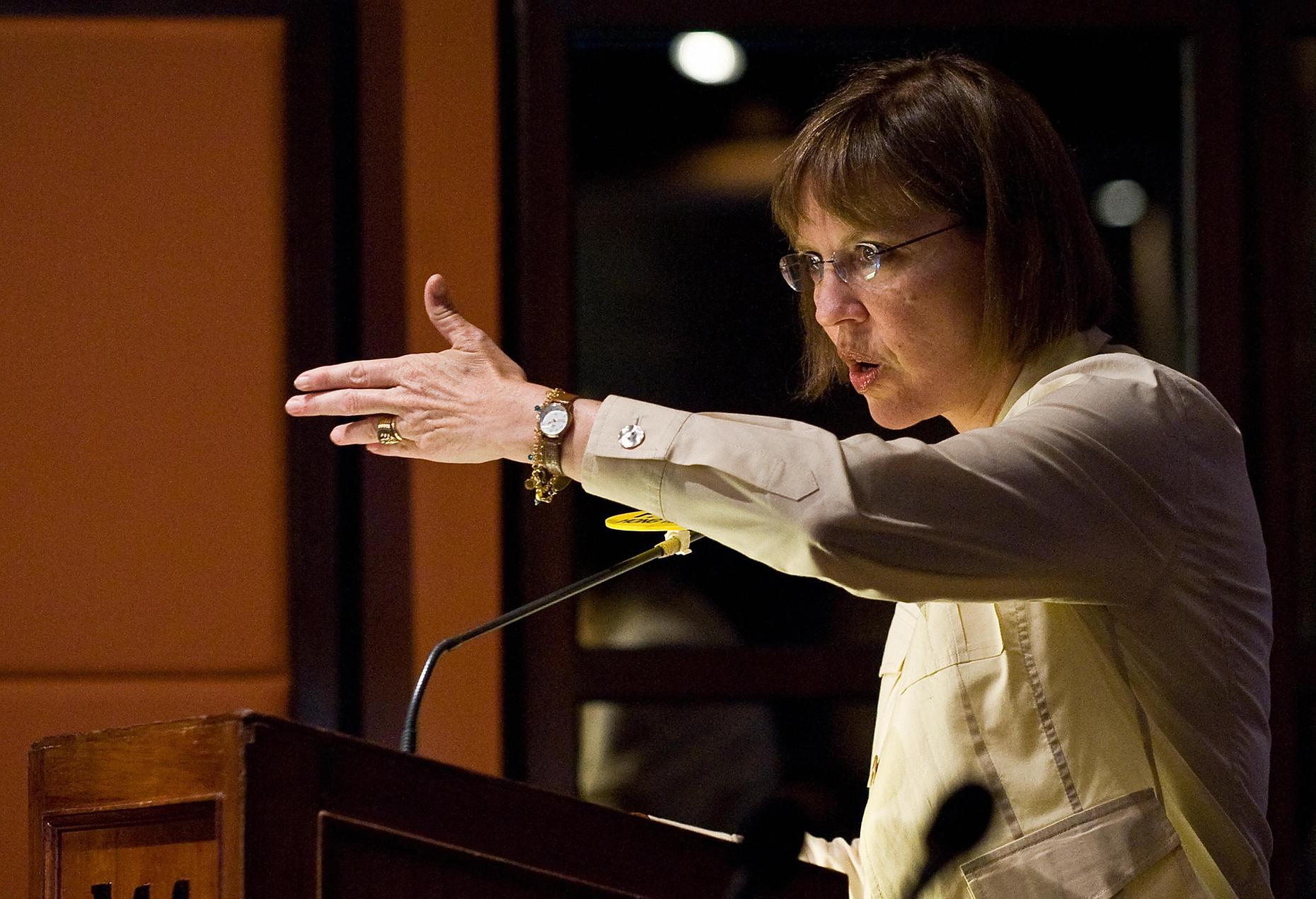
On the Media
Bob's Grill #1: Judith Miller
00:11:13
Our series of some of Bob's most sizzling interviews from years past kicks off with former New York Times journalist Judith Miller.
Loading summary
Transcript39 lines
- [00:00]
Progressive Insurance
On the media is brought to you by Progressive Insurance. You chose to hit play on this podcast today. Smart choice. Make another smart choice with Auto Quote Explorer to compare rates for multiple car insurance companies all at once. Try it@progressive.com Progressive Casualty Insurance Company and affiliates. Not available in all states or situations. Prices vary based on how you buy.
- [00:26]
Bob
Oh, hey, good to have you here. Just grab a cold one. Bob will be with you in a sec. He's just tending to the stake.
- [00:35]
Judith Miller
Mmm.
- [00:36]
Bob
Summer and grilling, they're made for each other, right? And that's why all this August, you're invited to Bob's Grill, a collection of interviews from over the years where one person takes on the role of the chef. That's Bob in the apron. And the other person?
- [00:52]
Interviewer
Well.
- [01:02]
Narrator
We launched the series this week with an interview I did in 2005 with former New York Times journalist Judith Miller. Back in 2002, Miller Co wrote a crucially influential article citing unnamed American officials and intelligence experts, claiming that Iraq's purchase of aluminum tubes proved that it was actively seeking to build a nuclear weapon. The Bush White House used that piece leaked to the Times as supposed independent verification of Saddam's threat to the region. So there was that plus, and I admit that this gets a little complicated. Miller was jailed for contempt of court in the Valerie Plame leak investigation. Now, Plame was a CIA operative whose cover was blown after her husband, Joseph Wilson, a former diplomat. Robert, wrote in a Times op ed in which he argued that some of the intelligence related to Iraq's nuclear weapons program was twisted to exaggerate the Iraqi threat. You still with me here? Miller never wrote about Plain, but she had information relevant to the leak investigation and she refused to give up her source and so chose to sit behind bars for 85 days until getting the go ahead from her source, senior White House official Scooter Libby, to name him in the Plain affair. And adding insult to injury, Miller left jail only to be vilified for her pre war stories about supposed Iraqi weapons of mass destruction and for her conduct as a reporter. Much of the criticism stemmed from her own 3,000 word article describing her conversations with Libby, who was later indicted in the leak probe. The fallout culminated with the announcement following contentious negotiations of Miller's retirement from the New York Times in 2005. She insisted she did nothing improper in the leak affair. On the contrary, she maintained she was a champion of journalistic principle.
- [03:11]
Judith Miller
Some people still felt that, you know, under no conditions should I have testified. But you know what? I never felt that way. I never felt that our right not to testify was absolute. I always felt that there were exceptions to the privilege that we were claiming. Every journalist, in the absence of a federal shield law, has to decide what constitute a voluntary and explicit waiver. And my standards, you know, I'm difficult. Everybody says that my standards were just very high.
- [03:44]
Interviewer
By your own retelling in the New York Times, you said that you agreed in conversations with Scooter Libby that you would identify him not as a high White House official, but in fact, as a former Capitol Hill staffer. A technical truth. Now, it never showed up in the newspaper, but you made an agreement with him to identify him that way.
- [04:05]
Judith Miller
No, I did not.
- [04:05]
Interviewer
Am I correct?
- [04:06]
Judith Miller
No, you are wrong. I never agreed to identify Scooter Libby in print by that attribution. I only agreed to listen to what he had to say under that attribution. If I. I had ever used that information, I would have gone back to him, as I have done with other sources, and said, you know, this attribution simply won't fly. Let's talk about an attribution which reflects who you really are, but doesn't identify you.
- [04:38]
Interviewer
You said to him, yes, I will listen to your story as a former Capitol Hill staffer. And then you let him tell you what he had to tell you, correct?
- [04:46]
Judith Miller
Absolutely.
- [04:47]
Interviewer
And then had you decided to print, then you would go back and try to get him to change.
- [04:52]
Judith Miller
Try to get him. He would either change the attribution, or I wouldn't use the information, or I would go to somebody else for the information and get it confirmed, hopefully on the record, which is what happens all the time in Washington, national security reporting.
- [05:06]
Interviewer
Well, then forgive, please, the do you still beat your wife? Question. But if you had no intention of using that attribution that you negotiated, then why have the negotiation to begin with?
- [05:19]
Judith Miller
Because I was interested in listening to what the man had to say.
- [05:22]
Interviewer
So one promise you make to your source is so important that you'll go to jail to honor it, but another is just a trick to get information.
- [05:30]
Judith Miller
No, it's not a trick.
- [05:31]
Interviewer
Out of your claim to be acting on principle.
- [05:33]
Judith Miller
Excuse me. You want to argue with me, fine. But that's the way that I conducted this interview and the way things unfolded. There was no story. So we'll never know whether you're right or I'm right. But there is one difference. Mr. Libby has never been identified in any way, shape, or form as anything other than an administration official in one of my stories. And moreover, in 28 years of journalism, I have never Ever been accused by my paper of misattributing a source? Not once.
- [06:06]
Interviewer
Let's move away from the particulars of the Plame affair for a moment and sort of the other general allegations that have been made against you by outsiders and insiders at the Times. You've acknowledged that your WMD reporting in several material instances got it wrong. But you've also said that the story is only as good as its sources. To put the question in plain language, Judy, were you played for a chump by these sources, Ahmed Chalabi in particular?
- [06:31]
Judith Miller
You know, first of all, I'm not going to be insulted by your question, but I think that the sources that I relied on were reliable. They had been reliable in the past. I'm not going to discuss who they were, though. Many of them were actually identified by name in my stories. Moreover, those stories were heavily edited. They just didn't dance their way into to the New York Times. As the editor's note acknowledged, everybody's wrong if your sources are wrong.
- [07:05]
Interviewer
There is this kind of archetype in journalism of this State Department reporter who takes to smoking pipes and wearing tweed and the police reporter who puts lights in his car and other reporters who become so associated with the beat that they're on that they cease to be distinguishable from the people they're actually covering. Were you so immersed in spooks that you sort of started seeing yourself as a spook yourself?
- [07:30]
Judith Miller
Oh, hardly. You know, I'm a journalist. Those lines don't get blurred. But yeah, I do hang out with sources. If I was hanging out with fellow journalists, I usually wasn't learning anything. If I was hanging out with, you know, national security policy wonks, I tended to learn something.
- [07:50]
Interviewer
Is there nothing to the charge that you are so successful in getting to the corridors of power that you're at times unable to distinguish what is good information from manipulation?
- [08:01]
Judith Miller
You know, look at my record and look at the record of stories and you'll see that the about 90% of them are not only accurate, but were front page stories that have been widely praised. And I think that, you know, the record will answer that question.
- [08:16]
Interviewer
But your record also includes a half dozen or so stories about weapons of mass destruction.
- [08:20]
Judith Miller
How many stories do you think I've written over my 28 year career at the New York Times? We're talking about half a dozen stories out of a career of literally hundreds and hundreds of stories, many of which have won prizes. And yeah, at times every reporter is gonna get things wrong. I've already said I got WMD Wrong. I've never said I'm a perfect reporter.
- [08:43]
Interviewer
But under the circumstances, considering how critical the New York Times reporting on this subject was to the administration's case for war, have you looked inwardly amid all of this controversy and said, not only did I make mistakes, but I made egregious mistakes, and this is really hard to live with? Just how come?
- [09:05]
Judith Miller
No, I have. Excuse me. Every time I make a mistake in a story, I go back and I look and I say to myself, how did I get this wrong? I honestly believe that if you look at my stories and very few people have even bothered to read them, you will see that the information that I was given was always vetted by outside independent experts. Did this make sense? Was it possible? Was it probable? I wish that people were more concerned about how the US Intelligence community, all of the agencies, got it so wrong.
- [09:44]
Interviewer
Well, I'm glad you posed that question, because it's true. They got that wrong. They got the Iranian revolution wrong. They got the fall of the Berlin Wall wrong. And understanding Soviet economy and military capability wrong. The US Intelligence apparatus has gotten a great number of things wrong going back decades.
- [10:02]
Judith Miller
Absolutely.
- [10:02]
Interviewer
Which makes me wonder what greater degree of skepticism a reporter should apply to anything coming from these very sources.
- [10:11]
Judith Miller
I do think that there was a difference here, like on the famous aluminum that Michael Gordon and I wrote in the fall of 2002, leading up to the war. You know, the reason we thought that the administration knew what it was talking about was that these tubes weren't kind of theoretical tubes or reports of tubes. These were tubes the CIA had. They had them in their possession. They were analyzing them. They were looking at them. They were touching them, feeling them, smelling them. And if they said, these are tubes for a nuclear weapons program, my gosh, I thought, you know, this is a real thing. We did the best we could with the information we had available. And I was glad to see that another group of reporters went on and looked at that issue in greater depth. But it shows you how really broke the intelligence community system is. And am I skeptical? Yeah, you're right. Now, I don't think I'm ever going to believe anything I'm told from the intelligence community if it's not checked 15, 20 different ways. And even then, there's still a possibility we'll get it wrong.
- [11:15]
Interviewer
All right, Judy. Well, thank you very much for doing this.
- [11:18]
Judith Miller
Okay, thank you.
- [11:20]
Narrator
Judith Miller is a former national security reporter for the New York Times. Check back in through the entire month of August for more episodes of Bob's Grill.
- [11:36]
Progressive Insurance
NYC now delivers breaking news, top headlines and in depth coverage from WNYC and Gothamist every morning, midday and evening. By sponsoring our programming, you'll reach a community of passionate listeners in an uncluttered audio experience. Visit sponsorship wnyc.org to learn more.