← On the Media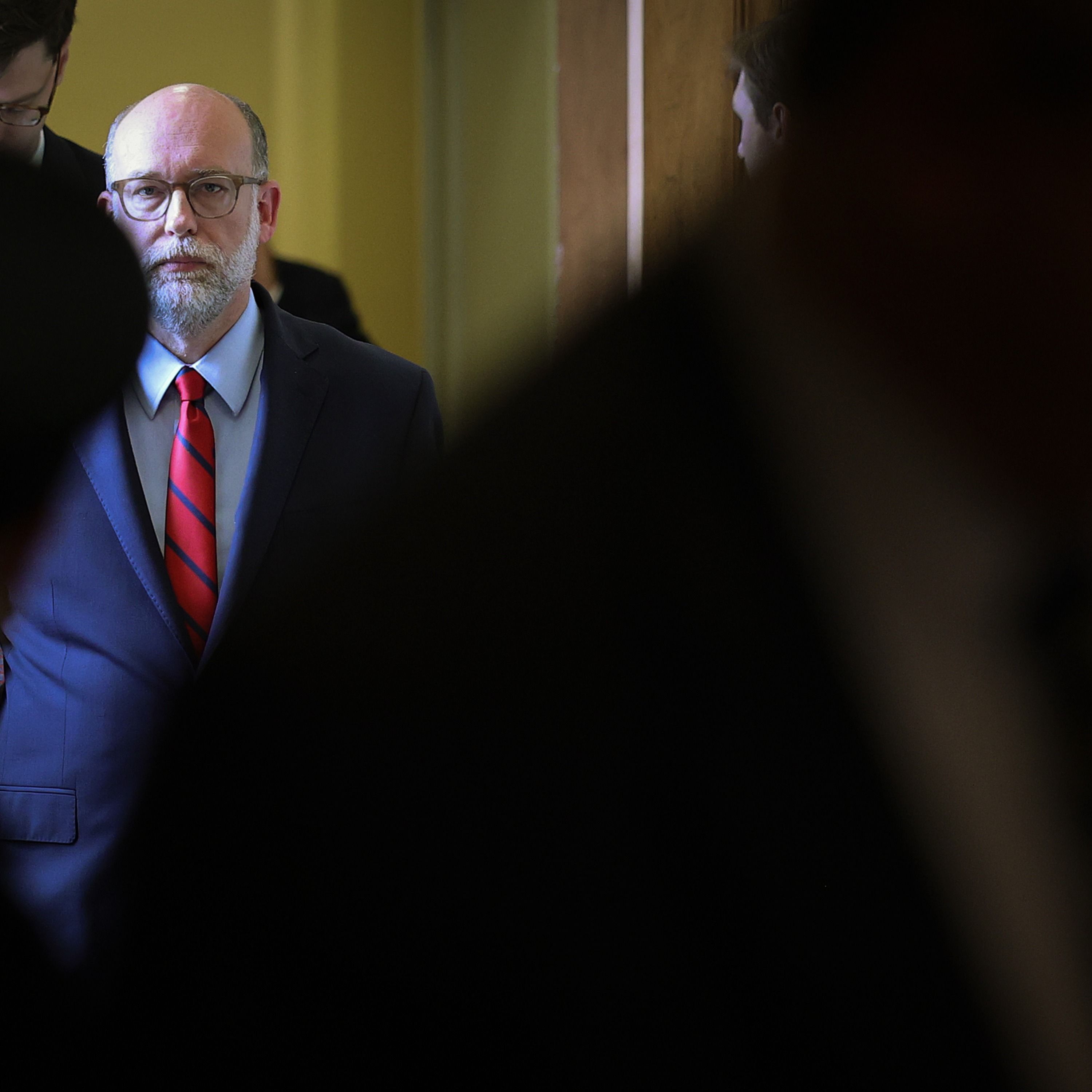
On the Media
Donald Trump's 'Darth Vader' is Approving Thousands of Federal Layoffs. Plus, the Rise of Nick Fuentes.
00:51:36
The “shadow president”; a white nationalist influencer; and the kids are alright?
Loading summary
Transcript178 lines
- [00:01]
A
Micah, I love our listeners.
- [00:03]
B
Me too. We asked 500 of you to support OTM by becoming sustaining members so that we could unlock a very generous $15,000 matching grant from George Hanby, a retired school teacher. And we did that and then some. We ultimately got 750 of you to step up. Thank you so much.
- [00:24]
A
And now we have one last goal. The last one until Christmas. Only a small percentage of you guys actually donate to keep our show running. Cause I get it. We're always there. That said, you all know by now that WNYC has lost its federal funding like $3 million. And so we're asking 250 more of the faithful, I mean you, to quickly step up and send some support. Really doesn't matter how much by the end of the month because every little bit helps.
- [01:00]
B
And if you give $12 a month or more, we'll send on the Media hat. It's blue and it's got the on the Media logo in orange right on the front. I think it's pretty cool. I wear mine all the time. To get your own, all you got to do is go to onthemedia.org donate. Thanks for your support, everyone. Enjoy the show. Several men have been dubbed the shadow president by the media. But one is the shadowiest of them all. We want the bureaucrats to be traumatically affected. They call him Darth Vader. I call him a fine man.
- [01:36]
C
He talks in terms of winning for the future of Western civilization.
- [01:41]
B
Russell Vogt, director of the OMB and Donald Trump's own Sith Lord from WNYC in New York. This is ON the Media. I'm Michael Olinger. Also on this week's show, the racist messages revealed when a Young Republican online chat was leaked bore the fingerprints of a certain right wing influencer.
- [02:01]
D
Nick Fuentes has always described himself as a tugboat. Someone who is further rightward than the GOP establishment. And his goal is to drag the whole thing kicking and screaming more in his direction.
- [02:15]
B
It's all coming up after this. On the Media. Supported by Progressive Insurance. You chose to hit play on this podcast today. Smart choice. Make another smart choice with Auto Quote Explore to compare rates from multiple car insurance companies all at once. Try it@progressive.com Progressive Casualty Insurance Company and affiliates not available in all states or situations. Prices vary based on how you buy.
- [02:45]
E
WNYC Studios is supported by AT&T offering a guarantee covering both wireless and fiber Internet service that is all about having your back. Staying connected matters. That's why AT&T has connectivity you can depend on or they'll proactively make it right. That's the att Guarantee. Visit att.comguarantee to learn more. Terms and conditions apply. Visit att.comguarante for details at and t Connecting changes everything.
- [03:16]
B
From WNYC in New York, this is on the media. I'm Michael Ohinger.
- [03:20]
A
And I'm Brooke Gladstone. As we enter the fourth week of the government shutdown, nobody's blinking. 12 votes on short term Republican bills to reopen the government have hit the Senate floor and none garnered enough support from Democrats who say they'll only vote for a package that includes extended Affordable Care act subsidies and reverses GOP Medicaid cuts. So we wait. And few noticed back on October 10th when the head of a lesser known arm of the administration tweeted, the Rifs have begun. The author was Russell Vogt, director of the Office of Management and Budget. And RIF stands for reduction in force.
- [04:05]
B
As in layoffs, an unprecedented move. The White House has begun firing more than 4,000 federal workers from a variety of agencies, workers that President Trump referred to as, quote, democrat oriented. Budget Director Russ Vote is also making permanent cuts to government programs it doesn't support. We have Darth Vader.
- [04:23]
D
You know Darth Vader, right?
- [04:24]
B
Donald Trump, they call him Darth Vader. I call him a fine man.
- [04:29]
A
In a White House cast of camera hogging characters, Vogt's public Persona is less grim reaper and more like ensemble player, middle aged bureaucrat number three. And this week, ProPublica reporter Andy Kroll bestowed an even splashier title on the nondescript office head, shadow president.
- [04:52]
C
The sources that I interviewed for this story work across the federal government and who deal with OMB in some cases on a day to day basis. That's how they described him to me.
- [05:03]
A
But you know, Trump has kind of been plagued by what people regard as shadow presidents. Elon Musk was a shadow president. Trump's Homeland Security advisor, Stephen Miller, still dubbed a shadow president. And they've had extraordinary influence. But vote is the shadow of shadows.
- [05:24]
C
OMB normally acts almost like a loving but diligent parent to the many agencies that make up the executive branch. It apportions, to use the technical term, money that Congress has already approved to these different agencies so that the federal government can run. And that is what OMB looks like in normal times. What it looks like now is a place where Donald Trump's ideological agenda, in some cases his overtly political agenda, is being enacted. Russ Vogt has found this place to basically put a kink in the hose of the Federal government to exert the president's will.
- [06:07]
A
Give me just an example or two.
- [06:09]
C
The National Institutes of Health, earlier this summer, the Office of Management and Budget froze more than $10 billion that was going toward outside medical research, the kind cutting edge research that this country is known for, that saves lives, that develops new treatments. OMB froze that money, said that it was, quote, unquote, reviewing the money to ensure that it aligned with administration priorities, in alignment with a MAGA agenda.
- [06:37]
A
There is amazing amount of plain speaking in this administration about what its intentions are now. There's no dog whistling.
- [06:47]
C
No, there's not. It's Russ Vogt, I think, is a great example of that.
- [06:50]
A
He's 49 years old, looks a little older, trim, graying beard. He gives off these tidy and meticulous vibes. That's the surface.
- [07:01]
C
He originally hails from the Northeast. His father was a Marine who went on to be a union electrician. His mother was a public educator and then later founded a private Christian school. It's very clear that his family were very devout and that they believed in taking that faith into the public sphere. And I think the mom's decision to help open this school and to really promote an idea of education steeped in things like creationism or the notion that if we aren't fundamentally a Christian country, we will descend into apathy and sin and sickness is a really key part of understanding him because he really brings together today both the slash government at all costs mentality, but also a Christian nationalist worldview.
- [07:48]
A
Vogt moves to D.C. right after college in 1999 and landed a mailroom job in the office of Texas Senator Phil Graham. Combative, libertarian, or as some said, the most hated man in America.
- [08:04]
C
Phil Graham is this iconoclastic, singular character in the Senate, someone for whom basically every program that required federal spending was an example of overreach or overspending, profligate behavior by the United States Congress. And he wanted to rein it in. Vogt went on to say that his time working for Graham laid the conservative foundation for the rest of his career. And just to give you a flavor, people would come to Phil Gramm and they would say, you want to cut this program that helps the poor? You want to cut this program that helps new mothers? Don't you have a heart, Senator Graham? And he would say in response, well, of course I do. I keep it in a jar on my desk. In the beginning, Vogt looks like the quintessential college grad who's interested in politics, gets an internship, and begins to slowly climb the ranks through Congress, working for different members. Eventually, he gets pretty darn close to the top of the political power structure in the Republican Party. But instead of sticking with it, he decides that the Republican Party is betraying its principles. It has drifted from what it was meant to be. And he grows disillusioned and ultimately leaves a really influential job on Capitol Hill to work in activism.
- [09:30]
A
He landed at Heritage Action, an offshoot of the Heritage foundation, and it's kind of aggressive and spiky. Describe how he did there.
- [09:42]
C
Heritage action launched in 2010 in this very fraught moment in American politics. The Affordable Care act has recently been passed. This Tea Party movement is brewing to push back on what conservatives see as this massive government overreach. And Heritage Action becomes the brawling. Spiky is a great way to put it. Affiliate of the Heritage Foundation. And Russ Vogt goes there and basically becomes the chief antagonist, the most persistent tormentor of all of these members of Congress that he used to work for or work in support of when he was on the Hill. To take one example, in the 2010 elections, he designs this attack ad against a senior United States Senator, Bob Corker of Tennessee. That puts Corker's face on a mailer next to three other people that a Republican doesn't want to be seen with. Barack Obama, Vladimir Putin, and the Iranian leader, Mahmoud Ahmadinejad. It's this kind of tactic that absolutely infuriates Republican leaders. Mitch McConnell, the majority leader, they are irate. And Russ Vote is loving it because he believes he has found a way to pressure Republicans to actually act in his view, the way Republicans should.
- [11:04]
A
And then he gets on Trump's radar with Vogt.
- [11:08]
C
There are a couple of key things here to understand. One is that when he was marinating in the teachings and the wisdom of Phil Graham, he studied the Office of Management and Budget. The OMB knew what that agency could do, and he dreamed of working there because he had come to see it as the kind of place where you could enact the massive spending cuts, that you could rein in government in a way that you couldn't from Capitol Hill.
- [11:36]
A
But that office isn't supposed to control the money. Constitutionally. It is appropriated by Congress. I mean, aren't there some suits about that?
- [11:46]
C
There are some suits about that. And your analysis is in line with what the law says, what legal experts, conservatives, including the late Antonin Scalia, the late William Rehnquist, have said about the president's power or not to freeze funding that Congress has appropriated. But that is not what Russ Vogt.
- [12:09]
A
Believes he has this long history of frustration with his own party, but nothing compared to the downright horror with which he regards the Democrats. You quote him saying last year, quote, the stark reality in America is that we are in the late stages of a complete Marxist takeover of the country in which our adversaries already hold the weapons of government apparatus. That would be the deep state. And so in the second term, he took that apparatus over and used it.
- [12:41]
C
To to shrink the government, fire employees en masse, freeze hundreds of billions of dollars, about 410 billion, according to Democrats on the Appropriations Committee.
- [12:56]
A
You know, you gotta wonder, Vote didn't agree to an interview with you, nor answer the questions you sent him. But why is a guy who claims to have been raised on the idea of slashing spending, gleefully slashing jobs, such a big spender?
- [13:11]
F
The Department of Homeland Security announcing today that it's going to buy two Gulf.
- [13:15]
B
Stream jets for more than $170 million.
- [13:19]
C
President Trump is now considering doubling his.
- [13:21]
F
Promised bailout to Argentina to $40 billion. The move is now drawing criticism from both sides of the aisle.
- [13:28]
E
The president's so called big beautiful bill aims to cut taxes by more than $3 trillion. The CBO said today that that tax cut would result in an increase of the deficit by $2.4 trillion.
- [13:41]
A
If vote is really a budget hawk, how does he square those line items?
- [13:47]
C
By fudging the math in the case of the one big beautiful bill or in some cases just not remarking on new gilded ballrooms or private jets for the DHS secretary. He couches all of this discussion about cutting government, cutting jobs, cutting spending as trying to eliminate, you know, the quote unquote woke element in government to rein in quote unquote weaponized agencies.
- [14:14]
A
But part of this is tactical on Vogt's part, right? He gets to do what he wants to do. If he doesn't complain about what Trump.
- [14:23]
C
Wants to do, it's no accident. That Vote is one of the very few people who served all four years of the first Trump administration, spent four years between the presidencies, working in service of the president and being very close in the inner circle. And then now he has come back, he knows what to say, what not to say, to have the trust of Donald Trump, which is a difficult thing to do. But Vote also has a long term view. This is a project of his that has been in the works for decades, long predating Donald Trump. And in 2023, Steve Bannon and Russ Vod are on stage together. And Bannon makes this comment that Trump is a very imperfect instrument, but he's an instrument of the Lord. In 2024, in a speech that we obtained that hadn't been reported, Vogt goes even further. He says that Trump is this singular historic figure, someone unlike any other president in American history, put on this earth to defeat the deep state, to end this supposedly corrupt government that we have found ourselves in, and that that is nothing more than a gift of God.
- [15:39]
A
And he believes that you believe he believes that?
- [15:43]
C
I absolutely believe that he believes that, yes. In one recording we obtained, Vogt said that Republicans need to learn to love shutdowns because shutdowns are the way we save the country. And that's the way he talks. He talks in terms of winning for the future of Western civilization. He views these kinds of fights, this shutdown that we're in right now, for instance, as existential battles for the survival of the United States of America. And then of course, that makes you think, what won't this person do in a position of power?
- [16:20]
A
Here's another tape of vote. It's in a private speech in 2023.
- [16:26]
B
We want the bureaucrats to be traumatically affected when they wake up in the morning. We want them to not want to go to work because they are increasingly viewed as the villains. We want to put them in trauma.
- [16:41]
C
As he put it in an interview with Tucker Carlson, the people who work in the bureaucracy, quote, hate the American people. Now that's just such an inflammatory, unfair comment when you know the kinds of people who work for the federal government, they're not doing it to get rich. They're not doing it to be famous. These people are public servants who serve our country in mostly invisible ways, but keep our country strong and healthy and running.
- [17:11]
A
So what's the end game here? As we white knuckle ourselves through one of votes reported happy times, a government shutdown. It'll end. And if he really is shadow president, what are his priorities for the next three years?
- [17:27]
C
One of the big things to watch is what is the high court going to say about unilaterally dissolving government unions and mass firing employees who supposedly have workplace protections? What is the Supreme Court going to say about the ombudsman unilaterally freezing hundreds of billions of dollars that Congress appropriated by law? Article 1, Power of the purse and vote has thrown a wrench, or as one person in our story put it, dropped a grenade into this system. That, to me is the big question hanging over all of this right now. And I don't think it's a guarantee that this conservative super majority marches in lockstep with the administration. But I certainly don't think it's a guarantee that they rule against Rough's vote in the White House either.
- [18:14]
A
So, like Stephen Miller, vote wants a blanket opinion that makes the presidency more powerful than it's ever been. It seems short sighted. It isn't always going to be their lot in power.
- [18:29]
C
I have had the same thought many times. Where I come down is in two places. One is again, vote in these private speeches he gave that I obtained the recordings of. You know, he talked about the 2024 election as akin to the 1860s, as akin to a civil war like moment.
- [18:50]
A
Not the only one who thinks that.
- [18:52]
C
No, he's not. That's right. But those were the stakes as he saw them. And then I also think that talking to people in government, talking to smart folks who observe government, the Trump administration can do so much damage in these four years, can traumatize so many federal workers, can throw such chaos into the federal bureaucracy that even a supercharged presidency under a Democrat can't rebuild.
- [19:21]
A
I think federal workers were traumatized, but there are many glimmerings of shaking off the funk and maybe uniting with each other and with other opposition forces. I don't know, maybe that's just wishful thinking.
- [19:38]
C
No, I think that's absolutely right. I mean, I talked with probably getting north of 100 at this point, federal workers, current fired folks who, you know, are in job limbo. I think one, they believe that knowing explicitly what Vogt has set out to do as it relates to them does give them some agency because they see that this is explicitly what he's trying to do. Not a byproduct, but not a bug, a feature. And also that there is solidarity among them, that they do have a voice, and that voice can be powerful when they find each other. You know, people don't necessarily interact when you're at CFPB and you're at cdc, the Fed, you're at the epa. But people are finding each other now, and it's slow. But I hear that more and more people comparing notes, people comparing strategies. And I would not be surprised to see from collectives of federal workers speaking out to defend their jobs, defend their colleagues, defend this idea that the civil service workforce serves the American taxpayer to try to make this country work better, make people healthier, make roads safer, and make this democracy function. And that has been a heartening sign in this reporting.
- [20:58]
A
Andy, thank you very much.
- [21:00]
C
Thanks, Brooke.
- [21:01]
A
Andy Kroll is a reporter at ProPublica. Covering justice and the rule of law.
- [21:07]
B
This is ON the Media.
- [21:17]
E
WNYC Studios is supported by Dell Technologies introducing the new Dell PC with the Intel Core Ultra processor. It helps you handle a lot, even when your holiday to do list gets to be a lot like organizing your holiday shopping and searching for great holiday deals and customer questions and customers requesting custom things. Plus planning the perfect holiday dinner for vegans, vegetarians, pescatarians and the rest of the family's dietary restrictions. Luckily, you can get a PC with all day battery life to help you get it all done. That's the power of a Dell PC with Intel inside backed by Dell's price match guarantee. Get yours today@dell.com holiday terms and conditions apply. See dell.com for details.
- [22:03]
B
Maybe you already know about naked short selling. Maybe you've personally shorted stocks yourself. But do you know about the time short sellers ruined a Super Bowl? Basically, for me, I was a little late, but red flags went up like, what is going on? This is really scary. At Planet Money we get the story behind the money. To explain how money works, listen on the NPR app or wherever you get.
- [22:25]
C
Your podcasts.
- [22:28]
A
This is ON THE media. I'm Brooke Gladstone.
- [22:31]
B
And I'm Michael Olinger. We're going to turn now to some breaking news on one of President Trump's most controversial nominees, Paul Ingrassia, who was tapped to lead the Office of Special.
- [22:40]
G
Counsel, announcing he is withdrawing his name.
- [22:43]
E
From consideration after allegations of racism surfaced. Following in one message in Grazia allegedly texted that the Martin Luther King Jr.
- [22:50]
B
High holiday should be tossed into the seventh circle of hell where it belongs. In another, Ingrazia in a back and forth allegedly wrote, I do have a Nazi streak in me from time to time. I will admit it. Those messages were shared with Politico mere days after the news organization reported on a different group chat, a much bigger one featuring young Republican leaders from several states. These are, you know, full grown adults.
- [23:16]
C
18 to 40 years old and over the course of these seven months they.
- [23:21]
B
Referred to black people as monkeys or the watermelon people, offering praise for Hitler and Nazis with jokes about slavery, rape and gas chambers.
- [23:32]
F
None of these guys were groipers. I mean, I don't know these guys, but they're influenced by the groipers. Everybody's influenced by groipers under the age of 30.
- [23:39]
B
That last voice is Nick Fuentes, the Gen Z neo Nazi influencer who along with his followers, the Groipers, have contributed to the normalization of this type of rhetoric among right wing men and boys.
- [23:51]
F
Gripers are all over the government, and everyone knows that there's gripers in every department, every agency.
- [23:57]
G
Okay?
- [23:58]
B
Ben Lorber, a senior research analyst at Political Research Associates, has been tracking Nick Fuentes and his movement since 2019. He's not convinced that Fuentes is quite as powerful as he claims to be, but says that the Young Republicans leaked chat is evidence of how quickly norms are shifting in the gop.
- [24:18]
D
These are not just basement dwellers who are online all day. These are people who want to shape the policy that is going to be leading the conservative movement of the next generation. This is a glimpse into the country that they want to build in their image.
- [24:33]
B
Even if those Young Republicans in the chat weren't necessarily themselves groipers, they were influenced by that larger ecosystem. For instance, one of the Young Republicans made this, like, bizarre comment about how sex is gay, and then another one replied that rape is epic, which is a kind of incel speak that we've heard from Nick Fuentes for years.
- [24:56]
F
People calling me gay because I've never had a girlfriend. I think if anything, if anything, it makes me less gay. If we're really being honest. Never having a girlfriend, never having sex with a woman really makes you more heterosexual, because honestly, having sex with women is gay and having sex with men is gay. And, you know, it's really. It's all gay. And if you want to know the truth, the only really straight heterosexual position is to be an asexual incel.
- [25:27]
B
Do you want to just kind of break that down?
- [25:30]
D
Yes. You know, Nick's fan base has really become inseparable from incel culture, which is short for involuntarily celibate, an extremely misogynist online movement of disaffected young men who have a lot of anger and alienation. And they, people like Nick Fuentes, take it in an incel direction of let's avoid women entirely and build a superior group of men.
- [25:54]
B
I want to kind of sketch out how we got here. He first stepped into the public eye as a freshman at Boston University in 2017, when he started streaming his show America first from his Dorm Room. In August 2017, he attended the Unite the Right rally, the white supremacist event in Charlottesville. He subsequently dropped out of college after getting a bunch of death threats. He was fired from Right side Broadcasting, which is a media company to that point, which had been broadcasting his show. Then he goes independent. He starts filming in his parents basement. Over the years on his show, he seems to be kind of hot and cold with the GOP establishment. Sometimes he's railing against it. Sometimes he's kind of cozying up. What would you say is his ultimate goal?
- [26:41]
D
Nick Fuentes has always described himself as a tugboat. He sees himself as someone who is further rightward than the GOP establishment and his goal is to drag the whole thing kicking and screaming more in his direction. He wants the conservative movement to reflect an exclusionary Christian nationalist vision where American society is run by right wing Christian men. He wants to ban most LGBTQ expression and identity from public life. He has praised fascist dictators Franco and Spain. He went through a long phase of praising Adolf Hitler. He has seen the radicalization on the right in recent years with the rise of Donald Trump and says this is a good start, but we have to go even further.
- [27:31]
B
In 2019 he launched the first of his so called Groiper wars where he directed his followers to antagonize Charlie Kirk and Turning Point USA speakers both at events and online.
- [27:45]
D
Yeah, so he was telling many of his followers who were in college to go to Charlie Kirk events or other TP USA events and to get in line during the Q and A and ask questions like why don't we support an end to all immigration? Or why does the US Give billions of dollars every year to Israel? Or why do we allow LGBTQ people to have leadership in the conservative movement? These views, or most of them anyway, are standard fare in today's conservative movement of 2025. But in 2019 they were quite radical and MAGA leaders like Charlie Kirk were not prepared to go that far. So he was really able to position his gripers as emblematic of the new wave of Gen Z conservatives who were asking tough questions.
- [28:38]
B
We've seen him turn against Trump and the GOP establishment many times.
- [28:42]
F
Trumpism was a cult. That was the moment when I realized liberals are right.
- [28:48]
B
There's one clip where he says this.
- [28:50]
F
Administration today just made it so that airlines don't have to refund you for canceling your flights. They're not giving away anything. Like if anything, the Democrats give stuff away. Think about it. Biden forgave student loans. Biden took medical debt off your credit score. That helped me. You know when Trump has ever helped my life zero times ever? Never gotten anything.
- [29:16]
D
At the end of the day, he's operating in a crowded field of right wing influencers who are all trying to distinguish themselves. He has to find ways to stay edgy, to keep up his brand as an outsider at a time when the MAGA movement has moved so far rightward that many of his ideas over the years have been adopted. People like him have their eyes on the future. Trump is not going to live forever. And Nick Fuentes. His criticisms are a way to position himself as more radical and more on the edge and more in the vanguard of whatever comes next after Trump.
- [29:53]
B
Fuentes appeal has waxed and waned. But it was really October 7th in particular and Elon Musk's purchase of X and subsequent reinstatement of Fuentes X account that supercharged his online fame. Is that fair to say?
- [30:13]
D
Yes, that's a great way to put it. Before Elon Musk purchased Twitter, extreme groiper rhetoric was mostly not allowed on the platform and it was mostly on GAB or 4chan or Telegram. Once Elon Musk opened the floodgates, Nick Fuentes accounts had been reinstated and thousands of gripers made new accounts and and the platform really became awash with even more hardline anti Semitic and white nationalist content. Once Nick Fuentes and Alex Jones were let back in after October 7th, they were able to capitalize on widespread outrage that evolved over Israel's relentless annihilation of Gaza and to turn it in an even more anti semitic direction by spreading memes about how the US support of Israel was due to a Jewish conspiracy. And Nick's influence grew. His Twitter account gained hundreds of thousands of Followers in the two years now since October 7th, he's invited onto larger conservative platforms. His voice is more welcomed thanks in part to people like Tucker Carlson and Candace Owens, who, while they aren't as radical as Nick, have also been spreading anti Semitism, laced in with critiques of Israel.
- [31:27]
B
Owens and Fuentes filmed a podcast together in which she played back to him clips of things that he said, which ended in a public meltdown between the two. Later in the summer, Tucker Carlson called Fuentes, this weird little gay kid living in his basement in Chicago, saying that he's really talented, like legit, but is also clearly part of a campaign to discredit non crazy right wing voices. To which Fuentes clapped back, accusing Carlson of being, you know, this kind of trust fund elite.
- [31:59]
F
He's lonely, he's weird, he lives in a basement. I'm sorry, did you guys forget that that's your target audience that you're trying to pander to? I am that person. I am a spokesman for the disaffected white man because I am one and you two are not.
- [32:17]
B
Is this all just kind of petty attempts to discredit each other and sort of boost their own bottom lines? Or are these fault lines among these right wing influencers significant it's both.
- [32:29]
D
And Fuentes does represent the most hardline anti semitic neo fascist vers of this America first movement. And by comparison, people like Tucker Carlson, if you can even believe it, they have one foot in less radical direction, a little closer to the establishment camp.
- [32:49]
B
As you've said, he's had the carpet rolled out for him by a number of prominent, less extreme right wing podcast hosts. People like Glenn Greenwald, the Nelk Boys on their kick livestream, on the show Raw Talk. One thing that he seems to do when he goes on these types of podcasts is he will moderate his speech a little bit. Here's what he said to Glenn Greenwald earlier this month.
- [33:15]
F
As I get older, I feel like an obligation to be more responsible in that way. And I think that I have become a lot more mature. I have to say though, I just find a lot of things kind of funny and you know, I can't help it if other people don't see the sense of humor.
- [33:30]
D
Nick Fuentes, season opening, if he can present himself as reformed and more wise and if he can say, oh, I was just making jokes for the last 10 years, all my Holocaust jokes, my praise of Hitler, that was this kind of edgy humor. You know, I'm a shock jock. He's trying to capitalize on this moment in the spotlight and put himself further into the mainstream. And the fact that that's even thinkable for him is kind of a barometer of just how far we've come. I would also caution though, it doesn't mean that he has become some all powerful influencer on the right. I think he's having a moment to call it some sort of generational run as his supporters say is a bit overplayed.
- [34:12]
B
He has claimed that there are groipers in every department of the government. In light of reporting from Politico, that doesn't seem so far fetched. But you don't buy it?
- [34:23]
D
Yeah, no, I don't buy it. He's been saying this for years. I think there was a time in 2020 or 2021 when he did have of contacts in the conservative movement. I think he's burned most of those bridges and I think a lot of suit and tie conservatives now who've gone and gotten jobs in the Trump administration, you know, they don't take him seriously. They view him as too far out there. This isn't to say that today's suit and tie conservatives are more moderate. They agree with, you know, 85% of Nick Fuentes views. They just don't view him as a serious conservative operative.
- [34:57]
B
Point taken. But Paul Ingrazia, the man who was nominated by Trump to lead the Office of Special Counsel, who subsequently lost the nomination after Politico reported text messages of him describing his so called Nazi streak. Paul in Gracia does have connections with Fuentes, right?
- [35:19]
D
Yes. Paul Ingracia has been documented to have attended at least one Nick Fuentes rally. He has expressed support for him on his blog. And Paul I Gracias. Nominated was just denied. I do think that outright support for Nick Fuentes is one step too far, even for today's MAGA movement. And Fuentes might want it that way. I mean, Nick Fuentes is happy to be one step outside of the mainstream, but getting his ideas out there, shifting.
- [35:46]
B
The Overton window, even if only a few meet him there. And this has kind of sparked a really interesting debate among prominent conservatives since those two Politico stories about Nazi comments from Paul and Gracia and the Young Republicans, a debate about whether this type of discourse needs to be actively policed. You have people like the Vice President of the United States, J.D. vance, trying to completely ignore it, saying who cares about a dumb chat room, Those are just kids. Obviously they're not just kids. A lot of these were, you know, 30 something year olds who work in the GOP. And then you have people like Ben Shapiro who played footsie with the fringes of his party but is put off by all the explicit anti Semitism. Here he is speaking on a recent podcast with Matt Walsh.
- [36:34]
G
I think that there are things that get said on the right that are.
- [36:37]
B
Really, really, really ugly.
- [36:38]
G
And pretending those away doesn't make them go away. To pretend that it has not infiltrated a lot of very important spaces I think is sort of whistling past the graveyard. Now again, that's not about the political.
- [36:46]
B
Do you think that people like Shapiro and some other prominent conservatives who have denounced this stuff are kind of of coming to realize that they might be losing control of parts of their base?
- [36:59]
D
I think that is happening. Ever since the Biden years, MAGA influencers have tried to hold by this position they call no enemies on the right. The emphasis is to not police their own ranks. They view that as doing the left's work for them. That just creates an opening for more radical outright fascists to gain entrance into the conservative conversation. To be honest, I think progressives could learn something from that. The old guard leaders of the Democratic Party, they are very hostile to new energy.
- [37:30]
B
Okay, but what energy and who? This week we also learned that Graham Platner a Democratic U.S. senate candidate from Maine had a prominent Nazi symbol tattooed on his chest, which of course followed a CNN report that revealed Platner had made racist and homophobic comments on Reddit. You have some in the party saying there's just not room for this type of bigotry, even if Platner has apologized. Meanwhile, you have the kind of Bernie Sanders response, which is, I still support the guy. And to extrapolate, like, how can we beat the right if we are not allowing people who can speak to the white male voters that we've lost? If we can't allow a candidate to exist in our party if he's truly a changed man, is no Nazis allowed not itself a good rule, whether we're talking about the right or the left?
- [38:22]
D
Yes, of course. To be clear, when I said we can learn something, I do not mean allowing for more bigoted views in any form. I meant allowing for more insurgent, progressive energy that is more reflective of the need for millions of Americans to win a living wage or for young people to have their college loans forgiven. We often see old guard leaders who are very resistant to allowing people like that into the conversation.
- [38:48]
B
And I don't mean to draw a false equivalency here by bringing up Graham Platner. He's just one candidate who seems to want to distance himself from the Nazis. He got the tattoo covered. Meanwhile, Fuentes and the like are proudly praising Hitler as they try to infiltrate the Republican Party. You wrote a whole book last year about anti Semitism. The fact that there's just so much Nazi symbolism in the news right now. Is it just a coincidence or do you think this says something about this moment in our politics?
- [39:19]
D
In my book, we talk about how antisemitism is one ideology at the core of rising white Christian nationalism in this country. You know, the very first day of this new administration, you could Trump's inauguration, Elon Musk flashing what he later claimed was not a Nazi salute. You know, the right has long claimed that figures like George Soros represent a Jewish conspiracy behind Black Lives Matter and non white immigration. This kind of anti Semitism has always been implicit, at least in MAGA politics. And people like Nick Fuentes have been at the vanguard of trying to make it explicit.
- [39:54]
B
Ben, thanks for coming on the show.
- [39:56]
D
Thanks so much for having me.
- [39:57]
B
Ben Lorber is the co author of the book Safety Through A Radical Guide to Fighting Antisemitism.
- [40:06]
A
This is on the media.
- [40:16]
E
WNYC Studios is supported by Dell Technologies introducing the new Dell PC with the Intel Core Ultra Processor it helps you handle a lot, even when your holiday to do list gets to be a lot like organizing your holiday shopping and searching for great holiday deals and customer questions and customers requesting custom things. Plus planning the perfect holiday dinner for vegans, vegetarians, pescatarians and the rest of the family's dietary restrictions. Luckily you can get a PC with all day battery life to help you get it all done. That's the power of a Dell PC with Intel inside backed by Dell's price match guarantee. Get yours today@dell.com holiday terms and conditions apply. See dell.com for details.
- [41:01]
B
Maybe you already know about naked short selling. Maybe you've personally shorted stocks yourself. But do you know about the time short sellers ruined a Super Bowl? Basically, for me, I was a little late, but red flags went up like what is going on? This is really scary. At Planet Money we get the story behind the money. To explain how money works, listen on the NPR app or wherever you get.
- [41:24]
C
Your podcasts.
- [41:27]
A
This is on the media. I'm Brooke Gladstone.
- [41:30]
B
And I'm Michael Oenger.
- [41:32]
F
Stanford University's independent student newspaper is filing a lawsuit against two Trump administration officials, claiming some of its writers in the.
- [41:39]
B
US on student visas have self censored to avoid being targeted for deportation. The Stanford Daily argues the Trump administration.
- [41:48]
A
Is using a section of federal immigration.
- [41:50]
B
Law to target and deport pro Palestinian.
- [41:53]
C
Activists, claiming that it's received a number of requests from lawfully present non citizens to have their names, quotes or photos removed from articles that many international students have stopped speaking to the paper's journalists. Altogether.
- [42:04]
B
Over 50 student media groups across the country have recently signed an amicus brief in support of the Stanford dailies lawsuit, many of whom say they've also seen a chilling effect on their campuses.
- [42:15]
G
So of course we signed onto this brief challenging the constitutionality of that. It is a huge overstep of the First Amendment and strips these people who are here legally of their ability to express themselves.
- [42:28]
B
This is Gregorio Olivera Gutierrez, a junior at University of Texas at Dallas. He says that student media are also facing pressure from school leaders. Back in June, I profiled Gregorio after he and his student newspaper found themselves at war with the UT Dallas administration in 2024.
- [42:48]
G
I had never gone into university with the plan of becoming a journalist.
- [42:53]
B
His student journalism career began the first day of his freshman year when he picked up a copy of the the Mercury, the campus newspaper.
- [43:01]
G
It was this investigative expose on the front page, talking about a cat torturer who worked in one of the departments at the University this man had been torturing the cats of his partner at the time as some form of psychological abuse. And that to me stood out that we had student journalists who were going out of their way to find something like this and put together a really good piece. So that to me was kind of like, oh, okay, I could do something like that on campus.
- [43:33]
B
So Gregorio began spending his free time at the Mercury, first as a reporter, then a news editor. And by the end of his freshman year, spring 2024. Editor in Chief, a wildly rapid rise for a first year student.
- [43:48]
G
May 1st was my first day as editor in chief and it was also the first day UTV had an encampment. By this point, we'd already seen over 80 other encampments form across the United States. So we kind of had an understanding of like, oh, this is generally how it happens.
- [44:07]
C
We started to very suddenly see law.
- [44:09]
B
Enforcement amass police, SWAT, heavily armed.
- [44:13]
G
They have over 60 police officers all in riot gear, some of them holding batons, some of them holding rifles. They had a vehicle that had a mounted tear gas launcher on top of. We spotted sniper rifles posted on top of the student union building, facing off against peaceful students who were at that point eating food after having finished a prayer in their peaceful encampment.
- [44:38]
B
This encampment being broken up by police. We saw them kind of tossing tents over. This person right here is. He's screaming, he's being. Being taken away.
- [44:51]
G
We thought, that's kind of insane. We have just seen the most violent event in campus history. We took some time to just discuss what we were going to do with this.
- [45:00]
B
Gregorio and his team at the Mercury began work on a special edition of the paper devoted to explaining what and how this had all transpired, featuring a timeline of events, various editorials, and some new reporting featuring interviews with some of the 21 who had been arrested that day.
- [45:18]
G
Thousands of people, alumni, faculty, students, have all signed petitions saying that they are furious with what has happened. We reached out repeatedly to various departments of the university. Every time we asked, why was this done? We weren't even graced with a PR response of just like we're doing what's best for the university. It was just full silence.
- [45:40]
B
On May 20, they began handing out their special issue.
- [45:43]
G
The front page of the special issue was this big dramatic juxtaposition photo at the very top of the front page. So on one side you have all of the students waving their flags. On the other side you have police and riot gear coming in against the students.
- [46:00]
B
Yes. In the middle of the COVID we see in big, bold letters, students speak admin silences.
- [46:06]
G
Yeah. And then underneath that we have the words welcome to UTD because we're going to be giving this out at freshman orientations. Underneath the fold, we had a scatter of blood spots. People were injured that day. People were also raising hands, covered in blood that we had photos of. And it just says, for more information, contact President Benson, the president of UTD at the time. And then we put his email and contact information that are provided by the school.
- [46:33]
B
You designed this cover in this special issue with the express intent of handing it out at orientation.
- [46:40]
G
Yeah.
- [46:42]
B
You had to have known that this was going to provoke the administration. I mean, it's kind of a big fat fu to them.
- [46:49]
G
No, we fully expected that they would be upset with it. We'd spoke to the Student Press Law center in advance. We spoke to members of the Society of Professional Journalists to make sure everything is legally checked. We've done everything we ought to be doing as journalists.
- [47:03]
B
How did the school ultimately respond to it?
- [47:06]
G
They demoted our advisor two days after the issue was published. And he told me that my head was next on the chopping block based off of the conversation he was at because the school was very upset with how they were portrayed.
- [47:19]
B
A day later, Gregorio and some of the other editors from the Mercury were called into a meeting with Jenny Huffenberger, the senior Director of marketing for the Student Affairs Department at UT Dallas. So the latest issue obviously has gotten.
- [47:37]
G
The attention of administration.
- [47:39]
B
Gregorio secretly taped this meeting and has since shared the audio with otm. I need you guys to understand that the approach on this issue was incredibly flawed.
- [47:50]
A
What I see here is wall to.
- [47:52]
B
Wall activism, and that really is journalistic malpractice. There's opinion that is just saturating this content.
- [48:01]
G
We asked her what was journalistic malpractice and she did not elaborate. Journalism malpractice is a comment way too far. There's nothing like that.
- [48:09]
B
Mike Heastand from the Student Press Law center, one of the organizations that reviewed the Mercury special before it went out.
- [48:17]
G
I think the students were frustrated and I think they were simply voicing their frustration in that of their classmates. That's what journalism sometimes is.
- [48:26]
B
Jenny Huffenberger did not respond to multiple requests for comment after the meeting. The school hired a new advisor for the Mercury, a woman named Lydia Lum. The students were initially optimistic after they saw her resume because she'd worked in journalism for over 20 years. But by the end of the summer, Gregorio was back in the hot seat.
- [48:46]
G
She tells us that unless we start doing prior review, unless we start giving her access to all of our material and letting her into every single one of our meetings, we wouldn't be allowed to travel to conferences anymore because she wouldn't be able to make a proper business decision about that. And in that meeting, I told Lydia that so long as I was editor in chief, we would not be doing prior review or any other form of censorship. Gregorio was absolutely right to say that this is not something that we are going to tolerate.
- [49:16]
B
Mike Keastand from the Student Press Law.
- [49:18]
G
Center, at least within public colleges in America, not only is it unusual, it's illegal. I mean, we've got clear case law in the books that says that school officials do not have the right to insist on reading an approving copy before it's printed. That's the job of the editors. We did agree with her that we would do more meetings with her. So after our pitch meeting with staff, we would talk to her about every single P and what our general thoughts for it were so that she was up to date on what the actual articles were. She said that was okay, but given that we were all fired a few weeks later, I guess it wasn't okay.
- [49:56]
B
Okay, so this is how it went down. First, Gregorio was informed that the school planned to remove him as editor in chief. When we requested an interview from UT Dallas, the university sent us a statement saying, quote, for clarification, the former editor was not removed for editorial content but because he violated student media bylaws. In a memo written by Lydia Lum that she said justified your removal, she accused you of holding multiple student jobs in addition to running the newspaper. You were a pa, a peer advisor in university housing, which is a role that provided monthly pay and free student housing. Is it true that you had two on campus jobs at the same time?
- [50:41]
G
I had two roles, but we had also double checked with Jenny if that was permissible because the specific prohibition is you can't have two employee positions at UTD just because they don't want to pay you like healthcare or compensation in any way by going over a 20 hour limit. However, Mercury Editor in Chief, Housing peer advisor, neither of them are classified as official employee positions and they're instead classified as stipend positions.
- [51:13]
B
Lydia Lum declined our interview request. Shortly after his hearing, Gregorio was fired. And so the Mercury staff voted to strike in protest and they had an.
- [51:24]
G
Opinion piece which was just. This is the stance of the Mercury's entire team and we're not going to write for the Mercury, unless we are spoken to by the school, unless an effort is made to engage with us.
- [51:36]
B
Did the administration respond to the strike?
- [51:39]
G
They suspended all of the Mercury email accounts on day one of the strike. We come to the conclusion that, like, if they're not going to engage with us in good faith, we'll just make our own newspaper.
- [51:51]
B
In late September 2024, the former Mercury team launched a nonprofit newspaper and website called the Retrograde. Get it? Mercury Retrograde. They raised around $7,000 to get their printing and business operations off the ground. An average issue costs a bit more than $1,000 all in. And the UT Dallas student government passed a measure recognizing the retrograde as the official paper on campus. Gregorio and some of his team attended the Texas Intercollegiate Press association convention. He says he and other student journalists in the state are working in a flaming cauldron of chaos.
- [52:29]
G
It was just kind of like talking to people in the trenches of World War I. I spoke to people from the University of Houston student newspaper. They had just had student government fully dissolved. We spoke to students from smaller universities across the state, community colleges, who have their own newspapers. And those students talk about how their advisor gets actively intimidated by the university, saying, like, hey, we're a small school. If we have to make budget cuts, you might be up next if your coverage is negative of us. So these students just fully don't cover protests that happen on their campuses. They don't cover ICE raids that happen on their campuses out of fear that they won't have a newspaper. We're in a cauldron because we're being boiled alive.
- [53:14]
B
Why then, given the obstacles that have been placed in your way, do you continue to do this work? Why do you think that student journalism at UT Dallas and beyond is worth all the trouble?
- [53:28]
G
I think it's worth all the trouble because someone has to do it. Because once you stop doing journalism, people can just act with impunity. That, in my opinion, is the biggest dispute I have with the UTD administration. They want to act with impunity. And if people are seeing headlines where it's like, Utd mass arrest 21 people. If there are photos of just the brutality of that day out on the Internet, it doesn't make the school look good. And if it were up to them, we wouldn't be here.
- [54:03]
B
Gregorio Olivarez Gutierrez is a junior at the University of Texas at Dallas. He's still working at the retrograde and is still very much involved in speaking about the rights of student journalists. That's it for this week's show on the Media is produced by Molly Rosen, Rebecca Clark Callender and Candice Wong.
- [54:25]
A
Our technical director is Jennifer Munson with engineering from Jared Paul and Sam Baer. Eloise Blondio is our senior producer, and our executive producer is Katya Rogers. On the Media is produced by wnyc. I'm Brooke Gladstone.
- [54:41]
B
And I'm Michael Olinger.
- [54:50]
E
NYC now delivers breaking news, top headlines and in depth coverage from WNYC and Gothamist every morning, midday and evening. By sponsoring our programming, you'll reach a community of passionate listeners in an uncluttered audio experience. Visit sponsorship.wnyc.org to learn more.