← On the Media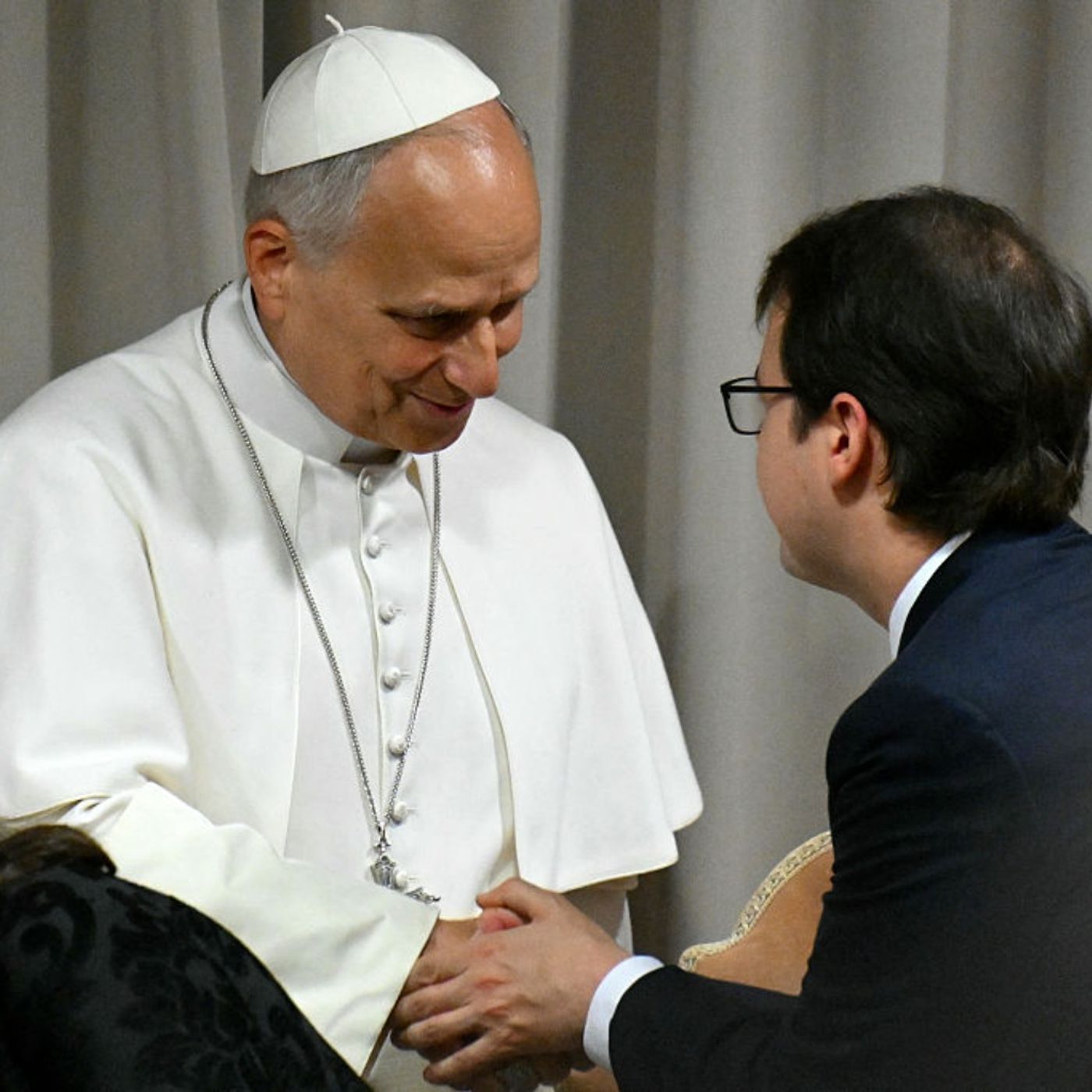
On the Media
How Anthropic Became Holier Than Thou
00:50:26
Plus, a literary AI scandal heralds a new era of publishing and journalism.
Loading summary
Transcript171 lines
- [00:03]
Brooke Gladstone
When the Pope released his AI encyclical, the co founder of Anthropic sat beside him and gave a speech.
- [00:09]
Chris Ola
How will we ensure that the gains of AI are shared globally? It is an unsolved problem, but is it really?
- [00:15]
Brian Merchant
We have historically proven tools that are actually pretty good at redistributing wealth and power. They're called taxes.
- [00:24]
Brooke Gladstone
How Anthropic markets itself as a moral leader. From From WNYC in New York, this is on the media. I'm Brooke Gladstone.
- [00:31]
Michael Loewinger
And I'm Michael Olinger. Also on this week's show, we visit an Epstein files reading room displaying printouts of 3.5 million files, 17,000 pounds of evidence.
- [00:43]
David Garrett
The first printer that we sent this project to came back and said, we work with a lot of lawyers. We're really worried that if they find out that we printed this, they're not going to work with us anymore.
- [00:54]
Michael Loewinger
It's all coming up after this.
- [01:01]
Brooke Gladstone
From WNYC in New York, this is ON the media. I'm Brooke Gladstone.
- [01:05]
Michael Loewinger
And I'm Michael Olinger. On Tuesday of this week, yet another executive order. Trump just signed an executive order this morning centered on government access to advanced artificial intelligence that lays the foundation out for federal testing of the world's most powerful AI systems before they're publicly released. Now, the testing would rely on volunteers, collaboration from the nation's top AI companies. This after earlier in the week, one company became the frontrunner in the race to become the AI startup that rules them all.
- [01:37]
David Garrett
Anthropic has filed what's likely to be one of the largest IPOs in history. By filing, Anthropic has leapfrogged its rival, OpenAI.
- [01:45]
Wahine Vara
We reported just last week that Anthropic closed a massive financing of $65 billion, $965 billion valuation, almost $1 trillion.
- [01:54]
Brian Merchant
Anthropic has built what many and many users consider the best in class AI product.
- [02:02]
Michael Loewinger
Brian Merchant is a technology journalist and author of the book and newsletter Blood in the Machine.
- [02:08]
Brian Merchant
Their Claude Chatbot is one of the favored chatbots anywhere, especially for commercial use, for automating work functions, especially software coding. Whereas OpenAI has been dabbling in consumer chatbots in video generation with its Sora app that's now recently shuttered. Name it and OpenAI is in it and probably key to sort of outmaneuvering OpenAI. More recently, anthropic has really leaned into their reputation as the safer and more ethical AI company.
- [02:44]
Michael Loewinger
How did Anthropic get this brand as the ethical AI company?
- [02:50]
Brian Merchant
Anthropic began when Dario Amodei, the now CEO and former employee of OpenAI, left the company, citing ethical concerns with Sam Altman's managerial behavior. So he leaves and resolves to found a more ethical, a more safety focused AI lab. From the beginning, they are hiring safety researchers, AI ethics people.
- [03:14]
Michael Loewinger
And they got another bump of press coverage in late February, when Anthropic had a big dispute with the US Military. Anthropic had a major contract with the Pentagon, but the US Government said they would stop using Anthropic's technology because of the company's red lines, that they wouldn't spy on Americans or let their tech be used in autonomous weapons. Walk us through how that moment was, like, metabolized by the media.
- [03:40]
Brian Merchant
The press kind of presents Anthropic as taking the ethical route.
- [03:46]
David Garrett
Anthropic is imposing another level of morality or control on the use of its technology, which is part of its sort of M.O. you know, they are taking the moral
- [03:56]
Michael Loewinger
high ground here and clearly have a set of red lines for how they feel their technology should or shouldn't be used. They stood up to Pete Hegseth.
- [04:05]
Brian Merchant
Exactly. And then they are served this absolute gift of Sam Altman running to Hegseth and the Department of War saying, ooh, we'll do it. We'll take this contract where we'll surveil Americans and lend our technology to autonomous killing machines. In truth, yeah, maybe there's this red line. But Anthropic is partnering with Palantir. It's lending technology to companies that are building mass surveillance apparatuses already. Anthropic is working with the government in the first place with the Department of War. It was involved in providing technology that led to the capture and kidnapping of Maduro and in the bombing campaigns of Iran. That's not hidden information, but the fact that they say, oh, well, we won't do these things. Suddenly they look like the good guys.
- [04:53]
Michael Loewinger
In April, Anthropic announced a new artificial intelligence model that it said was too powerful to be released to the broader public. They started by just offering it to a handful of executives, though they're starting to expand. You say this garnered them reams of credulous press coverage?
- [05:12]
Brian Merchant
Yeah.
- [05:13]
Michael Loewinger
Break it down.
- [05:14]
Brian Merchant
To me, this is the most sort of nakedly staged event. This is the clearest example of Anthropic's ethics slop. They make this big show of withholding a model that they say is too dangerous for public consumption. Like, oh, we've built this model Mythos. And it's so powerful that if we gave it to the public, then it could collapse the entire cybersecurity infrastructure of the world's digital systems as we know it. So we have to hold onto it. We're doing the ethical thing. And to kind of my surprise at this point, the media did, by and large, buy their line. And I'm just going to read a couple headlines that I pulled from the New York Times here. You can't use this AI, Claude. Mytho's preview is dangerous. Anthropic said, we explain the risks. Here's another one also just from the New York Times. Anthropic claims its new AI model, Mythos, is a cybersecurity quote reckoning. This is actually kind of a classic move that AI companies have made even before the AI boom really heated up.
- [06:17]
Michael Loewinger
It sounds so much like Sam Altman saying, please regulate us. Yeah, this technology, if it falls in the wrong hands, will, like, end civilization as we know it.
- [06:27]
Brian Merchant
Anthropic gets to have it both ways. It gets to look like it's built this transformative, totally disruptive technology that could change everything and if we're not careful, destroy it too. But you can just kind of hear the CFOs around the world kind of salivating. You know, what could it automate if it can do this? What kind of jobs could it replace if it can collapse world infrastructure? And that's the point. They want to feed this continuing hunger for the most powerful AI systems.
- [06:53]
Michael Loewinger
Yeah, you say that narrative plays a really important role in attracting the interest of VC and raising money. Can you give some other examples of that?
- [07:04]
Brian Merchant
The biggest example is the entire concept of AGI, or artificial General intelligence, which was, at least in the early years of the AI boom, the goal of all of the companies to achieve AGI, which is a system that is as smart as a human nominally, but is defined when you look at their charters, as a system that can do most meaningful work of a human worker. If you're hoping to raise enough capital to compete with one of these giants that are worth over a trillion dollars, like Google and Apple and Microsoft, you need a story that's going to generate tens of billions of dollars of investment. So you need the biggest story. And so there's all these factors contributing to the story, not just being, oh, we're going to build a product and we hope people like it and we think they're going to buy it to, we're going to build the be all, end all, automate every job machine. And you want to get in on
- [07:59]
Michael Loewinger
the ground floor just to point out the irony here, on one hand, Anthropic is raising money on this. We're the ethical AI company. And on the other, they're also benefiting from the hype of the major consequences that would come with realizing their sales pitch, replacing human workers and all of the negative consequences that would have on our society. This contradiction came to a head at the Vatican last month. Anthropic co founder Chris Ola said this at the press event where the Pope released his much talked about encyclical.
- [08:36]
Chris Ola
There is a real possibility that AI will displace human labor at a very large scale. If that happens, supporting those displaced will be a moral imperative of historic proportions. How will we ensure that the gains of AI are shared globally? We do not have a mechanism for this. It is an unsolved problem and it is the kind of problem the Church has historically refused to let the world ignore.
- [08:59]
Michael Loewinger
I heard you snickering. Why does this make you laugh? This is a serious problem.
- [09:05]
Brian Merchant
Well, to me this is such a great example of AI executive brain because we have historically proven policy tools that are actually pretty good at redistributing some of the wealth and power that's concentrated among a certain group of people with everybody else. They're called taxes. And just because AI companies don't really like that idea, they don't like the concept of being taxed, doesn't mean they don't exist. There are some pretty low hanging fruit solutions here that you could talk about.
- [09:36]
Michael Loewinger
You read Pope Leo XIV's 42,000 words on this topic. What did you think of it?
- [09:44]
Brian Merchant
It's actually a really fascinating and rich document. And I think the important things to know about it are that Pope Leo kind of views it as a continuation of or comment on the previous Pope Leo, Leo xiii, his famous encyclical Rerum Novorum, which was written and released in 1891. It's viewed as this transformative document in Catholic history as it's really marks the beginning of the Catholic tradition of social teaching. And it's primarily concerned with the impact of the industrial Revol revolution and how the industrialists are treating workers in the wake of this time of great tumultuous change. The rapid concentration of wealth, the rise of machinery and so many human workers sort of falling under the gears. And it makes this argument that in order to truly be a good Christian, to have the time and the space and the spiritual capacity to live with God, you also have to have your material conditions met. Right? You can't be suffering. And therefore the Church decides that every Human is worthy of dignity. Every human worker should be protected, even if that means sort of state intervention to get there. So Pope Leo XIV takes a lot of this framework and then moves it into the modern era, the AI era. Let me even just quote him here. Leo writes that the fundamental dignity of each person is neither acquired nor earned, nor does it need to be justified. It's not, oh, is he working hard enough or is he better than AI? Is he worse than AI? What's his productivity output? No, like the dignity is inherent. It's pretty powerful stuff.
- [11:28]
Michael Loewinger
Timney Gebru, who's an AI ethics expert, she previously worked at Google, she wrote on LinkedIn, calling this sort of PR event Vatican washing. Like greenwashing, allowing Anthropic to kind of robe itself in the holiness of the Pope's righteous criticism of this industry and the harm it might cause. She wrote, the Vatican could have told Anthropic to stop stealing data, exploiting labor, killing the environment, deceiving us with anthropomorphic designs, and lying about product capabilities. Instead, they partnered with them, like partnering with the Sackler family to discuss the harms of Oxy.
- [12:09]
Brian Merchant
Yeah, she did not hold back there. I think that's absolutely correct. They chose to have Anthropic there and speak out. An AI executive executive, a billionaire, presenting the AI company's take on the whole affair. They could have had a worker who's lost his job to AI, or a content moderator who has developed ptsd, looking at some truly horrific stuff that AI is outputting but is working for dollars a day to make these systems work. It was a huge public relations coup for Anthropic, getting to be there, co signing this document of great moral authority. I think it should bother us that just, just days later, Anthropic ran home and announced the biggest funding round yet, and that their company's now worth almost a trillion dollars. On the back of all of this sort of performative moral hand wringing, do
- [13:00]
Michael Loewinger
you think there's political appetite in the United States for the type of political intervention that the encyclical calls for?
- [13:07]
Brian Merchant
If it's not here right now, it's on the way. I think there's a rapidly growing demand for political action against this yawning inequality that we're seeing. Get entren.
- [13:20]
Michael Loewinger
Yeah, I think of the image of an American executive at a commencement speech preaching AI to classes of graduating college seniors.
- [13:30]
Wahine Vara
The rise of artificial intelligence is the next industrial revolution
- [13:38]
Michael Loewinger
and the boos they get.
- [13:42]
Wahine Vara
What happened? Okay, I struck a chord. May I finish it?
- [13:51]
Michael Loewinger
Just Feels like both a temperature check of this moment, but also kind of foreshadowing of the political battles to come. How do you think we should be talking about our future that doesn't just do the kind of PR work that the companies are looking for.
- [14:07]
Brian Merchant
There are a lot of great critical journalists covering this stuff, folks like 404 Media and Wired. I have a series of work that I do called AI Killed My Job. And the whole goal is to assess the claims of the AIC CEOs by talking to the workers.
- [14:24]
Michael Loewinger
Right?
- [14:24]
Brian Merchant
Like, that's how we know what's actually happening. And most of the time, if you talk to someone who's at a workplace that has been heavily saturated with AI, they'll have a much more nuanced story to tell than just, yep, it took my job. You hear stories about how, yeah, they talk about AI a lot and they force us all to use it, but we don't actually see a whole lot of gains. In fact, there's been a lot of talk in just the last couple of weeks about whether or not AI is actually providing the return on investment that was promised. And you have big firms like Uber saying, I think we're going to scale back. Amazon saying, I think we might have to scale back. We also need, I think, more focus on the financial balance sheets about what's actually going on behind the scenes here. They've gotten so much money by telling these wild stories without having a concrete business plan to put forward. To the extent that Sam Altman has said early on, we have no idea
- [15:20]
Michael Loewinger
how we may one day generate revenue, we have made a soft promise to investors that once we've built this sort of generally intelligent system, basically we will ask it to figure out a way to generate an investment return for you.
- [15:34]
Brian Merchant
That was the plan. People did kind of laugh at him in the room, and he said, no,
- [15:38]
Michael Loewinger
no, no, you can laugh, it's all right.
- [15:39]
Brian Merchant
But it is what I actually believe
- [15:41]
Michael Loewinger
is going to happen.
- [15:42]
Brian Merchant
For all of the fascinating technology and all of the breakthroughs and all of the disruption that this has caused, it is built first and foremost on this story. And we need journalists who are going to continue to sort of dig in to what lies beyond the story.
- [15:59]
Michael Loewinger
Brian, thanks for doing this work.
- [16:00]
Brian Merchant
Oh, thanks so much for having me.
- [16:02]
Michael Loewinger
Brian Merchant is author of the book Blood in the Machine.
- [16:07]
Brooke Gladstone
Coming up, did AI write that this
- [16:10]
Michael Loewinger
is on the media?
- [16:20]
Tonya Mosley
This is Tonya Moseley, co host of Fresh Air. You'll see your favorite actors, directors and comedians on late night TV shows or YouTube. But what you get with Fresh Air is a deep dive. Spend some quality time with people like Billie Eilish Questlove, Ariana Grande, Stephen Colbert, and so many more. We ask questions you won't hear asked anywhere else. Listen to the Fresh Air podcast from NPR and whyy.
- [16:51]
Brooke Gladstone
This is On THE media. I'm Brooke Gladstone.
- [16:54]
Michael Loewinger
And I'm Michael Oinger. Not long after the release of the Pope's encyclical, a rumor started to spread on social media that his missive on AI may have been written using AI. The fact checking site Snopes could not find conclusive evidence to support this claim, but it did reference scan results from Pangram Labs, an AI detection tool, which found that the encyclical was 94% human, 4% AI generated, and 2% AI assisted. If those results are accurate, then maybe someone on the Pope's staff fed parts of his essay into, say, Claude for editing help. In this moment, as it's becoming harder to tell what's real or fake, human or AI, more people are turning to tools like Pangram. In March, a researcher fed a New York Times Modern Love column by Kate Gilgan into the app and alleged that the piece was more than 60% AI generated. One writer for the Atlantic decided to dig deeper.
- [17:58]
Wahine Vara
I eventually spoke to the author of the column over text message.
- [18:03]
Michael Loewinger
Wahine Ivara is the author of the book Selfhood in the Digital Age. She's been tracking how AI has been creeping into reporting, writing, even literature.
- [18:14]
Wahine Vara
She told me that she hadn't actually copied and pasted anything from an AI model into her work. But then she went on to say that she did utilize AI as a tool for things like inspiration and guidance and correction. And then she gave me this whole list of five AI products that she'd used while writing the piece. And she called AI a collaborative editor.
- [18:37]
Michael Loewinger
And you reached out to the New York Times about the fact that they had published something that at the very least was written with a heavy assist from AI tools. How did they respond?
- [18:51]
Wahine Vara
The New York Times said that if people used generative AI in a substantial way, that needed to be disclosed to readers. I asked this spokesperson who I was in touch with, whether the level of AI use in that essay rose to that level that required disclosure, and she didn't directly answer the question. Eventually, many weeks later, the Times actually did change its policy. It introduced this new AI policy for freelancers, making clear that they were expected to largely refrain from using AI.
- [19:25]
Michael Loewinger
Here's another example of an AI reckoning the horror novel called Shy Girl. It had garnered some buzz before it was released by Hachette Book Group until a New York Times article made the case that, again, AI tools may have been involved.
- [19:41]
Wahine Vara
So in that case, the author of that book did tell the Times that she had not used AI to write Shy Girl, but that she had hired an acquaintance to edit an earlier version of the book, and that acquaintance had used AI. And then Hachette canceled publication.
- [19:59]
Michael Loewinger
Okay, let's talk about another case study where again, this AI detection tool, Pangram, was used. Last year's Commonwealth Short Story Prize, people
- [20:11]
Wahine Vara
again on social media started noticing that this one story that was published online on the website of the magazine Granta, which is very prestigious, seemed to just reek of AI use. And again, people ran the story through Pangram. In that case, Pangram believed that the story was 100% AI generated. But that was just the beginning of it because that story had actually been a regional winner of this prize called the Commonwealth Short Story Prize, and there were four other regional winners. And so people ran those stories through Pangram. One other story was flagged as 100% AI generated, and a third story was flagged as including significant amounts of AI generated material.
- [20:59]
Michael Loewinger
But what made this instance different from the other two we talked about is that these writers said that they didn't use AI. I want to ask you more about these AI detection tools like Pangram. How does Pangram work? How accurate is it? Do we know?
- [21:17]
Wahine Vara
It essentially shows lots of different examples of human writing and AI generated text to an AI model. And that model learns to distinguish the difference between what human writing looks like and what AI generated writing looks like. So it isn't a matter of this technology, like counting EM dashes per paragraph. Right. Or like tallying the number of really
- [21:45]
Michael Loewinger
bad metaphors, which, to a human eye, might be a sign of AI writing.
- [21:50]
Wahine Vara
Exactly. But Pangrim in particular, as well as another product called GPT0, have been found by independent research from the University of Chicago to actually be very accurate. There's almost a zero percent chance that something's going to be flagged as AI if it's really human, human written. The product does have higher false negative rates, which can be between 2% and 4%, according to this University of Chicago research, which means that it's somewhat more likely that it's going to take something that was actually AI generated and flag it as human written.
- [22:29]
Michael Loewinger
Interesting. In some of your own reporting, you have relied on Pangram's analysis and more specifically, the work of a Maryland PhD student and researcher named Jenna Russell. She and Other researchers from Pangram released a preprint, meaning you can read it online, though it hasn't been peer reviewed yet, which scanned 185,000 articles from 1500 newspapers. The team claims that 9% of those newspaper articles were either AI generated or mixed, and op eds specifically were six times more likely to have AI's fingerprints. In an OP ed published in the Wall Street Journal in April, an editor at the paper, James Toronto, dug into that Pangram research paper, which he says erroneously flagged three OP EDS in the Wall Street Journal as AI generated. And that term matters because two of the accused writers said they used AI to revise some of their work. But, he wrote, it's inaccurate and unfair to characterize work produced in the manner of described by any of these authors as AI generated. The Pangram tool has no ability to discern a writer's work process. It merely looks for linguistic patterns that tend to correlate with AI output.
- [23:45]
Wahine Vara
I wouldn't come to the same conclusion as the writer of that piece, but it is true that to flag something as AI generated does not reflect the nuance of how people actually use AI products, right? When you see that something is flagged as 100% AI, for example, I think what we picture is that somebody went to ChatGPT and said, write me an 800 word modern love column about a bad breakup. Right? It may be the case, actually, that people are giving the AI models very rough drafts or outlines of the material and then relying very heavily on the AI chatbot to suggest language or refine their language. But an author might feel that it was actually their work because it was their ideas or an original draft came from them. So I think that's a fair conversation to have. But I think it raises this other problem, which is that we don't really have clear standards about what we mean when we talk about AI reliance.
- [24:53]
Michael Loewinger
In all of the examples that we've discussed, shaming seems to play a role, I guess. I'd love to hear what you would say to people who don't necessarily believe that. That all of these writers did something wrong.
- [25:05]
Wahine Vara
Listen, I think it's a matter of disclosure and transparency. We can imagine a world in which the New York Times or the Atlantic or New York Public Radio have very clear policies about AI that they post on their websites, for example, and then in every article or opinion piece, there's a disclosure explaining exactly how AI was used in producing that piece. And that way people can know and they can make an informed decision about whether they want to read the piece at all, how much they trust it.
- [25:41]
Michael Loewinger
There was a really interesting piece in Poynter last month by a book critic named Rachel Megan. She had written about Shy Girl before its release and had given it a rave review before reading that it was 78% AI generated. She wrote that the experience was embarrassing. It made her question her judgment as a criticism, but it made me wonder if she, a fan of horror, found such value in this book. Why then does the realization that AI played a role undo all of that?
- [26:14]
Wahine Vara
For me, it has to do with what literature is for. So when we view it through that lens, if I as a reader appreciated it, isn't it Maybe. Okay. It's a sort of like consumerist lens to use to think about literature. I think we are customers and and all we need is to be given products that we appreciate. Right. There's another lens through which to look at it, which is a political lens which considers literature, but also journalism and also just communication in general to be this crucially important political act. There's something politically powerful about using language to serve our individual and collective purposes as people in the world. And something really dangerous, I think, about accepting language that's provided to us by big technology companies for which we have to pay in some way or other. Right.
- [27:14]
Michael Loewinger
We're sort of electing to give up our agency as thinkers and individuals when we let them talk for us.
- [27:21]
Wahine Vara
Exactly. The thing that makes us human as a species is our ability to use this really specific form of language that only we have in order to connect with one another. And so yeah, it's not really about like, should we do it or should a robot do it? It's about should we do it or should we relinquish it to products built by really rich, really powerful technology companies that are built to further enrich and further empower those companies.
- [27:54]
Michael Loewinger
Wahine, thanks for coming on the show.
- [27:57]
Wahine Vara
Thank you for having me.
- [27:58]
Michael Loewinger
Wahini Vara is a contributor for the Atlantic. She's the author of the recent piece this Literary AI Scandal Changes Everything.
- [28:09]
Brooke Gladstone
Coming up, an in real life tour through the Epstein files.
- [28:14]
Michael Loewinger
This is on the Media.
- [28:22]
WNYC Sponsorship Announcer
WNYC Studios is supported by Wise Wise, the smart way to manage the currencies you need around the world. With a Wise account, you can send, spend and receive in up to 40 currencies with only a few simple taps. Be smart, get wise. Download the Wise app today. Terms and conditions apply. WNYC Studios is supported by Odoo. When you buy business software from lots of vendors, the costs add up and it gets complicated and confusing. Odoo solves this. It's a single company that sells a suite of enterprise apps that handles everything from accounting to inventory to sales. Odoo is all connected on a single platform in a simple and affordable way. You can save money without missing out on the features you need. Check out Odoo at O D O o dot com. That's O d o o dot com.
- [29:12]
Tonya Mosley
This is Tonya Mosley, co host of Fresh Air. You'll see your favorite actors, directors and comedians on late night TV shows or YouTube, but what you get with Fresh Air is a deep dive. Spend some quality time with people like Billie Eilish, Questlove, Ariana Grande, Stephen Colbert, and so many more. We ask questions you won't hear asked anywhere else. Listen to the Fresh Air podcast from NPR and whyy.
- [29:42]
Michael Loewinger
This is ON the media. I'm Michael Loewinger.
- [29:44]
Brooke Gladstone
And I'm Brooke Gladstone. A few months ago, the Justice Department released on its website its last tranche of Epstein files, a tangled thicket of PDFs. Some 30 public figures, mostly foreign politicians, businessmen, academics and lawyers, have faced some sort of reckoning for their involvement with Jeffrey Epstein as a result of the files. But America's most powerful seem to have been left relatively unscathed.
- [30:14]
Madeline Dean
The President has lied about being on Epstein's plane and the unredacted files prove that. There's a lot in here.
- [30:22]
Brooke Gladstone
Pennsylvania Rep. Madeline Dean questioning Acting Attorney General Todd Blanche earlier this week as part of the House of Representatives investigation into the federal government handling of the Epstein files. It's worth noting here that while some three and a half million documents in the government's files on Epstein have been made public, roughly two and a half million have not.
- [30:44]
Madeline Dean
There's also this set of files. This is investigation into the potential co conspirators of Jeffrey Epstein. It's all covered up. The American people are not stupid. They know that when members of Congress have to go in and actually unredact, try to find the truth for these victims, something is corrupt. Something is corrosive.
- [31:10]
Brooke Gladstone
On a sticky day last month, I stepped into the cool interior of what had been an art gallery to behold the files in real life, at least those we've been authorized to see.
- [31:23]
David Garrett
In late March, we downloaded all of the Epstein files from the Department of Justice website, printed them out, bound them into volumes and brought them here.
- [31:35]
Brooke Gladstone
David Garrett is a luxury wine entrepreneur from Michigan and the co founder of the nonprofit Institute for Primary Facts. He organized this exhibit to shine a spotlight on the decades long relationship between Jeffrey Epstein and Donald Trump its synergies and synchronicities. The exhibit was open to the public in New York City for several weeks in May.
- [32:00]
David Garrett
3.5 million files ends up being about 3,500 volumes of 800 pages each.
- [32:09]
Brooke Gladstone
They're all in this room.
- [32:10]
David Garrett
We couldn't fit them all in here, so we have a few downstairs, but, yeah, £17,000 of evidence.
- [32:15]
Brooke Gladstone
that moment, I was standing in front of a bookcase filled with volumes and stark white binders, and I pulled out volume 2,742, as released by the Department of Justice of the United States. The Donald J. Trump and Jeffrey Epstein Memorial Reading Room, published by the trumpsonian. I laughed.
- [32:38]
David Garrett
So this all started when the Smithsonian took down the exhibits of Trump's impeachments. You know, I kind of of lost it a little bit. I mean, I'd been listening to too many podcasts and yelling at the TV for 10 years. But when the Smithsonian decided to bow to the Trump administration and rewrite history, I thought, we need someplace that's going to actually preserve the truth.
- [33:02]
Brooke Gladstone
I think a lot of people might think that, wow, it really takes a long time to Xerox all those files. We know that it took a long time for Ellsberg to get the Pentagon Papers Xerox, but that was a walk in the park compared to this.
- [33:19]
David Garrett
There were really two problems getting everything printed. The first one was technical. All of these files are heavily redacted. And when you redact a digital file, they go over the redacted material three times with full black. It's completely gone. The problem is that's so much ink that if you put it through a printer, it'll tear the paper. So we had to go through all 3.5 million files and correct each pixel that was 300% black to a format that could be printed. But the bigger problem was really political. The first printer that we sent this project to came back and said, we work with a lot of lawyers. We're really worried that if they find out that we printed this, they're not going to work with us anymore. A second printer, one of their biggest investors was a Trump supporter. We finally found some printers that are super courageous. And we got very lucky.
- [34:11]
Brooke Gladstone
And the locations.
- [34:13]
David Garrett
We had a very bad day when we lost both the printer and our first location on the same day. We literally sat down and said, is this too hard? We probably looked at five different places.
- [34:25]
Brooke Gladstone
And they turned you down.
- [34:26]
David Garrett
Yeah, a bunch of them turned us down. Yeah. And this exhibit, the reason that Donald Trump's name is on it is really for two reasons. One is what he shares with Jeffrey Epstein is dozens and dozens of allegations of sexual assault. They're both convicted felons, so putting their names together really makes sense.
- [34:45]
Brooke Gladstone
Trump's name is cited more than 38,000
- [34:49]
David Garrett
times throughout the documents. People can draw their own conclusions from that. But my point is this. He shouldn't be influencing the investigation into these crimes. That is a corrupt act, him slowing that investigation. That's the purpose of having his name on this.
- [35:06]
Brooke Gladstone
Now, I assume you've looked at a lot of these documents, right?
- [35:10]
David Garrett
Too many.
- [35:11]
Brooke Gladstone
Will you show me one that struck you?
- [35:14]
David Garrett
Oh, I. Well, here's what I'll tell you. One time last week, I was giving an interview, and I just pulled a random book off the shelf and started leafing through it to show them that it was real. And it was page after page of little girls with no clothes on. And I had to put the book back and I had to sit down. And so I don't do that anymore. I was here with one of the survivors a couple of days before we opened. We helped her to find the books where she's mentioned, and we pulled them down, and I sat down with her downstairs, and she showed me her name, her address, her birthday, her Social Security
- [35:54]
Brooke Gladstone
number, things that were supposed to be redacted.
- [35:57]
David Garrett
A picture of her driver's license. She was 17 when she did the FBI interview. And so she talked about some of her friends that she had told about it. Those friends names are unredacted. It is criminal what the Department of Justice has done in causing additional harm to the victims and survivors and exposing them. I don't know who to see about it when the Department of Justice breaks the law.
- [36:23]
Brooke Gladstone
He walks us towards the back of the room and to display the famous picture of Trump and Epstein. And Trump's got his hand on his shoulder. They're both smiling. And then there's a pretty extensive timeline. Three, actually. One on top of the other on top of the other.
- [36:42]
David Garrett
The top one is Jeffrey Epstein, his dozens of allegations of sexual assault, his felony conviction. The bottom timeline is Donald Trump and his dozens of allegations of sexual assault and his felony convictions. And in the middle, you see all these famous photos of them together. We built this timeline to create context so you would know when these photos were taken. And all of the allegations of sexual assault by both men. The notes that you see that are tacked to the timeline are all from survivors that have been here over the course of the last few days. They see themselves on the timeline. And they asked if they could include themselves.
- [37:24]
Brooke Gladstone
This one here, from Marina lacerda. Parentheses minor victim 1. My first time in Epstein's house, I was only 14 years old. He gained my confidence and groomed me till he was able to rape, abuse, and take my childhood away. Today I am 37 and reclaiming my power. And I encourage every woman not to forget that power is always within love. Marina. This happened to her in 2002. Alongside of profile of Epstein in New York Magazine. Trump said, I've known Jeff for 15 years. Terrific guy, a lot of fun to be with. It's even said that he likes beautiful women as much as I do. And many of them are on the younger side. Same year as Marina's encounter when she was 14. Yeah.
- [38:16]
David Garrett
This is in 2005, the same year the federal probe into Epstein started. And Danny writes here that she was trafficked to Epstein in 2004 at 17 years old. Jeffrey used dance, my ballet background, and my mom's brain tumor against me to get what he wanted. Demand from the powerful still exists. We have to make it safer.
- [38:38]
Brooke Gladstone
This is around the same time that Trump wrote that birthday card.
- [38:42]
David Garrett
Yeah. She put it on the timeline right above Trump's famous birthday card.
- [38:47]
Brooke Gladstone
And 2000, the same year, where there's the famous foursome photo of Trump, Melania Epstein and Ghislaine Maxwell photographed together at Mar a Lago. This is when Virginia Jeffrey was recruited at Mar a Lago. She was 16 years old. She became one of the most prominent voices against Epstein. Later, she killed herself Lisa Phillips, around the same time, brought by boat from Tortola. She writes in this note on your wall, she met Prince Andrew on the same day Epstein, she writes, abused me.
- [39:24]
David Garrett
Yeah. So everything that's happening now with transparency and accountability, as flawed as it is, is because of these amazingly brave women who stood up and refused to go away. The pictures that you see here are them speaking out in front of Congress to get the Epstein files Transparency act passed. And then two of these photos are from the very famous public service announcement advertisement that ran during the super bowl with all of the survivors holding up pictures of themselves the year they met Jeffrey Epstein.
- [40:00]
Wahine Vara
After years of being kept apart, we're standing together, standing, standing together because this girl deserves the truth, because she deserves
- [40:09]
Chris Ola
the truth, because we all deserve the truth.
- [40:14]
Brooke Gladstone
On the timeline, there's a girl, she looks maybe 13 or 14, smiling for her class photo. This was the year she met Epstein, 1991. And she leaves a note. Jess Michaels, raped by Jeffrey Epstein, brought to him by a woman who Would go on to work for Epstein for 18 plus years.
- [40:35]
David Garrett
So what we have in the middle is next.
- [40:37]
Brooke Gladstone
David Garrett brings us to a draped box. Inside there are 1400 electric candles.
- [40:47]
David Garrett
Each one of those candles represents one of the victims of Jeffrey Epstein. Each one of them is a life.
- [40:54]
Brooke Gladstone
You found that people looking at it had a tendency to start counting.
- [41:01]
David Garrett
Yeah, I think they start counting first to just say how many are there. And some people will stand here for 20 minutes or a half an hour. What we're surrounded by are 3.5 million files. It's the problem with big numbers. How do you know what 3.5 million files looks like? Well, now you can see it. But the same thing is true with 1400 victims. How do you know what 1400 little girls looks like? 10 is a volleyball team. 20 is a lacrosse team. 1400 fills a theater.
- [41:37]
Brooke Gladstone
Downstairs, the walls are blanketed with so many more handwritten notes. But these are written by the guests.
- [41:46]
David Garrett
This was our overflow room originally, where we have some more bookshelves and a few hundred last books. And we created a space down here where people that come through, if they want to call the Department of Justice, they can sit at that table and call and ask, demand that all of the files be released and that they be properly redacted. And then here at this table, people leave notes. We had one corkboard. We thought we'd only need one for the whole time that we were here. There are now maybe 20 corkboards.
- [42:15]
Brooke Gladstone
Here's one that says, we live in a prison with free monsters. We are not things. All this happened in the, quote, best country in the world. Are we great yet?
- [42:29]
David Garrett
So a lot of people that come through are survivors of sexual abuse or sexual assault themselves. A lot of women need a moment after seeing the exhibit upstairs and want to express themselves down here. We've seen dozens and dozens of survivors come through this space.
- [42:47]
Brooke Gladstone
There's one that says, why do men in power keep trying to protect us from imaginary threat and ignoring the real ones? Burn it all down. You call this enterprise a pressure campaign. How so?
- [43:05]
David Garrett
A year ago, when the authors of the Epstein Files Transparency Act Were contemplating that piece of legislation, Everybody thought, it'll never pass. It'll never be law. But because these incredibly brave women went to Capitol Hill and demanded that this law be passed because millions and millions of people called their congresspeople, it passed the House with only one no vote. It passed the Senate unanimously, and the President signed it. What that means is that if we work together, democracy can still work. That's what I Hope we can do a small part of here, get people excited. We've already done maybe 1500 calls to the Department of Justice. We hope to demand that all the files be released, that they properly redacted this time, and that there is real transparency that drives towards real accountability.
- [43:59]
Brooke Gladstone
The Institute for Primary Facts is primarily an anti corruption organization. Is that wrong?
- [44:06]
David Garrett
It's a pro democracy. Right. But I think that's the same thing. Corruption is the tool of autocrats to kill democracies.
- [44:14]
Brooke Gladstone
But primary facts seem to have much purchase in the current political climate. People seem to be immune.
- [44:25]
David Garrett
I'm not sure if it's the people. I think it might be the medium. You make more money, the more attention you get on social media. The things that get the most attention sometimes aren't true. You just have no idea when you're looking through your phone. So when I say the Institute for Primary Facts, what I'm hoping that we can do is use in real life, use tactile experiences, get away from your phone and come in and see what we've done here. It's really hard to ignore. You can't scroll past it when you're walking through this room.
- [44:57]
Brooke Gladstone
So many people are able to tsk, tsk at what happened with Jeffrey Epstein and move on. You clearly can't. Just talking about it made you something that the listeners couldn't see, but really upset. Why can't you pass it by? I have two daughters. How old are yours?
- [45:18]
David Garrett
I have a daughter who's 26 and one who's 15. I imagine that I'll have granddaughters someday. There have always been monsters. There have always been monsters. But for 250 years, we have the rule of law. And the rule of law meant that we could feel confident that regardless of who the perpetrator was, we could hold them accountable. And if we could hold them accountable, then there would be a deterrent for people to do it in the future. Well, what is the deterrent now? They've all gotten away with it. I don't think that's providing a safe environment for my daughters and granddaughters. Let's have some real accountability.
- [46:04]
Brooke Gladstone
Look, I've been a reporter for a long time. I've often told young reporters that it's like water dropping on a stone to change things. You need a billion drops to even slightly redirect the flow. Are your hopes for this reasonable?
- [46:19]
David Garrett
Maybe. Even if they're unreasonable, real change is a small group of people trying to do impossible things. That's the only way that change has ever happened. I think That a lot of people are hungry for change. So let's do it.
- [46:38]
Brooke Gladstone
Thank you so much.
- [46:39]
David Garrett
Thank you.
- [46:41]
Brooke Gladstone
While Garrett was guiding us through the tour, a woman in a long navy dress slipped into the exhibit. He introduced her as Andrea Sterling, an online content creator and also a survivor of one of Epstein's notorious assaults on minors. She agreed to sit down with me downstairs amid the spillover volumes and all those encouraging cork boards and tell me what happened to her.
- [47:07]
J
I was 17, and I recently moved from Colombia, and a friend of mine casually invited me. He was like, hey, you know, I have this gig. There's this rich guy, and I give him massage. There were no details. It was easy for me to accept, too, because she always invited me to very normal events. Barbecues, friends that were our age. Very normal. So when she invited me, it was a little strange, but to be honest with you, I trusted it. He clearly had a technique. Two cleaning ladies opened the door for me and his residence here in New York City. They put me in an office, because in the office, you can acknowledge all the pictures. Now that I'm older, I'm like, oh, they did it on purpose for you to feel, like, safe. Like, oh, he's with politicians. What bad can happen? Which is the trap. That's a trap.
- [48:01]
Brooke Gladstone
You think famous people won't behave that way?
- [48:04]
J
I thought. So I go with the two girls who brought me to the massage room. And quickly I realized that it's not all about a massage. It was not a massage. He just continued. And you're trapped. Some girls freeze. I was kind of fighting on it, but then froze. And it was a disgrace. It was.
- [48:30]
Brooke Gladstone
You felt shame. You felt shame.
- [48:32]
J
Unfortunately, that's. It's hard to explain. I don't understand. How did I carry that? That didn't belong to me and didn't belong to any of the girls. So I leave whenever I could leave. I stopped talking to the friends that brought me there. But now I understand that they were the victims, too. They were minors. They were even younger than me.
- [49:01]
Brooke Gladstone
So then there's this exhibit of the Epstein files. How did you get here? How did you happen to walk in? You never even made your name public.
- [49:12]
J
No. In 2018 or 19, when I saw him, I recognized him. I didn't want to get involved. I wasn't sure. And I saw a lot of the survivors already talking, and I thought, these girls are so brave. They're already doing it. Something's going to happen, right? And keep on waiting and waiting and waiting. And then I'm like, wait. This is getting darker. I have to step in. I can't. I create content in the cannabis industry, in jewelry and traveling. So I create a lot of like, fun and comedy content. And I felt, felt like a coward. Now I think it's time to step in and be part of the noise. And that's what I'm doing right now. And then they contact us about this amazing project. And I think this is very helpful because it helps you understand the magnitude. And these are only half of the files, I call it. These are the vanilla files, even though they're very dark. But I think they gave us the safer files. Imagine the other ones.
- [50:17]
Brooke Gladstone
I understand that you allowed your name to be used here for the first time.
- [50:23]
J
So I opened up in Latin America, only Telemundo, Univision in the United States, only from here yesterday in public.
- [50:33]
Brooke Gladstone
Wow. And so your strongest reaction to this
- [50:37]
J
enterprise was putting my name in the timeline and to see how many people are with us. And they take their time to actually come here and write a note to encourage us to keep going. A lot of survivors, they've been talking since 1996, 1998.
- [50:54]
Brooke Gladstone
And the shame you mentioned, the shame is gone.
- [50:59]
J
That's why I decided to talk to shame. You understand, when you're an adult, you've
- [51:05]
Brooke Gladstone
been an adult for a while.
- [51:06]
J
But it didn't, it didn't hit me until recently. I mean, it has been a process. I did have some therapy prior, worked on some of the things. But what am I going to be ashamed of? I wasn't the 55 year old hiring minors to hire older minors. So the shame is not mine. Yeah,
- [51:30]
Brooke Gladstone
we're very lucky you walked in.
- [51:31]
J
Oh, no, thank you. I'm very lucky to meet you.
- [51:36]
Brooke Gladstone
The Donald J. Trump and Jeffrey Epstein memorial reading room has closed in New York, but it's next headed to Washington D.C.
- [51:49]
Michael Loewinger
That's it for this week's show. On the Media is produced by Molly Rosen, Rebecca Clark Callender and Candice Waugh. Travis Manning is our video producer.
- [51:59]
Brooke Gladstone
Our technical director is Jennifer Munson with engineering help from Jared Paul. Eloise Blondio is our senior producer and our executive producer is Katya Rogers. On the Media is produced by WNYC. I'm Brooke Gladstone.
- [52:13]
Michael Loewinger
And I'm Michael Loewinger.
- [52:17]
WNYC Sponsorship Announcer
WNYC's journalism and storytelling is heard by millions of passionate listeners. Sponsors of our programming gain our listeners attention and their respect. Learn about how your organization can support WNYC and WNYC studios at sponsorship wnyc. Org.