← On the Media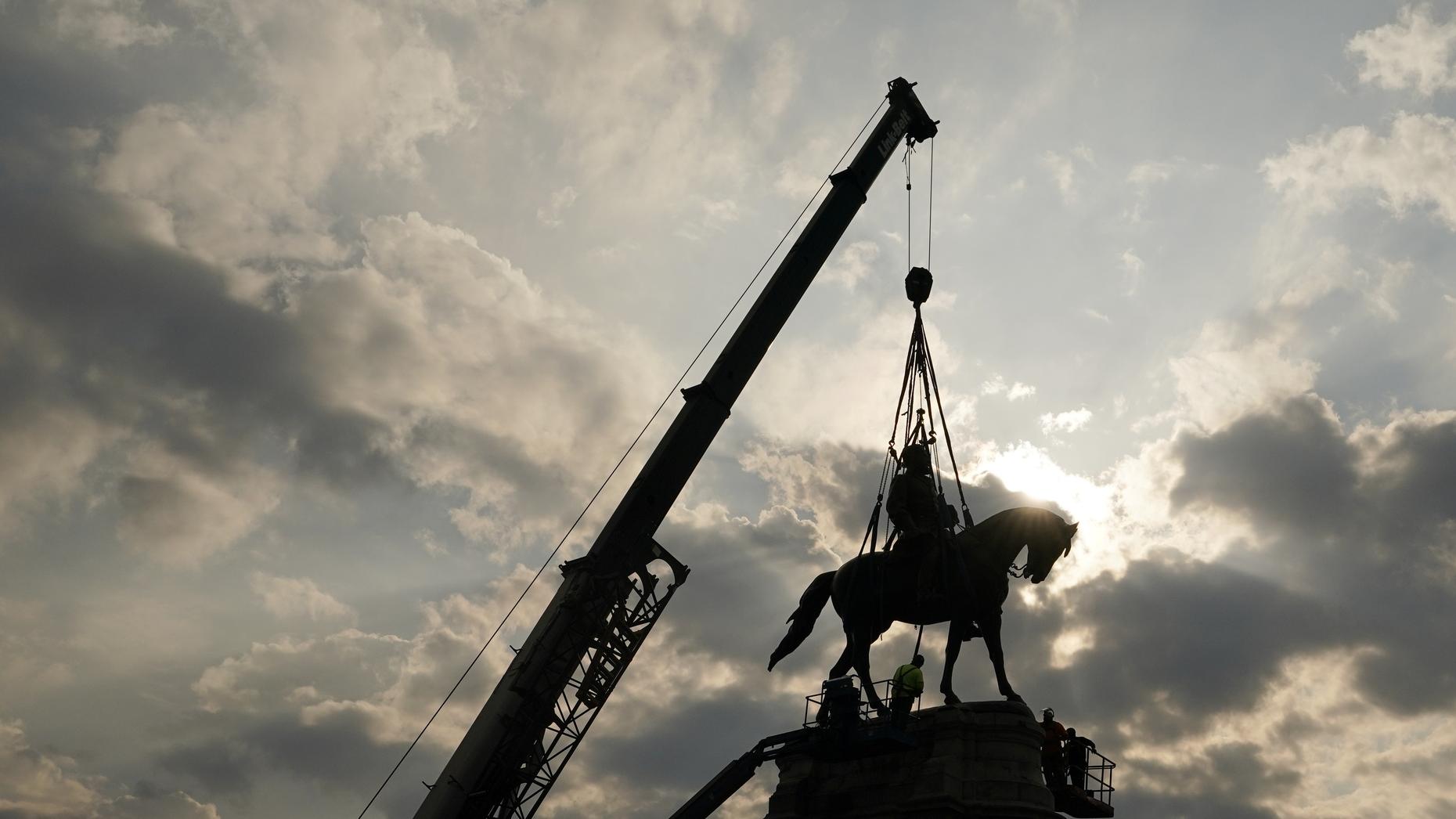
On the Media
Making History
00:50:41
New names for military bases; a coup in Niger; and the myths running rampant in Russia.
Loading summary
Transcript149 lines
- [00:05]
Brooke Gladstone
On this week's on the Media, the roiling tug of war over historical narratives at West Point.
- [00:11]
Ty Sigeley
Every year they're gonna study the Battle of Chancellorsville during the Civil War. And every year Lee is going to beat Hooker. That's not gonna change. We're not changing history. We're changing commemoration.
- [00:22]
Alexis Akwajirum
History is central to the dynamics of what we're seeing play out across the Sahel. Look at slavery, look at colonialism. The history is so ugly and so hideous, you don't have to go back very far. And this is all within living memory as well.
- [00:35]
Mikhail Zigar
President Putin laying out his case that Ukraine is always part of Russia. Historically, my mission was to start writing completely different version of Russian history because, unfortunately, it has always been written by historians who were serving the state.
- [00:52]
Ty Sigeley
The facts changed me, the archives changed me, and my culture lied.
- [00:56]
Brooke Gladstone
It's all coming up after this.
- [01:00]
Progressive Insurance
On the media. Supported by Progressive Insurance, you chose to hit play on this podcast today. Smart choice. Make another Smart choice with Auto Quote Explorer to compare rates from multiple car insurance companies all at once. Try it@progressive.com Progressive Casualty Insurance Company and affiliates. Not available in all states or situations. Prices vary based on how you buy.
- [01:26]
Preet Bharara
Since Donald Trump reassumed office, over 200 lawsuits have been filed against his administration. Firings, tariffs, immigration, climate policy. It's hard to keep track of and even harder to understand. I'm former U.S. attorney Preet Bharara, and on my podcast, Stay Tuned with Preet, I'm joined by experts to break down complex legal stories and cut through the noise of this administration. It may feel tempting to tune out, but now more than ever, we need to stay engaged. Search and follow. Stay TUNED with Preet wherever you listen.
- [01:59]
Brooke Gladstone
From WNYC in New York, this is ON the media. I'm Brooke Gladstone. You know, once there was a time when all the tumult was about Donald J. Trump, the man, the people.
- [02:09]
Preet Bharara
My people are so smart. And you know what else they say about my people?
- [02:12]
Matt Gaetz
The polls.
- [02:13]
Preet Bharara
They say I have the most loyal people. Did you ever see that? Where I could stand in the middle of Fifth Avenue and shoot somebody and I wouldn't lose any voters. Okay, it's like, incredible.
- [02:21]
Brooke Gladstone
But then the fracas abetted by the media spread to his party and widened an already national fissure so that a nation that once shared a few fundamental values would come to battle over the most basic the principle at least, that every citizen has a vote and is equal under the law. That is what this latest indictment, courtesy of U.S. special Counsel Jack Smith. The stakes went up considerably with this.
- [02:48]
Alexis Akwajirum
Indictment, because what's really on trial in.
- [02:51]
Brooke Gladstone
This case is democracy. Former Nixon White House counsel John Dean pleaded guilty to helping cover up the Watergate scandal and became a key witness in that prosecution.
- [03:01]
Alexis Akwajirum
If Trump can get away with what he has done, what's spelled out in.
- [03:06]
Brooke Gladstone
This indictment, our system of law no longer works, and our election system is in jeopardy. Smith lays out the case that Trump knew full well that he'd lost. Lost the presidency and still conspired to keep it by any means necessary. His document shows how. It also shows, by being so very persuasive, how loyal are Trump's people.
- [03:28]
Matt Gaetz
House Republicans should immediately demand that Jack Smith present himself for a transcribed interview before the Judiciary Committee in the next 15 days.
- [03:36]
Brooke Gladstone
Florida Congressman Matt Gaetz.
- [03:39]
Matt Gaetz
If he does not do that, he should send a subpoena. If he ignores the subpoena, we should hold him in criminal contempt of the Congress. And if Merrick Garland doesn't enforce that criminal contempt, then we ought to impeach Merrick Garland. And by the way, while we're doing all of that, to showcase how political and, indeed dirty this has all become, we can utilize congressional immunities to immunize President Trump. This is all an effort to try to distract us from the very real crimes committed by Hunter and Joe Biden.
- [04:09]
Brooke Gladstone
Point is, the United States of America has become a blur. Its institutions under attack, its culture wars increasingly ugly and cruel. What defines us, if it's worth the effort to fix and progress to what we could be? We first have to reckon with what we were. We need a true and honest historical narrative, teach it, see it reflected in what we choose to honor. Ty Sidjely is a former brigadier general and vice chair of the National Commission on Base Renaming. Ty, welcome to the show.
- [04:45]
Ty Sigeley
Thank you, Brook. What an honor to be here.
- [04:47]
Brooke Gladstone
Many army posts have had these titles since World War I. What spurred the creation of this commission now?
- [04:55]
Ty Sigeley
Well, I think there are three. The slaughter of black churchgoers in Charleston in 2015. I think it was the white supremacist violence in Charlottesville 2017, and finally, the murder of George Floyd in 2020, and the national reckoning that came with that. And Congress then passed a law that said to change, rename, or modify everything in the Department of Defense, including base names, but down to paraphernalia. Trump vetoed that bill and Congress passed it with a super majority to create that commission.
- [05:26]
Brooke Gladstone
So there was strong bipartisan support.
- [05:29]
Ty Sigeley
I think that's important to remember that the military only makes significant social change when its Political bosses tell it to. And this is one of.
- [05:37]
Brooke Gladstone
So can you tell me about the original namesakes? You've argued that they were all kinds of bad and some weren't even good at their jobs.
- [05:45]
Ty Sigeley
No. So they're bad and there's awful and there's evil in a way. John Brown Gordon, who actually was a great fighter, wounded five times at the Battle of Antietam. But after the war, he gave a speech to black Charlestonians where he said, if you African Americans are to demand equality, the 40 million of us white people will exterminate the 4 million of you in a race war. And then he later founded the Ku Klux Klan in Georgia and fought for segregation then and forever and never served a day in the U.S. army. And that's something to remember. These are named after the enemy. Henry Benning, famous post in Georgia, was someone who never served in the US army, but who gave speeches trying to break apart the United States of America starting in 1849. He's a fire eater and later said that he would rather have pestilence and famine than black equality. And then they're terrible generals. Leonidas Polk. Among historians, we often say that the worst shot the U.S. army fired, cannon shot they fired during the Civil War, was the one that killed Leonidas Polk, because if he had lived longer, the Confederacy would have lost earlier.
- [06:50]
Brooke Gladstone
How about Bragg?
- [06:52]
Ty Sigeley
Braxton Bragg was a terrible commander. His men hated him. During the Mexican War, he was fragged. In other words, his own troops tried to kill him. In the 1850s, he got out of the army and bought an enslaved plantation where he sent the workers out as young as 6 years of age and said they were at a very good age to send out to the fields.
- [07:12]
Brooke Gladstone
You've said that. The first thing to know is that in the 19th century, most army officers saw the Confederates as traitors. Probably the most egregious one being General Robert E. Lee, who is the most memorialized Confederate.
- [07:27]
Ty Sigeley
The thing about it is, there's only one crime in the US Constitution. That's Article 3, Section 3, which says that treason is levying war against the United States. And if anybody did that, it was Lee. Remember, Lee killed more U.S. army soldiers than any other enemy general in our history.
- [07:42]
Brooke Gladstone
It was about a quarter million of his own and a quarter million of the Union Army.
- [07:46]
Ty Sigeley
Look, I don't like to say Union Army. Remember, it's the United States Army. Grant wore the same blue uniform that I wore for my career. So these Confederates refused to accept the results of a democratic election and choose armed rebellion. Insurrection rather than accept the results of an election.
- [08:02]
Brooke Gladstone
I stand corrected.
- [08:03]
Ty Sigeley
When you use the language differently, you look at them differently. And in fact, in 1868 all of the Confederates were granted amnesty for the crime of treason to bring them back in.
- [08:15]
Brooke Gladstone
So if in the 19th century they never would have named bases and posts and streets and squares and schools after Confederate figures, when did it start to happen?
- [08:26]
Ty Sigeley
In World War I. By that time most of the Civil War generation have died out. And the idea that this was the war of the rebellion, which is the official name changes, and the Confederates and their children have the most successful propaganda campaign in history led by the United Daughters of the Confederacy to change the meaning of the war. The war was no longer about slavery. It was about states rights. That also coincides with they redo all the constitutions. And so it excludes black people. They exclude them from the vote. No black person can go in the courthouse. Lynching reaches its height at this period. All of these create lost cause of the Confederacy myth. And when that occurs now the south as a one party state Democrats allows these posts to be named after Confederates in World War I. So half after in World War I, half in World War II.
- [09:14]
Brooke Gladstone
And then we have a bunch of monuments, so many of them.
- [09:18]
Ty Sigeley
So there are two parts where Confederate monuments come in. One is 1890 to 1920, when as they would say back then, the whites are back in the sadd. Now there is a white supremacist government in the south that they put these monuments up in front of courthouses to show we're the ones in charge. It's a symbol of white supremacy. And that's what they say when they dedicate them. So there's that period then there's a period after World War II. And those are sort of a reaction to integration. So in fact I went to a school in Alexandria, Virginia. I was bused from the white elementary school, Douglas MacArthur to the segregated all black school. And what was the name of that segregated African American school? Robert E. Lee Elementary. Named in 1961.
- [09:58]
Brooke Gladstone
How did you find your way to this commission and how were the people picked?
- [10:02]
Ty Sigeley
So there were four people picked by the Secretary of Defense and four people picked by the House and Senate Armed Services Committee, the chair in ranking. And I was picked by Secretary of Defense Austin. And I had written about why the bases were named as they were. Publish a book about this. I'd written op EDS about what we could change them to. So when I retired from the military in 2020, I did it in part so that I would have the academic freedom to be able to say these things out loud. And once I had that freedom, you couldn't shut me up. The fact that we're changing these base names isn't going to end racism, but it's not a bad place to start. We want to make sure that who we commemorate represents our values.
- [10:43]
Brooke Gladstone
What was the process whereby these posts got new names?
- [10:47]
Ty Sigeley
Well, we first listened to the law, and the law had very clear things. One is that we had to listen to local sensitivities. So we started meeting In March of 2021, and in summer of 2021, we went to each one of these posts in person during the COVID time to ask the local communities, both on post and off post, what they thought. Then we did a website where we got 34,000 names of people open to the public. Now, some of them were saying that we should name it after Britney Spears. Then we took that. Of those, some 3,000 were unique names. And then we necked it down to about 87 names, then went back to the communities again, telling them that these are 10 names apiece that we think you should think about. And we did another session with them them and then we met among the eight of us, decided those names and announced them in May of 2022.
- [11:38]
Brooke Gladstone
Did you see a lot of pushback? Remarkably, not from the communities.
- [11:43]
Ty Sigeley
I mean, by the time we named them, they knew what was coming because we had engaged them so much.
- [11:48]
Brooke Gladstone
Not much pushback at all, you say, until a couple months ago. What happened?
- [11:54]
Ty Sigeley
Well, there are several candidates for the Republican nomination that think that this would get them traction. And so both Mike pence and Ron DeSantis went to North Carolina and said if it was up to them, they would change the name back to Bragg. And I also look forward to, as president, restoring the name of Fort Bragg to our great military base in Fayetteville.
- [12:16]
Brooke Gladstone
North Carolina, and thank the people that.
- [12:19]
Ty Sigeley
Have served there and they're proud of their service there.
- [12:23]
Brooke Gladstone
And it's an iconic name and an iconic base. And we're not going to let political.
- [12:28]
Ty Sigeley
Correctness run amok in North Carolina, Even though the 2020 National Defense Authorization act, that's the year before the commission was created, says nothing can be named after a Confederate.
- [12:40]
Brooke Gladstone
So what do you say to the people who charge that you're changing history?
- [12:45]
Ty Sigeley
We're not changing history. We're changing commemoration at West Point. Every year they're going to study the Battle of Chancellorsville during the Civil War, and every year Lee is going to beat Hooker. That's not going to Change. But commemoration is going to change because that tells us not about the figure memorialized as much as it does who put it up and why they put it up.
- [13:06]
Brooke Gladstone
What is Fort Bragg named for?
- [13:09]
Ty Sigeley
It's named after Liberty. The community was really rallied behind this idea. The 82nd Airborne, one of our storied units, one of the lines of their songs is, we are the Soldiers of Liberty. And the other part is army Special Forces is on Fort Liberty and Libertas is in their unit crest. So they felt like their communities could rally around that phrase. African Americans could not vote and they were being lynched to enforce that. But now these names represent all of America and they represent who the army is in 2023.
- [13:43]
Brooke Gladstone
Tell me about Lieutenant Colonel Charity Adams on what former army post is her name now?
- [13:51]
Ty Sigeley
Oh, I love this one, Brooke. She's at the former Fort Lee. Charity Adams was the highest ranking African American woman in, in Europe during World War II. And she commanded the 6 Triple 8 Postal Battalion. And they were the ones to ensure that mail got to all the soldiers. And before her unit arrived, they were failing in that mission. And when she got there, she turned it around immediately. And there's a great story where somebody found out that under her command were only black women. And they sent some white lieutenant young officer to take control. And as soon as she saw this young man come over, she said, you will take command of this over my dead body. She was absolutely a hero. And I think one of the things that the commission has done is to say, you know, the idea of who we think of American heroes, it is wide and it is broad and it is deep and it represents the diversity of the American experience. And Charity Adams is certainly one of those heroes, one of my heroes.
- [14:46]
Brooke Gladstone
What about Lieutenant General Arthur Gregg? Where's his name these days?
- [14:51]
Ty Sigeley
Also there at Fort Lee. So it is now Fort Gregg. Adams and Arthur Gregg joined the army when he was about 20, joined the logistics branch, you know, like transportation ordinance, quartermaster, eventually desegregated that officers club at Fort Lee and then became the highest ranking African American general when he retired. He is still alive. He is the only person that I know of that's ever had a post named after him while he was still alive. And I just was on a panel with him at Howard University celebrating the integration of the military. He is absolutely superb representation and mentored officers at what is now Fort Greg Adams for years after his retirement.
- [15:33]
Brooke Gladstone
Now Fort Lee is smack dab in the middle of Virginia. You go about an hour and a half or so out of Washington and you are in the middle of the land of the Lost Cause. Everything is named for Lee. Confederate flags. It does seem to be an outpost. People there are okay with this.
- [15:55]
Ty Sigeley
Well, one thing we should remember is that Petersburg, Virginia, and Hopewell is when you're. There are a majority African American cities.
- [16:01]
Brooke Gladstone
Ah.
- [16:02]
Ty Sigeley
You know, there are more African Americans in the south than there are at any other place in the country. And so this is showing the diversity of the American experience. And our logistics and sustainment branches are the most diverse of, I think, any workplace in the country. With nearly 50% black soldiers, what's next for the commission?
- [16:21]
Brooke Gladstone
Are all the army posts named now?
- [16:24]
Ty Sigeley
We're done. We folded our tent on the 1st of October of 2022 and gave our recommendations to the Secretary of Defense, who accepted all of them. And the army doing what the army does well, is implementing every one of them right now.
- [16:36]
Brooke Gladstone
So, Ty, tell me about the many dogs you have in this fight. Mississippi, you've written a number of books on this topic. Robert E. Lee and me, Southerners, Reckoning with the Myth of the Lost Cause is one of them. Did you run up against your own community, your family? How did you get from there to here?
- [16:58]
Ty Sigeley
Yeah, I grew up in Northern Virginia first and Alexandria has more streets named after Confederates than any other city in the country. I grew up believing that on a scale of 1 to 10, Lee was.
- [17:08]
Brooke Gladstone
An 11, that he was a God among men.
- [17:10]
Ty Sigeley
God among men. What you should emulate. And I later went to college to try to be a Virginia gentleman because that was the highest status in my community. And I went to Washington and Lee University, named after Robert E. Lee. And I became an army officer. My dad is from Mississippi. Grew up with these same myths that I did, believing in this lost cause myth, believing in Lee, the greatest human that ever lived. When I turned away from that and I turned away hard, there were lots of people there remain, lots of people who see me as either a traitor or someone who went against their own code.
- [17:45]
Brooke Gladstone
It sounds like you changed your mind in college.
- [17:48]
Ty Sigeley
I wish I could say I changed my mind in college, but I went where Lee was buried. I went to school where Traveler is buried. Traveler is Lee's horse. So they leave pennies and apples on Traveler's grave face down, so that the hated Lincoln cannot see Lee's grave. So, no, I did not get it until I had a PhD in history. And I was living on Lee Road, by Lee Gate, in Lee housing area at West Point. And I wondered, why are there so many things at West Point named after Lee and I went into the archives and realized that in the 19th century they saw Lee as a traitor. They said, I will never forgive those who forgot the flag to follow false gods. I realized that the oath that I took that everyone in the federal government takes is an anti Confederate oath written in 1862. So the facts changed me, the archives changed me. And marrying a woman who's incapable of lying, that changed me too. And my culture lied. And then once I figured that out, I realized that I could not change people's minds with facts. I had to tell my own story.
- [18:48]
Brooke Gladstone
Ty, thank you so much.
- [18:50]
Ty Sigeley
Thank you so much for having me on.
- [18:52]
Brooke Gladstone
Ty Sigeley, vice chair of the National Commission on Base Renaming, is a professor at Hamilton College and author of the book Robert E. Lee and Me, A Southerner's Reckoning with the Myth of the Lost Cause. Coming up, more teetering democracies and historical reckonings. This is ON THE media.
- [19:21]
Progressive Insurance
On the media, supported by Progressive Insurance, you chose to hit play on this podcast today. Smart choice. Make another smart choice with Auto Quote Explorer to compare rates from multiple car insurance companies all at once. Try it@progressive.com Progressive Casualty Insurance Company and affiliates not available in all states or situations. Prices vary based on how you buy.
- [19:46]
Preet Bharara
Since Donald Trump reassumed office, over 200 lawsuits have been filed against his administration. Firings, tariffs, immigration, climate policy. It's hard to keep track of and even harder to understand. I'm former U.S. attorney Preet Bharara, and on my podcast, Stay Tuned with Preet, I'm joined by experts to break down complex legal stories and cut through the noise of this administration. It may feel tempting to tune out, but now more than ever, we need to stay engaged, search and follow. Stay tuned with Preet.
- [20:14]
Brooke Gladstone
Wherever you listen, this is ON the media. I'm Brooke Gladstone. It no longer needs to be said, though I will, that recognizing and reckoning with one's history is an ongoing and these days it's happening just about everywhere, all at once and in every place it happens. The role of propaganda distorts the outcome. Consider the Sahel region, which spans a strip of northern Africa from the Atlantic Ocean to the Red Sea, where last week Niger's presidential guard turned on the Democratic leader it was supposed to defend. They said they dissolved the Constitution institution in the West African country, suspended all institutions and closed the country's borders. Propelled in part by resentment of their former French colonizers still in charge of much of its money and resources, and egged on by Russian propaganda, many demonstrators.
- [21:08]
Mikhail Zigar
Were seen with placards calling for the.
- [21:11]
Brooke Gladstone
Departure of French forces from Niger and.
- [21:14]
Mikhail Zigar
Shouting pro Russian slogans, there's been speculation that the couple coup leaders have enlisted the support of the Russian mercenary group.
- [21:21]
Brooke Gladstone
Wagner, the president of Niger, was only the latest to fall. In what the New York Times has called the longest corridor of military rule.
- [21:29]
Alexis Akwajirum
On earth, the western African nation of guinea has plunged into deeper political instability. A unit of military has declared a coup in the region.
- [21:39]
Mikhail Zigar
Army officers in Burkina Faso have announced the overthrow of military leader Paul Henry Gamiba.
- [21:44]
Brooke Gladstone
Leaders of a military coup in the west African nation of Mali say that they will enact political transition and fresh elections within a reasonable time. The Sahel is a place veteran reporters have dubbed the coup belt.
- [21:59]
Alexis Akwajirum
I describe it as a coup belt simply because there have been a number of coups, something like seven coups in the last three years.
- [22:06]
Brooke Gladstone
Alexis Akwajirum is the managing editor of SEMAFOR Africa and former Reuters bureau chief in Nigeria. He said that the impact of the coup in Nigeria has more geopolitical impact than most.
- [22:20]
Alexis Akwajirum
This particular coup is important because Niger is the West's strongest ally in the region. The US have about 1100 troops there, and there's a base from which they can launch drone attacks. The French have 1500 troops there, and they can also launch attacks from a drone base as well.
- [22:42]
Brooke Gladstone
There are all photos of protesters saying, down with France. There are also plenty of protesters in the streets of Niger waving Russian flags and chanting, long live Putin. Did Russian propaganda play a role in the Niger coup?
- [22:58]
Alexis Akwajirum
Yes, absolutely. I mean, I strongly suspect people in Niger do not have Russian flags and T shirts lying around. So someone somewhere is supplying these.
- [23:09]
Brooke Gladstone
So what does this propaganda look like?
- [23:13]
Alexis Akwajirum
There's rt, which is a rolling Russian news service, and there's Sputnik News, which is like a de facto wire service. And they've forged partnerships with a number of broadcasters across the continent. You don't get a Russian broadcaster in any form. It's actually local broadcasters speaking the local languages, presenting the news. But the content that they provide is very much anti Western and anti French in particular. These stories present the Russians as allies. Now, as well as that, another layer is online. The Russians have, as I understand it, paid certain influences that have hundreds of thousands of followers on Facebook and on Twitter or X as it is now, and on YouTube. And again, their commentary is very much about a narrative that is supportive of Russia. And the key thing here is some of them have existing networks. They've got an existing following. So, I mean, one guy that I'm thinking of is a French Beninoire influencer called Cami Seba. And he's been a long time critic of Franz Afrique. This idea of France's continued political and economic influence over its former African colonies. There was a big public outcry in 2017 when he was arrested for setting fire to the SIFA note, this currency that's pegged to the euro and controlled by France. And that's back in 2017. He presents himself as a Pan Africanist. People have referred to him as a kind of African version of Louis Farrakhan. And so by co opting someone like that, they can use him as a mouthpiece to present a narrative of the world that is sympathetic to Russia. So I found a Facebook post where he was referring to Russia's invasion of Ukraine. And he claimed that Moscow was trying to reconquer Russian lands. So it's subtle and it's coming from the mouths of people who you can relate to if you're from that region.
- [25:20]
Brooke Gladstone
I know that the coverage of Mariupol, where so many Ukrainians were slaughtered, was that, you know, Russia was invited in. And I would think that would be extremely credible to African nations when Mali invited them in, you know, for real. But I'm just wondering, in the rest of the region, in Mali, Burkina Faso, there's been a network of pro Russian and anti French Facebook pages to help drum up support for coups in both countries. So what's the message about the US that Russia is trying to send to African news consumers?
- [25:56]
Alexis Akwajirum
I mean, it's not necessarily specifically just about the US the message is fundamentally that the west is trying to bring about another wave of colonialism and they should not be allowed to do that. Bear in mind, there was the collective memory of slavery in West Africa, followed by colonialism. So the belief is, and the argument is that this is what Europe, the us, France in particular, is trying to do. They're trying to recolonize the continent. I mean, I stumbled upon a cartoon that was widely shared on Twitter. So you've got a fighter who's got a Malian uniform, he's got the flag on his arm and then the flag in the background, and he's shooting, he's shooting this army of French zombies. And then keeps on cutting to Emmanuel Macron. You see him from the back at his desk, and on his table he has a couple of framed photographs of his loved ones. So there's a framed photograph of his wife and there's a framed photograph of Joe Biden, and there is a Map of Africa. You've got West Africa, and it says Mali, and there's Niger and there is Ivory Coast. And then it cuts to a Malian soldier shooting French soldiers, who are zombies, effectively, and he's running out of ammunition. And then a brave Russian swoops down and says, do you need some help? And the Marley soldier says, yes, please. And the Russian soldier feeds ammunition into this assault weapon, and between them, as partners, they kill all these French zombies. And then we get the same thing in Burkina Faso. And then they said, next, we need to go to Ivory coast and help our brothers there. Merksy. And it's all very much about equals and being allies and nobody's helping anyone out. This is an equal partnership.
- [28:02]
Brooke Gladstone
A lot of African countries, though, didn't show up to the Russia Africa summit. And the Russian press secretary, Dmitry Peskov, blamed that on the west, putting pressure on these world leaders not to go.
- [28:17]
Alexis Akwajirum
It was very poorly attended. The Russia Africa Summit was held four years ago, and there were 43 heads of state that attended. On this occasion, there were only 17. Vladimir Putin is very keen to build these alliances across Africa because he's been locked out of the Western world through sanctions. And so it really helps the Russians if they have a supply of things that bypass the Western financial networks. Access to gold they get from Mali or from Sudan, access to uranium would be incredibly useful. It's clear that Putin needs Africa, and he's desperate to make sure that he deepens his foothold there.
- [28:56]
Brooke Gladstone
And thus the partnership between local African media outlets in Russia today, one of them is Afriq Media tv, based in Cameroon. Here's a recent headline. Putin Russia promises to deliver free grain to six African countries. Do the people in these countries know that it's Russia's war and Russian action that is responsible for the grain shortage that they're suffering?
- [29:24]
Alexis Akwajirum
Well, yes and no. It depends how you frame it, because the Russian argument is, well, Ukraine is part of Russia. Vladimir Putin's made it clear that he's just trying to reclaim land that is rightfully part of Russia. And at this summit, Putin announced that he'd give free grain to six African nations. And so he would say this is an act of benevolence. Russia is trying to help Africans to prevent them from being collateral damage in what is a fair and just war. So it's all in the framing, all of it.
- [30:02]
Brooke Gladstone
Alexis, what do you really think of the US coverage of Africa?
- [30:07]
Alexis Akwajirum
Oh, I mean. I mean. So, first of all, I'm the managing editor of Summer for Africa, and it was launched in October for the simple reason that there's clearly a gap in the American media market. I think far too long American media coverage of the continent has presented the continent as if it's a country rather than a continent of 54 nations. And I mean, I understand why that's happened because, you know, the US is the wealthiest country in the world. And for many years we've essentially lived in a unipolar world in which the US is this dominant force that drives everything across global foreign policy and the dollar is the global economy's engine. But it does matter because we live in an interconnected world. So if you take your eye off the ball in the Sahel, for example, that could be the next place where you get extremist groups forming camps and then launching attacks, and it leads to global instability. I think there has been typically a lack of nuance. So you end up with situations where you either get poverty, porn and famine or conflict. And whereas something like this, this story in Niger, as we've discussed, it's clearly more than just an eruption of anger and military strong men just wanting to be strong. There are a whole host of factors that all combine to make this happen.
- [31:38]
Brooke Gladstone
The history of the west in Africa is so brutal and gruesome, you don't have to embroider it to have it be wounding as a memory. How do you think history is being used for purposes here? What role does it play in the tug of war over hearts and minds and in Western Africa?
- [32:01]
Alexis Akwajirum
I think history is central to the dynamics of what we're seeing play out across the Sahel. And I don't think you have to aggressively rewrite it at all if you lay out the simple facts. Look at slavery, look at colonialism. The history is so hideous. And this is all within living memory as well, since so called liberation. The simple fact that African nations are imbued with incredible natural resources. There are diamonds, there's an abundance of oil, there is gold. And yet Africa is the poorest continent on Earth. And the parts of the world that are the wealthiest are the ones that enrich themselves off the back of those natural resources. The history is present in so many ways. There's a thread of it through all of what we're seeing in the Sahel. And so it doesn't take much for the Russians to come along and by being careful with their language and finding different ways to spread their message, just say, look, we're not like those other guys, we're not the West. And they can also hark back to History because the Soviet Union were friendly to and amenable to African countries in the liberation struggles when they wanted independence. That's why you're seeing, for example, South Africa refusing to denounce this invasion. In fact, roughly half of the countries in Africa refuse to denounce the invasion of Ukraine by Russia when it went to a UNN vote. And the reason is there's just the feeling that this is not Africa's fight and Africa doesn't want to get involved in the affairs of these colonizers.
- [33:43]
Brooke Gladstone
So what you're saying is that it isn't about wrestling with dueling narratives of history in Africa, it's about reckoning with it. The west has to figure out some way to reconcile with Africa its ugly history there.
- [34:00]
Alexis Akwajirum
I mean, I think a way forward would be to simply listen and adopt an approach which treats African countries as partners that doesn't seem paternalistic with the Biden administration. I do think you can see a shift in tone and approach. So, for example, there was the US Africa Summit, which was held in December. I attended that. And the African delegates that I spoke to were really pleased. Everybody was invited. It was a big tent. Everyone felt that they were treated as equals. And I mean, sometimes cliches are cliches because they're true. And one is people want trade, not aid. People want ways in which they can build themselves up and foster genuine partnerships. I know somebody who likens colonial history and the West's approach to you're standing next to somebody and that person's pushed you off a cliff. You've broken every bone in your body. And then you're at the bottom of the cliff and they come down, they say, let me help you up. Would you trust that person? What I'm saying is you've got to be really, really intentional and empathetic and find ways to particularly economic and business partnerships. And I say in situations like the situation in Niger and the Sahel more broadly and that instability, try and channels to subtly work with local partners so that those local partners can be in the driving seat. Because also knowledge is local people in the region have a far better and more nuanced understanding of local politics.
- [35:41]
Brooke Gladstone
Alexis, thank you very much.
- [35:44]
Alexis Akwajirum
You're welcome. Thank you for having me.
- [35:46]
Brooke Gladstone
It's been a pleasure. Alexis Akujiram is the managing editor at Semaphore Africa, and he's been covering the region for over a decade with the BBC, Reuters and the Financial Times. Coming up, the historical consequence of colonizing in another part of the world. This is on the media.
- [36:16]
Progressive Insurance
On the media supported by Progressive Insurance. You chose to hit play on this podcast today. Smart Choice. Make another smart choice with Auto Quote Explorer to compare rates from multiple car insurance companies all at once. Try it@progressive.com Progressive Casualty Insurance Company and affiliates not available in all states or situations. Prices vary based on how you buy.
- [36:42]
Preet Bharara
Since Donald Trump reassumed office, over 200 lawsuits have been filed against his administration. Firings, tariffs, immigration, climate policy. It's hard to keep track of and even harder to understand. I'm former U.S. attorney Preet Bharara, and on my podcast Stay Tuned with Preet, I'm joined by experts to break down complex legal stories and cut through the noise of this administration. It may feel tempting to tune out, but now more than ever, we need to stay engaged. Search and Follow Stay Tuned with Preet. Wherever you listen.
- [37:15]
Brooke Gladstone
This is on the media. I'm Brooke Gladstone. Colonizers are gonna colonize. And no, I haven't forgotten about Puerto Rico or Guam. We've reviewed that history in other shows. And though colonization is about land and resources and power, sometimes it's brazenly depicted as an act of goodwill or of kinship. Case in point. Days before Putin invaded Ukraine last year, he recited an old essay on, quote, the historical unity of Russians and Ukrainians, wherein he rewrote the past and this week started with President Putin quoting Lenin in saying that Ukraine was a fake country created by Lenin.
- [37:58]
Mikhail Zigar
President Putin laying out his case that Ukraine is always part of Russia historically cultural, ethnic, religious ties that go way back in history, that it's not a real country that is naturally part of a bigger Russia.
- [38:14]
Brooke Gladstone
The notion featured heavily on Russian news to justify the war says Kiev is the mother of all Russian cities. But this is not new fiction. In fact, Mikhail Zegar has traced it back at least as far as the Middle Ages. He's a Russian investigative journalist, founding editor in chief of the independent Russian TV channel Rain, suspended for its war coverage, now based in the Netherlands, and author of the new book War and Putin. Zelensky and the Path to Russia's Invasion of Ukraine. Zegar unravels a thousand years of fables, and he discovered a history entirely unlike the one he learned in Moscow growing up. Actually, he says that history starts in a Europe that would be familiar to fans of Game of Thrones, with empires and religions vying for power and for land.
- [39:09]
Mikhail Zigar
My mission was to start writing completely different version of Russian history because, unfortunately, we have never had any kind of history of Russian people or peoples of Russia. It has always been written by official Historians who were serving the state, and they were much more propagandists than historians.
- [39:31]
Brooke Gladstone
Your book explores seven myths about the relationship between Ukraine and Russia. We won't get to them all, but we'll start with the most crucial one, probably Unity, which was penned in a paper called Synopsis by a German monk 300 years ago.
- [39:47]
Mikhail Zigar
A myth of the unity of Slavic nations is very new. It was created only three centuries ago by that German person named Inakenti Giselle.
- [39:58]
Brooke Gladstone
So how does Gazelle's chronicle read?
- [40:01]
Mikhail Zigar
It starts from the creation of the world, then goes all the way to Noah and Moses and the first princes of Kyivan Rus. According to that chronicle, direct descendants of characters of the Bible. The first statehood was created in Kyiv, but then the grandsons of grandsons of the first Kyivan princes moved the capital of unified Rus to the city of Moscow. He draws that imaginary line that unifies old Kiev with new Moscow.
- [40:36]
Brooke Gladstone
You say Gazelle's Synopsis went on to be used as a textbook.
- [40:40]
Mikhail Zigar
It was one of the first scientific texts on Russian history. And Akinti Gazelle could not have foreseen that. But Peter the Great loved it and it was used by all the official historians. Actually, it was the main source of the information for most Russian historians in 18th century and the 19th century till 20th century.
- [41:03]
Brooke Gladstone
Okay, so stay with the era of Peter the Great, when the Ukrainian leader or hetman Ivan Mazepa was navigating two different empires, Sweden's and Russia's, now rapidly expanding. How did Mazepa become a symbol of betrayal? That would be the second myth that still resonates today.
- [41:27]
Mikhail Zigar
During that period, Ukraine has become part of Russian empire and he was considered to be one of the very close military leaders to Russian Emperor Peter the Great. As Mazepa always considered himself to be first Ukrainian leader and only then ally of the Russian Tsar. When the situation for his homeland has become really dangerous, he has chosen to switch sides and ally with Swedish emperor. And that symbolic choice is still considered for many years to be a symbolic betrayal by Russian historians. At the same time for Ukrainian historians, on the contrary, he chose his own people and his own nation. And he might have been a traitor if he had chosen Peter the Great but not his people and is right now, during the current war, it's associated with Ukrainian words zarada, that means betrayal, a very important political term in today's Ukraine. That moral dilemma of Ivan Mazepa. It's always raised when a politician or an activist has a choice between real interests of his nation and possibility of some political alliance.
- [42:47]
Brooke Gladstone
And it explains so Much, because in the last year or so, at various international cultural events like the PEN conference, which stands for the Freedom of Riders, Ukrainian writers simply won't appear on the same stage with Russians, even if those Russians are dissidents and at risk and opposed to Putin's war. I never understood until you explained the idea of Zorada, why Ukrainians would shun those Russians.
- [43:18]
Mikhail Zigar
Ukrainians blame not only Russian government and not only Vladimir Putin, but. But Russia is such. And all representatives of Russian culture, Ukrainians, blame Pushkin as well as Joseph Brodsky, Dostoevsky, or other representatives of Russian culture, claiming that they were imperialists. That's a very important idea for me, because I think that we won't find common grounds before we address all those issues. And we cannot, as Russian writers, Russian intellectuals, we cannot say, don't touch Pushkin. He's sacred. He's our everything that would be just blind. We should reconsider all the mistakes and crimes of Russian culture as well. And we are not. The first very symbolic example is, for example, Kipling, who has written the infamous.
- [44:13]
Brooke Gladstone
Poem about white man's burden.
- [44:15]
Mikhail Zigar
Yes, and Jungle Book is not canceled. It's still loved by kids all over the world. But this particular concept of Kipling is widely discussed and is denounced by British intellectuals and by British historians. And we must do that. We must get rid of our historical myths and of our sacred cows, including Pushkin or Dostoevsky or Solzhenitsyn.
- [44:41]
Brooke Gladstone
You want to just get rid of Dostoevsky?
- [44:46]
Mikhail Zigar
No.
- [44:47]
Brooke Gladstone
You mean that we have to understand that he's a creature of his time.
- [44:51]
Mikhail Zigar
We should read him in full. And if he was terribly wrong, we must find courage to admit it and to say it.
- [44:59]
Brooke Gladstone
You liken the Ukrainian poet Taras Shevchenko to Frederick Douglass, because Shevchenko was basically a serf who happened to become the greatest Ukrainian poet, liberated at the same time as Frederick Douglass ran away from slavery to New York City and liberated himself.
- [45:20]
Mikhail Zigar
There are no parallels in history, definitely, but there are rhymes. And different countries were facing very similar political and social process. And serfdom is a form of slavery. Serfdom in Russia was abolished the same year as the American Civil War started. And Taras Shevchenko is the first writer who used classic, traditional literary Ukrainian language, because before him, Ukrainians could reach the highest positions in Russian cultural elite or political bureaucracy. They could have become members of government or chancellors with only one condition, if they abandoned their Ukrainian background and started speaking Russian. So Shevchenko, even after being liberated and even after he had become one of the most popular artists in St. Petersburg. He never stopped writing in Ukrainian and he has become a moral example.
- [46:22]
Brooke Gladstone
It's interesting though, how many Russians suggest that Ukrainian is actually just pigeon Russian. The words look alike, they sound alike. How do you address the language issue or the language myth?
- [46:39]
Mikhail Zigar
A lot of Russians, and we know that Vladimir Putin is one of them, consider Ukrainian not as a real language, but as provincial Russian. Unfortunately, all those people don't know anything about Ukrainian literature or the history of Ukrainian language. And they don't know, for example, the history of Russian authorities, especially in 18th and 19th and 20th century, to suppress the usage of Ukrainian languages, Ukrainian books were banned. The education in Ukrainian was permanently banned. So yes, that's a real historical tragedy. And it's funny that the language that does not exist was banned and it still exists even after all those centuries.
- [47:27]
Brooke Gladstone
Another myth you address is the myth of Lenin, Putin's claim before invading that Ukraine was an invention of Lenin's. You write that an independent Ukrainian state was formed in spite of Lenin.
- [47:40]
Mikhail Zigar
Oh, yeah. It's important to say that after the collapse of the Russian Empire, Mikhail Krushevsky, who was the spiritual leader and the head of first Ukrainian Parliament, had an idea about Ukrainian autonomy.
- [47:55]
Brooke Gladstone
And he was, interestingly enough, a historian. And his book, the History of Ukraine Rus played a role in establishing Ukraine as a modern state.
- [48:07]
Mikhail Zigar
He is still considered to be probably the founding father of the political Ukrainian nation because he was the first author to write the academic history of Ukraine.
- [48:19]
Brooke Gladstone
That was written in 1898 and it was the first impactful response to the history written by the Monk Gazelle.
- [48:26]
Mikhail Zigar
He was successfully trying to prove that Gizel's concept, written in synopsis, was fake. So how Ukraine became the independent state back in 1918. In October of 1917, there was a Bolshevik coup in St. Petersburg and Russia had become a communist dictatorship. And that was a catastrophe for all the democratic movements in Russia and in Ukraine. So after Lenin has become Russian dictator, there was no other choice for Ukrainian authorities and Pokhrushevsky but to proclaim the independent Ukrainian state. So it's really ridiculous when Vladimir Putin says that Ukraine was invented by Lenin.
- [49:13]
Brooke Gladstone
Khrushchevsky was interrogated by the Soviet secret police. In the 30s, historians arrested in the Soviet Union were called wrecker historians by the government. So the Russian government has always been extremely sensitive to how history is depicted.
- [49:32]
Mikhail Zigar
That's the curse of Russian history, that it has always been very close to the power. All famous classical historians were always appointed by the heads of state and were reporting to the emperors or to the secretary generals. Nikolai Koramzin, probably one of the most famous Russian historians of 19th century, was reporting directly to the Emperor Alexander I. In 20th century, Stalin himself was editing the official version of the Communist Party history. So, yes, it was absolutely clear for Russian leaders that they have to create the version of Russian history that proves they deserve to be in power. It should explain why Russia needs to be the empire. That was very clear for me that the moment when Putin started to build his ideology around his version of Russian history and to justify the current brutal aggression.
- [50:36]
Brooke Gladstone
In the epilogue, you write that imperial history is our disease and that future generations of Russians will, quote, not tread the same path if we, their ancestors, bear the punishment today. So if imperial history has been the problem, you're turning to a revision of that history as the solution.
- [51:00]
Mikhail Zigar
Yeah, that's true. We have never had a proper people's history of Russia. And that's right time to start writing it. And if in history, Russian army or Russian leaders have committed war crimes, they should be named this way. We should know everything about history of peoples of Russia, history of Siberia and how Siberia was colonized, history of Far east, history of Urals, history of North Caucasus, all the neighbors of Russia and confess to ourselves and apologize to all other nations which have become victims of Russian imperial history.
- [51:42]
Brooke Gladstone
Have you been following the fight here in America over history? How to teach it, how to advance it, how to reckon with it?
- [51:53]
Mikhail Zigar
You know, the debate about history in America is an inspiration for me because I think that every time we add another historical narrative to the traditional one, that's the way out. For example, I love the African American museum in Washington, D.C. because it adds another very important narrative missing in the traditional version of American history. And I think that the more historical narratives the nation adds to its perception of history, the better. And that's the way I hope Russian historians will proceed.
- [52:32]
Brooke Gladstone
Michal, thank you very much.
- [52:34]
Mikhail Zigar
Thank you. That was a pleasure talking to you.
- [52:37]
Brooke Gladstone
Same here. Mikhail Ziger is the author of the book War and Putin, Zelensky and the Path to Russia's Invasion of Ukraine on the Media is produced by Micah Loewinger, Eloise Blondio, Molly Schwartz, Rebecca Clark, Callender, Candice Wong, and Suzanne Gaber, with help from Sean Merchant. Our technical director is Jennifer Munson. Our engineer this week was Andrew Nerviano. Katya Rogers is our executive producer. On the Media is a production of WNYC Studios. I'm brooke Gladstone.
- [53:25]
WNYC Studios
Since WNYC's first broadcast in 1924, we've been dedicated to creating the kind of content we know the world needs. Since then, New York Public Radio's rigorous journalism has gone on to win a Peabody award and a DuPont Columbia Award, among others. In addition to this award winning reporting, your sponsorship also supports inspiring storytelling and extraordinary music that is free and accessible to all. To get in touch and find out more, visit sponsorship wnyc. Org.