← On the Media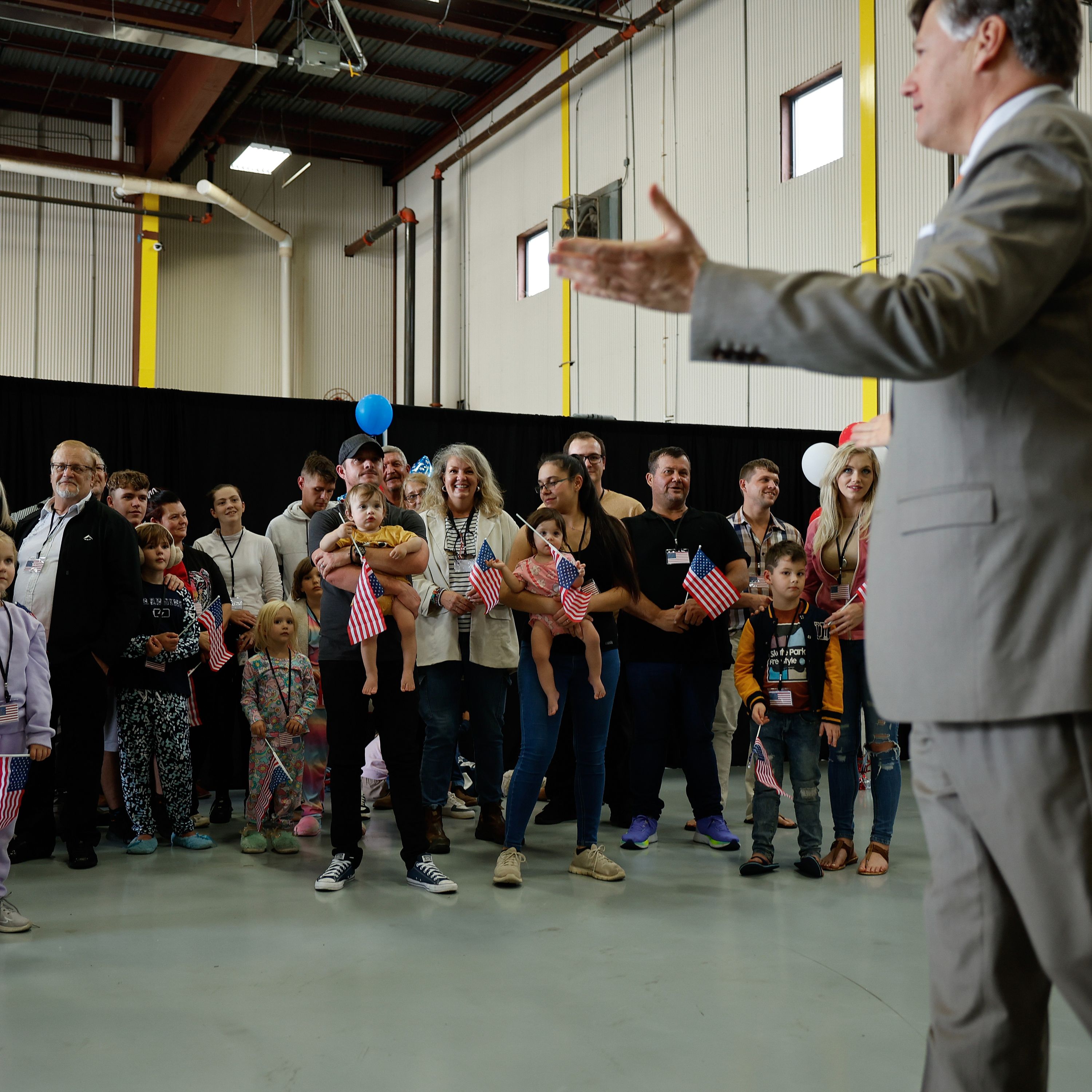
On the Media
Trump's Refugee Program Is Reserved for Whites Only
00:16:13
10,000 new spots for Afrikaners
Loading summary
Transcript66 lines
- [00:00]
Michael Olinger
On the Media supported by Progressive Insurance.
- [00:03]
Michael Lehenger
You chose to hit play on this podcast today.
- [00:06]
Michael Olinger
Smart Choice make another smart choice with Auto Quote Explorer to compare rates from multiple car insurance companies all at once.
- [00:15]
Michael Lehenger
Try it@progressive.com Progressive Casualty Insurance Company and
- [00:19]
Michael Olinger
affiliates not available in all states or situations.
- [00:22]
Michael Lehenger
Prices vary based on how you buy.
- [00:24]
Michael Olinger
On the Media is supported by Viking. Committed to exploring the world in comfort,
- [00:30]
Michael Lehenger
offering destination focused small ship experiences on all seven continents with a shore excursion included in every port and programs designed for cultural enrichment.
- [00:41]
Michael Olinger
And every Viking voyage is all inclusive with no children and no casinos.
- [00:47]
WNYC Studios Announcer
Learn more@viking.com WNYC Studios is supported by Wise Wise the Smart Way to manage the currencies you need around the world. With the Wise account, you can send, spend and receive in up to 40 currencies with only a few simple taps. Be Smart. Get Wise. Download the Wise app today. Terms and conditions apply.
- [01:07]
Michael Olinger
Hey, you're listening to the on the Media midweek podcast. I'm Michael Olinger. On Monday, President Trump announced a proposed expansion to the refugee program to allow 10,000 more people into the country, up from a record low of 7,500 refugee admissions. For context, before 2017, the average annual cap for Republican and Democratic administrations was 95,000. But there's a caveat here. Trump's new 10,000 refugees will consist solely of Afrikaners, white South Africans, a group that the Trump administration claims faces racial persecution in their home country. We reported on this story exactly a year ago, when the first round of Afrikaners were on their way to these shores.
- [01:54]
Narrator/Reporter
The first group of white South Africans granted refugee status by the Trump administration arrived in the US Monday. The group included 49 Afrikaners, which is an ethnic group in South Africa made up of descendants of European colonists.
- [02:07]
Christopher Landau
The United States really rejects the egregious persecution of people on the basis of race in South Africa, and we welcome these people to the United States.
- [02:21]
Michael Olinger
Deputy Secretary of State Christopher Landau last May answering a question from the BBC about why Afrikaners and not people from, say, war zones had been granted refugee status.
- [02:33]
Christopher Landau
The criteria are making sure that refugees did not pose any challenge to our national security and that they could be assimilated easily into our country. And all of these folks who have just come in today have been carefully
- [02:48]
Michael Lehenger
vetted pursuant to assimilated easily, right?
- [02:52]
Michael Olinger
Multiple outlets at the time reported that one of these carefully vetted Afrikaners had posted on X in 2023 that, quote, Jews are untrustworthy and a dangerous group. This despite a Department of Homeland Security policy that Anti Semitic activity on social media could lead to a rejected immigration request. But as we've been told, the safe refuge of Afrikaners is an urgent matter.
- [03:17]
Donald Trump
It's a genocide that's taking place that you people don't want to write about.
- [03:20]
Michael Olinger
President Donald Trump last May.
- [03:22]
Donald Trump
Farmers are being killed. They happen to be white, but whether they're white or black makes no difference to me. But white farmers are being brutally killed and their land is being confiscated in South Africa.
- [03:37]
Carolyn Holmes
There's been a problem with violent crime in South Africa. Let's put that out there first. But this idea that white farm owners are particularly victimized doesn't play out if we look at the police statistics. So where does this myth come from?
- [03:51]
Michael Olinger
Carolyn Holmes is a professor of political science at the University of Tennessee, Knoxville, where she specializes in South African nationalism. When I spoke to her last May, she had been tracking the years long PR campaign behind the white genocide narrative.
- [04:08]
Carolyn Holmes
A series of activist groups have really made this their central cause. There's a really easy way to make statistics look more powerful, and that's to mess around with who actually counts as a white farm owner, who actually counts as the victims that they're concerned about.
- [04:23]
Michael Lehenger
I read one piece in Al Jazeera that even looking at data provided by some of these Afrikaner advocacy groups, the supposed proof showed that just about 60 farmers across all races are killed each year in a country where there are some 19,000 murders annually. That doesn't make a strong case.
- [04:45]
Carolyn Holmes
No, it doesn't. Full time residents of commercial farms, regardless of race, are actually statistically significantly less likely to experience violent crime than and their urban and peri. Urban counterparts in South Africa. These activist communities have foregrounded this idea of white victimization by picking out a very small number of stories and continually focusing on them. They tend to be stories with incredibly sympathetic victims. They say, look at this particularly horrifying case that happened in 2018. And it's like, well, okay, that was seven years ago. Those folks were brought to trial. The people who perpetrated that, they're all serving time. Those that were convicted. This is not misinformation in the way that we've traditionally thought about it, where we can correct it by saying, oh, but that's factually incorrect. I can hold up every statistic in the world saying, you know, white people are not significantly more likely to be targeted. But the story has become so real that it has resulted in 49 people leaving their home and coming to Texas.
- [05:52]
Michael Lehenger
We've made reference to some of these activist groups you call them white rights groups.
- [05:57]
Michael Olinger
Who are they?
- [05:58]
Carolyn Holmes
There's a lot of them. So we have groups like Afriforum, we have groups like the Orania Movement, we have more militant groups like the awb. They historically have focused on things like language rights and self defense training and neighborhood watch patrols, and some would call it vigilante activity. They've recently pivoted to specifically talking about rural security and quote, unquote, farm murders, partially, I think, because it's been so successful for them in the international arena
- [06:32]
Michael Lehenger
and to advance the narrative of this disproportionate violence levied against them. Some of these Afrikaner groups have pointed to a Xhosa anti apartheid song, which they say explicitly calls for the killing of white farmers. The South African courts have weighed in on this. Elon Musk and Marco Rubio have posted about it repeatedly on X. Tell me about it.
- [06:58]
Carolyn Holmes
Right. Shoot the Boer is what that song is. And it was a struggle song. It was part of the anti apartheid movement. That this is a song that was sung in the context of an armed struggle against a white minority regime. So it's very controversial. It's sung sometimes in Xhosa, sometimes in Zulu. And it was particularly brought to the forefront by a politician by the name of Julius Malema. He was then the leader of the ANC Youth League. He sung it at a rally. Got a lot of people fired up about this. In 2010, the first time that made a lot of international headlines, there was also a farm killing of a far right Afrikaner leader, Eugene Terblanche. And so a lot of people sort of paired those two events and said, look, this is evidence. This is a causal connection between singing the song and violence against white people. And it was ruled to be a form of hate speech in 2010, although that ruling was then overturned in 2022. Other folks like Julius Malema, who has now been kicked out of the ANC and has his own political party, has said, this is a legitimate part of our struggle history and we need to be able to honor the people that fought for our freedom.
- [08:08]
Michael Lehenger
Of course, the reason that we're speaking is that the Trump administration has elevated the grievances and claims of some of these Afrikaner groups, including Afriforum. How and when did they first get the president's ear?
- [08:25]
Carolyn Holmes
So in the first Trump administration, a lot of these white rights groups saw an opportunity. And so Afriforum, one of the major groups that have forwarded this idea of white victimhood, came to the United States in 2018. They were wildly successful. They got meetings with people like Rand Paul, Ted Cruz. They posted a photo on their social media of a meeting with John Bolton in the White House. And in probably the biggest PR coup, they landed a sort of primetime spot on Tucker Carlson's show.
- [08:57]
Donald Trump
Well, now to a fascinating and significant story the media have all but ignored. An embattled minority of farmers, mostly Afrikaans speaking, is being targeted in a wave of barbaric and horrifying murders.
- [09:10]
Callie Creel
Best thing that you can do to help us is to talk about this, to talk about it on public platforms, and in that way, to continue to put pressure on the South African government
- [09:18]
Donald Trump
to tell the truth.
- [09:19]
Michael Lehenger
I agree.
- [09:20]
Carolyn Holmes
In the wake of that Tucker Carlson interview, we have the first Trump tweet in 2018.
- [09:26]
Donald Trump
Trump writes that he's asked his Secretary of State, Mike Pompeo, to closely study the South Africa land and farm seizures and the large scale killing of farmers.
- [09:38]
Michael Lehenger
What were they advocating for on this tour? Exactly.
- [09:43]
Carolyn Holmes
So that's an interesting question because aside from international attention, they didn't necessarily have a policy prescription that was embedded in these tours. What they said is, we need attention, we need help. Maybe we need some sort of international diplomatic pressure. We need possibly something like capacity building for the South African police forces.
- [10:08]
Michael Lehenger
Fast forward to the present. Policy did come out of this tour
- [10:11]
Carolyn Holmes
ultimately, yes, with the executive order that outlines this refugee status for Afrikaners. The fascinating thing is that it was met with deep ambivalence by these activist communities that had worked so hard to put this issue item on the agenda of President Trump and his administration.
- [10:31]
Michael Lehenger
Refugee status wasn't really on their wish
- [10:34]
Carolyn Holmes
list, not at all. And they have repeatedly said so since February.
- [10:39]
Michael Lehenger
We want not to be refugees in another man's country, as the Iranian movement say. If someone wants to help, help us here.
- [10:46]
Carolyn Holmes
And Strutz, the guy who was on Fox News with Tucker Carlson, was interviewed by the New York Times and he said, I'm not sure I know anybody that wants to be a refugee.
- [10:54]
Callie Creel
We like America, we regard ourselves as friends of America, but we want a future for our community here in the southern tip of the African continent.
- [11:03]
Michael Lehenger
One of the current leaders of Afriforum, Callie Creel, said, quote, afrikaners, let me be clear, cannot survive as a cultural community in the US or any other country. What they want is more power in South Africa.
- [11:16]
Carolyn Holmes
Exactly. And so, interestingly, there was a song that Afriforum Produced in late 2024 called Die Afrikaner Mak Sue. The Afrikaner does this the Africa. And it's all it's talking all about how we live here, we're from here, this is our home, this is where we speak our language. They're desperately trying to establish legitimacy in South Africa. Right. So the question is, what do you do when you've achieved this objective that you never set out to achieve, that is wildly unpopular and you're still trying to operate in that country? These groups are sort of like a dog that caught a car, but they caught the car that they weren't chasing. They were trying to get attention. They were even trying to get sanctions. They were never trying to get refugee status. And now that they have it, how that affects them domestically is a really big problem for them.
- [12:14]
Michael Lehenger
Another kind of lost in translation quality to all this is that people like Elon Musk, even Donald Trump have been using the term white genocide to describe these exaggerated claims of violence against white farmers. That term white genocide, it's pretty taboo in South Africa, right? And it's pretty taboo among the groups making some of these claims. No, it is.
- [12:40]
Carolyn Holmes
The term white genocide is a kind of third rail in South African politics. Afriforum has very carefully walked a line around never saying those words in that order. And in fact, the only groups that are making genocide type claims are paramilitary groups in South Africa. They don't command a lot of public support, but they exist. These most extreme claims come from a non resident population. And in fact they primarily come from a non Afrikaans population too. Elon Musk is not an Afrikaner, he is an English South African.
- [13:18]
Michael Lehenger
Is it fair to say that white genocide is akin to the kind of white supremacist idea of the great replacement theory in the United States?
- [13:26]
Carolyn Holmes
Absolutely.
- [13:27]
Michael Lehenger
This sort of cross pollination of racist ideology between the United States and South Africa goes much further though than white supremacist forums.
- [13:38]
Carolyn Holmes
It seems like every so often there will be a cataclysm of violence, like Dylann Roof committing mass murder in Charleston, South Carolina, wearing an apartheid era flag on his jacket. And people will say, what does that have to do with anything? And what I want to say is that this conversation has been happening, it's been happening for a century. The United States and South Africa have been intertwined sort of since South Africa became a single country. And there is this attention by particularly a philanthropic class of Americans, people like Andrew Carnegie, who said what South Africa needs is the same thing that the US south needs. It needs a welfare state to lift up white people and it needs institutional segregation. And so this took the form of a variety of laws in South Africa. So the Land act, the Prohibition of Mixed Marriages act, et cetera, and all of these were state efforts to define a population of whites that would then be the beneficiaries of welfare state programs in the service of making sure that white people didn't, quote, fall below their racial station.
- [14:56]
Michael Lehenger
In what ways did South Africans look to Jim Crow era United States for inspiration on their end?
- [15:05]
Carolyn Holmes
So one of those pieces of legislation that I had spoken about, the Prohibition of Mixed Marriages act, which was a bedrock of what was then the nascent apartheid government, has as its first appendix a list of US states, not just in the south, in fact, but across the Union, that had more restrictive covenants on interracial marriage than the one that was being proposed in South Africa. So it was very much a look, we can't be the bad guys. Look at what they're doing over there. So there's this trading off of respectability, trading off of ideas about how to define whiteness, how to institute segregation across the Atlantic Ocean throughout the 20th century.
- [15:47]
Michael Lehenger
These Afrikaner groups, they didn't ask for refugee status. There's no proof for the white genocide conspiracy theory. What does the Trump administration get from this stunt?
- [16:00]
Carolyn Holmes
This is a cause that many of his most fringe supporters believe in deeply. In many ways, the Afrikaans community has been made a sort of ping pong ball in the conversation about immigration here in a way that is profoundly dehumanizing. You know, they're not actually interested in engaging with the politics on the ground in South Africa. There is an effort to say, look at these folks who have been victimized when they let majority rule happen. We can't let ourselves be replaced.
- [16:37]
Michael Lehenger
Carolyn Holmes is an assistant professor of political science at the University of Tennessee, Knoxville. Carolyn, thank you very much.
- [16:45]
Carolyn Holmes
Thank you so much for having me. It's been great.
- [16:49]
Michael Olinger
That's it for the podcast extra. Do not forget to listen to the big show on Friday to hear the fourth and final episode of American Emergency, the Movement to Kill Female. We've been working on this series for
- [17:01]
Michael Lehenger
a really long time.
- [17:02]
Michael Olinger
We're super excited about the finale. We're going out with a bang. And if you haven't caught the first three, you can check them out in the OTM podcast feed or on onthemedia.org See you then.
- [17:13]
Michael Lehenger
I'm Michael Lehenger.
- [17:21]
WNYC Studios Announcer
WWNYC Studios is supported by AT&T Summer. It's when we share more time, more memories and more photos. And at ATT, the iPhone 17 Pro is your summer essential. Its center stage front camera auto adjusts the frame to fit everyone into group selfies right now at AT&T. Ask how you can get iPhone 17 Pro on them with eligible iPhone. Trade in any condition requires trade in of iPhone 15 or higher, excluding iPhone 16e and 17e requires eligible plan. Terms and restrictions apply. Subject to change. Visit att.com iPhone or visit an ATT store for details. WNYC's Journalism and Storytelling is heard by millions of passionate listeners. Sponsors of our programming gain our listeners attention and their respect. Learn about how your organization can support WNYC and wnyc studios@sporship.wnyc.org.