← On the Media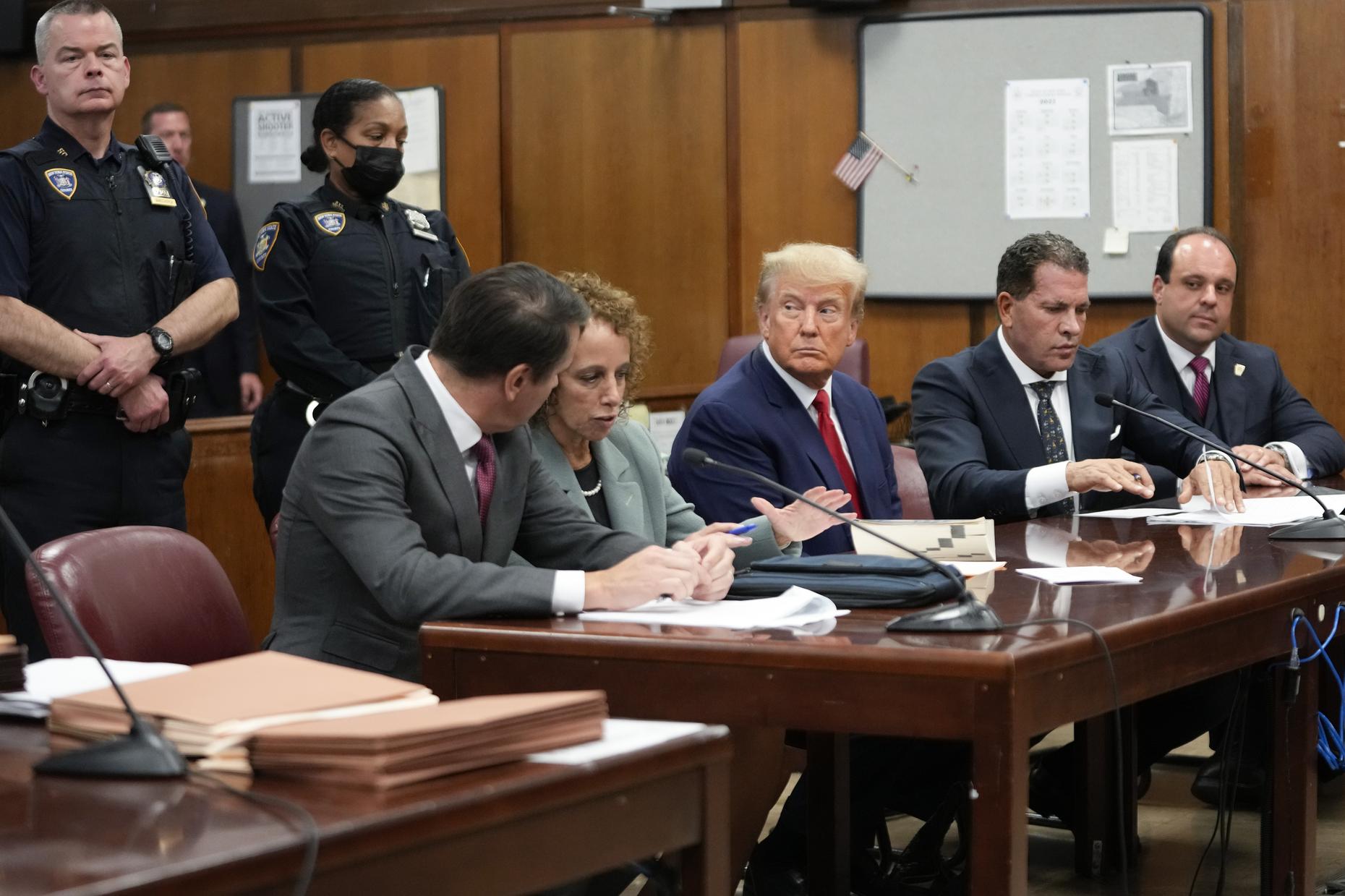
On the Media
When Presidents Go to Trial
00:12:56
Former President Donald Trump was arrested in New York.
Loading summary
Transcript93 lines
- [00:00]
Progressive Insurance
On the Media is brought to you by Progressive Insurance. Do you ever find yourself playing the budgeting game? Well, with the name your price tool from Progressive, you can find options that fit your budget and potentially lower your bills. Try it@progressive.com Progressive Casualty Insurance Company and affiliates Price and coverage match limited by state law, not available in all states.
- [00:23]
Ilya Maritz
Hey, it's Ilya Maritz. This is the on the Media midweek podcast. By now you've heard about the first indictment of a former US President in the history of our country. The charges against former President Donald Trump were revealed in his arraignment on Tuesday, April 4th. And that's the day I'm recording this. I'm right outside the courthouse, in fact, to cover the event for npr.
- [00:46]
Rick Perlstein
There's a lot of talk about how.
- [00:48]
Ilya Maritz
This indictment and how a trial could affect Trump's presidential run in 2024. Is it good for Democrats? Is it good for Trump? On that last point, it's been reported that Trump has already raised $7 million just in the time since the indictment was announced. So, yeah, to me, the entire case leads to larger questions about how democracies, where everyone is supposed to be equal under the law, do or don't hold their leaders to account. Which is why we're re airing an interview I did about six months ago with Rick Perlstein. He's a journalist and historian who has chronicled the post 1960s American conservative movement. We spoke about perhaps the most famous case of a former US president eluding punishment. On September 8, 1974, President Gerald Ford pardoned his predecessor, Richard Nixon, who'd resigned from office one month earlier. Pearlstein says Ford's decision to pardon Nixon.
- [01:44]
Unnamed Speaker
Still reverberates today after he resigned for Watergate, as many of his top deputies were facing trial for which they'd be.
- [01:54]
Convicted, including the attorney general, John Mitchell.
- [01:57]
The statement that the kind of establishment put out there was Nixon's resignation shows the system works.
- [02:03]
We had brought a president to judgment and it was clanking along towards what.
- [02:07]
Was likely to be an indictment. But then Gerald Ford, a month into.
- [02:13]
His presidency, was went on TV on a Sunday morning.
- [02:16]
He probably thought the American people were.
- [02:18]
In the mood for mercy after coming back from church. And he granted Nixon a full, free and absolute pardon for all offenses against the United States, which he Richard Nixon.
- [02:29]
And I'm reading from his document, committed.
- [02:31]
Or may have committed or taken part in during the period from January 20, 1969, through August 9, 1974.
- [02:40]
It was an extremely unpopular move by Gerald Ford.
- [02:43]
It lowered his Approval ratings, like overnight by 20 points. And for many Americans, it really seemed.
- [02:49]
To suggest that the system didn't work, that presidents were above the law. But time passed. The interpretation of Ford's actions really kind of made an 180 degree reverse among members of the media elite, the political elite.
- [03:06]
Rick Perlstein
You point out in a piece you wrote for Salon in 2014, quote, After Ford died in 2006, Wall Street Journal columnist Peggy Noonan went so far as to say that President Ford, and now I'm quoting her, threw himself on a grenade to protect the country from shame. And he did it because he thought it would help America to move on. And in some sense it did. No.
- [03:28]
Unnamed Speaker
Well, here we are.
- [03:29]
Is America healed? I mean, you know, kind of the.
- [03:32]
Proof is in the pudding, right? I think that one of the problems.
- [03:35]
With that reasoning is that future bad.
- [03:38]
Actors in the White House realized that they could get away with crimes.
- [03:42]
The very next Republican president and his White House decided that they could break the laws with impunity. That's Iran Contra.
- [03:50]
Rick Perlstein
Can you just recap for us what we know happened in Iran Contra and what the illegal activity was?
- [03:57]
Unnamed Speaker
Yeah, sure. Congress passed a law, it was called.
- [04:00]
The Boland Amendment, and Ronald Reagan signed it, that America could not pass on money to this underground army that was.
- [04:07]
Trying to overthrow the Nicaraguan government.
- [04:09]
And basically, a group of people led by a gentleman named Oliver north, who's a revered and respected figure on the right now, set up an operation in which they basically raised money by arranging to sell missile parts to Iran. Basically, their proxies in Lebanon, where there was a civil war going on, had.
- [04:32]
Taken a series of American hostages.
- [04:36]
And it was often the case that after we sold them the missiles they wanted, they would just keep the hostages anyway or take more hostages.
- [04:44]
Rick Perlstein
I mean, it's sort of like a breathtaking foreign policy Rube Goldberg machine do this thing over here to make this thing happen over there. I'm actually astonished they were able to carry it out.
- [04:55]
Unnamed Speaker
And Ronald Reagan actually testified that he didn't have anything to do with the.
- [04:58]
Planning of this, he claimed.
- [05:00]
But he said when he heard it, he thought it was a neat idea, quote, unquote, killing two birds with one stone, getting hostages out, supposedly, and fighting communism because, you know, his public policy was that Russia was going to use.
- [05:11]
Nicaragua as a base to invade America.
- [05:13]
He was quite explicit about that.
- [05:15]
Rick Perlstein
So Reagan said he had nothing to do with this. Was there ever good enough evidence to really link him to Iran Contra?
- [05:23]
Unnamed Speaker
Well, the real wackiness of this story, you know, people of a certain age will remember. This was that this guy, Oliver north.
- [05:32]
Received immunity to testify.
- [05:35]
And in one of the most astonishing.
- [05:37]
Spectacles, he testified in his Marine dress.
- [05:40]
Uniform, made no apologies whatsoever, said he was, you know, just a loyal soldier fighting for freedom.
- [05:46]
And in fact, there was one incident.
- [05:48]
Where the actual Justice Department investigators went.
- [05:51]
Into his office while he was shredding.
- [05:53]
And asked for documents. And they're like, what are you doing? We're from the Justice Department. And he said something like, look, you're doing your job, and I'm doing mine.
- [06:01]
So you shredded some documents because the Attorney General's people were coming in over the weekend.
- [06:06]
I do not preclude that as part of what was shredded. I do not preclude that as being a possibility. Not at all.
- [06:13]
And the fascinating thing about his explanation.
- [06:16]
Was that he didn't think he was admitting to wrongdoing.
- [06:18]
He thought he was admitting to this.
- [06:21]
Great stride for freedom and dignity and liberty.
- [06:23]
You know, fighting the Soviet empire, that's kind of a cognitive pattern on the right, that they're fighting for a transcendent.
- [06:30]
Good against a transcendent evil. We see this pattern repeating again and again. Richard Nixon saying if the President does.
- [06:36]
It, it's not illegal, or, you know.
- [06:38]
Dick Cheney saying that the Vice President's.
- [06:40]
Office is a fourth branch of government.
- [06:42]
And the Constitution doesn't quite apply to.
- [06:44]
It in the same way.
- [06:45]
Rick Perlstein
Let's zoom in on the role of Dick Cheney in the Ford administration. He's the chief of staff. By the time Iran Contra rolls around, he is a member of Congress. He is part of the committee that's investigating Iran Contra.
- [06:59]
Unnamed Speaker
The conclusion reached by the majority is that basically the Reagan White House was guilty, guilty, guilty. And the committee that the minority, the.
- [07:07]
Republicans put together said he was innocent, innocent, innocent.
- [07:11]
Cheney basically moved along this theory that had been kind of long in the gestation that. That later became described by legal scholars as the unitary executive theory.
- [07:23]
Rick Perlstein
So here's that quote from the report that Dick Cheney helped to author. This is a quote that you sent me. Quote, chief executives are given the responsibility for acting to respond to crises or emergencies. To the extent that the Constitution and laws are read narrowly, as Jefferson wished, the chief executive will, on occasion, feel duty bound to assert monarchical notions of prerogative that will permit him to exceed the law.
- [07:51]
Unnamed Speaker
Right.
- [07:51]
You almost expect a trumpet fanfare as the king arrives in his raiment.
- [07:55]
Rick Perlstein
You know?
- [07:56]
Unnamed Speaker
Yeah.
- [07:56]
Rick Perlstein
Monarchical notions of prerogative. Translate that for me.
- [08:00]
Unnamed Speaker
It's a bit of a gaslight because it comes from Jefferson. You Know, most anti monarchical, most democratic of the founders. I mean, it basically means, how dare.
- [08:07]
You tell the President that he couldn't.
- [08:09]
Defy laws about who the United States could fund when it came to military aid.
- [08:15]
Rick Perlstein
Do you happen to remember where you were or what you were doing when you first read that quote?
- [08:20]
Unnamed Speaker
Yeah, I saw it a couple years ago, and I was like, how the heck did I not know that Dick Cheney was responsible for this utterance? I mean, in a way, it indicts the media for not digging up this astonishing thing. Although people know about this Minority Report, and people have written at length about the evolution of Cheney's ideas about the unitary executive, the word monarchical should raise anyone's hackles when it has anything to do with the United States Constitution.
- [08:49]
Rick Perlstein
And we see this idea emerge again in the 2000s when Dick Cheney is the vice president. There's all kinds of questions about the conduct of the CIA, around the war.
- [08:59]
Unnamed Speaker
On terror, the National Security Agency spying on Americans, the use of what they called enhanced interrogation, which normal people call torture, in order to supposedly investigate 9, 11, all sorts of very clever lawyering around the idea that Congress did not.
- [09:20]
Have an oversight role in any of this.
- [09:22]
Rick Perlstein
We're talking about at this point, about five decades of sort of building this conservative ideology surrounding the powers of the presidency. What about the Democrats in this period? What's their view of the president and the law?
- [09:37]
Unnamed Speaker
In the years of Watergate and the Ford administration, the idea was that it was the responsibility of, you know, Congress especially to effect this national house cleaning. You know, both when it came to laws like the first serious campaign finance reform, or the laws requiring a judge to approve warrants from the nsa, the FISA court, or new laws about open meetings in Congress. The Democrats held that to restore kind of the nobility of the constitutional arraignment, we had to have reform. And beginning kind of in the second half of the 1970s was a certain failure of will around that. I think that the Democrats, after losing three presidential elections in a row by these, you know, kind of tough, swaggering guys, the Republicans began kind of losing.
- [10:32]
Faith in that reform impulse. This is the basic attitude.
- [10:35]
We saw Barack Obama, who, after he was elected with quite a striking mandate in 2008 by people who thought in a lot of cases that they were voting to call the Bush administration to account, said, no, we're going to be.
- [10:49]
Looking forward, not looking backwards.
- [10:51]
You know, there were no investigations of, for example, NSA spying by Congress. There was an investigation of torture, and it reached conclusions that were shocking. So it's kind of this combined and uneven development where, you know, we do have these reform energies, you know, kind of like now how the January 6th committee represents, you know, this really kind of strong voice for accountability. Whereas a lot of people are questioning how far we can push this again out of this fear that somehow justice can only be achieved at the expense of unity.
- [11:26]
Rick Perlstein
So for this episode of on the Media, we have been looking a lot at other countries, other democracies in particular, that have charged their leaders or former leaders with crimes. And the thing that I didn't really appreciate before we started to look at this is just how common this is. South Korea, Italy, Israel, France, South Africa, Brazil, the list goes on. Some of those countries have charged their former leaders more than once. I know this is not your area, America is your thing, but do you think an aversion to holding former presidents to account is in its way a form of American exceptionalism?
- [12:06]
Unnamed Speaker
I think actually this is very much in the wheelhouse of what's behind all my writing, whether it's my journalism or my history, is that America often has this almost unique aversion to conflict precisely because the depths of the division that are just very real in the very conception of the country, which was of course founded on this tarnished compromise between.
- [12:28]
The forces of slavery and the forces.
- [12:30]
Of freedom, are just so deep and people are afraid to open Paran Dora's box. And the fact that so many other democracies have proven themselves to be kind of more stalwart, more mature shows that maybe we're not the city on the hill that we like to imagine ourself as, that we're just far too afraid of our own contradictions really to privilege justice over this false and sentimental vision of what we like to call unity, which might be just a form of cultural repression.
- [13:07]
Rick Perlstein
Rick Perlstein, thank you very much.
- [13:09]
Unnamed Speaker
Thanks, Ilya.
- [13:10]
Rick Perlstein
Rick Perlstein is a journalist, historian and.
- [13:13]
Ilya Maritz
Authority of the invisible bridge, the fall of Nixon and the rise of Reagan.
- [13:18]
Ira Flatow
I'm Ira Flato, host of Science Friday. For over 30 years, our team has been reporting high quality news about science, technology and medicine. News you won't get anywhere else. And now that political news is 24 7, our audience is turning to us to know about the really important stuff in their lives. Cancer, climate change, genetic engineering, childhood diseases. Our sponsors know the value of science and health news. For more sponsorship information, visit sponsorship wnyc. Org.