
Podcast
Orthodox Wisdom
Hosted by Readings from Saints of Holy Orthodoxy · EN
Readings of the Writings and Lives of Orthodox Christian Saints.
These recordings are free to download and share. All I ask is that you do so respectfully and reference this channel.
You can also contact me, Timothy Honeycutt, at: orthodoxwisdom1@gmail.com
Glory to Jesus Christ!
23episodes
Episodes
Newest firstAll episodes

Renovated Orthodoxy: The Liturgical Theology of Fr. Alexander Schmemann - by Fr. Michael Pomazansky
Jan 3, 202500:54:32Tap to summarizeA thorough examination of Fr. Alexander Schmemann's views on the historical development and meaning of the Orthodox Church's prayer and worship. Fr. Michael Pomazansky, author of the popular book Orthodox Dogmatic Theology, provides an antidote to the poisonous stance of Fr. Alexander, which Fr. Seraphim Rose warns of, describing it as "the inevitable iconoclastic conclusions from Fr. Schmemann's already Protestant views". 0:00 Beginning 0:11 Introduction by Fr. Seraphim "Renovated Orthodoxy": The Liturgical Theology of Father A. Schmemann 2:10 Article Begins 3:50 The Orthodox Liturgical Order 9:51 The Constantinian Era 13:37 The Sacraments and the Sanctifying Element In Sacred Rites 21:53 The Hierarchy and the Sacrament of Priesthood 28:13 The Invocation and Glorification of Saints 41:43 Church Feasts 48:30 Conclusion Letters 51:13 "If Fr. Schmemann is their 'theologian'..." -Fr. Seraphim, Apr 26/May 9, 1970 52:31 “Who are not Orthodox” -Fr. Seraphim, June 8/21, 1970 📖 "Renovated Orthodoxy": The Liturgical Theology of Father A. Schmemann (published both by Holy Trinity Publications and St. Herman Press) http://orthodoxinfo.com/phronema/pom_lit.aspx https://archive.org/details/100101V17N05061981SepOctNovDec/035%20V06N06%201970%20Nov%20Dec/ 📖 Selected Essays of Protopresbyter Michael Pomazansky https://bookstore.jordanville.org/9780884651451 📖 Unpublished Letters of Fr. Seraphim https://thoughtsintrusive.wordpress.com/letters-of-fr-seraphim-rose-1961-1982/ ⛪ FIND an Orthodox parish and monastery: https://orthodox-world.org/ https://orthodoxyinamerica.org/ _______ In this article the work on liturgical theology of one well known and widely respected contemporary Russian theologian is carefully criticized and its "reformist" tendency pointed out. In all fairness it should be noted that Fr. Schmemann probably does not see himself as a 'reformer," and it will doubtless be left to other less sensitive souls, another generation removed from the life of genuine Orthodoxy, to draw the inevitable iconoclastic conclusions from Fr. Schmemann's already Protestant views. -Fr. Seraphim Rose, Introduction The author is convinced that he has succeeded, as he expresses it, in "escaping Western captivity" while using non-Orthodox sources. He avoids the extreme affirmations of Protestant historians. He writes: "We categorically reject the understanding of the Peace of Constantine (i.e., the era of Constantine the Great) as a 'pseudo-victory' of Christianity — victory bought at the price of compromise." But such affirmations are not enough in themselves, and we consider it our obligation to focus attention on the book's contents in one respect: has the author indeed escaped Western captivity? As many facts testify, he has in fact not escaped it. -Fr. Michael Pomazansky Basing himself on the ready conclusions of Western researchers in his judgements on the ancient Church, the author pays no attention to the direct evidence of the apostolic writings, even though they have the primary significance as memorials in the life of the early Christian Church. -Fr. Michael Pomazansky And which for us is more necessary and important: to strive for ecumenical communion and union with those who think differently and who remain in their different opinion, or to preserve catholic communion of spirit with those teachers of faith, luminaries of faith, who by their life and by their death showed faithfulness to Christ and His Church and entered into yet fuller union with Her Head? -Fr. Michael Pomazansky _______ Orthodox Wisdom is dedicated to sharing the writings and lives of the Saints of the Orthodox Church. Glory to Jesus Christ!
Transcribe →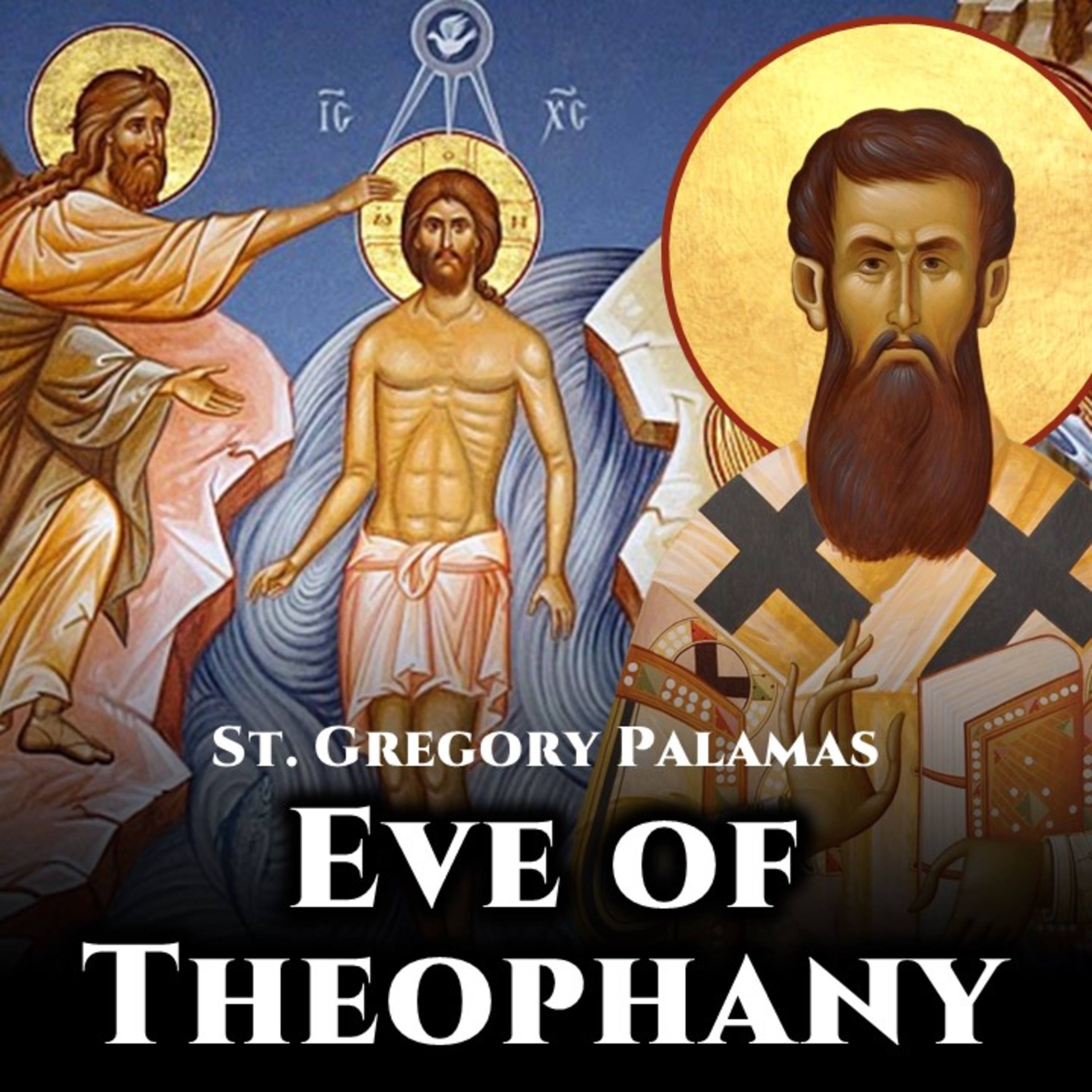
Homily on the Eve of Theophany - St. Gregory Palamas
Jan 18, 2024Tap to summarizeSt. Gregory Palamas, in preparation for the feast of Theophany, calls his flock to remember the grace of their baptism and the high calling they have as children of God. He provides a summary of the practical aspects of how a person is baptized, giving spiritual commentary about this apostolic tradition. He then details the example and teachings of St. John the Baptist and his perennial, soul-profiting wisdom as recorded in the Holy Scriptures. This is a reading of Homily 59: "On What is Accomplished in Holy Baptism, and On Repentance, and What Saint John the Baptist Said About This Subject" -BUY the collection of St. Gregory’s Homilies here: https://mountthabor.com/products/saint-gregory-palamas-the-homilies -BUY other books by St. Gregory, some of which can be found here: https://churchsupplies.jordanville.org/ -FIND an Orthodox parish and monastery near you: https://orthodoxyinamerica.org/ _______ St. Gregory taught: Repentance is the beginning, middle, and end of the Christian way of life, so it is both sought and required before Holy Baptism, in Holy Baptism, and after Holy Baptism. Holy Baptism is a symbol of death. After the holy anointing, he is immediately led to the sacred font, which has been thoroughly sanctified beforehand by various holy rites and ablutions. Once he has been brought, the bishop baptizes him by immersing him three times, invoking at each immersion one of the Three Persons whom we worship. Water is a means of cleansing, but not for souls. It can remove dirt from those being baptized, but not the grime that comes from sin. For that reason, the Healer of souls, the Father of spirits (Hebrews 12:9), Christ, Who takes away the sin of the world (John 1:29), enters the water before us to be baptized, as we celebrate today in advance. He draws the grace of the All-Holy Spirit from above to dwell in the water with Him, so that later when those being baptized as He entered the water, He is there, clothing them ineffably with His Spirit, attaching Himself to them, and filling them with the grace that purifies and illumines reasonable spirits. And this is what the divine Paul referring to: "as many of you as have been baptized into Christ have put on Christ" (Galatians 3:27). While the three immersions in the water are also the saving invocation of the Life-Giving Trinity, they represent the Lord's three-day burial. Following this, the person being baptized comes out of the water the same number of times, because otherwise he could not have been submerged three times, but also because this signifies the resurrection from sin of the three parts of the soul, and the return of the mind, soul and body, all three together, to incorruption. Thus in divine baptism both death and life can be seen, the tomb together with the resurrection, just as the Lord, Who "in that He died, He died unto sin once: but in that He liveth, He liveth continuously unto God" (cf. Romans 6:10). As repentance is the beginning and end of the Christian way of life, the Lord's Forerunner and Baptist, who was himself the starting point of this approach to living, preached saying, "repent ye: for the Kingdom of Heaven is at hand" (Matthew 3:2). And the Lord Himself, the perfection of all goodness, said the same in His preaching (Matthew 4:17). Repentance means hating sin and loving virtue, turning away from evil and doing good (cf. Psalm 34:14; I Peter 3:11). As I speak these words to you, brethren, I feel no small pain in my soul, that we who were long ago vouchsafed Christian baptism have not yet accomplished those very things which John demanded of those approaching his own baptism. Yet the Lord's baptism, of which we were deemed worthy, is as far superior to the baptism given by John in those days, as the grace of the Holy Spirit is more excellent than water… ______ Orthodox Wisdom is dedicated to sharing the writings and lives of the Saints of the Orthodox Church. Glory to Jesus Christ!
Transcribe →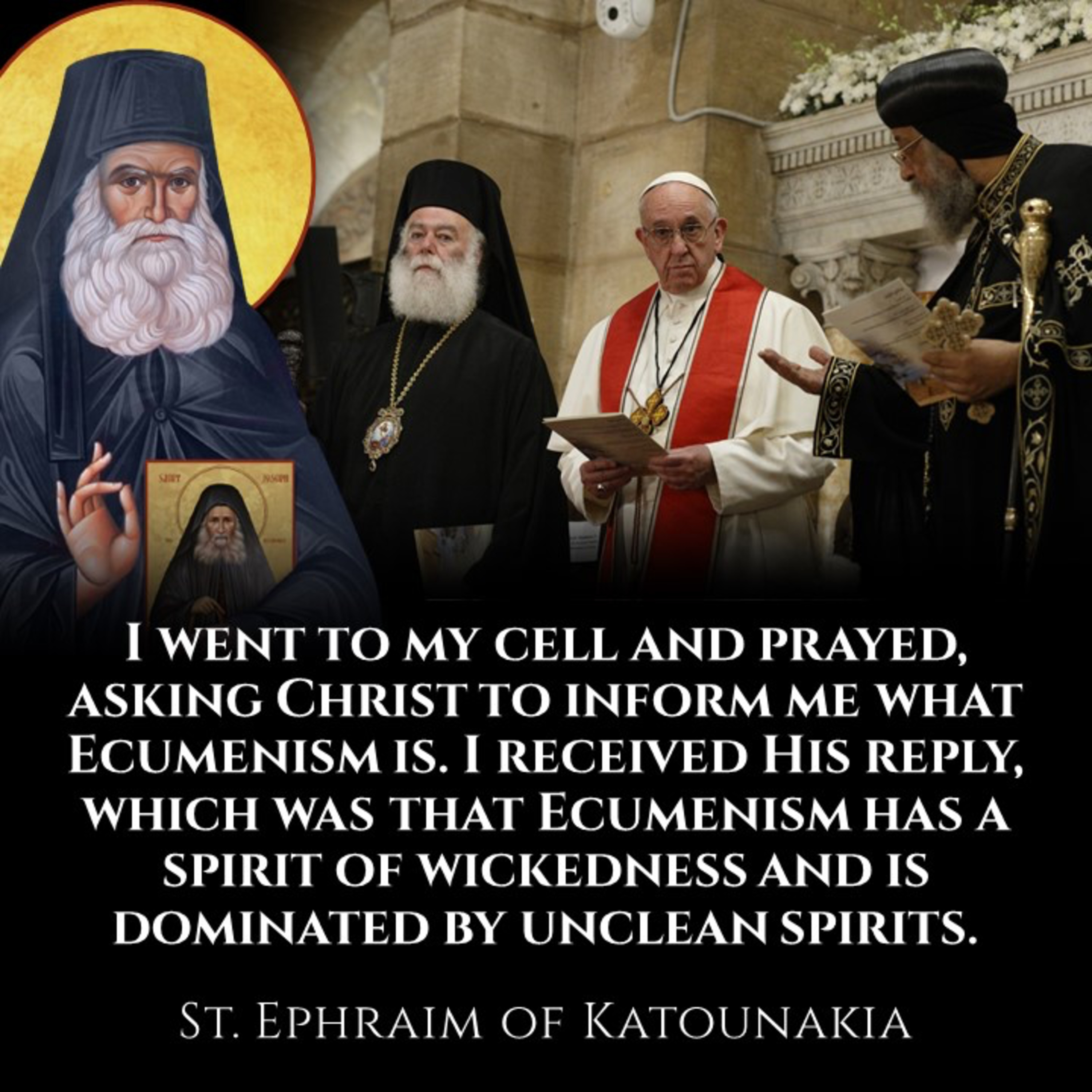
Ecumenism Has A Spirit of Wickedness and is Dominated by Unclean Spirits - St. Ephraim of Katounakia
Nov 7, 2022Tap to summarizeThe word of the Lord to St. Ephraim: "Ecumenism has a spirit of wickedness and is dominated by unclean spirits." Demetrios Tselengidis, professor of dogmatic theology at the University of Thessaloniki, writes of his experiences with St. Ephraim of Katounakia: So I asked him on the matter in hand - if he could tell me what kind of thing Ecumenism is. He replied outright and without any difficulty: "This question, my child, had also been posed by someone else, some time before you. I myself have been up here on these rocks for forty years... I have even forgotten my Greek (note that he had completed Middle School) and as such, I haven’t preoccupied myself with that issue. But, because I had to reply – seeing that I had been asked about it, and since I had no knowledge of the matter - I went to my cell and prayed, asking Christ to inform me what Ecumenism is. I received His reply, which was that Ecumenism has a spirit of wickedness and is dominated by unclean spirits." So I asked him exactly how that was verified. He replied that "after praying, my cell became filled with an unbearable stench, which caused my soul to feel asphyxiated; I couldn’t breathe spiritually." I asked him if that had been an extraordinary event for him, or if that was the way that Christ responds in analogous cases, and he assured me that "in all the cases that are involved with sorcery, with unclean spirits, that is the state in which He enlightens me. Sometimes there is a spoken response, but in the present case, that was His answer and I have the absolute certainty that Ecumenism does not have the Holy Spirit, but the unclean spirit." Read the full account from Professor Tselengidis here: https://orthochristian.com/93492.html Photo in the thumbnail is of an Ecumenical Prayer gathering at Sts. Peter and Paul’s Coptic Church in Cairo, Egypt in 2017. Featured at this gathering was Patriarch Theodoros II of Alexandria, Pope Francis of Rome, Coptic Pope Tawadros II, Ecumenical Patriarch Bartholomew and more: https://www.ecupatria.org/2017/05/01/ecumenical-prayer-in-egypt-for-peace-and-unity/ Many canons condemn prayer with the heterodox, among other expressions of the heresy of ecumenism. Apostolic Canon 45: “Let a bishop, presbyter, or deacon, who has only prayed with heretics, be excommunicated: but if he has permitted them to perform any clerical office, let him be deposed.” A useful starting point to understand the heresy of ecumenism is the 1983 ROCOR condemnation of ecumenism, added to the Synodikon read on the Sunday of Orthodox in Great Lent: "Those who attack the Church of Christ by teaching that Christ’s Church is divided into so-called “branches” which differ in doctrine and way of life, or that the Church does not exist visibly, but will be formed in the future when all “branches” or sects or denominations, and even religions will be united into one body; and who do not distinguish the priesthood and mysteries of the Church from those of the heretics, but say that the baptism and eucharist of heretics is effectual for salvation; therefore, to those who knowingly have communion with these aforementioned heretics or who advocate, disseminate, or defend their new heresy of Ecumenism under the pretext of brotherly love or the supposed unification of separated Christians, Anathema!" Orthodox Wisdom is dedicated to sharing the writings and lives of the Saints of the Orthodox Church. Glory to Jesus Christ!
Transcribe →