← Overcoming Distractions-Thriving with ADHD, ADD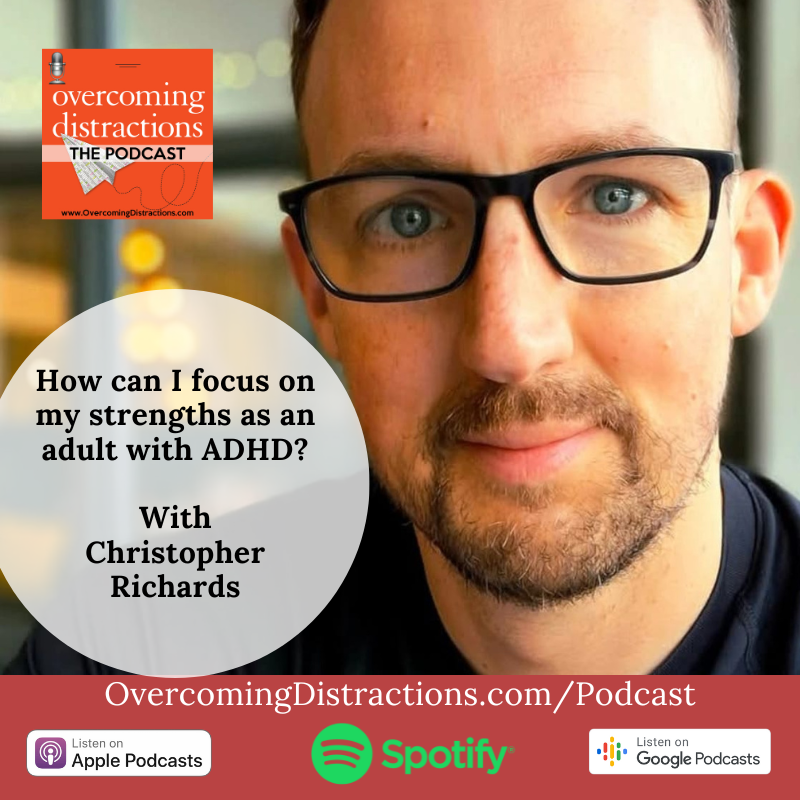
Overcoming Distractions-Thriving with ADHD, ADD
How can I focus on my strengths as an adult with ADHD?
00:41:53
Welcome to another episode of Overcoming Distractions! In this episode, Dave sits down with Christopher Richards, a leadership consultant and founder of Atomic Growth. They dig into the unique challenges and surprising strengths of busy professionals...
Loading summary
Transcript159 lines
- [00:08]
A
I'm Dave Greenwood, and this is Overcoming Distractions. If you are an adult with adhd, a busy professional, an entrepreneur, a high achiever, or just need some strategies to navigate your adult adhd, you're in the right place. Who am I? I'm an entrepreneur with ADHD and the author of two books, Overcoming Distract and Overcoming Burnout. I coach and mentor people just like you, and together we navigate the ups and downs of adult adhd, from getting out of our own way to helping people just like you thrive in the workplace. That's what I do. Want more info on working with me? Hit overcoming distractions.com ready? Let's get to today's podcast. All right, everybody. Welcome back. Welcome, my distracted friends. You are back on Overcoming Distractions. And like I always say, if you're that busy professional that just a little distracted, a little frazzled, got a lot of stuff going on, you are in the right place.
- [01:27]
B
So.
- [01:28]
A
And of course, that's what we're going to talk about today. So if you've listened to Overcoming Distractions, even for a little bit, you know that we do focus almost exclusively on the busy professional with adhd. You know, people like yourself, you got a demanding career, busy home life, you have some goals you want to set and, and other achievements you want to get done. Some of us need to figure out the mechanics of getting stuff done, as I like to say. So we also discuss entrepreneurship, leadership, how we can actually work with our ADHD brain and be successful and fulfilled when we get to that Friday afternoon. Right? So, and sometimes that takes a little bit of work, as I'm sure you have figured out. That's why you're here. So, so today we're going to have a discussion about just that. What are some of the basics in the core must haves of the busy professional with adhd? We've tackled this a million times. I do feel it's important to continue to tackle it, to continue to reinforce it, because many of you say, I bought some books, I listened to a bunch of podcasts, I still need more. So we just continue to beat this drum, right? So. And I always love talking to people that may have had to fight a little bit for the success they've had and ultimately deserved. I think there is. You know, I made a joke once about there is always lessons in. In a good train wreck. Right? So, so that's. And some of us can kind of classify parts of our lives as a little bit of a train wreck. So. And I think we learn a lot about how many of Us have navigated, you know, certain difficulties. So. So today we have Christopher Richards. He's a leadership consultant. He is the founder of Atomic Growth. He's going to tell us about that in just a second. Served in the British army for 15 years, and he became one of the lead experts in the Criminal Intelligence Bureau. I want to hear about that. So. And for the last 10 years, he's helped business owners like you executives to find, fix those internal barriers to success and fulfillment and all the things that make our life a little better and help us grow our businesses, helping them to become great leaders, build their business, have a more fulfilling life at home, daily life, etc. All that stuff that we come here for. Right. So welcome, sir.
- [04:17]
B
Hey, David, thank you very much for having me. Appreciate it.
- [04:20]
A
Now, do you go by Christopher or Chris?
- [04:23]
B
Chris is good.
- [04:23]
A
Chris. All right, cool. We're pretty informal here, so. So. So talk to us about Atomic Growth. What. How did you decide to, to get that started? Who you work with, what you want to achieve with people.
- [04:44]
B
Oh, okay. So Atomic Growth started just over 10 years ago. I started as a fairly, should I say basic life coach, focusing on anxiety. I did some cbt hypnotherapy for anxiety and depression, and I've slowly kind of worked it up and improved it and, and added to it as I've upskilled and grown myself.
- [05:12]
A
Yeah.
- [05:13]
B
And so now it covers a. The full range, the truly holistic picture of rituals, identity, somatics and environment, which I call rise, which is a RISE program. Now, what that means is the Atomic Growth really leans into helping entrepreneurs and business owners and global change makers really make a very, very amazing difference in this world. That's kind of the main factor that I work with, with people that I really look for. It's not just about making money. It's about really making a difference and helping people. I've worked with people who are eradicating domestic violence. I've worked with people who are teaching children all over Australia, you know, yoga practices for mindfulness. You know, all these things that kind of add to a better future.
- [06:11]
A
Yeah, And I think you're right because I think, you know, I've talked to so many people who, you know, reach out to me who listen to the podcast and, you know, just need some. Some kind of help one on one. They need to kind of navigate the complexities of business and life and a demanding career. And you're right, it's. It's not always about the money. Like, they may be making pretty good money.
- [06:37]
B
It's Money is very much a byproduct as well. Number one is many of them already know how to make money. They're already very, very good at business. They're very good at marketing, very good at sales. It just gets to the point where the leading bottleneck and problem in the business will always be the business owner. And basically what I do is I step in and make sure that doesn't happen, because the amount of businesses that are going up and down with how the business owner feels, you know, month to month, week to week even, is just incredible. And so if I can kind of step in, especially when half of them got ADHD and like that, it's like if I could step in and ease the distractions and improve the consistency and create that clarity and build the confidence and all these different things, then what tends to happen is the resistance removes out the way.
- [07:40]
A
Yeah.
- [07:41]
B
I mean, it's in my notes to kind of COVID today. One of the main drivers that a lot of business owners use is pressure. They just put on the pressure on themselves over and over. And that is possibly the worst thing you could possibly do if you want a sustainable, enjoyable lifestyle in business.
- [08:01]
A
Right. And you bring up a good point, because I've talked to so many people who, like, live under that pressure, and they go, well, I didn't leave the office till like 11 or 12 at night, and they've been under pressure all day. But then when they ask themselves what they actually accomplished, it was very little. But to your point, it's just like I, I gave myself pressure all day and. And you're right, I don't think that always works. I think that backfires. Correct.
- [08:35]
B
Yes. And something very, very nuanced about something you just said. I was in the office till 11 and 12 under the pressure. Me personally, I have no issue with sometimes needing to work long hours. It happens. We're in business, sometimes it calls for it. But where I see a lot of business owners going wrong is they think that pressure has to be a part of that.
- [09:01]
A
Yeah.
- [09:02]
B
And it doesn't. A lot of times you can work late and. Because likewise, I've worked late before and loved every minute of it, you know, if you, you. You're essentially exchanging the pressure for enjoyment.
- [09:17]
A
Yeah.
- [09:18]
B
Especially if you've got ADHD and things like that, because you're very dopamine driven. So the more you can make it identity led, which I'll cover in a minute, values led, and the more you can make it enjoyable, it doesn't really matter. The hours that you work, you Know, you could. I think there was a story about LeBron James or something, being on the basketball court first thing in the morning, like 3am or whatever, playing all the way through Tiger woods, hitting golf balls off the front lawn until ridiculous times. Putting in the effort and putting in the work doesn't have to automatically mean burnout. And it's the pressure element that people go wrong with.
- [10:02]
A
Right. No, and I completely agree. You're right. There's a book, How Champions think. It's by Dr. Bob Rotella. He's a sports psychologist, but that's what he talks about specifically, like LeBron James, Tiger woods and other people where they are, they are putting in the work.
- [10:23]
B
Absolutely.
- [10:24]
A
Yeah. Because they, they actually do enjoy the process. So, I mean, that's, that's a good point.
- [10:31]
B
Now, let's look at the business owners who are primarily driven by money. Yeah. And don't have that intrinsic as their highest value, but think they should.
- [10:40]
A
Yeah.
- [10:40]
B
Be driven to money.
- [10:42]
A
Yeah.
- [10:43]
B
That creates this massive amount of pressure to, you know, meet a certain level of good enoughness, a certain level of status.
- [10:53]
A
Yeah.
- [10:54]
B
I'm, I'll. I'm not good enough until, you know, I'm not. I'm not really successful until. And, and so they're working for this, this trophy as opposed to living the life of value and, and, and doing their natural expression of themselves and things like that. And so it's such a massive shift. And most people don't know either the shift exists or how to do it. And if they know how to do it, they don't quite know why they particularly can't or why they're having issues. And so it's a, it's this whole mixed bag. And the biggest thing I found is a lot of business owners will try to figure out themselves, and there's only so far you can take yourself. It doesn't matter how much psychological knowledge you have, everybody, including myself, needs somebody to reflect it back. Everybody. An expert to help you navigate to places that you don't want to go.
- [11:53]
A
Yeah. Right.
- [11:54]
B
Your subconscious won't allow you to go.
- [11:56]
A
Yeah. I mean, there's, there's, there's a lot of instances where we can't get out of our own way. And that, that actually might be the new terminology for adhd. Right. Like we can't get out of our own way sometimes. So, so, so speaking of adhd, we're talking because you are a successful adult with adhd. Right. And if I recall, you were not officially diagnosed till later on in life. So there were signs but there were signs. Yeah. Which I think a lot of us, you know, and. And it's such a common theme where, you know, I got diagnosed at 40 or 45. But you know what? If I look back, there was, like, so many hints and indicators that I don't know why I didn't go 20 years ago and actually diagnosed.
- [12:50]
B
You know, what was so funny about my diagnosis is that the method I used. I went to a private clinic, got to speak to a specialist, and part of their diagnosis was that you had to get someone who knew you very, very well in the present moment, and you had to get someone who knew you very, very well as a child.
- [13:12]
A
Yeah.
- [13:13]
B
As well as your own testimony.
- [13:15]
A
That's interesting.
- [13:16]
B
And they send a questionnaire to. To everybody, basically, so it's not this biased thing.
- [13:22]
A
Yeah.
- [13:23]
B
And now, quite naturally, I send it back to my mother, and the reply. The reply she gives back is like, how did I miss this? She's like, yes, yes, yes, yes. And, yeah, as it turns out, I. I had a feeling already that I. I had inattentive type because I. I daydream out during classes, you know, So I thought, okay, maybe. Maybe that one. But what was very strange and what had all my teachers confused with is that if they then called on me for a question, thinking, always daydreaming, let's catch him out, and all of that kind of mentality, what happened was I was able to answer the question.
- [14:16]
A
Yeah.
- [14:17]
B
So my subconscious was still in the room, very much paying attention. But I could only. And I realized this as well. I could only focus if I was doing multiple things at a time. If I focus just on one thing, it all went to pop. It all went.
- [14:33]
A
Now, that sounds almost like.
- [14:35]
B
Especially if it was something very, very basic, very boring.
- [14:38]
A
But that sounds almost like in the reverse of a lot of people.
- [14:41]
B
Exactly. So, yeah, it's copying from something like draft. You know, copy this into your best handwriting. That kind of. I'd make mistakes every single time. I. I'd. I'm also partially dyslexic, so I'd be missing out letters. But I knew how to spell, so I didn't have to go back and fill in the right letters.
- [15:00]
A
Yeah. See, I. I work best when I am just focusing on one thing. And to take that to another level, I focus best when I have, you know, a lot of Runway in front of me. So, for example, if, like, I'm trying to jam and work and, like, in between meetings, like an hour or two, I mean, that's just a fail for Me, you know, but if, if I, like, start the day working on something and I don't have anything for the rest of the day, I mean, I can do more than, you know, the average person can do in a week, so. And that's just the way I work. But it has to be kind of the same type of thing.
- [15:40]
B
It has to be the same type of thing. It has to be scheduled and things like that. But here's the thing about that. Doing the one thing, one thing at a time. If I'm doing something I don't particularly enjoy, something I can't get into a flow state with.
- [15:54]
A
Yeah.
- [15:55]
B
Then generally speaking, it's better if I have music going and something else happens and all of the rest of it, because that keeps the dopamine flowing while I'm doing the thing I don't want to do.
- [16:04]
A
Yeah.
- [16:05]
B
But if it's something I love to do, like speaking on a podcast, like doing a great many things, then I'll have absolutely no issues at all. And like you, I prefer doing one thing, honing in and getting it done. So it's, to me, it's, it's all about working out how you work best, but not thinking that you need to have the same approach for every task. Because especially with adhd, it's really dependent on, on the pressure and enjoyment of the task, of the thing.
- [16:43]
A
But it also, I mean, and this.
- [16:45]
B
And how much bandwidth you have going in.
- [16:46]
A
Yeah, but this is also, again, another myth that, and, and I, you know, I think we all agree, or a lot of us would agree, that there is still a ton of misinformation out there about adhd. There's a lot of blanket statements, but I know people that, like, I'm going to go work in a coffee shop. I love the noise. I love the, the, the, the, you know, the, the buzz in the background. I love the, the dishes clanging, all that stuff.
- [17:13]
B
I can't do it.
- [17:14]
A
That is my worst.
- [17:16]
B
Can't do it. I love working in a coffee shop, but it's noise canceling headphones.
- [17:21]
A
Yeah. I need to be, I need to be in a cave if I'm gonna, I need dead silence like an operating room or just, you know, it's just like, that's the way I work. What did, what did. Because you said, you know, your mother said, how did I miss this? How do they miss this? You know, etc. But what did that diagnosis actually confirm for you? I mean, did you go for the diagnosis to say, you know what? I probably have adhd, just want to have, like an official piece of paper. But. And what did, what did, like, going through the process confirmed for you?
- [17:58]
B
A very good question. It was a, Is a bit of a mix. Like all things with adhd. I like doing multiple things at the same time. Yeah, yeah, it was a bit of a mix. So I already had my suspicions. I'd already done my own, you know, rudimentary diagnosis off the back of Instagram reels that gave me the initial kind of, if you do this, this, this, you might have adhd.
- [18:25]
A
Right.
- [18:26]
B
So it was worth looking into. And in my study of that, I started to realize, like, oh, okay, there's actually quite a few boxes I'm ticking here, but let's not get into too much confirmation bias. Yeah, let's get an outside opinion. So, in part, I was already. I already thought I, I probably was. I wasn't going after it for the label. That's what a lot of people seem to worry about. It's like, oh, well, what if I'm labeled with adhd? Well, it's, it's just a. It's. People are so worried about being labeled and diagnosed, and this is my category now. And it doesn't have to be anything that heavy. It just so happens that. Okay, well, it's just another way of understanding. Okay, so my brain tends to work like this right now. And that's it. My brain tends to work like this as of this moment, as of right now. Maybe I can train out of it. Maybe it's directly connected to childhood trauma and, and become hyper vigilant and hyper active in order to maintain a feeling of happiness. Or, or maybe my dopamine parts of my brain was completely messed up. And so this was a factor, like, who knows? But.
- [19:46]
A
Right.
- [19:46]
B
It's, it's different for everybody. And, and I think we're still very early in the study of it.
- [19:52]
A
Right.
- [19:52]
B
But for me, it was having a clear understanding of and with an outside opinion of, okay, how's my brain actually work so I can get the best of it.
- [20:05]
A
Yeah, no, and I think that that is a good point, is that I think many people, given the demands of, you know, home life, trying to build a career, they're in a demanding career and they haven't had that confirmation, so to speak, they try and force certain behaviors and habits and ways of working. And I think when you finally understand that, okay, you know, it's like trying to fix, like, something in your house and you keep, like, you're getting nowhere, and then you go on YouTube and then they go, oh, no, this is the way this thing works. And you're like, oh, cool. You know, it's just like now I know that maybe forcing a certain way of working etc isn't the best approach.
- [21:02]
B
No, definitely not. So especially with adhd, forcing anything is very rarely a great approach.
- [21:11]
A
Right.
- [21:11]
B
Especially since a lot of people also tend to have other things like low level OCD or. Oh, the name escapes me. But it's, it's an immediate dissonance to being told what to do.
- [21:30]
A
Yeah.
- [21:31]
B
You know how people have that immediate kind of. No, it's like they want to do it.
- [21:34]
A
Yeah. That's what they, it's what they call demand. Yeah, demand avoidance.
- [21:39]
B
It's escape me. Pardon?
- [21:40]
A
Yeah, yeah, demand avoidance.
- [21:42]
B
Yeah, exactly. But here's the thing. If you have that, it goes for you too. So if you're the one demanding it, it doesn't matter if it's somebody else or you. If it's being demanded of you, you're.
- [21:53]
A
Treating your own brain doesn't like it.
- [21:56]
B
I don't want to do that.
- [21:58]
A
Yes, exactly.
- [22:00]
B
So to answer your question, just to kind of wrap that one, the main reason was to, to see if medication might help me as well. I never actually got to the point of getting medication, but. But really to better understand who I was.
- [22:20]
A
Right. Yeah. No, and I think you're right. It's just, it's more of like confirmation, like, okay, cool. Somebody else has told me that this is the way my, my brain works. So the I, you know, I work individually with maybe some similar type of people that you do. Everything from a CEO to an entrepreneur to a solopreneur, small business owner, sales executives, etc. Etc. And I always send a questionnaire over just very simple, 12, 15 questions just to get thinking about what, what we're gonna start to work on in the coming weeks and months, etc. But I always put on there in the beginning of me doing this is all the things they were challenged with and frustrated with. And then I realized that's kind of a mistake. So one of the first questions I put in there was, what are your strengths? Because I, I realized that I was already going to the negative in building a relationship with somebody that wanted my help and guidance. So in terms of strengths, where did you see your strengths and how does it help you focus more on those?
- [23:38]
B
Oh, I think my greatest strength. And besides, I don't know, it's cliche. Besides my heart, because that's what I always like to come back to as my grounding, as my greatest strength. But the greatest strength of the ADHD is the ability to the. The way my mind stacks, categorizes and creates this kind of flow diagram of information. And so what tends to happen, especially when I'm working with a client, is that I've got this, this, this archive of, of knowledge in, in various areas. So everything from CBT to sematics to habit creation to all the way through project management, leadership, everything. Communication, conflict resolution. So I've got a stack of knowledge that I draw from in my email, in my old memory palace. Now what my mind tends to do is I'll ask certain questions to create this picture of what's going on for them. And what it does is it creates a kind of a brain chart. But then by doing that, I can see the exact pieces that are missing and I can see how this links to that. That links.
- [25:05]
A
Would that be similar to like mind mapping kind of mind mapping?
- [25:08]
B
Right, exactly. So. So all these different things, and then what I'll do is I'll end up asking a question. And even if they've, they've, like, I've worked with people who have spent hundreds of thousands on coaching and therapy and I'll ask a question, they'll be like, no one's ever asked me that before.
- [25:27]
A
Right.
- [25:28]
B
That's a really weird direction to go in. I'm like, I hear you. Yeah, I hear you. Just humor me.
- [25:36]
A
Yeah.
- [25:36]
B
Because there's a piece missing here, and I'm pretty sure it goes in this gap that I can see that you can't.
- [25:43]
A
Yeah.
- [25:44]
B
And it goes in this gap. Answer that question and they'll answer it and, and then it will all click into place. I mean. Okay.
- [25:52]
A
Yeah.
- [25:53]
B
And once I've got that, I'll say, okay, well, all that needs to happen is this needs to turn 3, 4 degrees, this part that needs to turn 1 degree, and everything kind of lights up.
- [26:06]
A
Yeah. I always like to say that, you know. Yeah. When I talk to people that, that, you know, when I work with people, I work on the mechanics of like, adhd. Like, I'm not a therapist. Not to say that people don't jump on a call me and had a bad week and just I'm the only person that gets them, like, in their circle at the moment. So. So there, there's a, it's not therapy. It's just like.
- [26:32]
B
There's also some other issues with, with therapists. I mean, they're exceptionally well trained and.
- [26:37]
A
Wonderful point is that I've, I've. You know, you talk about, like, connecting things and turning this dial and maybe making this adjustment. But I, and again, I just, I'm gonna disclaimer, preface my statement right now. I'm not bashing therapy in any way. It's extremely useful for many people. But I think sometimes people in that area do kind of suggest things that maybe they don't have a full. Like, like somebody will say, my therapist told me to do this. Well, first of all, I don't tell anybody to do anything. You know, it's just not. But sometimes it doesn't make a lot of sense.
- [27:16]
B
Right, Absolutely.
- [27:19]
A
Yeah.
- [27:21]
B
So one, one of the things that I've personally found with a lot of therapists is that they're not business owners. They're not, they're not, they haven't. Many of them are exceptionally good at knowing the subject matter.
- [27:36]
A
Yeah.
- [27:38]
B
Exceptionally good. But when it comes to the idea, when it comes to both the neurological neurology of, of the business owner and the entrepreneur, especially if they have ADHD or OCD or, or, or various other things and understanding money mindset as well, and, and how the approach to solving problems has to be different.
- [28:03]
A
Yeah.
- [28:04]
B
It can't come from a very kind of problem focused way that for many millionaires that I've worked with, they don't even use the word struggle. They use the word resistance or challenge.
- [28:18]
A
Yeah, friction.
- [28:19]
B
Friction, right, exactly. So being able to bridge the gap, as it were, where I too am not a licensed psychologist or anything like that, but I've got enough knowledge and, and knowing my boundaries and knowing my limits, I've got enough knowledge to kind of bridge that gap, to bring them most of what they need that isn't therapy.
- [28:46]
A
Yeah.
- [28:47]
B
In order to help them really understand what's going on and how to fix it quickly. Because it's mechanical. It's nine times, like 10 is mechanical. It's something in the body and the nervous system and the mind, usually both. And as they work together.
- [29:02]
A
Right. And you bring up a really good point. And again, I'm going to say it again. We're not, we're not disparaging therapy. There's a lot of good that comes out of talk therapy and trying to figure out, as you mentioned, you know, earlier about, you know, maybe there was some trauma that was experienced as, you know, growing up or what have you. But, but you're right. And I've always said that like, you know, I ran a full service public relations firm for 20 years. Before that I was vice president at very well known global nonprofit organization there, There were, there were mechanics involved in having adhd in, in serving those roles, having to not only do your job, make sure other people are doing their job and as you say, focusing on the bottom line. There's a lot of mechanics involved there and I think where people can gain a lot of value with somebody like yourself or me is that we have been there. We have been there and somebody in another area of the, the, of the, the chain of assistance, so to speak.
- [30:12]
B
One thing I've noticed is that is the, one of the greatest things that I tend to bring people is, is not even teaching them or showing them the way as it were, and certainly not telling them what to do.
- [30:26]
A
Yeah.
- [30:27]
B
One of the main things that I noticed with a lot of my especially top tier clients is the most of the time I'm just feeding back to them what they need and what they already know. Just kind of reminding them as it were, reminding them of particular things where, where their answer will almost always be. Oh, you know what, I know that. And it used to be a really important thing that I had him in the front of mind and it has kind of dwindled away, but thanks for picking that up. So it's really just being able to see the problem from a very, very different perspective and be able to help them see it from a very different perspective.
- [31:09]
A
Right. And it could be something as simple as like I get up late every day now. My, my kids are out of school. Before I had to get up at 5:30, make sure the lunches were made and get them on the bus. And now there's no like, there's no. Yeah, yeah, but, and, and, and like you say, you point that out, it's like, well you know what, your, your morning routine has been shattered because there's no like fear of having your kids go to school late. I mean it's something simple. But you point that out and you're like, yeah, you're right. I don't really have to get up at 5:45am Yeah, I should. Yeah.
- [31:50]
B
Ritual rituals is the beginning of, of rise. Rituals, habits, routines, they are so, so important.
- [31:58]
A
Yeah.
- [31:59]
B
And me personally that if my rituals are thrown off even by an hour, it can be very difficult. I have to use very specific methods and tools.
- [32:09]
A
I'm the same way. Yeah. I've got the, I've talked about it a million times. I have the coffee machine on a timer like the night before. I have other things set up in other areas of the house that I cannot miss in the morning. And if those get moved then I instantly forget, you know, like say a medication or, or something like that. You know, my father has stayed with me from time to time for various health concerns and I've had to like move certain things to get ready in the morning and all of a sudden I realize halfway through the day I'm like, oh, I didn't take this medication or I didn't take my, you know, supplements or something like that because I move them. So, so you're right. I'm, I'm a massive fan of even the most simple routines. They, they. The way you start your day is the way you end your day.
- [32:59]
B
If it's not in my calendar, it will not get done.
- [33:01]
A
Yeah, yeah.
- [33:03]
B
So I put meal times in my calendar. Just, just an end of, end of day times, just, just to make sure it's there. Because. And that's the other thing. The amount of business owners who, who miss meals, who don't eat. Oh, I don't take any time off that just kind of peck at their desk and. Yeah, and that's it.
- [33:25]
A
ADHD or not, it's Right, right. Yeah. I always love people to be able to, to walk away with some kind of things they can think about, some maybe things they can put into action or experiment or, or just some kind of solid advice from these discussions. So as we wrap up, given kind of the, and I think the routines is a great jumping off point is what are some of those must haves for that busy adult with adhd, that entrepreneur, that person that has, you know, the, the. They, they have a lot of aspirations, they want to grow their career, their business, they've got a lot of stuff going on with the family, etc. What are those must haves that you feel somebody needs to have in place to, to be able to not get burned out and actually have some fulfillment.
- [34:20]
B
Okay, well, before we came on, I, I made a quick list of five things we've covered. Most of them very quickly. Go through them for must haves because what a lot of people, especially ADHD have is, is they have that squirrel moment where, where if they get knocked off track or if their routine gets pushed, they're in trouble or there's particular tasks that keep getting pushed, pushed away, pushed away, pushed away. But here's the thing. You don't quite know if that's an ADHD thing, a distraction thing, or an internal fear, resistance, limiting belief problem. So really, really important to know the difference on that one.
- [35:02]
A
Yeah.
- [35:03]
B
So let's see, number one, I got getting back on track when you are off track. What a lot of the main thing that I would Give for that one is don't wait, don't, don't say in. I'll just do this one thing, then I'll get back on track or whatever. But just get back on track immediately. Get back into whatever it was. The, the more you can remove any internal criticism or knocking yourself and not doing the task or getting distracted, the more you can remove that, the faster you can get back on.
- [35:37]
A
Right.
- [35:38]
B
But a lot of people add this extra weight to their internal bandwidth.
- [35:42]
A
Yeah.
- [35:44]
B
Just trying to get over the beating themselves up. So if you notice yourself being distracted, just notice it, acknowledge it, get back on track. Don't. You don't have to have a, a full judge, jury, executioner for it.
- [35:59]
A
Yeah.
- [36:01]
B
For staying focused. We actually already covered this a lot. Limit distractions as much as possible or if you are doing something that you don't particularly like, see what it looks like. Adding distractions, adding music, adding movement, you know, dancing in your chair if you have to while you're, while you're doing mundane tasks. But just make it as simple, easy and fun. It has been my, has been my guiding principle. Make it simple, make it easy, make it fun. Because if it's difficult, complex and, and boring, you're not going to do it or you're going to need a huge amount of bandwidth to, to get right.
- [36:39]
A
Yeah.
- [36:43]
B
Minimize distractions as much as possible. We already covered that. Limit decision fatigue. Yeah, absolutely. That's a big one for me. So have a set routine as best you can in your calendar. Update it, let it evolve over time. You know what, what will get you out of bed first thing in the morning and then what's the next thing that, that has to happen then what's the next thing that's going to happen? That's when the. An accident is going to happen.
- [37:08]
A
Yeah.
- [37:08]
B
And removing the. I have to to. I get to and I want to. Because I want to take the right supplements. I want to get to the gym first thing I want to, you know, do these things. And then lastly is really the identity piece. Leading with enjoyment and leading with values and what's actually important to you rather than feeling you have to force your way through life.
- [37:34]
A
Yeah.
- [37:35]
B
Because the amount of times I've seen people, I call them jelly beans. When you wake up with a certain amount of jelly beans and you've got to spend them in a particular way, certain activities are going to add to your jelly bean counter your bandwidth certainly going to take your jelly beans. And I've got some funny messages. It's like million multimillion Dollar Business owners going, I've got no jelly beans. I've run out.
- [37:57]
A
We'll take any analogy we can get.
- [38:01]
B
Jelly beans left. I've eaten all my jelly beans. It's like, okay, what do you need to do then? It's like, okay, I need to do something that adds to my jelly. Ah, there you go. So now you know. But, but I really have to get this thing done. I'm like, okay, so how you got to drive your car when it's empty? Like, what comes first? Yeah, I've got to fill up my, my bandwidth first, don't I? Yes, you do. I know you don't like it. Go fill up your jelly beans, then come back to it when you've got the bandwidth. Especially if it's a task you don't want to do.
- [38:30]
A
Right.
- [38:31]
B
Or a task that will mean you having to face your fear, or a task that means you have to step outside your comfort zone and step into a new identity or a new, new paradigm. The, the, the. Your old self. It wasn't normal for you before, but you're trying to make it your new normal.
- [38:47]
A
Yeah.
- [38:47]
B
It's all going to take more effort. More jelly beans.
- [38:50]
A
Yeah. Good. Point is, you know, people who, we, we talked about this a little bit, but you know people working late, working late, trying to push through, they're not getting anything done. As you say, they're out of jelly beans. Maybe you'll have more jelly beans. Jelly beans in the morning. So take.
- [39:11]
B
Your car is not going to work if you have no one to quit for the day.
- [39:14]
A
Yeah, yeah.
- [39:16]
B
As I say, there's nothing wrong if you, if you did something like. I've actually got to be really careful on this one because I sometimes have evening calls in order to facilitate multiple time zones.
- [39:30]
A
I work. Yeah.
- [39:32]
B
Now, one thing about me is that when I work with a client, it hypes me up so much that I love so much doing it that when I finish that I now need a decompression time.
- [39:44]
A
Right.
- [39:44]
B
I can't just try and go to bed because I won't sleep. I'll be firing on all cylinders still.
- [39:50]
A
Yeah.
- [39:52]
B
So what's really important is know yourself. Know what? Everyone is different. You know, there are lots of, lots of general advice. Know yourself. Know when you're. Whether it's your identity and, or fear of getting in the way, whether it's an identity, whether it's a. Sorry, a ADHD issue, whether it's just, just tired. Uh, maybe you're just tired. That's like. I could all be it that.
- [40:17]
A
Yeah.
- [40:19]
B
But understand that the. It's. You're never going to get your best work while you're running on fumes.
- [40:27]
A
Yeah.
- [40:27]
B
And you're going to be distracted more when you don't have the ability to self regulate.
- [40:33]
A
Right. Right. And that's that whole energy thing, you know, you're, you do better work, you'll be more fulfilled, you make less mistakes, etc. Etc.
- [40:41]
B
Somatics and your energy fulfillment and your flow state and your attunement and all of that and then you've got your environment. So this is why I did the rituals. Identity, somatics, environment. You need all, you need all four pieces.
- [40:55]
A
Yeah. Perfect. Awesome. Well, thanks for chatting with us today. There's some tremendous value in and what you brought to our audience today. So how can people find you?
- [41:14]
B
You can find me@atomic growth.co.uk okay. Or pretty much any social media platform. Search Christopher Richards, Atomic Growth and I can almost guarantee you'll find me.
- [41:29]
A
Cool. Awesome. Well come back anytime. This is a, this has been a great discussion and definitely some, some big value to the, the people who listen to this, so thanks so much.