← Passion Struck with John R. Miles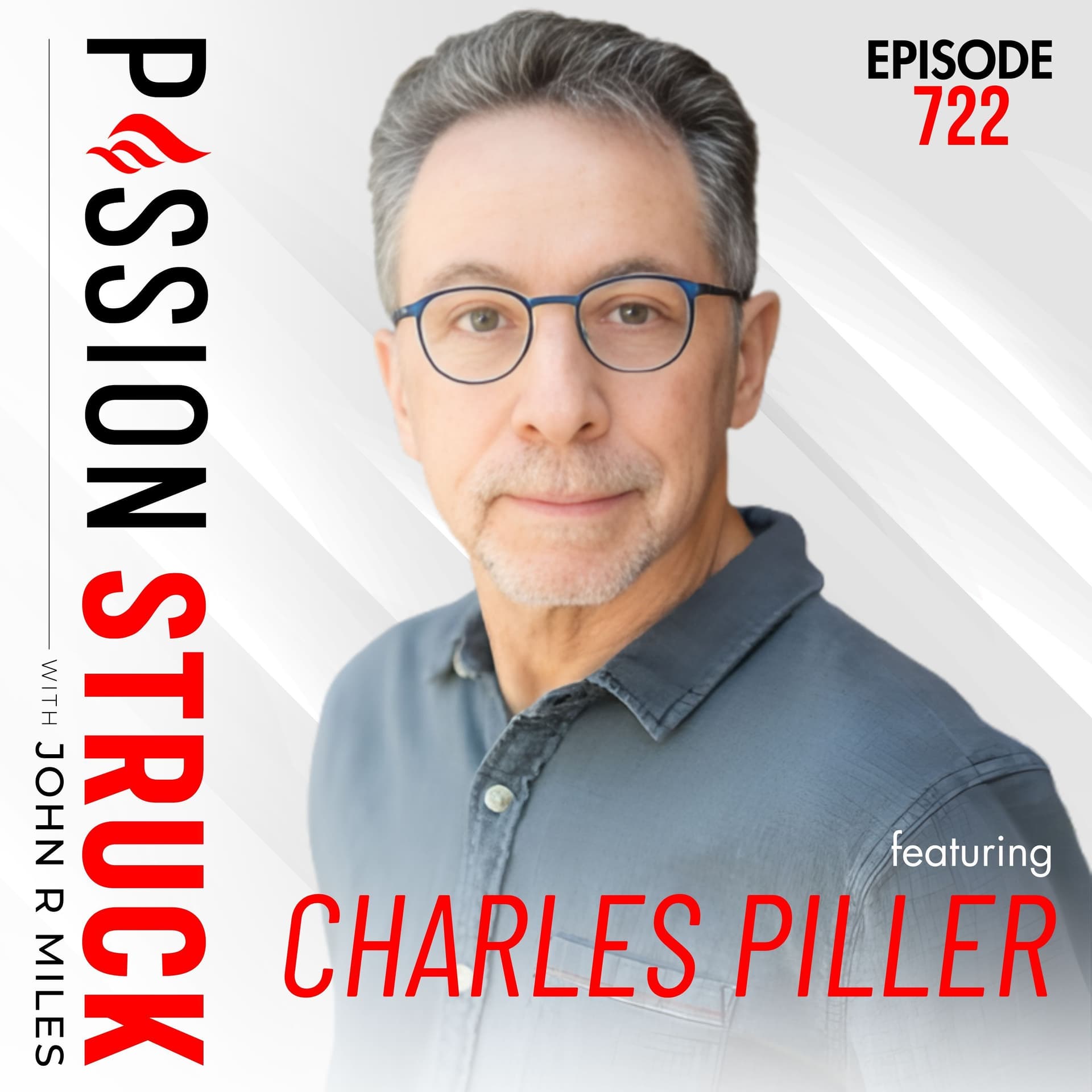
Passion Struck with John R. Miles
Alzheimer’s Research, Doctored Data, and the Human Cost | Charles Piller – EP 722
01:05:34
Loading summary
Transcript70 lines
- [00:00]
Sleep Number Salesperson
Why choose a Sleep number Smart bed.
- [00:02]
Charles Pillar
Can I make my site softer? Can I make my site firmer? Can we sleep cooler?
- [00:06]
Sleep Number Salesperson
Sleep number does that cools up to eight times faster and lets you choose your ideal comfort on either side. Your sleep number setting J.D. power ranks sleep number number one in customer satisfaction with mattresses purchased in store and online. And now the more you buy, the more you save on beds, bases and more. Plus get free home delivery on most beds with base limited time. For J.D. power 2025 award information, visit jdpower.com awards check it out at the Sleep Umber store today.
- [00:30]
Reba (realtor.com spokesperson)
Nearly Home Isn't home where we all want to be? Reba here for realtor.com, the Pro's number one most trusted app, Finding a home is like dating. You're not just looking for a place to live, you're searching for the one. That's where realtor.com comes in. Like any good matchmaker, they know exactly where to look. With over 500,000 new real listings straight from the Pros every month, you could find your perfect match today. Ranch style with a pool, barndominium with an in law suite. Realtor realtor.com's got them. Modern craftsman with a big yard and a treehouse out back. Realtor.com will have you saying yep, that's the one. No more swapping. It's time to start finding. Download the realtor.com app today cause you're nearly home. Make it real with realtor.com pro's number.
- [01:22]
John Miles
One most trusted app based on August 2025 proprietary survey. Over 500,000 new listings every month based on average new for sale and rental listings July 2024 to June 2025 coming up next on Passion Struck.
- [01:33]
Charles Pillar
I think people of good intentions can make mistakes. They can be drawn into actions that are counterproductive, that are even counter to what their expressed views and wishes would be. And my job is to try to tell the bigger story, to tell the human story behind some of these concerns so that I don't want to leave readers with a sense of cynicism. I think it's important to view the world as it is, but to also to try to generate a sense of hopefulness about what it can be by exposing bad actions and trying to correct them and also pointing out where things in the future might benefit from some of the work that's being done.
- [02:17]
John Miles
Welcome to Passion Struck. I'm your host John Miles. This is the show where we explore the art of human flourishing and what it truly means to live like it matters Each week I sit down with change makers, creators, scientists and everyday heroes to decode the human experience and uncover.
- [02:35]
John Miles (interviewer)
The tools that help us lead with.
- [02:37]
John Miles
Meaning, heal what hurts, and pursue the fullest expression of who we're capable of becoming. Whether you're designing your future, developing as a leader, or seeking deeper alignment in your life, this show is your invitation to grow with purpose and act with intention. Because the secret to a life of deep purpose, connection and impact is choosing to live like you matter.
- [03:05]
John Miles (interviewer)
Hey friends.
- [03:07]
John Miles
Welcome Back to episode 722 of Passionstropping. We're continuing our January series, the Meaning Makers, an exploration of how meaning is built, protected, and sometimes broken inside the systems we trust most. In recent episodes, we've been tracing how inner structures shape performance and identity. With New York Times best selling author Jim Murphy, we explored inner excellence on how courage, wisdom and love form the invisible foundation beneath extraordinary performance. Before that, we examined how pressure distorts judgment, how unseen cognitive strain erodes self trust, and how early systems of belonging shape regulation for life. Today, we turn outward toward truth, power and consequence. Because meaning doesn't only live inside individuals, it lives inside institutions. And when those institutions fail, the human cost is enormous. My guest today is Charles Pillar, an award winning investigative journalist for science and the author of the groundbreaking book Fraud, Arrogance and Tragedy in the Quest to cure Alzheimer's. For decades, Alzheimer's research focused on a single dominant theory backed by prestige, funding and pharmaceutical promise. But what if that certainty was built on manipulated data? What if careers incentives and institutional silence delayed progress for millions of families waiting for answers? Today's episode is not a conversation about cynicism. It's a conversation about integrity. About whistleblowers who risk everything to tell the truth. About what happens when systems prioritize certainty over curiosity and prestige over accountability. In this episode, we explore how manipulated scientific images reshaped Alzheimer's research for decades by the dominance of a single theory. The amyloid hypothesis became a billion dollar blind spot, stalling innovation and steering funding toward flawed research. The courage it takes to challenge consensus from inside a system. How universities and the FDA failed to police misconduct and what must change the hidden costs to patients, families and the 7 million Americans living with Alzheimer's. And what must change if science is to remain worthy of public trust. If your life has been touched by Alzheimer's, or if you care about truth in medicine, science and leadership, this conversation matters. Before we begin, a brief note. If you're interested in the broader work we're doing around mattering visibility and human worth, including how These ideas translate across generations. You can learn about my upcoming children's book, umatterluma@umatirluma.com youm can also go to our substack where we accompany each one of these episodes with a workbook and a detailed post. Find it@theignitedlife.net and if this episode resonates, please consider sharing it or leaving a five star review. Your support helps these conversations reach the people they're meant for. Now let's continue the Meaning Makers with investigative journalist Charles Pillar. Thank you for choosing Passion Struck and choosing me to be your host and guide on your journey to creating an intentional life. Now let that journey begin.
- [06:36]
John Miles (interviewer)
I am so excited today to welcome.
- [06:38]
John Miles
Charles Pillar to Passion Struck. How are you today?
- [06:40]
John Miles (interviewer)
Charles?
- [06:41]
Charles Pillar
I'm well, John. Thanks for having me here.
- [06:44]
John Miles (interviewer)
Well, you and I were talking beforehand that you're in the Oakland, California area and I have probably been to the bay area maybe 50 times in my lifetime and I absolutely never know how to pack when I go there because the weather, having lived in Southern California, for some reason I can't get that out of my head and so I never pack the right things.
- [07:06]
Charles Pillar
Well, if you were coming today, you'd be packing for rain because we are in the middle of a huge storm.
- [07:12]
John Miles (interviewer)
Well, I've seen my fair share of that when I've been on out there, but thankfully most of it, especially when I've been wine country, has been arid and I've been thankful for that.
- [07:21]
Charles Pillar
We're very privileged to live here. It's a spectacular area with usually a wonderful climate.
- [07:27]
John Miles (interviewer)
Charles, I have been following your work for a while. You're an investigative journalist and you write for some of the biggest names in journalism. What drew you to that career and did you ever think you'd be doing today what you're doing?
- [07:45]
Charles Pillar
Sure. Thanks for that question, John. I have been interested in this for a very long time and at the risk of dating myself, I'm old enough to have been inspired by some of the investigative reporting way back in the Watergate era. I was a kid then, but I was paying attention to what was going on. And to me, my inspiration has been the idea that through illuminating issues we can help inform the public and give people a better frame of reference for understanding our world. And so I have been working in investigative reporting for a very long time. I've done other kinds of journalism as well, including technology reporting, business reporting. And what has inspired me to do this is the hope and the thought that some of my articles could help people move in a direction of improving society and basically interrupting some corruption that might be causing harm to people. And so that's been my inspiration. But both when I worked for newspapers like the Los Angeles Times and the Sacramento Bee, and now writing almost exclusively for Science magazine about issues of scientific research.
- [09:00]
John Miles (interviewer)
Charles, was there a moment early in your career that taught you that power or cost? All right, I'm going to say that again. Was there a moment early in your career that taught you the power or cost of telling uncomfortable truths, something that, that shaped the journalist you became?
- [09:18]
Charles Pillar
Sure. I think one of the things that I face all the time is that we live in a complex world where more than one thing can be true at once. And there are contradictions that are often brought into high relief by investigative reporting. So let me give you an example. Not at the very beginning of my career, but this was about 20 years ago when I was working at the Los Angeles Times and I did a multi part investigation of the Bill and Melinda Gates foundation and some of the difficult contradictions in their work. This is an institution that's done great good in the world, in my opinion, has contributed to research that has helped turn back some terrible diseases and has been very generous in their support of important scientific research. But at the same time, I found in my reporting that the organization was also making investments in companies that were engaging in practices that directly contradicted their good works from their philanthropic efforts. And so what my stories were trying to do is to explain that we live in this complex world where people can be engaged in beneficial efforts, but also at the same time be doing things that contradict their work, and that people need to look at those nuances and to understand how they shape our world.
- [10:51]
John Miles (interviewer)
Well, I think that is a great story of a difficult topic that you covered. But in addition to that, as I've looked at your background, you've reported on everything from biological weapons programs to federal oversight failures. Is there some sort of similarities that you see across the systems you've exposed?
- [11:14]
Charles Pillar
Sure, I think the similarities are that, and this is something I have to remind myself about because a lot of my work looks at problems, corruption, challenges and difficulties in big systems and in big bodies of work, bodies of research. And consequently, I have to guard against getting a kind of cynical attitude about it. I think people of good intentions can make mistakes. They can be drawn into actions that are counterproductive, that are even counter to what their expressed views and wishes would be. And my job is to try to tell the bigger story, to tell the human story behind some of these concerns so that I don't want to leave readers with a sense of cynicism. I think it's important to view the world as it is, but to also to try to generate a sense of hopefulness about what it can be by exposing bad actions and trying to correct them and also pointing out where things in the future might benefit from some of the work that's being done.
- [12:23]
John Miles (interviewer)
Teros, your work in investigative journalism and science goes into incredible technical details. It has to because you're dealing with science. But I understand because you've exposed some things in science that, especially recently under the current administration, you've been criticized a lot and even been linked somehow to some of the policies that this administration has been handing down. What do you say about those accusations?
- [12:56]
Sleep Number Salesperson
Sure.
- [12:56]
Charles Pillar
Thanks for that question, John. As an investigative reporter, I am used to people pushing back against some of the things I write. This comes with the territory and normally I just like to let it wash over me because let's face it, people are entitled to their say. And I have a pretty big platform. I have an opportunity to put out my work in a way that's read by many people. And if people have different ideas, people of good faith should be allowed to say whatever they want. And I'm just gonna let that happen. But I think there have been some disingenuous criticisms of my work that to me are troubling because they reflect some of the weaknesses in the arguments made by scientists in the Alzheimer's field about their own work. And specifically what you were referring to is that some top officials in the Trump administration, including RFK Jr. And Jay Bhattacharya, who is the head of the National Institutes of Health, have used references to my work and my concerns about elements of research in Alzheimer's disease that I regard as having been corrupted by bad behavior by scientists as a way of making a larger critique of the scientific community. And so many things in my view, about the Trump administration's critiques of society. I think there's an element of truth in what they were saying, but that they're, in my view, ham handed way of describing these matters and their relentless attacks on scientific institutions such as universities and the grantees of federal agencies, to me is exactly the wrong approach to solving some of the problems in the scientific record. That said, I think some scientists in a misguided way have misrepresented my work, have used what I would call strawman arguments to describe my work as somehow responsible for these attacks. This is ludicrous. The book that I wrote was written and locked down before Trump was even elected. So the idea that I somehow am responsible for ideas that emanate from that administrative structure in the Trump administration, I think is something that I have to refute, and I have done so. I can talk about that further if you're interested. But the short story is that people of good faith and people who stick to the facts and to the real truth of my arguments, I think I welcome their criticisms, I welcome their pushback, because that's what a real debate is about. But disingenuous attacks, lies about what I do. And in my opinion, straw man arguments are probably not that useful to the public to illuminate the issues.
- [15:42]
John Miles (interviewer)
Well, I thought it was important to bring that up, especially with some of the discourse that's been out there, just for you to let the record be set straight. And the book you're referring to is titled Doctored Fraud, Arrogance and Tragedy in the Quest to Cure Alzheimer's. And the reason I was so interested in talking to you about this is I had a grandfather who was absolutely brilliant. He worked at Fort Detrick, where he was recruited, supposed to go to D Day, but had studied chemistry at the University of Michigan, and unknowingly was recruited into the chemical warfare, germ warfare ecosystem because his professor at Michigan was a leader in it and ended up saving his life, we think, because most of his platoon, when they parachuted in, lost their lives. But he went from that research to becoming the head of research by the time his career was over 40 years plus later at Kraft of Kraft Foods. And I saw this gentleman who was one of the smartest people I'd ever met, so articulate, during the later decade of his life, come down with dementia, eventually become a fraction of the brilliant man he once was. And so because of that, I've tried to profile a lot on the disease and bring different perspectives on it. And just recently, I was at my mother in law's senior living center, and I happened to see on the wall in the elevator that they now predict that one in nine seniors will someday get dementia or Alzheimer's. So it really is a huge thing that for all of us, we need to be concerned about. So I open it up like that. But I wanted to ask you a question before we get into this, and that is, when you're looking at something like Alzheimer's, what role does intuition play in your work? Is there a signal that tells you, like, a story like this might be built on lies? Like, why do you decide to go into things like this?
- [17:57]
Charles Pillar
My stories emerge in a variety of ways. But one of them is that I get a lot of tips because unfortunately there aren't that many reporters who are dedicated to investigations involving scientific issues. I wish there were more. There are a bunch of great reporters doing this kind of work. But shortage means that a lot of ideas come my way. And my book, for example, and many of the articles I've written for Science about Alzheimer's disease came out of that process of a tip. But I think one of the most important things to say about how do I assess ideas and decide whether it's suitable is that my stories often involve a great degree of skepticism about other people's work, about whether they're doing work that's valid and perhaps whether it's been corrupted. And because of that, it's incumbent on me to also have skepticism about my own ideas. Journalists, just like scientists and almost everybody, can be subject to expectation bias. In other words, the idea that what we're after, the story that we think would feed our determination to get it in such a way that we might overlook details or ideas that could contradict it. And so what I try to do is to test my thinking, to test my ideas in various ways to ensure that I'm not going down a road that could prove to be a false idea and that could possibly be harmful and damage thinking that maybe is worthy of paying closer attention to. And so I do this as a multi step process where I test my ideas, I test the ideas of others. And once I'm sure about both of those things, I know I've got a strong story to go forward on.
- [19:49]
John Miles (interviewer)
So I want to talk to you about Matthew Schrag, who's at the core of your book and this whole Alzheimer's debunk that's happened. And when I think about him and I think of whistleblowers, I think of the enormity of the decision that he took to stand up for this because. And I'll let you go into his story here in a second. When I think about this, and I have interviewed a ton of scientists on this program, what he did is like attacking the foundation of an entire industry. And it had the potential for him to be extremely dangerous to the career he was trying to build. And at the time he did this, he was pretty junior still in that trajectory. So maybe with that as a backdrop, you can tell a little bit more about him and maybe the courage that it took for him to come forward.
- [20:47]
Charles Pillar
Yeah, thanks, John. I appreciate that question in part because I, I do admire Matthew Schrag. Who's a key character in my book Shrag, at the time I met him, was an untenured junior professor at Vanderbilt University. He's a neuroscientist, so he does laboratory research about the brain and about how it functions. And he's also a neurologist, so he treats patients who have symptoms of dementia. He has this broad perspective on Alzheimer's disease that I think is critical to his bigger understanding of the field. And Matthew, so he's a whistleblower. And what he did is he uncovered certain seminal experiments in the field of Alzheimer's research. These are basic science experiments, laboratory experiments that steered a lot of thinking in the field and they steered the thinking towards the acceptance of something called the amyloid hypothesis of Alzheimer's disease. So perhaps it would be best before I answer your question directly about Matthew Schrag, is to take a step back and explain what is the amylan hypothesis and why does it matter? So maybe, if you'll forgive me, I'm going to digress.
- [22:09]
John Miles
Before we continue, I want to pause for a moment. Conversations like this can feel unsettling when systems we trust are questioned. Our instinct is outrage, but meaning is built in discernment inside the ignited life. Each episode of the Meaning Makers series is paired with guided reflection prompts designed to help you stay present with complexity without collapsing into cynicism or certainty. This week's prompts focus on recognizing when authority replaces inquiry, identifying where silence has felt safer than truth, and clarifying what integrity requires when the cost is real. You can explore them all@theignitedlife.net now a quick break for our sponsors. Thank you for supporting those who support the show. You're listening to Passion Struck on the Passion Struck Network. Now back to my conversation with Charles Piller.
- [23:06]
John Miles (interviewer)
I think it's an important thing to go into because even on this show, which is one of the reasons I wanted to have you have had numerous neuroscientists and neurologists come on the show and say that the biggest reason people have this disease is because they're not clearing amyloid plaque at night. And it's that buildup over time that causes these symptoms to occur. And what you need to do is try to free that Amazon amyloid plaque so it goes into, gets, goes out of your brain and through your nervous system and gets flushed. So that that is what I have been told repeatedly. And I'll let you take it from there.
- [23:43]
Charles Pillar
Okay, I'm going to step back very briefly more than 100 years to the the guy who Discovered, if you want to put it that way, Alzheimer's disease. The namesake, Eloise Alzheimer, a German scientist, and. And he, in doing an autopsy of a very terribly demented patient of his who died, he examined her brain and found these structures, amyloid protein plaques that you were mentioning, and also another kind of protein called tau, that takes the form of these kind of tangled shapes within nerve cells. And so you have these two proteins, amyloid, tau and dementia, that became the definition of a disease called Alzheimer's disease. Now, for many years, Alzheimer's disease was a relatively minor thing in the scientific world. And the reason is purely a demographic one. Back in the early 1900s, not that many people were living to the old age, where Alzheimer's disease would become a serious problem. And as medical science advanced in the 40s, 50s, 60s, suddenly we had vaccines, we had antibiotics, we had medical advances in cancer and heart disease. And the demographics shifted radically. Many more people were living to old age, and many more people were having the symptoms of dementia attributed to Alzheimer's disease. Consequently, a gigantic infusion of funds went into this in the 70s and 80s and 90s, and many hundreds of scientists started studying this. And because of the definition, as at first was stated by Dr. Alzheimer, it was strongly felt that the linchpin to this disease was amyloid plaques. And so I can state the amyloid hypothesis very simply. It's that the accumulation of amyloid plaques in the brain, which nearly everyone has, leads to a series of biochemical events that gradually kills nerve cells, kills the neurons that make up the brain, and causes the symptoms of dementia. And it was felt very strongly that by removing these amyloid plaques from the brain, that you would have the ability to arrest and possibly even reverse the cognitive decline of Alzheimer's disease. And so within that period of time, after billions of dollars are spent on research and billions of dollars are spent on the development of drugs that were then tested in people, there was a sort of very disappointing series of events. Drug after drug that were capable of removing these plaques from the brain were found to not be effective in arresting or improving the cognitive symptoms of the disease. And in fact, many of them also had very dangerous side effects, including brain swelling and bleeding that in few cases could even cause death. And so you had these ineffective drugs that were also dangerous to use. And so some contradictions came into play in the scientific community. Some doubts about whether they were on the right track came into play. And so I'm getting closer to answering your question directly about Matthew Schreck. So forgive me for this long Digression. But I think it's important to get a little bit of the scientific background to understand where the field stood. And so what happened was during this period of doubt, during this period of soul searching on the part of the scientific community, a brilliant experiment took place. And this was at the University of Minnesota. And in this experiment, scientists there were able to produce genetically engineered mice that produced copious amounts of amyloid plaques and other amyloid proteins within their brains. And the scientists extracted one very specific type of amyloid protein called amyloid beta 56, their star protein, if you will. And they extracted this from the brains of mice, they purified that one type of amyloid protein, injected it into rats, and then witnessed the symptoms of memory loss that they compared to memory loss and confusion that people who have Alzheimer's disease have. So what we had here was the first ostensible cause and effect relationship between a particular substance in Alzheimer's disease. And people thought, ah, this is a revelation because it shows we are on the right track. We may not have had the right specific amyloid target in our research, but we know we're on the right track. We know that we're headed in the direction of curing Alzheimer's ultimately, or at least coming up with a treatment that can help the sufferers of Alzheimer's disease.
- [29:01]
John Miles (interviewer)
Can I just add something here? So when I think about this, and you're talking about the work from Karen Ash and Sylvain Lesney, when I think about this in positive psychology, this would be almost like Marty Seligman's work on learned hopelessness, helplessness being found to be doctored, or Danny Kahneman's work on thinking fast and slow to be doctored. It was like that big revolutionary for a community. Is that a good way to think about it?
- [29:31]
Charles Pillar
Yes, I think that is a good way to think about it, John. And essentially to cut to Matthew Schrag, so this went on. Then there's a reinvigoration of the belief that the amyloid hypothesis was the correct way of looking at things, and an invigoration that meant many more billions of dollars being spent on possible remedies. And then we had again failure after failure of these experimental drugs, and then the science behind them to deliver on their promise. And we also, at the time, the science is a bit complicated. But I'm going to explain very briefly. One of the contradictions is that people who have Alzheimer's, when they die and autopsies are done, they're often found they have enormous amounts of amyloid protein in their brain and also tau proteins. And yet it's also been shown that people who die, who had no symptoms of Alzheimer's disease, also have the presence of these proteins in their brains. So it's one of the complexities of Alzheimer's disease that there's never been a fully understandable and good explanation for. So, consequently, what happened after this historic experiment by, as you say, Karen Ash and Sylvan Lesney at the University of Minnesota, it reinvigorated thinking in the field. It reinforced the amyloid hypothesis, it regenerated the funding for this and the many new experiments for it. But what Matthew Schrag did. And finally, I'm back to the beginning of your question. Matthew detected the problems in this study in the form of doctored scientific images that called into question the entire premise of the experiment. If you have image after image within a seminal scientific study that are shown to be based on false science, on changes in these images to reflect the experimental hypothesis, in other words, when the actual data did not prove the hypothesis, the images were changed in a way that would suggest to reviewers and suggest to scientists that this hypothesis was true. This is a form of apparent scientific misconduct that had an enormous effect on the field, an enormous effect on funding and scientific research and drug development. Now, it was not solely responsible for that, but it was important at the time. It was one of the most cited scientific studies in the field in decades. And this is what Matthew Schrag detected. This is what he found and brought the evidence to me so that he felt strongly that it had to be exposed into the world more generally so the scientific community could take stock and try to correct the thinking in the field that might have improperly skewed thinking in the direction of ideas that were not well founded. So now I'm going to get to exactly your question, the risks that he took. So you're talking about a junior professor at Vanderbilt University, did not have tenure, going up against some of the biggest journals, funders and authorities, all people and institutions. He needed to continue and develop his career to become successful as a scientist himself. And yet he ultimately decided that his journey of discovery was central to helping the public understand this set of contradictions, and that he was trusting me after literally months of discussion about this, that he trusted me to tell his journey of discovery in both Science magazine and in the pages of my book in such a way that we could try to illuminate the importance of it and to help to try to correct the scientific record in a positive way that could open up new ideas for the field.
- [33:34]
John Miles (interviewer)
So as someone who is not part of the scientific community, which is a very tight knit club based on what I have seen across universities, would someone in his position first attempt to go to some of the people in the scientific community themselves and confront them, and then after that confrontation ended in going nowhere, then they come to you, or does it not work that way?
- [34:04]
Charles Pillar
Well, yes and no. So what Shrag did is that he always found the path of the appropriate way to question research, which is to go to the funding agencies and the journals, the agencies that funded the work and the journals that published it, and to present all of his information openly to them and make sure that they had the full set of concerns about a body of work in order to judge whether it's worth looking at and whether his concerns might be well founded. And it was only after months and months of being stonewalled by those institutions, months and months of being ignored by the journals that are responsible for the scientific record itself, that he felt that it was appropriate for him to come out publicly through my writing. And so the short answer is yes, he followed the sort of prescribed protocols and found them to be, unfortunately, not very useful. And this is, I would add, a very typical story. These institutions are sluggish at best in examining problems that occur on their watch, both out of a sense of embarrassment and also out of the problem of trying to guard against people criticizing them. There's a longer story about it, but the gist of it is, yes, he did approach those institutions and did not get satisfaction.
- [35:31]
John Miles (interviewer)
So this isn't a simple thing like you see in the Washington Post or New York Times, Wall Street Journal, where they publish something someone writes in saying you didn't get all the information right. And you see in the editorial comments that we published this story and it's come to light that part of our reporting was incorrect. So we feel it's important to restate the information. So these publications that we're talking about don't normally do something like we see in a lot of newspaper reporting on a common basis.
- [36:01]
Charles Pillar
No, just to be clear, look, we're all human. We all make mistakes. I have made mistakes in my reporting, although I gotta say it's pretty unusual because I'm a careful person and I have great editing and great fact checking. But that said, whenever there's a claim that I've made a mistake, I drop everything and go directly to reinvestigate that issue to satisfy myself that either the questioner is incorrect, or if there was a mistake made, that we issue correction. This happens immediately. Not so with scientific journals. Usually they spend weeks, months or even years without doing anything. Normally they kick the question back to the home institution of the investigator who's been questioned. So let's take the example of the important experiment from the University of Minnesota. From 2006, the journal Nature publishes. This is an eminent journal, one of the most important journals of scholarly writing in the world. You might say an equivalent with Science, the journal that I work for. And Nature basically sat on this literally for more than almost two years before doing anything about it. And actually more than two years it turned out to be. Now what they did is they kicked it back to the University of Minnesota. This is the institution with the most to lose and the least to gain from doing a robust, complete and publicly accessible examination of concerns about one of its scientists research. And lo and behold, they went years investigating this. Ultimately the study was retracted, but we didn't get the details of what the University of Minnesota's investigation was. We didn't get those details because they behaved in an incredibly secretive way. I might add that ultimately Sylvan Lesney, who was implicated in being most involved with the apparent image doctoring in this study, was retired out of the university even though he was a young full professor there. Very unusual but clearly substantial problem that caused him to retire.
- [38:16]
John Miles (interviewer)
When you think about the papers and the funding that were all based on the amyloid hypothesis in practical terms, just so the listeners can get some type of sense, like how much time, money and human opportunity did we lose by chasing a theory that was based on falsified data?
- [38:37]
Charles Pillar
Well, let me put it this way. So I want to make it clear that I agree that amyloid proteins and tau proteins have something to do with Alzheimer's disease. I think where I part ways with the progenitors and supporters of the amyloid hypothesis as the dominant way of looking at the disease, is that I don't think they have everything to do with Alzheimer's disease. And I think that the way in which that idea has been promoted has squeezed out other ways of thinking, thinking about Alzheimer's because of the scarcity of funding. When so much emphasis goes on one dominant set of ideas, it can be hard for other researchers to get traction in their way of thinking about the disease. I think that is the sort of tragedy of the issue. If I could just expand on that briefly. There has been an enormous amount of fraud and misconduct in the field of Alzheimer's disease, a lot of it associated with the amyloid hypothesis. And that is in part because the Dominant way of thinking about the disease presents a big target and it makes the possibility of incorrect or falsified information more likely to be accepted by the scientific community if it fits with the dominant way of thinking about disease, even if it's wrong, even if it's based on fraud or misconduct, it's much more likely to pass muster and to be seen as being correct information. But I want to say briefly that fraud and misconduct is still, in my view, a small part of the overall scientific equation. Most scientists, like most people in all walks of life, are honest and deeply committed to doing the right thing, to develop human knowledge and to serve humanity in a beneficial way. And even though I think Alzheimer's disease has been badly damaged by fraud and misconduct, I'd say that most scientists are not in that category. Of course they're not. If you look at the scientific record, there's been a lot of fraud and misconduct in heart disease, cancer research, diabetes research, basically everything. Because very small percentage of people in every field of life are going to cut corners or even worse. But the difference is that unlike heart disease and cancer and diabetes and other very important human ailments, which have seen enormous progress in the last few decades, which have seen even cures in some cases, we have not seen that in Alzheimer's disease, there's never been a remedy developed that arrests or reverses the cognitive symptoms that are so terrifying and so damaging and really have created this dementia crisis that we have worldwide with Alzheimer's. In my view, part of the reason why progress has been slow is that the human brain is an incredibly complex organization and is very difficult to decipher what's going on inside there. So that's one reason. Another reason is that when so much seminal research in the field is based on thinking that has been skewed by doctored images, by falsification of data, and by basically fraud that undoubtedly that has been a factor in the problem of a lack of problems, progress in Alzheimer's research. So it's multiple problems.
- [42:11]
John Miles (interviewer)
Since you brought up things like cancer research, etc. One of the things in Doctored that you exposed was a cabal of researchers, funders and pharma executives who helped enable the deception that went on. And the reason I'm bringing this up is because it's an entire system and it's often systems that stop things from. From making progress or make things like this become something of progress. What incentives did you find that made fraud not only possible, but predictable?
- [42:47]
Charles Pillar
Sure. So I refer in the book to something that I call The Amalid mafia. And I want to make it clear that it's not a real organization, it's not a real mafia. These are not criminals. Except to the extent that some people who are proponents of issues in Alzheimer's, like some proponents of the amyloid hypothesis and other related scientific factors, have engaged in inappropriate actions, have engaged in doctored research. But what I mean by the amyloid mafia is people whose careers and personal fortunes and paydays from pharma companies and scientific reputations and their legacies as scientists are all integral to this idea of this one dominant way of thinking in the field. And when you have this enormous set of incentives for professionals in the field who are very powerful and who are often the gatekeepers of knowledge, who are prominent scientists, whose work has been cited many thousands of times, whose ideas tend to dictate the trends in drug development and the trends in scientific thinking, when you have them working in lockstep with each other to try to reinforce what is ultimately their professional legacy and to prove out one way of thinking in the field, then you can have the effect of forestalling the ideas that might run contrary to that or might just complement it in ways if they were not starved for funds, if they were not regarded as secondary or lesser or not worth pursuing. And I think what you had in the field is this dominance that crowded out other ways of thinking. Now I'm happy to say that thinking in the field is beginning to expand more and more. You're seeing people push back against the singularity of the amyloid hypothesis and to look at the aspects of it that might be extremely valuable to keep exploring, but also to expand out to other ways of thinking of the disease that might in themselves be equally valuable or might, in combination with research on amyloid and tau proteins, lead to better outcomes for patients.
- [45:17]
John Miles (interviewer)
Thank you for going into that, Charles. And I have a follow up question to that and it revolves around Big Pharma itself because many Alzheimer's patients, including my grandfather, had pinned their hopes on the evolution of drugs coming out to help them. Based on your reporting, how effective or ineffective are are these drugs really?
- [45:38]
Charles Pillar
Thanks, John. I believe you're referring to two anti amyloid antibody drugs. Their names that they're sold under are Kasunla and Leqembi and they've only been on the market a couple years. And these drugs were developed to strip amyloid proteins out of the brain with the idea that again, if you do that, you are going to be preventing this cascade of biochemical effects that lead to terrible dementia. Of Alzheimer's patients and large trials were done with these drugs. These are human trials where people with mild symptoms of Alzheimer's, or what they call pre Alzheimer's symptoms, very mild dementia or memory loss symptoms, join these trials, take the drugs for an extended period, and, and then they're compared against a group of people who are given a placebo, which is a kind of the classic sugar pill, although in this case it's not a sugar pill because these are infused through a vein. So they're getting a dummy infusion that does not contain any drug in it. And then they compared the results of these two groups and what they found is to a statistically measurable degree, statistically significant degree, the people who took these drugs, they just like the placebo group, their cognition declined, but it declined to a very slightly less rapid rate than the people on the placebo. And so you say, well, isn't this a really beneficial effect of the drugs? Yes, they did not reverse the cognitive decline of Alzheimer's, they did not arrest the symptoms. But what they did is they made it possible for people to decline very slightly less rapidly now. So if these drugs were completely safe to take, if they were completely affordable, if they were drugs that did not require potentially harmful infusion process in doctor's offices or in clinics, and they only had a slightly beneficial effect, then why would anyone refuse them who is beginning to experience the symptoms of Alzheimer's disease? But unfortunately, the story told, I think, is not quite correct. So in the community of neurologists and other doctors who prescribe these drugs, or don't prescribe them in some cases, is that these drugs, the benefits of them as described, are so minimal that that many doctors, patients and family members would not be able to notice those benefits. In other words, the effects would not be discernible. That's how subtle they are. But at the same time, they have potentially dangerous side effects, including brain swelling and bleeding, and including brain atrophy. That's the shrinkage of the brain that occurs more rapidly than the shrinkage that occurs within Alzheimer's disease itself. And so you have these contradictions of potentially dangerous brain swelling and bleeding that does kill people on occasion for the benefits of the drug that are so subtle that in many cases people say it's imperceptible. So I'm not saying that no one should take these drugs. That's a decision that people should make with their physicians and, and with their family members. But what I'm saying is that people should not exaggerate the benefits. They should See that these potential benefits are very slight and the dangers are ever present.
- [49:20]
John Miles (interviewer)
So all that being said, based on the research that you have done, and I'm going to phrase this in two different camps, for those of us who are younger in our lives and haven't reached the, the normal point for some of these diseases to take root, what have you found are recommendations people should do. And then if you are in the camp where someone has an early diagnosis for dementia or Alzheimer's, what have you learned through your research that might be appropriate steps for them to take?
- [49:56]
Charles Pillar
When you say an early diagnosis, you mean someone who's beginning to see the very early signs of dementia, who at any age or at a normal, the, what they call the sporadic Alzheimer's, age of maybe in 70s, usually from 65 to 85.
- [50:13]
John Miles (interviewer)
Yes.
- [50:14]
Charles Pillar
Well, let me say that in my view, Alzheimer's has been subject to some of the same things we see for all kinds of diseases. The two most important being that care and prevention has sometimes been sacrificed at the altar of cure. And so the vast majority of funds for research and development, for drug discovery, et cetera, has outweighed the emphasis being placed on prevention and care. And these are things that can make a big difference in a person's life and experience of the disease and also in trying to forestall the possible terrible effects of Alzheimer's. So let me put it this way. Living our best lives through good nutrition, exercise, controlling high blood pressure, controlling cholesterol levels, using your mind reading, having good social relationships, these are all things that can forestall the worst effects of Alzheimer's. If you're unfortunate to be someone who ends up getting the disease, there, in my view, is no brain game or supplement or exercise regimen that will definitively stop a person from getting Alzheimer's. But we know that this combination of effects, things that pay dividends in our lives generally can be extremely important in forestalling or preventing the worst effects of the disease. And so I would just say people should remember that they have some agency in their lives. And that's one factor. The science, the scientists who are proponents of the amyloid hypothesis, who again in my view, have important points to make, but their ideas should not prevent people from exploring other ways of looking at the disease and finding the combination of factors that might lead to Alzheimer's disease. But, but I think what they're advocating for is to treat early and earlier with these anti amyloid drugs that again, as I mentioned, have potentially beneficial effects, if very subtle effects on cognition. In other words, to reduce the rate of cognitive decline that people might experience. But when they're describing the idea of giving these drugs to younger and younger people, I think people should be cautious in adopting that advice, Particularly people who have no symptoms of cognitive decline, but may have evidence of amyloid and tau proteins in their brain. Young people who have those symptoms, have those evidence of those proteins might at some point be encouraged to take these drugs. And I think you need to proceed down that path with great caution because of the potential hazards associated with them.
- [53:16]
John Miles (interviewer)
I want to go back to image manipulation for a second. Based on your discoveries, is fraudulent image manipulation rare, or is it shockingly common across some scientific disciplines, such as what you found in neuroscience?
- [53:35]
Charles Pillar
John, let me just say that I again, I just want to emphasize that I think most scientists would never manipulate images, but even a minority of scientists who do can have profound effects on thinking in the field, which is what I discovered in my work. And I would say then that, yes, image manipulation is unfortunately quite common. And part of the reason for it is that I think scientists sometimes become very convinced of their ideas in ways that they follow a kind of slippery slope where they might make a small change in an image in order to exaggerate the beneficial results of a study, and that they see that they no one notices that they made an improper change, and they think this is good because I'm very convinced of the truthfulness of my science and the importance of my science. And by making this change, I have created an opportunity to get new funding, funding that I desperately need to prove out the validity of this work. And then the next study comes along and they see, well, I'm not quite getting exactly the results I want and need to prove my hypothesis. But I know I'm close. I'm just going to make a couple of other changes to reflect well on the experiment. And so you see where I'm going with this. Suddenly you're moving into the direction of outright fraud and misconduct that then goes into the scientific record skews thinking in the field. And in the case of the amyloid hypothesis, there have been many studies done that are above reproach, but many others that have been done that are based on doctored science, doctored data, that have pushed people in directions that suggest that the importance of this work is greater than it really is.
- [55:28]
John Miles (interviewer)
Given the decades of false starts and misconduct, how hopeful should the public be about the future? Are we closer than we think? Or is Alzheimer's still an unresolved mystery, similar to pancreatic cancer?
- [55:41]
Charles Pillar
In the near term, I think in the near term, we're going to be faced with many dilemmas and conundrums in the Alzheimer's field. That said, I do have a lot of hope, in part because I think scientific ideas are opening up a bit. Perhaps I've had some small part in forcing the scientific community to take a good hard look in the mirror and ask themselves, how can we do this better? How can we approach our science with both greater validity and greater open mindedness? And I think that is beginning to take hold. Let me give you a couple of examples that I feel very interested in seeing how they come out and potentially they could be great developments in the field. One is an emphasis on the infectious hypothesis of Alzheimer's. And this is the idea that latent infections such as that of herpes virus or other ailments could hide out in the brain for years or decades and cause problems such as inflammation that could contribute to or lead to the symptoms of Alzheimer's disease. People are studying these things ever more seriously. There's clinical trials going on right now to see if that idea might be one of great importance. And I think within the next couple of years we're going to see some evidence to suggest whether it is or not. So I'm very hopeful about that, adding new information to the field that could be beneficial. The other is GLP1 inhibitors. These are the new seemingly magical drugs that are used for weight loss and for diabetes and now a raft of other ailments that have taken the world by storm over the last few years. And they are also being tested as a possible preventive or treatment for Alzheimer's disease. And very soon, even perhaps by the end of this year or early next year, we going to have the initial reading of a big clinical trial associated with GLP1 inhibitors that will have some, I think, some interesting results to see whether they're heading down a path that could be beneficial. And so these are the kind of scientific projects that give me a lot of hope and a lot of belief that science is vast. Much of it has not been corrupted. Much of the set of ideas behind the brain and neuroscience and Alzheimer's disease, I think will bear fruit eventually in ways that can really be hopeful for patients. And in the meantime, we also have the kind of hopeful quality of again living our best lives in ways that could help us forestall or prevent some of the serious effects of the disease for years in a way that could really benefit our lives.
- [58:36]
John Miles (interviewer)
Charles, you alluded to this a little bit, but I wanted to ask you because it's intriguing to me. After years of reporting on what you wrote about and doctored, what changed in you? How has exposing fraud at this scale reshaped your belief not only in science, but truth and the human capacity to self correct?
- [58:56]
Charles Pillar
Terrific question, John. It's been a really difficult journey because I believe deeply in science and the scientific method. I believe that it's one of the greatest, most important developments in human thinking historically. We have reaped enormous benefits from it in medicine and in many other fields, of course. That said, I think the scientific method teaches us that you can't fake information ultimately and get away with it because science is what they call self correcting. And what that means is that false information will eventually be discovered, uncovered and corrected by new experimentation. The problem that I see in science is that because of difficulties in the journals, the funders, the universities and the regulators of science, all four of those important scientific institutions have deep flaws that have been created. The conditions where problems in science, either corruption or just simple error or simple misunderstandings that are part of the scientific research process are being allowed to remain in the record and to skew thinking in the field for much longer than they need to be. So I mentioned earlier that, for example, the University of Minnesota was charged with examining the possible corruption of this important study in Alzheimer's research. Because the university was very slow in doing their work, this study remained on the record influencing thinking for many years longer than it needed to be. What I would say and what I have been writing about in my book is the importance for these scientific institutions to up their games to do better at investigating, correcting and enforcing the importance of accuracy and truthfulness in the scientific record. And I say this because I have great faith that these institutions have the ability to do better and reform themselves. But we as citizens and consumers of science and journalists and everyone, we have standing to insist that they do better. Now this is different from insisting that we defund them or cause them to be redirected into, in my opinion, sometimes incorrect areas. I don't subscribe to the idea that the way to correct these institutions is to completely, in a way, challenge everything about them and destroy them in a way that I think to some degree that effort has been made by people in Washington of late. But what I do believe is that we should not stand for laziness and inconsistent enforcement of rules and an unwillingness to challenge conventional wisdom in ways that is vital to improving the scientific record.
- [62:08]
John Miles (interviewer)
Thank you so much for that. I just am curious, what is the next topic that you're now working on to tackle for Science.
- [62:17]
Charles Pillar
Well, unfortunately, John, I can't talk about that because all of my investigations are under wraps until I'm much farther along in the process. But stay tuned. We're going to have some stuff in the magazine pretty soon that I think will be of interest to your listeners.
- [62:32]
John Miles (interviewer)
Okay, great. And Charles, where is the best place for people to learn more about you and your work?
- [62:38]
Charles Pillar
The best place is really to go to my website, charlespiller.com and up there you can read more about my book Doctored. And you can also see links to my stories in Science magazine, the New York Times and in other locations. And I think if you're interested in any aspect of my work, that's a terrific starting point.
- [62:59]
John Miles (interviewer)
Okay, and the last question I'm going to ask you, I'm passion struck. We're all about teaching people. How do you create what I call a passion struck life, which you are obviously passion struck about the journalistic reporting that you do. For you, what does it mean to be passion struck?
- [63:17]
Charles Pillar
Well, for me it means you have to be a little obsessive and you have to be deeply concerned about doing something beneficial for the human condition. That's where for me it's central to my identity. But I have to say that I also feel that for me to explore, my passion most effectively is that I have to challenge myself and sometimes not take myself too seriously. And my method of doing that is to spend time with my 3 year old granddaughter who does not put up with any kind of pretension or she is someone who I love so much and value so much and, and spending time with her keeps me honest.
- [63:59]
John Miles (interviewer)
Well, Charles, you didn't know this before we did this interview, but I actually have a children's book coming out in February. The title is you Matter, Luma. Once I get some advanced reader copies, I'd love to send one to you. It's a little bit early for her, but she'll be four before you know it.
- [64:15]
Charles Pillar
I can't wait to see it, John. Thank you for mentioning that.
- [64:18]
John Miles (interviewer)
Charles, thank you so much for coming on Passion Struck and sharing this important research discovery that you made.
- [64:25]
Charles Pillar
It was my pleasure. Thanks for having me, John.
- [64:27]
John Miles
That brings us to the close of today's conversation with Charles Miller. This episode stayed with you. That's because it wasn't just about Alzheimer's research. It's about how truth survives or erodes inside powerful systems. Here are three reflections that I'm carrying forward. First, progress without integrity is fragile. When certainty replaces curiosity, systems stop learning. Second, Whistleblowers aren't disruptors, they're guardians. Truth often arrives through the people willing to risk belonging. And third, mattering requires accountability. Human worth erodes when outcomes matter more than honesty. Charles Work is a reminder that meaning isn't only something we cultivate internally, something we must defend structurally in science, leadership and culture. If today's episode resonated, please consider sharing it with someone who cares about medicine, ethics or or the future of truth. Or leave a five star review on Apple Podcasts or Spotify. It's the most powerful way to help these conversations travel. If you'd like to continue the work, visit theignitedlife.net for episode Reflections and practices. Watch the full conversation on YouTube at John R. Miles or passionstalk clips or explore intention driven apparel@start mattering.com Next Tuesday we start a new series, you Matter with a conversation that shifts from from corrupted systems to constrained choice. I'm joined by renowned psychologist Barry Schwartz, author of Choose Wisely, as we explore how the paradox of choice shapes mattering agency and regret, and why more options don't always lead to better lives.
- [66:02]
Barry Schwartz
What we're trying to suggest in the book is that it's important to think of our lives as ongoing narratives, that there's a trajectory to life, that it isn't simply about attaining one pleasurable moment of experience followed by another pleasurable moment of experience with no particular connection between them. That is to say, life needs to have meaning. There are different ways that people can get meaning out of life, and in a pluralistic society society like ours, you certainly see that.
- [66:42]
John Miles
Until then, remember, truth demands courage, mattering requires stewardship, and significance grows where integrity holds. I'm John Miles, and you've been passion struck.