← Passion Struck with John R. Miles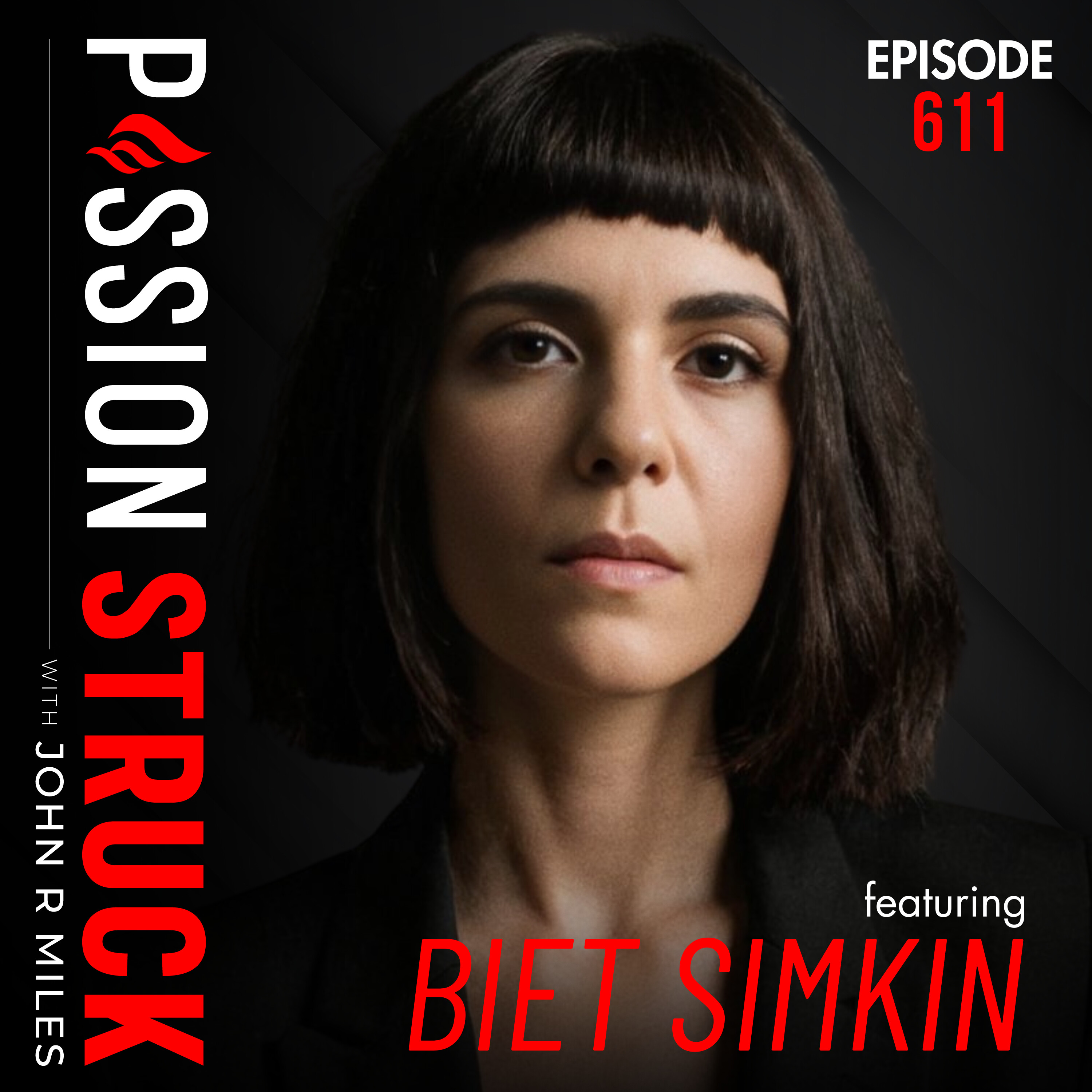
Passion Struck with John R. Miles
Biet Simkin on How to Wake Up When Life Breaks You | EP 611
01:01:50
Loading summary
Transcript62 lines
- [00:00]
Beette Simkin
Craving your next action packed adventure, Audible delivers thrills of every kind on your command. Like Project Hail Mary by Andy Weir where a lone astronaut must save humanity from extinction. Narrated with stunning intensity by Ray Porter. From electrifying suspense and daring quests to spine tingling horror and romance and far off realms, unleash your adventure aside with gripping titles that'll keep you guessing. Discover exclusive Audible originals, hotly anticipated new releases and must listen bestsellers that hook you from the first minute. Because Audible knows there's no greater thrill than the one that speaks to you. Discover what lies beyond the edge of your seat. Start your free 30 day trial at audible.com wondery us that's audible.com wondery us.
- [00:49]
John R. Miles
Coming up next on Passion Struck, I.
- [00:51]
Beette Simkin
Got sober and immediately things became different. It was like as if I stopped drinking and devoted my life to what I call God. It's a higher power of my own understanding. And in that moment everything became opulent and it was almost like one of those movies where everything's black and white and then it becomes color. Like wizard of Oz. Like it was like that. All of a sudden I saw the world in Technicolor. My life got immediately better.
- [01:22]
John R. Miles
Welcome to Passion Struck. Hi, I'm your host John R. Miles and on the show we decipher the secrets, tips and guidance of the world's most inspiring people and turn their wisdom into practical advice for you and those around you. Our mission is to help you unlock the power of intentionality so that you can become the best version of yourself. If you're new to the show, I offer advice and answer listener questions. On Fridays.
- [01:49]
Unknown
We have long form interviews the rest.
- [01:51]
John R. Miles
Of the week with guests ranging from astronauts to authors, CEOs, creators, innovators, scientists, military leaders, visionaries and athletes. Now let's go out there and become Passion Struck. Welcome to Passion Struck, episode 611 podcast that ignites change from the inside out. I'm John Miles and I couldn't be more excited. We just launched the Passion Struck clothing line and I absolutely love how it turned out. Every piece was designed with intention, wearable, inspiring and quietly bold. Whether it's a hoodie that says you matter, live like it. Or a shirt that reminds you to own your own spark, this collection reflects everything we stand for. To celebrate, we're also running a giveaway when you join the Ignition Room, our new community for episode reflections, prompts and behind the scenes conversations. You'll be able to win a Passion Struck T shirt and hat from the new line. To enter, just head over to the show notes. It's completely free and our community is growing every day. We're also in the middle of our Mental Health Awareness Month series, a journey that's challenged us to move beyond symptom management and towards deep, sustainable well being. Last week I released a solo episode exploring five mental health habits that form the foundation of an emotionally sustainable life. And earlier this week I spoke with Dr. Zach Mercurio about his powerful new book, the Power of Mattering. That conversation unpacked how simple acts of recognition can transform organizational cultures and individual lives. Together, we shift gears, but not direction. Now let me ask you this. What happens when you lose everything? The people you love, the dreams you build, the very sense of who you are? How do you rise from addiction, heartbreak and suffering not just to survive, but to matter? And what does it take to turn pain into purpose, loss into life, and destruction into deep transformation? That's exactly what we're diving into today with Life is extraordinary not just because of who she is today, but because of the path that got her here. Born to Russian immigrants who fled the Soviet Union in search of freedom, she was raised by a shaman and psychotherapist father who exposed her to deep spiritual wisdom from an early age. But her childhood was also chaotic. Her mother died when she was just seven. Her home life lacked structure and by the time she was a teenager she was chasing intensity wherever she could find it. At 18, she signed to Sony Records, living the rock and roll dream. But instead of fulfillment, she spiraled into a decade long battle with heroin and cocaine addiction. The final blow came when she lost her father, the last anchor she had to her past. It was in that moment that she faced a choice continue down a path of destruction or wake up. Today, Beit is one of the world's most sought after meditation teachers, known for blending music, mindfulness and modern spirituality in a way that is raw, real and deeply transformational. She's actually been called the David Bowie of meditation. She's been featured in Vogue, Forbes, Ellen Time, and is the best selling author of Don't Just Sit There. In today's conversation, we explore the childhood wounds that shaped her and the loss of her mother at seven, her rise in the music industry and the decade of addiction that nearly killed her. How she got sober and why recovery felt harder than addiction itself. The radical connection between meditation, mattering and reclaiming your life and why suffering isn't something to run from, but something to learn from. This episode is about awakening about what it means to go beyond survival and create a life of deep meaning, presence and purpose for those who want to go deeper. You can also check out our episode starter packs@passionstruck.com starter packs or Spotify. With over 600 episodes, we've curated playlists on themes like mental toughness, personal growth, and resilience to help you find the insights that resonate most with you. Now let's dive into this raw, powerful and deeply human conversation with the one and only Viet Simkin. Thank you for choosing passionstruck and choosing me to be your host and guide on your journey to creating an intentional life. Now let that journey begin.
- [06:09]
Unknown
I am so honored today to welcome Beette Simpkin to Passion Struck. Welcome Beet.
- [06:14]
Beette Simkin
Hey, John, thank you for having me.
- [06:17]
Unknown
Well, we've been talking about doing this for a while, so I'm glad we could finally get this one in the books. And I'm sorry, excited and honored to bring your story to our audience. This is going to be such a amazing discussion. Let's start with your parents. Your parents made the courageous decision to leave the Soviet Union around 1979, which was the height of the Cold War era. What do you know, looking back, about why they made that decision to like to leave?
- [06:50]
Beette Simkin
They lived in Soviet Russia thinking that was the way. Nobody was asking a lot of questions from what I understand. My father was an atheist and a smoker and he was a jazz musician and he was getting his medical degree to be a doctor and in Russia. I don't know how much you know about the Soviet Union. I'm sure you know all of this stuff, but for anyone listening, it was a place with great, like you could get an insane, insane education and you could get a career of very high standing by any estimation. Be like a doctor or scientist or for my grandfather was the first chair violinist in the Leningrad Philharmonic. Like, that's as like high a position as one could be in life, right? But they were all living in communal housing and there was breadlines. And so you would be like a medical doctor, you'd be living in communal housing and waiting in line for the green sweater when it was released for and then you either got the green sweater or you didn't. Also, when my family came here, my brother and my father went to the supermarket to just do a little grocery shopping. And they walked into the supermarket. The doors, they, how they will open like this. And they walked in and they saw all the produce and all the aisles of food. They'd never seen anything like that before. That's not something that existed in Soviet Russia. It really was just like the bread Appeared and people lined up around the block to get a loaf of bread kind of thing. Anyway, so they are standing there and my brother, who was eight years old, tugged on my father's jacket and he said, is this for us? Can we buy these things? And my dad crying, said, I think so, I think so. Like they didn't even know what it meant to have a supermarket filled with things you could buy. The decision came because my father was again lost and confused, as many of us are. And then he got very sick with tuberculosis and he was going to die. And instead of dying of tuberculosis, my father went to the woods and studied with a secret shaman, which was completely illegal in Russia at the time. And he came to a state of awakening at that time in the woods of Russia. And once he came to that state of awakening, he realized he was living in in the hell that he was in the hell became clear to him. And he said to my mom, do you want to leave and go to a free country together and have a freedom child? Let's create a baby with intention and bring this new baby to the free world and start a new life.
- [09:24]
Unknown
Yeah. I've been reading most recent book where he's explaining information and how it spreads. And the section I've been reading most recently he was talking about a dictator or a communist type of government versus a democratic government and how information spreads. And in the Soviet Union, the way he describes it, during that time it was very much a closed society where a very small group of people were making the decisions for everyone. And because of what you're saying, when it came down to the communal nature, even when it came down to farms, farms were distributed differently so that it was all equal to everyone, even if you were a landowner before. So it's so interesting how kind of unknowing, if you grew up with that type of system, how you didn't even realize how much control there was, where on the other side and the democratic side, again, there's a small group of people who are in control, but there's a feedback loop that ends up happening that self regulates its time itself, which you didn't really have in the former Soviet Union, so to speak.
- [10:35]
Beette Simkin
No, we didn't have checks and balances. We didn't have a judicial branch. We didn't in Russia, I wasn't there. I am the freedom child. So I was created on the wings of this awakening. And I was created with the intention of being brought to the free world. And I was told from the time that I was born that I was free. And because we're about to go into the next part of my story, like the mixture of understanding what a privilege it is to be free and to be born with that kind of legacy within me, that kind of talent and that kind of grace, and that to be raised with. My father was an awakened shaman by the time I was around. So he had this awakening in the woods of Russia, cured himself of tuberculosis, and then was like, let's create a freedom child. By the time they got to the States and I was born, he was already living as an enlightened master. And so I grew up studying with him my whole life. And yeah, I took that very seriously. So when my life became very painful, as we'll go into, I was confused. And I think till this day actually, and for anyone listening, I think there's something very painful about the juxtaposition or the paradox of the lie and the truth. Right? Like we're faced with so much adversity as human beings just by being alive. Just being alive is enough. You don't even need to go through all the. That I'm about to go through in this story to feel the burn of being a human being.
- [12:11]
Unknown
So I want to lean a little bit more into your story growing up first when your mom is part of it and then when your mom is not part of it. So you're being raised with both your parents, who, as I understand, didn't speak the greatest English when they came. And what was your home like with your parents as a child?
- [12:37]
Beette Simkin
I grew up being raised by my grandparents. The way that it worked was my entire family moved here. And, and so my grandparents, two sets, lived in a tenement building in Queens on one block, in one building, and then across the street, my parents had a one bedroom apartment in another tenement building in Queens across the street. And so I spent the weekends with my brother, my father, my mother, the four of us. And during the week, Monday through Friday, I was with my grandparents and my brother and I would swap grandparents day by day. So, like, they would take me, then the next grandparents would take me and back and forth. And it was a very close knit family. But my father and my mother were very advanced and very advanced spiritual seekers. And my grandparents were not that. They were just elderly, fun, drinking, interesting, smart as, but not like spiritual seekers. In fact, they were all trained to be atheists. In communist Russia, you were supposed to be. You were either atheist or you, like, believed in a very specific Christian God. I don't know, they just were like, no, they were very heavy believers in atheism.
- [13:50]
Unknown
So your parents being awakened at that point, being in the 80s, what was that like for them? What do you remember were the things that they used to do, their biggest influences, how that came, how that rubbed off on you?
- [14:05]
Beette Simkin
My father was doing yoga every day. He did asanas, he meditated. We had a million texts. We had a huge library in the house, from Carl Gustav Jung to Sigmund Freud to Erich, from Alan Watts, all the stuff that was floating around during that time. My mom was a aerobics instructor and she was becoming a massage therapist. She was just a very giving person and a community leader. I remember that she collected people and everyone circled around my mom. She was like the sun.
- [14:45]
Unknown
So when you were seven, you lost your mom. How much did your life change after she died? And how different was not only your home, but how your father was showing up?
- [14:59]
Beette Simkin
Everything changed. My mom's death was cataclysmic. It changed my entire life. It broke my father. Even though my father continued to be a very high spiritual teacher and a master, his heart was completely broken. My brother was completely destroyed by it. He went into his own agonizing pain. I was so traumatized to lose your mom. I was almost seven when she died. I was two months shy of being seven. And to lose your mom when you're that young, it's not comprehensible. It's not possible to comprehend the kind of agony that produces. A child cannot comprehend that they are not to blame. So I definitely took ownership of her death and I blamed myself. I thought that if I had just been a better person or more kind, or then she'd be alive. And I think it just resulted in so much agony and so much. There were side effects to rashes and twitching and so much craziness. And we had no money, too. My mom was. She was. We had no money in general because we were immigrants coming from Russia. But she was more of a structured, grounded human being. My father was just out to lunch as an alien, and he irradiated light. But he didn't care about worldly possessions. He didn't care about money. He didn't care about security of any kind, any real kind. I also don't believe in security. Even though I believe in making millions and millions of dollars, I still don't think that's where security comes from. But my dad really was like rebel. He was just, I don't need money. And so we just had no money and mice. There was men raising a little girl. There was no maternal factor anymore. So the house was just a disaster, and it was crazy.
- [16:51]
Unknown
So what I gathered from studying up on you is he was anything but a helicopter parent, and he had a deeply spiritual mind. But at this point, he was pretty much emotionally absent.
- [17:04]
Beette Simkin
He was not emotionally absent. There was nothing but love in the house. But he was absent in the way of. He didn't like structure and he didn't want to discipline me. He felt that my horror that I had endured by losing my mom and my. By the way, both grand. All four grandparents also died shortly after my mother. So it was like my mother and then every single grandparent, one by one, dying. And they weren't that old either. It was just like, catastrophic, unprecedented loss. My grandmother, actually, her mother died two weeks after she died out of nowhere from cervical cancer. So it was just chaos. And my father felt that a person who had endured the kind of pain that I had endured did not need any more pain or pressure. And so he just babied me. And I think he did his best. He really was trying to create as much, like, ease for me as possible. I do believe that the kind of ease that he created probably wasn't the most healthy for me. But I don't think his intentions were to, like, harm me in any way. And at the end of the day, he knew who I was. So he was always saying to me, I don't know how this will happen, be it, but you are a great teacher and you are a very high. Much higher than me, much higher. And he would tell me that, and he's, you will be so successful. I see you, you will be on television. He, like, saw everything. And he was like, I don't know how, but it will happen. He didn't know that it would have to happen upon his death. Like, he had to die for me to have my awakening.
- [18:46]
Unknown
I am so sorry to hear of so many losses at such a young age. And was for you, music a way to deal with the pain? Is that what got you initially into a love for music? Or was it something else?
- [19:04]
Beette Simkin
I think I've always been obsessed with music from the moment I was born. I can't even imagine, like, a greater love. For me, the only thing that trumps music is cinema, because cinema actually incorporates music and also the thespian, like story experience. You get story, you get relationship, you get hero's journey, and you get music. So to me, like, there's no greater art that I have ever experienced on earth than cinema, real cinema, not film, not movies, but cinema and. But music. I've just been singing since I was born. And yes, once she died and everyone was dead at. It's definitely how, I don't know, communicate it.
- [19:50]
Unknown
Music has always been so influential in my life and when my kids were born, as early as they were able, we had them start learning to play piano, which ended up being a great avenue for them into who they are today. Because I always think if you can play piano, you can pretty much learn any other instrument off of that. And that's especially, especially what my son has done, who's now gotten into music production, etc. But at 18, as I understand, you were signed to Sony Records, a dream come true for so many young musicians. But instead of fulfillment at that point, as I understand your story, you found yourself starting to spiral. Looking back, whenever it seems like we're spiraling, it's as if we're chasing something for you. What were you really chasing at that point?
- [20:48]
Beette Simkin
I desperately wanted external validation. I wanted the world to recognize how talented I was and I needed it. I wanted, like Gollum in the Lord of the Rings, I just felt like my precious, like I needed it. And I have had a story where God, or what I call God, I'm not religious, doesn't give me what I need when I desperately need something like that. The universe, God, the God that I'm so fond of, will not give it to me in effort to awaken me. Because I didn't come to this planet to get a bunch of crap and to get a bunch of things that won't serve me in the end, right? So there's people like Amy Winehouse, they got the recognition, it didn't do the thing they wanted and they're dead right? Then there's other very successful people on this planet who have created billions of dollars and incredible impact and are miserable and not even miserable like they're looking to have me or you guide them like they're not even awakened enough to know that they're miserable. Like there's documentaries being made about them and they're completely asleep to the fact that they're angry and miserable because they're so lullabied by money and success and fame and whatever else they've been granted. So to me, my genie is kind of, you can go yourself like you're not getting that until you open up to what you came to this planet to have, which is I did not come here to get, to need external validation. I get tons of external validation today. And I will be receiving much more in my lifetime and beyond that is no longer a need for me today.
- [22:38]
Unknown
I remember when I was a teenager when I started drinking. And for me, I guess, the reason I originally did it is I had a traumatic brain injury when I was about 5 years old, and it caused me to be different from that point forward. I had some cognitive issues, speech impairment issues, a bunch of other things. And as a result, from the time I was, like, five until I got into high school, I guess I was just trying to hide behind almost like a mask. And I never felt that I was worthy. And so I felt like when I would drink, it gave me this boost of being able to enter a different version of me who I thought was more acceptable to the outside and a response to the pain that I was feeling. What caused you to start using alcohol and other means?
- [23:33]
Beette Simkin
Everything you just said, I think that there's really only one person on this planet, and we are all part of that. And some people can tolerate how it feels to be different and alone and separated. Separated from God, separated from the mystery, separated from the invisible plane, separated from bliss, separated from the womb and separated from everybody on this planet. Like, I tripped on MDMA when I was 20 or so. And I remember I was in a nightclub in New York City, and I looked at the wallpaper, and it was pretty empty. It was like a very mellow party, like one of those where there was like a hundred people in a very large space. And I was looking at the wallpaper on the wall, and I turned to the wall and I said, why didn't you tell me that we were one? Why didn't you tell me? And I don't think I had the capacity to weep at that moment, because I was on mdma, but I was weeping in a sense. And what I feel today, on an average Tuesday or Thursday, which is similar to what I experienced on MDMA when I was 20, was a feeling of complete relief. Just thank God. I can't believe we're one. Me and this wall. Why did they keep this from me? And so I felt a prisoner in this world was filled with this illusion that we are all separate, that we are alone, that we have to fight to prove our specialness and all this. And I understood the spiritual tenets, but they didn't make sense to me in the light of the pain that I was experiencing. And I was an embodiment of these truths. And yet I could not experience the pleasure of this union at all times. Even when the MDMA ran out, which it will, five hours later, I was in a hysteria in an apartment in Chelsea being like, what the God? You're gonna send me back to duality? You're gonna send me back to where I'm separate from everyone, where I'm all alone. I don't want to go back. And so I spent so much of my youth just wanting to be back. Just. I just wanted to be back in that state. I'm so thirsty for that state.
- [25:57]
Unknown
Read. You described your addiction not as a response to pain, but as an addiction to intensity. Can you explain that?
- [26:06]
Beette Simkin
I think I just have an allergy to being separated from the world of God, which is, again, I'm not religious, but, like, to me, the world of God is the quantum field where we are all one. And I cannot stand to be apart from that. So I'll do anything to be a part of that. And I have a very low tolerance for being separated from it, which, by the way, you can't be separated from it. But I can feel like I'm separated from it when I'm judging myself or when I'm judging you or when I'm being afraid. Have you ever been, like, walking down the street and you're having a bad day, like, you're just edgy and annoyed and not feeling your best, and then you see someone you know, and you're like, I don't want to see someone right now. I'm not even like, 100%. And so what? I don't know what I meant by intensity, but to me, the world of God, the electronic plane and the galactic field that is oneness with everybody is very intense. And it's alive and it's filled with grace and it's. People wonder what gratitude is. Gratitude is a side effect of that state. And so I just wanted that. I wanted that. And you can't. There's just not enough alcohol or drugs in the world to give you that 24 hours a day, seven days a week for the rest of your life. There literally isn't enough anything to make that possible.
- [27:30]
Unknown
So during this time, what was going on in your professional life? So you were at this point, have. Having these out of body kind of experiences. What was happening in the real world?
- [27:45]
Beette Simkin
Well, those were caused by drugs back then. If you're listening to this and you're someone who's addicted to anything, you're addicted to drugs, alcohol, sex, Netflix shopping, overspending, debting, like, whatever it is you're using to numb your pain, it doesn't work. You already have probably seen that. It's not working. It doesn't work long Term, Right. So alcohol and drugs really did work for me for quite a long time. They were able to work for me to some extent from the age of 20 till 29 when I got sober. That's nine years. Not everyone makes it nine years. I made it nine years and I could have gone longer. I really was like on a path to a very destroyed life. Drinking wine and sleeping with young men and being lost and confused. I really was in for it and I was willing. But something happened. My story. There was a lot of very traumatic things that happened. I was a DJ in New York City at that time. My Sony career did not work out. It wasn't because again, I believe God just took it from me as God will when I'm not listening. It was like I just really wanted to drink and I really wanted external validation and I wanted the pain to go away. And my God, my universe was like, that's not what we're doing here. So you need to go down more. And I believe we go down to go up, right? So it's like how far are you willing to go? And I'm a psychopath, so I can go pretty far. Like I'm willing to go down to a very dark world when it comes to psyche. So my house burnt down. I had a daughter. I had a near death experience where I lost. I had a seven pound tumor in my uterus. The doctor saying to me, look, I solved this for you, I fixed this. But you have to have a child within two years or you'll never have children because I'll have to give you a hysterectomy. And two years to the day I got pregnant accidentally with my first child and she was born perfectly healthy. I was not ready to be a mom as a lot of young moms would not be. And then she died of sudden infant death syndrome four months later. And she was brought dead into my arms when I was 26 years old. And that was not enough. It was not enough to awaken me. All I did after she died was I got a lot of heroin and I really, I used it as more to go down the victim highway. And then my best friend hung himself and then my dad died of a heart attack. And that all happened within a span of two years.
- [30:26]
Unknown
I want to discuss this for a little bit, but let me first say I'm so sorry. For one loss would have been lotta having just lost our house to a flood. Losing your house to it burning down is traumatic. But losing your daughter, losing your friend, losing your father in quick Order. It probably brought you back to your experiences when you were younger, when you had lost your mom and your grandparents in quick order as well. A ton of trauma on top of trauma. But here's where I wanted to go with this. I know in my own life, I agree with you, that sometimes things are taken away from you because you're not listening. And the more you don't listen, the more you tend to go on a steep decline. And as I've talked to some of the people on this show who have talked to people on the other side, they say that the world we're living in is like an Earth school. And when we're sent here, we're put on this assignment where we are supposed to be learning important lessons that we come here to do. And the more we depart from that path, the more the pain we tend to feel and the more we lean into the things we're supposed to be learning, the easier life gets. And where I'm going with this is in my own life. I had felt this calling to do what I'm eventually doing now. But at the time, I wasn't listening at all. I was similar to you. I was stuck in this world where I was craving external validation from every angle. I was in the corporate world and doing extremely well and pushing myself to. To be at the top as quickly as I could. And when I had finally joined Dell, it all started to come crashing down. When I was at the pinnacle of my professional success, all of a sudden, it was as if I was faced with plagues. I had scorpions and bedbugs and termites and floods and more flooding, and I can't even tell you. And so. But I just didn't listen. I just kept pushing forward, thinking I was invincible. And it took me to coming to a place like you, where I was. I came face to face with a person inside my house pointing a gun at me. And a few days later, my best friend committing suicide to. I finally had this huge awakening of what the hell are you doing? When is enough going to be enough? Type of thing. But my question is, like, why does it take us so long when we're given these messages to. To do something with them, I guess, is where I'm going with it.
- [33:23]
Beette Simkin
I love how you're, like, flooding all over the place, like your agreement with the water gods or whatever. Because my house burnt down and then I just had another house burned down, like, five years ago. And I just think that's so funny. You just. Like you said, you lost your house in a Flood. But then you were, like, dealing with flooding back then. Do you know what I mean? It's interesting.
- [33:43]
John R. Miles
It's interesting.
- [33:43]
Unknown
Yeah. I came back from. I taken this job to Dell, and I had been there a couple weeks, went home back to North Carolina for the first time to go visit my family. And then I flew back, and I walk into my temporary condo that I was in, and the whole thing is. Has 2, 3ft of water in it. And then, yeah, more recently, our house got impacted by the hurricane. We had 2 to 3ft of water in it again.
- [34:10]
Beette Simkin
Wow. It's interesting. Like, with. There's something happening here. I just love how it's like a film. Like, it really is like a movie. Why aren't we listening, John? Why aren't we listening? I don't know. I can't speak for everybody, but I can for me. I don't. I'm a willful little bitch. I'm not interested. I want money and power and prestige, and I just want the things I'm seduced by. What the world is telling me is yummy and delicious. Because the weird thing is that what I call God's world, which, again, I'm not. I have to paraphrase with that. I'm not religious because the way that I love God is not subscribed to anything. I'm not subscribed to anything. I have a democratic relationship with God, but I have a relationship with God. And anyone who wants to work with me, anyone who follows my teachings, is someone who desperately feels a yearning for a power greater than themselves in their life. That is the distinction. Right? It's not someone who's like, I want to feel good. I want to have stuff. Yeah, you want to feel good and you want to have stuff, and you want a relationship with an unknowable, infinite power that floods you with an irradiant joy that is equal to the feeling at the peak of an MDA MDMA trip without any drugs, which, by the way, I've been sober for 16 years, since my father's passing. A year later, I got sober and I experienced states like that MDMA trip all the time. Now, without anything in my body, do I suffer in between? Yes. Do I pay? Do I do massive amounts of work? Yes. But I do it by the grace. I am given this by grace. Right. With absolutely no drugs. So, yeah, like, I think there's this willful little beast in us that is, I don't want to do the work. I don't want to do the work. I just want to show up and have like naked women and money rain down on me, like I'm not interested. You know what I mean? Like, just whatever the opulence is, is in a Twilight Zone episode. Like, I just think I'm asleep to that, just like everyone else, asleep to that jealousy and that craving for all that. And then there's a deeper part of me that's yes and right. So back to God's world. God's world looks just like the devil's world is basically what I'm saying, right? So it's like they're paradoxically side by side existing. So I think that what we're really craving is a kind of opulence, a kind of impact, a kind of grace. But it's easy to get seduced. One, like two $40 million homes standing next to each other may look the same, but one may be owned by a person who developed that money through conscious contact with a divine source and through love and through infinite wonder and the desire to serve the planet. Another person with the same looking $40 million home right next door to them may have come into that money by just serving greed and grind and create power. Wanting power, right? So looking at it, they can look the same. And I would say I didn't come into it willingly because I wanted to the devil home. I wanted it at any cost. I was like, just give me the results. And when I didn't get what I wanted, I felt betrayed. Like the universe was like, I'm not giving you a record. I'm taking your record deal away. I'm taking your whole family. I'm taking your house, I'm taking your child. I'm taking your best friend. I'm taking. I. You're never gonna have any money because you. That's what the world was saying to me. And I took it to mean, God is a hole. So why am I going to show up for a God that's not showing up for me? And I had to have a complete psychic change to even be willing to move my little finger.
- [38:31]
Unknown
I know for me, and I'm not sure if you hit this point, but I just remember as I was going through this downward spiral, I reached a point where, like the emptiness I felt was. I can't even explain it. I was just so utterly numb. I just didn't feel anything. And to me, that is the worst feeling on earth is you don't feel appreciated, you don't feel love, you don't feel anything. And it was just awful. And so I just thought anything has got to be better than this. But I think what was keeping me stuck so much is you end up building this imaginary life where. Because, at least for me, I was so fixated on all the external markers of success that I thought if I changed this all or I put it all at risk, that all the eyeballs were going to be on me and this house I had bought and the life I had created, I'd have to give all that up, and I didn't want to do that. And sometimes, as you're saying, in order to get to where you need to be, you got to give it all up and you've got to take that leap of faith that you're going to go through a rough patch, but it's. You can recover from it, but it's hard when you're in it to see that light at the end of the tunnel, so to speak.
- [39:51]
Beette Simkin
For sure.
- [39:53]
Unknown
I remember I was talking to Randy Blight, who, you might know who he is, the lead singer of Lamb of God. And he was telling me that he was on this tour with Metallica, and at the time, the guys in Metallica were all at that point sober. And he was doing a show with them in Australia. And he was so strung out that. And upset with himself that he was on stage. And at that time, he had really long hair, so it's covering his face and he is sobbing, but you can't even tell because he's screaming the words out while he's sobbing. And he reached this point that he realized he needed to get sober at that point in time. And he told me something that was similar to something I've read about you. He said that getting sober didn't instantly fix things for him, and it got worse before it got better. Did you ever feel that same way?
- [40:49]
Beette Simkin
No, I had a different experience with sobriety. I got sober and immediately things became different. It was like as if I stopped drinking and devoted my life to what I call God. It's a higher power of my own understanding. And in that moment, everything became opulent. And it was almost like one of those movies where everything's black and white and then it becomes color, like wizard of Oz. Like, it was like that. All of a sudden, I saw the world in Technicolor. My life got immediately better, but externally, things didn't catch up for a while. I was still broke for many years in sobriety. I was single for the first year of sobriety, and I, like, really wanted a partner. But I met the man of my dreams in sobriety. I became a woman of dignity and grace in sobriety. And one thing that I will say is beautiful for me about sobriety is the kind of high that I experienced in those first six months to the year of, holy shit, I'm alive and I'm sober, and, oh, my God, I'm having sex sober, or, oh, my God, I'm eating food sober. I just couldn't believe I could do anything sober because it had been so long that I had been on heroin that I couldn't even function without drugs in me. I couldn't face the world. And here I was facing the world again and again sober. It was just so crazy that I felt like I was having a transcendent psychic experience all the time. And I would say that the kind of high that I felt in that first year is the kind of high that I feel today when I'm in a state of awakening. And to always reference that, it's almost like a beautiful reference point point to me that I know that I don't need anything. I didn't have a boyfriend. I didn't have any money. I didn't have the career that I have now. I wasn't written up in all these magazines. I didn't have any. There was just so much missing from my life. But I felt like I had it all. And so what I can say today, that really serves me, because I can always reference and remember that the stuff that we are made of is in us right now. You can access it with absolutely no external results. What I also will say is that the external results, to me, are a manifestation of that state. So if you stay in that state long enough and you devote your life to that state, and you come back to it again and again, and you make a choice to create impact from that state and touch lives from that state, the kinds of things that will happen in your life as a result of that will be quantifiably different from other kinds of results in the sense of making a bunch of money or buying a nice car. It will be different, but it looks the same on the outside.
- [43:52]
Unknown
Yeah, I remember I interviewed Gabby Barnstein a while back, and I was talking to her about her life and her addictions. And she tells the story, she's also written about it, that she, at that point, was an addict. She was addicted to alcohol and drugs and whole bunch of other things. And she remembered going to a spiritual healer who sent her a tape who basically said, you can keep going down the route you're going and chase destruction, or you can chase what you're supposed to be doing. And you can impact millions of lives. When you started to chase the spiritual journey that you're on now with the same zeal that you chased your destruction, what did that pursuit start looking like?
- [44:41]
Beette Simkin
It took time. It took four years of me praying on my knees and begging God to show me what I was here to do. I didn't know. It looked like me begging, and it looked like me doing a lot of spiritual work. Like, a lot of invisible work. And when I say invisible, no one gives a shit. If you journal for thousands of pages and do an inventory of your past defects of character and judgments you've made, no one ever knows. Like, when they're reading the eulogy at your funeral, they're not going to be like, john, he really went for it with the spirit spiritual work. And he did 7,000 hours of meditation and prayer and visualization. Like, no one knows about the invisible work. But I was doing so much of that. It was just like a devotional practice of, I'm giving my life to this power because I trust it's going to guide me. And eventually it came to me and it said, you are a spiritual teacher. Which I just thought was hilarious because I'm like, have you seen me lately? Similarly, Gabby Bernstein, like, we don't look like the historical spiritual teachers. We don't look like an old dude with a beard who's sitting at some ashram being like, blah, blah, blah, blah. And everybody's, oh, God, that's so. To me. I just couldn't believe that that's what I was here to do. But as soon as I was told, I was like, okay. I was devoted to this power. So I was like, I'll do whatever the you say, man. I'm so done arguing with you. We do not argue, me and this power. We don't, by the way. I don't go to God anymore. I'm like, yes, whatever you say. Like, fast and furious. But at that time, I said yes. And I remember I called everyone I knew and told them I was now a. I didn't even know what to call what it was. I was like, I'm a meditation person. Like, I'm creating a meditation sequence. I'm bringing it to the world and blah, blah, blah. And everybody was like, oh, yeah, like, cool. Nobody was surprised. Everyone was like, you have always been like Yoda. And I was like, I have been like, I couldn't see myself at all. I thought I was just this. Because again, we see ourselves through the lens of all the judgments and fears and insecurities and doubts that we have. Right. So inside of me it feels like an agonizing shitstorm of self annihilating thoughts and self destruction, but outside what actually comes out of me. In the same way that like a cow produces milk, I produce wisdom, I produce spiritual transformation in the lives of everyone around me. And, and back then I was doing that for free. I just hung out at bars and did it for free there and then I hung out at whatever and I did it for. Even in sobriety, I just did. That's just what I do.
- [47:42]
Unknown
So it's safe to say that meditation wasn't just something you turned to, it became your lifeline.
- [47:48]
Beette Simkin
It was one of them, yeah. Prayer meditation.
- [47:55]
Unknown
So on this show I have really spent a lot of time talking about the concept of mattering. Not seeking external validation, but truly feeling like your existence has meaning. When was the moment you finally felt like you mattered?
- [48:16]
Beette Simkin
I have been graced to continually remember that fact. And two will continue to remember that fact till the day I die. If I tried to go back to the first time I remembered I mattered, I wouldn't even know which one to choose because there's been so many. Do you know what I mean, John?
- [48:37]
Unknown
Yeah.
- [48:37]
Beette Simkin
One of them would be the day that I got sober. That was one of them. But there was ones before that. There was moments when I remembered that I mattered when I was still on drugs. And because mattering is a act of being in union with what I call God, that's what mattering is. As soon as you're in union with the divine, you matter. And so I had that when I was on heroin, I had that when I was on lsd, I had it when I was on mushrooms, I had it when I was having sex with gorgeous people on the Lower east side, I had it when I was writing songs underneath grand pianos in the West Village, I had it. I just paid a really high price at those times. And as I evolve as a human being today, I'm interested in remembering that I am one with the divine and therefore mattering as a side effect of that state. But I'm not willing to pay prices anymore.
- [49:39]
Unknown
So one thing that has been unique about your style of teaching meditation and the retreats that you do and conferences etc, is that you have really brought your love for music together with your spirituality. And I was hoping you might talk about that and how those two came together.
- [49:59]
Beette Simkin
Well, I was doing these large scale events. The vision came to me after I was told that I was a spiritual teacher in a Vision. In one of my prayers and meditations, I then created a synthesis that I was going to bring meditation into the art world. So bring meditation and a specific sequence that I had constructed of the practices I loved most at that time. I was going to put them together and bring them into the art galleries. And so I started that and my career took off like a wildfire. And for two years I had given up music. I thought when the voice said that I was a spiritual teacher, that it meant focus the and stop making music because that's not what I put you here to do. Two years later, I was doing spiritual work in a very intense, condensed situation, like a personal development type situation. And I had an aha. Moment of grace. One of these many millions of moments where I remember that I matter. Like you said. And the voice said, you need to raise a bunch of money so that you can record your next record. And I said to this voice, I thought you said you didn't want me to do music anymore. And this voice said, now you get to do both. And I just wept because I thought that was some kind of sacrifice I was going to have to make was my music. And so then I did. I fundraised for a record, which back then was like a thing I did like this non for profit. It wasn't GoFundMe. It was like a non for profit arts organization where you raise money. And I raised money. I recorded my record the Lunar and then I started scoring these events and it really took my career even to the next level. And my career went from like art galleries to doing these huge events at Museum of Modern Art or Sundance Film Festival, partnering with huge brands, doing events in festivals. I partnered with Bonnaroo, etc. Etc. And it was because I was doing this thing that was taking music, which is pop music, not Om Shanti Bindi, like we love ourselves kind of music. Not like that. Like it was like really hardcore beautiful music that was made for people who love music. Not for people who want to do Kundalini, but for people who love music. And I come from a rock and roll background. I come from this. I'm from the streets. I got signed to Sony. Like I did a bunch of drugs. I'm not some Dairy Queen, as they call it in Jackson Heights. I'm not a Dairy Queen. I'm really from the street. I'm like a Patti Smith. And so bringing those worlds together and saying, I want enlightenment, but I want it to sound awesome and I want it in a cultural space and I want it in Alignment with great fashion. And I want it in alignment with opulence and, and business, like Andy Warhol, like really turns me on. He said once, business is a beautiful kind of art, isn't it?
- [53:03]
Unknown
Down here where I live we have the Dali museum. And one of my favorite exhibits was, I didn't realize the relationship that Dali and he had. And they did a whole Andy Warthol exhibit which has been one of my favorite ones that they've done in that museum. Love his work. Yeah. When we first met and we were talking about breath work, I will never forget our initial conversations because I was telling you I've had other people on the show who specialize in breath work and you quickly said, I'm the best in the world. What is it about your techniques that give you that ability to influence people in that way? Because a lot of people think breath work meditation itself is passive. But what I have understand through learning about you is that you use it in a way that it's not about escaping life but about engaging with it fully. Is that a good way to think about it?
- [54:07]
Beette Simkin
Yeah, definitely.
- [54:10]
Unknown
So how does the way you teach breath work allow you to engage and be fully present with it?
- [54:19]
Beette Simkin
My signature system is four minutes long and it gets you high as balls. The thing is, I'm a drug addict, right? So like I'm a sober drug addict, alcoholic. I've been sober for 16 years, but that doesn't take away my malady, right? And like a good drug addict and alcoholic and for anyone who's listening, who isn't those things. But you're still, still really irritated by this planet and you're still irritated by how painful it is to be separated from that state. And I'm talking about that state where you're like running through the woods with your in your hands or your tits in your hands and you're just like, I remember the meaning of it all. I remember who I am. I remember. And to me, merging music with a four minute breath practice that has you remembering exactly who you are and what your purpose is and who you truly are, I can't imagine anything sweeter. And my purpose on this planet is to A, to remember who I am, but then B, to help. I say billions because it's true, like millions. That's what you affect on the daily. But at the end of the day, if you're really affecting people on that scale, it's going to be billions eventually, right? Rumi? We're still reading, we're still affecting. And my purpose is to have that kind of bliss and to inspire everyone around me to have that kind of bliss too. And I shouldn't say I'm the best. That's so arrogant. I think it's very cute. What I mean by I'm the best, what does that mean? It means I'm a lover, right? Because I'm not special or different. Anybody can do my breath work. Anybody can make music. If you have a stick, you can make music. Just bang on something. If you can hum, you can make music. If you can breathe, you can breathe. You're breathing. There is nothing special about me. What makes me the best, what makes anyone the best is that they're willing to go to any lengths every single day to be connected to that energy. And that is one thing I can attest to is that I am willing and I hope that I inspire others to be as willing as I am by simply being as willing as I am to be in that state.
- [56:49]
Unknown
You have worked with major brands, done conferences for major hotels, worked with a long list of A listers. I know a lot of that changed with COVID You've written a book now. What's the next chapter for you?
- [57:06]
Beette Simkin
So fun. I just started online group, an online group which meets with me so I'm able to touch the lives of people all over the globe who otherwise wouldn't be able to come to my. I used to do live events locally and so that is one of the big things that I'm offering to the world. I'm also creating lots of offerings on my website currently it's taking me a minute to do so because again I have to move through the three dimensional field to create. But I really felt an urge to help more people and so I'm trying to delineate all this magic that I give one to one and through the book and through the group into products that people can just pick up and use in their home. I just launched a membership but I'm evolving even past that membership. But the membership is there which has the breath work and has somatic modalities that I'm sharing with the world.
- [58:09]
Unknown
And for someone who's listening, where can they learn more about that? Where can they go?
- [58:15]
Beette Simkin
My website is guided by.com and on Instagram I'm guidedby. I recommend there's also an enneagram quiz on my website which is really fun if you just want to like pop in and see who you are and what you're like, that's fun there. There's some fun stuff on the website and there's also lots of free content on my Instagram.
- [58:41]
Unknown
So the last question I had for you, if you could go back to that younger 6 year old girl who lost her mother, who then chased addiction, who felt lost, would you tell her to change anything?
- [58:56]
Beette Simkin
No. What a life. I bet you I come back and do it all over again. I sometimes think to myself as I'm living this harmonious, this gorgeous life of integrity with this beautiful husband and these gorgeous children and this fantastic career, I think, wow, remember that wild sex you were having with that random lover who like broke your heart into a million pieces and you danced all night in the nightclub with that girl? And the level of lost that I was in my 20s, the pain and the gorgeousness and the ephemera, you can't make that shit up and you can't go back to it once you're awake and you know how to dial in a real life, you can't go back to being lost like that again. And as horrible as it was and as brutal as the consequences were, in my case, I would not trade a second of it.
- [60:00]
Unknown
Thank you so much for joining us today on Passion Struck. So glad we finally got this recorded. And thank you for being so vulnerable.
- [60:08]
Beette Simkin
Thank you so much.
- [60:10]
John R. Miles
And that's a wrap. What an extraordinary conversation with Beet Simkin. Her journey from losing herself in addiction and suffering to awakening through meditation and radical self inquiry is nothing short of inspiring. Her story reminds us that pain is not something to run from, it's something to learn from. That mattering isn't something you chase, it's something you choose. And that true transformation doesn't come from external success, but from the inner work of becoming present, intentional and aligned with what truly matters. As we close out today's episode, I invite you to reflect on three key takeaways. How can you reframe your pain into a path for growth? What would happen if you stopped seeking validation and started living from your soul? And how can you create a daily practice, whether through meditation, self reflection, or intentional action that brings you back to yourself? If today's discussion resonated with you, please take a moment to leave a five star rating and review. It's one of the best ways to support the show and help us bring conversations like this to even more people. And if someone in your life could benefit from Beette's wisdom, share this episode with them. Because a single conversation can spark transformation. For all the resources we discussed, including B's book, Meditations and Music, visit the show notes@passionstruct.com and if this mission truly resonates with you, I'd love to bring it to your stage. I'm now booking speaking engagements for 2025 and 2026. Visit johnrmiles.com speaking to learn how I can support your organization's journey to purpose and performance. You can also join the Ignition Room, subscribe to the Ignited Life newsletter and catch full video episodes and bonus content on our YouTube channels. Coming up next on Passion Struck, I sit down with Joseph Nguyen, author of Don't Believe everything you Think, for a deep dive into the beliefs that hold us back and how to rewire your inner narrative. As soon as the parents don't feel enough worth, they're going to make their kids feel like that too. To make them work for approval, for praise, for love. And that's how the parents believe that the child can grow up to become, quote, unquote, successful. But is success worth it if the person is not happy, not at peace? And those are more important questions to ask, rather than can I be successful or not? Because then you have to really redefine what success means for you. And that's the point in which you can start to turn the tables and carve and pave a different path for yourself. Until then, live boldly, lead with purpose. And as always, live life passion. Strive.