← Passion Struck with John R. Miles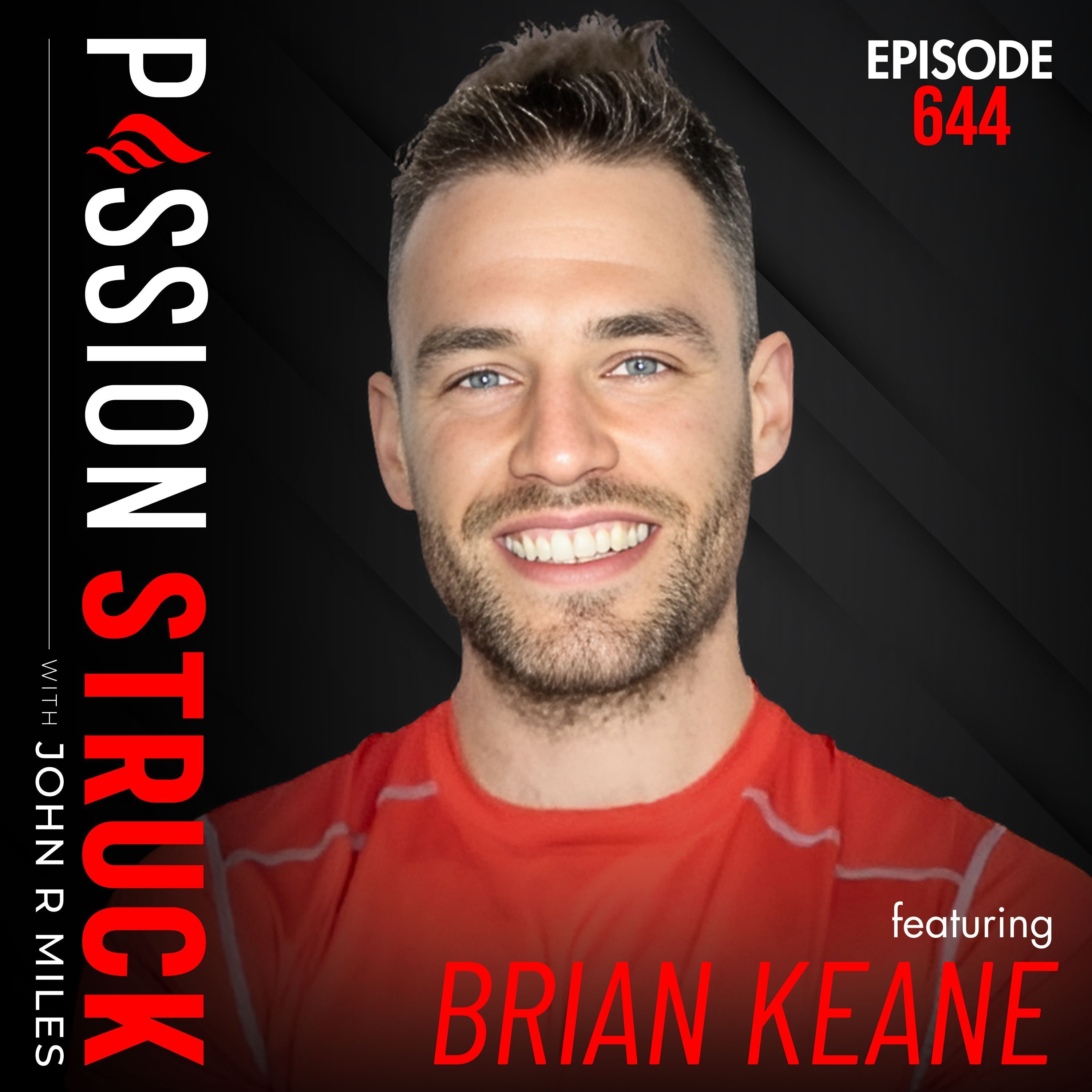
Passion Struck with John R. Miles
Brian Keane on How to Live With Unshakable Discipline | EP 644
00:56:58
Loading summary
Transcript64 lines
- [00:00]
John R. Miles
Coming up next on Passion Struck.
- [00:02]
Brian Keene
Once you do the thing you're afraid of, you won't be afraid anymore. Joining that gym, writing that book, going on that podcast, doing that interview, applying for that job, talking to that person you're attracted to. These are all things that potentially have unlimited upside that you won't even see yet. But it's the fear that's stopping you. And if that's the case, anchor a time in the past when you felt that fear and you did it anyways, and use that going forward to deal with any future fears that come up.
- [00:30]
John R. Miles
Welcome to Passion Struck. Hi, I'm your host, John R. Miles. And on the show we decipher the secrets, tips and guidance of the world's most inspiring people and turn their wisdom into practical advice for you and those around you. Our mission is to help you unlock the power of intentionality so that you can become the best version of yourself. If you're new to the show, I offer advice and answer listener questions. On Fridays. We have long form interviews the rest of the week with guests ranging from astronauts to authors, CEOs, creators, innovators, scientists, military leaders, visionaries and athletes. Now let's go out there and become Passion Struck.
- [01:12]
Welcome to episode 644. I'm your host, John Miles, and whether you're joining us for the first time or you've been walking this journey with us for a while, thank you for being part of a movement dedicated to living with deeper intention, meaning and purpose. Over the past month, we've been exploring our series the Power to Do More. We've unpacked how purpose, presence and mindset allow us to transform our lives from the inside out. And earlier this week, Helen Yepland took us into the realm of energy and soul alignment, revealing how our inner gifts and wounds shape the way we show.
- [01:48]
Brian Keene
Up in the world.
- [01:49]
John R. Miles
Today, we're closing this series out with a conversation that brings it all home. Because sometimes the the biggest breakthroughs don't come from working harder, but from rewriting the story we tell ourselves. My guest today, Brian Keene, is a best selling author, fitness entrepreneur, ultra endurance athlete and host of the Brian Keene Podcast. But before all of that, he was a schoolteacher questioning the life he had built until a single question from his mother changed everything. Brian, what would you do for free? In this powerful conversation, we dive into his latest book, Rewiring youg How to Spot and Release the Limiting Beliefs that Hold you'd back. We go into why awareness often comes before action when creating lasting change. How to Use Fear anchors to push through resistance and self doubt and why your self esteem, not your achievements, shape the lens through which you experience life. If you've ever felt stuck in someone else's script or wondered whether you're capable of more, Brian's story will inspire you to take back the pen and start rewriting your own. Before we dive in, don't forget to check out our passionstruck starter packs. These curated playlists are designed to help you go deeper into themes like purpose, resilience and mindset. You'll find them at passionstruck.com starter packs or on Spotify. And don't forget to join our free substack called the Ignited Life where you'll find workbooks and posts that supplement every episode. Plus you can check out our merchandise and find the core beliefs a fan favorite for our community. Just go to theignitedlife.net to get started. Now let's dive into this transformative conversation with my friend Brian Keane. Thank you for choosing Passion Struck and choosing me to be your host and guide on your journey to creating an intentional life. Now let that journey begin.
- [03:41]
Brian Keene
I am absolutely thrilled today to have my friend Brian Keene on Passion Struck. Welcome Brian.
- [03:46]
John R. Miles
It's been a bit John.
- [03:48]
Brian Keene
It has an absolute pleasure to be on. You've done tremendous things over the last few years, but since we even spoke on my podcast you've just gone onwards and upwards. So I really looking forward to having a chat on here today.
- [03:58]
Thank you and congrats on your brand new book Rewriting your Story which just came out in February. So excited for you to get this one out. I am told it took you about four years to write this one.
- [04:10]
This one took me quite a while. Similar to you and going deep in a topic that's interesting to you, I started writing a book about mental toughness off the back of having ran six back to back marathons through the Sahara, having ran 230k through the Arctic, having ran 100 mile marathon and having gone into that world. And as I started to unpack Mental Toughness, I started to see that it was actually a different book that was in me, that it was rewriting the story. It was the belief systems that was in my head and not necessarily just using toughness to get through everything, that there was an element of emotional resilience and correctionally and being directionally correct with your life path and finding your significance and the thing that makes you feel aligned with your purpose. And I ended up writing a book that became rewriting your story. Basically the stories that limit Us how to set up your day and then the seven habits so that you're able to change the narratives that hold you back. So I took a lot of different directional changes over the last four years.
- [05:08]
Awesome. And I can't wait to get more into it. But for those who might not be familiar with you, I wanted to start here to give some background on you. So you have this journey from a primary school teacher to a fitness entrepreneur, a best selling author, as you were just describing, ultra endurance athlete and all of that is such an incredible journey. What was the pivotal moment for you when you knew your path needed to change?
- [05:35]
That's a great question to kick us off, John.
- [05:38]
So my background was as a primary.
- [05:40]
School teacher, as an elementary school teacher and I went to university, I got my undergraduate degree in business and then a postgraduate degree to become a teacher and walked into my first teaching job in a school in West London at the age of 23 and was about 30 minutes into my very first day with 37 year old children in front of me. And I thought, I don't want to be a teacher. This isn't what I'm supposed to be doing. And the analogy that I've used in books is that it felt like I spent years climbing a ladder only to realize it was against the wrong wall. And to cut a very long story short, I came home that Christmas and my mum had to listen to me having a sob story for myself. I was really unhappy. I hated my job. It felt really out of alignment with what I should be doing. I didn't like the city being in London at the time. I felt very lonely and isolated. And she put a question to me that made us into the new book Rewriting youg Story. And that is what would you do for free? And I asked the question for the first time ever as opposed to following a career path that I thought I should do because it's what my other family members had done, it's what I told people I was doing. There was a sunk cost fallacy in there. Having spent time, energy and money getting a degree, getting the job, and for the first time ever, my success metric of what would I do for free or what would make me happy started to merge in my mind. And I said, well, I'd be in a gym for free. I was like, I loved working out, I played sport all my life and fitness was a huge part of everything that I did. It was an anchor point for me in mornings or evenings, even in dark times.
- [07:17]
And I thought I'd love to work in the gym for free. Even if I was only sweeping the.
- [07:21]
Floor, cleaning the gym, if I was.
- [07:23]
In that environment, I'd be happy. And again, cutting that Long story short, I handed in my teaching notice that Christmas I went back to London. I studied a and qualified to get the most basic fitness instructor course you can get in 20112012 January 2012 at this point and I had the complete opposite feeling when I walked into that room. I felt I'm at the bottom of a wall, but my ladder is against the right wall here. This is what I'm supposed to be doing. And fast forward two, three years later I got my degrees in nutrition in personal training and over the last decade or so set up a fitness business which moved online in 2016. And I've been using content, books, podcasts, social media to try and help and serve people in a meaningful way when it comes to their fitness, when it comes to their mindset, when it comes to the nutrition, when it comes to their life in general. So yeah, a very short synopsis of.
- [08:22]
How I got there to here, but it all came from that question, what would I do for free? And then still asking that regularly now. And it's how I'm able to move through, have great conversations with amazing people like you. Same as when you were on my podcast and getting to do the things I would do for free still to this day.
- [08:40]
So in your new book, rewriting your story, you really go into how we're trapped by the narratives we've unconsciously adopted. And it's something I also explored in Passion Struck. I had the last chapter I actually wrote in the book I called the Conscious Engager. And it really is about this topic, how we find ourselves, I call it living in a pinball life where we end up just bouncing around our lives instead of really consciously engaging in the path that we want to take.
- [09:13]
Why do you think so many people.
- [09:15]
Get trapped in this gap?
- [09:18]
From what I've seen, and as a focus group of one, from what I've experienced, it's normally a combination of not knowing that there's more out there mixed with not believing that you can actually go and do that thing, regardless of what that is, whether that's a fitness goal, a career goal, a relationship goal, a life goal in general. And something I started to do a few years ago was running questions of things that I was afraid of through the lens and filter and thought experiment of what would I do, have or be if I knew I couldn't fail? Because that would make me think that actually I'm I want to go do this marathon, for example, or I want to go do this bodybuilding show, or I want to set up a business. Those were three very limiting beliefs for me. My language, John, was that's something other people do. I'd love to start a business, but I don't know anybody. None of my family members or friends have their own business. That's something other people do. I'd love to do a bodybuilding show, but I don't even know the first step or how to start. That's something other people do. I'd love to run a marathon, but I'm not a runner. I'm five foot eight. I'm built like a little muscular hobbit. That's something other people do. So I had these narratives and stories running in my head and limiting beliefs because of a fear for me. So what I normally see with people, most common, myself included, was an element of not knowing how to do it, but also not believing that you can. And the first question comes, or what do you want to do? What kind of life do you want to leave? This is your whole message. We had a great conversation on my podcast when I was going through the book and taking out some of my favorite parts that was highlighted everywhere for.
- [10:54]
Just for context sake as well here.
- [10:57]
But there was so much overlap in our belief systems on what makes you feel passion, what makes you feel inspired, what gives you energy, and that's a good starting point. My career when I was a teacher depleted me. It didn't nourish me. It felt like something that took energy from me. And ironically, I still probably could be argued to be a teacher to this day, just in a completely different topic, in an environment and around areas that are particularly of high curiosity for me and that I still break down my courses and programs the same way as I broke down literacy classes when I was working with 10 year old children. And so it's the skill set and the things that led you to your point are still useful going forward, from my experience anyway. But you also have to sometimes surround yourself with the right people and listen to conversations like this. We've had a lot of overlapping guests and a lot of overlapping friends. You've had Jerry Hussey on the podcast as well, a really good friend of mine, someone I consider a mentor to this day. We've known each other for years, we're from the same part of Ireland and jury is doing tremendous things. So you've got people around you who want to see you succeed in weight loss in Business in relationship in life in general, and just being happier. And not everybody has that. My mom used to always tell me and give myself and my sister a line that when you lie down with dogs, you get fleas. And if you're around negative people, you're going to become a negative person potentially. And Jim Rowan has that famous line I've heard you quoted as well, that you're the average of the five people you spend the most time with. And if you're around five people who are really negative and not going after a life of purpose and a life of passion, it's very likely you're going to be the sixth. So our environment plays a massive role in this. And I think a combination of the stories and our environment are the things that ultimately hold us back.
- [12:49]
Absolutely. And I love Jerry Hussey. And you also introduced me to Angela Foster, who I actually did the launch episode for the new book. So I was really happy to see that.
- [13:01]
She's tremendous. Angela and I have been friends for years, and she's doing incredible work. And when I launched that podcast, she brought me on her show, and it was one of those that I was like, angela, I need to take this and put it up for everyone to hear, because it unpacks it in just a really unique way. And you know this. When you've got great people who are supporting what you're doing, they end up pulling out different things out of you, and then you can help people in a different way. That's how it works on podcasts. But life is exactly the same when you're in the right environment with people who are either a cheerleader for what you're doing or supporting what you're doing.
- [13:35]
Whatever that looks like. I always remember in 2014, I used to compete in bodybuilding shows, and my mom and my sister were in the audience for my first show.
- [13:44]
Now, a bodybuilding show is as weird.
- [13:46]
As you can expect. Your fake tan, you've got oil, you're on stage doing muscle poses. You're basically, like, paraded around like a poodle. It's crazy. It's the most. It's the weirdest experience. I used it as a platform for business. I was trying to separate myself from other coaches in the area at the time, and it worked really well for that. But I remember my mom and my sister in the audience not having a clue what was going on, but they were there cheering me on all the same. Not everybody has a mother and a sister like that, but you can have coaches and mentors, and if you're lucky enough, they're family members or friends. But it's really important that you have people on your journey supporting you with whatever it is you're doing. They don't have to get it. They just need to get that it's something that you want to do.
- [14:32]
Something you and I both agree on is that mindset is the foundation of everything. And as you were on this transformation yourself, going from the school teacher to where you've gotten to, where do you think some of the most limiting beliefs were? Let's just pick one or two that you had to rewire very early on your path to transformation.
- [14:56]
One was that you can have anything, you just can't have everything. One of the personal things I didn't struggle with that a lot of other people do was because of underlying type A personality, I don't struggle with taking action and getting things done. But on the flip side of that, I get a lot of shiny object syndrome. I get a little bit of imposter syndrome as well when I come up to the edge of my competency and things. And as a result of that, I swap around and do a lot of different things at once. And in the early days that's really detrimental because focus and I love the acronym for focus follow on one course until successful. And I didn't do that. I started to split my attention in lots of different areas and lots of different things. And then I would wonder why certain areas of the business wasn't growing. And then when I started to put more attention, energy and focus into one thing and then putting it on what I call an immediate, a minimum effective dose, a pharmaceutical term. But it works for life qualities here that you put fitness on an immediate, that is you don't have to train. For me, I'm training 23 years. I can go into the gym now four times a week and do 45 minute sessions. And that works great for maintenance, great for fitness. And if I'm not training for a race, that's perfect. So it gives me this energy over here for time at my daughter, time with my partner, time with my family, time to grow a program or create more content or write a book. And you're able to understand that life isn't about having this perfect balance at all times. This was a misconception I had in the early days. I thought I'd break my life into four quadrants. Health, wealth, love and fulfillment. And I thought balance was about having 25% in each or being a 5 out of 10 in autumn. Just keeping it balanced. It's more like a juggle lean act. Sometimes you've got your personal relationship in your hand and you've got your fitness in your hand and your business is up in the air and then it flips and you're juggling it. I didn't understand that. It's not about having perfect balance in all the facets of your life that are important. It's about learning to juggle it so that you, you don't keep one ball in the air too long or you don't drop a ball. And it's fine to do periods of monk mode and go heavy into your training or heavy into your business or heavy into book writing, but then you need to pull it back and potentially spend more time with your family or your loved ones. Or maybe it's your fitness or your health that's taken a hit over the last several months because of work priorities. Now it's time to get it back in order. Where work gets put more on a minimum effective dose, you can potentially say no to more things, particularly if you're an entrepreneur where you're drowning in opportunities. This isn't as applicable for someone with several bosses over them, but if you have the opportunity to potentially step back and then start focusing on your health more, then you put that in a minimum effective dose and it just goes round and round. I didn't understand that a decade ago. I didn't understand that at any period in my 20s. It wasn't until I hit my 30s or where all these opportunities started to present themselves. I wanted to have a balance and a harmony across the board. But that took a skill set. I had to acquire it the same as you learn any skill. The skill of podcasting, the skill of writing books, it's a learnable skill, but it's not something that comes second nature or by accident.
- [18:12]
That is absolutely the truth right there, Brian. And I think the first thing to realize, to do any of the things that you talked about is is that awareness is that first step. You often say it's the first step to change and it really is. Because if you're not self aware, you're not going to realize areas that you're lacking in. And what is your advice for someone who doesn't yet see the limiting beliefs that are holding them back? They don't know because maybe they're so busy, they're so distracted by the life that they're in, they haven't figured out how do you take a step back and gain that self awareness? What would be your advice to them?
- [18:56]
I can use myself as a personal example because this isn't a strong suit of mine. And I had to do a lot of work on this twofold. One is having someone, a third party, externally putting the mirror back on you. And the second is learning to check in with your intuition and making sure that you're living in alignment. And they're two different things. And I can unpack both because both have served me in different ways at different times. In the early days, I was exactly, as you mentioned, so busy being busy, my plate was full. And if there was a small little space on that plate, I would fill it up with something else and then I'd stack it on top. And sometimes, and during that period of my life, I needed a coach or mentor or sometimes a friend or a family member to show me what was happening in 2018. I remember. I'm still embarrassed to even admit this story, John, but in 2018, I hired my mom to work with me. I sat down with her. I used to meet her every week for coffee. And she hated her job. She was working in insurance. She had done it all through her life. My sister and I always remember my mom working. And I remember she was complaining about her job. And my mom does not complain. She's not a complainer, doesn't moan about things. And she was complaining about how much she hated her job. And in 20, it was actually 2017 was after the first book came out, the Fitness Mindset. And I was doing very well at this point. And I said, quit your job. I'll hire you, and you can come work for me. And I thought, John, I was the best son of all time. There was going to be award ceremonies and parades about how amazing I was as a son. My mom hates her job, and I'm hiring her savior. I'm amazing. Six months later. What I didn't know then and what this happens, unfortunately, to a lot of us is when we're going through stressful periods or burnout or just a bad time, we tend to take it on the people that love us the most, our family members, or husband or wife or boyfriend or girlfriend or mother or father or brother or sister or a friend that's close to us. And my mother came up to me six months after I'd hired her and said, I'm going to go back and apply for my insurance job again. And I sat there going, what? I was like, you hated that job. And she said to me, the last few months, we haven't gone for coffee once. Something that we used to do Every single week. And you've been so angry and frustrated, I feel like you're taking it out on me. And my heart sank. And I thought to myself there and then, what am I doing with my life? I've been working 40 hour weeks with clients and then another 20 hours to prepare, and then maybe another 10 to 20 to create content, which was racking up hours very quickly to the point that I wasn't really sleeping, I was really run down, and I was frustrated and angry and I was taking it out of my mother because now she saw me every day because she was working for me. And I said, mom, please give me a month. I was like, give me a month. If you're still not happy, you can go back and we'll forget this happened. The next day, I hired two more people and I started to automate, eliminate, and delegate things that were on my place. And then a month later, we were back to what we were before and better. And that was such a wake up call because it was a blind spot. It was taking on way too much. And I needed somebody external to pour and reflect the mirror back to me for how I was actually being with somebody that I thought and at the time thought was one of the highest value people in my life. But I wasn't acting with that. And it's an interesting question. I'm not sure if you've had Dr. John Demartini on the podcast. I'm subscribed to your podcast, so he might have been on in the early days before I subscribed, but he's got a book around values. And one of the questions in there was, tell me what your values are and. And then tell me how you acted yesterday and tell me how you acted the day before and the day before that. And my values were. My mom was one of my closest people. My mom and my daughter at the time were the two most important people to me. But my actions weren't reflective of what I was saying to myself. There was a huge disconnect. And in that case, I needed a mirror reflected back on me. The other side of it is getting in tune with your intuition, which is actually really difficult. This took a lot of meditation and therapy and journaling to know what was my voice and what was the voice that other people put into me. And that question alone is important. Who were you before they told you who you should be? That's a really important question to ask yourself because a lot of the living beliefs we have were put there by somebody else. A mother, a. A father, a Teacher, a family member, a friend, or society in general, somebody else put that voice of limitation there. And a question that I come back to, that I still meditate on several times a week, is who was I before they told me who I should be? And when you get to the root of that question, it clears up who you should be spending time with, what you should be doing in your career, what you should be saying yes to, what you should be saying no to. And I think when you combine those two things together, it gives you, for the lack of a better expression, a blueprint for how to potentially live your life. Because you're getting it from the mirror and you're getting it from inside. And that's a good combination from my experience.
- [24:32]
Well, thank you so much for sharing that. I have to also admit that there were periods of my life where I felt like I was just chasing one meeting to the next meeting. And I was so consumed because that's what the work environment was like, that I'd spend the full day attending meeting after meeting, not getting any of the work done. And so I'd get home, spend a little bit of time with my kids, and then I was right back in front of the computer doing the work that I needed to. I probably do that from 8 o' clock at night till midnight, 1 o' clock in the morning, and then I'm up again at 5am doing the same pattern. And after a while you don't realize the toll that it's had on you physically, emotionally, and as you were describing in most especially in your relationships. Because all that starts taking a back seat and then before you know it, you're just spiraling out of control.
- [25:35]
Troll.
- [25:37]
So I know that feeling firsthand. So I wanted to talk about another thing that you and I both talk a lot about. I have a chapter in my book on this called the Fear Confronter. But fear is a massive theme in your work and the new book. And one of the things you like to do is to tell people not to eliminate fear, but to anchor in it. Can you explain what a fear anchor is and how it helps you to grow?
- [26:07]
I love this question, John, because fear anchoring is potentially a life changing approach for when you ultimately come up with something you're afraid of. And fear is very peculiar because we're all afraid of different things. And that can be fear of a loss of a relationship, fear of potentially death of a loved one, fear of what people will say, fear of what people will think. It ranges all the way from intense physical changes in your Life that potentially need a grieving process to worrying too much about what people think about you and everything in between. What I call as a fear anchor is something in the past and a time in the past when you felt afraid and you learned to feel the fear and do it anyways. And understanding that fear comes in different shapes and forms. There's real fear and there's perceived fear. Real fear is the threat of, or an actual potential threat of something bad happening. When you veer over into the wrong lane driving a car and it's coming head on towards you, that's amygdala's response. That's real fear. There's actually a potential threat happening here, but in most cases it's perceived fear that we're afraid of. What will happen if I talk to that person I'm attracted to? What will happen if I go for that job? What will happen if I actually end up getting in the shape I want it and I'm afraid I can't handle it or what will happen if I get there? Perceived fear, the worst case scenarios of situations, and an example here is just basic dating, one on one that we've all been through at some stage in our life. When you see someone across a bar who you're attracted to and you think, okay, what's the upside here? What's the downside here? Can I handle the downside? It's Risk Management 101. The upside is, is you potentially meet the love of your life, someone you're supposed to be on the rest of your life's journey with. The downside is that they ignore you, they throw a drink in your face, maybe they laugh at you or they slap you and tell you to go away. Can you handle that downside? In a lot of cases, you're weighing the upside and the downside, and there's a disproportionate upside to something happening here. In a lot of cases, the catastrophization of that downside never happens anyway. But sometimes you need an anchor. A time in the past when you were afraid and you learned to feel the fear and do it anyways. And the two examples I give, one is extreme for my own life, one is relevant to nearly everybody listening. The extreme example for me was when I was going out to do marathon to Saab, which is the six back to back marathons, self sufficient through the Sahara Desert in 2018. That's a race where you carry all your food on your back. You do a marathon a day through the Sahara Desert in Morocco for six days Straight, you need to have a venom within arms reach at all time in case you get bitten. And it's self sufficient. Apart from that, they give you water every 10 kilometers so that you're able to stay hydrated. Other than that, you're basically on your own. When I signed up to run through the Arctic a year later, it was 2019. I was terrified. Before going out to the Arctic, I had thought, okay, I've done the heat, but the cold is a different monster completely. So I had to anchor how I felt before I went to the Sahara. And I reminded myself that I felt exactly like this before. And I did it anyways. I learned to feel the fear and do it anyways. And I anchored that going out to the Arctic. Now that's an extreme example from my life, one that I give people is remember the first time you ever kissed a boy or a girl? Because it was probably the biggest deal to you ever. And I remember my first kiss. I was 10 years old, she was 11. It was on a holiday in the south of Ireland and I was terrified. I remember sitting in a hotel room, shaking on the bed, going, oh my God, this is the biggest deal ever. What's going to happen? And not only that, but this was my first kiss. She had kissed someone before and I did what every confident young 10 year old guy does. I sat there, puffed up my chest.
- [30:04]
And I like squirmed and went, oh my God, I hope she makes the first move.
- [30:07]
Thankfully she did. And then what happened after was something I never forgot. And that was I wondered what the big deal was once I had done it. And you probably kiss your partner every single day. I kiss my partner every single day. And it's a normal now. It's a new normal. But once upon a time, that was the biggest deal ever. And most things we're afraid of that aren't extreme examples are like that. It was huge before we did it and then we did it, and then it's the normal after that. And you sign up to a marathon and you're terrified that you've got to run 26.2 miles. And then you do one and you, and you sign up to another one thinking, maybe I can beat my time. So now the fear is completely transmuted and translated into something else because your fear anchor has changed. And sometimes you have to use a time in your past when you felt afraid, check in with that fear and use it to push through something that you're afraid of doing now. Currently, and in eight or nine out of 10 cases, that fear anchor is going to be strong enough because once you do the thing you're afraid of, you won't be afraid anymore. Joining that gym, writing that book, going on that podcast, doing that interview, applying for that job, talking to that person you're attracted to. These are all things that potentially have unlimited upside that you won't even see yet. But it's the fear that's stopping you. And if that's the case, anchor a time in the past when you felt that fear and you did it anyways and use that going forward to deal with any future fears that come up.
- [31:38]
I wanted to go back, Brian, to both the Sahara run that you did and the Arctic run, because sometimes getting to the starting line is the hardest part, but sometimes the next hardest part is when you start really feeling.
- [31:57]
John R. Miles
A.
- [31:58]
Brian Keene
Terrible amount of discomfort and you're in pain and in your cases, you might have blisters or other things going on. How do you learn to push through those moments? Because I'm sure in both of those races there were times when you just wanted to quit. What kept you going?
- [32:18]
Wanting to quit is a massive understatement. Yes, a hundred percent, that came up. I had two different solutions to both challenges in the Sahara. It was my first ever ultramarathon I had signed up for. And how I got into this was I was at an event, a business event in Amsterdam, and one of my friends who just recently sold his company, Create Immediate Agency in one of the top marketing agencies, Dubai, I met him at this event and he was telling me about this crazy race in the Sahara and explained about the venom pump and the self sufficiency. And I was like, oh my God, that sounds insane. And I remember looking and missing the whole next speaker because I was looking through the website of Marathon ASAB going, this is incredible. I would love to do something like that. And then that old voice of that's something other people do. What are you thinking about? You're five foot eight, you're £180, you're not an ultra runner, you've never ran a marathon. What are you thinking? So I parked it and then three months later, I don't know if you remember or even were on, because I actually, I know phases of life are different, John, based on your background, but in 2018, there was on Instagram, it was big on quotes and quote cards and things along those lines. So you were just posting up quotes and they went viral and all insights and out for social media and the quote card I was about to put up that day was an acronym for fear, which is behind every fear is a person you want to be False evidence appearing real. And I sat in my car thinking, you hypocrite, you're about to post this on your social media and there's this race and challenge in the Sahara that you were actually just too afraid to do. And I felt really disjointed and out of alignment in that moment, the first time it happened in quite a while. And I said, okay, I'm gonna sign up to this race tonight. And I went home and I paid for the whole thing in full. I posted that quote card and then the next time we did to the gym. And I said, I'm going to do 3 kilometer run on the treadmill, which is 1.6 miles or so. 3 kilometer run. I said, I'll start, I'll do my normal bodybuilder workout, my push, my pull, my legs. I was doing shoulders, chest, triceps, and I'll run on the treadmill after. And I set the treadmill to 21 kilometers an hour, which is about 15 miles an hour, which is way too fast for a treadmill, especially if you're not a runner. But I had no context. I had never ran the treadmill before in my life. I had no idea what was fast and what was slow. I ran the 3km and nearly got sick. I went back into the dressing room the day after I signed up to run the six marathons in the Sahara. And I sat there with my head in my hands going, oh my God, six marathons is 250 km. I'm after feeling sick after three. How am I going to do another 247? Don't mind the fact it's self sufficient with 40 degrees Celsius in the Sahara desert. And I did what? Something I recommend to people in fitness and businesses was a pyramid of prioritization. I said, okay, I need to worry about running one marathon. Because if I never ran a marathon to this point, there's no point worrying about six if I can't even run one. So I signed up to the Dubai Marathon in 2018. Several months later, I ran that and then did the Sahara in the April. And until I got to the finish line, I wasn't sure I was going to be able to finish it. And I anchored in my why. My why at the time was a combination of my daughter and wanting to push past physical pain, even when it got uncomfortable. But also my story was, I'm never going to do anything like this again. Just finish it.
- [36:01]
That was my Story at the time, I was like, I'm going, this is it. I've done these six marathons and then.
- [36:06]
I'm never running again, ever. I'm done. So they were my two anchors. So when it got really difficult and when there was sandstorms and. And when I was thirsty and when I was hungry, I ran out of food on the last day and I was starving and blisters on my feet, I remember thinking, okay, I've got my daughter at home. She's a. Why she's an anchor. But also, I'm not coming back here. I need to finish this. Then fast forward to the Arctic a year later and rewind back four months. I went to sign up. I did sign up to an ultramarathon 72km in Barcelona in Spain. And I was several months after running through the Sahara and I thought I was invincible at this point. I was like, I've ran six back to back marathons in the Sahara. I can do anything. And I rocked out to Barcelona on what I thought was a road race that turned out to be a trail race of which started up Mount Tibidabo and over the highest peak or one of the highest peaks in Spain. And 40 kilometers into that race, I started talking to a girl and I followed her, who turns out to be on a different ultramarathon to me, and went to the wrong checkpoint. That on top of the wettest November in Barcelona history to date, I was like, I am out. This is rubbish. I hate this. I'm not having fun. My feet are sore, I'm wet, I've got the wrong shoes. I'm done. So I went back to my hotel that night, having DNF'd. Do not finish the race. And then what happened is what happens to a lot of people who have quit something and regretted it is you get food, you get showered, you're resting on a bed, you're no longer hungry, you're no longer sore, you're no longer wet. And I thought, oh, I quit that race. That's going to live with me way longer than the feeling of discomfort. And then I had this realization that I am flying out to the Arctic in four months. If I go with this attitude, I'm going to die in the Arctic. And I put my blinkers on for four months and I trained harder than I've ever trained. And I went out to the arctic and over five days ran 230km. 86km from the end, my Achilles tore. I pulled my foot behind me for 86km and Barcelona ran into my head. I remember thinking at some point and, oh, my God, John, again, I've had injuries. I played sport all my life. Nothing compares to tearing my Achilles at minus 38 degrees in the Arctic. There's a video or a photo that went viral here in the Irish newspapers where, because obviously all the water in your eyes is. It was minus 38 and I wasn't moving fast enough to keep my core temperature high. My eyelids, because I couldn't blink, went bloodshot red. I looked like something out of a zombie or vampire movie because I wasn't able to blink. And I ended up pulling my leg with me into every 12km. There was like these teepees. So the local indigenous Sami tribe, which is a local reindeer Arctic tribe, they set up these teepees and they have water holes in the ice and they boil the water. They give the do you in special thermal flasks so that you can stay hydrated. They're incredible people, this reindeer tribe. Some of the salt of the earth. I've never met anybody like them. And I pulled in and walked, hobbled in when my Achilles tour. There was a medic there and she looked at me and was like, your Achilles is gone. She's. That's torn. I said, okay, what does that mean? She's, well, you're done. I was like, hold on. I was like, can I still move on her? She goes, well, theoretically, yes. I was like, okay, well, what do I have to do to move on it? She goes, well, I have to strap it. She said, you're not going to be able to feel your ankle or anything below your ankle. I said, strap it. I said, strap it as tight as you need to go. And she said, okay, but this could rupture. And if this ruptures, you're leaving here in a helicopter. And I said, check, my GPS is working. And she said, yeah. I said, perfect. If you see me and I stop moving, you know that my Achilles is ruptured. Pick me up, then I'll get and figure it out until that point. So for 86k. And it sounds insane when I read it back or hear it back, but my mindset at the time was no plan B. My mindset at the time was, at some point, my Achilles won't be torn. At some point, I'm not going to be in the Arctic. But I felt horrible for a month after Barcelona. And that was only a training race for me at the time, the Arctic I'd spent nearly a year working towards, and I had to keep the goal in Mind that if you pull me out and I run the risk of dying. Yeah, I'm not an idiot. I love my life as people who love me. I'm not going to risk that. But can I push through the pain of a torn Achilles? I probably can. And at some point, it won't be torn. Fast forward several years, and it still flares up on me on occasion, but it's not torn. Now I'm in a nice warm house. I have food in my stomach. I have a microphone in front of me having a conversation with you, John. And I'm not in minus 38 degrees in an Arctic. And my thought and thinking at the time was, if I quit this, it's going to last with me forever. And as long as I can still move, I should move forward. And it completely rewired my relationship with pain, because most pain is temporary. At some point, you won't have it, or it'll be less severe at some point. And that became an anchor for me going forward. So the Sahara and the internal dialogue was just, keep going, you're not coming back. You don't want to tell your daughter at home you didn't do this. The Arctic was. I don't ever want to feel that way again because this discomfort and this pain is temporary. At some point, your ankle won't be numb below the foot. At some point, your Achilles won't be torn. At some point, you left food in your stomach. At some point, you'll be in normal temperatures. Keep going. And that's something that I still use to this day, just in different facets of my life and using it in areas that are important.
- [42:19]
And that's an incredible story. I had a torn Achilles for a couple of years, and it has to be, out of all the injuries I've ever had, the most painful one, because it's impossible to avoid. And the worst thing for me was when you sit down for a little bit and then you stand up on it and it's gotten itself cold. Oh, my God, does that hurt? So I started to do this thing where I would do standing desk almost all day long because it was less painful than sitting and standing up because it would tighten up every time. But I can't even imagine having to go 89 kilometers in that state. But interestingly enough, if anyone's a basketball fan, they might remember Shaq's last season that he played. And a lot of people were complaining, saying he's not jumping as much as he used to, he's not hustling as much. And what I think most people don't realize is he played his entire last season with a torn Achilles. And I met his doctor who told me that the size of his terror got to the point that it was as big as a grapefruit and that they would wrap this thing every single time and that he would play a game, he could barely walk on it, and yet he'd go out there and do what he could. And knowing how much pain that is in it gave me so much respect for Shaq to endure through that for practically an entire season. But I can understand why afterwards, given the recovery, why he ended up retiring as well.
- [43:58]
Same like it just shows you that the human body is capable of so much more than we think and not everyone will want to or get to push it to that limit. But seeing the shocks of the world and people doing these extreme things that you would feel aren't possible just shows you that we're only bounded or limited by our own perspective and perceptions and biases and experiences because there are people out there doing these incredible things.
- [44:29]
Ryan to me, values and self esteem have a lot in common with each other because if you're not upholding the values that you hold sacred, your self esteem is going to go through the toilet. And you wrote something powerful. You said your self esteem creates the lens you view the world through.
- [44:49]
John R. Miles
I want to ask what does that.
- [44:50]
Brian Keene
Mean in practice and how does someone strengthen that lens?
- [44:55]
Something that I didn't understand in the early days was the difference between self esteem and self confidence. And I'm using a subjective viewpoint here to anchor the difference between the two because I think it's important, because I had them confused for years. Self confidence is normally either repeatedly keeping promises to yourself or a domain dependent knowledge that I'm confident to do this thing. I've ran a marathon once, I'm confident I could do it again if I trained first. Self esteem is how you feel with yourself and about yourself, and it's your relationship to yourself and the way you view the world and the lens in which you view the world, that everything is a perspective and an experience that we paint on it. I didn't understand this and I've done a lot of work over the last few years with different psychedelic treatments, different therapies, different shamans, different experts, different psychologists in whole host of different modalities. And what I started to understand was that I'm painting the world with my own paintbrush in terms of how I see things. And when I was struggling with self esteem, my relationship to myself, that skewed the lens in which I saw everything, and building up self esteem and building up that relationship with yourself is a combination of letting go of the things that don't serve you anymore and aligning with the values and the things that are truly important to you. And they're so subjective. There's an old viewpoint of success is so subjective. You ask a hundred people, you get a hundred different answers, but there's truth in that, that you have to determine what is valuable to you. And if you don't, you're going to have other people put their values onto you or society will put it onto you. And if your value for me and my personal ones are love, peace and freedom, they're the three values. The highest frequencies for me, Brian Keane in 2025 is the love I give out and the love I receive. Making sure that I'm giving out love to people around me and that I'm receiving it back from those who are closest to me. Having a peaceful mind and a peaceful heart for so long, that type a mental chatter, and never switching off that ADHD brain, which is a superpower as an entrepreneur, if you can get it under control because it means you'll get a lot of things done. But it also means that you're moving through the world in a very turbulent way. And if you're able to get that peace from mind is probably more accurate, and peace of heart, you're going to show up differently with the people around you. And then the freedom to choose to be around the people you want to be around, to do the things you want to do, have the conversations with the people you want to have conversations with, and living life on your terms. For the lack of a better cliche, they're all things that day to day can build up your self esteem and your relationship to yourself because they're in alignment with what you're supposed to be doing. And the 0 to 1 with that is probably the most difficult part. Getting started and how I got started with building up that self esteem was learning to let go of the things that weren't helping me anymore. The stories, the narratives, the belief systems, the limiting behaviors, the surrounding and being in an environment where people were trying to pull me back and not supporting what I was doing because of their own insecurities projected onto me. And that hurt people mantra became a brain tattoo for me. And it's an interesting one because in fitness and in nutrition they will regularly say you talk to dietitians and nutritionists, that nutrition is overcomplicated, that if you Just removed some of the more unsupportive food, highly processed foods, etc. By proxy, you would be healthier as opposed to having to introduce anything new. And belief systems are similar. Instead of adding new belief systems that help you, how do you rewrite or rewire or change the ones that don't serve you anymore? And if you're going through the world with an unbelievable worthy belief system, I'm not worthy of love, I'm not worthy of being lean, I'm not worthy of having money. And you're living in the scarcity mindset that all impacts your self esteem, that all impacts the opportunities that are out there. You know this John, your reticular activation system, the internal brain gps or law of attraction. If you want to go from the western to the eastern philosophy, both systems are the same. One is the brain and the cognitive neuroscience. The other is eastern tradition, that the law of attraction, that we vibrated a certain frequency and if we can raise our frequency, everything will come towards us. And that's removing the blocks from us, that's changing the stories with us, the things that are holding us back. And if you have hate and you're moving through in an angry way because of something that happened to you in childhood, or something that happened to you when you were a teenager, or something that happened to you in life, a relationship, a boss, somebody who didn't treat you the way you wanted to be treated, you need to let that go. And when you're able to let these things go, which sounds easier said than done, what happens is you start to shift your frequency up, you shift your vibration up. And when you're able to do that, your self esteem comes up with it. And in the way you see the world is different, you don't see all this negativity everywhere. You start to see the positive, you see the love, you see the peace, you see the freedom, you see you will attract what you put out. That's again a very esoteric way of coming at it, but it's how I've done it personally.
- [50:10]
Thank you for sharing that Brian. And I have one last question for you. What does it mean to live a passion struck life to you?
- [50:19]
It's habit six in the new book, and that's jumping out of bed every morning. There was a time, particularly when I was working as a teacher, where I really struggled to get out of bed. And I've had bouts of depression in my life. I was depressed and I was actually a suicidal teenager. I had a very difficult time during that period in my life. And I had remnants and echoes of that when I became a teacher, because for a completely different reason. It was the uncertainty, the unfulfillment, the misalignment and depression for me, whether it is short, acute bouts because of being in an environment that you're not happy in, that is, as a teacher or teenage life, when you feel you're pulling in different directions and you want to be this way, but you can't, and you don't have the tools because you're 15 years old, 16 years old, you don't have these mental models, frameworks and tools that you can pull from to help you move through. Being passion struck is learning to jump out of bed every morning excited, because that's something you're going to do every day. Assuming that you're fortunate enough in the Western world to have a bed, you're going to do that every single day. And the days add into weeks, weeks into months, into years. And that's something that we sometimes fail to think about, that we try and worry and control what's going to happen in 12 months time, 6 months time, 3 months time, when in reality, our spiritual teachers have been talking about being here now and being present for millennia, for thousands of years. You go back to the Stoics, you go back further to Plato and Aristotle and Stoic or Socrates methodologies in terms of Greek philosophy. All the way back, they're telling you to be here now, be present. What can you do today? And jumping out of bed and getting out of bed every morning is something you're going to do every single day. And as long as I'm jumping out of bed every day because I love the people that I get to be around, I love the conversations I get to have, I love the people I get to serve in my business, I love the movement patterns I get to do with my body. As long as that's happening consistently, it leads me to jumping out of bed every day. And being passion struck is having that fuel underneath me, that because I love jumping out of bed every single morning. Having had a contrast of a time in my life when I didn't, that's what passion struck means to me.
- [52:52]
I love that answer. And Brian, it's been such a joy to have you on the show. We'll have to do this again in the future, but for those who are wanting to learn more about you, your podcast, your books, all the stuff that you're doing, where's the best place for them to go?
- [53:06]
Thanks so much, John. Brian Keane Podcast is my baby. It's the thing I love doing the most. Instagram. I'm on all the channels, but Instagram is where people will get me directly on dm. Brian Keane Underscore Fitness I'm a terrible consumer of social media, but I'm very good at replying to my audience through Instagram in particular. Comments Replies DMS I try and clear all my DMS which can feel like a minefield at times, but it is something I prioritize. And then the books are available Amazon and everywhere books are found generally.
- [53:34]
Brian, congratulations on the latest book and the success of the podcast as well as thank you for introducing me to the guests that you have because they've been superb and look forward to continue collaborating with you in the years to come. Thanks so much for being on Passion Struck.
- [53:51]
An absolute pleasure. Thanks so much again.
- [53:53]
John R. Miles
And that's a wrap on this powerful, deeply personal conversation with Brian Keane. From the courage to walk away from a life that no longer fit to the grit it takes to rewrite the quiet stories we tell ourselves to the strength required to keep going when everything body, mind and fear says stop. Brian's journey is a reminder that real transformation doesn't start on the outside. It begins with how we choose to see ourselves. Here are a few key takeaways I invite you to carry forward. First, awareness is the first step to change, because if you can't see the.
- [54:26]
Brian Keene
Story, you can't rewrite it.
- [54:27]
John R. Miles
Second, fear isn't your enemy, it's your most honest invitation to grow. Third, self esteem isn't built through achievement, it's built through aligned action and consistent self respect. And perhaps most of all, when you ask who was I before the world told me who to be? You start to reclaim your life on your own terms. If today's episode spoke to you, I'd be honored if you took a moment to leave a five star review on Apple or Spotify. It helps passionstruck reach even more people who are ready to break free from old patterns and start living with intention. You'll find today's full show notes, links and video highlights@passionstruck.com where you can watch the full episode on our YouTube channel at either John R. Miles or Eclipse Channel at Passion Start Clips. And if you want to dive deeper into these ideas, head over to theignitedlife.net our free substack where I share companion guides, journaling prompts and exclusive bonus insights from every episode. Now, here's what's coming next. We're kicking off a brand new series for National Wellness Month reclaiming wellness healing from the inside out. This isn't about green smoothies or 5am workouts. It's about whole person health. Emotional, biological, spiritual and social. Tomorrow I'll be dropping a solo episode that sets the stage for what this new series is all about and why Healing isn't just for when you break down, it's for when you finally decide to wake up. And later this week, I'm joined by none other than Dr. Drew Ramsey, a pioneer in nutritional psychiatry who shares how what we eat impacts how we feel and how food can become a tool for emotional and cognitive healing.
- [56:01]
Unknown
The algorithm is whatever social media feed or screen feed you might be on. It could be anything from your daily news to one of the social media to cruising YouTube, even going on LinkedIn. Just there's a lot of time that gets usurped. And so I think that's really the number one problem. Because how we learn, how we entertain ourselves, our little private moments when we go to the bathroom even right, we always have our phone with us to access everything. That's certainly one of the problems everyone is noting. It's like you can't put it down until then.
- [56:33]
John R. Miles
Remember, you don't need to become someone new to change your life. You just need to become more deeply, more courageously. You live boldly, lead with intention, and above all, live life. Passion struck.
- [56:48]
Brian Keene
Sam.