← Passion Struck with John R. Miles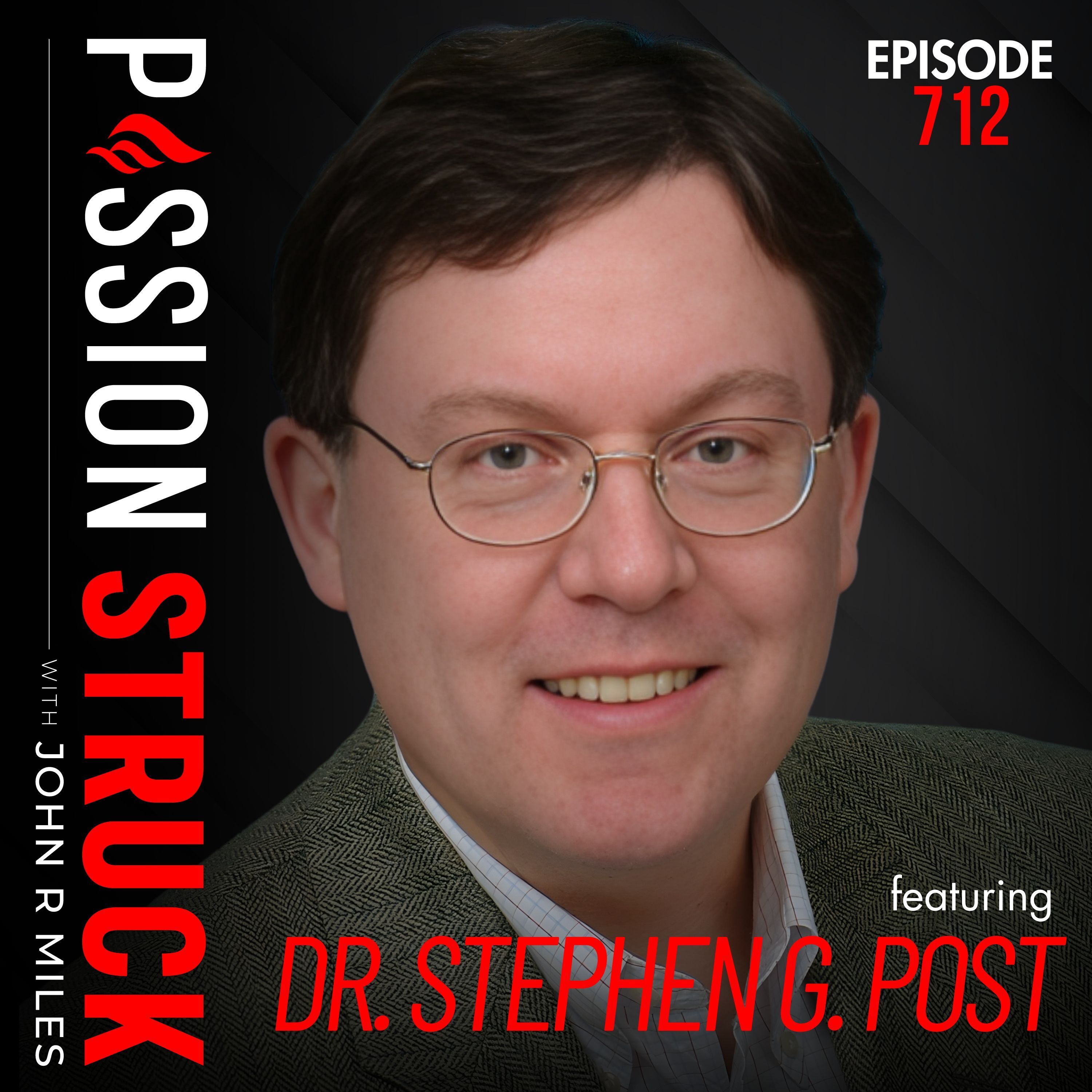
Passion Struck with John R. Miles
Dr. Stephen Post: Pure Unlimited Love & 7 Paths to Inner Peace | EP 712
01:14:11
Loading summary
Transcript67 lines
- [00:00]
John Miles
Coming up next on Passion Struck.
- [00:02]
Dr. Steven Post
Freedom means a lot to me, but more in terms of honoring the spirit of freedom, which means the positive version of the Golden Rule, which means much more to me than the negative version. Do not do unto others what you would not have them do unto you. Well, I can get home tonight, and if I haven't kicked anybody in the shin, I can probably feel okay about myself. Hopefully not. But if I've used my moral imagination and I've asked myself how can I contribute meaningfully and positively to the lives around me, then I fulfill the Golden Rule.
- [00:39]
John Miles
Welcome to Passion Struck. I'm your host, John Miles. This is the show where we explore the art of human flourishing and what it truly means to live like it matters. Each week I sit down with change makers, creators, scientists and everyday heroes to decode the human experience and uncover the tools that help us lead with meaning, heal what hurts, and pursue the fullest expression of who we're capable of becoming. Whether you're designing your future, developing as a leader, or seeking deeper alignment in your life, this show is your invitation to grow with purpose and act with intention. Because the secret to a life of deep purpose, connection and impact is choosing to live like you matter. Hey, friends, and welcome Back to episode 712 of Passion Struck. We've spent the last several weeks navigating the season of becoming. We've deconstructed identity under pressure, explored agency when the world narrows, and studied the mechanics of flow and momentum. Last week, we anchored that season with.
- [01:46]
Interviewer/Co-host
A look at the Dunbar number, the.
- [01:48]
John Miles
Hardwired limit of our social capacity. I discussed why the coming year may not require a larger reach, but a smaller radius. Choosing depth over scale, choosing the integrity of the few over the performance of the many. But that shift brings us to an inevitable what is all this movement for becoming gives us the capacity to move. But meaning is what gives that motion a direction. Without it, we aren't growing, we're just accelerating in place. Today, we open a new chapter. The meaning makers. The architecture of significance. This isn't about the fleeting high of achievement. This is about the structural integrity of a life. We are looking at what sustains the human spirit. Once the roles are filled, the goals are checked off, and the external noise of success fails to quiet the internal.
- [02:41]
Interviewer/Co-host
Ache for something more.
- [02:42]
John Miles
My guest today is Dr. Steven Post. Stephen has spent 40 years at the intersection of bioethics, neurology and compassion. His research looks past the sentimentality of giving to understand the biological imperative of altruism. He asks what happens to the human system. When our concern finally outgrows our self interest in today's conversation, we deconstruct the anatomy of meaning. Why significance is a biological requirement for health, not just a philosophical choice. We go into the discipline of love, moving from love as a fleeting feeling to love as a repetitive nervous system regulating practice. We unpack the exhaustion of self. Why More for me eventually depletes us, while more for us restores us. And lastly, we go into the difference between a life built on trades and a life built on contribution. If you have ever reached a summit and found the air strangely thin, mastered the doing, but feel a void in the being, or suspect that your true work begins where your ego ends, this conversation is for you. Before we dive in, a quick note on a project that's close to my heart we often spend our adult lives trying to rediscover the self worth we should have been anchored in as a child. My new children's book, releasing February 24, titled you'd matter Luma, is a bridge to that truth. It's the story about inherent value, the kind that isn't earned but simply is. You can pre order it now at Barnes and noble or@umatterluma.com if this episode resonates, please share it with someone Navigating a similar season. And if you haven't yet a friend, five star rating or review on Apple Podcasts or Spotify helps these conversations reach the people who need them most. You can also catch the full visual experience on our YouTube channels, Passionstruck clips and John R. Miles. Now let's begin the meaning makers with Dr. Steven Post. Thank you for choosing Passion Struck and choosing me to be your host and guide on your journey to creating an intentional life.
- [04:46]
Interviewer/Co-host
Now let that journey begin.
- [04:51]
John Miles
Hey friends, it's the beginning of 2026 and if you're like me, you didn't come into the Shear to coast. You came to live with purpose, to show up with energy, clarity and intention. That's why how you start your day matters. And for me, that starts with Huel. Every morning I reach for two things. First, Huel Daily Greens ready to drink. The peach and hibiscus flavor is crisp and refreshing with 42 superfoods, vitamins and minerals all in just 25 calories and 1 gram of sugar. Then I turn to Huel Black Edition ready to drink with 35 grams of protein, 27 essential nutrients and no junk. It's a full meal that fuels focus, not fatigue. I start with Huel because I want to be present, intentional and ready, not just Today but every day start 2026 like a minute grab heel today with my exclusive offer of 15% off online with my code passion15@huell.com passion15 new customers only. Thank you to Huell for partnering and supporting our show.
- [05:56]
Interviewer/Co-host
I am absolutely thrilled and honored to have Dr. Steven post on Passion Struck today.
- [06:01]
John Miles
Welcome Stephen, how are you?
- [06:03]
Dr. Steven Post
I'm fine, John, and thanks for having me aboard.
- [06:06]
Interviewer/Co-host
Well, I cannot tell you how excited I am for this interview and we're going to be talking throughout about your extremely valuable new book titled Pure Unlimited Science and the Seven Paths to Inner Peace with a forward by His Holiness the Dalai Lama. Congratulations on its release.
- [06:26]
Dr. Steven Post
Well, thank you very much. I'm excited. We're just about at the launch.
- [06:30]
Interviewer/Co-host
I love the book. So that was one of the reasons I wanted to have you on this show. And I think you're a living example of someone who's passion struck. So a question I love to always ask guests is what does it mean to you to live a passion struck life?
- [06:47]
Dr. Steven Post
I have been referred to as a passionary. That may be a neologism, but it's really definitive of my life's work, whether it's in medical humanities and compassionate care building programs at Case Western Chicago, here at Stony, Brooklyn. I've always been a passionary and engaged lots of wonderful people in these ideas and practices. But it's also something that on a spiritual level, if I may, begins earlier in life, really in high school, When I was 14 or 15 years old, I determined that this would be my calling, my passion. And I'm a big believer in the idea of callings that everybody has gifts and talents that they are free to develop hopefully and apply to the benefit of some identifiable constituency.
- [07:45]
Interviewer/Co-host
You were lucky that you developed your calling at such a young age. I think I first started getting wins of it when I was in my mid-30s. And at that point I really had no idea what to do with it because who I was being called to serve seems so foreign to me at the moment. But can you take us back to that 14 year old version of yourself and how this hit you?
- [08:09]
Dr. Steven Post
Well, it's really pretty straightforward. There's nothing particularly remarkable about it. I was at a high school in New Hampshire, an Episcopal High School, St. Paul's and there was a little grade school across the street, across Pleasant street, and that's where the French Canadian kids, many of them were quite impoverished, went to school. And I made it my mission in life to be over there at least three times a week tutoring them and I enjoyed that so greatly that I knew from that moment that my destiny was somehow to be a messenger, a conveyor of truth, and someone who would spend his life teaching. And I've done that. Despite all the ups and downs, I've been very fortunate and blessed. I've stuck with my callings. It's important to stay with your callings. Don't get diverted by a little more prestige or maybe a little more money. You've got to stay with your callings because that's what's deep inside and that's what you're given. And I've been blessed.
- [09:16]
Interviewer/Co-host
I think that raises a good question for you. I think sometimes people feel a calling and then they start going to pursue it. And what naturally happens is things get tough and it gets harder and harder. You feel. Because you don't see the traction possibly that you're making with that calling. Have you ever had feelings like that where you maybe lost sight of the calling or have advice for someone who feels like they're not making ripples towards their calling and what to do and how to bring themselves back to it?
- [09:53]
Dr. Steven Post
Well, that's where spirituality and calling and the love of nature all come close together. I think it's very important not to be caught up in a lot of the technological manifestos of our time and to simply get out into the natural world, which I do regularly. I'm going to ride the ferry from Port Jefferson to Bridgeport this afternoon and get on a train for Boston. And I love that ferry. When I'm on that ferry, it gets me away from all of the little. The events that are really unimportant over the course of the day. I'm here in a big university environment, and I get lots of different interruptions, but I have to get away from that, and I have to really center myself meditationally, mindfully and prayerfully on what really matters in my life. I have been able, fortunately, to do that. Not without a few ups and downs, admittedly, but I've been fortunate and I've been really grateful for that.
- [11:00]
Interviewer/Co-host
Well, one of the things that this podcast is really about is how. How to create a flourishing life. And I'd like to ask you this philosophical question. How do you personally measure a flourishing life? What does success mean to you?
- [11:16]
Dr. Steven Post
Well, success is a very difficult word to use because it means all the wrong things to great many people. I'm surrounded by wonderful medical students. Here I was at Case Western UChicago, Ann Arbor, just really talented people. But it doesn't mean that they feel in their hearts that they're successful, they can get tired out, they can get burned out, they can feel that they have done all they can with their careers and they want to shift to something else. So you have to be very careful with what success is. It includes balance in life. A lot of our great doctors do get, in fact, so out of balance that they can't quite make themselves focus anymore on their callings. And that's what they're best at, that's what they should be doing. So I think balance is really important and not overdoing yourself. Although on the other hand, going sometimes beyond what most people would ordinarily expect.
- [12:24]
Interviewer/Co-host
Well, I think that's a great answer and it leads me into your book. And for those who are listening, we live in a world now that feels every day more increasingly divided. Yet your work invites us to return to the most unifying force of all, which is love. Not romantic love, but what you call pure, unlimited love. Can you start out by defining what that means and how it differs from the love most people talk about?
- [12:53]
Dr. Steven Post
Well, first thing, to be honest and clear, I was given that title by the investor Sir John Templeton, who founded the Templeton Funds years and years ago. And he was my mentor for probably 15 to 20 years. And we went all around the country, all around the world, talking about a kind of love that is not typically on the tip of everyone's tongues. It's not the love of designer jeans, although I like designer jeans. It's not the love of chocolate, although again, I like chocolate. But it's really by definition as follows, and we agreed on this together because I was really very close to him. He loved me and I loved him. When the security and the well being of another is as real to you and meaningful to you as your own, and sometimes even more, you love that person. Now, there's no fancy language there, John. No Greek, no Latin, no Hindi, nothing like that. It's just pretty ordinary, commonsensical, street corner language. And it works for me. It's always worked for me and it works for a lot of people who I've encountered and influenced. So if you have a student who comes into your office and they're imperiled and thinking about quitting medical student school, you know that you want to put yourself aside and take their security and their well being seriously, make time for them. And that's what love really is. It can be love for people who are what I call deeply forgetful. I've written a lot about people with Parkinson's and Down syndrome. I believe that they are the great test of love because they are cognitively compromised and yet they're still there. Underneath all of this, there is still a human being with a soul. I believe, and it's been my joy in life for the last 40 years to reach out in a special kind of mission of love, a kind of a calling to those populations. So for sure, that's what pure unlimited love is now. That's the definition. At a deeper level. I have a wonderful colleague here, Jeff Trilling, and he's very mystical. And I said to him, jeff, we talk a lot about pure unlimited love. What is it? I don't want a definition. I want you to tell me from deep inside what is pure unlimited love. And here's what he said. This is in the introduction to the book. He paused and he very slowly said, it's the first thing you see when you close your eyes for the last time, comma, hopefully. Which really means he's talking about something metaphysical. Not just ethical, but metaphysical. And I do believe that you've got to have that in the context.
- [16:22]
John Miles
Before we continue, I want to pause on something important. Listening to a conversation about the science of giving or the biology of love is one thing. Living it, especially when our own resources feel thin, is another. So many of you write to me saying I want my life to mean more, but I'm just trying to survive the weak. I'm stuck in the doing and I don't know how to shift into being. That tension between contribution and depletion, care and self protection is exactly what this conversation with Steven Post is about. Meaning isn't created by doing more, it's created by how we give and whether that giving is chosen freely, not driven by guilt or obligation. That's why each episode in this series is paired with reflection tools Inside the Ignited Life. We don't give you answers, we help you build the architecture to find them, asking questions like where am I choosing transactional trades over transformative contributions? What would it mean to reduce my radius so I can actually feel the.
- [17:18]
Interviewer/Co-host
Impact of my care?
- [17:19]
John Miles
Inside the Ignited Life, you'll find weekly reflection prompts tied to Stephen Post insights, identity and agency practices and tools to help you integrate these meaning maker principles into how you actually live. Because meaning isn't a feeling to wait for. It's a choice. You practice consistently and with courage. You can join us@theignitedlife.net now a quick break from our sponsors. Thank you for supporting those who support the show.
- [17:47]
Interviewer/Co-host
Foreign.
- [17:51]
John Miles
You'Re listening to Passion Struck on the Passion Struck Network. Now back to my conversation with Dr. Steven Post.
- [17:58]
Interviewer/Co-host
Thank you for sharing both of those definitions. I think it speaks more and more to what more of the world needs to be as we become less and less connected. Which brings me to His Holiness, the Dalai Lama. I have never had the opportunity of meeting His Holiness, but I've interviewed a number of people who have from varying different disciplines. But through it all, he seems to touch each one of them uniquely and gives them all their own, I guess, task or mission from him. But it all comes to uniting humanity to be in service to one another and to make the world a better place. He wrote that for you. The book addresses themes such as consciousness and interconnectedness. But how did that connection come about? And what does it mean to you to personally have his words in your forward?
- [18:58]
Dr. Steven Post
I really appreciate His Holiness, the Dalai Lama. I was in Bangalore, India, where they have the Indian Institute for Advanced Studies, and he sometimes shows up there. He likes it quite a bit. And they have wonderful neuroscientists, wonderful Hindu philosophers, and also some Western philosophers. And I was giving a talk on dignity for deeply forgetful people. I don't like the word dementia, John. It's too much like the word retard. It's a very negative word. Sometimes our politicians deride their antagonists by calling them demented, which I do not appreciate. Invites negative metaphors like shell, husk, empty, gone, right, and so forth. So I've been popularizing the expression deeply forgetful people, which is now on the tongues of about half the primary caregivers in America, based on our recent Gallup study. So that's an accomplishment in life. I want to see them come out of the shadows. I want to realize their creative potential. That's what I love to do. I have a calling for that particular constituency, and I've had it for a long time. But in terms of His Holiness, I was giving a talk about love for deeply forgetful people, John. You'll be happy to know this. I don't have enemies, but I have adversaries. And I take my adversaries positively because they're the ones who bring out the best in me. I have adversaries here at Stony Brook. I had adversaries in Cleveland at Case Western. You're always going to have some adversaries, and they push you and they try to diminish you at times. But that's a blessing. That's a beautiful thing. So I was talking about the deeply forgetful and how we should not think less of them because their memories are weakened. Due to these conditions that they must deal with. And I said that we in the west are hypercognitive, meaning we so value intellectual dexterity that really comes to define personhood morally and spiritually. So if you're not cognitively fully intact, whether you're reading John Locke or Immanuel Kant, you're not quite a person and you're therefore not quite protected under the umbrella of do no harm or benefited under the umbrella of do good. So that to me is very important. And I, I was talking about that and His Holiness walked into the back of this ballroom and I was very surprised. And he said, he put his hand down on the table and he said, there's no reason to think less of somebody because they are memory impaired. They still have creativity, they still have love, they can still enjoy the beautiful colors of the fall leaves. They can do many things. They can be very wonderful contributors to society. And we need to completely turn that attitude around. I was very much taken with his words and felt confirmed, because you have to remember that in Hinduism and Buddhism, the mind is not just residual, it's not just tissue, it's not just brain, it's not just cells. It utilizes the brain, but it's more than matter. And this is what all the great spiritual traditions argue, that mind even comes before matter. It's not just derived from matter. And I believe that very strongly since I was 15 years of age and hanging out with Steve Jobs at Reed College, reading the autobiography of a yogi. And one, one night this motorcycle guy came into the coffee shop and he was all lit up. He had a black leather jacket on with lots of spikes, and it was about nine at night. And he said, who wants to go for a ride on my brand new Harley Davidson Shovelhouser, the fastest bike in the world? And like a total fool, because my executive function didn't develop until I was in my mid-20s, I said, I'll go for a ride. And I jumped on his bike. It was raining out, it was slushy, it was late January. And this guy took off. He hit 180 miles an hour in the city of Portland, going through every stoplight, blowing through every stop sign, went out on the Pacific coast highway, headed south for an hour and he was screaming into the night rain and cold air. And I thought I was dead. I honestly felt this, this was my final moment on earth. And I was crying, I was in tears. I just didn't think I could make it. So lo and behold, he did an incredible U turn. Evil Knievel U turn. And he dropped me off right where he picked me up. Exactly where he picked me up in front of the coffee shop. And I stumbled across the bridge to. There's a ravine there to my dormitory, Ackerman dormitory. And I never picked up the payphone. In those days, John, they had payphones. I never picked up the payphone. But I had given my mom, who was in New York, the number some months before. Just as I crossed the threshold, the phone rang. And now it's 11 at night in West coast time. And it's 2 o' clock East coast time. And I picked up the phone. I felt nudged. I felt really almost pushed by some kind of mysterious force to pick up the phone. So I just picked it up and I said, hello? And it was my mother. And she said, I just woke up. I had this incredibly frightening premonition that you were dead. And I said, mom, I thought I was dead too. We went back and forth about that. And she said, I was sweating. Your dad didn't know what to do. I'm just calling you and I'm hoping you can help me get through this. And I said, mom, I'm okay, but I almost was dead. So you were very intuitive. And we talked about the idea of the non local mind, or the one mind. It's an idea that Deepak Chopra and Larry Dossey and many great spiritual thinkers hold to. And so I said to my mom, you're 3,000 miles away and we don't have any communication. But somehow you knew that. I was incredibly imperiled at this particular moment. And I wanted to say, mom. And I did say, that's the power of a mother's love. It's the power of pure love. And she had a lot of pure love. So I believe that can happen with mothers and children. And there's a lot of history of that. There are whole books written about it by people. But somehow or another, the best, the strongest form of love in the human experience is motherly love. I don't know if you agree with that. I hope so.
- [27:07]
Interviewer/Co-host
Well, you definitely. There's nothing quite like the love that your mom shows you. So I definitely have felt it.
- [27:16]
Dr. Steven Post
Yeah. So I've been very blessed. So ever since that event and some dreams I had when I was in high school, I've always felt that mind is more than matter. I was at the University of Chicago and I had the opportunity to study with a Nobel Prize laureate named Sir John Eccles. And he won the prize for figuring out before anyone else the basics of the communication between brain cells. He basically laid out the synaptic communication system.
- [27:53]
Interviewer/Co-host
Pretty incredible.
- [27:54]
Dr. Steven Post
He was incredible. And he always said to me, stephen, I don't want you to think that mind is nothing but matter. There's more to mind than matter. And there's a chapter in the book, May the One Mind. And that's what all those people at Bangalore like His Holiness. But there were two or 300 of them there, and they were all very well regarded in Indian culture. Intellectually, scientifically, they view the mind in a way that we somehow don't quite grasp. I think in the west, at least not as cleanly as we could.
- [28:36]
Interviewer/Co-host
I want to go back to that motherly love. Because in the book, you translate a big word, love, into 10 concrete forms. Why does this wheel of love matter so much for everyday behavior change?
- [28:52]
Dr. Steven Post
That's a great question, and I'm so happy to answer it, because it really is the heart and soul of the book. Since I was 15, I get up every morning, I meditate for an hour or so, I pray, and I am very concrete. I actually imagine the encounters I'm going to have over the course of the day. I have a lot of repeated interactions. Like, I run a center here at Stony Brook. I chair a division of medicine in society. And I pretty much know. I'm in my office right now. I pretty much know most, for the most part, who I'm going to encounter and what their need is. And so love. It's very hard to come into a functional school or workplace and just be spouting the word love. Pure, unlimited love. I once did that at Case Western Medical School, and a lot of people thought I'd gone nuts. But what you can get across is the expressions of love. What expression does love need to take in this particular situation? So I spend a lot of time around patients who are suffering, and I ask them, can you identify your suffering? And then they need compassion. So compassion is one of the ten forms of love. It's not the only form of love, because depending on who you speak with, not everybody is suffering. Or at least not everybody is suffering equally much. So compassion is when you have an empathic presence with someone who is suffering, and it includes the desire to alleviate that suffering. That's something His Holiness always says. He says, we in the west, sometimes we talk about compassion as a pleasant internal emotional state that makes us feel good about ourselves. Maybe it's virtuous or whatever, but if it's not attached with actual efforts to alleviate the source of that suffering, it's really not Quite valid. So he wants us all, and he said that to me a number of times, he wants us all to have active compassion. And sometimes when I come into this hospital, in this workplace, I use a little bit of mirth. Mirth is on my wheel. Because, look, to be honest, a lot of people have forgotten how to laugh. I don't think you have, but I think laughter is so important. Norman Cousins laughed himself through a major illness that everybody thought he was going to die of. And then he started the Norman Cousins center at UCLA in California and is completely devoted and has been for 35 years to the empirical study of laughter. What happens to our emotions, our biochemistry, when we laugh. I think laughter is so important because in a sheer millisecond, a tasteful, uplifting, tactful, non derisive bit of humor can turn people around 180 degrees. And so the other day, people in the hallway seem to be a little bit despondent. And I said, by the way, I want to tell you a little new joke that I've heard. Where do ghosts build their houses? Here we go on dead end streets. So just a little thing like that, never derisive, even around patients. Mirth can heal them. Mirth can be very healing, but it has to be tasteful. It can never be hurtful. It can never be humor at someone else's expense. And this is why they talk about the laughing Buddha. This is why Dostoevsky wrote his book the Idiot. There's a lot of this, east and west, that mirth and humor and laughter are important. Another thing, I won't go through all these, but forgiveness is very important because a lot of people I know, they need to be. Somebody may have made a huge medical error and it could even have resulted in the loss of a patient. And they may be thinking about leaving medicine. You never know. I've seen it happen. And so what I need to say to them, and I'm meditating on this early in the morning before I leave for work, what they need to hear is something that Martin Luther King said beautifully. He said, those who make no mistakes make nothing. I saw that on the desk of a neonatologist in Lexington, Kentucky, once upon a time. And neonatologists make lots of mistakes and everybody does, medical students included, of course. You've got to be able to live with that creativity, listening. My wife just, just yesterday afternoon was upset with me because I was not listening attentively. And I realized she was completely right. Cicely Saunders, who founded the International Hospice Movement, she was from London, she started St Christopher's which was the world's first hospice. She was the first recipient of the John Templeton Prize and we were close friends. So I invited her over to MIT because we were doing a conference on empathy, altruism and agape. She came over and she gave the dinner speech and she said, I'm 81 years old and I still get up early in the morning. I go into St Christopher's and I change bedpans, which is a kind of a grungy job. But she says, I was a nurse before I was a doctor. And I consider it an honor to change the bedpans of these people who were passing away. It was beautiful. And then she said, after that, I sit on the end of the bed and I ask them what they feel most happy about with their life. I don't want them to focus on, oh, I could have done this, I could have done that second guessing themselves. But I asked them to focus on the things they've done in life that are most meaningful. And she just sits there and she said, listening is an act of love, which I think most of us would agree with. She was a great woman. She died a couple of years later. But I really like Dame Cicely. Maybe one other part of the Wheel of Love, creativity. I come in here and I know that there are some people who are struggling with their research projects, with their writing. They're not getting where they want to be. And my job is just to sit down, listen to them, and then to give them some helpful ideas. Final one I'll touch. This is Carefrontation. I love this one.
- [36:37]
Interviewer/Co-host
Yeah, I love that one.
- [36:39]
Dr. Steven Post
Now, I didn't come up with this, John. I have to be honest. I was a case Western for 20 years in the medical school and there was a guy who went there long before I arrived and his name was M. Scott Peck, who wrote a very best selling book called the Road Less Traveled. It was a huge hit. And in it he talks about carefrontation. He knew I was a Case Western at the time and he started writing me about Carefrontation because he said, your ideas around love, they're too soft. I'm a psychiatrist and I have to be able to straighten people out. I have to keep them on their callings. We both use that language. I have to be able to help them when they get off course to re center inwardly on the things that are most important to them. And he said, that is not confrontation, that is carefrontation. And it's a nice term. So I do carefrontation at least every couple of days because I have some leadership roles and I don't want to just do confrontation because that's where you emphasize the negative. It's not appreciative inquiry, which is a big deal in the business world right now, but carefrontation. How can you help people to realign themselves with their core callings and not get off track in a permanent way? You want those people on your board of trustees. I run the institute, which Sir John Funded in 2000, the Institute for Research on Pure Unlimited Love. And that has been the love of my life. But Sir John, fortunately, was supportive. We shared this set of values, and he really kept me on the straight and narrow. I saw him at a golf club outside of Dulles Airport once upon a time in about 19. In about. Actually, it was about 1901. And he would just ask me, how are you doing? Are you sticking with it? And we're not just talking about the love of humans because he was a mystic. They called him the Tennessee Mystic. We're not just talking about the love of humans, but we're talking about the love of whatever it is that made humans. So he wanted me to be thinking very broadly. He appreciated human love, but he especially appreciated it when it somehow invaded or informed by this higher spiritual quality.
- [39:31]
Interviewer/Co-host
So as you were talking, I was thinking about the University of California, Berkeley, Professor Dacher Keltner.
- [39:38]
Dr. Steven Post
Yeah.
- [39:39]
Interviewer/Co-host
And a couple things that you brought up reminded me of him. 1. One is his focus on the science of compassion. But the other thing is, as you've been talking, it keeps bringing top of mind his whole concept of moral beauty and how he ties moral beauty to when we experience awe most profoundly. And you argue that kind giving, which is really a form of moral beauty, reliably produces an inner glow which reduces stress, gives us a better mood and more meaning in our lives. What does giving.
- [40:22]
Dr. Steven Post
This.
- [40:23]
Interviewer/Co-host
What does giving to others do to us that changes our state so quickly?
- [40:30]
Dr. Steven Post
Happy to respond to that. First thing, though. I was supposed to be out at Berkeley with Keltner's group and that new grant they have from the Templeton foundation to look at how media report on love. I'm actually a senior advisor for that project. However, it happens to be the case that two weeks ago when I was supposed to get on the plane, I fell ill, so I couldn't make it out. But I'm sure I would have enjoyed it very much. And I think his work on awe is powerful. It goes back, believe it or not, it goes back 25 years. And I Remember the first grant that he submitted to the John Templeton Foundation? Chuck Harper was the president at the time. And Chuck had never seen anybody wanting to study the psychology of awe and beauty. It just hadn't occurred to him. Brilliant guy. And so he asked me to review it, and I was happy to do. And I gave it a rave review. And happily. Because when you think about it, awe and beauty are so important. And that's why in the book there's a sixth chapter. May you cherish the gift of nature. Not that it's all naturalistic. You can find beauty in art, you can find beauty in chapels, wherever you want. But there is something very important about beauty, and it does transform the self and giving. If you go back to the British moral philosophers, the moral sense theorists, don't anybody write this, this name down, but the Earl of Shaftesbury, he believed that ultimately ethics comes down to beauty, that there is an inherent beauty and awe and wonder in a moral action. And so I think that Keltner is onto something there. And I've always agreed with that. But for me, I started writing on this in 1995 in scientific journals. And there's no question that kind giving makes a big difference in your own sense of well being. When I first came to Stony Brook from Cleveland, oh, my goodness, it was 2008, and there was a call from United Healthcare, and they wanted to know if we could just in a very simple way, look at the benefits of being a kind giver. And it turns out we looked at people who. Now, this is the beginning of 2010. So we looked at people who in 2009 had volunteered. Now, how much did they volunteer on average in America? It wasn't too much. It was about 100 hours a year. And then the interesting thing is, how many Americans were volunteering? About 41%. And then we asked simple, positive psychological questions because I was spending a lot of time with Marty Seligman and helping get the positive psychology movement started. And that was an honor. So I was meeting all these wonderful people like Bob Emmons and Keltner and just so many individuals of great merit and Jonathan Haidt, people who were really way over my head in a lot of ways. So we were asking them questions. So when you were doing your roughly two hours of giving a week, you can break it down to two hours a week if you want. What were you experiencing? And it turns out I just have this in the book, and I might as well just be accurate. 73% said volunteering lowered my stress levels. So that's about serenity and tranquility. You're not being forced to volunteer or forced to be a giver because that's actually counterproductive. And there's some very good studies to point that out. But if you're drawn to this, if you have the right mentoring, it will lower your stress levels. 89% said volunteering improved my sense of well being. 92% gave me an enriched sense, sense of purpose in life. Now 68% said volunteering, quote, made me feel physically healthier, a little more robust. 77% said it improves my emotional health. 78% I'll end up here. Recovery from loss and disappointment. 96% the participants said they felt happier. Now here you go, John. Talk about culture. So we did a study of widows and widowers who had been importantly, relatively happily married for some long period of time. They weren't at each other's throats, they had pretty good relationships. And now one of them had passed away. And typically these individuals went through a period of grief and bereavement, as you would believe, you understand that. So we did a study and we asked them, while you were going through grief and bereavement, were you volunteering to help people formally or informally in the neighborhood through maybe the hospital, wherever it could be? Turns out that the ones who were helpers were recovering more robustly and more quickly than the non helpers, if you look at the high quartile and low quartile of helping, because that's typically how these things get done. And so I got a phone call, a hell of a phone call from someone in New York, from the New York Society of Widows and Widowers. There is such a thing. There's probably that in la too, and in California, in Texas. They wanted me to come in and give a talk on this project for their constituency. So I went to some hotel on Fifth Avenue in Midtown. This has got to be 15 years ago. And I gave this talk and I said, it's not reciprocal benefits that we're talking about here. It doesn't mean that you're going to get a pay it back moment. It just means that by involving yourself in this kind of other regarding, to use the word altruism, this kind of kind love, that you'll feel a lot better, you'll feel healthier and happier and whatever. And this guy in the back of the room, he just stood up. He just stood up. He was dissed, if I can use that word, he was dissed. And he said, I don't care what you say, buddy, I Don't do nothing for nothing. And okay, because some people have a purely transactional view of life or they force themselves to have that view of life. And my response was, well, okay, but are you happy? Have you ever been happy? And he said, not really. And then we could talk more deeply from there. But that was basically the point that I took home from that meeting as I took the train out to Long Island. There are some people who just won't do nothing for nothing.
- [48:32]
Interviewer/Co-host
You wrote you asked him, does life for you boil down to entirely the art of the deal? Yeah, And I think he had that self awareness that he did approach every interaction as a transaction and because of that he never felt happy in life.
- [48:48]
Dr. Steven Post
Yeah, And I think that's a problem for an awful lot of people. They get these jobs where they fit in. They've been trained to fit in and make the numbers match. And I have a son I love and he's got a good job in finance, but what's he really doing? Well, I'm doing finance, dad. That's okay, that's fine. And he's good at it. He has an MBA and all of these things. But in the end, it's a strictly transactional consciousness. And that's not going to get you to the moon and back.
- [49:27]
Interviewer/Co-host
Stephen, in the book, you outline three spears, near and dear, the neediest and humanity at large, on where we should choose to give. And I think, at least for me, it seems that our natural inclination would be to go near and dear. But that's not always the case. But how do you prioritize without guilt? And how do you still stretch to help people outside that inner circle where I think most of us tend to focus on?
- [50:05]
Dr. Steven Post
So I don't have an absolutely clear cut, precise answer to that question. I do honestly believe, and it's reflected in my own life, that we need to prioritize the near and dear, because whether you're reading Thomas Aquinas or Aristotle, these are the people that have been placed in our pathway by our biological nature. And so I say that it was my mother who called me from New York. It wasn't somebody else, it was my mom. And she had a profoundly intuitive sense of what was going on. So that's valuable. I'm not someone who's an arch utilitarian because I think that special relationships like parents and children and siblings hopefully do matter in our lives. But what I'm against is this kind of myopic insularity where people just so focus on the nearest and the dearest that Honestly, they don't give a hoot about the neediest or about humanity as a whole. And that's where even parental love can go astray, because some parents really teach, by bad example their kids to love only those who are most like them, whether that's color or ethnicity or religion or whatever. I don't believe in that. I think that we need to lean outwards. I use that expression. I think, lean outwards. I actually wrote once a whole book about this called Spheres of Love. We need to lean outwards toward the neediest, regardless of their connection to us in friendship or family. And we also need to do certain kinds of things for a shared humanity. So I like to do little things for Compassion International, where you just send a few bucks a month to this organization, and they make sure that those dollars are used very wisely for people who are truly needy, generally someplace in Africa. And what they encourage, though, to personalize it, they encourage you to write a little note telling you, telling these people that you appreciate them and look forward to hearing from them, and then you'll wonderfully get a little card back from them at some point. But balancing is. There's no precise algorithm. There's no precise formula to that balance. And Paul Farmer, who's passed away now, the great physician who spent a lot of time in Haiti and South America, he went into his marriage and he determined with his wife that they would only have one child, and this was his preference, and she was fine with that. So they had the one son, and he later had some other children with her. And that son would go down to the Caribbean with him and work on these projects. And he was trying to teach that son to have a love for all people, regardless of their background, their level of poverty, their destitution and so forth. And in the end of his life, he spent more time in Boston and he spent more time with his kids. So there was a kind of a fluidity in all of that, and it was a beautiful thing. So there's no one shoe fits all, but I think we need to just be reflective about it and not allow our families to become so insular that they blind us to the needs of humanity and of the neediest. I hope that answers it.
- [54:29]
Interviewer/Co-host
It does. It reminds me of a section of the book where you describe healing with kindness. And you said that this may be the hardest path because not everyone sees themselves as a healer, but you believe healing is everyone's calling. And where I want to take that is I mentioned to you before we even got on that I have a book coming out, but the book I was mentioning isn't the book that I have coming out first. I have my first children's book coming out in February, and it's titled you Matter, Luma. And the reason I wrote it is that I feel that we are not raising kind children and that this is a cyclical thing that's going on, that if parents aren't modeling behaviors, the kids aren't going to learn it. And so what I'm trying to do with this book is to show how a ripple of kindness radiates throughout the forest and kind of awakens kindness and the other forest creatures through the story of this little bunny. But at the end of the book, I invite the child and the parent to go to an app that we're building called Past the Ripple. Because what I'm trying to show them is that even a small act of kindness can ripple in ways that you never could possibly imagine for sure. And I think we get too caught up in trying to think that a small act done to one person isn't going to radiate yet. I think that's where it all starts. I don't think any big movement was launched by doing something at mass. I think it all starts with something small that then grows. Long way of me to asking you this question. What are some practical ways that you think parents can model kindness in today's culture where it will help their children be awakened by it and practice it as they get older?
- [56:38]
Dr. Steven Post
So I totally agree. It's not the amount of giving, but it's the amount of kindness within the giving that makes all the difference. And that's something that even Mother Teresa cited. She felt that way. It's not how much, but it's the quality of the kindness. It could be a very small action, but if it's kindly operationalized and that kindness is powerful, palpable, that makes all the difference in the world. So for me, kind giving as a parent is the be all and end all. Why bring children into the world if you don't want to raise kind children? So a whole chapter of this book is may you raise kind children. I'm grateful every day that I think my two kids are reasonably kind. They're not perfect and their parents weren't perfect, and they let us know that. But they're reasonably kind people, and that makes such a huge difference. Now how to so we spent actually $4 million funding research on the how to question of raising kind children. It's hugely important because if you can raise kind Children, all the health care literature points out that they're going to be healthier mentally and physically in midlife and they're even going to live somewhat longer lives. So I think that the first book I wrote with Jill Neimark, It's Good to Be Good and then it goes on how you can live a healthier, longer, happier life through the simple act of giving. And that is just absolutely the case. What can a parent do? Well, number one, every kid comes into this world with an inherent natural empathic capacity. There's no question about it. That's what Paul Bloom has proven time and time again with his very impressive studies at the Yale Child Study center in New Haven. So even that one year old child or 18 month old toddler is able to feel empathically into the emotional experience of other children in that age range. I won't go into how that was proven, but it's a real contrast to what was going on in the 20th century, because the 20th century was a mess. It basically said that a child is a swashbuckling source of seething, boiling anger and hatred. And by the way, non human primatology argued this too. So when I was a boy growing up in high school, we read Robert Ardrey's the Territorial Imperative. Basically he gave up on the human child, as he did on all non human primates. But then Jane Goodall, thank heavens, who I had the opportunity to speak with three weeks ago, four weeks ago at the Templeton Prize Award at Lincoln Center. I've known her for quite a while and now, of course, she passed away. She passed away the next day. But she gave the introduction and what she did was she completely turned around our false assumptions about the nature of the child and about non human primates. And so suddenly she, and also people like there are others writing books like the Ape within, that there's a natural empathic quality and compassion. Now it's there. Rousseau is correct. But don't push the wrong buttons. Parents, if you can be scream free, that will help a lot. Don't scream at your kids and this is proven. Have a little statement of values that you as a family agree to and that everybody has signed onto. Kindness, forgiveness, creativity. And when there's a meltdown with a child, instead of screaming bloody murder, don't do that. Just convene around that statement. It could be tacked onto the refrigerator, it could be up above the fireplace, it could be Rockwell's golden rule. It could be a lot of things. But use that as a cultural center, because honestly, the culture is so negative. It's pulling people away from. From kindness. Just read the papers. And so we need to re center ourselves and also our families on kindness, and that will make the difference.
- [62:08]
Interviewer/Co-host
Thank you so much for sharing that. The last path, Stephen, that I wanted to go into is may you honor the spirit of freedom. And this final path explores how love and freedom intertwine. And you write that love that is free is love that endures. It liberates rather than binds, empowers rather than controls. This chapter, to me, offers a vision for cultural renewal, a society animated by autonomy, compassion, and mutual respect. Is that what you were trying to do with the chapter? And what message beyond that do you want listeners to take away?
- [62:46]
Dr. Steven Post
Well, freedom means a lot to me, but more in terms of honoring the spirit of freedom, which means the positive version of the Golden Rule, which means much more to me than the negative version. Do not do unto others what you would not have them do unto you. Well, I can get home tonight, and if I haven't kicked anybody in the shin, I can probably feel okay about myself. Hopefully not. But if I've used my moral imagination and I've asked myself, how can I contribute meaningfully and positively to the lives around me, then I fulfill the Golden Rule. Now, in the Hindu tradition, I'm an Episcopalian, but I've always loved Hinduism. Hinduism says that there are three qualities of the eternal infinite mind. One is love. Two is creativity. And three is freedom. So you and I, John, and all your listeners, we are made to practice love, freedom, and creativity. Not because we're rough, rude animals chewing our way through some chain. No, that's not the way they look at it. They look at it as a divine gift. And actually, Sir John Templeton and I had many conversations about that, and he believed that freedom was a gift, not something that we just have, evolutionarily speaking. Because a lot of people, honestly, they'll give up their freedom for a bite of food, for security. That's what the brothers Dostoevsky, the brothers Karamazov is all about, that people will give up their freedom for a better plate of food. But actually, freedom is much deeper than that. The true disciples of freedom pursue freedom despite insecurity, despite hardship. And so I'm such a believer in freedom and such a believer that we have a truly a divine responsibility to spread freedom, but not irresponsible freedom. See, I'm pulling my ear. But we have to spread freedom coupled with the Golden Rule in its positive sense. And that's why every spiritual tradition, east and west brings in that positive version of the Golden Rule, and I list a lot of those in that chapter. So I'm a huge believer in freedom, but the right kind of freedom. And I think that the essence of the book. May you give and glow. May you heal with kindness. May you follow your callings. May you raise kind children. May you know the one mind. May you cherish the gift of nature. May you honor the spirit of freedom. In a lot of ways, that last one brings it all together.
- [66:10]
Interviewer/Co-host
Yeah, I agree. Stephen, I wanted to end on this question. Our mutual friend Dr. Lisa Miller called pure unlimited love a treasure chest, an ancient map to love that's been buried within you all along. My question following up on that is, what's one key you'd leave with listeners to help them open that chest?
- [66:34]
Dr. Steven Post
Always expand the canvas. Even if there's a very harsh, difficult moment in your life, it's never the final word. It's like a Jackson Pollock painting. He could throw that gob of paint down on that canvas on the floor in that barn, and it just looked terrible. But by the time he covered it over with these beautiful, energetic lines of love, it was something beautiful. So you have to expand the canvas. When I came here to Stony Brook from Cleveland, there was a cub reporter who'd found out about the Institute for Research on Pure Unlimited Love and had been in a lot of newspapers, and she had actually interviewed the dean of this medical school and the chair of my department because they hired me to teach compassionate care in a very realistic and successful fashion with medical students and faculty from all kinds of different backgrounds. And she interviewed. She asked them, so what's this unlimited love guy coming to Stony Brook? And they had great responses. It's one of the reasons I love the place. They said, well, we don't really care about that, but it's okay. They didn't hit the ceiling about it. Didn't drive them nuts. And I've been here 16 years, and people have been very supportive. So that's the point, was that you have to expand the canvas. And that night, I came into Stony Brook from Cleveland. It was raining cats and dogs. My son and my wife were mad at me because they realized we've really left Ohio. It was tough. And the Three Village Herald, a little local paper, had only one headline on the front page. John, are you ready for this?
- [68:28]
Interviewer/Co-host
What is that?
- [68:29]
Dr. Steven Post
Unlimited love comes to Stony Brook. And I practically freaked out. So the next day, I had to walk up the escalators in the middle of the medical school, and there was a Guy who was staring intently at me and I didn't know who he was. And I looked up and I said, sir, do I know you? And he said, are you Dr. Post? This guy is an almost Nobel Prize laureate in biochemistry. Are you Dr. Post? And I said, yes, I am. And he asked me the first question that I responded to here on this campus, Are you going to save us? I just shook. I said, sir, I don't think I'm saving anybody, but I'm glad to be here. And it worked very well. And then a little later on, I called the then president of this university, Shirley Kenney, who had recruited me. And I said, shirley, did you see that article in the Three Village Herald? And she said, yeah, I did. I said, did you get any phone calls? She said, yeah, I got calls from emeritus professors. And I asked her, so what did they ask you? And she said, well, they were mostly male emeritus professors. And they asked me, what kind of love are we talking about? And we laughed. We laughed our way through that and everything was fine. With mirth, with love, with compassion, with all these elements, creativity on the wheel of love, you can overcome those difficulties. And don't ever forget that.
- [70:11]
John Miles
Stephen, As I read the book and.
- [70:12]
Interviewer/Co-host
What it showed me is that love is not merely an emotion, but it's a field of energy and consciousness accessible to everyone and that bridges the personal and divine, science and spirituality, self and society. So I think what His Holiness said in the forward, that it is my hope that this book will contribute to the flourishing of humanity, is exactly what it does for a listener who wants to get the book. But more importantly, look at your 40 years of work. Where's the best place for them to go?
- [70:47]
Dr. Steven Post
This is it. Actually, this is a culminating book. There may be something to follow it, but I'm not certain. Just go to your local bookseller or go to something online and order a copy of Pure Unlimited Love. And Stephen G. Post, even with a pH. That's the Irish spelling. So I'm all. I'm. I think it could be a helpful book. That's why I wrote it. And I think it's a sincere book. I think it has a lot of authenticity and it's a nice mixture of good science, but also fun vignettes and little anecdotes. And also because I'm a uchicago guy, great books all the way. So you're going to find some philosophical reflections and even some spiritual reflections here and there. Because I used to study with not just people, Csikszentmihalyi. When he was writing the book Flow, but with Mursha Eliade when he was writing his book on shamanism. So I have a very mixed background and I tried to bring everything to bear on the question of pure, unlimited love, to honor every human being and especially to honor Sir John Templeton.
- [72:15]
Interviewer/Co-host
Well, Stephen, it was such an honor to have you here today. Thank you for joining us on Passion Struck.
- [72:20]
Dr. Steven Post
Hey, you're a passionary too, so let's just keep it up. Thanks, John. It's a pleasure.
- [72:26]
John Miles
That's a wrap. On Today's conversation with Dr. Steven Post. What stood out to me the most is how practical this really is. Dr. Post shows us that meaning isn't something we think our way into. It's a biological state our bodies respond to when we move beyond self protection and into contribution. When care is chosen freely, not out of guilt or obligation, people don't burn out, they stabilize. Energy returns. Life starts to feel workable again. But that understanding brings up an honest next question. How do you live this when your life is already full? How do you navigate this when you've already built the success, the identity and the momentum, but the internal architecture still feels off? That's exactly what we explore next in my upcoming episode, where I'll be joined by Mark Nepo. Our conversation is about the difference between doing well in life and living truthfully. Mark deconstructs the mechanics of presence and what it means to stay engaged with the world without the cost of self erasure. We talk about the physics of acceptance, the power of attention and quiet contribution, why the most significant work often looks much smaller than we expect.
- [73:33]
Mark Nepo
And if you're lonely, you say hello, get out of the house. Doesn't mean that every interaction will be Some may be awkward, some may. Some may not work out, some may be irritated. But you're engaged in life. And so even as simply as instead of reading at home alone, read in a cafe where even if you never say hello to another person, you're around other life. You're exchanging presence and energy. So expand our sense of solitude to let all others in so that the line between self and other blurs.
- [74:15]
John Miles
If Stephen's episode today helped us understand why meaning matters biologically, Marx will help us explore the discipline of living it. Before you move on to your next task today, I'd encourage you to pause. Notice the data your body is giving you, where energy is being restored and where it's being drained. That awareness is the structural foundation where change actually starts. If you want to start applying these ideas, join me inside theignitedlife.net and don't forget to pick up a copy of.
- [74:42]
Interviewer/Co-host
Youf Matter Luma A reminder for the.
- [74:44]
John Miles
Next generation that significance is your birthright. I'm John Miles. You've been passion struck. And as we move through the meaning makers, remember, significance doesn't come from doing more. It comes from doing what aligns consistently and with care. Until next time, live life. Passion struck.