← Passion Struck with John R. Miles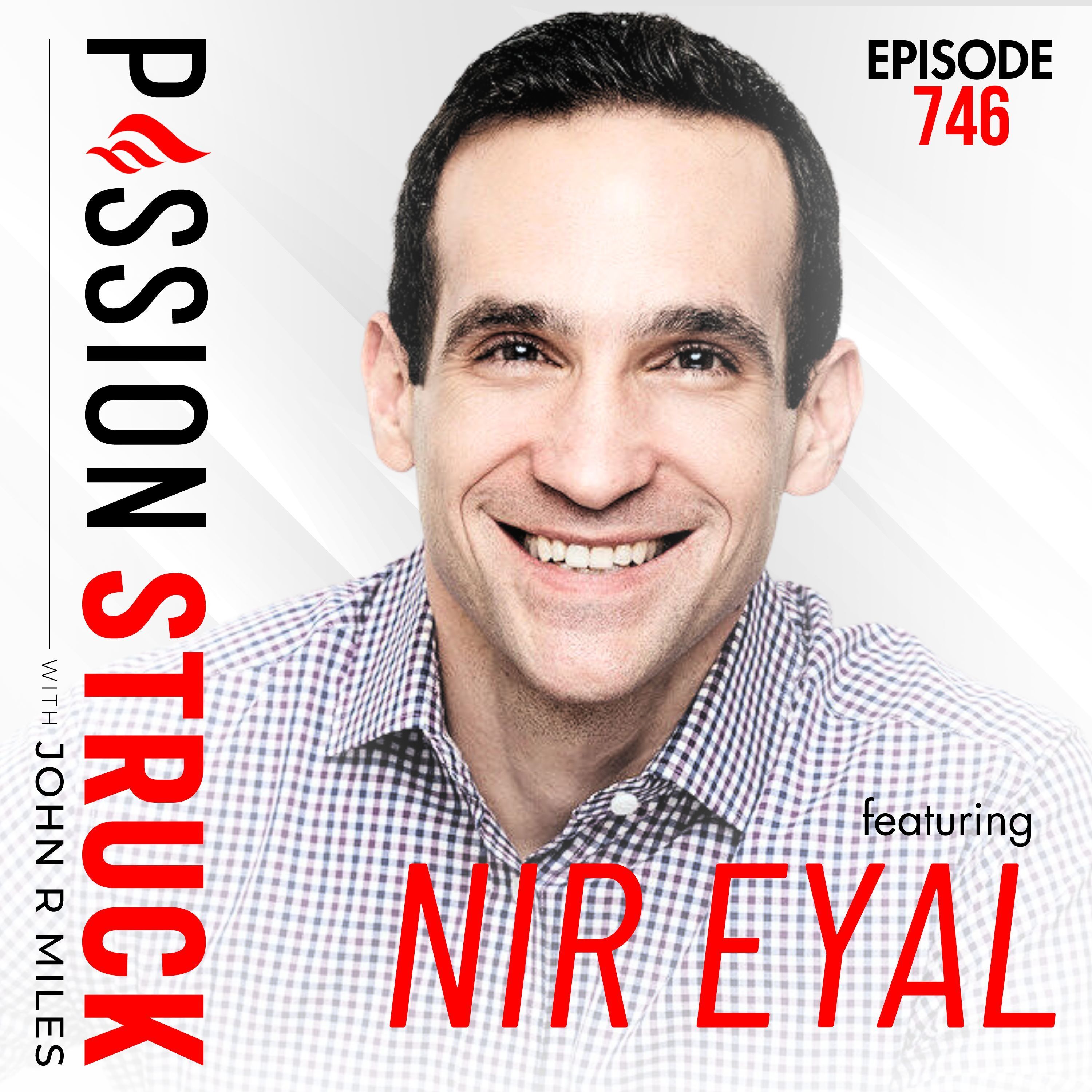
Passion Struck with John R. Miles
How Beliefs Shape Behavior, Motivation, and Resilience | Nir Eyal — EP 746
00:59:49
Loading summary
Transcript512 lines
- [00:01]
Progressive Insurance Announcer
This episode is brought to you by Progressive Insurance. Do you ever find yourself playing the budgeting game? Well, with a name your price tool from Progressive, you can find options that fit your budget and potentially lower your bills. Try it@progressive.com, progressive Casualty Insurance Company and affiliates. Price and coverage match limited by state law. Not available in all states.
- [00:21]
Bleacher Report Announcer
The Bleacher Report app is your destination for sports right now. The NBA is heating up, March Madness is here and MLB is almost back. And the every day there's a new headline, a new highlight, a new moment you've got to see for yourself. That's why I stay locked in with the Bleacher Report app. For me, it's about staying connected to my sports. I can follow the teams I care about, get real time, scores, breaking news and highlights all in one place. Download the Bleacher Report app today so you never miss a moment.
- [00:51]
John Miles
Coming up next on Passion Struck.
- [00:53]
Nir Eyal
Another study that blew my mind was a study conducted at Yale where they
- [00:57]
found that people who had positive views
- [01:00]
about aging versus negative views on aging
- [01:03]
lived on average 7 1/2 years longer. 7 1/2 years longer is a tremendous effect. That is longer than the effect of diet. It's longer than the effect of exercise. It's greater than the effect of quitting smoking on your lifespan. And for all the attention, we talk about vitamins and minerals and don't eat right and exercise and don't smoke. Who talks to you about your beliefs? We almost never hear that.
- [01:26]
John Miles
Welcome to Passion Struck. I'm your host, John Miles. This is the show where we explore the art of human flourishing and what it truly means to live like it matters. Each week I sit down with change makers, creators, scientists and everyday heroes to decode the human experience and uncover the tools that help us lead with meaning, heal what hurts, and pursue the fullest expression of of who we're capable of becoming. Whether you're designing your future, developing as a leader, or seeking deeper alignment in your life, this show is your invitation to grow with purpose and act with intention. Because the secret to a life of deep purpose, connection and impact is choosing to live like you matter. Hey friends, and welcome Back to episode 746 of Passion Struck. Throughout this Life beyond the Script series, we've been exploring what happens when the assumptions we've lived by about identity, health, success and connection stop working. Earlier this week, in my conversation with Dr. Justin Garcia, we looked at intimacy, how humans are biologically wired to bond, and why modern life is creating an
- [02:39]
unprecedented crisis of connection.
- [02:42]
Because beneath everything else we pursue. Most of us are searching for something deeply human to feel understood, to feel safe, to feel like we belong. But there's another layer, even deeper than relationships, the beliefs that shape how we interpret everything, including ourselves. Because before we change our life externally, we interpret it internally. My guest today is Nir Eyal, behavioral expert and New York Times best selling author of Hooked, Indistractable and now his new book, Beyond Belief. In this conversation we explore a powerful and sometimes uncomfortable idea. Your beliefs don't just reflect reality, they shape it. Nir explains how beliefs influence motivation, pain, resilience, relationships, and even how long we persist when things get hard. He shows that many of the limits we experience are not structural, they're perceptual. Today we discuss why motivation is driven by belief, not just goals, how learned helplessness becomes a default mindset. We go into the surprising science behind placebo effects and expectation. Nir explains why perception often determines suffering more than circumstances, and how changing a belief can unlock behavior that once felt impossible. At its core, this conversation is about reclaiming authorship over your inner world, because the script you live by is often written by assumptions that you never choose. Before we dive in, a quick ask if this episode resonates with you, share it with someone who might benefit from it. You can also watch the full conversation on YouTube and if you haven't yet, leaving a rating review on Apple Podcasts or Spotify helps more people discover these conversations. Let's dive into my conversation with Nir Eyal. Thank you for choosing passionstruck and choosing me to be your host and guide on your journey to creating an intentional life that matters. Now let that journey begin.
- [04:38]
Progressive Insurance Announcer
This episode is brought to you by Progressive Insurance. Do you ever find yourself playing the budgeting game? Well, with the name your price tool from Progressive, you can find options that fit your budget and potentially lower your bills. Try it@progressive.com Progressive Casualty Insurance Company and affiliates Price and coverage match limited by state law not available in all states. This episode is brought to you by Progressive Insurance. Do you ever find yourself playing the budgeting game? Well, with the name your price tool from Progressive, you can find options that fit your budget and potentially lower your bills. Try it at progressive.com, progressive Casualty Insurance Company and affiliates pricing coverage match limited by state law not available in all states.
- [05:19]
Vrbal Announcer
With Vrbal's last minute deals, you can save over $50 on your spring getaway. So whether it's a mountain escape with friends, a family week at the beach, or sightseeing in a new city, there's still time to get great discounts. Book your next day now. $72 select homes only.
- [05:53]
John Miles
I am so excited today to welcome back my friend Nir Ale Near. How's it going? And congratulations on this fantastic new book that I'm holding right here, Beyond Belief. Thank you, Masterpiece Man.
- [06:06]
Nir Eyal
Thank you. I really appreciate that.
- [06:07]
That's so good to say.
- [06:08]
It's great to be back with you.
- [06:10]
John Miles
When you reached out to me, you told me you thought it was the best book you've ever written. Which coming off of your last two, which have sold millions of copies, is a pretty bold statement. What is different about this one than the previous two?
- [06:25]
Nir Eyal
I think in this book I solved my issues. This is a much more personal book
- [06:33]
and a much more revealing book in terms of the journey that I went on to.
- [06:37]
It sounds like an exaggeration, but it's really not. I reduced my suffering so much in this book. I reframed how I see the world
- [06:45]
in so many ways.
- [06:46]
The research, the book, just to catch everyone up. The book is about how beliefs shape
- [06:50]
our reality, or at least our perception of reality.
- [06:53]
And I always knew that, how powerful
- [06:56]
the mind is and all the amazing things that the mind can do.
- [06:58]
But one, I don't think I was
- [07:00]
able to separate fact from fiction. I think there's a lot of misinformation about this and it takes on almost this spiritual, not very scientific tone in terms of what is possible, possible and what is not possible.
- [07:10]
But I wasn't able to separate the two.
- [07:12]
So that was very educational for me. It really illuminated what's possible, what's not
- [07:16]
possible, and what is actually possible. What is backed by quality peer reviewed research is just unbelievable what the mind
- [07:26]
is actually capable of.
- [07:27]
And so what I concluded was that we don't use this enough.
- [07:30]
We don't understand how to change our minds by changing our beliefs and how that ultimately changes our lives.
- [07:36]
John Miles
I recently came out with a children's
- [07:39]
book titled you Matter. Luma and I wrote this for many reasons, but one of them, in addition to teaching children that they matter, I wanted to use this as a message for parents because I often think mattering is passed down or not mattering. And to me it's as psychologically important as feeling safe or loved. And one of the ways we do it is oftentimes we're busy these days and our mind is somewhere else or it's on our device. And oftentimes one of the ways we're not showing the kids that they matter is because we're tuned out and I understand from doing some research that part of the reason for writing this book is you say you reached the bottom and you cite this example that happened with your daughter where you experienced something similar to this. I understand you were playing a game or an activity with her when an event happened. I hope was hoping we might be able to start there.
- [08:41]
Nir Eyal
Sure.
- [08:41]
So this has to do with my
- [08:42]
previous book with Indistractable, where I was sitting with my daughter Afternoon. And we had this beautiful afternoon, just some daddy daughter time together. And we had this book of activities that dads and daughters could do together. And it had do a. Have a paper airplane throwing contest or do a Sudoku puzzle together, all kinds of cute little games that we could play together.
- [09:01]
But one of the activities was to
- [09:03]
ask each other this question, that if
- [09:04]
you could have any superpower, what superpower would you want?
- [09:08]
And I remember that question verbatim. But I can't tell you what my daughter said because in that moment, I thought it was a good idea to
- [09:15]
just let me just check my phone real quick.
- [09:16]
And by the time I looked up on my device, she was gone. Because I was sending a very clear
- [09:21]
message that whatever was on my phone
- [09:23]
was more important than she was. And she went to go play with some toy outside. And so that's when I decided that if you asked me what superpower I would want today, it would be the power to be indistractable. The power to do what I say I'm going to do.
- [09:35]
Because, look, there's no aspect of your
- [09:38]
life, whether it's your physical health, your mental health, your career success, your relationship
- [09:44]
success, you know, the people you love,
- [09:46]
all of these things require your ability to focus your attention. And so that was the inspiration for Indistractable Nir.
- [09:53]
John Miles
You open the book by talking about researcher Kurt Richter. And people are probably not familiar with his name, but they're probably familiar with one of the famous tests he did that involved rats. Why did you choose to start here?
- [10:08]
Nir Eyal
Okay, so let me just share the study so people hopefully will be as blown away as I was when I first read it. In the 1950s, Kurt Richter decides to do a very simple experiment. He wants to figure out how long can a wild rat swim in a container of water.
- [10:21]
Right?
- [10:22]
Pretty simple.
- [10:22]
So he takes a wild rat, puts
- [10:24]
it in a cylinder of water filled halfway up. There's no way out of that cylinder.
- [10:28]
And he just stands there with a
- [10:29]
stopwatch and times until the rat gives up. Now, you can't do this kind of experiment today. It's pretty Unethical, but the rat's already dead, so we can learn from it.
- [10:37]
And so what Richter concludes is that it takes a wild rat about 15
- [10:41]
minutes to give up and die and sink under the water.
- [10:45]
Now, what's interesting is that the rat wasn't necessarily exhausted.
- [10:48]
It just gave up for some reason.
- [10:50]
Then he had a second experiment. He wanted to figure out what he could do to extend the rat's persistence.
- [10:56]
Could he somehow condition the rat to swim longer?
- [10:59]
Here's what he did. He took a new group of rats, he put them in a cylinder.
- [11:03]
There's a lot of rats back then.
- [11:04]
He put them in another cylinder of water. And this time at the 15 minute mark, when he knew the rats would start giving up, he reached in, took out the rat, dried it off, let it catch its breath, and then plunk.
- [11:18]
Back inside the water it went again.
- [11:20]
Now, he wanted to determine how much
- [11:22]
longer the rat could swim for after he did this intervention a few times. And so you know the answer. But most people, when I tell them the study, they know there's some kind of surprising result. And so I asked them, well, how much longer did the rat swim for? People guess double, triple maybe, if they're feeling super optimistic, four times longer.
- [11:39]
The rat went from 15 minutes to
- [11:41]
60 minutes to a whole hour of
- [11:43]
swimming, which is, if you think about it, absolutely crazy.
- [11:46]
That's remarkable.
- [11:47]
If you could have some kind of
- [11:48]
intervention that made you four times more persistent, being able to study for that big exam four times longer, working on those sales calls, four times longer, having four times the patience with relationships, that's frustrating a person, that's annoying you.
- [12:00]
Having four times the persistence to run a marathon for four times longer, that would be incredible.
- [12:05]
That would be an unprecedented intervention. But that's not what happened.
- [12:09]
Now, what happened is that the rats
- [12:11]
did not swim for 30 minutes or 45 minutes or even 60 minutes.
- [12:17]
They swam for 60 hours, not 60 minutes, 60 hours of non stop swimming.
- [12:28]
Now why?
- [12:29]
What had changed? Their rat bodies hadn't changed. They didn't suddenly become super rats.
- [12:35]
Their bodies were exactly the same. The environment hadn't changed.
- [12:38]
It was the same exact experiment, same exact cylinders. We can't ask the rats, obviously, but something we think changed in their minds.
- [12:46]
It was the only variable left, that
- [12:47]
something about their belief system changed when they believed that salvation might be possible, that maybe that hand might reach in
- [12:56]
again and save them if they kept swimming.
- [12:59]
And so what's so remarkable about this study and why I start the book with it, is because it demonstrates to us that There is a hidden power
- [13:08]
inside all of us to sustain motivation.
- [13:11]
Now, why is motivation so important? It turns out that the number one determinant of whether you succeed at a goal or fail at your goal is not your intelligence, although that helps.
- [13:22]
It's not your resources, although that helps.
- [13:24]
It's not your skill set.
- [13:26]
Skills can be learned.
- [13:27]
The biggest predictor of whether you will meet one of your goals is, is
- [13:31]
whether or not you quit. Simple as that.
- [13:34]
Those who persist are much more likely to reach their goals. Those who quit 100% will not reach their goals. So what if we had some kind of magic potion, some kind of intervention, some kind of way to flip a switch in our minds, just like these rats in this study that unlocked this incredible persistence of 240 times more persistent that these rats went from 15 minutes to 60 hours. And so the question becomes, in all of us, where are we quitting at 15 minutes, when really we have 60
- [14:03]
hours of persistence within us?
- [14:04]
And so that's what I reveal in the six years of research I did on this book.
- [14:09]
That's really the thing that changed my life.
- [14:11]
John Miles
A lot of people are familiar with Daniel Pink's book Drive, which is really an examination of self determination theory. And I've been fortunate to have Richard Ryan on the show and really dive into self determination theory because it's really one of the leading sciences around intrinsic motivation, which is what you're just talking about. When I think of it, he talks about autonomy, mastery and relatedness. It seems like initially what you're talking most about is the first two in the book. You talk about relatedness. But when you think of self determination theory, how do our beliefs fit into that model?
- [14:53]
Nir Eyal
So I think self determination theory is
- [14:55]
downstream of what I'm talking about.
- [14:57]
Self determination theory is the why, why
- [15:00]
do we sustain our motivation? It's because we're seeking mastery, we're seeking autonomy, we're seeking relatedness.
- [15:06]
My question is a little different. My question is why is it that no matter what we want, let's call
- [15:12]
those three things the benefits? Okay, I'm looking for a mastery experience. I'm looking for autonomy. I'm looking for relatedness in some form or another.
- [15:20]
And that's what Desi and Ryan say
- [15:21]
are these long term motivators that are much more motivating than intrinsic motiv than these are intrinsic motivators. They also know that there's extrinsic motivators, like doing things for some kind of ends rather than the means.
- [15:32]
So there's lots and lots of different things we want, I will group all
- [15:35]
those in terms of benefits. Okay. I want a close relationship with my spouse. I want to feel like I'm important at work. I want to accomplish a big project. I want all these things. We call those benefits.
- [15:48]
Now you would think that to get those benefits we have to do a behavior, right? Some kind of behavior needs to happen. And my perception, I think most people's
- [15:58]
perception of motivation is that as long
- [16:00]
as I know what I want and as long as I know how to get what I want, well, I'll just do it. That is demonstrably false. In all of our lives, don't we
- [16:11]
all know what to do and why
- [16:13]
we should do it? Oh yeah.
- [16:14]
I definitely should go to the gym more.
- [16:16]
I definitely should eat.
- [16:17]
Right?
- [16:18]
Okay, but do we do it? I definitely should get to work on
- [16:21]
that book I've been wanting to write
- [16:22]
or start that business. Well, do we do it? I definitely want to repair that broken relationship. Okay, but does it happen? No. There are these things in our life that year after year are still on
- [16:32]
our to do list, right?
- [16:33]
They're still on our resolution.
- [16:34]
There's still those relationships that need repairing and those projects that we haven't finished.
- [16:39]
And so my fundamental question is why
- [16:41]
is it that despite knowing what to do and wanting the outcome, why don't we do it?
- [16:46]
And the reason is that motivation is not a straight line. It's not that simple, right? If we, if all was that was missing was knowing what to do and having a reason to do it, we'd all have six pack abs and be multimillionaires because the answers are out there, right?
- [16:59]
Google it.
- [17:00]
Ask Chat, GPT. We're drowning in information. There's no shortage of information. What we're missing is something more fundamental that if you think about it, having a benefit.
- [17:10]
And the belief is only two sides of the triangle. So motivation is not a straight line. The behavior we need to do, the benefit of why we're doing it.
- [17:18]
But then what underlies and holds us
- [17:20]
all together is a belief. Think about it.
- [17:22]
If I have a boss who I am dependent on for some kind of benefit, they're going to give me a promotion, a raise.
- [17:29]
But I don't believe in them. I don't believe that they have my best interests at heart.
- [17:34]
Well, am I going to stay motivated
- [17:36]
to do my best work? No. I'll slack off and do the minimum
- [17:38]
I can because I've lost motivation because I don't believe I'm going to get the benefit. Conversely, if I don't believe in my own ability to sustain that behavior.
- [17:48]
We call these limiting beliefs.
- [17:50]
Well, then I'm not going to persist either. So for sustained motivation, what we talked
- [17:55]
about is the most important thing. To meet our long term goals, you
- [17:57]
have to have not only knowledge of
- [17:59]
what to do the behavior, not only knowledge of the reward, the benefit that you're doing it for.
- [18:04]
But most importantly, you have to have
- [18:05]
the belief to tie it all together.
- [18:08]
And so that's, I think, what's been
- [18:09]
missing in the dialogue.
- [18:10]
John Miles
It's interesting. About 18 months ago, I had Angela Duckworth on the program and we were obviously talking about crit because her new book hadn't come out yet. And I was talking about this whole thing that you're just explaining here. And I was, where I was trying to get her into a conversation about was self control. Because what I call intentionality, because I think you can have all the passion, perseverance in the world. You can have these behaviors, you can want to take the action. But if you're not aligning it, I look at it more as your value
- [18:45]
system instead of beliefs.
- [18:46]
But that's where I'm going with this. I'm like, that grit will get aimed at something that's the opposite of what you want to achieve. So how do we close that gap? Because a lot of times our beliefs don't get solidified for us, I guess is where I'm going.
- [19:04]
Nir Eyal
I think there's a few ways to
- [19:05]
sustain motivation that fundamentally. What is motivation?
- [19:08]
There's a bunch of different theories out
- [19:10]
there, but Desi actually tells us that motivation is defined as the energy for action, how much we want to do something.
- [19:17]
But fundamentally, in the brain, what is motivation? What does motivation look like? We think about motivation as just about pursuing the benefit, but. But really at a base level, and we can actually see this happening in the brain.
- [19:28]
Motivation is about the desire to escape discomfort. That's really what motivation is, the desire to escape discomfort.
- [19:34]
Even wanting to feel good.
- [19:37]
People say, well, isn't there carrots and sticks?
- [19:39]
Don't I also want to feel good? No. In fact, the carrot is the stick. The carrot is the stick in that even when I want to feel good,
- [19:50]
I want that delicious meal, I want to make more money, I want to have more love in my life.
- [19:54]
I want all these things. How does the brain get me to
- [19:57]
get those things to get off my butt and go pursue them?
- [20:00]
It has to create a spark of pain, of suffering in order for me to go get that right. So wanting, craving, lusting desire, all of these things are psychologically destabilizing.
- [20:11]
And that's what motivates me, what drives me to go get things.
- [20:13]
Now, we can persist through things a few different ways.
- [20:17]
One of them is to grit our teeth, to suffer through it, and, well, get out the other end.
- [20:22]
That can work for short term projects. It's more difficult to sustain them long term. And so here's the secret. The secret is that people who are high performers in pretty much every conceivable
- [20:35]
industry, whether it's the arts, whether it's
- [20:37]
sports, whether it's business, these people have
- [20:40]
a very peculiar trait.
- [20:42]
And it's not in all areas of their life.
- [20:43]
It's a thing that they're very good at.
- [20:45]
Somehow to them, the thing that for the rest of us, looks hard is easy for them. They don't grit their way through things. They have somehow changed the relationship between pain and suffering. This is the killer insight that the people who are doing things, for example, I've tried many things that I'll just
- [21:06]
quit after a while because they're just too hard. I don't enjoy them anymore.
- [21:09]
Ugh, this sucks.
- [21:09]
It's not fun. I'm no good at this.
- [21:11]
This is too hard. And yet you'll meet somebody who's really excellent at it, and it's no big deal. The same exact behavior for one person
- [21:18]
is a drag and they quit.
- [21:20]
And for the other person, it gives them energy and life force and they're having a great time.
- [21:24]
Why?
- [21:25]
Same stimulus. They're doing the same thing. It's that they perceive it differently, they
- [21:30]
believe in it differently.
- [21:32]
I think that's an un.
- [21:34]
An unexplored path that I think is
- [21:36]
a hack, is a unlock for doing exactly what those rats did, changing that
- [21:40]
belief around what we're going through.
- [21:43]
John Miles
Before we continue, I want to pause for a moment. One of the central ideas in life beyond the script is that real change doesn't begin with external action. It begins with awareness. Awareness of the assumptions that you've been living by, the stories you tell yourself and the beliefs shaping what you think is possible. On theignitedlife.net I'm publishing companion reflections and articles for each episode in the series, designed to help you examine your life more deeply. Because insight creates clarity, but intentional action creates transformation. If you want to explore the reflections
- [22:14]
for this episode, visit theignitedlife.net I also
- [22:17]
want to say thank you to our sponsors for supporting the show. Their support makes these conversations possible. Now a quick break. You're listening to Passionstruck, right here on the Passionstruck Network. Now let's return to the discussion with Nir Eyal.
- [22:40]
How do you think near that beliefs become invisible assumptions rather than conscious choices. And where I'm going here is I've recently been rereading Thinking Fast and Slow by Daniel Kahneman. And when I think of beliefs, sometimes I think of it as our system, one in action. And our choices then become our system too, once we act on those beliefs. But oftentimes those beliefs become assumptions about what we think we should do. And then we get in this loop. You know, people call it autopilot about them. What do you think about that?
- [23:17]
Nir Eyal
I think that's a very apt observation, that, that these beliefs always come from somewhere. They come from priors is what we call them prior experiences. Prior.
- [23:24]
And why do we have these prior
- [23:26]
experiences and why do we hold on to these beliefs even when they don't
- [23:28]
serve us is because at some point they did. Right?
- [23:32]
There was a line of research which I'm sure every one of your listeners is going to be familiar with called learned helplessness. Seligman and Meyer, they had these experiments where they showed that, that people, and they did animal studies as well, would learn to give up. They would learn helplessness. And this seemed to explain persistent poverty and inequality. And all kinds of social theories came out of this idea of learned helplessness.
- [23:53]
Well, a few years ago, didn't get much press, unfortunately.
- [23:56]
But a few years ago, Seligman and
- [23:57]
Meyer concluded that not only were their studies conclusion incorrect, that the conclusion was 180 degrees the opposite of what they
- [24:06]
thought, that we don't learn helplessness. Helplessness is our default state. That's what they concluded.
- [24:16]
And if you think about it, it makes evolutionary sense, right? A baby, when a baby is born, it is helpless. It has to be catered to by other people. It can't do anything, has zero agency other than its bodily functions. It needs help. And so what we do as human beings is that we always will retreat to what we know, to what has been safe in the past, whether or not it helps us grow in the future. Because frankly, evolution is not concerned with your greatness. Evolution does not care if you meet your full potential. What evolution cares about is that you stay alive so that you can procreate. That's it. And so we are constantly being pulled into helplessness. We are constantly being pulled into victimization. We are constantly psychologically dragged into doing things, looking at things, feeling things exactly
- [25:05]
the same way we have seen, felt and done them before in the past,
- [25:09]
all because of what's called These limiting beliefs, these beliefs that reduce our motivation
- [25:14]
and increase our suffering.
- [25:17]
John Miles
I just want to ask you about a belief as an example. If someone has the limiting belief that they don't matter, what does that do to them in their daily life?
- [25:28]
Nir Eyal
I think it's a perfect demonstration of a limiting belief, because if you think about it.
- [25:32]
Give me an example. Can you give me, like, a case
- [25:34]
study or a person, or let's back it up with maybe a real scenario might make it more.
- [25:38]
John Miles
Yeah, so I'll give you a great example. So a lot of people now know Oksana Masters because she's very much in the news because she's just won three gold medals at the Paralympic Games. What people don't really understand is her backstory. She grew up in post Chernobyl Ukraine and had birth defects from the very beginning. So much so that she was never given to her mom. She was put right into an orphanage that treated her like she didn't matter. And she grew up like that for the first four or five, six years of her life believing that she didn't matter in the system that she was in. And it was only after she was adopted by her American mom that she started to feel differently. That said, when I've talked to her, she still has periods of time where that now fuels some of her desire to feel like she matters by accomplishing things such as winning medals. That. That. That's an example.
- [26:39]
Nir Eyal
So I could see how had she
- [26:41]
not had that transformational experience? And even probably today, she still, as you say, she slides back into those old limiting beliefs. That.
- [26:48]
Those limiting beliefs, what do they do? They cause you to, by definition, lose that motivation.
- [26:52]
That she must have gotten some kind of signals in the past from some kind of operant conditioning that taught her that, you know, sticking your neck out or being a tall poppy or drawing too much attention to yourself had negative consequences in some way. That's her default position. And if she didn't learn it, that's something that we all, I think, inherit.
- [27:09]
And so it was only when she
- [27:10]
pushed beyond her comfort zones that she learned agency. Not learned hopelessness, but in fact, learned agency. That's a perfect example of limiting belief. Anything that decreases your motivation to try and persist and increases your suffering along the way. And that's, in fact, how it does this.
- [27:26]
These limiting beliefs are so pernicious because in the short term, they feel good. In the short term, they protect us from suffering.
- [27:33]
Remember, all motivation is about the desire to escape discomfort.
- [27:36]
Well, when I used to have terrible
- [27:37]
anxiety around public speaking not the best thing to feel when you are a professional public speaker, or at least that's your dream. And what would I do when I was about to get on stage? I would get sweaty armpits and I would feel the cotton mouth and I'd get. My heart palpitations, would get going and
- [27:52]
I. I'd start telling myself a story
- [27:53]
based on my beliefs that I'm not going to do very well on stage. And if I. What if I forget what I was going to say and people are going
- [27:58]
to laugh at me and I bet other public speakers don't feel this and what's wrong with me? And I would go down this rumination cycle that made me shrink and I would cancel on.
- [28:07]
I wouldn't take opportunities and I would look for ways to get out of
- [28:10]
speaking engagements because that limiting belief protected me, right?
- [28:13]
It protected me from embarrassment, it protected me from potential danger.
- [28:16]
And so I constantly was being pulled
- [28:18]
back by that limiting belief. Well, today I've adopted a new liberating belief.
- [28:23]
That liberating belief, even though I feel
- [28:25]
the same physiological symptoms I've always felt, I'll be totally honest with you, John.
- [28:29]
I have the sweaty armpits and the cotton mouth and the beating heart. Right now I still feel. Nothing has changed in terms of the physiological sensations. I still still feel them right this minute. But the belief completely changed. Now when I feel the same exact signals, the sweaty, the sweaty armpits and the cotton mouth and the beating heart, now I've changed the story. Now I tell myself that those physiological symptoms, my beating heart, for example, is happening because my brain needs more oxygen. And so my heart is beating faster to deliver more oxygen to my brain
- [29:03]
so I can deliver my best possible presentation about something I really care about.
- [29:08]
Same signal, same information, same physiological stressors, but the interpretation is completely different in a way that serves me rather than hurts me. Now, here's the most important part of that story. Is it true? Is it actually factually true that's happening? I don't know. I don't care. Because beliefs are tools, not truths.
- [29:32]
Beliefs are tools, not truths.
- [29:33]
If you want to summarize my six years of research, this would be it, that we have this misconception that our beliefs have to be facts.
- [29:40]
That's not the case.
- [29:42]
Facts are things that are objectively true
- [29:46]
whether you believe them or not.
- [29:48]
Beliefs are convictions that are open to
- [29:51]
revision based on evidence.
- [29:53]
So what makes beliefs so special is that they can change. If they don't serve us, we can adopt new ones. So as long as we are able to recognize the fact that these beliefs are not facts, that they're there to serve us. We can swap them out at will. And I think most of our personal problems, our interpersonal relationship problems, even our geopolitical problems, are caused by the unfortunate fact that people confuse facts for beliefs.
- [30:22]
John Miles
So since you just brought up relationships, I want to go to your chapter three, because I think your chapter, which is about the secret to better relationships, is probably one that the listeners are keen to understand. And your subtitle for this chapter is, you don't have relationship problems, you have a perception problem. So how much of conflict in relationships do you think is misinterpretation rather than wrongdoing or something like that?
- [30:52]
Nir Eyal
So let me illustrate with my example, which is always a little hard to tell, but it's important and I think quite relatable to folks.
- [30:58]
So here's what happened.
- [30:58]
So a few years ago, while I was writing the book, my mom had her 74th birthday and I decided I want to do something nice for her. So I wanted to send her some flowers. The problem was I was in Singapore and she was in central Florida, where I grew up. Now I decided to look for the best florist I could find. I looked at all the Google reviews. I stayed up till one in the morning to call the florist to make sure they would be delivered on time. And I went to bed that evening
- [31:24]
and thought, near, you did a good job. What a good son. Your mom's going to call you tomorrow
- [31:29]
morning and tell you how much she loved the flowers. That's not what happened, John.
- [31:34]
What happened was, is that when I called her the next morning, I said, hey mom, happy birthday. Did you get the flowers I sent? To which she responded, yes, I did, thank you. But the flowers that you sent, they
- [31:45]
were half dead and so don't call that florist again.
- [31:49]
To which I responded something like, well, that's the last time I buy you flowers. And that went over just about as
- [31:55]
well as you'd expect. Not so good. After the call, I turned to my wife, who was listening during this whole
- [32:00]
conversation, and she turned to me and
- [32:04]
she said, would you like to do a turnaround?
- [32:07]
To which I said, no, I don't
- [32:10]
want to do your touchy feely, hocus pocus mumbo jumbo.
- [32:13]
I want to venture, because that's what we're supposed to do when we feel
- [32:17]
like we've been grieved.
- [32:18]
We have to speak our truth. We have to tell people how we feel. We're not supposed to hold our feelings inside, right? Well, actually, the literature shows that's exactly wrong. That when we vent we are doing nothing but solidifying this effigy.
- [32:31]
We're building this effigy of a person because we don't see people as they are.
- [32:34]
We see people as we are.
- [32:37]
That's the only way the brain can
- [32:38]
process information is based on its predictions. It's called predictive processing.
- [32:41]
So we see people based on what we believe about them. There she goes again. She's doing it again.
- [32:47]
This is such a pattern. This has always happened.
- [32:48]
There's always.
- [32:49]
That's why we don't see people clearly,
- [32:51]
especially the ones who are closest to us, who we have this whole record of all their past behaviors and our
- [32:56]
interpretations, our judgments of those behaviors. So I knew enough to not vent and instead I decided to do a turnaround. Here's how a turnaround works.
- [33:03]
And this comes. This is called inquiry based stress reduction. It's a technique that was first developed
- [33:08]
by Byron, Katie, but actually it has
- [33:10]
roots all the way back to Aristotle,
- [33:12]
who did something rather similar. Here's how it works. You write down the belief that you
- [33:17]
think is a fact. In my case, my mother was too judgmental and hard to please.
- [33:22]
Then you ask yourself four simple questions. The first question, Is it true? Is it true? Obviously, John, you heard what happened, right?
- [33:31]
She was very clearly being way too judgmental and hard to please. What a stupid question. Let's skip that one. Second question.
- [33:37]
Is it absolutely true? Now this one sounds like the first question, but it's a bit different. Is it absolutely true that my mother
- [33:44]
was too judgmental and hard to please?
- [33:46]
Is there any other interpretation? Is it absolute? 100% certainty? There's no doubt whatsoever that there could
- [33:53]
be any other explanation?
- [33:54]
Well, I had to admit, maybe, maybe if I really squinted, maybe there's another interpretation. Fine.
- [34:01]
Okay.
- [34:01]
Third question.
- [34:03]
Who am I when I hold this belief?
- [34:06]
How do I feel? Who do I become?
- [34:08]
Well, I'm short tempered, I'm not very nice. And I become this 13 year old version of myself, which I don't really like.
- [34:14]
The fourth question. Who do I become when I let
- [34:19]
go of the belief?
- [34:20]
How do I feel when I don't have that belief? If I could wave a magic wand
- [34:23]
and tap myself on the head and
- [34:24]
poof, that belief disappears. How do I feel? Well, I would feel lighter, I would feel more at ease. I would feel less short tempered. I'd feel like myself. So with just four questions and about 30 seconds, which by the way, you can substitute anyone in your life or Even yourself or any situation, Any limiting belief.
- [34:44]
You can run through these four steps.
- [34:46]
I discovered that one, that thing that
- [34:48]
I thought was a fact was nothing more than a belief.
- [34:51]
It wasn't a law of nature that
- [34:53]
my mom is too judgmental and hard to please.
- [34:55]
It was just a belief.
- [34:56]
I also discovered that belief wasn't serving me. That was making me feel pretty crappy, that was causing suffering in my life,
- [35:02]
and that I didn't actually. I would feel much better if I didn't have that belief. But then how do we get rid of it? Right. Well, here's where we do the turnaround. Now, the process asks us to consider whether the exact opposite of what we think is a fact could also be true. The exact opposite.
- [35:20]
Now, disclaimer.
- [35:22]
When you do this, you will hate it. You will hate it. Your brain will find every possible reason to try and prove to you why what you think is a fact, even if it's just a belief. Because if there's one thing I've learned
- [35:36]
is that the brain hates changing its mind. The brain hates changing its mind.
- [35:41]
John Miles
Why?
- [35:41]
Nir Eyal
Again, because in the past, it served you. It was safe to think that your mother was judgmental. It was safe to think you're not good enough.
- [35:48]
It was safe to think you're bad at this. It was safe to think that you're not ready.
- [35:50]
And this hurts. And this is terrible judgment, all to protect you. But we can't grow if we don't change our minds. We just stay stuck. So I gave into this process, and here's what I did. I took that statement.
- [36:02]
My mother is too judgmental and hard to please.
- [36:03]
And I asked myself, could the exact
- [36:05]
opposite also be true?
- [36:08]
Well, what's the opposite? My mother is not too judgmental and hard to please. How could that possibly be true? Well, she was just saying a statement of fact, Right?
- [36:19]
The flowers looked half dead. Okay, is that a judgment on me?
- [36:23]
No, she. Maybe she was just trying to make sure I didn't get scammed from the florist. So that's maybe trying to be helpful, not hurtful. Okay, well, now I have two beliefs. Now let's try for a third.
- [36:34]
Another opposite of my mother is too judgmental and hard to please.
- [36:37]
The opposite would be I am too
- [36:39]
judgmental and hard to please.
- [36:41]
How could that be true? Well, when I called her the next morning, I had scripted in my mind exactly the effusive praise that I deserved. And when that praise didn't come, I lost it.
- [36:58]
And I said something that I later regret.
- [37:00]
So who exactly was being Judgmental, I was. Okay, here's another turnaround. Here's the fourth one. I am too judgmental and hard to please towards myself. How could that be true? Well, when I put a lot of
- [37:16]
time, effort and money into doing something and it didn't exactly work out the way I planned, the flowers weren't so nice, that meant that I was incompetent somehow, that I had done something wrong,
- [37:28]
and that didn't feel very good. This is what we call a misattribution of emotion. I felt crummy, and so I was looking for someone to take that out
- [37:36]
on, and my mom got it.
- [37:39]
That one actually was the most difficult to accept, but turned out to be the most true. Now, Now I have four beliefs. First, I just had one. Now I have four different beliefs. This is called creating a portfolio of perspectives. Just like collecting Pokemon cards or baseball cards or stocks. You want this portfolio of perspectives. You want to diversify the potential views that you're working with so that you can pick which ones are better for you. Now, John, which one is true? Out of those four beliefs, which one is true? Which one is false? All of them. None of them. Who cares? Who cares? Because beliefs are tools, not truths. We're not looking for the level of factual truth here. There is no factual truth. It's not a law of nature that
- [38:21]
my mom is judgmental.
- [38:22]
It's all in my head. But one of those beliefs, the first one, that my mother is too judgmental
- [38:27]
and hard to please.
- [38:29]
There was only one way out of my suffering. She had to change so I could be happy. That's not going to happen, okay? If you hold your breath waiting for
- [38:39]
people to change, you're going to suffocate. Don't wait.
- [38:42]
It's not going to happen. Whereas the other three beliefs help me reduce my suffering. When I took on the belief that I was actually being hard to please towards myself, it increased my motivation to work on my relationship with my mother, and it immediately decreased my suffering, because now it was something I could do
- [39:01]
something about, as opposed to sitting there
- [39:02]
and waiting for her to admit that she was wrong. And she shouldn't have said that. Is it true? Is it right? Is it wrong? Who knows?
- [39:08]
Who cares?
- [39:09]
But here's a great example of how we can use these beliefs. It's not easy, let me tell you. It doesn't mean you have to be with the people you don't like. No, I'm not. I'm not spending more time with my mom. But the time I spend with her, I'm not as antsy. I'm not as annoyed with her. I'm more at peace. And that has gone so far in
- [39:30]
helping our relationship bloom.
- [39:33]
John Miles
And there, as I was reading that chapter, what occurred to me before I got to the section where you lean into this is when I've done cognitive processing therapy in the past for ptsd, they use a concept you refer to in the book as cognitive flexibility. And it's really the same thing.
- [39:51]
It's.
- [39:52]
You have these stuck points, which are beliefs that end up having huge impact in your life, much more than you consciously realize, similar to. To what you were saying about your public speaking. And these things, left to their own accumulation, grow and grow over time and then cascade into other parts of your life. So I think this example that you have here in this whole section of the book was really good because you, as you discussed it, that's the same way that you go through it in the book, which I think is a really good way for people to see the initial beliefs and how you turn those beliefs around. And I really did love that thing that you just talked about, which was the perspective shifts and developing a portfolio of those, which is a really unique way to think about it.
- [40:43]
Nir Eyal
Yeah. Thank you.
- [40:44]
And it's.
- [40:44]
The applications are just amazing. We can do this in so many different areas of our life. All the way we talk about emotional pain, psychological pain.
- [40:51]
It also applies to physical pain that
- [40:54]
a very similar process is called pain
- [40:56]
reprocessing therapy, which has shown to be incredibly effective, even more effective than traditional
- [41:01]
medical treatments to treat chronic pain. So treating fibromyalgia, treating ibs, treating any kind of chronic pain, which is pain that doesn't have a physical cause that we can identify, but still persists for longer than six months.
- [41:14]
There are documented cases, thousands of documented cases, where people can use a similar process. It's sometimes very difficult to accept because people interpret what I'm saying as saying that it's not real. Well, no, all pain is real.
- [41:28]
All pain is real.
- [41:29]
Whether it's psychological or physiological pain. Pain is real, but pain is only a signal. It's just data.
- [41:37]
It's just information.
- [41:39]
The suffering comes from the interpretation of that data because the brain just can't
- [41:44]
process all this information.
- [41:45]
Did we talk about the keyhole of attention? Not yet. Right.
- [41:48]
John Miles
No, we have not.
- [41:49]
Nir Eyal
I think this is a super important concept in terms of what we're capable of processing. Why are beliefs so important in shaping
- [41:56]
what we see, feel, and do?
- [41:58]
Because the brain just cannot process all
- [42:01]
the information that it's absorbing. So Right now your brain is absorbing 11 million bits of information.
- [42:07]
11 million bits of information. That's the equivalent of reading War and Peace every second twice. It's a tremendous amount of information. The light entering your retinas, the sound
- [42:17]
of my voice in your ears, the ambient temperature of the room. Your brain is processing all that information.
- [42:23]
However, your conscious attention can only process
- [42:27]
about 50 bits of information.
- [42:29]
So put that in comparison, 50 bits of information is like one sentence per second. That's all your entire conscious awareness, one sentence.
- [42:37]
Sentence awareness.
- [42:38]
Whereas reality is 11 million bits of information per second. So that's you're actually consciously aware what you think is reality is 0.000045% of
- [42:48]
what is actual reality.
- [42:50]
So you don't see reality as it
- [42:52]
is, you don't feel reality as it is.
- [42:53]
And you don't understand what you can and can't do in reality because you're seeing reality through this tiny pinhole of attention. And so not only do we not understand our own what we think is
- [43:05]
reality, we don't see our reality clearly.
- [43:07]
There's almost no way we see anybody else's reality either. That's even more of a difficult task.
- [43:13]
John Miles
So for the listener, I just wanted to point out that Nir's book is really divided into three parts. And the part that we've been discussing in Death right now is the power to see what you believe. The next section I wanted to dive into is what you call anticipation or the power to see, to feel what you believe. And I love that word feel, and how you start out the next chapter about we're already living in a simulation.
- [43:41]
So if we're all living in subjective
- [43:43]
simulations, what determines whether life feels meaningful or bleak?
- [43:48]
Nir Eyal
I think it's exactly what we've been talking about. It's about these beliefs, it's about how we interpret these signals. For example, I'll give you a good example. When it comes to action, we interpret everyday items. For example, there was a study done about wine where they asked people to
- [44:05]
try two different kinds of wine.
- [44:07]
And the first kind of wine was a very cheap $5 bottle of wine. And as people were trying this wine, they were scanning their brains to identify where the blood was flowing in their brains. Was it going, what areas of the brain were becoming more active.
- [44:22]
So first they gave them this sip
- [44:23]
of a very cheap five dollar bottle of wine. So what do you think of the wine? Oh, it's a little flat on the finish. I don't really care for it so much. Not that great.
- [44:30]
Okay. And they washed out their mouth. Okay, now we're going to give you the next wine.
- [44:34]
This wine is a very expensive bottle of wine.
- [44:37]
It's a Chateau de something.
- [44:39]
What do you think of this one? Oh, people would say this is a very good wine. It's. I can taste the notes of BlackBerry and hints of oak. All the stuff that wine snobs say that I don't understand.
- [44:49]
And as they did this, they were monitoring again, blood flow throughout the brain.
- [44:52]
Now, here's the amazing thing. The wine, there's a trick. The wine was the same bottle, and
- [44:59]
yet people not only would articulate that the more expensive wine was better, they actually felt it was better. It changed their subjective assessment of the wine. They weren't lying. It actually tasted better for them because we could see that blood flow was increasing in the reward centers of the brain. So they weren't lying. They weren't just telling the researchers what
- [45:23]
they thought they wanted to hear.
- [45:24]
They felt the wine was better. They actually tasted the wine differently because
- [45:29]
of what they anticipated would happen.
- [45:32]
So this is the second power of
- [45:33]
belief, the power of beliefs to change what we feel based on what we anticipate.
- [45:37]
So this is explains the placebo effect.
- [45:38]
It also explains the nocebo effect about how we can have subjective symptoms.
- [45:43]
Pain, insomnia, anxiety, depression, depression, ibs. So many of these maladies, turns out,
- [45:50]
are highly affected by placebos.
- [45:53]
Here's a crazy new revelation that placebo
- [45:55]
effects, we've known placebo effects are very
- [45:57]
effective at subjective perception. What placebo effects can't do placebo effects
- [46:01]
can't fix a broken bone. Placebo effects can't cure cancer. They're terrible at that.
- [46:06]
But placebos are very good at subjective feelings.
- [46:09]
So what we like to say is
- [46:10]
the difference between sicknesses in the body. Illness is in the mind, right? Because all suffering is in the mind, right? My interpretation of those signals that we
- [46:19]
talked about earlier, that 11 million bits
- [46:20]
of information, how I interpret those 50 bits of information, that's all up here. Pain is not here or here. All pain perception is up here. And so what we found is that the placebo effect, believe it or not, two amazing things. One is effective even if you know it's a placebo. This is new. This is the work of Ted Kaptchuk at Harvard. And just a few years ago, he ran a study with people who were
- [46:45]
suffering from irritable bowel syndrome, and he gave them a bottle of pills.
- [46:48]
And he said, this is a placebo. It is a completely inert substance. However, and here's the important part, it has been shown to alleviate symptoms of
- [46:58]
IBS in some people.
- [47:00]
Now, just that anticipation, just that hint that this might be helpful, it turns out, produced an effect that was as effective as the leading IBS medication. And after the study, people called Dr. Kapchuk and told them, hey, Dr. Kaptruk, I would love some of those placebo pills. Can I get some more of them? They were so effective. And in fact, since that study, if you go on Amazon right now and you search for placebo pills, you will find them for sale. Placebo pills that people know are placebos. And you'll see in the 5 star reviews effusive praise about providing fast acting relief. Now these people aren't lying. It's just the placebo effect is incredibly effective. The second interesting finding is that the placebo effect is getting stronger. Why would the placebo effect get stronger? By the way, this is a big problem. Every pharmaceutical company needs to test its
- [47:50]
treatment against a placebo controlled group. In a double blind placebo study, the patient doesn't know if they're taking a placebo.
- [47:56]
The administrator doesn't know if they're giving a placebo. And this is a big problem because if you have a new drug, you have to demonstrate that it's more efficacious than the placebo. And so if the placebo effect keeps getting stronger and stronger as it has over the past 50 years, this presents
- [48:10]
a serious challenge to pharmaceutical companies.
- [48:12]
Well, why is the placebo effect getting stronger? The placebo effect is getting stronger because more people are hearing that the placebo effect works and so they anticipate it to work. And so it does.
- [48:27]
John Miles
A little bit later this afternoon, my wife and I are heading to Reggae Rise up, one of my favorite festivals of the year. And the reason I'm bringing this up is a number of years ago I was at Reggae Rise up when I needed to get a water. And the only product that they had, which I didn't even realize was water at the time was this crazy looking bottle that said liquid death. And I love that in this chapter you bring up the whole liquid death phenomenon because like when I taste it, it doesn't taste any different from any other water. Tastes exactly the same. And I think that's what the blind test have said. But interestingly enough, it's a great example of people's beliefs in how a product like this came out of nowhere. And as you rightly point out at the book, sold out, it's 150,000 initial cases in what, like eight weeks.
- [49:22]
Nir Eyal
Yeah. It's an incredible success. And who knows? A company's not built on one product.
- [49:26]
But the fact that a company like
- [49:27]
Liquid Death could so upend the orthodoxy of the water bottling industry that when it first came out, everybody thought it was a joke. You're not going to put death on the shelves. What parent is going to buy death in a can for their children?
- [49:41]
Well, it turns out that they use
- [49:43]
what's called the experience loop. And this is what I've defined as
- [49:46]
how our perceptions can change our.
- [49:49]
Sorry, our expectations and belief can change how we actually perceive a product.
- [49:53]
That when we have a certain belief about something, we anticipate how we will feel, then we actually feel it, and then we confirm what we felt, and
- [50:02]
that solidifies that belief in the future, and it becomes a loop.
- [50:06]
And so we see this not only
- [50:07]
in a product like Liquid Death, which
- [50:08]
doesn't even try and hide the fact
- [50:10]
that it's canning, plain old tap water.
- [50:13]
It's not trying to be anything but canned tap water, but we see this when golfers are given a putter that
- [50:19]
they are told was used by a
- [50:21]
very famous golfer, they actually putt better. We know that there are all types of these placebo effects time and time again that. That are proven to be quite effective when it comes to this.
- [50:31]
These perceptions. Again, placebos don't cure cancer, they don't
- [50:34]
heal a broken arm, but they absolutely
- [50:36]
will change the pain and perception of suffering associated with those maladies.
- [50:41]
John Miles
I wanted to talk about longevity being an alternative health podcast. I have, of course, had a ton of people because it's a billion dollar market now, longevity.
- [50:51]
But do you think on the other
- [50:53]
side of that, our cultural narratives are actually shortening lives?
- [50:57]
Nir Eyal
That.
- [50:57]
That's a fantastic point. In fact, the. Another study that blew my mind was a study conducted at Yale where they
- [51:03]
found that people who had positive views
- [51:06]
about aging versus negative views on aging
- [51:09]
lived on average 7 1/2 years longer. 7 1/2 years longer is a tremendous effect. That is longer than the effect of diet. It's longer than the effect of exercise. It's greater than the effect of quitting smoking on your lifespan. And for all the attention, we talk about vitamins and minerals and don't eat right and exercise and don't smoke. Who talks to you about your beliefs? We almost never hear that. Well, let's dig a little deeper. What's going on here? Is it that our beliefs become our biology? Is it changing the mitochondria because of the vibrations we're sending out through our beliefs?
- [51:41]
No, nothing like that. At least that's not what the science has shown.
- [51:45]
What we're finding is that beliefs affect your biology because of an intermediary step. So take the person who has a
- [51:53]
positive view about aging. What does a positive view about aging sound like?
- [51:57]
A positive view about aging might sound like growth is possible at any age.
- [52:02]
A negative view of aging might be,
- [52:04]
aging involves inevitable decline. I'll say it again. Aging involves inevitable decline, or growth is
- [52:11]
possible at any age.
- [52:12]
Now, which one of those statements is true? Which is a fact? Both. Both are what comes to mind first
- [52:21]
when you forget your key somewhere, Is
- [52:23]
it, ah, I'm having a senior moment, Right? If that's what comes to mind, you are reinforcing a belief, an expectation which lowers your agency and changes your behavior. So when you have a belief like growth is possible at any age, what are you more likely to do than
- [52:42]
someone who says, ah, I'm getting old, My back hurts.
- [52:45]
This hurts that, all these complaints, you're focusing attention and anticipating what you're going
- [52:51]
to get more of.
- [52:52]
And so the secret is not that having a positive view about aging miraculously
- [52:57]
changes your mitochondria or vibrations or any of that.
- [53:00]
It's that having positive view about aging changes your behavior. The people who have a positive view about aging are more likely to go out there and garden for the day, get a little bit of exercise that way, or go volunteer in their community and get established relationships and friendships that way. So it turns out that beliefs really do become your biology, but because they change your behavior now, the nice thing is it's in our control. We can stop telling ourselves this nonsense
- [53:28]
of I'm having a senior moment.
- [53:30]
Even if you are, why would we reinforce it? It's literally making us die sooner.
- [53:35]
John Miles
So, Nir, we talked about learned helplessness already, which is a big aspect of the third part of your book, which is on the power to do what you believe. So I want to talk about Joseph Campbell. When I think about the power of myth, what I really think he's talking about underneath that is the power of ritual. And this is something that you really talk about in chapter nine on prayer, ritual, and transformation. And what you write is, regardless of what you believe, if you believe in God, if you don't, humans across all cultures rely on ritual during periods of uncertainty. So how do our rituals strengthen our agency?
- [54:12]
Nir Eyal
This was an area that really did affect my life. And we're coming full circle with the beginning of the conversation where I told you that this is a book that Was very personal for me. And I stopped praying at about seven years old. And I remember when I was around six years old, my. My family was going through a really hard time. They were only three years in, in this country, and they got scammed out of almost every dollar they had. Some unscrupulous con man had taken basically all their money. And I remember my parents had a really tough time. They were constantly fighting. And I would go out to my driveway in the morning before anyone else woke up. I was the youngest member of my family.
- [54:44]
And I would go out there and
- [54:45]
I would look up and I would talk to this voice, and that voice I called God. And I remember that voice giving me a lot of comfort.
- [54:52]
But then as I got older, I
- [54:55]
couldn't prove that anyone was listening.
- [54:56]
It didn't speak to me to believe
- [54:58]
in something supernatural that I couldn't prove
- [55:01]
because I had this conviction that it had to be a fact. And if it wasn't a fact, then
- [55:05]
who was I talking to?
- [55:07]
And then as I was doing the research for Beyond Belief, I kept coming
- [55:11]
across the incredible power of prayer, that
- [55:14]
people who pray live longer.
- [55:16]
They make more money, they have more friends, they contribute more to their community.
- [55:20]
It seemed like all these good things
- [55:21]
were happening to people who pray.
- [55:23]
However, I also found data that found that people who are spiritual but not religious have much worse mental health outcomes. I'm not just saying this.
- [55:32]
You can look up the studies for yourself.
- [55:33]
People who call themselves spiritual but not
- [55:36]
religious have much higher rates of anxiety and depression disorders than people who pray.
- [55:40]
So I thought this was not for me. There was nothing here for me. I was jealous of these results.
- [55:44]
But I don't really have a particular faith in the supernatural, so how could I benefit from this?
- [55:49]
Well, turns out there's a study that changed everything. And that study found that when there were three groups of people who were asked to do a standard protocol to test pain tolerance, and here's what the study looked like. They asked three groups of people to
- [56:06]
put their hands in very cold water,
- [56:07]
ice cold water, and they timed how
- [56:10]
long they could last in that cold water. And they also tracked what was happening on their faces. Were they grimacing and complaining or what happened?
- [56:15]
And so they measured how much pain tolerance they had. And for those three groups, here's how
- [56:21]
they split them up.
- [56:22]
One group, they didn't teach anything.
- [56:23]
They said, hey, just put your hand in this very cold water, and let's see how you do. Let's see how long you can last.
- [56:27]
For the next group were people who had Some kind of faith tradition.
- [56:31]
They were Christian or Muslim or Jewish or Buddhist.
- [56:33]
They had some kind of faith background and they already knew how to pray. Then there was a third group of people who they taught how to pray who didn't have any kind of faith background. So they didn't affiliate with any particular religion and they taught them how to pray. But they said, you can substitute the word God for whatever is meaningful to you.
- [56:52]
Back to your questions around meaning. It's the sum of all forces, it's
- [56:56]
mother nature, it's the universe. Whatever was meaningful to you, you can
- [57:00]
substitute that for the word God.
- [57:02]
Now, what's amazing here is that the people who prayed out of a faith tradition had a much higher pain tolerance
- [57:08]
than those who didn't pray at all.
- [57:10]
But even the people who prayed without faith also had a much higher pain tolerance. Now that is fascinating because there seems to be something in that practice, that pain, that prayer has some kind of protective effects. And I think this is particularly important because for the first time, the largest religious group in America today are the nones. Not the Catholic nuns, the N o N E, the people who, like me, don't have any particular affiliation to any faith. And I think this is terrible. And I blame myself that I only
- [57:43]
thought that I could step into a
- [57:45]
religious institution if I bought everything blindly, that I had to believe everything without any doubt. And it turns out I was very wrong, that in fact, for this book
- [57:55]
I went to five religious leaders. Excuse me, but it sounds like a setup for a joke. I went to a rabbi, a priest, an imam, a monk and a swami. And I asked them all this. They all walk into a bar, right?
- [58:04]
I asked them all the same question. Can you pray even when you have doubts about God? And I collected from each and every one of them these principles that many
- [58:13]
of them were overlapping that were embedded in all the religions.
- [58:16]
But there was something about each one of these faiths that I think any of us, no matter what your faith background is, no matter whether you have a faith background at all, you can incorporate these practices not because they speak to an absolute truth that you need to have blind faith in, but because they make you a better person in your community. They help you reduce suffering, they help you give back in a way that allows you to be your best self,
- [58:39]
to have greater connection and ultimately live a better life.
- [58:45]
John Miles
Nir I'm going to end there and I am so appreciative of you coming back on the show. And for the audience I highly recommend Beyond Belief, the science backed way to stop limiting yourself and achieve extraordinary results. Last thing, where can listeners go to buy the book and learn more about you?
- [59:04]
Nir Eyal
Thank you John.
- [59:05]
My book is again, Beyond Belief. And actually if you go to my
- [59:08]
website, near and far.com that's spelled like
- [59:11]
my first name, N I R. And far.com we have a five minute belief
- [59:16]
change guide that's absolutely free. You don't have to buy anything. Just starts on this process of helping you identify these limiting beliefs and adopt liberating beliefs. And that's again@nearandfar.com yeah, and I just
- [59:26]
John Miles
want to give a shout out because your substack is great as well. So please check that out too.
- [59:30]
Nir Eyal
Appreciate it.
- [59:31]
John Miles
Thank you so much Nir for joining.
- [59:32]
Nir Eyal
Thank you John.
- [59:34]
John Miles
That brings us to the end of today's conversation with Nir Eyal. What stood out most to me is how invisible beliefs can be and how powerful they become precisely because we don't question them. The assumptions you carry about yourself, about other people, about what is possible, quietly shape your decisions, your resilience and your experience of life. Nir's work reminds us that change doesn't always start with new skills or new circumstances. Sometimes it starts with seeing things differently. And once perception shifts, behavior often follows. In many ways, this episode is a reminder that freedom isn't only external, it's cognitive. And that insight leads directly into our next conversation. Next Tuesday, I'm joined by Arthur Brooks, social scientist, bestselling author, and one of the world's leading voices on happiness and purpose. We're discussing his new book, the Meaning of youf Finding Purpose in an Age of Emptiness. While today's episode explored how beliefs shape perception and behavior, Arthur examined something even broader. What makes a life meaningful in the first place? It's a powerful continuation of what we've been discussing all month, moving from belief to purpose and from perception to meaning.
- [60:40]
Arthur Brooks
Interesting to point out is when people get very far down the rabbit hole of conspiracy theories, it's because they're trying to answer the question, why do things happen the way they do? Which is a cry for meaning. Anybody who has a meaning crisis is going to be prone to conspiracy theories, for example, and there are much better ways to help them, like engaging them in modern science or religion, or in my case, both. I'm a Christian believer who happens to be a scientist, actually is how we actually do that. The second is purpose. And you find that more and more young people are struggling to answer the question, why am I doing what I'm doing? They feel like they're going in circles and nobody ever helps to explain what the goals and the direction direction of their life can be. And then the last is significance. Why does my life matter?
- [61:21]
John Miles
If this episode resonated with you, share it with someone who might benefit. Leave a five star rating or review on Apple podcasts or Spotify and watch the full episode on our YouTube channels. Until next time, remember, the life you experience is shaped not only by what happens to you, but by the lens through which you interpret it. I'm John Miles and you've been passion struck.
- [61:53]
Progressive Insurance Announcer
This episode is brought to you by Progressive Insurance. Do you ever find yourself playing the budgeting game? Well, with the name your price tool from Progressive, you can find options that fit your budget and potentially lower your bills. Try it@progressive.com, progressive Casualty Insurance Company and affiliates. Price and coverage match limited by state law, not available in all states.