← Passion Struck with John R. Miles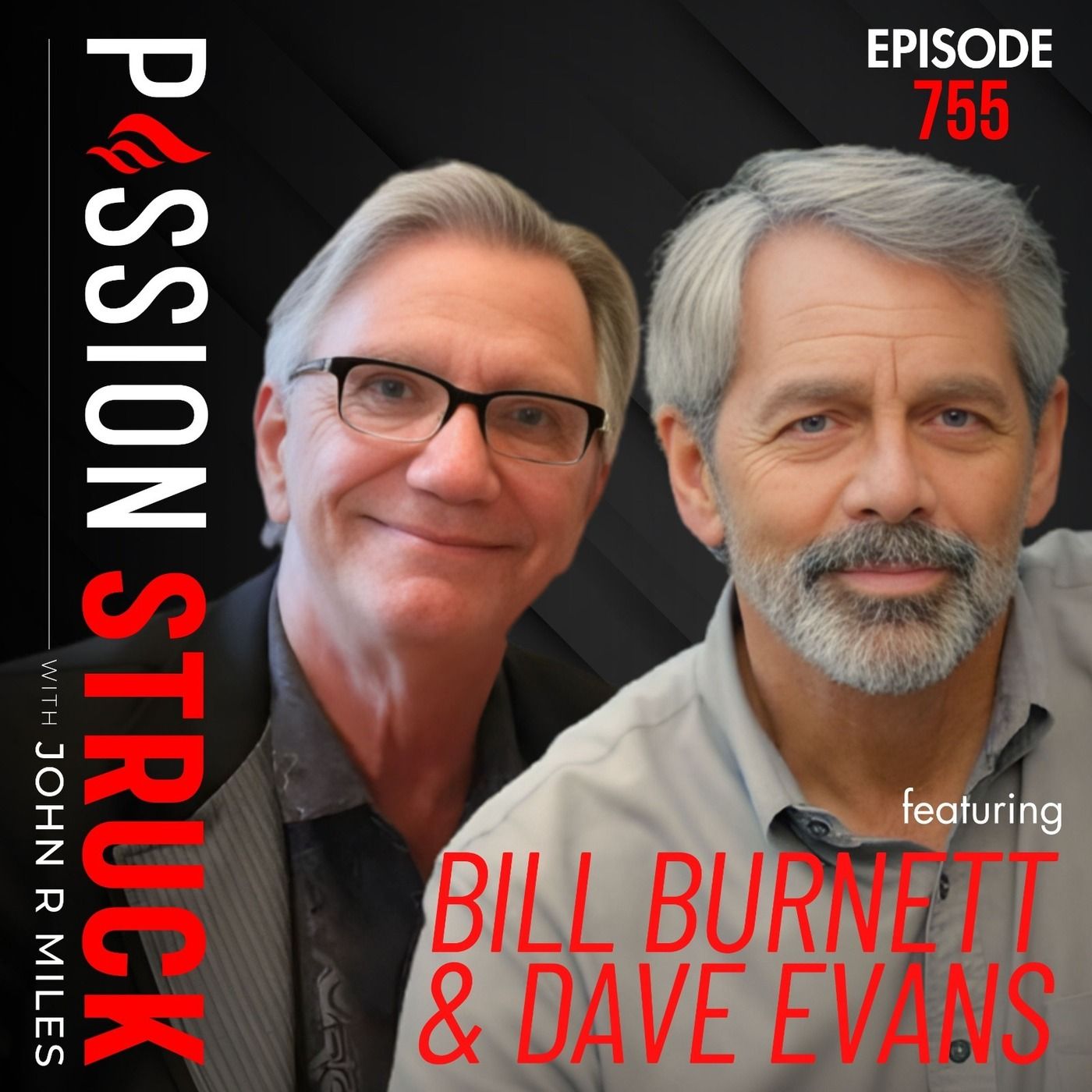
Passion Struck with John R. Miles
How Do You Design a Meaningful Life | Bill Burnett & Dave Evans - EP 755
01:02:42
What if the reason you feel unfulfilled is that you’ve been approaching it all wrong?In this episode of Passion Struck, I sit down with Bill Burnett and Dave Evans, the visionary minds behind Stanford's Life Design Lab and co-authors of How to Live a...
Loading summary
Transcript129 lines
- [00:01]
Spinquest Announcer
Forget whatever plans you have this weekend because you're staying at home and playing on spinquest. And there's never been a better time to sign up than right now. New users get $30 coin packs for just $10. All the table games you love with hundreds of slot games and real cash Prizes. That's at spinquest.com S P I N
- [00:21]
Spinquest Legal Disclaimer
Q U-E-S-T.com Spinquest is a free to play social casino void where prohibited. Visit spinquest.com for more details.
- [00:33]
Liberty Mutual Insurance Spokesperson
And Doug, there's nowhere I wouldn't go to help someone customize and save on car insurance with Liberty Mutual. Even if it means sitting front row at a comedy show.
- [00:42]
Liberty Mutual Casual Commentator
Hey, everyone, check out this guy and his bird. What is this your first date?
- [00:46]
Dave Evans
Oh, no.
- [00:46]
Liberty Mutual Insurance Spokesperson
We help people customize and save on car insurance with Liberty Mutual together. We're married. Me to a human, him to a bird.
- [00:53]
Liberty Mutual Casual Commentator
Yeah, the bird looks out of your league.
- [00:54]
Liberty Mutual Insurance Spokesperson
Anyways, get a quote@libertymutual.com or with your local agent.
- [00:57]
Liberty Mutual Casual Commentator
Liberty. Liberty. Liberty. Liberty.
- [01:01]
John Miles
Coming up next on Passion Struck, we
- [01:03]
Dave Evans
flip the micro erasures that you're talking about. People not noticing and letting life get away from them into inking it down. That's why one of our exercises is the savoring exercise. Try to pay attention while you're living life. But if life goes by at real 1x speed, if you're I'm watching this on stream. I could 1.2x or I could 0.7x. Life is 1.0x all the time and it's too fast to fully appreciate it. So grab some of those moments, come back to them later, and do a deep savoring exercise. Then you not only don't erase it, you get to keep it.
- [01:32]
John Miles
Welcome to Passion Struck. I'm your host, John Miles. This is the show where we explore the art of human flourishing and what it truly means to live like it matters. Each week I sit down with change makers, creators, scientists and everyday heroes to decode the human experience and uncover the tools that help us lead with meaning, heal what hurts, and pursue the fullest expression of who we're capable of becoming. Whether you're designing your future, developing as a leader, or seeking deeper alignment in your life, this show is your invitation to grow with purpose and act with intention. Because the secret to a life of deep purpose, connection and impact is choosing to live like you matter. Hey friends and welcome. Welcome Back to episode 755 of Passion Struck. Over the past few weeks, we've been building something intentionally together in this April, Purpose by Design. We started with Arthur Brooks, exploring why so many people today are facing a crisis of meaning. Then with Wharton Professor Corrine Lowe, we looked at how the systems around us shape our lives. With Stanford professor Claude Steele, we explored how identity and perception influence how we show up. And with Angela Meyers, we uncovered the fundamental human need to feel like we matter. Earlier this week, in our last episode with Kayla Shaheen, we turned inward, exploring how to integrate our past and reconnect
- [03:01]
John Miles (Host)
with our authentic self.
- [03:03]
John Miles
But today, we take the next step. Because once you begin to understand who you are, the question becomes, how do you actually build a life around it? Because meaning isn't something you stumble into, it's something that you design. And that's where today's guests come in. My guests today are Bill Burnett and Dave Evans, pioneers of life design, co authors of how to design your Life, and also their latest work on building a meaningful life. In this conversation, we explore a powerful reframe that life isn't a problem to be solved, it's a process to be designed. Because so many people today are stuck. Stuck waiting for clarity. Waiting for the right path, waiting for certainty. But what Bill and Dave show us is clarity doesn't come before action. It comes through it. In this episode, we explore why meaning isn't something you find, it's something you design. The difference between wayfinding and chasing a fixed destination, how to prototype your life instead of waiting for certainty, why curiosity is more powerful than fear driving change, and how small experiments can unlock entirely new directions. At its core, this episode is about one of the most liberating ideas that you can embrace that you don't need to have your life figured out, you just need to start building it before we dive in. Quick note if you want to go deeper into this Purpose by Design series, I'm sharing companion reflections and tools@theignitedlife.net you can also catch this episode in all
- [04:32]
John Miles (Host)
our episodes on our YouTube channels at
- [04:34]
John Miles
John R. Miles with Passion Struck clips. Now let's dive into my conversation with Bill Burnett and Dave Evans. Thank you for choosing Passion Struck and choosing me to be your host and guide on your journey to creating an intentional life that matters. Now let that journey begin.
- [04:51]
Spinquest Announcer
I'm here with spinquest, where you can play and win from the comfort of your own home with hundreds of slot games and all of the table games you love with real cash prizes. Right now, $30 coin packs are on sale for $10 for new users. It's all@spinquest.com that's S-P-I-N Q U-S-T.com Spinquest
- [05:14]
Spinquest Legal Disclaimer
is a free to play social casino void where prohibited. Visit spinquest.com for more details.
- [05:23]
Liberty Mutual Insurance Spokesperson
And Doug, there's nowhere I wouldn't go to help someone customize and save on car insurance with Liberty Mutual, even if it means sitting free front row at a comedy show.
- [05:32]
Liberty Mutual Casual Commentator
Hey, everyone, check out this guy and his bird. What is this, your first date?
- [05:36]
Dave Evans
Oh, no.
- [05:37]
Liberty Mutual Insurance Spokesperson
We help people customize and save on car insurance with Liberty Mutual together. We're married. Me to a human, him to a bird.
- [05:43]
Liberty Mutual Casual Commentator
Yeah, the bird looks out of your league.
- [05:44]
Liberty Mutual Insurance Spokesperson
Anyways, get a quote@libertymutual.com or with your local agent.
- [05:48]
Liberty Mutual Casual Commentator
Liberty. Liberty. Liberty. Liberty.
- [05:51]
Blue Lizard Sunscreen Announcer
The sun is calling. Are you ready? From beach days to soccer plays. Blue Lizard Australian Sunscreen helps protect your family's skin. Skin so you can focus on the fun, not the sun. With no fragrances, parabens or phthalates, our mineral sunscreen is designed for your sensitive skin and trusted by dermatologists, pediatricians and parents alike. Be fearless in the sun with Blue Lizard Australian sunscreen. Shop now on Amazon.com.
- [06:25]
John Miles (Host)
I am absolutely, absolutely thrilled today to welcome Bill Burnett and Dave Evans, who are co authors of this fantastic new book, if you're on YouTube, that I'm holding up, called how to Live a Meaningful Life, which I absolutely just devoured. So I'm so honored to have you guys both on the podcast today. And I understand you all got together almost two decades ago when you were thinking about the way of life and the future is unknowable, but you might be able to design your way into it. And Bill, maybe you can give us the backstory of that.
- [06:59]
Bill Burnett
Well, Dave and I have known each other from the business world for a while, but back in 2006, I had been teaching part time at Stanford, working at Apple, working in other places. In 2006, I joined the faculty full time. And in 2007, Dave called me up and said, hey, I'm teaching this class over at Berkeley. He can explain what that was about. What do you. Let's have lunch. I want to tell you about what I'm doing. And we talked about it and I said, hey, we should have that class at Stanford. Absolutely. And we got to do it through a design lens because I'm running the design program. That's the only thing I know how to do. So it turned out to be a pretty easy synthesis. Dave, you want to talk about the Berkeley thing?
- [07:32]
Dave Evans
Well, yeah. Long story short, I'd been working with young people for a long time. And I too, had been struggling with what do I do with my life since I was 19 and I got invited to teach a class at Berkeley. And so I taught a course called Finding youg Vocation, subtitled Is yous Calling Calling? And thought I was going to do it once. And one of the kids says, hey, my roommate wants to take the class. You're coming back in the spring, aren't you? And I said, well, tell him to bring at least nine of his friends and I'll come back. And 14 semesters later, we appear to be onto something. And then Bill had the wise idea of taking a 50% cut and pay from being a CEO of a design firm to being a teacher full time. And we said, yeah, let's play. And the drive to Stanford is much better than the drive to Berkeley. And you get it had much better support through the team that Bill had built. And then we started teaching just designers between 2007 and 10. And then the university said, hey, I think you guys could do this for everybody. We gave it a try in the spring of 2010, and that took off. And then we wrote the book and that exploded. And then you called and we got here this morning, we wrote two more books and did more things.
- [08:33]
Bill Burnett
Whole thing was that the students really needed it, like we needed it. When we were graduating, we didn't get any help. David used to say, we're the only Popsicle stand in the desert. At the time, we were the only guys talking about, how do you take your education and figure out what it's for? And that's what we've been doing ever since.
- [08:50]
John Miles (Host)
I absolutely love it. And on a side note, my brother works for Chick Fil A and is in charge of design science for them. So they use it pretty heavenly in how they're collaborating teams and how they're thinking about new stores and etc.
- [09:08]
Dave Evans
They do a really good job. Chick Fil A is a particularly coherent company, so. Nice. Nice to hear that.
- [09:14]
John Miles (Host)
Well, we were talking before you guys came on about mattering its focus. And interestingly enough, Chick Fil A, in talking with my brother, designs their store ecosystems around the concept of how do you make your customers matter? And how do you cater to them in a way that all your interactions make them feel that way. So it really is an interesting company to study when you think about mattering and implementing it at scale. So a few years ago, bill, in episode 206, I had Jeremy Utley on the show, and we were discussing what he And Perry teach a concept called IdeaFlow. How does idea flow differ or complement the work that you guys do?
- [10:02]
Bill Burnett
Oh, I know Jeremy well. He's a good friend and I've known Perry. In fact, Perry was one of my master's students many years ago. And their idea was a reframing of venture capital. Talks about deal flow. And their reframe was it's about ideas and this human centered approach to design where you're constantly having empathy for trying to understand users, putting the users first. Chick fil a example is a good one. And figuring out how to really delight them with what we call latent means. You can't just ask people what they want. You have to really dive into their what the situation is, whatever you're trying to solve. And from that, this idea of generating lots and lots of ideas which turn into prototypes, the core thing in design thinking, it's exactly the same in life design. You don't know what the world is going to be five years from now. You have empathy first for yourself, who am I? What's my goal? What are my direction, my ideas and directions. That takes a little bit of time to figure out, right? We're talking about intrinsically, what's my motivation? And then empathy for the world. What does the world need? And then you have lots of ideas as you prototype your way forward. So I think the two are very compatible, very similar because they come from the same human centered design basis.
- [11:12]
Dave Evans
What's really going on there, John, is a very important part of what we do. Because as Perry and Jeremy and we know those guys well, zoom back from venture capital and go, no, it's not deal flow, it's idea flow. That's a reframe. That's looking at the circumstance differently and defining your problem in what will actually end up becoming the most generative way that allows the most innovation to occur. And so reframing is like a super tool, a superpower for designers. And everything Bill and I have done has been because we heard this hue and cry from a community that we care about and what can we do for these guys? And it always starts with a reframe, as does the book you just read, which spends a bunch of time reframing. Oh, so you're in a lot of pain about this meaning making thing that's not working for you. What's your problem? Then they describe the problem. Then we go, oh, well, if you're thinking about that, where you're probably stuck on a dead end, we need to reframe that. So reframing is almost where we start every time.
- [12:07]
John Miles (Host)
Well, thank you for sharing that because I think as I was looking back upon their book and stuff that I implemented during my Fortune 500 career and thinking about how you're applying this to life design, there were a lot of similarities and that's why I brought it up, given we're on passion struck. Dave, I've heard you say that passion isn't something you find, it's a way of being. And I feel it's the same thing. People get confused when they hear passion struck. And I'm not telling them, go out there and find your passion. It's more once you find it, how do you live it? How do you design a life around it? When you think about that, how does that idea change the way people should think about building a meaningful life?
- [12:48]
Dave Evans
Bill and I have a rep as the anti passion guys. One of the lead dysfunctional beliefs we've been Talking about for 20 years is the question what's your passion? And the research shows that 8 out of 10 people answer that question with I don't know yet, Dave, I hope I find mine or I've got a bunch. Which one did you want to hear about first? And either the I haven't found it or I'm oversupplied with passion person doesn't have the convenience of that one clearly defining passion that will direct their lives for the rest of time and open the way. If you're one of those people, eight out of 10 of them have a passion the marketplace isn't currently interested in. So watch out for that presupposition that passion is the starting place. Our position is not the passion is the starting place. It's usually earned by living deeply into a life in front of you and then growing into something that actually could become a passion. So we're big fans of living passionately, but not around the prescription of an a priori passion is the prerequisite to the well lived life. And probably the terminology we use more recently is living fully alive. And on the way to that, if you find a particularly animating passion, great, but don't stop if you haven't yet.
- [13:58]
John Miles (Host)
Bill, I want to turn this one to you. I had interviewed Hal Hirschfeld a couple years ago and we were talking about the concept of future self in his last book that that he wrote. And we started talking about the concept of heading north. And I've once heard you said this concept that you don't necessarily know where you're going, you're heading north and are open to something Wonderful happening.
- [14:19]
Bill Burnett
Yeah.
- [14:20]
John Miles (Host)
In a world that we live in that's obsessed with certainty. And five year plans, two year plans, ten year plans.
- [14:27]
John Miles
What does it mean to live with
- [14:28]
John Miles (Host)
a direction without a destination?
- [14:31]
Bill Burnett
I think there's an old expression, no plan for battle survives first contact with the enemy. So I'm not a military guy, so I'd say no plan for your life is going to survive first contact with reality. You can plan some things, you can plan your retirement, you can put money away in a 401k, you can plan to put some money away for the kids education. But we are always moving into an uncertain world and even more so now with AI and other disruptions, climate and other things. In our second book we wrote a whole four chapters on what we call disruption design. So I think design starts in reality. One of our mindsets is radical acceptance. I'm here, I don't really know what the next five years is going to be, but doesn't mean I couldn't do something. We do five year odysseys, for instance, three completely different versions of your life. So we're not against imagining the future. In fact, we're very pro imagining the future. But you got to have multiple options because you can't know what's going to happen in the future. So that's the uncertainty part. But the way I like to frame it for my students is don't you hope that five years from now you're doing something that hasn't even been invented yet? That's going to be so cool. We believe that the future sense certain, but we believe. But designers do uncertain things all the time. I don't have my iPhone with me, but like folks doing the iPhone, before there was an iPhone, nobody knew what one was, so they had to invent it by prototyping, by building into the future. And that's how designers imagine the product that doesn't exist yet. And you are like the product that doesn't exist yet. You'll be something different. We define people as a becoming. So you'll be something different a year from now, two years from now, three years from now, and the outside world will be different. And design is a way of prototyping into that uncertainty, taking small steps. And then if you have done the work we call the compass exercise in the book, where you've done your life view, your work view and your story, you know, the story of who I am today, that gives you a really good sense that I've got. I don't necessarily have to know where I'm going exactly. But I have to know I'm going in the right direction. And if I have a compass, I can do that.
- [16:33]
Dave Evans
Just to piggyback on that a little bit, we state that the objective of the Life Design Lab is to assist you in the formation of a conscious competency in life and vocational wayfinding. Wayfinding, which is figuring it out as you go along, not navigation. Hitting directly. Exactly. The most efficient pathway to that known destination. And we don't know the future. So you're wayfinding, not navigating, which means we're making it up as we go along. Life is in fact an improv skit. We're improv trainers. The improv thing doesn't mean, oh my gosh, we're out of control. It means life's really interesting. Let's get good at that. A good buddy of ours named Mark Schar, who's a profit Stanford now, happened to accelerate himself to being the co CEO of Procter Gamble by his early 50s, late 40s, and then got sort of killed. Corporate life. Now what do I do? Ended up becoming the chief marketing officer of Intuit, the Quicken people. Because this little guy named Scott Cook, who founded that company happened to be his old college roommate. And he calls Guy, he says, I'm bored, what do you want? He said, come work for us. Come do high tech. So he nails that, takes that company public. Now he's only 50 something. Look, now what I know, I'll get a PhD in neuroscience at Stanford. What else? And becomes a Prof. That's why we've talked with him a couple of times. But Guy's a killer corporate leader. And Mark does a thing on planning. And he says, by the way, that five year plan idea, that was Marx's idea. We know how well that worked out. He said how long? And he asks his grad students, how long a plan do you think makes any sense to do? And he would say two years max. And that was pre AI. So the truth is the really smart guys know that planning is always a dynamic reality.
- [18:12]
John Miles (Host)
As you guys have been promoting this book and I'm a little bit late to the game, there have been some tremendous conversations you've had. Two of my favorites were the ones you did with Lori Santos and then Mel Robbins. Lori, I always think she's such a great interviewer. So I love it when I'm doing research and I catch one of her episodes. But she was opening it up, talking about this idea that people are exhausted today and I'm going to reframe this from that because I don't think people today are necessarily miserable, but they're just not fulfilled. And you guys don't know my background. I know, Bill. I think you started at Apple. I was the CIO at Dell. I spent a lot of time in rooms. We were talking about Microsoft with Steve Ballmer, and I've met Gates a number of times and even interviewed there to become their cio, which had I know where Satya was going to take it, I probably would have accepted, but. Yeah, but what I found in my career was I had reached this point where I wasn't necessarily miserable, but I definitely didn't feel fulfilled. I felt like more of me was getting erased, the more I was pouring my time into this company at the expense of my health and my relationships. And oftentimes life looks good on paper like it did for me. Yet something feels missing. What do you think, Dave? I'll throw this to you. Is actually going on. Beneath that quiet dissatisfaction, the two complaints
- [19:48]
Dave Evans
we heard the loudest that goaded us to write this book are it's not working for me because one, I'm not having the impact I hoped for or I'm not being fulfilled so that I'm not as fulfilled as I had hoped for. Thing that you're characterizing, we're hearing up and down the line. And I think what's going on there is two things. Number one, the life people are living is not as fulfilling as it could be. Which is why our book is about how to get more out of the life you're in, not cram more into it. Because I'm not fulfilled. What am I missing? Let me go add something. And the adding thing isn't working. That gets you on the hedonic treadmill. There's never enough of adding. So the never enough problem is really desperate. And the other one is, well, how we think of fulfillment doesn't work because without doing the whole diatribe on it, the average person thinks of fulfillment in our observation and based on our research, the way that Maslow told them to think about it, which was self actualization, defined in the 1943 origination paper that created the hierarchy of needs as becoming all that one can be. And Bill and Dave will tell you after 20 years of this Life Design Lab thing that we know for a fact as the psychology and neurology that you contain more aliveness than your lifetime will permit you to express. If your goal is to be fully manifested, you're doomed. And that's the good news. There's more of you than time. So you're never going to be bored. But if I have to experience all of me getting out in the world and being recognized, and a lot of people want that, you can't because you're way too big. So if you have that decision about your fulfillment, you just said you now have a policy of being despondent for the rest of your life. Bad choice. So we pivot that the reframe is you can't be fulfilled that way, but you can be fully alive. You can be all in in what you're presently doing in this particular moment. So probably the former John was less fully alive even in that moment than his finite self wanted to be able to be. And that was a hint that the universe or God or your soul is telling you it's time to be doing something differently.
- [21:53]
John Miles (Host)
Before we continue, I want to pause
- [21:55]
John Miles
for a moment because one of the ideas at the heart of today's conversation is this Many of us are waiting for clarity before we take action. But what if the real issue isn't clarity? What if it's disconnection? Disconnection from who we are, from what matters to us, and from the belief that our life actually counts. That's what I've been exploring in my upcoming book, the Mattering Effect. Because what I found is that so many people aren't stuck because they lack options. They're stuck because they've lost their sense of mattering. And when that happens, you hesitate. You overthink. You wait. But when you reconnect with your sense of mattering, something shifts. You start acting. You start experimenting. You start designing your life in a way that actually feels aligned. The Mattering Effect is about helping you understand that shift and how to reclaim it. You can pre order the Mattering effect now@thematteringeffect.com it's available October 6th. Now a quick break for our sponsors. Thank you for supporting those who support the show.
- [22:56]
Spinquest Announcer
Whether it's slots or live dealers, Spinquest.com has the fun and action you're looking for with Spinquest exclusives. Blackjack, roulette, baccarat and even live dice. With craps and bubble craps. The games never stop so you don't have to. And right now, new users get $30 coin packs for just 10 bucks. Play now@Spinquest.com SpinQuest is a free to
- [23:20]
Spinquest Legal Disclaimer
play social casino for where prohibited. Visit spinquest.com for more details.
- [23:26]
Ryan Reynolds (Mint Mobile)
Ryan Reynolds here from Mint Mobile with a message for everyone paying big wireless way too much.
- [23:31]
John Miles
Please.
- [23:31]
Ryan Reynolds (Mint Mobile)
For the love of everything good in this world stop. With Mint, you can get premium wireless for just $15 a month. Of course, if you enjoy overpaying. No judgments. But that's weird. Okay, one judgment anyway. Give it a try@mintmobile.com Switch upfront payment
- [23:48]
Blue Lizard Sunscreen Announcer
of $45 for 3 month plan equivalent to $15 per month required intro rate first 3 months only, then full price plan options available. Taxes and fees extra. See full terms@mintmobile.com.
- [24:01]
John Miles
You're listening to Passion Struck right here on the Passion Struck Network. Now let's return to the conversation with Bill Burnett and Dave Evans.
- [24:10]
John Miles (Host)
That is so true. And thanks for bringing up Maslow. And I've done a lot of studying of self actualization. And I think it's interesting that towards the end of his career he realized that self actualization wasn't exactly working. And so I've really shifted more to self transcendence.
- [24:28]
Dave Evans
Right.
- [24:28]
John Miles (Host)
And studied Yadin and Newberg and Vago and Scott, Barry Kaufman's work. And I think that is really where a lot of people should focus more of their time. What do you guys think about that?
- [24:40]
Dave Evans
Well, just a quick on that. Absolutely. Because it's really interesting that 8 out of 10 people still think the top of the pyramid is self actualization. His private notes before he died, but never published are self transcendency. The result of which is meaning making, by the way, not fulfillment. And he's still wrong because he made it hierarchical. And it's not. Why is it that refugees in war camps in Afghanistan are experiencing self transcendency? They're only on level two. They're not allowed to get to level seven. Surely you're. Because self transcendency stripes through all the layers. It's fundamentally a different way of thinking about being a person.
- [25:13]
Bill Burnett
And it shows up in all the wisdom traditions. It would be called compassion. It would be called selflessness. And we know that meaning comes primarily from relationships. Right. The Harvard study shows that relationships is the number one predictor of longevity and happiness and fulfilling thinking your life was meaningful. And all of that is about doing something for somebody other than yourself. Transcending. If you think of self actualization as the ego fully realizing itself. And then self transcendence is beyond the ego and recognizing that we're connected to a much, much larger system than ourselves. That's where meaning comes from. So you got it right in thinking of it that way.
- [25:55]
Dave Evans
The lovely irony is the best way to feel just like yourself is be having an experience this bigger than you, which it can be service. It could be nature. It could be a Mystical experience. It could be a variety of things. Dr. Keltner's eight versions of awe, they all work, but it's about transcendence, not about fulfillment.
- [26:12]
John Miles (Host)
So I'm glad you brought Dacher up, because I probably quote him more than anyone because I love his concept of moral beauty. And, yeah, I actually just released a children's book a number of weeks ago, and I actually built something off the back of it based on his work. I was just chatting with him the other day called Passive.
- [26:28]
Dave Evans
You know, I was hanging out last week.
- [26:30]
John Miles (Host)
That's all. That's great. I think you guys will like this idea, because Pass the Ripple is all about how do you get children to start practicing acts of kindness and then watch to see that kindness grow? Because as you just framed it, we don't experience awe enough. If you think about it only through the big moments, but if you think about it through the acts that we do on a. On an everyday basis and how much that fulfills you and actually causes you to. To live longer, it really becomes a compelling thing to think about. That or compassion. I'm going to tie this in because in the book you guys really write about that meaning isn't discovered, it's designed. And it arises in these moments that we're talking about, these micro moments. And I often think, whether it's meaning or what I like to call mattering, that the way we lose either is through a series of micro erasures. And so the way you have to build it back is through a number of micro moments or micro gains. And you explicitly frame life as a wicked problem with no single solution. What did you mean by if you design for meaning, you will find it everywhere? And I'll turn that to Bill.
- [27:46]
Bill Burnett
In the book, we call it the scandal of particularity, that the finite human mind cannot experience the infinite love of God, the infinite beauty of the universe, or anything infinite. But we do recognize it in these moments. A beautiful sunset, a connection with someone you love. So the scandal particularly suggests that it is scandalous. It's crazy that you can't have the infinite thing, but the infinite thing shows up all over the place. In these finite moments, particularly, people will experience it in nature. They'll experience it in connection with other people. Those are the two places where we find the most meaningful moments. So that's where we. That's where both the neuroscience of things like flow. We talk a lot about the transaction world and the flow world living just underneath all these transactions. And we expand the idea of flow to be more than just these peak experience. But flow experiences are moments where time stands still. You're fully engaged in the activity. And those are intrinsically meaningful moments. So all the things that we can experience in moments and we can design them or we can recognize them when they arrive. Right. Are the things that will make us, will make us more human. And you talked to the beginning of people being either exhausted or just overwhelmed. I think we are overwhelmed. Media and everything else are overwhelming us and stealing our attention and that those are the little microaggressions against meaning. Right.
- [29:10]
John Miles (Host)
That.
- [29:10]
Bill Burnett
Oh, there's another thing in my Instagram feed. Oh, there's another thing on my YouTube feed. So if we can help people get back to discovering those moments and then designing the moments so that they have the experience of flow, of wonder, of awe, that's where the good stuff is. And again, it's not about adding another practice. I got to learn mindfulness. I got to learn some new practice. I got to learn fire breathing or whatever. It's just about getting more out of the moments that are already available to you right now.
- [29:39]
Dave Evans
John, you really, by asking that question, you've revealed that you really got it. Because the subtle little trick we're trying to play in this book is frankly just flipping the question from stop waiting to find it and start choosing to design it. It flips from, boy, I hope some of that meaning stardust falls on me today as opposed to I'm going to go get it. I mean, you actually can be an agent of it. You're not going to fantasize. It's not magical thinking, but it's actually your intention realizing itself by taking steps that you can take. And you we flip the micro erasures that you're talking about, people not noticing and letting life get away from them into inking it down. That's why one of our exercises is the savoring exercise. Try to pay attention while you're living life. But life goes by at real 1.1x speed. If you're I'm watching this on stream, I could 1.2x or I could.7x. Life is 1.1.0x all the time and it's too fast to fully appreciate it. So grab some of those moments, come back to them later, and do a deep savoring exercise. Then you not only don't erase it, you get to keep it.
- [30:44]
John Miles (Host)
So, Dave, I'm going to come back to you and I wanted to say I was so sorry to hear about your wife and why I'm connecting. This is. I lost my sister about 18 months ago to pancreatic cancer.
- [30:59]
Dave Evans
Oh, so.
- [30:59]
John Miles (Host)
And I've heard that's a bad choice.
- [31:02]
Dave Evans
Pancreatic cancer is a bad one to pick.
- [31:06]
John Miles (Host)
It really is a bad one. But if you catch it early enough and you can do the Whipple surgery, many people are living decades and decades beyond it. But you're right, it's a difficult one to get thrown at you. But something that I heard you talk about with your wife and something that Carolyn really decided to do in her last years of her life were very similar. She decided that for her, she didn't want it to be a death sentence. She wanted to still live out fulfillment in her life. And so she designed it in a way that she had always wanted to become a counselor. And so once she got her diagnosis, she actually went back to University of Texas and got her degree, her master's degree in social work and was actually practicing it. And she told me in the last couple years of her life, she found more fulfillment than she had in the decades before as a result, because. And she told us as a family, I don't want you to live through me like I'm dying. I want you to live like I'm completely present with you, because that's how I'm trying to live my life.
- [32:11]
Dave Evans
And I think I'm still here.
- [32:12]
John Miles (Host)
Yes, I think it goes to the decision you made with your wife as well.
- [32:17]
Dave Evans
Those of you listening what John's referring to. I lost my beloved wife Claudia to cancer five years ago. And though in the amazing generosity of the universe, on the other side of that door is the woman I'm going to marry later this year, somebody else has signed up for the outrageous project I never would, which is living with me, but nonetheless. So we had this fabulous marriage, and at 69, she contracts terrible cancer and then dies at 70 nine months later. But we framed that. We held the news of her terminal diagnosis first day into the Dr. She's terminal. Four, metastasis. Dead woman Walking picked a really bad cancer, and we said, okay. She goes, okay. It's sad, not tragic. So thing one is, it's sad that I'm dying 15 years ahead of the plan, but I'm almost 70 and I've done a lot of things, and there's really nothing left on the list I need to do so we can live well into what remains. And so thing one is, it's sad, not tragic, so don't let this thing overwhelm you. And thing two is, there's nothing I really need, but there are a couple of Second helpings, I wouldn't mind. So let's live into the second helpings. And we did that as well as we could, and it really did work, because, again, what your sister's doing is living in the present tense. I'm the theist and Bill's the atheist, but I go down to this monastery for 26 years with a bunch of splinter group Benedictine guys, and part of their rule is to daily contemplate the hour of your death, which I used to think was astonishingly morbid. And then after going through death intimately, I've been through a lot of death, but never the intimacy of death with my wife and the intimacy of the grief. You're following it in 2021. And then I got it, like, oh, being reminded of your finite particularity, which this death thing brings front and center, really makes right now animated, so your ability to be present. So your sister did a really good job of saying, how can I live here and not be stuck in this? Oh, I had in mind living to 80. And now how old is she?
- [34:09]
John Miles (Host)
When she died, she was just about to turn 50.
- [34:12]
Dave Evans
Oh, man. So I get to 50, and all this thing that I had in mind I'm not going to get. So I'm going to spend the last year of my life suffering I. The loss of this thing that doesn't exist called the age 50 to 80, as opposed to. No, I'm spending the last year of my life living my 49th year. So am I here in reality or here in this magical space called what I had in mind, which the Buddhists call suffering? So it's just about being here.
- [34:41]
John Miles (Host)
Bill, I'm going to take that and throw this to you. When I think about what you were just saying, Dave, and I think about Carolyn's life, to me, she is an example of someone who prototyped her life because she was experimenting, because she was like, what do I have to lose? I'm going to try to do everything I've always wanted to do. So I live without regret. For a listener, we started this conversation talking about idea flow, which is really about prototyping. What does it really mean to prototype a life? And how can a listener experiment without blowing everything up in their life?
- [35:15]
Bill Burnett
Yeah, well, that's the beauty of prototyping, is our mantra. Set the bar low and clear it. I'm very sorry to hear about your sisters. That's way too young to die. But she gets this diagnosis, and she says, all right, screw it, I'm going to do. What I really wanted to do was be A counselor. And then she is one, and she reports that as the most meaningful years of her life. God, for God's sakes, let's not wait till we get cancer. Stop now and say, what is it I'm really supposed to be doing with my life? And if you have this, like you said, this sort of moment where you realize I'm not that fulfilled, I'm crushing it. Cio, big company, But I'm not that fulfilled. There's a signal in there from your gut, from whatever, that some part of your intuition that's saying there's something you're not paying attention to or something you're leaving on the table. So maybe you want to make a change, come to a decision. I need to make a change. Prototyping is the way of making it really simple and really less scary. Right? I just saw a neuroscience report. They put people in a scanner and they make them contemplate a problem that's really painful for them that they currently have, and then they contemplate changing it and doing something new in the future. And it turns out the brain is far more afraid of changing something in the future than it is of holding onto something that might even really be painful. We like our problems, and it's hard to change. So prototyping is a way to change, which is really low threat. And anything can be a problem. A conversation. Maybe if I woke up one day and I said, yeah, maybe I want to be. We run, we train coaches on our stuff and we run into people say, I want to be a coach. I think being a coach would be a good thing. I'm going to help people, maybe executive coach, life coach, something. Well, you don't quit your job and then try to start a coaching practice. That's crazy. Do a prototype, talk to a coach. Talk to two or three coaches. You can find them there. People who like to talk to people, that's what they do for a living. Find out what it's like to be a coach. Find out what it's like to market coaching services. Maybe do a ride along with a Coach. Take a 1, 1 session with the coach and just be, hey, I'm Harrison and Zerber. I'm a trainee or whatever. So prototype things to see both to get the information. Like, you can do a lot of research, but talking to somebody is way more powerful. They've gonna talk about surrogation versus research, but do the research, do the prototypes. Have the felt experience of what it might be like to be that person. And slowly. This is about building your way Forward. Every prototype is a mini build. When we were, I was at Apple, we were inventing laptops. They want to know what a laptop looked like. We built 350 prototypes roughly of small subsections and systems to see how do we sneak up on this thing. So prototyping is about sneaking up on the future low risk, setting the bar low. And you can prototype anything in prototype a birthday party, you can prototype a career change. But it's all about taking small measured experiments. We call them prototypes to discover what does it feel like to maybe be a person moving in that direction.
- [38:08]
John Miles (Host)
My first book I wrote titled Passion Struck. Right last third of the book I introduced something called the deliberate action process. And the first two parts of the book really focused on prototyping techniques to build a life of significance. And I came up about this deliberate action process because have done so much agile development. I wondered could you apply this to designing your life?
- [38:36]
Dave Evans
Right.
- [38:37]
John Miles (Host)
And in fact it actually works.
- [38:38]
Alvin Roth
Right.
- [38:39]
John Miles (Host)
So the first phase for me is you prototype all these things that, that and then you got to prioritize it. Yeah, but the biggest stuck point that I see with people is after they do some prototyping and then they prioritize, they don't do anything. They like get so stuck, they don't take that next action, they don't have that momentum. What have you guys found? Get someone to go from the prototyping phase to the action phase.
- [39:07]
Dave Evans
Two things come to mind. First of all, keep the prototype going. So if you did one prototype, I went and met with a coach. Yeah, I liked it. I think I probably want to do that. What you really did there was a test, not a prototype. So in design language, you prototype to learn something experientially rather than conceptually. You go out and have biased action lived experience. It's an empirical, bottom up, reality based approach to innovation. And so do it again. Because I'm not just prototyping, I'm not just doing these things to answer the question what does it cost here? Should I do it? Those are transactional questions. It's the narrative. What's it really? Does it really matter? I noticed, I think it's probably the right thing to do. But I'm not yet animated enough to overcome my own inertia. So apparently I need more activation energy to get over the speed bump to get into that parking lot. So go talk to some more people, go find somebody else who's go, oh, I need to go prototype somebody who stalled or somebody who is in regret. And five years later it's too late. I wish I had done that. That's a product. I should go prototype what it's like to be that person. So part of it is keep the prototyping going and keep the questioning going until there's enough momentum that you can't not. You're going for the can't not momentum build. That's thing one. Thing two is stop doing this by yourself. This is where the community thing have a design team. Even if you two counts of teams one, we're all doing something like this together and supporting one another. That's a preferred team or just it's my support team. The spotters on my equipment. And these three people are checking with me every three weeks and like how's it going, Dave? And they're there to support what I'm trying to do and they can call me on my stuff including, well, gee, I noticed you're still learning that you want to do this and you're not taking any action. What's going on there? Do you want us, do you want us to go with you while you sign the form to take the coach certification training? What does it take? So two things are keep the prototype going and get some friends involved to hold you accountable. That'll help pull you over the bump. Bill, do you have any other other inertia overcoming ideas?
- [41:09]
Bill Burnett
Well, the number one one of the mindsets, big mindsets in both books is curiosity. We take curiosity up a notch and call it wonder by adding mystery. But curiosity is the thing that will overcome the fear. It's all about fear. The reason I'm stuck is that I'm afraid to try something new. And the reason we make break it into really small steps is that's doable. I can see going from one step to another. I can't see going from here to running a full marathon. That's too much. Or quitting my job. That's too much. But curiosity in these conversations, you should get deeply curious about why people do are doing what they're doing. And I would ask, I would also, I would ask if I'm thinking about coaching. I ask coach, what's the most frustrating part? Oh, I'm coaching people and they're not making any progress. How does that happen? Yeah, they're just. And then so there's a Just get curious. Deeply curious. Because the other thing is you're asking people to have a conversation with you about their lives. And people are pretty willing to tell the story of their lives. But don't call somebody and say, what's it like being a coach. That's not a curious question. You could look that up on the Internet, find out about the person, their practice, where they came from, how they. What the transformation in their life was. Nobody graduated from college with a coaching major as far as I know. So there's always a transformation. Get curious. And that curiosity is just an intrinsic human thing. You might have had to turn it off because jobs and people don't like a lot of curiosity. Schools don't like a lot of curiosity, it turns out. But if you're curious, it will animate you past the fear of trying something. And if you're stuck, suck. I'll bet you're trying to do something too hard. We talk about. Prototyping is something that's available. It's available this week. Well, I need to talk to the COO of Microsoft or I can't move forward. Well, I happen to know the other one. She's in Mary Ellen. But if you want to talk to the current one, that's a pretty heavy lift. Unless your dad's roommate's best friend happens to be that guy gal, you're not going to get that prototype. So try something. If you're stuck, you're trying something too hard probably. And I can't believe you'll ever run out of curiosity because once you start, I got a base, got a bunch of grandkids, I've got five year old Connor, and when I hang out with Connor, I remember what curiosity is really all about. Because when you're five, the world is a really cool place and he asks questions about everything.
- [43:38]
John Miles (Host)
I am going to have to send you guys both a copy of you
- [43:41]
John Miles
Matter Luma because it targets three to eight year olds.
- [43:44]
John Miles (Host)
Yeah, absolutely.
- [43:45]
Bill Burnett
I'd love it.
- [43:46]
John Miles (Host)
So, Dave, I'm going to turn this to you. One of the things that I really enjoyed about the book was the whole section where you talk about meaning is not a solo project. And you've alluded to this already, but you emphasize the role of formative communities, groups where people become better together.
- [44:03]
Dave Evans
Yes.
- [44:03]
John Miles (Host)
And I talked to Greg Walton about this when I had him on the podcast last year. Why is belonging, or what I like to call mattering so central to a meaningful life?
- [44:15]
Dave Evans
We're doing it for a variety of reasons. First of all, it's fundamental to the human person. So we're big fans of Dan Siegel's work, the Mind side Institute. And Dan was a psychiatrist and a faculty member at ucla, working in attachment theory primarily. He wrote a bunch of books on child development, very highly regarded in whole, no drama, discipline, whole brain child. He's great at that stuff. But as time went by he goes, oh, this thing I'm observing is not just this temporary weirdness between a small child and a lactating woman. This is a person to a person, this is people. This isn't just what's going on in infants. And he zooms back to start studying consciousness and recognizes the consciousness is in fact social. So Dan would say the myth of the autonomous self is at best a scientific error. More honestly a terrible mistake and quite candidly a profoundly toxic lie. We are truly members of one another. You're trying to invent a new word, by the way, called mu M W E. Well, good luck with that, Dan. It's hard to install a new word, but yeah, particularly when you can't pronounce but the whole idea. You are an entity, but you're an entity in fundamental structural, neurophysiological, mirror neuron based experiential consciousness, grounded communal reality. So we are part of one another. That's thing one, thing two. Bill and I will often say we put people in small groups because it's almost impossible to hear yourself by yourself. Bill mentioned the compass exercise, the little essays we have. People read their essays back and forth to each other. And just hearing your own words in the presence of these other supportive souls, reflecting you back without saying a word, you actually get insights about yourself you didn't have before. So that's the nature of reality. And so now if I spend all my time in a social gathering to have a good time, lovely. But that's just that if in a collaborative gathering to get something done together, which is hugely bonding, hence I want to go back to my college reunion, I want to go back to my military reunion. But it's not the whole story. If I'm a becoming and Bill and I's Bill, and my shortest definition of a human person is you're a becoming, a never ending story. So if you take responsibility for that becoming and living deeply into that is a meta purpose of what it means to be alive, what is meaningful, becoming your realized self as best you possibly can and choosing which one of those you're going to get around to, because you're not going to get around all of them. So that meta purpose moves us along. If we do that in concert with other people who are also becoming and in conversations that nurture that and articulate that, it's profoundly generative life making and reaffirming and it allows me to grow into my more meaningful version of myself much more easily. So we've seen this time and again. And so that shift from a content centric community, which is around, oh, we all like bowling, we all like pickleball, that's a content centric. Oh, we all want to go build Microsoft software, we all want to go make cowboy boots, we all want to go paint the fence for Huckleberry Finn or whatever. We're all doing a content based thing, solving climate change as opposed to an intent based thing, which is I want to become a more authentic version of Dave. Bill wants to be a more authentic version of Bill. John wants to be more authentic version of John's into passion, Bill's into art, Dave's into sailing. Oh, you can't help me because you don't know anything about sailing. Me being in the presence of John, becoming more John, even if it's for a different reason, that harmonic frequency, literally of your soul beating more precisely to who you really are becoming animates my own becoming. And so being in the presence of other people actively growing into their selves enables you to do the same thing. We've seen it time and time again. So surprisingly, even strangers with cultural gaps can do this in almost no time at all, in as long as you're aligned on the intent. And we have a rubric behaviorally amongst ourselves that's generous and inclusive, which is pretty easy to do.
- [48:19]
John Miles (Host)
So, Bill, I want to take what Dave was just saying and I want to go into chapter three, because I thought out of the whole book, this was one of the most important chapters. One of the things I have been thinking about, and I use different terms than you do, is I think so much of us are experiencing what I call systematic unmattering. And the reason I say that is because we live, as you guys suggest, in a transactional world where all these things, goals, outcomes, performance status, are really the erasures that are taking our mattering from us. And I was having a really interesting conversation with Jamil Zaki about this because it really is a marketplace of unmattering that the world has become. But you introduce the other side of this, which you've alluded to before, which is the flow world. And I wanted to build on what Dave was just talking about. What does a community experience look like in a flow type of world? How does it change the community? How does it change our experience in it? And I'd like your answer. And then we can hear Dave's.
- [49:30]
Bill Burnett
Yeah, I think first of all, the community Dave just described, wouldn't that be fun to Be in that community. Have people who really care about your becoming, which is not about the transactions you've done. It's not about your job title. It's not about your recent promotion. It's about you growing into the. Into the kind of a person that you wish to be become. So I think we talk about in the chapter called Tale of Two Worlds, we say there's two worlds. Obviously there's one world, but there's two. Two worlds that we occupy cognitively. One is the transaction world. And we're in that world almost all the time getting stuff done. Nothing wrong with that, but we get stuff done. But you're right, it's systematically. It systematically drives us towards transactions, towards accomplishments, towards extrinsically measurable outcomes. And it does not recognize the things that matter, that matter in. In terms of the human growing into their best self. So there's the transaction world. And right below that, like an aquifer of water, right below that is the flow world. And you can drill down into that anytime. The traditional idea of flow is that it's a peak experience. This is peak experience, when the challenge and your skills just match. But actually, if you look at more recent neuroscience than the Czechs mahal stuff, there's 21 triggers for flow. And flow is really a structure state of your brain where you are in the present moment and you are in. In. In the meaningful particular. And you're experiencing time as standing still and you're experiencing yourself as. As a whole human being. Both sides of your brain. There's a awakened brain and the achieving brain. From Lisa Miller at Columbia. Similar. Yeah, yeah, she's great. The achieving brain is the transaction brain. Getting stuff done brain. An update on the left right brain model and the achieving brain. And the awakened brain is the brain that's in the moment and having trans, potentially transcendent experiences. So that's why we. And we believe you can have those simultaneously. But we know from all the other psychology that you only see what you're looking for. You don't really see what you're looking at. So you have to start looking for moments of flow. Four moments of transcendence. And we have a simple exercise called flip the switch. You're in the. You're in a staff meeting. You're in a kind of a regular transactional environment. People are talking about what needs to get done. People are talking about budget schedules, whatever. And you can be in that, and you can fully participate in that and make your contribution. That's great. But you can also flip the switch and Just stop looking for the transactions and looking for what else is going on in the room. And what else is going on in the room is all the human to human stuff. It's all the little moments where somebody said something and somebody shut them down and you can just notice how bad they feel. Or somebody said something and everybody said, hey, that's really a great idea. And you can look at how the energy in the room changes. So you have the ability to be in the flow world if you practice almost any time, because it's always available. It's not just in peak moments. And I think that's one of the big reframes in the book, is that transactions and flow exist simultaneously. What you pay attention to is the thing you end up experiencing. And you can experience, if you can experience more flow and more particular moments of meaning, you're gonna, you're gonna, your life is fundamentally gonna change. And then that, that little nagging thing in the back of your mind that says, maybe I'm not fulfilled enough, that the information about where to go next, it's in that, it's in those moments, it's in that flow experience because you can tell what feels good and what doesn't.
- [53:09]
John Miles (Host)
Dave, I want to build on this. So you were talking about task groups where you get things done and there's social groups where you have fun. Yeah, I want to focus on formative communities and I want to give a couple different examples of what I think a formative community is.
- [53:24]
Bill Burnett
Sure.
- [53:25]
John Miles (Host)
One example for me would be Toastmasters, because everyone who's in Toastmasters is trying to be part of the community because they want to become a better speaker and the whole group builds each other's. Another community that I've been part of where I find we all get better together is improv. And I love doing short and long form improv. Another one, I was talking to Daniel Coyle about his new book Flourish, and he brought up the Chilean miners and he basically, without, he didn't use your words, but he basically said that when they had the mine collapse on them,
- [54:01]
John Miles
they basically went from a task group
- [54:03]
John Miles (Host)
focused on getting coal out of it to a formative community where they were trying to survive together. Can you talk a little bit about how these formative communities work and why they help us to become better together?
- [54:16]
Dave Evans
And I think at least two out of three of those examples, if not three out of three, are hybrid groups, really, because in Toastmasters, we're here to improve our public presentation skills. I'm supposed to be, I'm supposed to Exit Toastmasters a better presenter than I walked in. And that's a skill formation, which is a transaction. But what's really going on, of course, in a really effective presentation isn't just I wrote a good script and I mouthed it well. I learned how to lip sync what an effective presenter would have done. I'm actually grounded in myself and I'm able to. What happens in the presentation is not the delivery of an exceptional presentation, but it's an experience of a person who is presenting themselves well, which means I've got to bring a grounded person to that. So Toastmasters has this quality of caring about the person who is the embodiment of what actually the presentation feels like. So these people are moving into that. So what's really going on there is when the other people are not just a resource on the way to the transactional outcome desired, but they are a person. I'm looking at John, kind of. So John, what's going on with John and how can we help you with that? That's the core of a formative community and it has to do with, with the who much more than the what. And it can flip in a second. I'll give you a quick example of my four part time jobs. One is I'm a venture partner and a social impact venture acceleration group based out of New York City that's very global, called Praxis. Been doing it for 14 years. I'm the discernment lead, which means I'm the oldest venture partner they've got. And we do a thing called a discovery session, which is for serial entrepreneurs who are in between companies, not sure what the next thing is. All doing very different things, anywhere from 10 to 15 of them at a time. Just did one. And for three days we get around and have this intensive experience with really lovely people who never saw each other before. And they all give a 10 minute talk about what's going on with them. Might be a personal talk, might be a venture idea, might be all over the place. And then they hear from one another in this incredibly desperate group and we hope that they move forward on becoming whatever they need to become to make the next moves they're going to make. And at the end of the 10 minute talk they can ask questions. And most of the questions, well, tell me more about this. Have you heard about this guy? It's helpful stuff, but it's pretty much collaborative. And during one of those talks, one woman had just shared for 10 minutes and bunch of those questions came along and I raised my hand. She goes what's your question there? I said, well, I don't really have a question other than that part where you were talking about. Seems to me that's really important to you. Is there more we need to know? And she goes, well, and then she drops down into what's really going on, and the room changes. And from that minute on, we were in a different place. It's right there. Here's what I'm doing. Here's who I'm being. It's not as quite as, I don't know, overdo the being, doing dichotomy. That's not a good way to position. But nonetheless, a formative community is committed to what you're becoming.
- [57:24]
John Miles
Love it.
- [57:25]
John Miles (Host)
So I have two last questions for you gentlemen. Bill, many people chase impact as the ultimate path to meaning, but you both argue that impact is fleeting. If not impact, what should listeners be aiming for?
- [57:38]
Bill Burnett
Look, go out and have impact. Have all the impact you want to have. Impact is in the transactional world. Hey, I. We launched the product, we did the marketing campaign, we got 2,000 more followers, whatever the goal was, but it is a transaction, and after it's done, it's okay. 2, 3, 4, 5, 6. All right, now what? What's the next impact? The other thing is my students all want to have impact. I want to start up have impact and stuff. You don't always get to decide whether the world wants your impact. So you could work really hard and for situations outside of your control, maybe be you don't end up having the impact you wanted. Dave would say, don't put all your meaning making eggs in the impact basket because it is a transactional thing. So have impact, but have impact for the right reason. Dave's question to the woman who just presents. I notice, and this is a prompt we have for our students when they're in their threes and they're talking about their worldview or their life view. What's my big picture of life? We'll say, notice when the speaker was the most authentic and you can hear it. It's in the voice. It's in the body language. And then you go, so what's. You said you want to have impact, but you talked about this thing. Tell me more. What's really going on? That's when you sounded the most authentic. Because again, we can't hear ourselves by ourselves. Sometimes someone has to reflect back to us. The thing that we didn't even know was the most important thing until somebody said, I think that's it. Tell me more. Impact is great. It's a transaction, right? Remember, you can't get meaning in the transaction world. You get meaning from the flow world. So look behind the impact. What's going on there? What are you, what's the bigger question? What are you trying to heal in the world or what is going on? Find those moments and you can keep impact from just becoming another hedonic treadmill. Got to have more, got to have more, got to have more.
- [59:24]
John Miles (Host)
And Dave, I want to end here. I started out the beginning of this conversation talking about Lori Santos, talking about how we're all exhausted, excited, etc.
- [59:31]
Bill Burnett
Yeah.
- [59:32]
John Miles (Host)
And one of the core things I got from reading the book is meaning is not somewhere else. It's not in the future. It's not after achievement like I thought it was. It's not after clarity. You guys say it's through attention, action and connection. Y so if someone's listening today and they feel exhausted or unseen, whatever term you might want to use, where's the best place for them to start this journey?
- [59:56]
Dave Evans
Right in front of you. So my 92 year old mentor, now dying slowly in Colorado, sadly, was really good at this stuff. And he'd be sitting and people came to know that talking to Ken was probably going to be helpful. So people in very difficult, dire, confusing, demanding situations, often exhausted and overwhelmed like you're describing, would sit with Ken and try to work it out. And he would listen and listen and he'd go, boy, I don't know, that sounds pretty tough. John, I can see why you're upset. Hard. How's the coffee? And they go, what? He goes, that coffee cup in your hands. How's the coffee? Goes fine. He says, no, no, how's the coffee? Taste it. And they go, this fine. Goes, no, taste it. It's pretty good. Oh, good. And the point of that exercise was, look, I know it's hard, but you're not dead yet and what's currently going on. So if you're in a difficult situation, you feel cornered, you're at the end of a cul de sac, There is still something in front of you. You're still alive here. And okay, maybe I need to work myself through this. I was complaining to Bill yesterday. We're podcasting our little fannies off. I was traveling five out of six weeks. I haven't got my taxes done. Like, did I sign up for that? I was whining and it's not gonna last forever. But oh, by the way, all that stuff I'm not doing right now, I'm talking to John. John Miles really Look at this guy. Used to be CIO of Dell, by the way, Dell's a client of mine, really all the company, and he cares deeply. He read our book thoroughly. Are you gonna enjoy that or not? So there's something in front of you right now that may not solve the big problem, but if you give your attention to it, it could allow you to tap into that thing that Joseph Campbell meant in his interview on the PBS Power of Myth, which was, yeah, meaning is important, but at the end of the day, is it really that what we're really after, what are people really after? The rapture of being alive and becoming more human. The becoming thing is simply leaning more deeply into becoming more fully alive. The guy I respect a lot, named Jesus, didn't said, I came that you might have life and have it more abundant. He didn't say, I came that you might stop that sinning and cut that nonsense out. I came that you would understand who I really am. I came that you would get a lot of things done and fix the world quickly so I can come back. Didn't say any of that stuff. Said, have life.
- [62:30]
John Miles (Host)
I'm so glad you ended on Joseph Campbell. And if you guys haven't read it yet, a great new book that just came out that kind of parallels Campbell is by Martin Shaw called Liturgies in the Wild, which was a great book.
- [62:41]
Dave Evans
Oh, yeah, I just saw that. It looks great.
- [62:43]
John Miles (Host)
It's a fantastic read. And if you want to go back a couple episodes, I had them on, so that'll give you a teaser. Well, gentlemen, it was such an honor to have you both on this show, and you have impacted millions through your work. So I just feel truly humbled to have a chance to speak to you. And I thoroughly love this book and highly encourage the readers get a copy of it. So thank you so much for joining us on Passion Struck.
- [63:10]
Bill Burnett
Yeah. Thanks for. Thanks for saying nice things. That's really lovely.
- [63:14]
Dave Evans
And thanks for your commitment to what your calling pulled you into. Good work, John.
- [63:20]
John Miles (Host)
It was a. I think, a universe calling me to. To serve a group of people who need it now desperately. And I think we're best positioned to help the people we once were. And so that's. I think I'm uniquely positioned to do it.
- [63:34]
Dave Evans
I'm glad when Passion Struck, you paid attention.
- [63:39]
Bill Burnett
All right, thank you. Take care.
- [63:41]
John Miles (Host)
Take care.
- [63:42]
John Miles
That brings us to the end of today's conversation with Bill and Dave. What stood out most to me is this. So many people are waiting for their life to make sense before they start living it. But what Bill and Dave remind us is something deeply freeing. You don't need certainty to move forward. You need curiosity. Because life isn't something you figure out once. It's something you continuously design through small experiments, through conversations, through trying things that might not work. And in that process, you begin to discover something powerful. That meaning isn't waiting somewhere in the future. It's created in the way you engage with what's in front of you, in your attention, your actions, and your connections with others. And maybe that's the biggest shift of all. You don't have to find your life, you just have to start building it. And that insight leads directly into our next conversation. Because if today's episode is about how you design a life, next week we explore how the systems around us shape the choices we make within it. I'm joined by Nobel laureate Alvin Roth in his new book, Moral Economics. Alvin explores a fascinating how do markets and the rules that govern them shape human behavior? And more importantly, how do we design those systems to better reflect our values? If Bill and Dave help us understand how to design our lives, Alvin Roth helps us understand how the world we live in is designed and how it shapes us in return, you won't want to miss it.
- [64:59]
Alvin Roth
So in the 1920s, we passed a constitutional amendment that forbid most sales of alcohol, alcoholic beverages, and a dozen years later we repealed it. And the reason was Prohibition didn't actually limit consumption of alcohol by all that much and it gave rise to organized crime. Now, having repealed Prohibition, we now have legal markets for alcohol. That doesn't mean the problems of alcohol went away, right? There's still alcoholism, there's still driving under the influence. But one thing you can't do anymore is buy moonshine whiskey from gangsters, right? We've taken a lot of the crime out of alcohol.
- [65:38]
Bill Burnett
We still have alcoholism.
- [65:40]
Alvin Roth
And the birth of Alcoholics Anonymous came just around the time of the repeal of Prohibition.
- [65:44]
John Miles
If this episode resonated with you, share it with someone who might need it, leave a five star rating or review on Apple Podcasts or Spotify, and pre order the mattering effect coming October 6th.
- [65:53]
John Miles (Host)
Until next time.
- [65:54]
John Miles
Remember, you don't need a perfect plan. You need the courage to take the next step. I'm John Miles, and you've been passion struck.
- [66:14]
Spinquest Announcer
Forget whatever plans you have this weekend because you're staying at home and playing on spin quests. And there's never been a better time to sign up than right now. New users get $30 coin packs for just $10. All the table games you love with hundreds of slot games and real cash Prizes. That's at spinquest.com S P I N
- [66:34]
Spinquest Legal Disclaimer
Q U-E-T.com Spinquest is a free to play social casino void where prohibited. Visit spinquest.com for more details.
- [66:44]
Road Safety PSA Speaker
I drive my bus in a busy city. That's why road safety is so important to me. I know that I must slow down and be extra careful when I make a wide turn. Buses need more room than cars. Everyone can help keep our roads safe. Next time you're driving, remember to give buses plenty of time and space to finish turning before driving ahead. Let's all plan to share the road safely. Learn how at www.sharetherodesafely.gov.