← Passion Struck with John R. Miles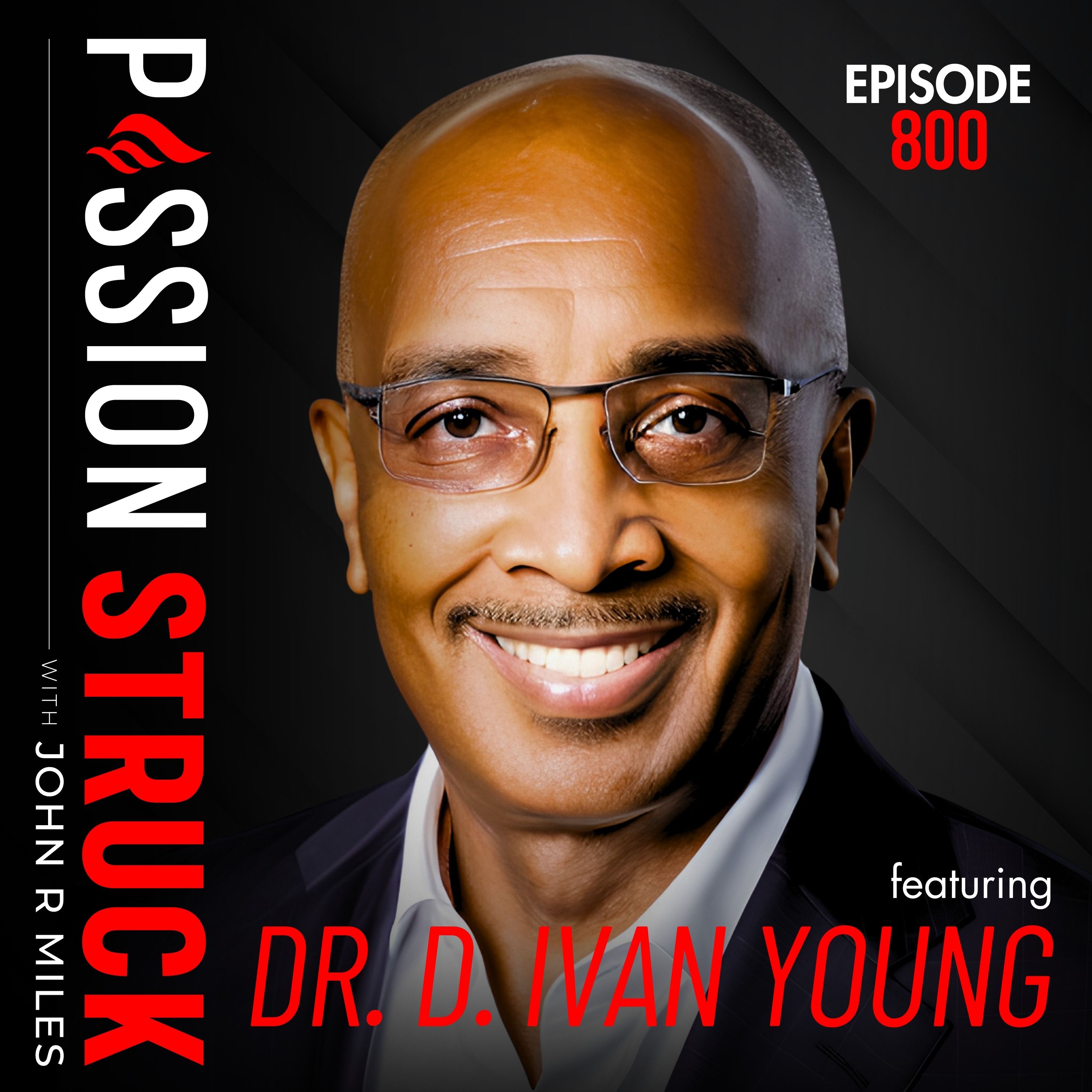
Passion Struck with John R. Miles
How to Stop Being So Hard on Yourself | Dr. D. Ivan Young - EP 800
00:55:41
In this episode, John R. Miles sits down with Dr. D. Ivan Young, one of today's leading voices on leadership, resilience, and emotional well-being. Together, they explore how trauma shapes identity, why your inner voice influences every relationship you have, and how practicing self-compassion can help you become stronger, calmer, and more resilient.
Loading summary
Transcript49 lines
- [00:01]
Grow Therapy Announcer
Summer's supposed to be the easy season, so why are so many people quietly googling a therapist between summer Fridays? Because more daylight doesn't fix the hard stuff. Sometimes it just turns the volume up. Grow Does Therapy Differently Therapy is not only for when you're in crisis. Grow therapy is here for all the moments when you decide you want more. More support, more clarity, more tools. Mental health isn't a destination you reach, it's something you build. And Grow makes that easier. Grow connects you with thousands of high quality licensed therapists across the US Offering both virtual and in person sessions, nights and weekends. You can search by what matters like insurance, specialty, identity or availability and get started in as little as two days. There are no subscriptions, no long term commitments. You just pay per session. Grow helps you find therapy on your time. The therapist you want takes your insurance on. Grow grow accepts over 125 insurance plans. Sessions average $21 with insurance and some pay as little as $0 depending on their plan. Visit growtherapy.com booknowtoday to get started. That's growththerapy.com booknow growththerapy.com booknow availability and coverage vary by state and insurance plan.
- [01:26]
John Miles
Coming up next, I'm Passion Struck.
- [01:29]
Dr. D. Yvonne Young
These biases and stereotypes only have strength until we question them. And once we decide that, we're going to establish our own identity, our own set of core values and our own beliefs. Now the filters shift. And if we come to the table with objectivity, thank God for neuroscience because mirror neurons work. And if I come to you with a smile and I come to you open with compassion and earnest. If you're a sane person and you're not some crazy extremophile, at some point in our interactions, you're going to give back to me what I'm giving to you.
- [02:09]
John Miles
Welcome to Passion Struck. I'm your host, John Miles. This is the show where we explore the art of human flourishing and what it truly means to live like it matters. Each week I sit down with change makers, creators, scientists, and everyday heroes to decode the human experience and uncover the tools that help us lead with meaning, heal what hurts, and pursue the fullest expression of who we're capable of becoming. Whether you're designing your future, developing as a leader, or seeking deeper alignment in your life, this show is your invitation to grow with purpose and act with intention. Because the secret to a life of deep purpose, connection and impact is choosing to live like you matter. Hey, it's your friend John. Welcome back to Passion Struck and welcome to episode 800. 800 conversations later. One thing has become abundantly clear to me. The quality of our lives rarely exceeds the quality of the relationships we have with ourselves. I've had the privilege of sitting down with neuroscientists, psychologists, military leaders, CEOs, Olympic athletes, best selling authors, and people whose stories have changed the way I see the world. And no matter where those conversations begin, they almost always lead back to the same place, how we see ourselves. Let me ask you something. Have you ever noticed how easy it is to extend compassion to almost everyone except yourself? You encourage your friends when they struggle. You forgive the people you love. You remind others that setbacks don't define them. But when it's your own mistake, your own fear, your own disappointment, the voice in your head often becomes the harshest one you'll ever hear. And what if that voice isn't just shaping how you feel? What if it's quietly shaping every relationship you have, every decision you make, and every version of yourself you're capable of becoming? That's the conversation we're having today. By the end of this episode, you'll understand why self compassion isn't self indulgence. It's one of the foundations of resilience. You'll discover why so many high achievers remain trapped in survival mode even after they've achieved extraordinary success. How trauma continues shaping our decisions long after the original event has passed, why empathy can heal or manipulate, and why the relationship you have with yourself ultimately becomes the relationship you have with everyone else. Our guide for this milestone conversation is Dr. D. Yvonne Young. Dr. Young is a neuroscientist, executive coach, leadership expert, and the author of Leading from the Heart. For decades, he's worked with elite athletes, Fortune 500 executives, entrepreneurs and public figures, helping them understand something many people spend a lifetime avoiding. You cannot build a flag flourishing life while remaining at war with yourself. His work explores how trauma, self awareness, empathy and self compassion shape not only our leadership, but the quality of every relationship we build. But here's what stayed with me long
- [05:28]
John Miles (Host)
after we stopped recording.
- [05:29]
John Miles
This wasn't really a conversation about neuroscience or leadership or even trauma. It was a conversation about learning to offer yourself the same grace you spent your life giving everyone else. Because maybe the most important relationship you'll ever repair is the one you've been living with all along. So let's dive in. Here's my conversation with Dr. D. Yvonne Young. Thank you for choosing Passion Struck and choosing me to be your host and guide on your journey to creating an intentional life that matters. Now let that journey begin.
- [06:07]
John Miles (Host)
I Am so excited today to be. Welcome Dr. D. Yvonne Young to Passion Struck. Welcome Dr. D. How are you today?
- [06:14]
Dr. D. Yvonne Young
I'm doing great, John. It's fantastic to be here.
- [06:17]
John Miles (Host)
Dr. D. I wanted to start out with. I understand you grew up as an only adopted child during the civil rights era. Often feeling like an outsider in different worlds, which is something that as a child I felt myself but for different reasons. How did that shape the way that people see you and the way you learn to read them?
- [06:37]
Dr. D. Yvonne Young
Wow, that's an interesting question. I think there it's, it's bi directional. It shaped the way that I saw myself maybe more than the way people see me. What I mean by that is I grew up in a time where there was so many things colliding. America was. And I would say during my early childhood and by that 8, 9 years old, 7 years old, all you saw on TV were raised was the Vietnam War, black people getting bit by dogs and water hoses. I was in a city, Fort Worth, Texas. I had a father that was a very devout Christian and I don't mean that like in this MAGA crap. He really practiced faith and love and no bias, no prejudice. So in the house that I'm in, I have a mother that's an overachiever that had had her own post traumatic issues. And I had this. I'm going to these preparatory schools. We integrated our neighborhood. So all of this is intersecting, right? I at seven years, six years old in first grade, I come home to a sign in the yard that said Nigger move. But all our neighbors were white except for one next door and one across the street. They had just moved in the neighborhood too. And Ms. Lofton, a white female, she saw that and she ran over and got me and it made me cookies and all this. So early on I was being bombarded with all these different messages. I was around a lot of people who weren't black that was so kind and loving and hyper supportive at the same time. I'm looking at stuff in media. My mother was the first black state official in Texas that was appointed. Andrew Young is a distant cousin. He and Martin Luther King at that point were being architects of the civil rights movement. So I saw all of these things and it definitely affected me. I remember my first experience, I was in Cub Scouts. I was only a little black guy in there with all these, with about 12 of the boys and didn't have any issues except for when we decided to go swimming. Me and one of the boys had become very good friends and we went to the pool at. In the country club where we live. And they. I'm a child, I'm like 8 or 9 years old and they wouldn't let me swim in the pool. And I didn't know. And I remember Larry's mother went back home and she was crying and she called my mother and she said, juanita, I am so sorry. I tried to take the boys swimming and they wouldn't let Derek in. That's what the D stands for in my name. And I never clicked right until I was an adult and thought about it literally decades later. So to answer your question, it did affect how I thought other people see me, but I had no clue how much it affected how I saw myself.
- [10:01]
John Miles (Host)
I can completely relate to that. When I was between five and six years old, I was playing a game of tag and got pushed from behind and unfortunately flew through a basement window and woke up in intensive care with tubes coming out of my head. And I, after that started to have language issues, speech impediment, sensory and processing disorders. And so all of a sudden I was different. And kids can be merciless at times. And it. All I wanted to do myself was to put a hood over my head and try to disappear because I felt so different from everyone else. And it was really a shock. It's one day you can see and all of a sudden you're blind. And, and how the world changed. How much do you think of what you do today traces back to those experiences? Because I know for me it traces back a lot.
- [10:56]
Dr. D. Yvonne Young
Being honest, I. I know for a fact everything's connected. I work with people that are typically high profile, high net worth, entrepreneur, pro athletes, what have you, C suite executives. People feel that when you attain status that it opens a lot of doors. Well, it does. It opens a few doors, but it closes even more doors. And I know what it's like to question whether I'm valued, respected, seen. I know what it's like to be in a crowded place and how people applaud you and you wonder if it's real. Do you really. Are you applauding me or what I bring to you? Are you aligned with me because there's a synergy between you and I or it's a synergy between what my presence can facilitate for you. I think it's very challenging to be in a position where if you don't have self empathy and self compassion, you can quickly get stuck in survivor mode rather than just being present.
- [12:14]
John Miles (Host)
I recently did an interview with Stanford behavioral scientist Claude Steele, who's Now retired, but we were. He's really known for his work on stereotypes and has a new book out called Churn. And a lot of what you were just describing is what he calls churn. How much of that churn do you think blinds us or others to what a person they're interacting with could offer, but because of their prejudices or the ways that they look on others changes the discussion?
- [12:51]
Dr. D. Yvonne Young
Well, when I wrote Leading from the Heart, my, my current book, one of the things that I realize is you, whatever you expect, that's probably what you're going to get right? The law of attraction says attracts like so in the book there's, in the early chapters I have people do what I call an inventory of self. Where were you born? What generation are you in? What socioeconomic status? What are the things you saw in terms of parental modeling and your parents core values? Because all that stuff got passed down to you. And it is the lens from which you look out and see the world. Now you can control that. What you can't control is the lens that people are looking at you through. However you can shift it. And I think what like with respect to a book like Churn, which I'm familiar with, these biases and stereotypes only have strength until we question them. And once we decide that we're going to establish our own identity, our own set of core values and our own beliefs, now the filters shift. And as we, if we come to the table with objectivity, thank God for neuroscience, because mirror neurons work. And if I come to you with a smile and I come to you open with compassion and earnest, if you're a sane person, you're not some crazy extremophile, at some point in our interactions, you're going to give back to me what I'm giving to you. So I think there is a path forward. Regardless of someone's initial bias. We can affect that by how we show up in our presence.
- [14:37]
John Miles (Host)
I love that I just had Angela Myers on the show who has been working in the area of mattering for about two decades. And we were actually talking about that smile because the second we're born, we are born with a mattering instinct. And the first thing that we're doing when we come out of our mother's wombs is we're looking to be seen to be valued for that smile. And I often tell people, especially parents, that one of the most important things you can do for your child is before you ask them about chores or making their bed or anything like that, it doesn't have to Be long, it can just be 10, 15 seconds. But smile at them, show them how much they matter to you, because it signals to them that they're the most important thing in the world to you. And as you were just bringing up, effective neuroscience really shows that the adults are playing a mirror for the children who observe them, because that is the mirror for our worth.
- [15:36]
Dr. D. Yvonne Young
Well, there's a big thing about understanding the difference between the mind and the brain, though some people try to fuse the two. But being honest, the brain is. It's on autopilot. It's in a default mode at 20, 24, 7. And our species, we are equipped to be hypervigilant and hypersensitive to shifts in our environment that threaten us. We typically refer to this as fight or flight mode. Right when we have this fight or flight mode occur. Historically, it's been associated with a threat that would probably end your life or your well being. You hear something growling in the middle of the night, the shadows shift, your pupils dilate, your hearing becomes more acute. Well, we don't live in that world anymore. The world we live in. The new threat is a text message saying the wrong thing or from the wrong person. We literally can look at our phone. And when we look at the phone now, we're in fight or flight mode. We can get an email. Hell, we can even have an internalized just ruminating thought about something that was traumatic. Here's what you don't know. You don't know when people are walking around in that state. I do a lecture every Wednesday to a bunch of MDs, PhDs. And what I'm teaching them is you cannot reach the psychology until you bypass the physiology. What I mean by that is if I'm already anxious, if I'm stressed out, even in a latent way, a subconscious way, when I interact with you, I'm not fully present. And in order for you and I to really have a meaningful interaction, somebody's going to have to diffuse that thing and create a safe space. That's why clinicians, coaches, leaders and organizations would be well served to understand this. And the best effect is your presence. If you were to look at this from an energy standpoint. If you say here's on 10 you are at Zen and on one you are hopeless. Well, the average person is around six. That's just the average person. Normal person, if that person has trauma and turmoil in their life, they're at about a three or four. If they have all adequate resources and a pretty stable life, they're probably the seven. Well the thing is, as a leader, as a human being, awareness about how you show up matters. And in leading from the heart, one of the things that I really pushed is making sure that your presence gives off safety and acceptance, that you regulate yourself by just taking a few breaths, being able to be authentic and transparent and say, I'm having a bad day, what about you? And again, the neuroscience kicks in because there's a chemical, serotonin, there's another one, oxytocin. These things are relational hormones and they're triggered when someone feels seen, when they feel safe, when you touch someone in a non threatening, compassionate way. And I believe that the way we show up and being intentional about the energy that we're giving off or even housing within ourselves can play a pivotal role and everything connected to people that's connected to our lives and well being.
- [19:06]
John Miles
We'll be right back with more of my conversation with Dr. D. Yvonne Young. As you're listening today, I want you to notice something, the voice you use when you talk to yourself. Because if there's one lesson from this conversation, it's that changing that voice may be one of the most important forms of growth we'll ever experience. That's why every episode in our flourishing series includes a companion workbook, Inside the Ignited Life on My Substack with practical exercises to help you turn these insights into action. You'll find everything in today's show Notes. Now a quick break for today's sponsors. Thank you for supporting those who support the show. You're listening to Passion Struck on the Passion Struck Network. Now let's get back to the conversation.
- [20:07]
John Miles (Host)
I couldn't agree more with you. I want to go a little bit deeper into Leading from the Heart. So you start out the book describing that it was originally going to be a playbook for others, but then your own life started to unravel. What specifically happened and what did that moment strip away for you?
- [20:30]
Dr. D. Yvonne Young
I was on a show called Fatal Attraction, a few other shows on national tv. My agent at that time was looking at engaging networks for me to either be part of an ensemble cast or something to have my own show. In doing that, I figured I want to have that smile everybody else has got, right? So I'm going to this dentist and he's checking the inside of my mouth and he says, I feel some banding in here. I'm concerned about that. And I'm like, well. He said, do you drink? He said, do you smoke or use tobacco products? And I'm like, no, I don't do any of that he said, well, I want to biopsy this and just see what's going on. So he did it. We went to MD Anderson. Nothing went back. A couple of months later, they took pictures, looked at it again, nothing. By this time, I'm like, man, this is a waste of my time. So I don't go back for the next visit. I skip it. Well, I go back to another dentist and I'm having these procedures done. And he looks at my mouth. He says, I don't like that. He said, I don't think I want to proceed today. And I'm like, what do you mean? He said, I want to biopsy this and send it in for pathology. Comes back, I have cancer. Comes back, it's stage two. So now I'm going to the MD Anderson and I'm becoming a human guinea pig. If I'm getting scanned, stuck, everything you could imagine, These people are very thorough. And while I'm doing this, we're wrestling with my insurance company. And I've got great inch overpriced 2000amonth insurance. So all of this stuff is happening. And I'm kind of like, what the. But during this process, I was tending to my media presence. So I would go do these lives on Facebook and there'd be like a half million people that would look at them over the course of 30 days or whatever, doing these lives. And after I did one, I would typically be out in nature on a hiking trail by the ocean, whatever. I was on this hiking trail. All of a sudden I got off and I started crying. And I'm like, what the hell? Why am I crying? Then I heard this voice. Some people call it our creator, God, the universe, angels, sub, the higher consciousness. And the voice said, well, it's okay to be scared. And I realized I was scared. I had never had surgery before. I damn sure hadn't been facing something that could kill me. Cancer, this stuff is nothing to play with. And then when I found we got ready to have the surgery, I was talking to Patrick Garvey, my surgeon. He said, well, doctor, you ski? And I said, man, I'm black. I don't ski.
- [23:21]
John Miles
You know.
- [23:22]
Dr. D. Yvonne Young
And he said, well, if this were skiing, snow skiing, he said, this surgery would be a double black. And I'm like, what the hell does that mean? He said, well, let's say green is down by the lodge and yellow is kind of light incline. And now we go to green and we get a little bit of slope but no trees. He said, double black is when you've gone up on top to the damn mountaintop. And they have warnings, avalanche warnings, right.
- [23:53]
John Miles (Host)
He said, you're seeing around trees.
- [23:56]
Dr. D. Yvonne Young
Yeah, ain't no damn trees. Rocks and 40 foot drops.
- [24:00]
Guest or Additional Commentator
Right.
- [24:00]
Dr. D. Yvonne Young
So he said that to me and I'm thinking, okay, the clinician in me, the neuroscientist, before my mother died, I was going to be a neurosurgeon. So I'm looking at this from a clinical perspective. Oh, this is interesting, but hell, we're talking about my life, man. And he said, well, it's going to be seven surgical teams and we're going to take your fibula out and we're going to remove your mandible and we're going to take this and do that. I was like, whoa. So at that point there was nothing anybody outside of me could really say. I'm not religious, but I'm very Zen, I'm very prayerful. I do believe in God and I do believe faith and prayer matters. So I started praying and I tapped into the fact that I'm very good, extremely good at showing my clients just, even a stranger, kindness, empathy, compassion, acceptance. But I hadn't been very good at doing that with myself. And that experience forced me that I could take one or three paths, maybe, well, more than three paths. But I could be pissed, I could be frightened, or I can just accept this is happening and I can have faith. Well, in order to do that, I had to empathize with my condition. And then I started really paying attention to, to the fact that when I was nicer to me, I felt better. When I was collaborative with my care team, things would go well. And then even when I did have this, that seven hour surgery ended up being 12 and a half hours fighting with Blue Cross and Blue Shield to get this, this new form of proton radiation where instead of it killing everything, it hits only the cells that need to be killed. But it is, it's very expensive and I finally get it. And at that point, that's when I started seeing me be compassionate with myself. I would have to go to MD Anderson and go to proton radiation. And this is like some Star Trek life stuff. And I lay down with this mask and they strap it in and this laser thing goes and just hits only the cancer. Well, that's some scary stuff. But between the empathy and the compassion, I made it through it. At that point, now I'm on the other side of this. The cancer's gone. I'm praying it doesn't come back. But I'm having all these side effects and the side Effect wasn't the proton radiation, though. That left me kind of swole whatever it was. Okay, where do I go from here? Who am I? I don't look the way I used to look. Not that I was all that cute, but I wasn't all that ugly either. But this was, what if this shit comes back, right? And when I started understanding that there's a correlation between empathy and recovery, there's a correlation between compassion and quality of life. And then I started studying these aspects because I thought these were benevolent, pious personality traits, when in fact, weaponized empathy is one of the most powerful tools, warfare strategies, psychological strategies that could be willfully deployed towards someone to get them to do what you want, to think how you want them to think, and to behave how you want them to behave. And when I really tapped into, okay, weaponization of empathy. Well, as a weapon can do two different things. It can get you killed, or it can make you. Give you what you need to eat. It can keep you safe. So when I started tapping into weaponized empathy in clinical practice, I noticed that it would create more successful patient outcomes. It would align patient and care, team and provider, in a way. Then I started looking at this from a corporate standpoint, even political, and I saw that there's something more here. And I think this is a power we all need to be aware of. We need to change our perception of what it is and how it can be used for us and against us.
- [28:42]
John Miles (Host)
Dr. D, thank you for sharing that story. I know it must still be one that's painful for you. I've had several people close to me who have had throat cancer and those who've had to go through radiation. And it sounds like they had it a little bit differently than you did. Oftentimes couldn't eat because they were in so much pain. And in one case, one of them lost their ability to taste, which never came back. So it's. All of them have always told me that the surgery, no matter how bad it is, was easier to go through than the ramifications, oftentimes of having to go through the radiation part of it. I'm happy to hear you were able to fight for that and get it. One of the things that you write in the book is that you had to. Your words were ingest your own rhetoric.
- [29:35]
Guest or Additional Commentator
Yeah.
- [29:37]
John Miles (Host)
What belief for you broke first, man.
- [29:42]
Dr. D. Yvonne Young
Like that day in the park. I'm always telling other people everything is working for your good. I remember in a few of those podcasts, going Lives, I would actually say, I'm going through this so you guys can see what faith looks like. Sometimes God will allow you to experience something that may or may not be directly related to you. Even if it is or isn't, there's going to be people that are witnessing what you go through and how you go through it can have a serious impact on their perception of self and life. Because if they see that you made it, they have hope and think, okay, I can make it too, right? But at some point, what is rhetorical? What just flowed off my lips like oil poured from a decanter? I had to come to a conclusion. Do I believe this or do I know it? See, when you believe something, there's still room to massage it, shift it, pivot it. But when you know something, there's a piece that comes with it. I. I'm a tech founder. I created this app called Uriel. Well, between Uriel coming to life, which it's now in a beta phase, and going through all this stuff that prepared me to handle money and to handle power and wealth, I believed a lot of stuff. I believe that the universe source God would provide. I believe that all things work for, for my good. But in late in the midnight hour when I had too much month left at the end of my money, all of a sudden these beliefs, were they really anchored the way that I portrayed? Because if they were, why am I worrying? Why am I waking up at three in the morning looking at the bills? Why am I feeling forsaken sometimes? Or okay, God, I know you're gonna help me, but damn, I have to go through this. At one point, John, I actually thought God was like a game developer, a sports guy that controlled all sports, and I was his favorite athlete because he wanted me to make the shot at the very last minute, three seconds on the clock, let go of the ball goes in the net or the guy catches it right when the clock stops. Because that's how he was waiting to answer my prayers. It's damn, man. What. And in some cases, deadlines would pass and it still wasn't going my way. But then here comes resurrection or restoration. There are times when we say things, there are times when we act a certain way, but it's not in earnest. It hasn't been authenticated. And what this season taught me is sometimes you have to go from belief to knowing. And that's the stage even that I'm in now. You and I have were talking about a company before this show started, and one we had in common, where we had experienced. Here's all our hard work. Here's our dedication. And basically that entity was like, okay, we're going to take advantage of that. We'll see if we can make money off of it. And we're going to give you a platform. We're not going to support you, but if you have a home run, we share in that. But if you don't, well, so what? Well, the truth is that's a one sided partnership. And when we get into life where we give more than we receive, when we get into a relationship where someone is taking so much from us but not pouring back into us what they're taking, all of a sudden you're trying to pour from an empty cup that is never a good idea. And leading from the heart. After we get through with the self actualization piece, we really start thinking about are we accepting things that we shouldn't? Are we misaligned and we're giving all this energy and effort to something that's not reciprocating. There is no altruistic relationship. There's something that's more of a pathogenic relationship, a parasitical relationship. And we have to tell ourselves no is a complete sentence at that point. I don't have to accept less from you when I'm giving you more. And what that means is I'm going to have to now honor me. I have to stop and think about what do I need? And many of us don't. Many of us watched our parents, our caregivers, even ourselves continue to give and give and feel bad when we actually expect someone to treat us the way we treat them or have an organization honor us in the way we honor that institution. So this is that season where we do stop and let's recalibrate not only how we're leading from the heart, but what leads are pouring back into our heart. And some of them may need to be disconnected.
- [35:11]
John Miles (Host)
I have gone through this as well where I was supporting myself while supporting others while suppressing myself. And in my first book, Passion Struck, I wrote a chapter on this that I call the Mosquito Auditor. And basically what I'm trying to get the reader to do is to audit the those influences in their lives because they're oftentimes invisible like a mosquito is that are I call them the, the pain in the asses, the invisible suffocators, the blood suckers who want everything from you or want your blood while you're giving it out willingly and in effect you're suppressing yourself from doing so many important things, things with your life that you could be. And there's a long Term cost to that that most people don't even think about. And I think that's exactly what you were just alluding to.
- [36:03]
Dr. D. Yvonne Young
Yeah, we have to do better about honoring ourselves. And one of the things in leading from the heart that I lean into heavily is you cannot receive what you don't, what you don't give, number one. But you're teaching people how to treat you. Whatever's in you, you're going to probably in some way have that leak out. Sometimes it's going to just project out. What I'm saying is if you want to experience more compassion, practice self compassion. If you want people to see you, see yourself. If you want people to respect, love and care for you, respect, love and care for yourself. And see, leading from the heart isn't always about this external stuff. In many ways it's about doing these things for you, to you. And the more that you can internalize, the easier it will be to externalize itself later.
- [37:15]
John Miles (Host)
Dr. D, you talk about in the book the battle between the omnificent self and the obnoxious self. Can you explain what those two selves are and real examples of how those two voices appear in conflict?
- [37:28]
Dr. D. Yvonne Young
The obnoxious self is how you think and talk to yourself. I find myself and I do it still sometimes and correct myself right after. Damn, why in the hell that was so stupid. We have this obnoxious interaction with ourselves or with others where we unintentionally. Oh really? You go there, you eat that well, why are you wearing that? Right, that's that self that is either leveraging self awareness and self acceptance at somebody else's expense or that's the self that's self sabotaging you because you're ID in the froidal example, that id ego, super ego, idiot. Being the horse. The horse is leading the man everywhere and the man is in no way using the bridle to help the horse move in a direction that is going to be in the long term or even the short term interest of the man's well being. Where the omniscient self, it looks at things from a proactive point, not a reactive point point. It looks at things objectively rather than subjectively. And the omniscient self doesn't ask why. It asks what's possible. It looks at okay, what are the other possibilities and turmoil and destruction. It says okay, what's the opposite of this look like? When anxiety and depression is present, it doesn't run from it, it looks at it and says okay, here's what's Happening. Here's how it's making me feel and think about myself and here's the outcome. But see, the omniscient self, it accepts A, what's happening, the circumstances, but the challenges. B, rather than looking at, okay, what is it causing me to think? Okay, what could I be thinking? What are the alternatives? What are the other possibilities? And if you change B, then C changes. C is the outcome. C is how is this affecting your life? So if the obnoxious self, a quick example is in a situation where some external force, some you couldn't control, happens and it disrupts how you can be sustained or how you the resources you had to take the next step, then the B of that is okay, what is that creating? Well, it's creating anxiety, hopelessness, it's creating despair. And then C, now you're sitting home with a joint in your mouth or a glass of wine or Misery loves company, friends, and you're amplifying the exact thing you don't want. I had a mentor named Wayne Dyer. And Wayne said as when you think whatever it is that you're thinking about the way if you want the things you look at to change, you need to change the way you look at things with what Wayne would say. But the greater truth is the omniscient self, it looks at what's happened, it looks at the resources being compromised or gone. It looks at the circle, the door being closed. But the omniscient self says, okay, what is happening now that wouldn't be happening if I didn't have this problem. In other words, what attributes, what unearthed capacities are now showing up for me. That wouldn't happen unless you had cut my water off, unless you had fired me, unless you left me. If it's the love of your life or your friend, your 10 year best friend, your dog died. Okay, well the fact that I'm in the middle of this, but I'm still getting up, what am I tapping into inside me that I wouldn't have tapped into had this problem not existed? And see, when we make that shift internally, we reposition our relationship with calamity. And calamity now becomes a catalyst. And that's the difference between the obnoxious self and. And the omniscient self coming forth.
- [41:49]
John Miles (Host)
Dr. D, you say that empathy isn't just a feeling you write, it's a precision instrument. What are we getting wrong about empathy today?
- [41:58]
Dr. D. Yvonne Young
Well, I love that question. We are living in a polarized nation here in America. Many other places around the globe too, but here in America, our country and I've been around and I've been here six decades, so I've seen a few things. Our country is ugly right now and it starts at the top. So that's weaponized empathy though that's some industrial organizational psychologists enabling a self centered, self serving leadership style and people that are self centered and self serving and leadership positions. But they didn't just get there magically. They used weaponized empathy. They knew what to say to make someone who felt othered feel included. They knew how to message and speak to your blind spots, to your vulnerabilities and to your wounds. See, that's weaponized empathy. That's someone that appears to be empathetic with you when in fact they're just tapping into the things that will get your attention. Motivates you cognitively, physiologically and emotionally. And the next thing you know you're climbing a wall trying to break into the legislatures to do with a flag in your hand calling yourself a patriot when in truth you've been pimped. Someone has made you feel that you know what you are othered but I love you or you're unseen. Well, the reason your life is so bad is because of them. Them being the other race, the other hair texture, the other political party, vegan versus a meat eater. However you want to break it down. Gay, straight, how you want to break it down. But people are speaking into your wounds, your blind spots and your need to be so seen and valued when that's weaponized empathy. But you can do the opposite. You can accept your blind spots and see them. You can look at where you have lack and stop judging yourself because you don't have what the guy next door or the guy that you see on social media has. And here's the big one. These are neurochemical processes that create primal states in you. And I'll prove it. If you get on social media even a little bit, you're going to notice a pattern. It's titillation. You're going to see a video of a puppy or dog or something funny that's going to make you laugh. You're going to scroll a little bit. You're going to see something that pisses you off that probably makes you even angry. It's going to be a demonstration of bias and injustice of and to some degree. And now weaponized empathy is being used on you again. And it's a love hate relationship, right? One minute you're really laughing, next minute you're pissed. And you do all that in three to five minutes. One Dopamine hit at a time. Well, your mind, that's something that you don't want to offer to people unless they're going to put something in it that's going to help it function better. And see, this is where you can take this empathy and turn it around toward yourself. And now you can choose. Okay, I don't want to see that video anymore. Let me block that. I do want to see more of this though. And what you feed yourself, you become. There's a thing that I read in a spiritual text that says, as a man thinks, so is he. That is some true stuff. There's nothing ever been more true in a statement. Whatever we feed ourselves, we become. It's the same thing with a diet. If you sit up and eat a bunch of processed foods and a bunch of stuff rich in nitrates. I've read in some one of these stores Whole foods or somewhere, if you can't pronounce the ingredients, they're probably not good for you. And that's true. That's so true. So what we have to look at is what are we consuming mentally, emotionally, spiritually and environmentally? Does it serve the greater good? We look at things like smoking, drinking. Yeah, you're pissed. Why not have a drink that'll help give you a little bit of relief. But see, if you end up being an alcoholic and now you have cirrhosis of the liver and kidney failure, was that really a good idea? Right? You smoke a joint, smoke a cigarette, you got that nicotine hit, you're up for three minutes, but later you have some pulmonary disorder and you're coughing up a lung. Is that really a good idea? Because that surfactant laden with tar isn't how you were designed. So we have to ask ourselves, what are we allowing in? And whatever that is, at some point that's going to come back out and it's either going to bless you or curse you.
- [47:18]
John Miles (Host)
At the beginning of the conversation you mentioned that you work with a lot of high profile people. And my experience with being around some high profile people, I sometimes felt really sorry for them. One of my really good friends was a six time Pro Bowl, NFL wide receiver and we would meet for lunch or coffee or whatever. And it just always felt to me like he was under the microscope because people always recognized him, always would come over and if they didn't come over, were paying attention to everything that he did. And I also worked for several billionaires and one of them, I saw the latest Forbes list now has a net worth of 147 billion. But I always felt sorry for him and his family because everywhere he went, he was in a bulletproof car bomb proof. His wife would ride on her bike through our neighborhood guarded by five people around her. They would often helicopter places to isolate themselves. And I always felt, man, you're not even getting to live a real life. You can't even go to the grocery store with without feeling threatened. What have you found when you think about empathy and what we've been discussing about that you see in some of these high performers that you work with. That's common amongst all of them.
- [48:49]
Dr. D. Yvonne Young
Well, I'll say this. Heavy is the crown on the king's head, right?
- [48:56]
John Miles (Host)
Yep.
- [48:58]
Dr. D. Yvonne Young
When people are extremely successful, there's a price tag, there's a statement that says, to whom much is given, much is required. At the same time, we get to shape how we live and the choice becomes one of common sense. There are evil people in this world that just don't like the fact that you've been blessed, that don't like the fact that you have resources. They don't. But there are also people in the world that need your help. There are people that have created things. Like right now I'm looking for a venture capital partner, but I just don't want any partner because I understand the value of association. And if you don't love people, if you don't honor why you're put on this planet, I'm probably not a good guy to align with and I don't want to be aligned with somebody that's the opposite of that. Right, right. The first thing with, with this, that isolation has much to do with self perception. With self awareness, you can make a difference in life and be welcome in most places you, you visit. Especially if you're coming there because you care about people and you want to make a difference in someone's life. Now I'm not going to tell you that because you become a humanitarian that you can escape the vicissitudes of life. You won't. But what I am going to tell you is when the closer you get in contact with the purpose of your existence, the more peace you find, the more alignment you find. If you're going to enjoy this life, take yourself and make yourself a servant. And what I mean by that is, look at what can I, what is it that I can do to touch somebody else's life in a meaning transformational way? And that doesn't mean you got a billion dollars. So go give everybody a thousand dollars. Sometimes just a word from you, sometimes you're present sometimes the fact that you can pick up a phone and influence a decision on Congress, the legislature, if they go and remove a program and you can easily afford to create one, just go create that program again. You don't need to deal with the US Government or any government on this planet to help other people. Another thing that you can do is stop and think about meaning. Abraham's hierarchy of needs, the very last need is that relational aspect of yourself with the world around you. And generativity is what it's called. But how are you shaping the world that you are in right now? And if it's for the better, there's going to be a peace that you will find even in the midst of your imperfections. But if you allow yourself to fall victim to where everything with you is about a deal, about we're going to make so much money, then more than likely at some point that narcissistic need for power and control is going to consume you. And when it does, you're only getting what you set out to be.
- [52:32]
John Miles (Host)
I think you did a great job of just describing in many ways what it means to be Passion struck.
- [52:38]
Dr. D. Yvonne Young
Yeah.
- [52:39]
John Miles (Host)
And with that, Dr. D, where is the best place that our listeners or viewers can go to learn more about you and pick up a copy of Lead from the Heart?
- [52:50]
Dr. D. Yvonne Young
First, you can just type in Dr. D like in Day or Derek, but just the initial D. My middle name is pronounced Yvonne, but it's spelled just like Ivan. Dr. D. Yvonne Young. You can put me into ChatGPT, Google, Gemini, Claude, whatever, and just put books and it will take you to Simon and Schuster or to Barnes and Noble or Amazon. And you can buy Leading from the Heart of my other book, Break Up, Don't Break down the expanded edition to help you deal with separation anxiety and the loss of a relationship. You can find me on all social media channels under Dr. D Yvonne Young at Instagram, at Facebook, and at LinkedIn. I don't do Twitter for personal reasons, but I can tell you that I'm available. Feel free to reach out. My job and my goal is to help you live a profoundly extraordinary life. And if I can do that, please get in contact with me.
- [53:57]
John Miles (Host)
Dr. D. It was such a pleasure to have you on Passion Struck. Thank you so much for joining us, John.
- [54:02]
Dr. D. Yvonne Young
Thank you for having me. Let's do this again soon.
- [54:05]
John Miles
I hope. Today's conversation leaves you with one simple question. What kind of relationship am I building with myself? Because as Dr. Young reminded us, the voice we hear most often isn't someone else's it's our own. And over time, that voice shapes our confidence, our relationships, our resilience, and ultimately the life we create. The good news is that voice isn't fixed. It can become more compassionate, more honest, more hopeful. And that's where real flourishing begins. If this conversation resonated with you, I'd love for you to share it with someone who could benefit from hearing it. And if you haven't already, be sure to follow and subscribe to Passion Struck on Apple podcasts or Spotify or YouTube so you'll never miss an episode. Next time, I'll be back with a special solo episode as we conclude our Flourishing series. Over this past month, we've explored purpose, connection, resilience, healing, and what it truly means to become fully alive. In that episode, I'll bring together the biggest lessons from these conversations and leave you with one final challenge for your own journey toward flourishing. Then we begin an exciting new chapter. Our August series is called the Adaptive how your mind learns, changes and heals. We'll kick it off with one of the world's foremost experts on brain health, Dr. Daniel Amen. If Dr. Young challenged us to rethink the relationship we have with ourselves, Dr. Amen asks an equally important question. What if lasting change isn't just about willpower but about building a healthier brain? Together, we'll explore why insight alone rarely changes behavior, how chronic stress, loneliness, and our daily habits reshape the brain, and why no one is ever too damaged or too far gone to heal. I can't wait to share that conversation with you.
- [55:52]
Guest or Additional Commentator
Social media Constant negative news the political divide it has just caused great stress. Suicide from 2000 to now has gone up over 60%, and young people are in serious trouble. 57% of teenage girls report being persistently sad that people think of alcohol as a health food, marijuana is innocuous, psilocybin is the next savior. We're really in a different, dangerous, very stressful time, especially for young people.
- [56:39]
John Miles
Until then, remember that every meaningful transformation begins with a single decision to treat yourself with the same compassion, grace and humanity that you freely give to others. I'm John Miles, and until our next episode, stay intentional, stay curious, and stay passion struck.
- [56:59]
Dr. D. Yvonne Young
Sam.