← Passion Struck with John R. Miles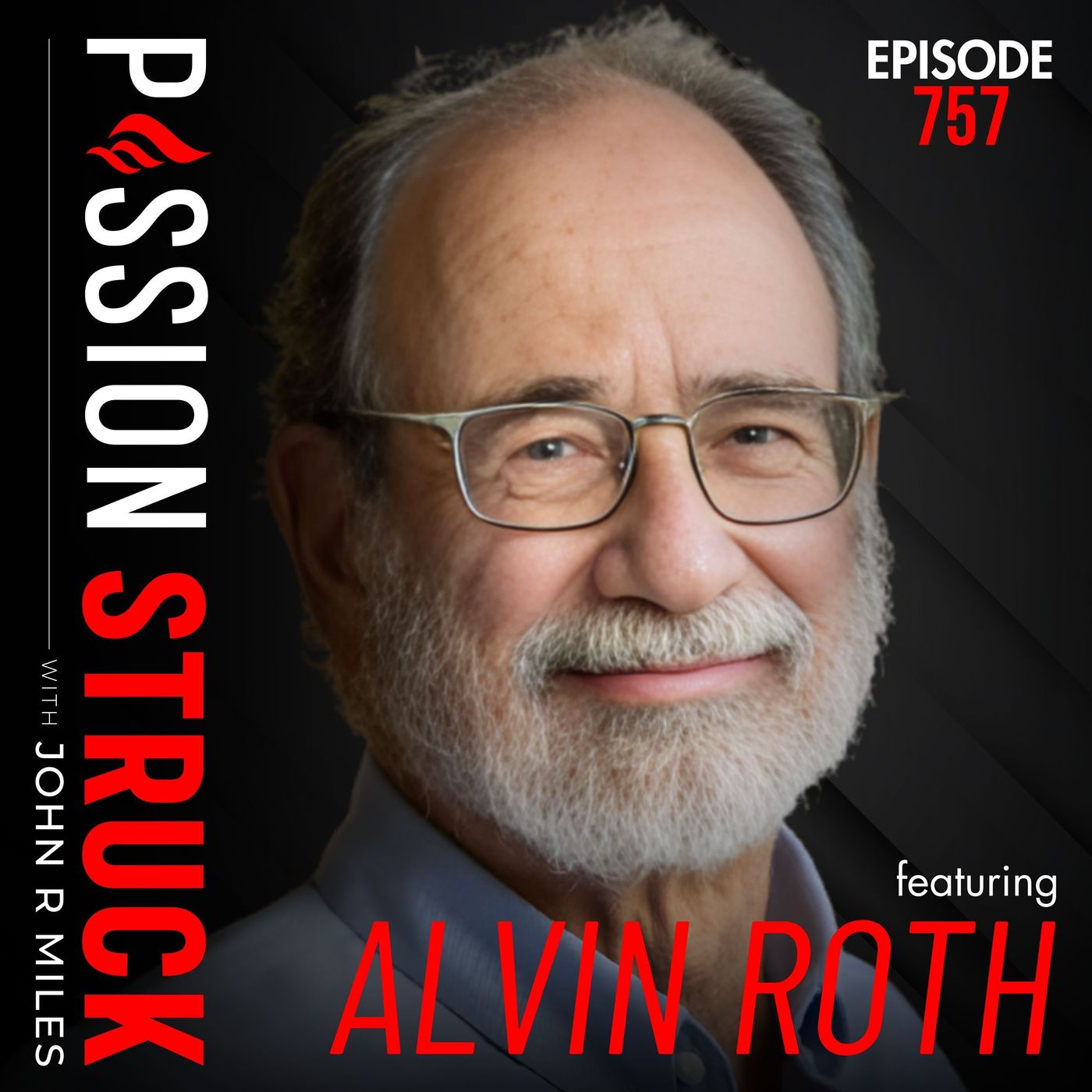
Passion Struck with John R. Miles
Nobel Laureate Alvin Roth: How Incentives Shape Your Life | EP 757
00:56:24
What if the choices you make every day aren’t entirely your own?In this episode of Passion Struck, I sit down with Nobel Prize-winning economist Alvin Roth to explore how incentives, systems, and hidden structures shape human behavior—often in ways we...
Loading summary
Transcript77 lines
- [00:01]
Progressive Insurance Announcer
Insurance isn't one size fits all. That's why customers have enjoyed Progressive's name your price tool for years now. With the name your price tool, you tell them what you want to pay and they'll show you options that fit your budget. So whether you're picking out your first policy or just looking for something that works better for you and your family, they make it easy to see your options. Visit progressive.com, find a rate that works for you with the name your price tool. Progressive Casualty Insurance company and affiliates price and coverage match limited by state law.
- [00:32]
John Miles
Coming up next on Passion Struck.
- [00:34]
Alvin Roth
So in the 1920s, we passed a constitutional amendment that forbid most sales of alcohol, alcoholic beverages. And a dozen years later, we repealed it. And the reason was prohibition didn't actually limit consumption of alcohol by all that much and it gave rise to organized crime. Now, having repealed prohibition, we now have legal markets for alcohol. That doesn't mean the problems of alcohol went away, right? There's still alcoholism, there's still driving under the influence. But one thing you can't do anymore is buy moonshine whiskey from gangsters, right? We've taken a lot of the crime out of alcohol. We still have alcoholism. And the birth of Alcoholics Anonymous came just around the time of the repeal of prohibition.
- [01:19]
John Miles
Welcome to Passion Struck. I'm your host, John Miles. This is the show where we explore the art of human flourishing and what it truly means to live like it matters. Each week, I sit down with change makers, creators, scientists, and everyday heroes to decode the human experience and uncover the tools that help us lead with meaning, heal what hurts, and pursue the fullest expression of who we're capable of becoming. Whether you're designing your future, developing as a leader, or seeking deeper alignment in your life, this show is your invitation to grow with purpose and act with intention. Because the secret to a life of deep purpose, connection and impact is choosing to live like you matter. Hey, friends, and welcome Back to episode 757 of Passion Struck. Over the past few weeks, we've been building something intentionally.
- [02:15]
Podcast Host / Interviewer
Together in this April series, Purpose by
- [02:17]
John Miles
Design, we kicked off the series with
- [02:20]
Podcast Host / Interviewer
Arthur Brooks exploring the growing crisis of meaning.
- [02:23]
John Miles
Then with Wharton professor Corinne Low, we looked at how the systems around us quietly shape our lives. Last week, with Stanford professors Bill Burnett and Dave Evans, we went deeper into how to build a well lived, joyful life. Today, we take the next step. Because once you begin to live a meaningful life, the question then becomes, what are the systems you're living inside of and how are they shaping your choices. Because even as we design our lives, we are all operating inside systems that are already designed for us. Systems that shape what choices we have, what opportunities we see, and even what we believe is possible. So here's the deeper question. What if the invisible architecture of those systems is influencing far more than we realize? My guest today is Nobel Prize winning
- [03:15]
Podcast Host / Interviewer
economist Alvin Roth, one of the world's
- [03:17]
John Miles
leading thinkers on market design and human behavior. In his new book, Moral Economics, he explores something both fascinating and that markets aren't just economic systems, they are moral systems. They quietly determine who gets what, who's left out, and what we as a society decide is acceptable or not. In this conversation, we explore why markets are really about human values, not just money. What repugnant transactions reveal about our moral boundaries, why banning something doesn't make it disappear, it often just pushes it underground. How systems from organ donation to pricing shape behavior in ways we rarely question, and what it means to design markets that actually reflect who we want to be. At its core, this episode is about seeing the world more clearly, because once you understand how systems shape behavior, you begin to realize something powerful. We don't just live inside systems, we have the ability to redesign them before we dive in. One quick note if you want to go deeper into this Purpose by Design series, I'm sharing companion reflections and tools@theignitedlife.net to help you not just understand these ideas, but actually apply them to your life. You can also watch these full episodes on our YouTube channels and please leave a rating or review on Apple Podcasts or Spotify to help others discover the show. Now let's dive into my conversation with
- [04:40]
Podcast Host / Interviewer
Nobel Laureate Alvin Roth.
- [04:42]
John Miles
Thank you for choosing passionstruck and choosing me to be your host and guide on your journey to creating an intentional life that matters.
- [04:50]
Podcast Host / Interviewer
Now let that journey begin.
- [04:54]
Progressive Insurance Announcer
This episode is brought to you by Progressive Insurance. Do you ever think about switching insurance companies to see if you could save some cash? Progressive makes it easy to see if you could save when you bundle your home and auto policies. Try it@progressive.com Progressive Casualty Insurance Company and affiliates. Potential savings will vary. Not available in all states. This episode is brought to you by Progressive Insurance. Do you ever think about switching insurance companies to see if you could save some cash? Progressive makes it easy to see if you could save when you bundle your home and auto policies. Try it@progressive.com Progressive Casualty Insurance Company and affiliates. Potential savings will vary. Not available in all states.
- [05:39]
Podcast Host / Interviewer
I am extremely honored today to bring Nobel Laureate Alvin Roth to Passion Struck Al. How are you Today I'm well, how about you? I am doing fantastic and I am so honored that we get to discuss your brand new book, Moral Economics Subtitle From Prostitution to Organ what Controversial Transactions Reveal about How Markets Work. Congratulations on that book and thank you for all that you have done in the field of behavioral economics.
- [06:13]
Alvin Roth
Well, thanks. It's good to have the book almost done.
- [06:18]
John Miles
Al you open up the the book
- [06:21]
Podcast Host / Interviewer
with Danny Kahneman's decision to end his life under Switzerland's medical aid and dying laws. And this has been a really controversial topic and it's a deeply personal act that society fiercely debates. What did that moment reveal about morality and autonomy and how they collide in modern markets? And why did you choose to start the book that way?
- [06:47]
Alvin Roth
Well, that's a couple of questions. One reason I chose to start the book that way is Danny Kahneman is of course an icon of careful decision making. He spent his life thinking hard about how to make decisions. Well, and so one of the arguments about medical aid and dying is that people might go into it unthinkingly. And I don't think anyone could think that Danny did that. But in general, what the book's about and the reason I started with medical aid and dying is the book is about controversial markets. And the provision of medical aid and dying is very controversial. Danny lived in New York, which has just recently decided to institute a very restrictive form of medical aid and dying. But it didn't have that when he was, when he was contemplating ending his life. And the form of law in New York wouldn't have helped him because it's for people. It requires that people be terminally ill with a six month expected lifetime. And he was much healthier than that. But he didn't want to have a long protracted death. He'd seen some of those in his life. So that's the kind of market where, you know, in Switzerland, which is a perfectly civilized country, they think that's part of medical care, aid and dying. And in much of the United States we don't think so. And in much of the world we don't. And one of the things about markets where there are legal bans, as they are on medical aid and dying in many places, is that there were often covert, not quite legal markets that take their place. So of course, when you talk to physicians who deal with dying patients, they are very well aware that the same medicines that reduce pain can also shorten life. So there's plenty of medical aid in dying that isn't recognized. And that's also quite Common in controversial markets that are banned, there start to be covert markets, gray markets, black markets. And. And so my book is about the economics of those things. How should we think about them? What should we be trying to do as a society? And what should we do when we can't fully regulate markets by banning them?
- [08:50]
Podcast Host / Interviewer
When I think about Danny's decision, I think about Robin Williams. And my grandfather, who was a brilliant researcher and served as one of the top research directors at Kraft, was one of the most brilliant people I had ever, ever met. And in the late stages of his life, he suffered a series of mini strokes which led to him coming down with dementia. So similar circumstances to Robin. And just to see how painful it was for him to go through those last five to seven years, seeing him lose himself, I can understand why this is a decision for so many, including those who might have terminal illnesses. So I think it's an important point that you brought up when people think of the word. Do you want to talk about that?
- [09:40]
Alvin Roth
I was just going to say that in the United States, we're now seeing more states allowing some form of medical aid in dying. So it's controversial, it's deeply debated, but I think there are about a dozen states now in the US that have some legal form of medical aid in dying, including California, where I am right now.
- [09:59]
Podcast Host / Interviewer
So the listeners of Passion Struck are typically well educated, but I still think when people hear the word market, they think of money. But you describe markets more broadly as systems that decide who gets what. What changes when we begin to see markets as moral institutions rather than purely economic ones?
- [10:18]
Alvin Roth
Well, economics, economic life pervades all aspects of life. Our prehistoric forebears knew about trade. You can find stone artifacts far from where they were quarried long before writing was developed. So we know that people knew about trade before the invention of money. Money is a market design invention that makes a lot of trade possible, but it's not essential to economy, to people cooperating and coordinating and competing with each other in various ways. So some of the markets I've studied don't permit money to enter it all. The one that really got me going on this subject was kidney transplants. You can get live donor kidney transplants, but it's against the law almost everywhere in the world to pay someone to donate a kidney. Nevertheless, we have a lot of kidney transplants, not nearly as many as we need. So that's how I got into studying markets without money. And that's also how I got into studying morally contested markets, because the feelings about letting people pay for a kidney are very strong, and so we don't let them do that. But we have a big shortage of kidneys. Many more people need a transplant than will be able to get one. So I think that these debates about what we should allow and what we shouldn't allow and what happens when we try to ban things are things that economists should study more because they're important to a lot of how scarce resources are allocated.
- [11:47]
Podcast Host / Interviewer
I want to return to kidney transplants here in a couple of minutes because it's really at the heart of the book. But I think as far as definitions go, a lot of your work focuses on what you call repugnant transactions. And repugnance is not a word that's used often in everyday conversations. But these are cases where willing participants want to engage in something, but others believe it should be forbidden. Can you talk about repugnant transactions and what they reveal about our moral architecture as a society?
- [12:23]
Alvin Roth
Well, you asked about money in markets, and one of the things about money is it's become such an important store of value that it plays an outsized role in lots of human relations. And lots of people think that isn't something that we should welcome. So anyway, my definition of what's a repugnant transaction is just as you said, except I would add that a repugnant transaction is one that some people want to engage in, other people don't think they should be allowed to, and their objections are based on moral or religious arguments. So I'm ruling out of that the bans on markets we make because of immediate harms that they do. Right. You might not be able to pollute the air because that harms people. That's a different kind of objection to a market if you're polluting the air or making a lot of noise or bothering your neighbors in some way. But there are lots of transactions that don't necessarily involve money that some people would like to engage in and other people object to. So, for example, same sex marriage was widely illegal around the world before the turn of the present century. And that there's a sense in which that's a repugnant transaction in the sense that some people want to engage in it and other people thought it shouldn't be allowed, but it doesn't obviously harm other people. That's why people wear wedding rings. It's because you can't even tell if they're married if they don't tell you that they're married. So it's a very subtle kind of transaction. But we had, of Course, a big debate about that in the United States that's ongoing to some extent, even though same sex marriage is now legal in every state. So that's how people get together. That's an economic interaction. You know, if you're an economist, almost everything is an economic interaction. So that's another place to think about what are the natures of the objections. What, what is actually banned when you ban formal marriage and not other things. There's an old joke about economists and sociologists, and the joke says that economists study why we make the choices we make and sociologists study why we don't have any choices. And when you're studying morally contested transactions, controversial markets, you're studying social decisions about what choices you should be allowed to make. And also what happens if we decide, if we legislate that you can't make some choices, it doesn't mean that you stop making them. We don't all obey every law, especially when we think the laws are ill founded.
- [14:52]
Podcast Host / Interviewer
Sticking on what you were just talking about, Al, I think the story of Alan Turing is a significant one that we should probably explore because here's a gentleman who in many ways turn the tide of World War II in favor of the Allies, yet he was treated so evilly when you look back upon it, it's hard to believe it happened. Could you possibly go into his story?
- [15:15]
Alvin Roth
Okay, Alan Turing, for those who don't recognize the name, is maybe the most important computer scientist who ever lived. He developed the idea of machine intelligence and he talked about touring machines and the touring test, how you could tie tell whether a machine had human intelligence or not. So incidentally, of course, large language models, artificial intelligence is now bumping up against the Turing Test. We're seeing intelligence in machines, but he was the computer scientist who first thought about all that. And he also, during World War II, was critical to the Enigma code breaking machine that broke some of the German codes that were very important to help win the war. But he was homosexual and he was convicted under the British laws of the day of being a homosexual. And he, and part of his sentence was he was chemically castrated and he committed suicide. I think he was around 45 when he died. So here's a hero of science and of the war who was really mistreated for something that was a crime in British law and probably American law at the time, but is no longer right. It's no longer all the. Not only have we changed our view about same sex marriage, we changed our view about same sex sex. But there was a time where people were vigorously prosecuted and persecuted for their sexual identities. We're still seeing echoes of that. There's still arguments about sex and gender and gender identities today. And of course, there are people who changing the law doesn't change their gender identity. So when we ban things, they were imposing great difficulties on them. And as homosexuality, black markets develop. There's a national monument in Manhattan called the now forgetting the name. There's the place of the first gay civil disobedience against the New York police. Famous name that I'm blocking on. But. But it's a national monument. It was made a national monument under the Obama administration, and the Trump administration has just ruled that the rainbow flags have to be removed from it. So these controversies live on. But as a country at least, we no longer try to ban different varieties of consensual sex between adults.
- [17:30]
Podcast Host / Interviewer
Yeah, when I think about black markets or underground networks emerging, we have a local restaurant down the street from me called Prohibition, and it's all about the ban of alcohol. And when I think about that time in American history, it really begs the question, what does criminalization accomplish? Does it reduce harm, or is it simply push transactions into more dangerous environments? What would you say?
- [17:55]
Alvin Roth
Prohibition is a great example. So in the 1920s, we passed a constitutional amendment that forbid most sales of alcoholic beverages, and a dozen years later, we repealed it. And the reason was prohibition didn't actually limit consumption of alcohol by all that much, and it gave rise to organized crime. Now repealed prohibition, we now have legal markets for alcohol. That doesn't mean the problems of alcohol went away. Right. There's still alcoholism. They're still driving under the influence. But one thing you can't do anymore is buy moonshine whiskey from gangsters. Right. We've taken a lot of the crime out of alcohol. We still have alcoholism. And the birth of Alcoholics Anonymous came just around the time of the repeal of prohibition. So the idea that maybe we should get rid of alcohol wasn't a crazy idea, but it turned out not to be a practical idea. And that's part of why economists need to study these things. That is, just as markets need social support to work well, so do bans on markets. And the prohibition of alcohol made lots of Americans into willing accomplices with circumventing the law. Right. So lots of American. It wasn't a crime to drink alcohol under Prohibition, incidentally. It was a crime to sell it or serve it. And there were neighborhood speakeasies just thinly disguised that people knew they could go to get a drink. You could go to a local bar. But it was, but the bar was illegal, right? To get a drink. You were, during Prohibition, you were an accomplice of criminals, and people didn't like that. And some of the crime itself was quite violent. There were gunfights between gangsters looking for turf. And it was very hard to enforce, not just because people can make alcohol in their own stills, but because it was legal to make whiskey in Canada and then smuggle it into the United States wasn't a violation of Canadian law. So it was very hard for Prohibition to be effective. And that's an important thing to think about. Even if you're someone who at the time was in favor of prohibition for moral reasons, you have to recognize that you can't be morally obligated to do things that aren't possible to do, that you aren't able to do. And so I think it made a lot of sense even for people who really despised alcohol consumption to think, let's turn this into a regulated market and have age limits on buying alcohol and need licensing for serving alcohol as we do today. It doesn't solve all the problems, but neither is it Wild West.
- [20:28]
John Miles
Before we continue, a quick note. One of the core ideas at the heart of this conversation is this. Systems don't just allocate resources, they signal something even more fundamental. Who matters, who gets access, who gets overlooked, and whose needs are prioritized. And when you zoom out, you start to see that many of us aren't just navigating markets, we're navigating what feels like a mattering economy. That's exactly what I explore in my upcoming book, the Mattering Effect, bringing together insights from over 80 leading researchers and experts I've interviewed, including today's guest, Alvin Roth. Because when you understand how mattering works, you don't just see the world differently, you start showing up differently. If this resonates, you can pre order the mattering effect@matteringffact.com it's out October 6th. Now, quick break for our sponsors. Thank you for supporting those who support the show. You're listening to Passion Struck right here on the Passion Struck Network. Now back to my conversation with Alvin Roth.
- [21:38]
Podcast Host / Interviewer
It's so interesting because when I think of the parallels to that era and what we're dealing with now with narcotics, there are a lot of parallels. And for backgrounds, you don't know my background in depth. I went to the Naval Academy and then I served as an officer on many tours. And one of the ones that was in some ways the most challenging. And in Other ways was really fulfilling was I served at this command in Key West, Florida, called Jadif south, which still exists. And it is the command that leads all narcotics interdiction coming into the United States. And what was so interesting for me there is here we are in this command, and yet about a football field away, you could see the chain link fence and you could see people doing drugs right, right on the other side of this field. And I often wondered, as we were spending all these resources trying to interdict these drugs coming at the time from Colombia or Ecuador or Asia, what impact were we really having? Or was all this resolve we were putting in this just making people's desire to have them because they were illegal even more? So it really raises the question whether drugs are harmful or not. How do different policies affect their rates of use, crime, public health, et cetera?
- [23:03]
Alvin Roth
Yes, indeed. I think there's a really close parallel between our experience with drugs and our experience years ago with alcohol. So we would like there to be no heroin addiction, but there's plenty of heroin. Our prisons are full of people with drug convictions, but heroin is still cheap enough that poor people can buy it, Right? So it's a real failure to stop the supply chain. And at the same time, we have lots of overdose deaths. Right. The pain we feel as a society from drug addiction isn't just a moral pain. It kills people. So I think there's plenty of reason to think that we fail to stop the availability of drugs. We should start experimenting with other ways of dealing with it than just treating incarceration as the treatment of choice. And we might want to start treating drug addicts more as patients than as criminals, or at least as patients and not just as criminals. Addiction is a powerful force. So it might be that incarceration will still be part of the treatment that we try to prescribe. But if we're going to do that, we have to make sure that there's real anti drug medical care in prison and we have to provide lots of support for people who are addicted but don't wish to be addicted any longer. So I think we're really failing on the medical aspects of addiction when we concentrate exclusively on the criminal aspect.
- [24:26]
Podcast Host / Interviewer
No, it is not working. And I have another example to bring up that was personally painful to me about 18 months ago. I live here in the Tampa bay area. And September 2025, we were hit by two hurricanes in a matter of two weeks. And many of us, me included, were severely impacted. But as we were trying to crawl our way out of this one of the biggest issues was getting fuel for our cars and generators. And not only did it dry up, but the price was getting hiked so high that what should have been costing us at the most three to three dollars a gallon, some places were charging 10, 12, $15 a gallon when so many of us needed it just to survive. And I think this is something that you go into about controversies and money and lending and pricing. But what are your thoughts when it comes to gas?
- [25:24]
Alvin Roth
Well, price gouging is a crime in many places and it's often defined as raising the price on scarce goods during an emergency that makes them scarce. And economists are very conflicted about that because it's a much more nuanced phenomenon than you can simply describe by writing a law. And part of the story is when you have an emergency like that, all of a sudden there's both a big increase in demand for gas, but also disruption in supply. So I'm not familiar with how gasoline gets its way into Florida, but one could imagine that refineries were shut down, that roads were shut down, and that the usual sources of supply were not available. And so there's two things to think about in price gouging. One is I'm a gas station and I have full tanks on the eve of the hurricane and I see your desperation and I grin at you and raise my price. And that's the thing we don't like, right? You say, here I am profiting from your distress. But another possibility is here I am on the eve of the hurricane and I have just my normal supply of gasoline and it's quickly exhausted in the run up to the hurricane as people fill up their cars and their spare gas tanks. And now I have trouble getting gasoline in my gas station. And to get it, I have to hire tanker trucks from far away to come in, specially because the my usual sources of supply aren't available. And so now my cost of having gasoline in my gas station has gone way up. And so I pass it on to you because what can I do otherwise? I won't be able to supply gasoline. So those are two very different things, both of which are reflected in a high price of gasoline when you go to the station to get some. And sometimes the laws are clumsily written to make both of those things illegal. And when they do that, what it means is if my tanks, I'm the gas station. If my tanks are empty, they just stay empty because I wouldn't be able to sell at the price I have to pay in order to bring in new Gasoline, and that doesn't serve anyone right. When people need gasoline, if it's simply not available, that's even worse than it being much more expensive than usual. So those things have to be thought about in a little bit separately. And I think carefully crafted laws would try to not suppress the bringing in of new supply when it's difficult and expensive to bring in, even though that new supply would be priced higher than the old supply. But they might very well reflect that windfall profits are repugnant. If I were not an independent gas station, but part of a big chain, British Petroleum or something like that, I might instruct my stations not to raise price because I understand that if you're really pissed at us during the hurricane, you might not buy ordinarily price gasoline from us after the hurricane. So I think you see both of those forces contesting with each other. One of the examples I gave in the book was there was a terrorist attack in some city in Australia. I forget now which one. And Uber put in its surge pricing because lots of people wanted to leave the central business district where this terrorist had taken over a chocolate shop. And people died eventually in the chocolate shop. But people were very upset. They're trying to escape from this area and Uber is very expensive. During the emergency, Uber changed its pricing and refunded to people because they understood that this was something that would give them very bad will. But what you needed nevertheless was to pay Uber drivers a high price to go into the dangerous area while everyone else was fleeing. So you had a. In order to have supply of taxis of Ubers, you needed a high price for the drivers. And Uber decided that as a public relations gesture, it wouldn't impose that high price on the passengers. So pricing during emergencies is complex.
- [29:18]
Podcast Host / Interviewer
Here in Florida, we've recently seen the cost of our Ubers and Lyfts go up considerably because they're starting to mandate that the drivers get some forms of benefits. And instead of assuming these costs, that the companies have decided to just pass it on to the end consumer, which to me is. Is crazy as well. But so many people continue to pay it. Why wouldn't you do it? Well, I want to talk about, now that we've laid this formula out. Much of my career I was a business executive in companies like Dell and Lowe's home improvement. And in my own work, I describe something that I call a tax. I think we're paying in these systems. We look at why do we have so much burnout, why do we have so much disengagement globally and I think that there's a professional and emotional tax that people pay when we have to silence, in many cases, our value systems to remain useful inside a system like a company that we find ourselves existing in. From your perspective, Al, can an organization that ignores the moral signals of its members be understood as a kind of failed market if so many people are disengaged?
- [30:35]
Alvin Roth
Well, it might depend on the magnitudes and the degree of consensus. I can see why a company that, that sells hardware, say, or food, might not want to. It might want to. But I can also understand why it might want not to become engaged with a highly contentious issue. In other words, I'm willing to go to a restaurant regardless of how the owner of the restaurant voted in the last presidential election, so long as they don't tell me how they voted in the last presidential election. I can go eat good food at someone's restaurant without having to agree with them on politics or on any contentious issue. On the other hand, if they have a strident position that I disagree with, I might not want to go eat there. So I can understand why a chain of restaurants might want to not become identified with a political party, right? Because everyone needs good food regardless of their politics. So I think there's a business interest sometimes in keeping the business separate from politics. Now, individual employees have protected speech, right? If you're an American employee of an American company, you have lots of rights of free speech. So I think companies probably overstep their bounds if they want to police what kind of opinions you express on your podcast. But they could perhaps want you to wear a company uniform without a political pin on it when you're serving tables at their restaurant. So again, I think these are more complicated things than are easily summarized in a sentence. And that's why legislation is often a sentence. I think that's why I have some hesitation about broad brush legislation that tries to solve socially contentious issues.
- [32:22]
Podcast Host / Interviewer
When I was doing my studies for my mba, one of the books that I used the most was the one that Don Moore and Max Baserman wrote that is still being used today in MBA programs across the world. And when I had Max on the show to talk about his last book, we got into a conversation about Richard Branson formed this thing called the B Team. And he's trying to get executives together to start thinking about how do you measure what an institution stands for over shareholder value and productivity. So some of this gets into how do you start getting them to consider moral legitimacy as part of their health, whether that's how do they comply with trying to change things that might impact climate change or other things. So when you think about this, what
- [33:15]
John Miles
do you think it would look like
- [33:16]
Podcast Host / Interviewer
if institutions started to measure moral legitimacy?
- [33:20]
Alvin Roth
I think to some extent already institutions can't completely shy away from measuring moral legitimacy. I think if you're a bank, well, for good or for ill, banks often don't like to have business accounts from shops that sell sex toys, for example, even though sex toys are perfectly legal in the United States. But if your business name has sex toys in it, you might have trouble opening a bank account for your business. And it's because the bank worries that somehow the controversial nature of your business might reflect badly on them. And of course, there are places where there are laws. If your business is importing and retailing heroin, well, there are laws against that and there are laws against money laundering. So a bank not only could be associating itself with your terrible business, but could be guilty of violating anti money laundering laws. So there are reasons for banks, for example, to want to know something about their customers and avoid certain kinds of businesses that of doing business with certain kinds of customers. So I think it makes, if you take a long view, a lot of companies last for a long time and they live in American democracy. U.S. companies live in American democracy and they thrive in the general protections that offers to American businesses and American citizens. So I don't think it's crazy for them to think in the long term is something that's going on good for that water in which we all swim.
- [34:49]
Podcast Host / Interviewer
It is an interesting discussion. I think when people think about companies, oftentimes they don't think about the ancillary benefits that industry has provided the world. And it's just easy to look at a company like Verizon or AT&T and you see a mobile device. But what you don't see is all the capabilities that exist on that device that benefit people far beyond what the device itself can do.
- [35:13]
Alvin Roth
Well, so the device has lots of properties not immediately visible and lots of consequences. But how about buying broccoli in a city where they don't grow broccoli? It depends on roads and on trucks and on the whole economy that allows trucks to bring broccoli to supermarkets. So broccoli is pretty simple stuff, but it depends on a lot of social construction that makes society healthy so that you can eat broccoli even if you live in a city. Yeah.
- [35:40]
Podcast Host / Interviewer
When I was at Dell, our chief marketing officer worked on this great campaign that was going to be called the power to do More. And it was all trying to showcase how Dell's products were positively impacting society. And one of the first commercials they developed that they showed to us as an executive team was this one on how we were powering much of healthcare's systems and how they were performing surgeries and making diagnosis because of the analytics platforms, etc. And not sure why the board pulled it, but they decided that they didn't want to go with the campaign. But I thought it was a great way of showing how a company actually serves society in many more ways than people realize right now.
- [36:25]
Alvin Roth
Again, that's complex because if they had the footage, they could show you a drug kingpin hold up in some part of the world using his Dell computer to manage his supply chain. So your general purpose tools work for lots of good and lots of ill, if that's what it means to be general interest. If I'm a crime lord, I still need a computer. So that's a complicated message, but there's something about an orderly society that is good for business and good for the people who live in it, as opposed to a violent. If you go look where that drug lord lives, he might live in a place where there's lots of social violence, where the police and the militias fight each other all the time, and it's dangerous for citizens to live there. So one of the things about Dell is it sits in a civilized, peaceful, safe part of the world, and that's pretty valuable.
- [37:14]
John Miles
So, Al, I said I'd get back
- [37:16]
Podcast Host / Interviewer
to kidneys, and I want to go back there. My wife is a primary care provider, and today I was talking to her about your book, and I had listened to a podcast recording you had done all the way back in 2015. Today, were you talking pretty extensively about kidneys? And one of the things I picked up from that interview was that, as you said earlier, paying money for kidneys is not allowed in most countries in the world. But in that interview it was mentioned that in Iran it actually is allowed. And I'm not sure if you've, since that time, had a chance to look at Iran and what has differed there between economies that don't allow it and economies that do. But I thought I would ask the question.
- [37:58]
Alvin Roth
Well, so in Iran, there's a legal market for kidneys where kidney donors, living kidney donors, can be paid. It's facilitated by the state. There are a couple of national charities that run it. There are other parts of the world. In most other parts of the world, it's illegal to pay for a kidney. But that doesn't mean that there aren't black markets. So the black markets, some of them are just concealing financial payments, but going through the usual hospital system. But some of the black markets are very dark indeed. The laws against paying for a kidney have forced some of those black markets to operate outside of the traditional hospital system. And so you can see videos taken of transplants going on outside of hospitals. And the doctors aren't always wearing masks or gowns. The quality of the medical care is very low. It's dangerous for the patients, it's dangerous for the donors. These markets are run by criminals. The donors are often not paid. They're very seldom given adequate post operative care. Same for the transplant patients. So those are markets like the market for illegal abortions when, you know, in the 1970s and earlier in the United States when abortions were illegal that are not done inside of medical institutions and are therefore not only illegal, but very dangerous. So one thing you can say about the Iranian market is the surgeries for the donors and for the patients for their preoperative care, for their post operative care is all done in real hospitals with real surgeons. And by all accounts, I haven't visited those hospitals myself, but they're, by all accounts, they're excellent hospitals. When European and American medical observers go, they're impressed by the quality of the medical care. So there's a question of is it wrong to pay the donors? And that's a separate question from having allowed donors to be paid. Can you provide first quality medical care? And on the second question, the answer for Iran is positive. And it's not at all positive for many of the parts of the world where you can indeed still pay donors even though it's illegal, but then you and they are involved in a really substandard kind of medical attention. So it's like prohibition of alcohol. Not only was there plenty of available alcohol, some of it was methyl alcohol instead of ethyl alcohol and it would blind you, or it was made inexpertly by people who weren't trying to kill you but weren't sufficiently good chemists to avoid killing you. So I think we're seeing something like that in black markets where in parts of the world where people are paid to donate a kidney, but it's illegal, and Iran has at least dodged that. So you can think of them as being a sort of a post prohibition society, the way we are in alcohol, where there's still alcohol which you can feel good or bad about, but you buy it in regulated conditions from legal providers.
- [40:52]
Podcast Host / Interviewer
Yeah. And I'm sure Most people who are listening this don't think about blood donations. Yet many countries prohibit paying for blood donations. Yet here in the United States we allow payment for plasma, and not only that do we allow it. We export a significant amount worldwide, so
- [41:10]
Alvin Roth
it's tens of billions of dollars a year. So the situation much of the world regards blood donation and in particular plasma donation is similar to kidney donation. It's great to do, it's life saving, but you can't pay the donors. And only a few countries, of which the United States is one, allow plasma donors to be paid. In the US we mostly get our whole blood from volunteer donors, but our plasma is both from volunteer and from paid donors. And most countries that don't allow plasma donors to be paid don't have enough plasma to fill their domestic needs. Plasma derived pharmaceuticals are life saving for many conditions. They're essential pharmaceuticals. But in many places they think although it's immoral to pay plasma donors, you don't have to because you can buy as much as you need from the United States. And of course, the United States is selling blood from paid plasma donors. So I think much of the world adopts a out of sight, out of mind policy regarding blood and plasma donation because they buy all the plasma they need from the United States. And a lot of the plasma exported from the United States is collected and processed by subsidiaries of foreign countries from places like Spain, where it's illegal to pay plasma donors, but it's not illegal for Spanish companies to pay American plasma donors. And by and large, plasma donation hasn't led to a disaster in the United States. In other words, it's a little controversial and people are worried about it, but it's sufficiently regulated that plasma donors aren't dying of having given too much plasma. The plasma is not contaminated. It's a high quality pharmaceutical product around the world. So that's an example where the reason there aren't millions of people dying for lack of plasma pharmaceuticals is that the United States pays for plasma and exports it and sells it. There are millions of people dying for lack of transplants.
- [43:07]
Podcast Host / Interviewer
Well, Al, listening to you describe these morally contested markets, what strikes me is that beneath the economics, I think there lies a deeper human signal whether people feel they belong and whether they feel they matter within the systems shaping their lives. And research in psychology from Jeff Cohen and Greg Walton's work at Stanford on belonging to Gordon Flett and Rebecca Goldstein's work on mattering suggest that when systems signal a person's worth, trust and performance increase. How does that resonate with your view that markets require social support to function?
- [43:45]
Alvin Roth
Well, I think there's a big difference between legal markets that have social support and black markets that involve you to deal with and maybe become a criminal. Think about medicine. So one of the nice things about medicine, and it's not the only profession by any means, one of the nice things about medicine is that lots of doctors feel committed to their profession, not just to their employer, right? So when you go to see some doctor, even though he's employed by a medical practice or maybe by a hospital or some other kind of health plan, that doctor mostly feels an obligation to not harm you and maybe help you and not to prescribe some expensive drug that wouldn't help you and might harm you. Right. So you expect a level of care from medical professionals that's due in part to their professional identity. And I'm a doctor. They say my job is to treat you properly. Now there are also doctors working on various margins. We've talked about black markets for kidneys. But let's think about performance enhancing drugs. Supposing you're a doctor who works with a bicycle team in the Tour de France and your job is to help them climb hills really fast when they're really tired because they've been doing it for previous days. But your main obligation is to make sure that the pharmaceutical drugs that you give them are undetectable because it's against the rules to take performance enhancing drugs in these athletic competitions. So all of a sudden you're in this criminal enterprise, but you're a doctor, your main object is undetectability, not long term health of your bicycle riders. You want them, you're interested in their short term health. You want them to be able to climb hills really fast, but you're not so interested in whether they'll get congestive heart disease when they're middle aged. Because you've been asked to conspire with the bicycle team and the racing industry to defeat the medical profession. The medical profession is going to have urine tests and blood tests and look for performance enhancing drugs in your bike riders, by golly, you're such a good doctor and pharmacist that you're going to find ways to defeat that and that the mattering is of a different sort than it was when you were a health professional and you were worried about how would taking steroids affect people when they were no longer riding their bikes. So I think that there's this question of professional ethics that is a little bit like the belonging and mattering that you're talking about, which we mostly talk about in terms of how students do in college. That's where I've encountered it. You should feel like you belong and that being in college matters, and that'll make you more effective at being a student. But I bet that being in an illegal black market part of your profession erodes your sense of I'm a responsible member of my profession with obligations outside my immediate payments for what I'm doing today.
- [46:46]
Podcast Host / Interviewer
It is interesting. I have a book coming out in October and I interviewed a number of people for it, including Jim El Zaki, and he and I were talking about when you think about the loneliness epidemic and how many people today are experiencing greater forms of anxiety and depression than ever before. As we were talking about it, he referred to it as it's because our society has almost become a mattering market, a system in which our presence, attention and even our identity feel increasingly commodified. Like, how do you think about that? When markets began shaping not just what we buy, but whether we feel valued.
- [47:27]
Alvin Roth
I'm not a historian, but my guess is that's not an entirely new thing. It happens at a speed and intensity, maybe that it didn't used to happen. But a lot of people, maybe forever, have identified themselves by how they earn their living. If I meet you casually and I say, what do you do? Very often your answer has to do with how you earn your living. I'm a professor of economics. I teach. Now, of course, we're all parts of many communities, and part of the modern smartphone era is that some of those communities are ephemeral. You're seeing them on your phone and there might be people you don't know and you only know about them, but they show on their phone. And that can make you feel disengaged from your regular world in a way that going and teaching a class makes me feel engaged with students. We had a year during COVID when we taught remotely. When my students looked the way we're looking at each other on a screen, and when we met them the next year, it was a little disorienting. You couldn't tell the male sized pictures, you couldn't tell who was big and who was small and who was cheerful and talked a lot and who didn't talk very much because you hadn't really met them, you'd seen them on screens. So I think that's something that's new. But I bet that feeling like you matter in various ways has long been identified with your role in society, your profession, your religion, your socioeconomic status, your location. Am I a Californian or a New Yorker? I grew up in New York, but I now live in California. We're a very mobile society. I think that there was a time where your locations was a much bigger part of your identity than it is today.
- [49:05]
Podcast Host / Interviewer
Al, thank you for addressing that. One other peer of yours that I wanted to talk about was Claude Steele. He describes wiseness as the active signal that someone has seen in their full potential. And you speak about market design, shaping trust and cooperation. And how can we think about some of these companies or systems that we've talked about, how they can become not only efficient, but wise.
- [49:33]
Alvin Roth
Wise is a tough word because wisdom and what's a wise thing to do might change over time. I thought you were going to ask about being trusted, which that was going
- [49:43]
Podcast Host / Interviewer
to be the second part of it. But so if you want to go,
- [49:45]
Alvin Roth
there is a different thing. And economists and economic historians are of two minds about how markets affect trustworthiness. On the one hand, we at least imagine that before there were markets, we were mostly in hunter gatherer bands that were kin, right? You lived among your immediate family and your cousins and your uncles and your nephews. And so there were some trust relations that grew out of that. They were family. But then as societies got more complex and trade became important, we started dealing with strangers and people we don't know. Here you and I are talking to each other, having met for the first time today on a screen. When I go to the grocery store, I don't know the farmers who made the broccoli that the truck driver brought to the supermarket. So one thought is, and it's what's gone under the name of the bourgeois virtues. One thought was markets made people more reliable and trustworthy. In other words, if I'm part of a market arrangement, if I sell broccoli or buy broccoli, it's to my advantage. It's necessary for me to become a reliable person. I have to regularly send the shipments that are due. I have to regularly pay for the shipments that arise, that arrive. So that's the idea that markets increase moral behavior, trustworthy behavior, even to strangers, not just to family. But then there's also this idea that the market makes me focus on making money and that corrodes my morality. You know, that at the bottom of the box of broccoli is one that's spoiled. Do I still put it out in my supermarket on display? Because if someone buys it without looking at it, I'll make more money than if I throw it away? As I should, because it's spoiled. So both of those things happen. But if you buy spoiled broccoli from a supermarket, you might not go back again. So there's limits to how much you can impinge on the trust that people expect you to the trustworthiness that people expect you to exhibit if you're selling groceries in a supermarket or if you're doing anything else. So part of thinking about how markets work and regulating them and trying to make them work well is to make it easier for people to be trustworthy and therefore easier for people to trust each other in market transactions.
- [52:07]
Podcast Host / Interviewer
The last thing I wanted to make sure we covered before we finish today is that part four of your book really goes into the road ahead. And you start talking about your anticipation of emerging controversies. Technologies from reproductive innovations to digital markets, they're all going to evolve and they're going to generate new forms of repugnance. But things that I picked up reading the book are repugnance and legality are not identical. And laws and moral norms evolve on different timelines. So some of the things that you call for are things like evidence based policy and experimentation with careful regulation. But I was hoping you could talk about these.
- [52:49]
Alvin Roth
Well, so I didn't write about artificial intelligence in my book, but it's clear that arouses lots of fears and concerns as well as lots of hopes and potentials. So I think that we're going to have to think hard about as a society, I think we're going to have to think hard about how we're going to incorporate various kinds of machine intelligence into our lives. So for instance, in San Francisco, not far from where I live, the city has banned the police department from using facial recognition software. The question is, as Americans, we've always had some protection against unreasonable search and seizure. And back in the time of independence, that meant your papers and possessions, police couldn't come into your house without a warrant and shuffle through all your papers. But now when you're out in public, you can be pretty anonymous if no one knows what you look like. But if cameras that can recognize you by your face are looking at you, then you're not so private anymore. So these questions about privacy, what privacy are we entitled to? What privacy would we like to have? What privacy are we willing to give up in order to let police operate more effectively? These are all questions that are, I think, coming to the fore and that we're going to have to decide because lots of our traditional privacies, which just had to do with people, don't recognize you when you're, when you're out and about. Those are going away. Technology is changing those things. But I bet that we're gonna have to think about, among our other civil rights, we're gonna have to think about what are our rights of privacy.
- [54:20]
Podcast Host / Interviewer
Al, I really appreciate you coming on today. And for the audience, I highly encourage you to buy a copy of Moral Economics. It was really a fascinating read for me, as you could tell from my questions. Really got me thinking about a number of different, a number of different markets that we interact with every single day. It was such an honor to have you. Al, thank you so much for joining us.
- [54:41]
Alvin Roth
Oh, thanks for having me. I enjoyed our conversation.
- [54:43]
John Miles
That brings us to the end of today's conversation with Alvin Roth. What stood out most to me is this. We often think of markets as neutral, as if they simply reflect supply and demand, but they don't. They reflect us, our values, our fears, our moral boundaries. Because every system we participate in is quietly answering a question. What do we believe is acceptable? And what Alvin shows us is something both sobering and empowering. When we try to ban something we don't like, it doesn't disappear. It often just becomes hidden, more dangerous, less accountable. Which means the real challenge isn't just deciding what we oppose, it's deciding what are we willing to design instead. Because better systems don't happen by accident. They happen when we're willing to confront complexity, to question our assumptions, and to take responsibility for the world we're shaping. And maybe that's the deeper invitation in
- [55:39]
Podcast Host / Interviewer
this episode to stop seeing systems as
- [55:42]
John Miles
fixed and start seeing them as something we can influence. And that insight leads directly into my next conversation. Because if today's episode is about how external systems shape our choices, next we turn inward to explore how we use our energy within those systems. I'm joined by psychologist Diana Hill, author of Wise Effort. In that conversation, we explore what it means to align your energy with your deepest values and how to shift from constant striving to what she calls wise effort. Because it's not just about how hard you work. It's about where and why you apply your energy. If today's episode helped you understand the systems around you, this next episode will help you understand how to navigate them without losing yourself.
- [56:26]
Podcast Host / Interviewer
You won't want to miss it.
- [56:27]
Guest Expert on Mindfulness
Some of these methods that we think were just one size fits all, like mindfulness is good for everyone. It is not. Mindfulness is not beneficial for some people, self compassion. For a subgroup of people, self compassion is not beneficial. I wrote a whole book on it. I'm like this hurts, but we actually really need to look at folks more at the individual level. And so a lot of those older studies were just like big averages with population sample populations that were, as we know, like male white graduate, male white college students. So that's not who I am. So I don't necessarily want to apply that to me. So yeah, science is changing for sure.
- [57:03]
John Miles
If today's episode resonated with you, share it with someone who's curious about how the world really works. Leave a far star rating or review on Apple podcasts or Spotify and pick up the workbook for today's episode and@theignitedlife.net our substack until next time. Remember, you're not just shaped by the systems around you. You are part of what shapes them. I'm John Miles and you've been passion struck.
- [57:39]
Progressive Insurance Announcer
This episode is brought to you by Progressive Insurance. Do you ever think about switching insurance companies to see if you could save some cash? Progressive makes it easy to see if you could save when you bundle your home and auto policies. Try it@progressive.com Progressive Casualty Insurance Company and affiliates. Potential savings will vary. Not available in all states.
- [58:01]
Hello Nancy / Mayflower Advertiser
I'm officially obsessed and you will be too if you haven't tried Lem by hello Nancy yet. What are you doing? Over 1 million women are using it and the reviews are wild. One girl literally said, join the incredibly satisfied brigade. I didn't believe it until I tried it myself. The hype is 100% real. Don't let the cute design fool you. Go to hellonancy.com and see what the hype is about.
- [58:30]
Alvin Roth
So why didn't you just rent a truck and move yourself?
- [58:33]
Hello Nancy / Mayflower Advertiser
Once was enough. Smash dishes, sore neck, family drama.
- [58:37]
Alvin Roth
So moving yourself is not as easy as it looks.
- [58:39]
Hello Nancy / Mayflower Advertiser
That's why we used Mayflower. They packed, loaded, timed everything. No chaos. No chiropractor.
- [58:44]
Alvin Roth
But isn't a mover more expensive?
- [58:46]
Hello Nancy / Mayflower Advertiser
Not really. After the truck rental, gas, time off and broken stuff. Plus I actually slept.
- [58:52]
Alvin Roth
Okay, I get it. Do yourself a favor. Move with Mayflower and relax. Moving? Go with the pros every step of the way.
- [58:58]
Podcast Host / Interviewer
Get a free quote@mayflower.com.