← Passion Struck with John R. Miles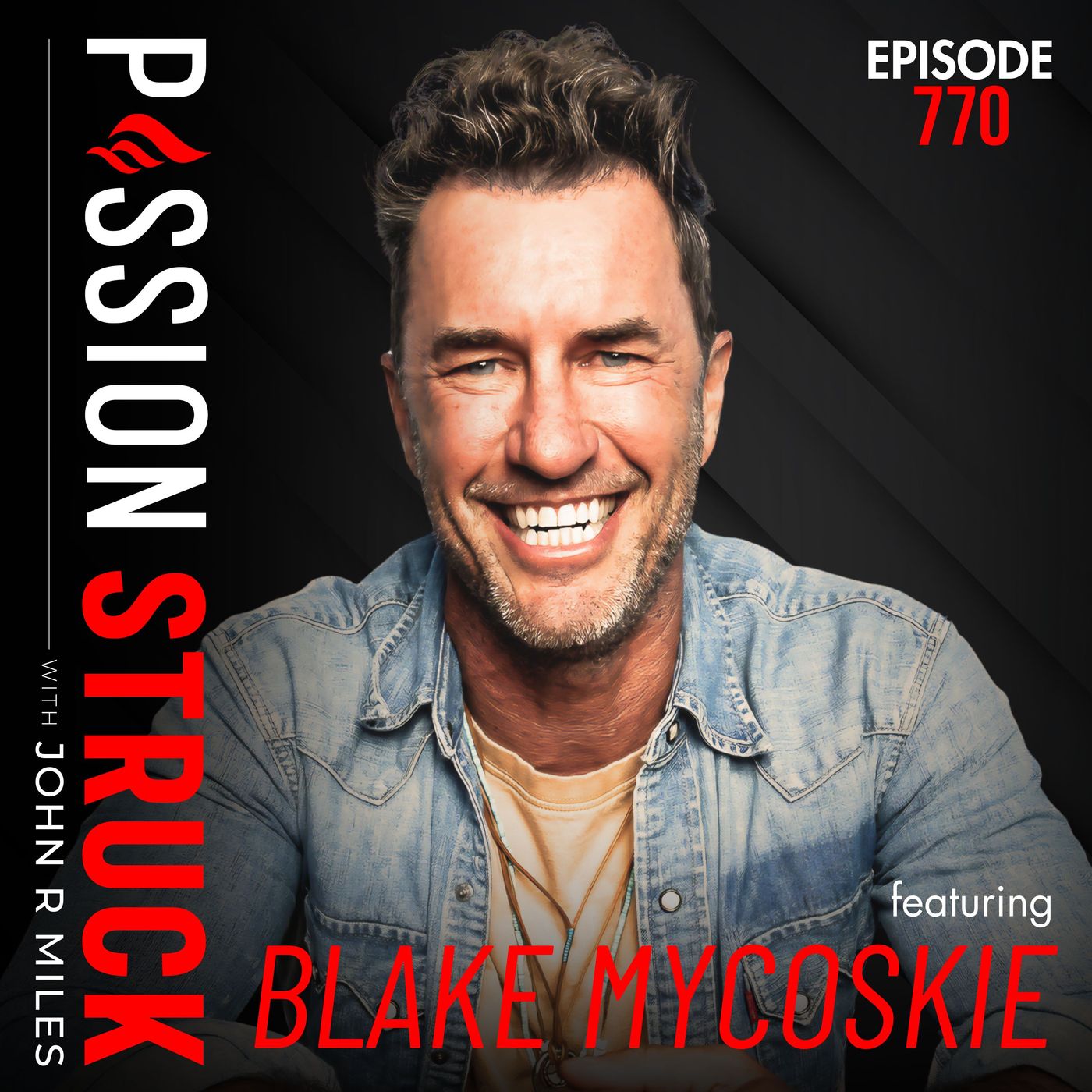
Passion Struck with John R. Miles
The Courage to Believe You Are Enough | Blake Mycoskie - EP 770
00:55:08
In this episode of Passion Struck, John R. Miles sits down with Blake Mycoskie, entrepreneur, philanthropist, and founder of TOMS, to discuss the hidden emotional cost of success, the mental health crisis affecting high-achievers, and the powerful...
Loading summary
Transcript157 lines
- [00:01]
Blake Mycoski
Premier hosts on VRBO deliver quality vacation rental stays with fast responses and clear instructions so you don't have to worry about surprises.
- [00:08]
VRBO Customer
I asked our host a question about the house last night and he got back to me super quick.
- [00:13]
Blake Mycoski
See, that's the premier host move right there.
- [00:15]
VRBO Customer
I wish I had a premier group chat. I asked them where we should have dinner last night and they left me on red. I know you saw it. It says it.
- [00:22]
Blake Mycoski
Classic group chat move. Don't walk into a surprise. Book a top rated vrbo. Stay with a premier host. If you if you know you vrbo,
- [00:30]
VRBO Customer
get a jump on next summer with vrbo's early booking deals. Don't wait to claim your dream summer spot, whether that includes a good porch swing or a poolside lounger. When you book early, you get the best places at the best prices. But back to poolside loungers. With vrbo, you don't have to reserve any loungers. They're all yours. In fact, the whole private home is yours. Book with early booking deals and you can lounge around all summer long, however you please. Book with vrbo, Nemo, Evil and Doug.
- [01:03]
Liberty Mutual Spokesperson
There's nowhere I wouldn't go to help someone customize and save on car insurance with Liberty Mutual. Even if it means sitting front row at a comedy show.
- [01:12]
Liberty Mutual Spokesperson's Partner
Hey, everyone, check out this guy and his bird. What is this, your first date?
- [01:16]
Blake Mycoski
Oh, no.
- [01:16]
Liberty Mutual Spokesperson
We help people customize and save on car insurance with Liberty Mutual together. We're married.
- [01:21]
Blake Mycoski
Me to a human, him to a bird.
- [01:22]
Liberty Mutual Spokesperson's Partner
Yeah, the bird looks out of your league.
- [01:24]
Liberty Mutual Spokesperson
Anyways, get a quote@libertymutual.com or with your local agent.
- [01:27]
Liberty Mutual Spokesperson's Partner
Liberty. Liberty. Liberty. Liberty.
- [01:30]
John Miles
Coming up next on Passion Struck.
- [01:33]
Blake Mycoski
I started doing this mantra based meditation practice for 40 days to reprogram my subconscious. Once I did that and really started to feel it in my body, not just say it out loud, but actually feel that I was enough. And then I also then started to see the how ridiculous it was that I didn't feel enough. It was almost like huge humorous to me because it really was something I embodied. Everything changed. I simplified my life completely again. I stripped away a lot of the noise. I definitely stopped performing. You know, I just felt, okay, I'm enough just because I exist.
- [02:09]
John Miles
Welcome to Passion Struck. I'm your host, John Miles. This is the show where we explore the art of human flourishing and what it truly means to live like it matters. Each week I sit down with change makers, creators, scientists and everyday heroes to decode the human experience and uncover the tools that help us lead with meaning, heal what hurts and pursue the fullest expression of who we're capable of becoming. Whether you're designing your future, developing as a leader, or seeking deeper alignment in your life, this show is your invitation to grow with purpose and act with intention. Because the secret to a life of deep purpose, connection and impact is choosing to live like you matter. Hey friends. Welcome Back to episode 770 of Passion Struck. And boy, do I have a special episode for you. Today we're continuing week three of our May series, Forged in how struggle shapes meaning, resilience and transformation. And over the past few weeks, we've explored something I think a lot of people quietly wrestle with. How adversity doesn't only come from tragedy or trauma. Sometimes it comes from success, from achievement, from performance, from building a life that looks meaningful on the outside, while internally, something still feels missing. In our last episode on Tuesday with Amy Purdy, we talked about how adversity can reshape identity and become a catalyst for reinvention. But today's conversation takes that idea somewhere even deeper. Because what happens when you accomplish everything you thought would finally make you feel whole? And it still doesn't. Today's guest is Blake Mikowski, entrepreneur, founder of TomShoes and creator of a new movement that's focused on being enough. For years, Blake was seen as one of the greatest examples of of purpose driven entrepreneurship. Through TOMS, he helped pioneer the one for one giving model and donated more than 100 million pairs of shoes around the world. But behind all that impact, Blake was quietly fighting something much more personal. A growing feeling that no amount of success, recognition or achievement could make him feel like he was ever enough. And honestly, this conversation hit very close to home for me, because one of the central ideas in my upcoming book, the Mattering Effect, is that people often don't lose their sense of worth all at once. They lose their ability to feel it gradually through performance comparison, disconnection, burnout, and the slow erosion of believing they matter beyond what they produce. And Blake speaks about that with remarkable honesty. In this conversation, we talk about identity, entrepreneurship, mental health, suicidal ideation, loneliness, performance culture, and the dangerous belief that our value must constantly be earned. But what I appreciated most is that this isn't just a conversation about struggle. It's about healing. It's about what changes when someone finally stops chasing validation long enough to realize I am enough simply because I exist. And maybe that's why this episode feels especially important during Mental Health Awareness Month, because I think a lot of people today are exhausted from trying to prove
- [05:29]
Interviewer / Host
their worth to the world while quietly
- [05:32]
John Miles
losing connection to themselves. Before we dive in, one quick note. If this show has ever made a difference in your life, please share it with someone who might need it, leave a rating or review and follow along on YouTube for full episodes. It helps us reach more people who aren't just searching for answers, but for a better way to live. Now let's dive in with Blake Mycoski. Thank you for choosing Passion Struck and choosing me to be your host and guide on your journey to creating an intentional life that matters. Now let that journey begin.
- [06:05]
Liberty Mutual Spokesperson
And Doug, there's nowhere I wouldn't go to help someone customize and save on car insurance with Liberty Mutual. Even if it means sitting front row at a comedy show.
- [06:14]
Liberty Mutual Spokesperson's Partner
Hey everyone, check out this guy and his bird. What is this your first date?
- [06:18]
Blake Mycoski
Oh, no.
- [06:18]
Liberty Mutual Spokesperson
We help people customize save on car insurance with Liberty Mutual together. We're married.
- [06:23]
Blake Mycoski
Me to a human, him to a bird.
- [06:24]
Liberty Mutual Spokesperson's Partner
Yeah, the bird looks out of your league.
- [06:26]
Liberty Mutual Spokesperson
Anyways, get a quote@libertymutual.com or with your local agent.
- [06:29]
Liberty Mutual Spokesperson's Partner
Liberty. Liberty. Liberty. Liberty.
- [06:34]
Lowe's Advertiser
During Memorial day at Lowe's shop household must haves for less. Save $80 on a Char Broil Performance Series 4 burner grill to chef up something special. Plus get up to 45% off select major appliances to keep things fresh. Our best lineup is here at Lowe's. Lowe's we you save valid through 527 while supplies last selection varies by location. See lowe's.com for details.
- [06:57]
VRBO Customer
Visit your nearby Lowe's.
- [07:05]
Liberty Mutual Spokesperson
And Doug, there's nowhere I wouldn't go to help someone customize and save on car insurance with Liberty Mutual. Even if it means sitting front row at a comedy show.
- [07:14]
Liberty Mutual Spokesperson's Partner
Hey everyone, check out this guy and his bird. What is this your first date?
- [07:18]
Blake Mycoski
Oh no.
- [07:19]
Liberty Mutual Spokesperson
We help people customize and save on car insurance with Liberty Mutual together. We're married.
- [07:23]
Blake Mycoski
Me to a human, him to a bird.
- [07:25]
Liberty Mutual Spokesperson's Partner
Yeah, the bird looks out of your league.
- [07:26]
Liberty Mutual Spokesperson
Anyways, get a quote@libertymutual.com or with your local agent.
- [07:30]
Liberty Mutual Spokesperson's Partner
Liberty. Liberty. Liberty. Liberty.
- [07:37]
Interviewer / Host
I am so honored today to welcome Blake Michalwski to passion struck. Blake, so great to meet you.
- [07:43]
Blake Mycoski
Hey John, thank you so much for having me on the show.
- [07:46]
Interviewer / Host
I'm ecstatic to have you here and I'm excited to talk about your brand new initiative that's all near and dear to my heart. When people hear of your story, Blake, it's often told of one of impact millions of lives touched. You donated over 100 million shoes when you were overseeing TOMS it became one of the most iconic, purpose driven companies of our time. But what struck me is I was doing more and more research into you, is how all of that was a backdrop to something much deeper. And as I was explaining to you before we come on, in my upcoming book, the Mattering Effect, I explore how people don't lose their sense of worth. They lose slowly, I believe, lose their sense of mattering. And it's not in one moment. I describe it as a gradual disappearance that happens when life looks like it's working on the outside, but it isn't on the inside. So I wanted to start there.
- [08:47]
Blake Mycoski
Yeah.
- [08:48]
Interviewer / Host
When did this erosion of feeling like you were enough start to begin for you?
- [08:55]
Blake Mycoski
Yeah, I think it became very obvious after I sold the company. So that was about nine years ago. But looking back now, I think this was prevalent all through growing up and into my tennis career and then into business and then to Tom's. And I think I had this kind of core wound that I never really addressed. And I don't think it really surfaces much until after I sold toms. But it was the fact that I just never felt that I was enough. And I think so much of my drive and ambition and starting five companies before Toms and then my desire to really help the world and help people, kids get shoes, was all tied to this kind of deep need for external validation because I didn't feel that I was enough just as I was. And I think it really came to light once I sold the company. And then I should have been feeling at my best. I helped 100 million kids get shoes. I made hundreds of millions of dollars myself. I had this great family and that still wasn't enough. And I still didn't feel that intrinsic sense of worth. And that's when I was really faced with that wound that had probably been there since I was a kid.
- [10:08]
Interviewer / Host
Well, that's where I wanted to go to next. Because something you don't know about me is similar to you. From the age of three or four, I was introduced to tennis and played competitive tennis all throughout my adolescence, up up to the point where when I went to college, I had also gotten into competitive running. And it became a choice between am I going to do Division 1 tennis or Division 1 cross country and track, And I ended up picking the latter. But probably experienced a lot of what you experienced as you were going through that period of your life. How much do you think of your early identity was shaped by that performance culture that we both know is our own tennis?
- [10:52]
Blake Mycoski
Oh, all of it. I think I literally. I moved away from home at age 15 and lived at a tennis academy. I practiced five, six hours a day. I didn't go to the movies on Friday nights with my friends because I was hitting on the ball machine. My whole identity was based around being a competitive tennis player and a great competitive tennis player. It's hard because it's a. You don't have teammates. Right. It's all on you. So there's a lot of pressure for someone who's young and feeling like they needed to win. And so, yeah, I think so much of my identity was. Was based on that. And then I think it became. I changed that identity for the identity of a young entrepreneur. I started my first company when I was 18 years old. I dropped out of college, and then I went from Blake, the great tennis player to Blake the great young entrepreneur. And so then that was the identity. And so I think what happens is, if you don't have that intrinsic self of worth and the peace that comes from that, you're constantly trying to construct these identities that give you the validation that you don't give yourself.
- [11:56]
Interviewer / Host
I want to just go back to tennis for a second because I.
- [11:59]
John Miles
Where did you grow up?
- [12:00]
Blake Mycoski
Texas.
- [12:01]
John Miles
Okay.
- [12:01]
Interviewer / Host
You grew up. I grew up in Pennsylvania, so even during the winters, I would go and play tennis inside. So it was like. Yeah. Indoor courts. It was like five, six days a week. I was on the tennis court.
- [12:14]
Blake Mycoski
Yeah.
- [12:15]
Interviewer / Host
Did you end up doing something like img?
- [12:18]
Blake Mycoski
Yeah, it is similar to it. It's called the John Newcombe Academy, but it was in Texas. New Braunfels, Texas. And very similar to img. Yeah.
- [12:26]
Interviewer / Host
Yes. I ended up. When I was young, I got to play against Sampras and Agassi when they were both my age, young kids. I just remember feeling so much pressure on me. And it wasn't necessarily pressure my parents were putting on me. It was personal pressure.
- [12:42]
Blake Mycoski
Yeah.
- [12:42]
Interviewer / Host
That I had to perform. Did you feel the same thing?
- [12:44]
Blake Mycoski
Yeah, John, we had the exact same story there, because I think a lot of people get that wrong. They assume that I had crazy tennis parents that put all this pressure on me, and I didn't get love unless I won. That was not the case at all. My parents are like, if anything, they probably thought I was a little bit crazy how much drive and pressure I was putting on myself. And so it really did come from this intrinsic drive that I had. And I just think I was born with it. And then I think the feeling of not feeling enough. One thing that's hard about competitive tennis If I was like the best player in my town and I was one of the best players in my state, but when I went to national tournaments, I would lose pretty early in the tournaments. And so I was losing a lot more than I was winning really in tournament play. So that's not really good when you already are putting your value based on your performance and in that sport. So it my tennis career, I wouldn't say, like, help. It probably made my feeling of not feeling enough greater, not better.
- [13:42]
Interviewer / Host
Another thing that happened uncanny is when I was running competitively at the Naval Academy, I got injured during my sophomore year. Sounds like you had something similar for you.
- [13:52]
Blake Mycoski
Yeah, that was my Achilles tendon injury. And. But that was actually turned out to be like, a great blessing because I wasn't going to become a pro tennis player yet. I was organizing my life as if I was. And then when I had that injury and I wasn't able to play for eight months, it really had me rethink, well, what do I want to do with my life and what am I doing to build on my future? And I ended up starting my first business, and it was a laundry business. And I learned a lot. And we grew it, surprisingly grew it to like, five universities. And it got so big that I had to drop out of college because I had 40 employees and I was like 18 years old. But I never would have probably started that business if that injury didn't happen. So I actually look back on it as a blessing in reality.
- [14:35]
Interviewer / Host
And if I have my research correct, your father was a physician or is a physician, and you had a conversation with him that you didn't know how it was going to go about should you stay in school or take a gap year. And I think it's a great story.
- [14:49]
Blake Mycoski
It was really a beautiful moment. I'll never forget it. I was actually driving in one of my laundry vans at the SMU campus in Dallas, right around the rotunda, and I knew the exact spot. And he called and asked me how he's doing, and I said, great, but I got to talk to you about something. I said, we have gotten so many more customers than we ever imagined. Because it was just when school started and a lot of the parents were signing their kids up for our laundry service. And I've got to hire people and we got to find a larger facility, and there's just no way I can go to class on Monday, the first day of school. I think I'm going to take the semester off and see if I can get a hold of this and he was, like, so excited for me. He was like, that sounds like an amazing adventure. And that's. You're going to learn so much. And I fully support it. And it's interesting. There's been two conversations with my dad, a lot of great conversations. My dad, we're very close, but two that really were defining for me. That was one of them. And then the other one was. And I've shared this with a few people, but I went on the entrepreneurial path. I dropped out of college. I had some success in the laundry business. Then I had some failure, and I tried to launch a cable television network, and I lost a lot of money. And then I had a little bit of success with this online driver's ed company. And I just bounced around between kind of successes and failures as an entrepreneur for about a decade. And I wouldn't say I was burnout, but I was, man. Like, how am I going to have some stability if I want to get, like, married someday and have kids? One year I had a million dollars in my bank account. Now I have zero. I really. That was the swing that was happening in my mid-20s. And I took some time off, and I went to Argentina, and that's where I had the idea for Tom's. And I came back, and I remember calling my dad and I saying, you know what? I had this idea where there's these really cool shoes I found, and I saw all these kids in the streets that didn't have shoes. And so I'm going to sell these, like, really cool Argentine shoes. And every time I sell a pair, I'm going to give a pair back to these children that need shoes. And I'm going to do it for the next six months or so and then go back around Christmas time and give away whatever shoes we sell. And I said, I don't know if this is, like, a business or if this is just a project, but I really think I should do it. And as having. In order to do it, I was having to turn down a pretty lucrative opportunity that someone had brought to me to run kind of the sales division of a new startup that was really progressing. And my dad knew I was trying to decide if I should do that or not. And. And he said to me, he said, you know what? I think this is the best idea you've ever had. I would do. I would put everything into it. And I did. And then the rest is kind of history. But. But it was really cool because it was like. It was another point where my dad, who had more of A servative career path, became an orthopedic surgeon, went to school, did the thing, had a lot of stability in his life. He encouraged me to do something that was sounded to most people completely radical in terms of giving away a pair of shoes every time I sell a pair. In face of taking opportunity, that would have been probably me making a couple hundred thousand dollars a year. It was like a really great, very lucrative opportunity with this startup. And so that was really cool.
- [17:58]
Interviewer / Host
My son now is in his mid-20s, but when he was in high school, one of his best friends wanted to become a doctor. And the parents of his friend were both doctors, and one of them had created a whole bunch of patents. And it was interesting because this friend of my son had gotten into uva and his father kept telling him, I would rather just give you 150,000 or 175,000 and have you go and just try to start a new startup rather than you going to college. Because I think you're going to learn more from it than you will from that college experience as you look back upon that. And both of us, when we played tennis, had a clear scoreboard of what success looked like and how you climb up the leaderboard to when you start a business, it changes to an undefined one. Did you find that shift when you started getting into the entrepreneurial missions? Did that make you more driven or more uncertain?
- [19:00]
Blake Mycoski
That's a good question. I think that as I went into my entrepreneurial career and even today, like I'm involved in three startups right now, I don't think it necessarily is about drive as much as it is curiosity for me, like, I love to help solve problems, or I love to help people with something that maybe I struggled with. And because I struggled for almost seven years with my mental health, which I know we'll get into, I'm much more inclined to be investing in and mentoring entrepreneurs that are working in the mental health space. And some of those are for profit, some of those are nonprofit. But my drive to be entrepreneurial, I think, has always come from seeing a need and then wanting to fulfill it. And it's not ever really been financially motivated. Even though I've made a lot of money, it's always been like, how cool would it be to help people with this? Or I struggle with that. Perfect example right now is I'm mentoring these guys who've started a AI therapy app, and it's called Sonia. And I met these guys, they went to MIT, they're 26 years old, they're super smart. They spent three years basically training with every single CBT textbook, ACT textbook, every single therapy modality, every hard case study they literally have literally built on the backs of every great therapist and in the world. And they've designed this AI therapy app called Sonia. It's in beta right now. And I met them at a mental health conference and I was fascinated because I have a standing therapy appointment, two o' clock on Wednesdays. And the reality is I travel a lot. I do the podcast, I have my podcast, I have a lot going on. I miss it probably half the time just because there's something I can't move or I'm on a plane. And what is so amazing, and the reason I tried it out was I found that sometimes I might wake up with some anxiety on 5am on a Tuesday. Well, my therapist isn't available to talk to me and I don't want to wake up a friend. So now I go to the AI therapy app, and I've been doing it for six months now. And it is the most remarkable thing I've ever dealt with in my life when it comes to mental health. Like, it remembers every conversation, it's trained in every model. So I know enough about therapy that I can make. Oh, it's using CBT right now to talk to me about kind of processing this emotion or this disagreement I had with my ex wife or this anxiety I feel about one of these investments I made, which I really can't put enough time on. It's amazing. And so for me, like, I am putting a disproportionate. I'm not even an investor. I'm just like, friends with these guys and I'm advising them. I might invest. I don't know if they get further along, but I'm putting so much energy in this because it's been so helpful to me. And then I introduced it to my dad and some other people and they're all using it. And. And so I don't know, it's just. I guess that's how my brain works. When it's like this, I follow. Like Joseph Campbell, who wrote Hero's Journey, always said, follow your bliss. And for me, my bliss has always been starting and helping organizations that could have a massive impact grow and scale. And I felt like that with Toms and now with this with Sonia. I feel the same way. And I'm. It's funny, I was like, talking to my girlfriend the other day and I was like, man, I talk to these Sonia guys like every day, like three times a day. And like I don't even know if I'm even going to be involved or not. But it's just so exciting because it's been so helpful for me and then the people that I've introduced it to has been so helpful to them and it's just so fun to see that we get AI gets so much bad rap about what it could do to our society and our culture. But like this is like a way to potentially give therapy to people who never would see a regular therapist or maybe can't afford a regular therapist or men. I've given it to my guy friends and I have a lot of guy friends that have no interest in going and sitting in a therapist office. But they use this every day and so it's, it's really cool. So I don't know I went on a tangent there, but that's just the way that I think about these things is really follow where your energy is.
- [23:08]
Interviewer / Host
Probably over the weekend you saw all the hoopla over veterans. Marcus Luttrell in the Oval Office talking to the President about using psychological treatment for veterans. It seems as a veteran myself, this app would be great for a lot of veterans who don't want to have to go physically to see someone and talk through it like that, but could get something really valuable that could help them on a very on a everyday basis.
- [23:33]
Blake Mycoski
John that's a great idea. I'm going to tell the founders that really think about veterans because the other thing is just obviously it's judgment free and so like you can tell it everything. And I even find with my therapist I'm embarrassed about some thoughts or a feeling or something. But with this is yeah, you just tell it everything because there's no judgment and that's how you can actually get the best help. And I think veterans would be a great market to to test it with.
- [23:56]
John Miles
Before we continue, I want to thank all of you who continue to support Passion Struck and share these conversations with others. One of the biggest themes in today's conversation is that healing often begins the moment we stop tying our worth to performance. That is something I explored deeply in my upcoming book the Mattering Effect. And it's also why I created the companion workbook and weekly reflections available through the Ignited Life newsletter. You can download the workbook and explore more@theignitedlife.net now a quick break for our sponsors. Thank you for supporting those who support the show
- [24:36]
Lowe's Advertiser
during Memorial Day at Lowe's Shop Household Must Haves for less save $80 on a Char Broil Performance Series 4 Burner Grill to chef up something special plus get up to 45% off. Select major appliances to keep things fresh. Our best lineup is here at Lowe's. Lowe's we help you save. Valid through 527, while supplies last selection varies by location.
- [24:58]
VRBO Customer
Seeloes.com for details, visit your nearby Lowe's.
- [25:04]
Lowe's Advertiser
With the blue Cash Everyday card, it's easy to earn 3% cash back on groceries at U.S. supermarkets, U.S. online retail purchases, and U.S. gas stations. That's how we grow our family's little nest egg. Learn more@americanexpress.com Explore BCE terms and cash back cap apply during Memorial Day at Lowe's. Shop Household must haves for less. Save $80 on a Char Broil Performance Series 4 Burner Grill to chef up something special plus get up to 45% off. Select major appliances to keep things fresh. Our best lineup is here at Lowe's. Lowe's we help you save. Valid through 527, while supplies last selection varies by location.
- [25:44]
VRBO Customer
For details, visit your nearby Lowe's.
- [25:53]
John Miles
You're listening to Passion Struck right here on the Passion Struck Network. Now back to my conversation with Blake Mycoski.
- [26:02]
Interviewer / Host
Blake, something you said, and then I'm going to get into your story again, but something that you said that I just wanted to highlight is are you friends with Jim McKelvey or know who he is?
- [26:10]
Blake Mycoski
No, I don't know who he is. No.
- [26:12]
Interviewer / Host
So Jim and Dorsey founded Square.
- [26:15]
Blake Mycoski
Oh, okay. I'm familiar. Square. Yeah.
- [26:17]
Interviewer / Host
And I. I was interviewing Jim about eight or nine years ago, and we were talking about what he has always found makes a powerful startup and makes it differentiated from everyone else. And he said, you have to focus on the problem and what ends up happening with a lot of which is what I heard you saying is I always get so passionate about a problem that I see out there that's worth solving. In the case of Square, he was a glass artist, and he couldn't take payments for his art to sell it, so he found this big gap. But he was telling me what ends up happening to a lot of entrepreneurs is they find that problem and then they lose sight of it. And as they encounter difficulties along the way, as you all do always do, you seem to get further and further away from the problem.
- [27:03]
Blake Mycoski
And.
- [27:03]
Interviewer / Host
And it seemed to me during your whole tenure at TOMS that you really understood that problem and then it fueled the whole mission.
- [27:11]
Blake Mycoski
Yeah.
- [27:11]
Interviewer / Host
Is that another way to think about it?
- [27:13]
Blake Mycoski
I think that's a great way. And I think that when organizations falter is when you Stop focusing on the problem. And I think that was a little bit of what happened to me with tom. I think over the years I went from here I am trying to give kids shoes and I'm spending a lot of time not just selling shoes, but giving shoes. But then as a business got bigger and you have a whole giving department now that's responsible for the giving shoes, I got more removed from the mission and more focused on presenting to Nordstrom's. And not that there's anything wrong with that, but. But I do think it, me and others at toms, we lost touch with the mission of it. And I think that over time is also what motivated me to do it in the first place. I lost motivation as well.
- [27:58]
Liberty Mutual Spokesperson's Partner
So.
- [27:58]
Blake Mycoski
So I wouldn't say it was more like it had a negative effect on the business, but just personal motivation to be doing it every day and to be working hard and to be traveling so much and to be doing all this was. It was harder and harder to do. The further I was removed from the act of actually putting shoes on kids feet.
- [28:15]
Interviewer / Host
Yeah, that's exactly where I was going to go. So I'm glad you answered it because I had a suspicion that you were moving farther and farther away of actually feeling the impact you were creating and you reached this point where you're operating a lot on momentum rather than that feel.
- [28:31]
Blake Mycoski
And that's what's so fun about running the enough program right now is like I am so connected to the stories and people giving the bracelets and wearing the bracelets. And I did a TED talk last week in Vancouver and Ted gave everyone a bracelet on the way out and I saw 1500 people wearing it and then talking about how they were going to give the next one to their son or to their daughter or their best friend or one was going to send it to their mom for always making this feel enough. And so I'm right at the epicenter right now of seeing the impact of what this enough movement is doing already even though we're only four months old. And I'm very aware that it's so important for me to always stay in that place. So I think I learned that through toms and I think now no matter how big or small enough is, I will continue to make sure that the bulk of my time with it isn't in the supply chain and selling and donations and more in the really connecting with people who the bracelet is making a difference in their life.
- [29:35]
Interviewer / Host
I want to come back to this bracelet in just a second, but I want to go to your pain point. Are you familiar with who Tony Sway is? Founded Zappo. He founded Zappos.
- [29:45]
Blake Mycoski
Oh, Tony Hsieh. Yeah. Sorry. Yes. Yes.
- [29:48]
Interviewer / Host
I did one of the last interviews with weeks before he unfortunately lost his life. And I remember him talking about not on screen, but off screen, that just something for him felt off in a big way. And I think part of it was at that point they'd already been acquired by Amazon, and he felt the whole culture of the company dwindling away from him. But I think internally, obviously, it was dwindling away for him as well. When did you realize that moment when something was off and that all the success that you had, all the accolades, everything else wasn't fixing it?
- [30:28]
Blake Mycoski
Probably about a year after I sold, I think, the excitement and I moved to Jackson Hole and I built this house and did all the things that people probably do when they have financial freedom for the first time in their life. And once the kind of buzz of that wore off and I was faced with, wow, I did all that and I don't feel any better or any different. And if anything, I really miss the early days of Toms, when I felt so much connection to my purpose and what mattered. And what was so scary about it was I didn't know how to fix it. All the other times in my life, I felt like I figured out a way to fix it, and then I was just left with, man, I built the company, I helped a lot of people, I made all this money, I got married, I have kids, I have this house. And I still feel this shitty. What the. You know, and so then it's really hard because there's nothing I could do. Now, looking back, that should have been the beginning of the inner journey that I went on, which ultimately led me to a big healing. But I was just not capable of going within yet. And so that started the beginning of what became a really dark period in my life, and probably not. I remember the day I got the news with Tony. I knew Tony, and I was in a pretty dark place when I heard that news. And it woke me up a little bit to, man, I need to get some help, because this might not end well if I don't. And that was around. I did get some help then, and it did help for a little while. It wasn't ultimately the help that helped me break through and get back to myself. Yeah, it was. I had about five years. Yeah, that were really difficult, and then about two that were very dangerous.
- [32:22]
Interviewer / Host
It's interesting, I interviewed Esther Dyson about 18 months ago, who knew Tony extremely well. And when I asked her about the whole situation, the way she described it was she used the words negligent suicide. And when she used those, it was really an awakening for me. Yeah, because I. I don't think from the research I've done that people necessarily lose their worth. I think what ends up happening over time is we lose our ability to feel it. Yeah, I know. For me, what I went through was I just started to feel more and more numb. And I couldn't put a word to it because it happened so gradually. It was just like the world felt less alive and I couldn't figure out why. It just didn't seem as bright day to day for me as it used to. Is that kind of how you felt about it as well?
- [33:21]
Blake Mycoski
Yeah. Yeah. I think that numb feeling was there. And then I think in the case of me, I started then trying to figure out anything and everything I could do to feel better. My hat says no Magic pill, because that's the name of my podcast that I'm launching in May. And it's all about the fact that there is no one path to good mental health. There is no one path to mental wellness. And so what I found during that time is I just kept searching for anything outside of myself that could make me feel something. And ultimately I realized that it was a combination of things. A great therapist, some really important core wound, inner child work. It was some psychedelics. There's a combination of things that really helped me find my true self again and make changes in my life to be more aligned so that I was living with more integrity. Because I think that's a big part of it too, is there's that feeling of numbness, but there's also a feeling of little compromises you make over and over time. And then you wake up and you're like, I'm not even living the life that I believe in anymore. And that was definitely the case for me. And so, yeah, so I think that for me, looking back, in some ways, I'm grateful that I tried all these different things and trans magnetic brain stimulation and ashrams in India and silent retreats in California and all different types of therapy, because now I have the opportunity to help guide people to what might work for them. And it's one of the things that I really love doing and I never would be able to do it had I not gone through the suffering. So I think of as, depression isn't something that happened to me, it's something that actually happened for me. Because it's led me to my next purpose.
- [35:05]
John Miles
Yeah.
- [35:06]
Interviewer / Host
Well, I always firmly believe that we're best positioned to serve the person we once were.
- [35:10]
Blake Mycoski
Yeah, I love that. That's a great phrase. Yeah. Yeah.
- [35:14]
Interviewer / Host
Do you think you've been talking to more and more people, that what so many people are doing today is they're performing, meaning more than they're experiencing it?
- [35:26]
Blake Mycoski
Yes. I think that happens a lot with high performers. I had my. I had Matthew McConaughey on the show, and then the next week I had Kevin Loves. I go from an actor to a five time NBA all star, and both were really open about their mental health journeys.
- [35:42]
Interviewer / Host
And.
- [35:43]
Blake Mycoski
But what I found was, is that they. When they were at their darkest moments was when they were. It's interesting thinking McConaughey, because he's an actor, when they were performing. I can think of two stories in both of those podcasts I did with them where the darkest moment really came when they were, in a sense, performing. Forming meaning versus really feeling it from an authentic place. And luckily, both of those guys really recognized that and did the work to get through it. And that's why I had them on the show, because I was like, more men need to hear this, that you guys went through this and you got through it, and this is how. And so I think that's very much the case that happens with a lot of people who are suffering.
- [36:26]
Interviewer / Host
Yeah. I love the story about Matthew. I met him when I was an executive at Dell, and we went to the same church in Austin.
- [36:34]
Blake Mycoski
Okay, cool.
- [36:35]
John Miles
Yeah.
- [36:35]
Interviewer / Host
And I met him when he was filming the Dallas Buyers Club.
- [36:38]
Blake Mycoski
And I have to tell you, that
- [36:41]
Interviewer / Host
first time I saw him, it was like I had. He was so skinny. I had this moment. You knew the person, you thought they were like a friend of yours, but you couldn't just put two and two together. But what was amazing to me, witnessing him week in, week out in that environment, was how authentic he is, how much he loved his kids. He would shoot basketball with my son and hang out with the kids, running around the jungle gym. And it totally was a huge influence, actually, on my son, because at the time, he was struggling in middle school, going through a lot of the feelings of not being enough that middle school students go through now. And he didn't want to go to church, but when he saw Matthew was going there and he saw how much he was into it, it kind of changed his whole reality there. I'm very grateful for that time that. That we got to spend with him.
- [37:30]
Blake Mycoski
Yeah. You have to listen the episode comes out on May 5th with him, and it's awesome. He is, like you said, so authentic, incredible storyteller, but also just has a lot of really good, practical life lessons to share, especially with men. I learned so much from that interview. It was one of my favorites.
- [37:50]
Interviewer / Host
Yeah. So, Blake, you have been really open about how dark things became for you.
- [37:56]
Blake Mycoski
Yeah.
- [37:58]
Interviewer / Host
What do you think made that moment in life so much different from everything that came before? Because you had. Yeah, a lot of momentous things.
- [38:08]
Blake Mycoski
1. So which moment are you referring to?
- [38:12]
Interviewer / Host
Well, I'm referring to the one where you contemplated. Oh, yeah.
- [38:15]
Blake Mycoski
Yeah. I was really suicidal for about three months. I would say a full year. It was in my consideration, which is so sad to say, but three months where I couldn't stop the idea in my head. And that's when I really got severe help and went to a treatment facility and really took it incredibly serious. And that was also, I will say, for anyone, this is important. I was misdiagnosed as bipolar, and during this whole five year journey, and I got put on four different pharmaceuticals that I think really led to this suicidal ideation. Not only did it numb me, because in bipolar, they're trying to mitigate any highs or lows, and so it just flattened me, but then it also just made me not want to be alive and not think that I should be alive. And so I was weaning off the meds with. Under the care of an incredible psychiatrist, but still weaning off four different psychiatric meds that you should never have been put on in the first place is really hard on your brain chemistry. And so I feel like during that time, I was not even control of my thoughts. It was like a demon had taken over my brain, and it was just wrecking havoc on me and telling me the worst things about myself and about life and about potential for any joy in the future. And I think when someone takes their life, it's because they just want it to stop. They just can't handle that inner monologue anymore. And I was there. I was there, like I said, for three months. I made a plan to do it on my sailboat that I lived on for six years when I started toms. And because I just didn't want my family to be the ones who found me. That's the way I was thinking back then. And. Yeah, but hitting that rock bottom is what really forced me to take my healing or my mental health much more seriously, because I did feel like I was losing control. And then that's when I reached out to friends and family and started getting really good help. And so, yeah, it was, I think, accumulation of a lot of pain and suffering for years and just that. And then also these meds that really got me to the place where I just couldn't handle it anymore.
- [40:22]
Interviewer / Host
I went on this retreat to support a nonprofit I was working with. It's probably been six or seven years ago, but it was a whole bunch of veterans. There were maybe a hundred of us there, most of them special operators and those of us who've gone through combat trauma. When you go to the VA for treatment, they put you on this cocktail. And I would say 95% of the people who were there, it brought them closer to suicide than it did moving away from it. And I'm not sure what you experienced, but like when I was coming off this cocktail, it was like my, I, I can't even explain it. It was like I had these synapses that just felt like they were broken in my brain. And yeah, it was like the weirdest feeling I've ever experienced of just coming completely apart. I wouldn't wish it on anyone, man. But interestingly enough, on this retreat, almost all of them had gone through either psilocybin, mdma, ketamine or some other type of intervention because talk therapy wasn't working. And out of that, like 85% of them were getting better because of these new modalities. And it is, and it's just so amazing how different your life changes when you feel you are enough again.
- [41:43]
Blake Mycoski
Everything changes. Literally when I had the realization that was really at the core underneath all of it, and that I had been there for a very long time. And I started doing this mantra based meditation practice for 40 days to reprogram my subconscious. Once I did that and really started to feel, feel it in my body, not just say it out loud, but actually feel that I was enough. And then I also then started to see the. How ridiculous it was that I didn't feel enough. It was almost like humorous to me because it really was, it was something I embodied. Everything changed. I simplified my life completely again. I stripped away a lot of the noise. I definitely stopped performing. You know, I just felt, okay, I'm enough just because I exist. And literally that was, gosh, 16 months ago now. And knock on wood, I haven't had any anxiety, any depression, any signs of all the shit I went through for so many years since that moment, since that really became something I embodied. And that's why led me to starting the organization to help spread that message. Because I think it is the most important message, it's at the foundation of all of our mental wellness, is a sense that I am enough. Just because I exist, it doesn't mean you don't go out and achieve great things. Or if you're a high school student, you're not a great athlete, that's what you want to be. Or they don't strive to build great companies, but it has to come from a place of doing that out of joy because you exist and you are enough and that you are made in God's image. Really, if you think about that scripture, it's. That is at the core of it is that we are enough. Just because we are, there's nothing we can do to earn our way into the kingdom of heaven. Like it's. It is because we just exist. And when you have that feeling and that grace with yourself, everything changes. And that's why wear the bracelet every day. That's why I give it to everyone I know. Because I think more than ever in this time, we need a reminder that we are enough just as we are. And it's just so important.
- [43:50]
Interviewer / Host
Yeah, I couldn't agree more. I remember 2005, 2006, I was an executive at Lowe's Home Improvement and I wanted to get closer, from a spiritual sense to understanding the Bible. I grew up as a Catholic, but I never really read the Bible and understood it. So I took this 34 week class called Discipleship. And in the midst of this, I started getting these subliminal messages that I was supposed to help. The words I was given was the lonely, the hopeless, the beaten, the board, the broken, the battered, the disengaged. And man, for years I just beat my head on the wall. I'm like, like all of these things seem like they're so far different from each other. And the more I started putting attention to this, the more I realized they're all symptoms that people are feeling around the world, that they're not enough.
- [44:47]
Blake Mycoski
Yeah, yeah.
- [44:48]
Interviewer / Host
And when you don't, you feel disengaged, you experience burnout, you feel lonely, you feel hopeless. And so I completely agree with what you're doing. I wanted to just spend a couple minutes just. If the audience doesn't understand the statistics behind this and why this is so important, I'm going to just spit out a couple because I didn't prepare you to do this. But one of my favorite things to quote, have you ever looked at the belonging barometer?
- [45:16]
Blake Mycoski
No.
- [45:17]
Interviewer / Host
This is something you have to check out. Like, I found this about 18 months ago, when I was researching and it was. They were evaluating the sense of how adults in America feel. And they measure it in. At work, in your communities, your families, how you feel about mattering well, how you feel about belonging across all environments. And the statistics are crazy. 64% of people feel like they don't belong at work.
- [45:47]
Blake Mycoski
Wow.
- [45:48]
Interviewer / Host
74% feel like they don't belong in the communities that. That they're part of. And the one that was crushing for me is nearly 20% feel that they don't belong at all in any situation that they're encountering in their life.
- [46:02]
Blake Mycoski
Wow.
- [46:03]
Interviewer / Host
And so as I was trying to look into that, I then started to backtrack, like, where does that begin? And this gets back to both of our tennis stories.
- [46:11]
Blake Mycoski
Yeah.
- [46:12]
Interviewer / Host
This is all originating when we're growing up. And so now you have 40% of high schoolers who are feeling persistent issues of sadness or hopelessness, but it actually starts earlier than that. And what my research is showing is that nearly 35% of kids who are between the ages of 4 and 8 don't feel like they matter. And so for me, it's why I recently put this thing out in the world, a children's book called you matter, Luma. But I've been going on this school tour of Title 1 schools, and it's amazing how many kids that I'm interfacing with who don't feel like they're enough. And these are pre K kindergarteners, first graders, second graders.
- [47:00]
Blake Mycoski
Yeah.
- [47:01]
Interviewer / Host
So I just wanted to put this out there so people understand how big an issue this is. So from what you're doing with enough, what is the core mission of this nonprofit and who are the people you are trying to reach?
- [47:16]
John Miles
Yeah.
- [47:17]
Blake Mycoski
So I don't know if it's a good business model, but we're trying to reach everyone because every human being needs this message. Just like you said, they matter, that they are enough. And we started with this. I'll show it here. It's this box that you can buy@youarenough co. And inside it, it has two bracelets. So just like the one that I'm wearing here. And there's these beautiful beaded bracelets, and there's one for you to wear, and then one for you to give to someone else. And really, for me, that's the transformation that happens when you share a bracelet with another person. You are telling them you are enough just as you are. And sometimes that can be make the biggest difference in someone's life. The other thing is that when you wear the bracelet. What we're trying to do is use it as a signal to those around you to say, you can talk to me, you can tell me how you're really doing. This is not abstract. The research is 100% clear. Telling one person how you're really doing lowers self harm dramatically because then you have that bond to someone. You have someone to call when you're having a really hard day to confide in. And so we look at the bracelet as something that is given to someone as a gift that is worn as a daily reminder. Like, for me, I just wear it as a reminder every day that I'm enough. And I still have to remember, remind myself of that some days. And then also as a way to thank someone. I gave one to my mom because my mom has always made me feel enough. And so she wears it every day as knowing that she's always been that for me. And so she wears it with pride. And so people wear the enough bracelet for different reasons. 100% of the profits go to mental health organizations. We have five partners now. A lot of the partners we're working with are really focused on helping high school students and college students. Because I think at that stage you're so impressionable. And you mentioned it a little bit earlier, there is, because of social media and everything else, there's so much comparison to do you match up? Do you stand up to this person? And so we really are trying to instill this incredibly important value that you are enough at that age. And we have a little website, it's wearenough Co. And we have T shirts and hoodies and other things we sell too. But our main thing is to really get as many people as we can to wear the bracelet and most importantly, to share it with just one more person.
- [49:31]
Interviewer / Host
I love it. I was thinking, as you start building this, how do you create something that doesn't just scale impact, but actually helps people feel their worth?
- [49:42]
Blake Mycoski
Yeah, I think what, for me, it's all about the conversations that happen when people recognize another person is wearing it. That's where I've seen the real magic happen so far. It's, I was at a Starbucks and there was a random person wearing the bracelet. And so I went up to him and started talking to him. And before you know it, we both were like sharing a little bit of our own journeys in a very intimate way where I felt so seen and connected. And I think that's where it makes a difference. I think we have a loneliness epidemic in our country. I think that so Many of us feel so disconnected from others and even ourselves. And I think if this can be like a signal or it can be the catalyst for a conversation among strangers or even intimate conversation among friends or family members. Like, I had this one high school girl that told me that she gave the second bracelet to her dad and that she had noticed for years that her dad seemed to be depressed, but they never talked about it. And she had this unbelievable experience when she gave it to him and said, dad, if you're ever struggling, you can talk to me. You're enough, and I'm enough, and let's wear these together. And that's where it becomes much bigger than just a bracelet and a fundraiser. It really becomes something that is creating and being the catalyst for conversations that can really be healing and transformative for people. And that's, to me, what gets me excited. My favorite thing is hearing about someone. I'll give the bracelet box to someone, and they'll put one on in front of me, and they'll be excited, and I'll be like, okay, I'm so glad you like it. But what I really want to know is text me after, send me a video after you give the second one to someone else, and tell me how that felt. What did you experience? What was that exchange like? How did that affect that relationship? And so I think it's really about it being a signal. And so that's where it's. It were just getting started. But that's where, over time, as we get more and more people wearing it, so more and more people see each other then I think it's just going to hopefully create a much more open conversation about mental health in our country. And I think the more we talk about these things, the more we can make it to where people aren't feeling ashamed or are isolating or all the things that lead to bad outcomes.
- [51:57]
Interviewer / Host
What does a normal day look like for you now that you're living from a place of enough instead of chasing it?
- [52:03]
Blake Mycoski
Oh, man. Let's see. Are today with making eggs for my kids, which they did not eat. And then, gosh, every day is different, and every day is really beautiful. I am getting to do things right now that I never thought I would get a second chance to do. I'm building companies. I've launched this podcast. I'm coming on shows like yours, having conversations. I feel so effing alive. And it all is happening because I don't have the pressure anymore. I know that I'm enough. Whether people like this interview or not, it's not going to matter to me because it's not. I'm not hoping to see what the comments are and what people say. By living at a place, even being a parent, I know I'm going to f up with my kids and that doesn't make me a bad parent anymore. I know I'm going to forget something or some or whatever. I'm going to get distracted on my phone and my kid's going to remind me for the 13th time today. It's just going to happen. But I don't take it as a shot at my worth anymore. And a day for me is I'm getting to do things and a lot of the things I'm doing might look the same. I launched this hydration company called Morning Water a few months ago and all my friends who are entrepreneurs like, man, this could be like your next thing. And it's so exciting. And we had all this press and all these people were using it and loving it and I was like, yeah, it might be, but it doesn't even matter. It's just the cool, creative act of having an idea of something, creating a formula with this other really cool young entrepreneur, launching it and giving it to the world. And to me, that is only possible because I'm starting my day knowing that I'm enough no matter what happens. And so I think that to answer your question is like, when you feel enough. And this is why getting this message out there is so important to me. It just makes everything in life better. It just, it is the stress and the pressure and all that negative self talk that just lived with me for years is just not there anymore. And so I'm not carrying that weight. And so I'm able to go to things and do a sales presentation or launch a company without that fear that if it doesn't work, my whole identity and self worth is tied to it. And it's just really nice. And it also helps me have more balance. I think for all the people who are listening, running companies or CEOs or executives, it's so hard to have balance because you feel like this pressure of you got to get the next thing, you got to do the next deal you got. And now I'm kind of like, yeah, I want to achieve things, but I'm not going to do those things to sacrifice my relationship with my kids or my own ability to go work out every day. Enough, really enough is like a. It's a mentality. It really is a mentality and it affects every area of my life and really every Single day.
- [54:43]
Interviewer / Host
Awesome. And then last question for you, Blake, is if this movement works.
- [54:47]
Blake Mycoski
Yeah.
- [54:47]
Interviewer / Host
If enough lands culturally, what changes?
- [54:52]
Blake Mycoski
I really do think we'll see a. A reduction in suicides in our country. I think that all the research I've done around this is people feel completely disconnected, like they're the only person that feels this way. They don't tell anyone. They completely isolate, and their mind gets worse, and no one knows. And I've lost friends to suicide. Had they had this bracelet and they were talking about it with someone, and they were. And they felt like they were in an environment where they could be more open at work or with family about how they're really feeling because someone gave them the bracelet, which created the conversation. I think those people would be around today. And that sounds really bold to think like a little green $24 bracelet can save lives, but I really believe it can. And I think the other thing it can do is it can help to really have people feel more connected around the fact that life is hard. And we are 50. And I read a statistic the other day from the U.S. department of Health said 50% of Americans will be diagnosed with a mental health condition during their lifetime. 50%. That's half of us. Right? So if half of us are going to go through something, then why do we treat it like a failure when it happens or we're shameful of it when it happens? 50% of us are also going to break a bone, and we don't make a big deal about that. We just get the damn bone fixed. So I think that's also what I'm hoping the Enough movement does is by people wearing this bracelet, it raises the awareness that mental health is just part of health, and it's an important part of health. And the more that we can talk about it and share about it, then the less bad things will happen.
- [56:26]
Interviewer / Host
Blake, it's honored to have you here today. I'm so stoked about what you're building. Thank you for joining us on Passion Struck.
- [56:32]
Blake Mycoski
It's been amazing. I've had so much fun.
- [56:35]
John Miles
That brings us to the end of today's conversation, and honestly, what stayed with me the most is this. So many people today are living as though their worth is conditional, conditional on achievement, conditional on success, conditional on how productive, impressive, or needed they appear to be. But eventually, that kind of performance becomes exhausting because no external accomplishment can permanently solve an internal belief that you are not enough. What I appreciate most about Blake's honesty is that he doesn't hide from how dark things really became for him. He openly talks about the loneliness, the numbness, the mental health struggles, and the dangerous spiral that can happen when someone loses connection to their own intrinsic worth. But he also reminds us that healing is possible, that transformation begins when we stop outsourcing our value to achievement and start reconnecting to the truth that our worth is inherent, not earned. And maybe that's one of the most important conversations we can be having right now. Because in a culture obsessed with performance, many people are quietly starving for permission to simply believe I matter as I am. And next up in our Forged in Adversity series, I'll be joined by my dear friend Eric Zimmer to discuss his powerful new book, How Little Becomes a Lot. In that conversation, we explore how the smallest daily behaviors, thoughts and habits quietly shape the trajectory of our lives, for better or worse. Because transformation rarely happens at once, more often it happens through the tiny choices we repeat every single day.
- [58:06]
Guest Speaker / Expert
And so how do we live in uncertainty? And so I think the message I would have given my 28 year old self and I would give my son also is to a certain degree is how do you relax into being where you are? How do you learn to trust in your ability to navigate? How do you learn to say, okay, I will figure this out. I have skills, I have strengths, I have internal resolve. I will be okay and I will figure it out. That's what I think it would be really valuable to cultivate.
- [58:39]
Blake Mycoski
I think it's worth cultivating.
- [58:41]
John Miles
If today's episode resonated with you, share it with someone who may need it. Please consider leaving a five star rating or review on Apple podcasts or Spotify and explore more@theignitedlife.net and if Blake's message connected with you, I also encourage you
- [58:56]
Interviewer / Host
to explore the enough movement and the
- [58:58]
John Miles
work they're doing to support mental health and belonging. Until next time, remember, your worth does not begin when the world approves of you. It begins the moment you realize it was always there. I'm John Miles and you've been Passion Straight.
- [59:24]
Blake Mycoski
Need a new couch, a bigger tv, a fridge that actually stays cold. At Aaron's, you can get the brands you love with flexible payments that work for your budget. Approval is easy and delivery is free. Shop online@errands.com or visit your local store today. Approval not guaranteed. Restrictions apply. See store for details.
- [59:39]
Nanit Advertiser
Okay, can I be honest? When you're pregnant, everyone, and I mean everyone, has an opinion on what you should buy. The thing experienced parents agree on, a Nanit Smart baby video monitor you don't need separate products for video, breathing, motion monitoring and figuring out sleep cycles at 3am Nanit has that all covered. One camera, one app, more peace of mind. Nanit tells you when baby's crying, standing or finally asleep, and video history catches all the cute moments you'll want to send to the group chat. You can check in on the app from anywhere, like book club or your own bed, which you'll be spending a lot of time in. Here's the best part. Thanks to personalized sleep insights and guidance, NANIT Parents get 36 more nights of sleep per year, starting from night one. Add it to your registry or shop at Nanit. Nanit.com I'm here on the job site
- [60:35]
Geico Advertiser
with Dale, who's a framing contractor.
- [60:37]
Blake Mycoski
Hey, good morning.
- [60:37]
Geico Advertiser
Dale traded up to Geico Commercial Auto Insurance for all his business vehicles. We're here where he needs us most.
- [60:43]
Blake Mycoski
Yep, they sure are.
- [60:44]
Geico Advertiser
We make it easy for him to save on all his insurance needs, all in one place with coverage that fits his business and bottom line. Oh, I shouldn't have looked down.
- [60:53]
Interviewer / Host
It's all right.
- [60:54]
Geico Advertiser
We're so far, far up here.
- [60:55]
Blake Mycoski
Look at me. Take a deep breath.
- [60:56]
Geico Advertiser
Oh, I'm good. So good.
- [60:58]
Interviewer / Host
Get a commercial auto insurance quote today@geico.com
- [61:01]
Blake Mycoski
and see how much you could save. It feels good to Geico.