← Passion Struck with John R. Miles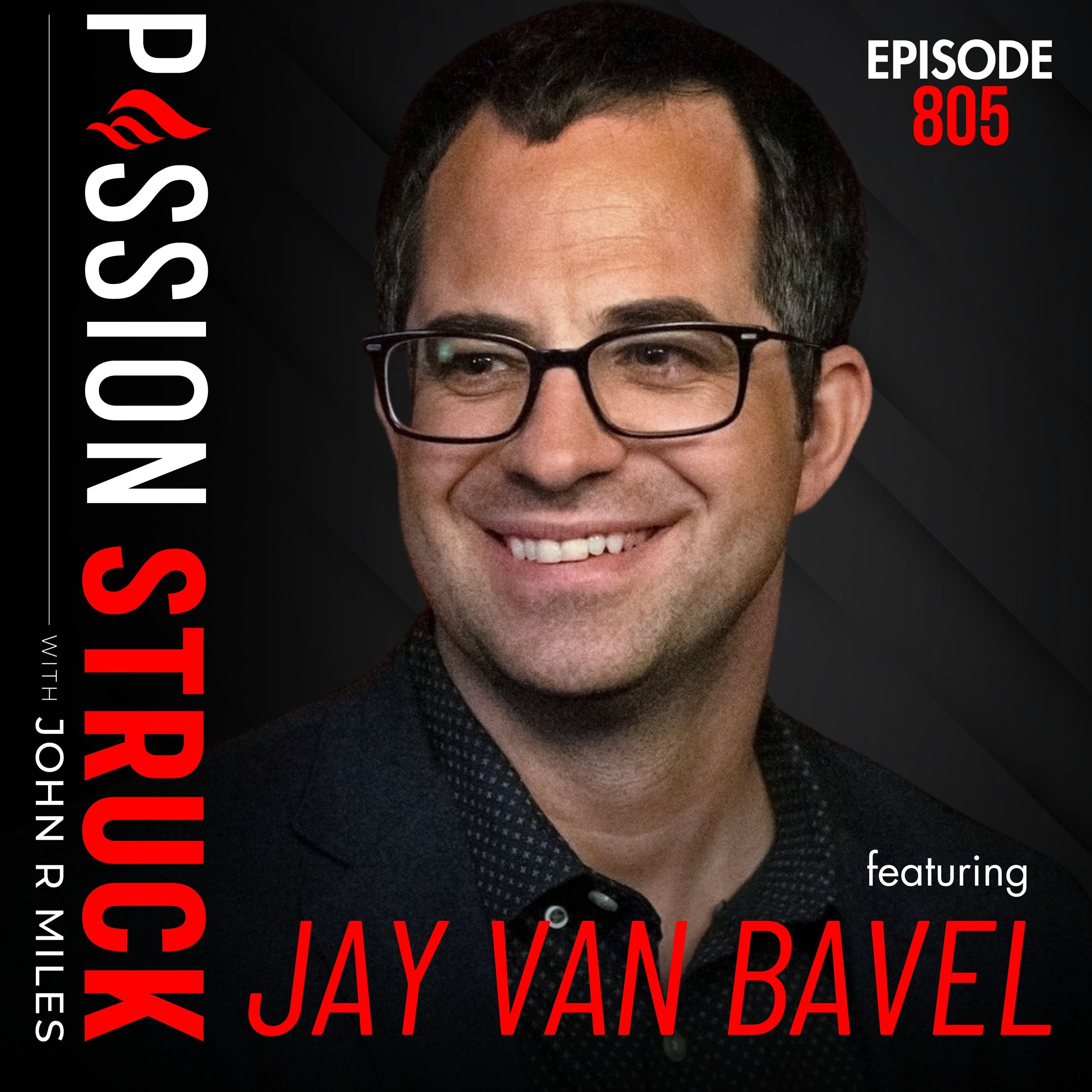
Passion Struck with John R. Miles
Why Don’t Facts Change People’s Minds? | Dr. Jay Van Bavel - EP 805
01:02:22
Why do good people become so divided? Social psychologist Dr. Jay Van Bavel explains how identity, belonging, and the groups we join quietly shape our beliefs, relationships, and ability to connect—and what it will take to bridge our deepest divides.
Loading summary
Transcript80 lines
- [00:01]
Dr. Jay Van Bavel
The snack wrap plus Caesar sauce equals extra crispy chicken Caesary greatness. Sounds delicious. Caesar sauce at McDonald's for a limited time.
- [00:15]
Commercial Voiceover / Advertisers
There's a fire inside you you can't ignore. Stand still. Not a chance. You're a lifelong learner who's come this far. Now we are here to help you keep going further. Capella University. What can't you do? Visit Capella Edu to learn more.
- [00:31]
Dr. Jay Van Bavel
Queen K. Carvania stood haloed by the morning sun. An army hung on her every word. My champions, I have sold my chariot on Carvana. Twas a lovely suv, an inexplicably queenly offer. They're even coming to the castle to collect it. Tonight we feast. An offer you can feast on. Sell your car today on Carvana. Pickup fees may apply. Avoiding your unfinished home projects because you're not sure where to start. Thumbtack knows homes, so you don't have to. Don't know the difference between matte, paint, finish and satin or what that clunking sound from your dryer is. With thumbtack, you don't have to be a home pro. You just have to hire one. You can hire top rated pros, see price estimates and read reviews all on the app. Download today.
- [01:21]
John Miles
Today on Passion struck, social psychologist Dr. J. Van Bavel shared new research that should make all of us rethink how we're using artificial intelligence. He found that the more an AI flatters us, the more extreme and overconfident we become. Take a listen to this.
- [01:42]
Dr. Jay Van Bavel
I think it's harder to build trust across groups. I'm starting to study it more and more. I think trust is also one of those linchpin basic things. We're dealing with a loss of trust in institutions, a loss of social trust in our neighbors. And countries that don't have trust lack resilience. When a crisis happens, people don't support one another. And so social trust and trust in institutions are two of the most fundamental things for a flourishing society. So now we're talking going from an individual to a society. If you don't have trusting institutions, societies fall apart.
- [02:16]
John Miles
It's your friend, John. And welcome to Passion Struck. I'm so glad you're here. Whether you're a longtime listener or someone who just discovered the show, thank you for pressing play today. Maybe you've built the life you were supposed to want, but you've quietly wondered why it still doesn't feel like enough. If that's you, you're in the right place. Every week I sit down with the world's top scientists, researchers, and thinkers to uncover what is it actually takes to build an intentional life that matters. Thanks for joining me. Let's get Into It. Welcome Back to episode 805 of Passion Struck. I am so glad you're here. Today we're continuing our series the adaptive how your mind learns, changes, and heals. Over the past three episodes, we've explored something remarkable. The brain is constantly adapting. But that raises an important question. If our brains are always changing, what are they changing? In response to I hear some version of that question from many of you, you tell me you're trying to stay grounded in a world that feels louder than ever. You want to think for yourself, raise resilient kids, lead with integrity, and stay true to your values, even as algorithms, social media, and artificial intelligence seem to be competing for your attention more and more every single day. That is exactly why I wanted to bring Dr. Jay Van Bavel back onto the show. Jay first joined us in episode 265, and I knew it was time to continue that conversation because his work has only become more relevant since then. Jay is a professor of psychology and neuroscience at New York University and one of the world's leading researchers studying identity, belonging, trust, and polarization. He's also the co author of the great book the Power of Us, and his research explores a question that affects every one of us, whether we realize it or not. How do the groups we belong to shape the people we become? In this conversation, we're going to explore why belonging to be one of the most powerful forces influencing human behavior, why intellectual humility is becoming one of the most valuable skills that we can develop in an age of polarization and artificial intelligence, how our environments often shape us more than our intentions and what it takes to stay curious when the world keeps rewarding certainty. But here's what stayed with me the longest after we reported we spend a lot of time talking about changing ourselves. Our habits, our mindset, our routines. Jay reminded me that one of the fastest ways to change your life isn't always to change yourself. Sometimes it's to change the people, places and environments that are quietly changing you every single day. That idea. That idea stayed with me ever since. So let's dive in. Here's my conversation with Jayvon Bavel. Thank you for choosing Passion Struck and choosing me to be your host and guide on your journey to creating an intentional life that matters. Now let that journey begin.
- [05:40]
Dr. Jay Van Bavel
The snack Wrap plus Caesar Sauce equals Extra Crispy Chicken Caesary Greatness Sounds delicious. Caesar sauce at McDonald's for a limited time.
- [05:55]
Commercial Voiceover / Advertisers
I'm Livy Dunn, All American gymnast and Vuori athlete. When you travel and train as much as I do, you find happiness where you are on the mat or on the sand. Movement and comfort are essential. That's why I live in performance. Joggers by vuori. Made from Dream Net fabric that's made of 89% recycled materials, effortlessly soft and made to move as much as I do. My happiness starts here in the softest joggers on the planet. Get 20% off your first purchase at biore.com livy that's V-U-O-R-I.com L, L I V V Y. Exclusions apply. Not only will you receive 20% off your first purchase, but enjoy free shipping on US orders over $75 and free returns. Go to Vuori.com Libby and discover the full versatility of Vuori clothing. Exclusions apply. Visit the website for full terms and conditions.
- [06:46]
Dr. Jay Van Bavel
Evening. Buyer's remorse. Buy a new car. I'll be moving in. Let's get started. Sorry, I think there's been a mistake. I bought it from Carvana. You what?
- [06:56]
Commercial Voiceover / Advertisers
Yeah, Great price.
- [06:57]
Dr. Jay Van Bavel
I even have seven days.
- [06:58]
Commercial Voiceover / Advertisers
Love it or return it.
- [06:59]
Dr. Jay Van Bavel
So there's no.
- [07:00]
Commercial Voiceover / Advertisers
No, no Buyer's remorse. More like buyers rejoice.
- [07:05]
Dr. Jay Van Bavel
I guess I'll let myself out. Congratulations. I mean it.
- [07:09]
Commercial Voiceover / Advertisers
Buyers rejoice. Buy your car today on Carvana.
- [07:12]
Dr. Jay Van Bavel
Limitations and exclusions may apply. See our seven day return policy at Carvana.com.
- [07:19]
John Miles
I am so excited today to welcome back Jay Van Bavel to Passion Struck. Jay, how are you today?
- [07:26]
Dr. Jay Van Bavel
Great. Thanks for having me again, John.
- [07:28]
John Miles
Jay, you first joined me on Passion struck for episode 266. And if you can believe it, we are now on episode 785.
- [07:36]
Dr. Jay Van Bavel
Congratulations.
- [07:38]
John Miles
A lot in between during that conversation. Thank you. We discussed your book the Power of Us. And we explored how social identities shape our beliefs, behaviors, relationships and even our own perception of reality. It was a really fun conversation for those who want to go back and check it out. But looking at society today, a lot has changed since then. What concerns you more? Polarization itself or the growing certainty people have that they're unquestionably right?
- [08:07]
Dr. Jay Van Bavel
First of all, it's a great question. I would say that to some extent those are interwoven. And so I'm going to tell you about. You're asking me that. I was thinking, what is worse? So I ran a study a few years ago and we actually measured the extent to which people are passionately convinced they're right. So there's a measure for that called dogmatism. And it means you think you're absolutely right and anybody who disagrees with you is certainly wrong. And what we found is that it used to be the case that people who are more right wing were more dogmatic. But what we found as of a few years ago, it's pretty much the extremes. And I think that's partly due to polarization, that now pretty much anybody on the extremes has become more and more dogmatic and absolutely convinced the right. And the other thing we measured was belief superiority, the extent to which you think your beliefs are superior to people who disagree with you. And again, the biggest predictor of that was just people who are at the extremes. And so I think what has happened is the more we've become polarized and the more intense our disagreements, the more it's being entrenching this sense that our beliefs are superior, that anybody who disagrees with us is an idiot or evil. And these things feed into one another in a bit of a vicious cycle.
- [09:22]
John Miles
JAY One of the things I've heard you say is that one of the most exciting moments of science is when your data proves your hypothesis wrong. And recently been rereading Thinking Fast and Slow by Danny Kahneman. And if people aren't familiar with the book or his work, when he and his cohort Avis Am I mispronouncing Amos Tversky? Amos Tversky, when the two of them came up with Prospect Theory, they were really going after something in behavior science that had been not questioned for many decades. Why is being wrong and then finding out that you have a better mousetrap often a prerequisite for growth?
- [10:05]
Dr. Jay Van Bavel
I think so. I want to say, first of all, that Danny Kahneman is in some ways one of my idols for people who's really comfortable being wrong. I actually got to see his very last lecture as I was a summer student in Santa Barbara, and he came and gave his very last lecture before he retired. And it was in front of a group of about a hundred of us or 200. And then we got to ask him questions. And he opened his lecture by saying when he came up with Prospect Theory with Amos Tversky, which, by the way, won a Nobel Prize, he's the only psychologist in history to have won a Nobel Prize. So eminently brilliant, famous person, he said his goal at the time was because he saw all these problems with economic theory, and he tried to design a theory that grad students or young people new to the field would look at his and not see as Many holes in it and be able to poke it apart. But when he wrote Thinking Fast and Slow, which as you know, is a runaway New York Times bestseller a few years later, he looked back on it and actually said that he got a lot of things wrong in it. And one of the things he got wrong was he relied too much on this area of social psychology where there was a lot of social priming, embodiment priming, and he cited it uncritically. And then a lot of that failed to replicate. And then he actually was one of the lead people who first came out and said, all you people doing this work need to replicate each other so we can trust it. And then later when it didn't replicate, said that he was too credulous and that was an error on his part. So not a lot of people as prominent as him are comfortable coming out and saying that. But to me, that's what it means to be a scientist. It means you read things, you take them seriously, but if they don't hold up to scrutiny and other people can't replicate them, that you have to be able to abandon them and update your thinking. And that is really a superpower. Especially in a world where your opening question is, are we becoming too certain and overconfident to be able to critically evaluate your ideas and be open to evidence that contradicts them is really going to set you apart. I think in the modern universe that we're in.
- [12:08]
John Miles
I absolutely agree. Especially as more and more people are becoming skeptical of all information and where it's derived from. So I've heard you say that intellectual humility is being open to changing your. Your perspective when new information emerges. And as I think about intellectual humility, I think it's becoming increasingly difficult in modern society to have it. Do you agree?
- [12:34]
Dr. Jay Van Bavel
Yeah, I really agree. I have so many thoughts on this. I've been working on three papers on intellectual humility in the last couple of years. And first of all, intellectual humility is that openness and willingness to acknowledge that you don't know everything and you might be wrong. And there's lots of research showing that people who are higher on intellectual humility are less polarized, but they're also less susceptible to misinformation. So we ran a study around the globe during COVID and measure people's beliefs and conspiracy theories. And you might think that people who are high on intellectual humility are so open minded they'll believe anything, but it's actually not true. They're actually pretty good at listening to everything. But then looking at the evidence critically. And so they actually don't get sucked into conspiracy theory. They will hear them out, but if they don't have evidence for them, they will quickly abandon them. And so I like to think of intellectual humility as a really good taste. People who have great taste in wine, they can tell the difference between good wine and bad wine, so they have great discernment. And people who score high in intellectual humility, we find over and over again have that quality. Two other things you said in the modern world. So one of the big things that everybody's thinking about right now is artificial intelligence. And let me tell you something about artificial intelligence. This is a brand new study of ours, has not yet been published, but we have seven studies on this. So I'm pretty confident in it. First of all, there's research showing that AI chatbots are highly sycophantic. So they will flatter you and tell you you're brilliant and courageous whenever you share your perspective. Now, we ran a study where we manipulated how sycophantic they were. We cranked it up to 11, or we turned it down a couple notches. And what you find is the more sycophantic it gets, the more it blows smoke up your ass, the more people like it and want to keep engaging with it. So this is reminds me of engagement based algorithms on social media. They flatter you because you like it and will keep you engaging with the technology. Now here's the problems with it. We find that it makes people more extreme in their beliefs. So again, that kind of extremism you were talking about and overconfident, which are, it's a really bad combination to be too extreme and overconfident. Now here's the worst part. People have a blind spot about it when they encounter an AI that is actually designed to challenge them, but with facts, they see it as biased and they see the one that's flattering as accurate. And so this is very similar to in psychology, what we call the bias blind spot. We're really good at seeing biases and flaws in other people, but we have a hard time seeing it in ourself. And so when people interact with sycophantic AI, this is the dynamic. Now, the one exception we found. I'll loop back to intellectual humility. So first of all, AI seems to be fueling the opposite of intellectual humility because of its design features. Now, the only people who are willing to engage with the disagreeable AI who actually seem to enjoy it were people who scored High on intellectual humility. Those people are engaging with the chatbot, and they're interested to hear when they're wrong or interested to hear alternative perspectives that round out their viewpoint and reveal some of their blind spots. But again, those people tend to be in the minority. Unfortunately, that's not the average person. The average person wants the flattery. But if you do have that trait of intellectual humility, you've built it up, you've cultivated it. It is, again, like a superpower, means you're willing to engage with technology in healthier ways and learn from them in better ways without getting duped and getting suckered into always being told that you're brilliant and courageous.
- [16:10]
John Miles
Jay, thinking about that, I think at times society rewards confidence over curiosity. And so then it begs the question, what's the difference between confidence and intellectual humility?
- [16:23]
Dr. Jay Van Bavel
First of all, you made two great points. The first one, I agree with you. I think the world rewards confidence over intellectual humility, and I think it is especially true on social media. What we have found on social media is the people who dominate the conversation are people who are very extreme in their views, and they speak with certainty, especially moral certainty, that they're absolutely right. And anybody who disagrees with them is often not only wrong, but evil. And that's the type of content that generates engagement. And you build, it gets shared, it goes viral, it gets liked, you build a following, you get clout. And people who aren't like that get left behind. People who are nuanced and complex and subtle in their thinking don't get as much engagement on that platform. It's actually one reason why I like podcasts, because podcasts allow you to go deep and get nuanced on something. And people who like podcasts, I think, are people who want that rather than the hot take that's overly certain. So that's a little bit of the information diet we're being fed, right? So when you log, five and a half billion people are on social media, we scroll through an average of 300ft of social media content a day. That's the height of the Statue of Liberty. So we're scrolling through that, and what we're seeing is an over representation of extreme, overconfident views. And that can be misleading because it leads us to believe that everybody's overconfident. And that could create an incentive for us to feel like, oh, I'm going to have to talk like that to be heard. I'm going to have to talk like that to get status or attention. From my perspective, even If I don't actually genuinely feel that confidence. So you also get an incentive structure that fuels a lot of false overconfidence and expressions of false confidence. And so I've been really thinking that's a real damaging thing for us psychologically and societally. And so we need to think of how we can incentivize people to express intellectual humility, to admit they're wrong, to lean into growing and exposure to different perspectives. But that type of psychology, that type of mindset, again, I think it's a superpower. But I think all the technology, from artificial intelligence chatbots to social media is really pushing in the opposite direction. So it's like going into these headwinds where everybody's spewing over confident perspectives. It really is easy to get overwhelmed in that.
- [18:43]
John Miles
Thank you so much for sharing that, Jay. And I understand that early in your career, if I have it right, you worked in anti racism education.
- [18:51]
Dr. Jay Van Bavel
Yep.
- [18:52]
John Miles
And one of the things that I think you discovered is that presenting people with facts doesn't always change their minds. What did that experience teach you in a larger context about our identity?
- [19:06]
Dr. Jay Van Bavel
So this was my first job after I graduated out of College. Paid me $8 an hour, and I got a job in. It was in northern Alberta, where I lived. And we would go into high schools, often into grade 10 or 11 social studies classes, and we would do skits, and then we would talk to people about sexism and racism and all kinds of biases. And then you'd get the students to open up, you'd make them comfortable, and they would start sharing their stereotypes and beliefs about certain groups. And a lot of times these are young people. These are things they've heard but aren't necessarily true. And so you'd explain, oh, that's not actually true, or where did you hear this? And they didn't have a good source for it. And so then we would correct it. And I was expecting at the time, naively, that if you corrected someone's false beliefs or false stereotypes, they'd be like, oh, wow, I didn't know that I was wrong. Thanks for updating me. I shouldn't despise that group in the same way. But when you updated them, they didn't update. They just shifted to another stereotype. And they would keep doing that to try to cling to their belief. And it got me thinking a couple things. First of all, a lot of our biases are automatic or unconscious. And a lot of the time when we're talking to people about them, we're trying to rationalize them. And so if they're debunking our rationalizations, it's not getting to the root of the bias. And so it started me thinking about how can we get to the roots of these things? And then what are their origins? And it turns out a lot of the origins of our biases are social. People will make a racist or sexist joke or an offensive joke because they think it helps them fit in, because they think other people will laugh at it. If no one laughs and they say that's gross, they'll stop making that kind of joke. And so you start to realize a lot of it is our people's. In fact, the single biggest predictor. This is one of my favorite studies of people's willingness to express different types of prejudices towards groups. And they measured 105 different groups in society, from terrorists to pedophiles, single mothers, every ethnic group, rich people, poor people, every group you can imagine. And the single best predictor of what people are, what prejudices people are willing to express, is what they think other people in their community believe. There's like a 0.95 correlation, which means almost a perfect correlation. And so a lot of our expressions of prejudice are determined by what we think other people believe.
- [21:29]
John Miles
We'll be right back with more of my conversation with Jay Van Bavel. As you're listening today, I'd like you to reflect on one simple question. What environments are shaping the person you are becoming? One of the ideas Jay returns to throughout our conversation is that transformation isn't driven by willpower alone. The people we spend time with, the communities we join, the conversations we have and the norms we absorb all influence the direction of our lives in ways we often underestimate. That insight connects deeply with my research on my upcoming book, the mattering effect, coming October 6th. When people feel seen, valued, and like they genuinely matter, they become more resilient, more trusting, more open to growth, and more willing to help other people flourish. If you'd like to continue exploring these ideas, every episode on Passion Struck includes a companion workbook inside my substack, the Ignited the Life, designed to help you turn these conversations into practical changes in your own life. You'll find links to both in today's show Notes. Now a quick break for our sponsors. Thank you for supporting those who support the show. You're listening to Passion Struck right here on the Passion Struck podcast. Now let's get back into my conversation with Jay Van Bavel. Therefore, is misinformation really an information problem, or is it an identity problem.
- [23:04]
Dr. Jay Van Bavel
So this gets to the heart of it. A lot of people in psychology, there's this whole movement about fact checking, misinformation. If we just get enough fact checkers or we just nudge people to try to be accurate, they'll be accurate. And those things, don't get me wrong, those things work, but they work very modestly. The effects are very small. And not only that, they don't work at all for polarized misinformation. Something around, let's say, immigration or abortion or the Iran war, whatever's in the news, if it's polarized, these fact checks and moderators don't have as much of an effect. People don't really update their beliefs very much. And so what you start to realize is it's really about their identity. And if you are challenging or threatening someone's identity, they can get very resistant to it, especially if you're from a different group than them and you're saying, listen, you're an idiot, you're wrong. What we find in those cases in our own research is sometimes people will have a backlash or backfire if someone from the opposite group is consulting them and telling them they're wrong and trying to fact check them. What we found is by far the most effective is just signaling that other people like you find it misleading. So if I hear that people like me find something misleading, I'm way less likely to share it, even if it's a hyper polarizing piece of misinformation, because I don't want to do something that alienates me from my community. I want to fit in. And if they find it misleading, I'm way less likely to engage with it and spread it.
- [24:31]
John Miles
I was reading up on your I House study and one of the most surprising things I found at it was that people became more open minded, more pro social, and less polarized from what I read, during one of the most politically polarized periods in recent history. And it begs the question, how is that possible?
- [24:52]
Dr. Jay Van Bavel
I'm so glad you brought that up. This will be the first podcast I've ever had a chance to talk about this study. So we got approached by this, it was called International House I House in New York. And it's been around for about 100 years. And they have people from all over the world who are in the city to go to school, to go to college or university, for some classes, and they live there like a residence. And it's almost like the perfect model of how to deal with differences that I've seen. We're in A world where there's huge backlash against DEI programs, diversity, equity and inclusion programs. And there's all these programs that try to divide people up into different races or groups or genders at workplaces. And those generated a huge amount of backlash. They often didn't work, sometimes they backfired. Now very unpopular and they're very politically contentious. I House has been doing something for decades that is the opposite of that, and it works way better, which is they bring all these people to live with one another from every single religiosity, ethnicity, nationality, background that you could possibly imagine, belief system. And they have all these programming that gets them talking about contentious issues in the world. And then they have dinners, they all break bread every night. And when we surveyed these people, we looked at about 40 years of alumni from I House. We gave them a survey and these people were off the charts on intellectual humility, off the charts on empathy, extremely low levels of polarization. You can't believe the comments when we got them talking about their experience. Many people said it dramatically changed their life and it made them far more open minded and created this intellectual humility and respect for difference and ability to navigate it, ability to have a conversation and be comfortable being disagreeing with somebody and just being, oh, wow, I didn't think of it that way. I don't necessarily even change my mind, but I see where you're coming from, which most people, colleges, by the way, in the entire country, are desperate to figure out how to get students to have conversations like this. Right? The students are very defensive, they feel very insecure and anxious and they don't have much tolerance for disagreement. A lot of teachers I know, professors like me can't get students even talking in their class around these contentious issues because they'll bully each other or blast each other on social media if they disagree. And so I House has done this amazing thing and it's by basically leaning into difference and accepting it, but also an intensive exposure. And it reminded me of the most famous research on how to get rid of prejudice is just have people interact with one another on equal footing and have positive intergroup contact. So rather than pulling us into these little echo chambers or pulling us, sorting us by ethnicity or gender or something, or religiosity, it's the exact opposite of all that stuff. So I really hope that if organizations want to see how to do this, they should really go take a look at I House because we also ran a study longitudinally where we track people when they started for the whole year and we saw all these Trends emerge. And it was especially among the people who had the most room to grow. So the people who are the most polarized benefited the most. People who are lowest on intellectual humility grew the most. And so it was just a perfect example of what I wish every university were doing in this country.
- [28:10]
John Miles
Jay As I was looking at the study, I couldn't help but think of Amy Edmondson's work on psychological safety as well. And I wonder if you came to the conclusion after looking at what they were doing. Do you think psychological safety isn't the absence of disagreement, but based on what I, House, has shown, it's the presence of respect? Is that a good way to think about it?
- [28:35]
Dr. Jay Van Bavel
It's exactly how I got to think about our study, John, which is when I wished we had measured psychological safety when we started the study. But it wasn't until I got through the study and looked at all the data and all the qualitative reports we had from people that I came to the exact same conclusion as you. I thought what they've created here is psychological safety. And I talk in organizations about this a lot and about Amy Edmondson's work, and I always have to tell them the definition of psychological safety, because it's the opposite of the way it's talked about in the public sphere, that universities have safe spaces where everybody goes into a corner and everybody looks like them and they don't disagree. And I'm like, that's literally the opposite of what psychological safety is. It is a space where you're comfortable disagreeing, you're comfortable challenging the status quo, you're comfortable taking risks, and people won't reject you after, even if you're wrong, even if they disagree with you, even if you took a risk and it failed, if they value that and welcome you back. And that's really what unlocks human potential, it what makes it safe to have conversations and understand people who are different than you. And so I tend to think of psychological safety as kind of that key ingredient to unlock the potential of diverse groups and diverse in the broadest possible way, across belief systems, identities, cultures, religiosities. And I, House, just seems to have figured out the magical ingredients to create a culture where it's just psychologically safe for people.
- [30:09]
John Miles
Jay One of the things that got me excited about this conversation is that I think you and I share a few things in common. I think much of the public conversation is constantly focusing on what's broken in society. And so I've switched the whole direction of this podcast a number of years ago to really increasingly focus on what helps people thrive. And so I'm trying to examine all elements of how do you create flourishing? And I think it intersects beautifully with your work. And so I was wondering if you could give your definition of social flourishing.
- [30:50]
Dr. Jay Van Bavel
Oh man, that is a great question. To me, one of the core ingredients of social flourishing is social connection and a real form of inclusion where people value you for who you are. Now I talk a lot about social inclusion because social inclusion is not only part of social flourishing, but it affects our psychological well being, it affects our physical well being. The research on this and the medical literature finds that loneliness is about as harmful to us as smoking a pack of cigarettes a day in terms of our mortality and longevity. So social connection is fundamental to life, to living. Aristotle said it best. We're social animals. This is like part of who humans are. And we've become more isolated over time in society. People are dating less, marrying less, having families less. All of the markers of social connection, they have fewer friends, fewer best friends. And this is by the way, especially among people who are less educated and lower income. I saw a study on this last summer. A lot of people who are have a high school, lower than high school education have no best friends. And so there's inequality on this social flourishing aspect. And I actually, the Surgeon General called it an epidemic and a crisis. And I really think it is. And so I'm really interested in a what we can do to find and create environments that bring people together. And I'll give you an example of this. I saw that was really beautiful. I live in New York. I was not a New York Knicks fan until this, the last few months. And they wanted this incredible run and were underdogs and won the NBA championship. And I've lived in New York 16 years. I have never seen the city come to life like that. People were cheering and huge watch parties on the streets. Thousands of people giving high fives to people on the subway, singing and chanting together. Spike Lee even noted crime went down. So there was these stupid videos of people vandalizing something. But if you look at overall crime, especially violent crime, it dropped in the whole city. And so because people had something that was connecting them to their neighbors. And now what's happening right now in the entire United States, but also in New York is the World Cup's happening. And I'm seeing all these. I wandered into a restaurant for my stepson's 13 year old birthday party the other day. And basically what happened was we were at this Planet Hollywood restaurant And it was a watch party for the team, Brazil team Morocco game. And there was everybody in the Brazil colors. All the Brazilians came to the city or lived here dressed up and the Moroccan and they were singing and chanting and dancing. And it was such a joyous. It's called collective joy or collective effervescence. When people come together as communities around anything. And sports is just one example. And celebrate together. And it can be based on your national team or based on the local basketball team or something. And people were having watch parties. I was invited to friends house for watch parties. And we got together in ways we hadn't got together with people I hadn't really hung out with in the that way. And that's how you build community and connection. And it feels so good. But our world is almost designed to avoid those types of things, to avoid talking to strangers, to make it frictionless. Easier to stay home and watch a Netflix show than to go to the movie theater. It's easier to ask for advice to your chatbot than ask a friend for advice now. But I think you need to go to the bar and talk to your friend and walk through it because you're not just going to get the advice. And not only do they know you, but also it's the social connection that's going to be something that is a resource that makes you resilient when you go through a bad breakup or period of unemployment or whatever the thing is. And so we've offloaded so much of that to these artificial forms of entertainment and connection and we're losing those rich forms of social connection that really foster the flourishing aspect.
- [34:42]
John Miles
Yeah. I have to say, speaking of the World Cup, I think everyone has been hearing about the. The Scots and not only how they descended on Boston, but now 8,000 of them marching in unison to. To see a Marlins game. But I have really liked Norway and how you see thousands and thousands of fans rowing the boat all at the same time. It sure does show what potential communities could be if we all united instead of doing the opposite.
- [35:15]
Dr. Jay Van Bavel
I'm so glad you mentioned Norway. So, first of all, I have a position at the Norwegian School of Economics, so I go there every year and give a talk. I've done workshops there on my book. So I have a connection to the world. Norway. I just got back from there about a week ago and this weekend I was at a local park and I set up a pickleball net with my son, who's 16, and my daughter, who's 14. And we were just going to play pickleball which, by the way, is also this amazing way to just meet people. So we set it up in the park. All of a sudden, these two Norwegian fans, all the way from Norway, walk up and they were wearing a flag, like as a cape, walking around New York, and they bought two pickleball rackets. And they said, we don't have a net. Can we play with you? And I said, sure. And so they played against my son and I. And these guys are. Norwegian guys are huge. So 1 5. And we played them and it was so fun. They were good. They really whipped us good. But it was so fun. They were so friendly. We got talking about the game, their visit to New York. We gave them recommendations of things to do. And then the next night, the Norway game was here, just outside the city in New Jersey. And it was just. It has this energy right now where you just can go talk to strangers and make these connections, and you can see the pride they have and the joy. But it's also the World Cup's beautiful because you can cheer for your team and you can connect with other fans. You're not notice, you're not seeing any violence in the crowds. You're getting hundreds of thousands of people, all wearing their jerseys, chanting. And you think of national conflict throughout human history, but you just aren't seeing it. You can have these identities and celebrate them in a joyous way and be inclusive of other groups and connect with them in a positive way. And this is one of the things I always try to drive home when I talk about identity. When people think about identities, they often think about, oh, nationalism, World War I, World War II, or genocide, or these awful moments of human history. And I say, you're forgetting what's happening. 99.9% of the time when people are getting together in groups, it's flourishing. It's connecting with strangers, it's supporting one another, it's cheering, it's all these beautiful things. And it also can be something that you can connect with people who are not even part of your group. As long as your group's norms are positive, the rowing thing isn't hurting anyone. It's beautiful, it's fun, it's great to see. And so part of it is also having these really healthy norms that you identify the group, but it's not in opposition to any group in any harmful, violent way.
- [37:43]
John Miles
So I want to do a follow up on that, because I know your recent research has really been focusing on groups and how dramatically they can alter your perception, et cetera. But when I Wrote my first book, Passion struck. I was trying to outline if a person wants to change the trajectory of their life, what are the things that get in the way. And the first thing I went into is like their own fear of failure, their own identity that's been trapped since childhood. But then the next thing I went into was this concept that became the thing I talked about most about the book. I called it the mosquito principle. But it was really about that the next thing that's going to get in your way is your environment, because it shapes so much of the choices that you make. And it made me want to ask you, based on your research, how much of human behavior is individual choice versus environmental influence?
- [38:40]
Dr. Jay Van Bavel
So this is a debate that goes back about 70 years, 60, 70 years to Kurt Lewin, who is really considered one of the fathers of social psychology. And he said even back then that it's most things aren't interaction. So it's not even just that personality drives you and your biology, which does matter a lot, or the situation. It's often an interaction, It's a person by situation interaction. So an extrovert is going to act very differently at a party. They're going to be the life of the party and going to really flourish there than when they're sitting at home watching TV or watching or reading a book. And so it's like they have that potential as a person and they might opt into those situations, but when they're in them, it brings out that potential in them. And so I like to think of it in kind of these dynamic interactions. The other way that we often talk about this in biology is nature versus nurture. Is it your nature or is it nurture the society around you? And almost always we've now come to the agreement that it's both. But you're totally right that if we ignore the nurture, if we ignore the social influence, we're going to misunderstand why people are happy, why they succeed, how they can flourish. Because if you have a mismatch, you have the wrong person, maybe the right person, but in the wrong situation, you get a job that just doesn't fit you, you can be miserable, and the same person in a different job can flourish and have all this incredible potential and success. It is really important that we understand what situations are going to bring out the best in us, given our unique personalities. But I also drive home that when we talk about self regulation and goal pursuit, there's a huge amount of research and books and discussion about how it's really at the individual I gotta have willpower and work hard and beat, grind away hustle culture and that. There's a truth in that. But it's also just as critical to be in the right situation because if you're surrounded by the right people, they're going to support you and make it easier for you to succeed. This is something they say, for example, to people who are trying to say, quit drinking. If you're an alcoholic. And I've had family members who are, one of the first things you'll get advice to do is stop hanging out with your friends who are all heavy drinkers, because otherwise you'll never be able to quit. If you're always just hanging out with those friends at the bar, it's going to be impossible for you to have enough willpower to overcome that. You're going to have to hang out with a different set of friends or develop a different set of hobbies so that it's not triggering you all the time. If you want to lose some weight or get healthy, join a running group, because guess what, you're going to meet people, but you're going to start running and it's going to be fun and you're going to get supported and it's going to keep you going or get a workout buddy. And so those are the things that make it way easier than just fighting through willpower or trying to build the right habits is finding the right groups that are going to support you to flourish. And I would say this in your career, if you want to be successful in your career, find people who are going to push you to be successful, who are going to mentor you, who are going to challenge you or going to expose you to the right role models and ideas and ways of working. And if you see, look, one example of this, one of my favorite shows is the Chef's Table. Every episode on Netflix is one of the world's best chefs. And almost all of them went to a three star Michelin restaurant and interned there and learned from one of the world's best people. And then they took those lessons and came back and built their own restaurant with its own culture and identity and cuisine. But they learned from the world's best so that they could then be that kind of next generation of excellence.
- [42:14]
John Miles
Like the Bear.
- [42:15]
Dr. Jay Van Bavel
The best show I've ever seen on this.
- [42:17]
John Miles
Yeah, it was funny. I was, I'm friends with Will Guidera and I happened to bring up to him, are you familiar with the show the Bear? And he said, no. And I said, I think they're using your Entire book to create this show. And so he said, I have to start watching a couple episodes. So he starts watching a couple episodes and next thing I know he's on the show. Because they were.
- [42:41]
Dr. Jay Van Bavel
Yeah. Oh, man, that show is amazing. It's one of my favorite shows and my wife's favorite show to watch.
- [42:47]
John Miles
If you think of Will's work, I didn't expect to bring this up, but it really intersects with what we've been discussing. Because he talks about hospitality in a restaurant, but all of that is really about creating the community inside the restaurant. But then how they want their customers to feel with unreasonable hospitality. Isn't that a good way to think about it?
- [43:10]
Dr. Jay Van Bavel
So it's all about creating an experience. The world's best restaurants are about creating this experience, making you feel really valued when you come in and it's customized to you. The other thing about them that, that struck me so I actually assigned Chef's table all the episodes to my lab one summer because I said this is actually a great model for also a research lab. Because a research lab is you're mentored by some top scientist, then eventually you become your own professor, start your own lab. But you eventually also need to figure out what your culture is going to be and how you're going to pursue your own excellence and with your own sense of creativity. And all of them have that. They have like an excellence and a real aspiration towards creativity, but also culture. It's not just ever one person. All of these amazing restaurants have these incredible teams and that's also what they show in the bears. All these people are building their skills the whole time. And then they all also go and do these internships in these other world's best restaurants to learn the skill that's relevant to their job, to make a truly world class team. And that's very much what science is like. And I think there's all kinds of fields like that. And so I think of it as when I think of how to be a successful professor or scientist. Some people have this theory of the scientist is Einstein, right, The lone genius. But almost none of us are lone geniuses. Pretty much every great scientist now has a whole lab or research team. And even if you look back to Einstein, his wife never got credit, but she was brilliant and she was a brilliant physicist who helped him with a lot of his early major papers. And so almost everybody is doing it with a team. And so you really want to build a great culture with practices and procedures that leverage the insights and creativity and brilliance of everybody. And if you do that, you can do brilliant work for years and years. And it doesn't matter if you have a bad idea, someone else is going to root it out or find your error and correct it, or have a different perspectives that you didn't see. And so it's really about harnessing a group to create an amazing culture.
- [45:10]
John Miles
Let's take that a step further, because I was going to ask you the question, if you're going to design a community from scratch to maximize human flourishing, what would the ingredients be? But how about we go back to the I House findings? Because what they showed was repeated contact, shared experiences, diverse perspectives, belonging, meaningful conversations, and psychological safety were the ingredients that were making that environment so successful. If you look at those ones I just mentioned, which one do you think is most important?
- [45:45]
Dr. Jay Van Bavel
So it's like describing a recipe for a cake and saying which ingredient is most important? The flour, the eggs. I think actually you unlock the potential for a place when you have the kind of four or five of those all together. I think any one of those might not be successful without the other pieces. You can have contact, but if you don't have mutual respect, then the contact can backfire, can lead to conflict across differences. There's lots of evidence of that throughout history. And so you really need four or five of those, three or four or five of those things together to create the cake and then have it emerge. But I will say one of the interesting things about I House is almost everybody there is going to a university in New York, right? A lot of graduate students, master's students, PhD students, professional students. One of my favorite quotes I got when we interviewed all of them was, one of the students was at Columbia University, which is an Ivy League university. Columbia's regularly in the top 10 universities in the world. And the person was going to Columbia full time in some graduate program. And she said, I'm getting a better education at I House than I am at Columbia. And how could that be? You got into one of these world's most exclusive universities. You have the top best professors, the best resources, massive endowment of resort of support, great hit, incredible history, great resort facilities, and yet it's the place where you have dinner that you're learning more. And so I thought that kind of captured to me the essence of it is it's you can put all these other things together, but if you don't have the right culture there, then you're not going to harness all the benefits. Whereas another place, even if they don't have a formal curriculum, even if there's not professors teaching you and you're not required to read textbooks. You could be learning more just by absorbing all the experiences of the people around you if it's a situation that allows you to engage with them deeply. And so I think that's the thing. It's the culture is more important than all the expertise and resources and textbooks in the world. And if Columbia, Columbia's had a real. I don't want to come down too hard at Columbia. It's still a great university. But I have people in my lab who spent time there in the last few years, and it's really gone downhill in the last four or five years. It was like the student protests and then they had a police campus and then they had people occupy the buildings, and then they had the Trump administration take $400 million away, and then they had three presidents get fired in a row. And it has just been, you can have the world's best place and it's mismanaged and it's really eroded this environment. That is, at one point, I think it will be again one of the world's best educational institutions. But the culture there is not good and it doesn't have the right leadership. People are in constant conflict, from the students to the professors to the administration, whereas Ihost you feel much more synergy. There are disagreements. It's no place is perfect, but the culture seems to be like 100 times better. And so people who are having that kind of apples to apples comparison are realizing and identifying and articulating. That's the place they're learning more from.
- [48:49]
John Miles
Maybe they need to put you and Scott Barry Hoffman in charge of cultural reinvented.
- [48:55]
Dr. Jay Van Bavel
Scott would be fantastic. Yeah.
- [48:58]
John Miles
So one of the things Jay I've really been working on over the past four or five years is studying the science of mattering. And speaking of Columbia, one of the people I interviewed for this is one of their prior provosts, Claude Steele. I've interviewed about 250 people for my book the Mattering Fact, which comes out in October, and I wanted to ask you a question on this. As it pertains to mattering, do people become more defensive and tribal when they stop feeling like they matter?
- [49:30]
Dr. Jay Van Bavel
I think mattering is one of the most fundamental of human needs. I told you about this AI study I ran on chatbots and sycophancy. One of the reasons I think the flattery from the chatbot resonates so much is because it signals to people that they matter, that they're being seen. And we actually created a new version of the chatbot that disagrees with you, but if it disagrees with you after making you feel seen, that's the one that people actually are willing to engage with, even if it disagrees with them. And it was inspired for me by Carl Rogers, who's the. Arguably the most famous therapist. He was big on unconditional positive regard, which is basically that people. You can't get through to people and help them until they feel seen and that they matter to you. And he says once you do that, by giving them unconditional positive regard, you can actually help them and work on the things that are their challenges, they're facing and help them grow. But without that, they can close off and become defensive. And so I think that's why the mattering thing is so important. If you don't feel that people respect you or see you or think you matter, it's incredibly diminishing for people. Has all kinds of terrible consequences for their mental health and physical health. So that's why I think that's a real fundamental, basic aspect of human nature.
- [50:51]
John Miles
Well, this is where I disagree with our former surgeon general a little bit. He calls it an epidemic of loneliness. Like we talked about earlier, I think loneliness is just one of the symptoms of the epidemic of not mattering, which I think is sitting underneath so many of these feelings that people have today, loneliness being one of them. But that's for a bigger discussion.
- [51:13]
Dr. Jay Van Bavel
That's interesting. I like it. It's very provocative.
- [51:16]
John Miles
If you start thinking about disengagement, burnout, helplessness, hopelessness, loneliness, they're all growing in epidemic proportion. When you look at what all of them have in common, it's mattering is mattering touches all of them. It's the foundation that all of those things are built upon. So that's what I keep coming back to. It's taking me a while to get there and a bunch of research, but that's what I'm finding more and more to be the root of it all.
- [51:47]
Dr. Jay Van Bavel
I think you're onto something. I. Like I said, I think it's really essential and I think also connects to things like inequality, why it's challenging for people. If you feel like you're at the bottom of a hierarchy and you don't matter, that's really devastating. And it creates, I think, a lot of resentment, a lot of bad movements and political systems where you want to tear down the system. If you feel that you don't matter, you've been demeaned or a group you belong to has been demeaned. And so this is a real core issue at the heart of a lot of the problems we have in society.
- [52:20]
John Miles
I was actually talking about it a few months ago with Rick Hansen, who you may or may not know, but also with Joshua Green. I brought them both on to do this conversation on moving from us versus them toward a broader sense of shared humanity. And it was interesting because what we were talking about is that mattering helps people expand their circle of concern without feeling like they're losing their own identity or community. Do you see that as well?
- [52:50]
Dr. Jay Van Bavel
I think that's a really great insight. I think people need to have that sense of community. But also, again, even within a community, people need to feel like they're someone, that they have some value, that they have some social status. And so mattering is a good way of, I think, connecting to that basic need that people have. If they don't feel it, then they won't be identified. This is like cuts to my research and identity. If you don't feel like you matter in a community, in an organization, in a relationship, you're going to become very disenchanted as it gets disengaged very quickly.
- [53:23]
John Miles
I think, Jay, that begs the question, what do you think is harder today? Building cooperation within groups or building trust across groups?
- [53:31]
Dr. Jay Van Bavel
Okay, so you asked a question. I think it's harder to build trust across groups. I think trust, although I'm starting to study it more and more, I think trust is also one of those linchpin basic things. We're dealing with a loss of trust in institutions, a loss of social trust in our neighbors. And countries that don't have trust are lack resilience when a crisis happens, people don't support one another. And so social trust and trust in institutions are two of the most fundamental things for a flourishing society. So now we're talking going from an individual to a society. If you don't have trusting institutions, societies fall apart. If you talk to political scientists and they say, how can we build up some country that's suffering? They'll say, the first thing you have to do is build trustworthy institutions. And then if you're talking about how to build up a community, you need to have that social trust that I don't have to worry about locking my door, or if my kids playing out front of my building, my neighbor will have an eye on them. I don't have to worry about them being kidnapped or something. And so having high degrees of both forms of trust is really fundamental to every aspect of society. Flourishing and being successful. And we've lost that. We have a lot of bad incentives that are making it worse, a lot of attacks on our institutions, a lot of things that are eroding our sense of cohesion and connection with our neighbors. But I tend to think those are two of the most important things to a flourishing society. And I'm very worried that we on such a bad trajectory, I don't know how we build those back. With the exception that if we have some source of collective joy that can bring us together, like the World cup or the Knicks or something, those can quickly shift our psychology in ways that make us feel that connection to our neighbor again. But we definitely need that. And we also need to think. I say this as a scientist. There's been a lot of criticisms of science. We talked about the replication challenges of our field before. I think the burden is on us to produce more trustworthy research. And there's been a couple reports recently in universities. One was by Yale University. They commissioned a report to figure out how do we become more trustworthy again at higher education. And there was another one last week that was commissioned. And one of the things they said is we have to do work that is more trustworthy. We can't be too activist in our work. And we have to have really rigorous methods. And if we abandon that search for truth and rigorous methods, the public's not going to trust us. And guess what? In our world, they're not going to want to fund our research, they're not going to want to fund our universities, they're not going to want to send their kid to our classes. And so I do really think that a lot of academics feel very under attack right now. And I understand why that administration is attacking a lot of universities, cutting their funding. But I also think we have to do a lot of soul searching and look at why we've lost so much trust over the last 20 years, 30 years, and work on our end to make things better and make our work and our institutions more trustworthy. So I do think that's a burden that we have and it's going to require a correction in course. We got to get better.
- [56:35]
John Miles
So I've recently become aware and have been looking at this study that's going on of Microsoft, and I'm not sure if you're aware of this or participating in it, but given that they're Microsoft and the employees work for Microsoft, as I understand it, Microsoft has been storing all this data. So they've been looking at Zoom records or their equivalent. They've been looking at teams meetings, They've been looking at emails, they've been looking at texts across their computer systems, and they've been trying to analyze whether people should work remote or come back to the office. And what I'm seeing, the researchers are finding is that being on these zoom calls and being remote is allowing them to build cooperation in their group itself. But it's drastically eroding the trust across the broader organization. And hopefully I'm interpreting this because it seems like you're aware of this.
- [57:31]
Dr. Jay Van Bavel
I love that study. It was an analysis of 61,000 Microsoft employees. And they tracked them right up because they had all their data right before the pandemic. And then right when the pandemic hit and went remote, they find working remotely, you can be just as effective as an individual. And it turns out you're just as effective on your individual team, the people you meet each week. But what gets eroded is your connections to other people in the organization and organizational trust and identity. But also the other thing that's potentially lost is innovation, because a lot of innovation doesn't happen within a team, but at the intersections of teams or groups. So bumping into someone from sales at the water cooler, if you're from research and realizing that you have an idea that they can then take to the world, or that they're realizing there's this gap of what they need and that you then realize, oh, you couldn't help fill that. But you have to have those interactions with people from different groups to have those innovative breakthroughs as well.
- [58:24]
John Miles
I saw this firsthand when I was a senior executive at Dell and 3/4 of my employees were in other continents other than the US and people would ask, why do you travel so much? It's because if you weren't there physically sharing meals with them, walking the halls, talking to the employees, they didn't trust you. So to me, it was really important with everything that we had going on to change the organization that you needed to be present to instill the trust, to get them to follow your direction.
- [58:57]
Dr. Jay Van Bavel
That's something. So one thing I've talked to organizations about this. One thing I say is you either need to have regular in person meetings. And so for me, after the pandemic, I told my lab, come in on Tuesdays and Fridays and we'll have all our meetings and our guest speakers and stuff then, but at least everybody's in. And so you get those real in person interactions. And then if you want to work from home the other days, read, write, do deep work, that's really important, and block off that time so you're not disrupted. Do that. And that can be really useful. And you don't have to commute in, but we have to have days where we come in together. Because the worst case scenario is some companies were forcing people to come back, but then they would stagger the days, they come back and then you just come in and do zoom calls all day from your office. And that's the dumbest possible strategy. I'm going to do the commute, get dressed, come in, and then not see anybody in person all day. So you really have to have a thoughtful kind of coordination around ways to have in person connections to build those relationships and trust.
- [59:55]
John Miles
Jay, last question for you. If every listener or viewer wanted to contribute to a more civil, connected and flourishing society, what do you think is one practice they could begin today that would have the greatest ripple effect?
- [60:08]
Dr. Jay Van Bavel
I would say reach out to someone and say something positive that's affirmational, that'll give them a sense of meaning. It turns out that I'll just go to one of my favorite studies on this. People underestimate how much pleasure they take in interacting with another person, even a stranger. So this was the study you might have heard of on it was on commuters in Chicago and they randomly assigned people on their commute to talk to a stranger and no one wanted to do it. They didn't think it would be fun, but once they did it, they enjoyed the entire day more. And even small talk. Those small social connections build social capital. Build connections, build trust. And there's another study on this also from a different research group in Chicago, that even having conversations with someone who disagrees with you politically, people expect it to go way worse than it is and they often find it's more enjoyable than they expect. And so again, our expectations are holding us back from talking to people who we'd otherwise benefit from. And that would enrich our quality of life intellectually and socially. So that's what I'd say is reach out, make contact with one person today in a positive way and it could be a stranger at the cafe. It could be someone you might otherwise think you might disagree with. But just try to have a positive, open minded conversation with them and see where it goes.
- [61:26]
John Miles
Awesome. Sounds like one of those studies was Nick Epley's work.
- [61:30]
Dr. Jay Van Bavel
Nick Epley, I thought you might have heard of it.
- [61:32]
John Miles
Yes. Awesome. Well, Jay, where's the best place listeners can learn more about you, your work, and also your interview that you recently did with Oprah?
- [61:41]
Dr. Jay Van Bavel
Yes. So I have an interview coming out with Oprah on her TV show and podcast on August 6th. So come out on Amazon on her podcast podcast. But you can learn about everything. The best place is my substack, which is the Power of Us substack, and we share our research studies summarized in simple prose. So if you want to keep up with the research, but we also give practical advice. We also give things that people can use. Our substack that came out today had teaching and educational materials for people who teach in high schools or colleges or in organizations. So we try to create practical things that people can use to enrich their lives, enrich the groups they're part of.
- [62:20]
John Miles
Awesome. Jay, such a pleasure to have you back on the show. Thank you so much for joining us.
- [62:25]
Dr. Jay Van Bavel
Thank you as always, John. And again, fantastic questions. I was not expecting most of those and I really enjoyed all of them. So super stimulating. Be sure to contact me when your book comes out. I'd love to do an interview with you for my substack. It sounds right up our alley.
- [62:38]
John Miles
That's awesome. I hope today's conversation with Jay Van Bavel leaves you thinking differently about one simple idea. None of us becomes who we are alone. Our identities are shaped by the relationships we build, the communities we invest in, and the cultures we participate in. While we often focus on changing our habits or strengthening our willpower, Jay reminds us that one of the most powerful ways to change our lives is to become more intentional about the people and the places that are shaping it every single day. If today's conversation resonated with you, I'd love to hear your biggest takeaway. Share it with me on LinkedIn, Facebook, or Instagram. And if you know someone who could benefit from this discussion, please send them this episode. One meaningful conversation has the power to change a perspective. And sometimes a changed perspective can change an entire life. And if you haven't yet, please subscribe to our YouTube channels, Spotify and Apple podcasts so you never miss an episode. On Thursday, we're continuing our exploration of what shapes the lives we lead with Neal Shore, whose new book, the 25th Hour Challenges 1 of the most deeply held assumptions that we simply don't have enough time. In our conversation, Neil shares a different perspective. He argues that the problem isn't that our days are too short, it's that we become disconnected from what deserves our attention in the first place. If today's conversation asked who is shaping the person you're becoming? Thursdays asks an equally important question. How are you choosing to spend your time on the life you're becoming. I think you're going to love it.
- [64:20]
Dr. Jay Van Bavel
The Ochs are very negatively contagious, and they spread very quickly, and it is absolutely part of what drains time and energy and focus. So it winds up being, oh, I got to go to that meeting, or I have to sit with this person again, or, oh, man, I really just don't want to go to that event tonight. And that negativity that we forecast and we spread winds up just being a presence that we create that we can manage, that winds up just being like weights on our shoulder just weighs us down.
- [65:03]
John Miles
Until then, remember this. The environments you choose, the relationships you nurture, and the communities you build are all shaping who you are becoming. I'm John Miles, and as always, stay curious, stay in intentional, and stay passion struck.