← Philosophy For Our Times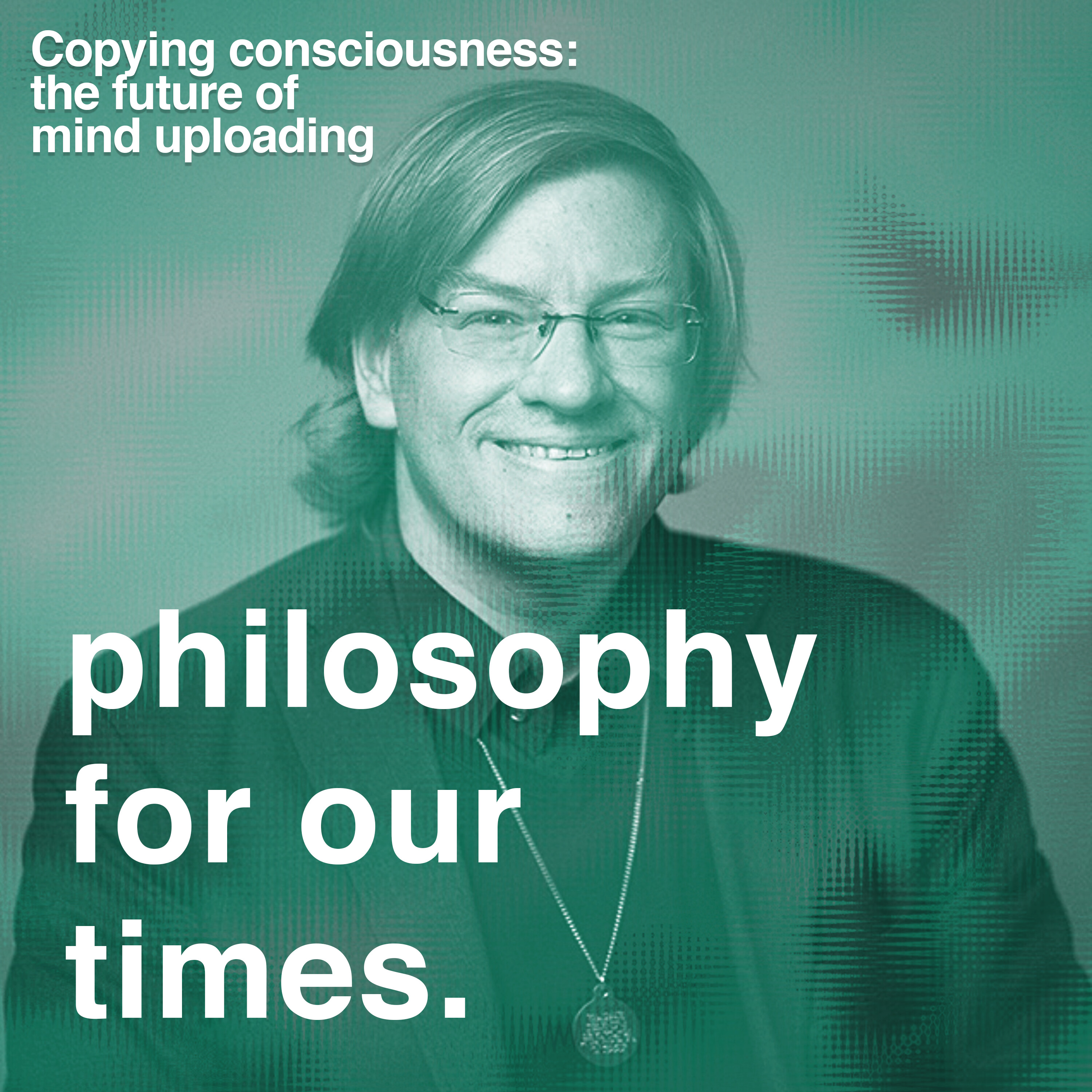
Philosophy For Our Times
Copying consciousness: the future of mind uploading | Anders Sandberg
00:37:00
Loading summary
Transcript6 lines
- [00:01]
A
This episode is brought to you by Progressive Insurance. Do you ever think about switching insurance companies to see if you could save some cash? Progressive makes it easy to see if you could save when you bundle your home and auto policies. Try it@progressive.com Progressive Casualty Insurance Company and affiliates. Potential savings will vary. Not available in all states.
- [00:29]
B
So if I wake up and find myself to be virtual and I have an eternal hangover that sounds like a really bad thing or oh no, half of a brain was a good scan, the other one not so good. So you get into a very interesting domain of ethical problems here. Indeed, you actually end up with those ethical problems long before you get anywhere close to humans. Of sure, we should treat the lab animals well too. And if I manage to scan a mouse and have this little virtual mouse running around its virtual cage, just as it's wrong for me to pinch the tail for no good reason of unreal mouse, I should not, using my virtual reality glove, virtually pinch the tail. So nerve signals go to its virtual brain and it gives up a virtual squeal and tries to get away. That might be just as bad
- [01:18]
C
welcome to Philosophy for Our Times, the podcast brought to you by the Institute of Art and Ideas. I'm your host, Omari Edwards. For centuries, philosophers have wondered, what makes you you? Is it your body, your memories, your personality? Or something else entirely? Today's advances in neuroscience and computing are turning these ancient questions into practical ones. A growing number of researchers believe that one day we may be able to scan the human brain with such extraordinary detail that a digital version of a person could be recreated inside a computer. This idea, known as whole brain emulation, or more popularly, mind uploading. Once confined to science fiction, it is increasingly being discussed by neuroscientists, technologists, and entrepreneurs as a genuine future possibility. But if we can upload a mind, would that copy really be conscious? Would it actually be you? And what kind of society would emerge if human experience could be digitized, duplicated, and perhaps even made immortal? In this talk, Oxford futurist Anders Sandberg explores the latest developments in computational neuroscience, the scientific challenges that remain, and the profound philosophical questions raised by the prospect of copying consciousness. Anders is a former Senior Fellow at Oxford University's Future of Humanity Institute and is internationally recognized for his work on human enhancement, emerging technologies, and the future of intelligence. Today's talk is Copying Consciousness the Future of Mind Uploading. I hope you enjoy.
- [03:19]
B
Good morning and thank you for coming to this little impromptu lecture. I'm going to talk instead of something that might totally transform the World, which may, might or might not be a good idea. I certainly find it an exciting idea. Now this is going to be a talk about what I like to call whole brain emulations. And quite often when people talk about this in fiction or philosophy, people talk about uploading consciousness. We're talking about uploading minds to computers. And indeed that's a bit of a framing that's going to happen at the panel later today where we're going to talk about consciousness in the cloud. But it makes me uneasy because I'm a neuroscientist who hang out way too much in philosophy department. I have no clue what consciousness is. And uploading is also a slightly tricky thing because that makes us think of it as the pictures we got on our smartphone and then we take a cable and connect it to a computer and then we just copy the pictures. But that might not be how the mind works. Yet. There is something very interesting about the possibility of translating what's going on inside the brain into a computer. And stuff is happening in this domain at an accelerating pace, which might have big repercussions, even if it doesn't lead to humans moving into a data center somewhere on Ireland. So this is the story about translating biology into software. And it began relatively early on in the 1940s. Hodgkin and Huxley were working at the Plymouth Marine Laboratory and they were studying the squid giant axon. So squids have some pretty large nerve cells and being cold blooded and relatively easy to catch, if you're in a harbor town and you can get hold of these fresh nerve cells and dissect the squid and do experiments on that nerve cell. And this was in the 40s where people started to figure out how does actually the nervous system really do what it's doing. There was a battle between the people that were known as the sparks and the supes. The sparks felt it's obviously electrical stuff. We know for many decades that electrical stimulation seems to generate not just muscle action. After all, Alessandro Volta famously discovered electricity that way with his frog legs, but also that the nervous system seems to be using electricity somehow. The supes, on the other hand, noted that stuff in the body tends to be chemical in nature. So it's probably some kind of chemical signal. Hodgkin and Huxley managed to actually figure out what was going on and construct a model that gave them the Nobel prize over in 1968. And their model is that basically what the nerve is doing is it's filled with electrolytes just like the rest of the body outside it. But you have little molecular pumps in the membrane pumping electrolytes in different directions. So you're pumping out the potassium and pumping in the sodium, and that way you get an equilibrium. They want to equalize. So when ion channels that let them through open, the ions flow through, and that causes an electrical change. And now if these little channels are electrically sensitive, a change in one end of a nerve cell can cause a wave of activity going down. It's a little bit like setting up domino bricks. The molecular pumps are setting up the bricks in an unstable equilibrium. And then something tips over one brick and you get a wave moving along. That is basically what Hodgkin actually demonstrated how it worked chemically in the squid axon. Great. Except that they went a bit further. Remember, this was the 1950s and they had now figured out some of the chemistry. And now we did a computer simulation of this, or actually it was a hand cranked calculator. They built a mathematical model of electrical and chemical interactions, because it turns out that both the Supes and sparks were actually right. And then they carefully calculated how this wave would look. And it took them weeks to do a calculation. But today, of course, any student in computational neuroscience does instantly on their computer. But it was the first time we actually simulated what is going on in the nervous system. And in the decades since, people have been working in computational neuroscience on doing this better and better. We figured out how the parameters of these equations change depending on what kind of nerve cell it is. We've added different ion channels, the synapses where two nerve cells connect to each other. How does a signal coming in get transformed into signal coming out? And can we model that? So when I started studying this back in the 1990s, and we already had a lot of lovely software that could run this, and of course, that software is just running much, much faster these days. This is of course, fairly traditional normal science. This is scientists trying to understand the complicated system by making a model of it. Not too dissimilar from climate scientists modeling climate, or somebody in astrophysics trying to simulate the way the behavior of a star or works. You build a model, after a while, you get data, you check that data against reality, and then you go back and forth. This is fun. This is also normal size. But the idea with brain emulation is to go a bit further. What if we could make that simulation not just a crude simulation, but a one to one copy of the original system? So already in the 1980s, people have mapped out a complete nervous system. This is the little Nematode worm, C. Elegans. C stands for kinahabaditis or something like that. I'm totally mispronouncing it because I'm not great with Latin and I'm not so much of a worm guy myself. In neuroscience and any biological science, you typically get various little tribes who got their favorite lab animal. And the C. Elegans people are one such tribe. And it turns out that a typical hermaphrodite C. Elegans worm has 303 neurons. In fact, all of them have 303 neurons. There have been this argument that maybe all these worms are the same individual because they got exactly the same nervous system. That's probably not true. You can actually train them to like and dislike certain smells so you can change the constraints of the connections. So it seems like, can we run a simulation of 303 neurons? And even I could have done that back in 90s, except that you need to know all, all the parameters, the settings, what is the electrical conductance, how much resistance is there in that particular branch. That little connection, is it exciting or is inhibiting? Because in the nervous system, the excitatory synapses that make one neuron tell other neurons, you need to fire. Now, they are a bit dangerous because if you only have that, of course all the neurons will start firing like crazy. You want the inhibitory synapses that tell neurons shut up and they are shaping the dynamics. If they start failing, that's where you get epileptic seizures. This is also why you get interesting effects. For example, alcohol, because that's generally inhibitory. It strengthens the inhibition and typically makes you less active. Except that it also inhibits some parts of our brain. Telling us that's a stupid idea, don't do it. Which is why people on alcohol do a lot of stupid things very energetically, up until the point they get enough alcohol to actually fall asleep. The interesting part here is, though, C. Elegans is still not fully simulated, because although we have the computational resources to do a full simulation, and we even have some simulated body models that one could use, we actually don't know enough about the pyrometers. And that's because it's a tiny little warm, it's half a millimeter long. So actually teasing out which strength there is in what connection requires that you take extremely fine glass electrodes and put them very carefully on the right spot and measure things. And this is extremely finicky. There are some people who are very good at doing it, and they're treasured beyond belief. In the lab. But unfortunately there are not that many of them. And C. Elegans is hard to work with because it's a small thing it. And when you pierce the shell of this worm, its innards tend to spill out. So it's not easy to work with at all for very boring mechanical reasons. I'm a theory guy. I hate this kind of boring mechanical reasons. I want profound philosophical or scientific problems. Not that the innards of the worm spills out, but that's science. What has more recently happened is that we are advancing to the fruit fly. But in the 90s, when I got started, I'm a science fiction reader, I'm a transhumanist, I like to think about big, bold, radical futures. We also started thinking about where would this eventually go? Well, if we could make a perfect copy of a brain and a simulated body for that brain to interact with, what could we achieve with that? That sounded really interesting. So the idea with a brain emulation is just like you have emulators for old computers, we might do emulators for old biology on computers. For example, my first computer was a Sinclair ZX81 computer. Maybe some of you remember this lovely, lovely British computer. One kilobyte of memory, 44 times 63 pixels, black and white resolution. You connected it to your tele. As I was growing up, I had to stop programming at 5 o' clock because Swedish state television turned on the radio transmitter at that point and I started getting interference in my. The picture. That's a way of limiting screen time. Lovely computer. And I still actually got the physical computer, but I doubt it will run because I think the capacitors have gone bad over the past 40 years. But if I really wanted to run some of my old code, I could of course just start up one of my modern laptops and run another piece of code that simulates all the parts of the old computer because it's so much simpler than a modern computer. And some of these emulators are fun because they even include awkward things like if you nudge the table and you have an expansion pack for memory, generally that tends to crash it. I don't know why they actually added that as a feature, because it was decidedly very annoying for me as a programmer when I was a kid. But maybe nostalgia won out. But the point is, everything that happened in the real computer is mirrored in this emulated computer. And this is sometimes done, of course, when you have old code in your bank and yeah, you don't want to run that really ancient, clunky computer anymore because it's probably burning a lot of energy and the environmental regulations are starting to have opinions about it. Well, you make a one to one copy and as long as you work on digital computers, this copying actually can be done. That's the idea with brain emulation. We take a biological brain, we scan it somehow, we convert that into a software simulation that does exactly the same thing, and then we run it in a computer. Now that could be amazing. Now we might be able to do quite a lot of cool stuff if that can be done. Some of you will say, yeah, wait a minute, Anders, it worked maybe for your old ZX81 computer, because that's a digital computer. Brains are decidedly not a digital thing. Very soft, squishy, complicated stuff with a lot of analog components. And that gets to some of the more cool, profound questions I think face us in neuroscience in understanding exactly how digital our brains. Where are the different scales that we need to simulate? Because it might be that they're more like computers and it might actually, with the right readout, be possible to do an emulation, or it might be more that they're more like a turbulent river. You actually need to get all that fluidity into your emulation that might actually not be possible to measure well enough. So I mentioned earlier, the fruit fly. So a few years back, Janelia and Google actually managed to make a connectome of a fruit fly. The fruit fly is another of the stars of lab animal world. It's been helping us out in genetics since absolutely forever. And it has a brain with about 140,000 nerve cells and about 54.5 million connections between them. It's less than a cubic millimeter large. So it sounds like this would again be a very, very easy thing to scan. I was told recently by somebody in the know that that scan that ended up on the COVID of Nature magazine last year, that was the one brain that managed to get out of about a thousand fruit flies without damaging it too much and start fixing it. There is again a really tough scientific and practical problem on how to take these fragile, small, soft things and move them about. What typically happens in a biolab is that you fixate the brain, you use formaldehyde or something else to make it more solid. It's no longer alive, but it retains its shape and some of the chemical properties. And then you might use even more plastination to make it really hard. And then you start scanning it in a microscope, typically slicing layer after layer to get a three dimensional stack of images. Then you have another problem. This stack of images are a bit uneven. You need to figure out exactly which image goes on top of which one and how to align them. This is traditionally done by having grad students do it. That's the traditional solution to most problems in science. And the grad students can learn how to do it well, but they grumble a lot about it. And once you start getting really big brains, these stacks are going to require an inordinate amount of grad students and the amount of grumbling is going to be too big. So people are working very hard on doing the electronic versions of doing this alignment. And this is an interesting application of artificial artificial intelligence. The interesting part here is that when you do it, eventually you end up with this three dimensional map of a fruit fly brain. You can see the nerve cells, all the little dendrites and axons and synapses between them, and you can start figuring out what's connected to what. But this is still a dry model. This is not living fruit fly. And thinking about fruit, this is very much just the static map. So in order to make an emulation, you would actually need to figure out how the signals are passing around. So there was another paper when somebody did something amazingly clever and amazingly stupid. So Eckstein and Valvers basically took these pictures and tried to use machine learning to figure out what kind of connection is there between two nerve cells. Let's try to train on the few. We actually know exactly what strength they have and train a machine to predict numbers. And they managed to get about 90% correctness. This is way more than I had ever expected. I wrote a roadmap for stuff like this back in 2008, and ever since, I've been kind of saying, maybe we can use these scans, these dry scans, and figure out the actual connectivity and strengths. And people said, yeah, the connectivity, no problem. But synaptic strength, do you really believe you can do it? And I vaguely said, yeah, I'm hoping. Turns out that X time does prove that. Actually, even the crude approach does a surprising good job in this modern era of machine learning. We can probably make it much better if we do some more clever stuff, which doubtless a lot of people are indeed doing in the lab. Okay, now we have the strength of connection between the different nerve cells. That is still not a simulation. But when Shiu and others did another wonderfully stupid thing. What if we took the simplest neural model we can get, not even the fancy Hodgkin Huxley model, which is kind of a gold standard based on Hodgkin And Huxley's classic experiments with the squid axons down in Plymouth. But instead, the leaky integrate and fire, which is the simplest, crudest caricature of what nerve cell does, basically it sums up input in a kind of leaky integrator. It's literally like a leaky bucket where you get electricity in and it's leaking out at a certain rate. But if it reaches the edge of a bucket, the neuron fires and then resets. This is a caricature of what nerve cells do and you can use it very efficiently. And it turned out that when you applied that to the fruit fly brain, they could stimulate some nerve cells that we know what they're supposed to do and get surprisingly good responses. There is one nerve cell connected to sweetness receptors, and when you triggered that one, you got a cascade of activity in this network and some other neurons that normally would control the proboscis of the fly. Moving the proboscis in the right direction. So if you stimulate the sweetness on the right, it would kind of move its virtual proboscis to the right. Do it on the left, it moves to the left. There is another cell that in a real fruit fly would make it stand still and twirl around. Yep. You got motor activity that looked like it's trying to twirl around. It wasn't much more. It is still a very primitive model, but the fact that you can do this even with leak integrated fire models was mind blowing. So I had to congratulate you personally and say that was the most stupid thing ever. Please do more of it. So that is actually ongoing now. So now people are trying to build an even better version of it using slightly fancier methods. Meanwhile, others have been working on humans. So the Lichtman lab have actually managed to scan a cubic millimeter of human cerebral cortex taken from a patient that had it removed because of brain. I think it was an epilepsy case. And again, it's a treasure map to neuroscientists. This is wonderful because we see all sorts of weird things we didn't know existed in there. Because it's a complete scale scan, nobody knows how to run a simulation of it yet. But that is still beside the point from a scientific perspective. So right now what is happening is that there are startups and projects that are increasingly working on trying to make this full connectome and make it functional so you can actually run it. I have some friends over at MIT working on zebrafish larva. So the zebrafish, the little fry, or completely transparent. So you can do all sorts of clever things to these fishes to see the activity. And that lab, the Boyden lab, also has been working on expansion microscopy. Because one of the fundamental problems we have when imaging this is the resolution of our microscopes. So you can't see things that are shorter than the wavelength of light in a light microscope. This is why people like electron microscope, because they are much shorter wavelength. The downside is that now you need to take your sample and you need to dust it with osmium tetrocide, which is exceedingly obnoxious and poisonous compound, and then you use your electron beams and then you fry what you got. But hopefully you get a picture with very high resolution at the price of having to manage an electron microscope, which is costing a lot of stuff and is also very hard to manage. But what Ed Boyden came up with was this crazy idea. Again, it's so stupid that it can't work, but actually it does work. You embed your little brain tissue sample in gel and then you add water to expand it so it becomes larger. Suddenly, those fine details that previously you couldn't see because they're below the resolution of a microscope become larger. You need to add various dyes to color things in, so make it possible to see. But this way we can actually look at stuff that previously you needed a very expensive electron microscope and now you get a bigger block of gel. So now it's more a question, can we automate this? Can we make a robot lab where you put in a small piece of brain and it automatically scales it up, slices it into nice sugar cubes, and then various microscopes work on it? So my friends at MIT are talking about future brain fabs, a bit like the chip fabs in Silicon Valley. But in this case, you put in a brain and gradually what comes out at the other end is a map of what's connected to what, how strongly, and then you can upload that to your data center and run it. Now, how soon are we going to get to that? Well, I have some friends arguing that within five years we could have a mouse brain. I think we're optimistic, but I'm also very aware that my ability to predict stuff is really crappy. This is one of the best abilities to have as a future studies person, recognizing that, actually, I'm not very good at predicting the future. What you can do is you can kind of trace and see what works, what doesn't work, what is scaling up. And it's no doubt that we're going to see a lot more of this neurotech and at first, of course, this is mostly interesting to us neuro nerds who really like to figure out what brains are doing, have a stuff is connected to other stuff. Later on, it's probably going to be more useful to the people doing computational neuroscience because we don't have to make up our idea about what's connected to what. A surprising number of classical modeling computational neuroscience are based on sometimes very good educated guesses on how stuff ought to be connected, but in many cases based on very little data. Now we can actually base it on raw data and get the full network with all its warts and all, and try to run that in a computer and see what it's actually doing, which is sometimes surprising because biology is under no obligation to be nice to us researchers. It doesn't have to make sense, it just does stuff. Biology only cares about surviving. And that means that if some crazy interaction works well, then it's going to use that crazy interaction and we might just have to learn that it exists and then try to think, figure out why it exists. The really interesting part is, of course, are we eventually going to end up being able to do this with a full human brain? So that cubic millimeter of cerebral cortex, that was a big project that cost tens of millions of dollars to do, and it's rare that you get that chance scaling up a mouse brain. The Wellcome Trust has kind of estimated that, oh, it's going to cost billions. It's not likely that anybody is doing that anytime soon. But they had an assumption that it was very hard to do the alignment between the pictures and that would be expensive because that requires an enormous army of grad students. My friends in Silicon Valley, of course, are thinking robots and AI to do this instead of grad students. And suddenly the amount of grumbling in the room goes down quite a bit. So they think that they can make it a hundredfold cheaper. We'll see if that works. I'm hoping it works. Similarly, we're probably going to need to use AI for a lot of other stuff, because simulating just the electrical and chemical activity, many of you probably already have started to say, yeah, but wait a minute, what about. And there's fairly long list of other things that might be going on in our heads that matters. I have a friend who's very much into temperature. She argues that the temperature, temperature shifts in different parts of the brain actually have an important effect on our thinking. I don't think so, but she might be right. Again, I'm wrong about a lot of stuff all the time. And we need to test that. We need to make simulations including temperature. Others are saying, oh, when electrical signals move along these long axons, they actually make magnetic fields that might synchronize other signals. You need to think about these so called epaptic interactions. Maybe that's going to complicate things. We know how to simulate it, but it's, oh, it's awkward. Others are saying, no, no, no, there is a lot more to electrical fields in biology. We should really simulate that. The cool part is we can actually, once we have simulations, add that and remove it and see how different it is from real biology. The big problem is of course, right now having that gold standard having. Ideally, you take your little fruit fly, you train it to run a simple maze. It you scan its brain and then you check whether the emulated fruit fly running a little simulated body runs through the simulated maze in the same way. If it doesn't, then you need to figure out what's wrong. That might be a long loop, but it looks like we are on the pathway to this. Of course, me being a futurist, I mean interested in when we get to the humans and that's still far away. After all, all we can't do a mouse brain. And a mouse brain is less than a cubic centimeter and our brains are 1400cm3. And also we care a lot about it. If we fail at an experiment with a mouse brain, we get another lab mouse. If we're compassionate, we might still feel sorry for the first lab mouse, but we can get another one. If it's my brain, I don't want the scan to fail at all. It better work if the first shot also you want it to run really well. So if I wake up and find myself to be virtual and I have an eternal hangover, that sounds like a really bad thing. Or oh no, half of a brain was a good scan, the other one not so good. So you get into a very interesting domain of ethical problems here. Indeed, you actually end up with those ethical problems long before you get anywhere close to humans. Obviously, after all, we should treat the lab animals well too. And if I manage to scan a mouse and have this little virtual mouse running around its virtual cage, just as it's wrong for me to pinch the tail for no good reason of unreal mouse, I should not, using my virtual reality glove, virtually pinch the tail. So nerve signals go to its virtual brain and it gives up a virtual squeal and tries to get away, that might be just as bad. At this Point, of course, some of you might say, wait a minute, this is numbers in a computer. This is not a real mouse. It might look like a mouse on the screen, but that's just computer graphics. But others would say, philosophically, yeah, functionalism, actually the interactions between the different parts of a system, even though they're materially very different from the original one, are the right the ones to be functionally pain. This is a quarrel that's not exactly going to go away anytime soon. I think we're going to continue it in the big panel on uploading consciousness to the cloud. And it's an interesting open question. Do you get consciousness this way? What can and cannot be done? But even the basic neuroscience question is actually a really awesome one to get into, because figuring out how the nervous system work, that's kind of important for us. After all, we are to a large degree nervous systems, and when they fail, that's usually very bad for us. Just figuring out how to regulate pain better would be a tremendous boon. Being able to do experiments where we can figure out how various mental conditions come about and might be ameliorated might be really valuable. There is an interesting issue even whether maybe you can replace your lab animals for ethical reasons. And the funny situation here is of course, that a lot of animal rights people, they really hope this is true. They would love to see simulations replace actual feeling animals. And they have a kind of vested interest in hoping that there is no consciousness in the machine. Meanwhile, the transhumanists, who are kind of hoping that one day I can scan my brain and become an immortal software being that can have backup copies and travel to Mars using Laserlink and all of that. There better be consciousness in the machine. So the transhumanist is going to say, oh yes, I have a motivation, maybe not a good argument, but I want there to be consciousness in the machine. Which means that the transhumanist might say, actually, be careful with those lab mice, because I'm hoping that there is consciousness there. Meanwhile, the philosophers are very confused about it. My own philosophical view is if we have some kind of AI program that is very different from ourselves and animals, we don't know much about what it's in the life at all. It's a profound philosophical question whether it's conscious and self aware, etc. But if we take something that functions in a way we kind of understand, I think we can say that a mouse has at least some awareness and it's got some self interest. It is a moral patient in the sense that we shouldn't pinch its tail unnecessarily. And we make something that is very similar. It's intended to be a one to one copy. We have good reason to be careful about that. Maybe we can't know whether the simulated mouse or emulated mouse feels anything, but we should probably be much more careful than compared to some random neural network that I just generated on the fly. Okay, so that is kind of my story. I think what we're in right now is this prehistory with we started with very simple nervous systems that don't pose big ethical problems, but still a fair bit of technical problems. It might turn out that it takes a long while because there is not that much interest from many scientists to build these complicated models that we don't understand. Or it might be that people throw a lot of money at it. We don't know yet what is going to happen. I think we are about a decade away from having the virtual mouse, which is going to start getting people thinking, wait a minute, what about the virtual human? I think that this might happen faster because of artificial intelligence, because a lot of this work is expensive, because you need to have a lot of grad students and postdocs and professors doing stuff. But a lot of it is the grunt work. You need to get the robots to work, you need to scan stuff, you need to fix bugs in software code. And as AI gets better, I think we are going to gradually replace some of the grunt work the grad students students are doing, or rather they are going to be directing a herd of bots doing stuff. They're going to do what the postdocs used to do, and the postdocs are going to be using AI to do research more efficiently, telling the grad students what to do. We might see an acceleration of this research pipeline that doesn't require super intelligence or any particularly smart AI. What it's going to do instead is that it's going to speed up research. And this is probably just one example of how research pipelines speed, speed up. And then we are going to see an acceleration where eventually, as AI gets better, this domain gets better. And I have some friends and colleagues who think this might be necessary for AI safety. Because one of the fundamental problems we have with actual autonomous artificial intelligence is we want to align it with human values. Not any particular person's value, but just being able to align it with values. That's hard enough have also both because it's hard to write software that actually has values and understands value, but also what are human values? Well, if we had a digitally readable brain that might actually be possible to copy some of that into the AI and at least teach it that way. So there are some people who are worried about AI safety who think that we should be putting a lot of effort into these brain emulations in the hope that that's going to give us relevant stuff for the programming or AI. I don't know whether this is going to be fulfilled. I don't know whether they arrive in time. It might be that you get this synchronization as AI thundering along and getting better and better. This technology also thunders along in the slipstream and might become ready just at crunch time. That would be the good story for some kind of heroic science science fiction, but there is no guarantee. It could be that it actually arrives 10 years after everything has settled down for some other reason. We don't know that. But what I do know is that our brains might be digitalized in the future, or at least some brains, and that's going to teach us a lot of interesting things. And I think that might change a little bit how we think about minds and brains, because we have copies of them. Perhaps good copies, perhaps bad copies. But that's the sign for me to end now. And thank you so much.
- [36:14]
C
You've been listening to Anders Sandberg on copying the future of mind uploading. Whether mind uploading ultimately proves possible, or remains a technological dream, the questions it raises cut to the heart of what it means to be human. If a perfect copy of your mind could exist, would it really be you? Could consciousness be recreated in silicon? And what happens to our understanding of identity, morality, and personhood if human minds can be duplicated? Please share your thoughts with us in the comments, and if you enjoyed this episode, please take a moment to rate and review philosophy for our Times on Apple Podcasts, Spotify, or wherever you listen. It really does help more people discover the world's leading thinkers and their ideas. For more talks, articles, videos and debates on philosophy, science, politics and culture, visit the Institute of Art and Ideas from all of us at Philosophy for Our Times, thank you for listening. We'll see you next time.
- [37:23]
A
You're listening to this podcast, so I know you've got a curious mind. Here's a helpful fact you might not know yet. Drivers who switch and save with Progressive save over $900 on average. Pop over to progressive.com, answer some questions, and you'll get a quick quote with discounts that are easy to come by. In fact, 99% of their auto customers earn at least one discount. Visit progressive.com and see if you can enjoy a little cash back. Progressive Casualty Insurance Company and affiliates national averaged 12 month savings of $946 by new customers surveyed who saved with Progressive between June 2024 and May 2025. Potential savings will vary.