Loading summary
Transcript24 lines
- [00:07]
Iain McGilchrist
I believe that not only are matter and consciousness not entirely separate from one another, but that actually what we call matter is a way in which consciousness may manifest itself. It manifests itself in many ways and one of them is as matter. And why? Because matter offers two things that consciousness on its own doesn't. One is resistance and. And the other is persistence. And without resistance, anything goes. It's much too vague. But without persistence, everything goes. So you need both resistance and persistence for every act of creation. And matter is what achieves that.
- [00:50]
Narrator
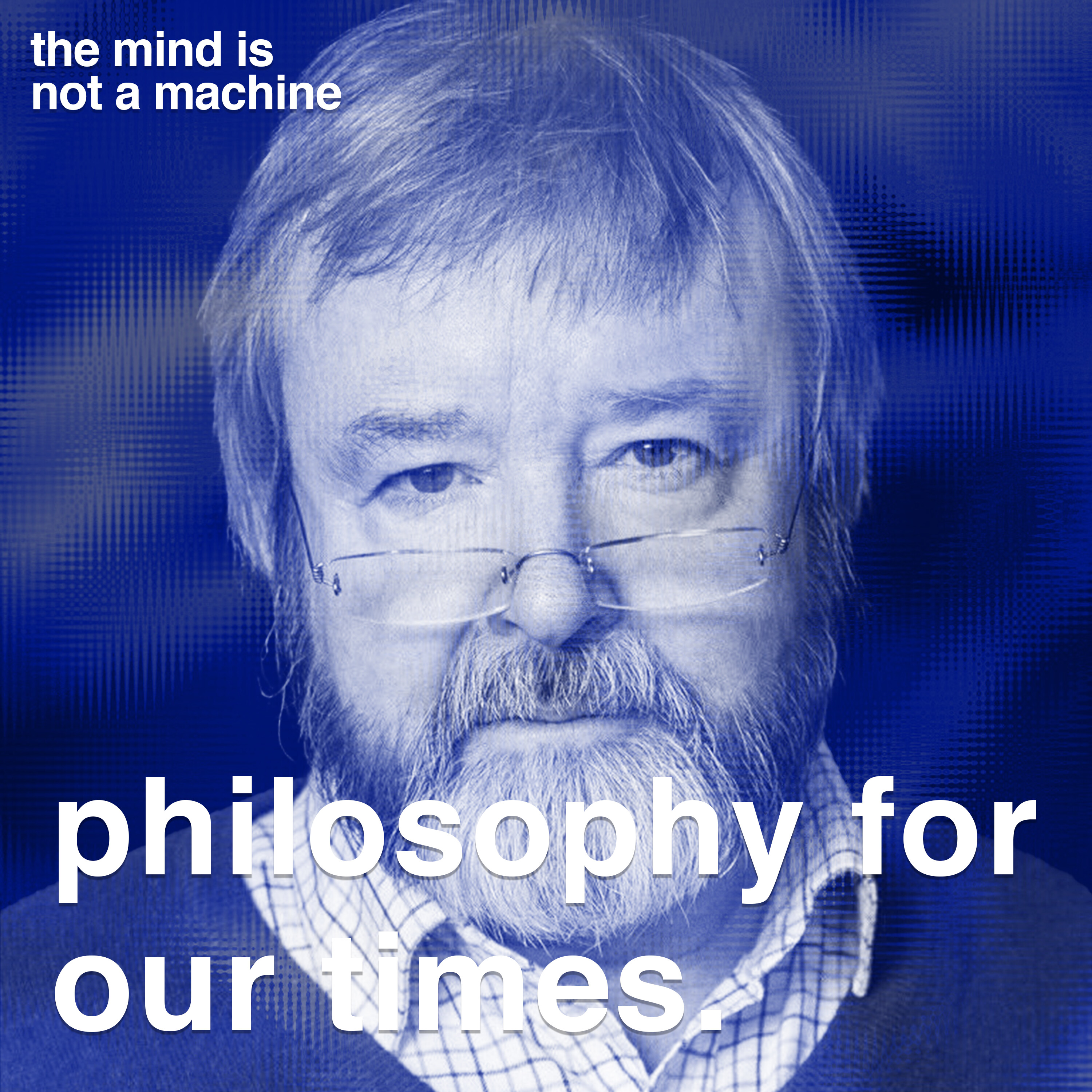
Hello and welcome to Philosophy for Our Times. Today's episode is an interview with Iain McGilchris, a world leading neuroscientist, philosopher, psychologist and medical doctor. Ian's great work can be found in two of many books and articles such as the Master and His Emissary and the Matter with Things. Today's episode is conducted by Oliver Adelson, the philosophy desk lead of the Institute of Art and Ideas. I'll hand over to Oliver now.
- [01:33]
Oliver Adelson
IAN McGILCHRISS, welcome to. I love.
- [01:36]
Iain McGilchrist
Oh, thank you very much. Delighted to be here.
- [01:39]
Oliver Adelson
Now, the left hemisphere of the brain is said to be the rational, analytic side. And yet it's your contention that what we've had is too much, not too little, of left hemisphere thinking. Can you explain what led you to this view? Yes.
- [01:50]
Iain McGilchrist
Most of the things that used to be said about hemisphere differences have to be put out of mind. But there is some truth in the idea that the left hemisphere thinks that it understands something by taking it apart. In other words, analysis. Yes, that's right. And what we've got here is two halves of the brain which for evolutionary reasons, which I won't go into right now, that are everywhere in my work. All creatures have had to develop two ways of attending to the world. And one is with a very narrow, targeted attention to a detail that they already know what it is and they know they want to get it and have it and having it will make them powerful and is useful. So that's very important. One whole half of the brain is dedicated basically to that process and the other half of the brain is doing everything else. It's looking out for the rest of the 357 degree arc of the view. It has open, sustained attention to everything and it is the one that actually understands the whole. Now, when you come to look at how they construe the world, the left hemisphere sees the world as made up of bits and the bits are separate from one another. They don't change, they don't move, they are fully known. They are explicit. They're also abstract. They're taken out of context. They're categorical in nature and effectively inanimate. And just something like a diagram, something like a diagram or a map of the world rather than the world itself. The right hemisphere, however, sees the closest we get to knowing what the world is like. It sees a world in which everything is connected, in which everything is not fixed and unchangeable, but is constantly flowing and changing, in which the implicit is vastly more important than the explicit, in which context is everything. Things are unique and they're not just exemplars of categories. And this world is a living world and it presences to us, as Heidegger would have said, rather than just being represented in the way the world of the left is. So that's it in a very, very brief nutshell.
- [03:55]
Oliver Adelson
So if the relationship between the world presented by the left hemisphere isn't simply a mirror relationship, if the left hemisphere doesn't just mirror the way that the world is with its categorical bits, Absolutely no. What is the relationship then between the world presented by the right hemisphere? Do you think that that is a sort of mirror of the way that reality is? Or do we need to discard the mirror metaphor altogether?
- [04:18]
Iain McGilchrist
Well, I don't think the mirror is terribly helpful. But I suppose what I would say is that the world as conceived or perceived and understood most importantly by the right hemisphere is at least in touch with the experiential world. It is a world that if you follow its beliefs, you will be, as William James put it, not about hemispheres. But he said, how do we know when we're seeing the truth? We are less likely to be caught out all the time by reality. And I think that if you understand the world the way the right hemisphere sees it, you will find it's enormously congruent and explains a lot of the things about the structure of the world that the left hemisphere model, which is, I would say the absolutely dominant model of our society, would have it. So one way of looking at it is that the. I don't agree with David Hoffman that we're just like sitting in a padded cell reading off dials. But that is a fair description of the left hemisphere. The left hemisphere is basically out of touch with reality. It's one remove. The right hemisphere feeds things to it and it then does something to them. And its job is then to feed that back. It's rather like putting data into a computer, hoping the computer will spew out the information the computer doesn't understand. It, but you do, and you put it back into the whole. That is the important thing that you're trying to understand. Whereas the right hemisphere is like a room with a window on the world. So when it comes up with an idea, it doesn't just say, oh, this is a marvelous theory. It says, does this actually add up? Is this anything to do with the world as we know it?
- [06:01]
Oliver Adelson
One human enterprise in which left brain thinking appears to dominate is science. Now, what do you think the implications of your account are for science and for the scientific method?
- [06:13]
Iain McGilchrist
Well, I'm a great supporter of both science and reason, but I'm also a great believer that they have their limitations. Most good scientists and most philosophers are very well aware of that. Some people who are not terribly aware of these things think that they can answer all our questions. The fact that they can answer very many questions and be extraordinarily helpful servants doesn't make them the arbiters of everything that we know. So the limitations of science and this method are not as great as one might think. I don't want to overestimate or overemphasize it, I should say. As I say, there's a lot to be said for the scientific method. But what people don't understand is that actually most discoveries in science and in mathematics, the great discoveries, were not made by following the scientific method at all. They were not made by linear paths of logic or algorithms or anything else. They were made by suddenly seeing a gestalt, in other words, a whole that is a form that cannot be reduced to its parts without loss. That's a very, very important idea. And if you think everything can be understood by analysis, you will miss it. So that sometimes it overemphasizes the approach by analysis, without realizing that that only tells us information that is useful when it's put back into the context of the whole. You know, and sometimes I. I think about a piece of music. You're attracted to it as a whole. That's the right hemisphere working. You then try to play it. You break down in various places. You take it apart analytically, you practice passages over and over, and the piece is a bit of a mess and a bit of a theoretical bodge. And then you go on stage and you have to forget all that and play. And that doesn't mean that the business of taking it apart and fiddling about with it and practicing bits and fragmenting it wasn't useful. But at the end it will be a hopeless performance unless that is recohered. Now, that is an area in which science is less good is seeing the bigger picture. And I think a lot of the big steps forward have been made by scientists who did see the big picture, and often famously Einstein. But I could give you 40 other examples of scientists and mathematicians, and some of them are in my work, who made their discoveries in a moment of insight, either looking at something, just walking, putting their foot on the step of the bus after going shopping, in the case of, in Einstein's case, picking up a fiddle and going, I've got it. And it's very interesting that these things are not done in the way that science pretends that they should be and are done. So while it's very good to have a bit of donkey work done in linear thinking, you have to be able to go beyond that. And all science also has to walk a tightrope between giving up on a paradigm too quickly, too easily, and not shifting early enough. So of course you don't want science every time there's a finding that seems to contradict something that is believed to go and say, well, we're going to change everything on that basis. But when the evidence builds up to a certain point, you should adopt a position of, well, let's see, maybe this is right, maybe we've been barking up the wrong tree. And it's very rare that public science is humble enough to do that. Although some very great scientists have the humility to say that. And I have to say, they're very often physicists.
- [09:51]
Oliver Adelson
Actually, I suppose we see the most extreme case of this sort of fractured reality in the dominant paradigms of reductionism and materialism. So do you think that these paradigms are fettering science? Do you think that the dominance of these paradigms perhaps explains why we haven't seen an Einstein in recent years, for example?
- [10:12]
Iain McGilchrist
Yes, it's very interesting, isn't it, that up until about the 1970s there were a whole lot of Nobel Prizes in science and it made many leaps forward, but more recently it hasn't. And I think this is to do with stereotypical thinking rather than thinking, quote, outside the box, more creative, creative thinking, allowing yourself to listen to an intuition to see a form, a shape, a gestalt, as I say, which could lead you to a conclusion. So I think that is stopping science from moving forward. But another thing is, and it's not unconnected, I'm afraid in a left hemisphere dominated world, bureaucracy is very top heavy and everything has to be legally laid out and there are rules and procedures and so on. And when Eddington discovered the electron, he was just One man in a shed with a pencil and paper. And nowadays a lot of the papers come out, have literally thousands, tens of thousands in some cases, of authors. And this kind of huge enterprise is not. It's like a galleon in the face of a skiff that can quickly change direction. And science needs flexibility and it needs more of the big picture and more imagination. But it doesn't need to abandon anything that it considers important. It just needs to branch out a bit more.
- [11:41]
Oliver Adelson
It's very interesting, and I want to move on to the mind and consciousness. But before we do that, I just want. I just want to touch a little bit on the relationship between mind and body. Because when people discuss this, it's often assumed that the body is straightforward and it's the mind which we have to crack. But one point which some philosophers like. No, I'm trying to get made, is that we don't understand matter any more than we understand mind. The notion itself of matter as traditionally conceived is very problematic. Could you say a bit about that?
- [12:06]
Iain McGilchrist
Yes. Well, we have very little time, sadly, but it's a totally fascinating topic. But what I would say is that he's entirely right, that as many physicists have themselves said, that if we reduce everything to matter, then we're faced with the question, but what the hell is matter? And physicists will readily say they don't know. So we haven't gone from somewhere mysterious to somewhere clearer. But what we have done is create a barrier between two things that I don't think should be kept entirely separate. To be very brief about this, I am a panpsychist. It's an odd sounding position, but my position is that consciousness was never derived from matter. There was never a moment in which suddenly consciousness emerged like a magic trick out of lump and matter that had nothing to do with it. The more rational position is that consciousness is, if you like, a building block of the universe. The way I would put it, is it's an ontological primitive. It's something that isn't accounted for in any other terms. It is what it is. And I believe that everything that exists in the cosmos exists within that field, that very large field of consciousness, and partakes of it. One of the things that I go on to suppose. And again, sadly, I have no time to give any rationale for this at all. But I have written at length about it. I believe that not only are matter and consciousness not entirely separate from one another, but that actually what we call matter is a way in which consciousness may manifest itself. It manifests itself in many ways. And one of them is as. And why? Because matter offers two things that consciousness on its own doesn't. One is resistance, and the other is persistence. And without resistance, anything goes. It's much too vague. But without persistence, everything goes. So you need both resistance and persistence for every act of creation. And matter is what achieves that. And people may say, well, matter doesn't look like consciousness. It doesn't seem to have the same qualities at all. How can that be? But I would say, look, water has phases in one, it's transparent, it's translucent, it runs across your hand. It's the thing we know that flows. And then there is this other thing, which is a huge block of something very cold and hard, and it can't be moved except with great effort. It's hard enough to split your head open. But that is water as well. It's just what we call ice. And in this room, there are tons of water suspended in the air, without which I couldn't speak to you. And none of these looks remotely like the other or has the same qualities.
- [14:51]
Oliver Adelson
Now, there's some other accounts, of course, that people have about how we might crack the mind. And usually these make use of different metaphors. Of course, in the case of Freud, Freud had his hydraulics. Now we've updated to computers and machines. Is the machine metaphor just the latest metaphor? Is there something fundamentally different about it in comparison to the past metaphors that people have used to understand the minds?
- [15:15]
Iain McGilchrist
Well, I think that the machine metaphor has been creeping upon us since the end of the 17th and certainly since the early 18th century. And it has become the default metaphor with which science accounts for things. Scientists sometimes talk as if metaphors should be avoided. But what they don't understand is that anything that is complex and pseudogenerous can only be understood by a metaphor. And they are therefore inevitable. The question is, have you got the right one? And if they think they haven't got a metaphor, they've got a metaphor of the machine nonetheless. And that has its own insidious quality, partly because it isn't recognized as such. So I do think it's very important that we change the metaphor. And I think metaphors such as music and water, for me, I mean, they may sound terribly airy, fairy, but believe me, they are very important ways of understanding the connectivity of things and the ways in which they interrelate and change. And I'm not suggesting that they are the truth about anything in some very simplistic way, because I think the whole problem is that some Scientists believe that they have simple truths, but there are no simple truths. All truths are contextual. All truths are modified by the way in which they're understood and by whom they're understood and how they are discussed. And so it behoves us to be very careful how we pay attention to the world, because the way in which we attend to it changes what it is altogether that we see there. If we attend to a body in a certain way, we see just a machine. If we attend to a body in another, like Blake, we see something miraculous that is holy. And I believe that is just as legitimate a way to understand the body if you lived a life. And once we, which of course an AI machine has not, importantly, it has no body, it cannot suffer, it cannot love, it doesn't know that it's going to die. None of the things that humans deal with. And so it's a very, very poor guide to how we should think.
- [17:20]
Oliver Adelson
I mean, on the issue of AI, AI's been remarkably successful in some of the left brain tasks. You see this with large lengths.
- [17:28]
Iain McGilchrist
That's where it belongs.
- [17:29]
Oliver Adelson
Could there be an AI model of what the right hemisphere is doing? Or is that never going to happen?
- [17:36]
Iain McGilchrist
I don't think that can ever happen. Because what it requires is in a way, an ability to see that things are not best structured according to principles. It's rather like Zen. If you admire a Zen thinker, then you say, so how do I become Zen? And the Zen master will say to you something completely absurd. And that's a way of bringing you up against the fact that the idea that there are steps or procedures or principles will not work. It's something beyond that. You have to, in a way, make a leap to. And the right hemisphere is the world that deals with these leaps of insight. It really does. I mean, particularly the right superior temporal gyrus and sulcus is very important for this. So it's in that world that we see the unexpected, the new. And the left hemisphere sees only repeats of what it already knows. And it's very happy with that. So as long as it stays within the confines of a self referring system, that's fine. And an AI can be a self referring system. And unfortunately the problems that come from self referring systems are beginning to make themselves evident. For example, making stuff up and thinking that you're always right, which are both features of, of people with right hemisphere damage relying on the left hemisphere. They make things up. It's called confabulation. They are prone to delusion. Most of the important delusions are dependent on right hemisphere failure, not on left. And they begin to be absolutely clear that they are right. And the more we move into this modern world, the more I see people with very stupid ideas who think they're absolutely right and that anyone who disagrees with them is completely wrong and must be cancelled.
- [19:20]
Oliver Adelson
And final question, one striking part of your account is that there seems to be this oscillation in different epochs. So, for example, in the Renaissance, you argue that there was a predominance of right hemisphere thinking which swung to left hemisphere thinking in the Enlightenment, and then with Romanticism, it swung back to the right. I think most people would argue that we are in a left hemisphere dominant society. Do you think that the next epoch we see in these grand terms will be dominated by the right hemisphere? Is that something we can look forward to?
- [19:50]
Iain McGilchrist
Well, of course, I'm very much hopeful of that. And the way I see it is that there tends to be an overarching thing over these pendulum swings, which is towards the left. So there may be slight corrections, but like romanticism, but then it goes on further towards the left. So I'm not really sure. But I live in hope. And reasons for hope are that people who think they can predict the future are very often wrong and end up with egg on their face. People are much more resource than we're taken to be. As long as we don't believe ourselves to be machines in the way AI and the culture of AI makes us think, as long as we realize that we are unpredictably creative and responsive creatures. I think that there will be a redress, and I think there already is beginning one among the young. And the young are the future. And my soul goes out to the young who are saying, enough of this reductive materialism which is such a trivial philosophy. It can be taken apart so quickly and easily, and it misses out everything of importance. So be loyal to the things you know that call to you, which will be things that call to you spiritually and through things like beauty and sheer truth and goodness. Those are the things to not allow to be degraded into ticking boxes and procedures that can be assessed by a machine. They can't.
- [21:14]
Oliver Adelson
On that note, Ian McGilchrist, thank you very much for joining me.
- [21:20]
Narrator
You've been listening to an IAI live interview with Ian McGilchrist. If you enjoyed today's conversation, please leave a comment a like a rating and tell a friend. It's really through these actions that you help us keep the philosophy for our times going. And from all of us at the Institute of Art and Ideas. Thank you so much for listening. We'll see you next week.