Podcast
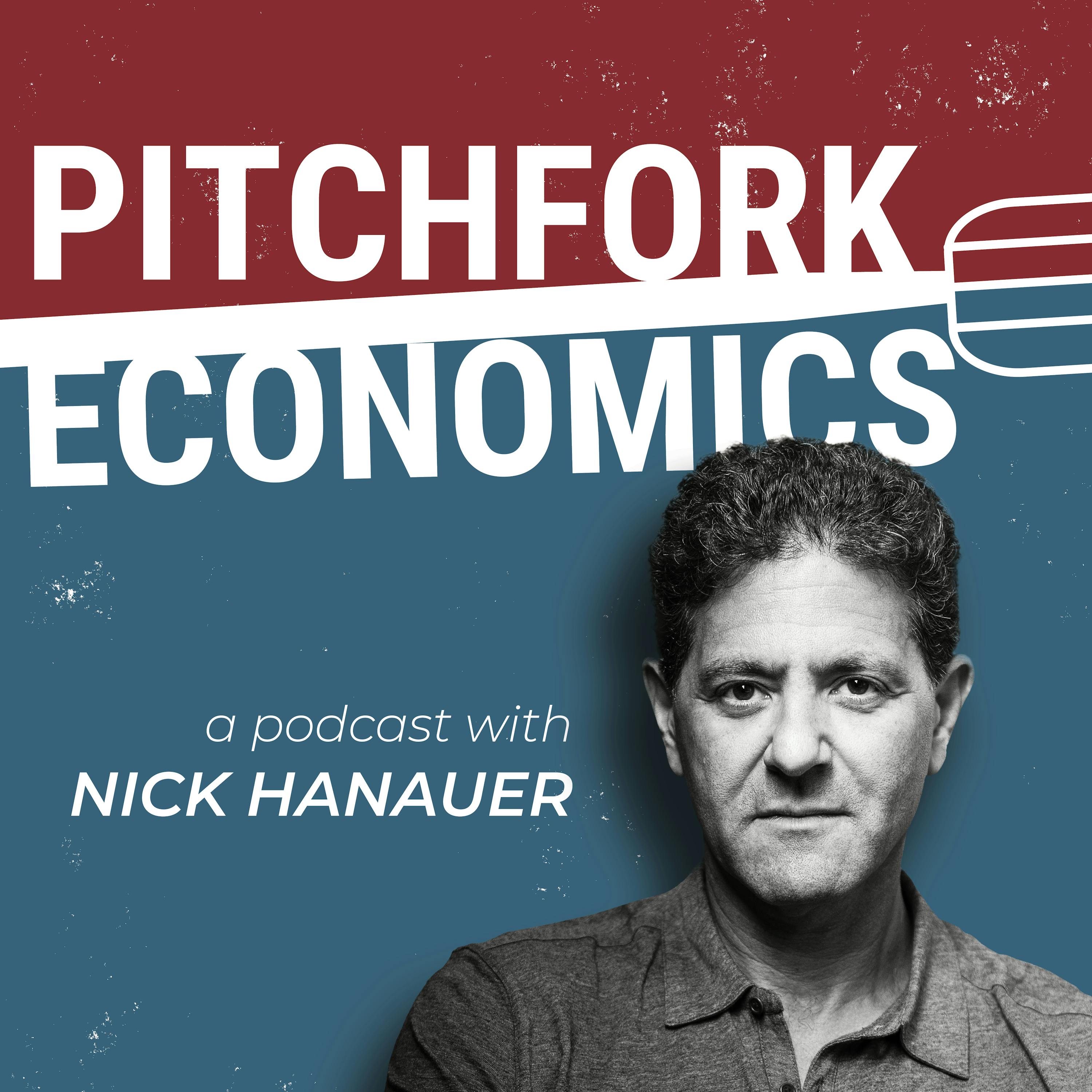
Pitchfork Economics with Nick Hanauer
Hosted by Civic Ventures · EN
We are living through a paradigm shift from trickle-down neoliberalism to middle-out economics — a new understanding of who gets what and why. Join zillionaire class-traitor Nick Hanauer and some of the world’s leading economic and political thinkers as they explore the latest thinking on how the economy actually works.
139episodes
Episodes
Newest firstAll episodes
What Happens When the Other Washington Stops Enforcing Antitrust? (with WA State Attorney General Nick Brown)
2d ago00:39:59Summary readyParamount Skydance wants to merge with Warner Bros. Discovery in a $111 billion deal that would put even more of Hollywood—and two major newsrooms—under one corporate roof. Washington State Attorney General Nick Brown joins Nick and Goldy to explain why a coalition of states is suing to stop it, how they forced Paramount to pause the merger, and why state attorneys general are increasingly stepping in as the federal government retreats from antitrust enforcement. They also discuss the successful fights against Live Nation–Ticketmaster and Kroger–Albertsons—and what happens when corporations become powerful enough to escape competition. Nick Brown is the Attorney General of Washington State Social Media: @atg.wa.gov @AGOWA Further reading: Washington Post - Washington state is suing Paramount. Here’s why. Washington State Office of the Attorney General Check out THE BILLIONAIRE AGE on IDEAS Website: http://pitchforkeconomics.com Facebook: Pitchfork Economics Podcast Bluesky: @pitchforkeconomics.bsky.social Instagram: @pitchforkeconomics Threads: pitchforkeconomics TikTok: @pitchfork_econ YouTube: @pitchforkeconomics LinkedIn: Pitchfork Economics Twitter: @PitchforkEcon, @NickHanauer Substack: The Pitch
SummaryThe Good Life Economy (with Elizabeth Wilkins)
1w ago00:41:55Summary readyWhat is the economy for — GDP, corporate profits, or people? This week, Nick and Goldy talk with Elizabeth Wilkins, President and CEO of the Roosevelt Institute, about Roosevelt’s new Good Life Agenda and why so many old assumptions about markets, government, and growth are suddenly up for grabs. It’s a conversation about human flourishing, public power, and what democracy has to deliver if people are going to believe in it again. Elizabeth Wilkins is the President and CEO of the Roosevelt Institute.She previously served as Chief of Staff to the Chair and Director of the Office of Policy Planning at the Federal Trade Commission. She has also held senior roles in the White House and the Office of the Attorney General for the District of Columbia, clerked for Justice Elena Kagan and then-Judge Merrick Garland. She began her career as a labor organizer with SEIU 32BJ. She is one of the authors of Roosevelt’s new report, The Good Life: An Agenda for Fuller Lives, a Stronger Economy, and Renewed Trust. Social Media: @elizabethwwilkins.bsky.social @ewwilkins Further reading: The Good Life: An Agenda for Fuller Lives, a Stronger Economy, and Renewed Trust. Website: http://pitchforkeconomics.com Facebook: Pitchfork Economics Podcast Bluesky: @pitchforkeconomics.bsky.social Instagram: @pitchforkeconomics Threads: pitchforkeconomics TikTok: @pitchfork_econ YouTube: @pitchforkeconomics LinkedIn: Pitchfork Economics Twitter: @PitchforkEcon, @NickHanauer Substack: The Pitch
SummaryMyths That Built Trickle-Down Economics: Productivity Doesn’t Trickle Down (with Preston Mui)
2w ago00:37:21Summary readySome of the world’s richest executives are selling AI as the engine of a yet-to-be realized “historic” productivity boom — while warning that it will also eliminate millions of jobs. But if workers absorb the disruption while the gains flow upward, that isn’t shared prosperity. It’s trickle-down economics with better software. In the final installment of Myths That Built Trickle-Down Economics archive miniseries, we’re returning to Nick and Goldy’s conversation with economist Preston Mui about why productivity is a policy choice. Mui explains how full employment, sustained public investment, resilient supply chains, and affordable essentials create the conditions for workers and businesses to produce more value. Technology may help us build a more productive economy. Policy will determine who benefits from it. This episode originally aired April 2, 2024. Preston Mui is a senior economist at Employ America specializing in macroeconomics, labor economics, productivity, and Federal Reserve policy. Social Media: @prestonmui.bsky.social @PrestonMui Further reading: Post-ECI note: The Supply-side May Spoil Warsh's Productivity Story The Dream of the 90s is Slipping Away in 2025 Early Estimates of the Impact of AI Within BEA’s Industry Economic Accounts Our Mission In An Age Of Turbulence: Creating A New Economic Policy Toolkit Website: http://pitchforkeconomics.com Facebook: Pitchfork Economics Podcast Bluesky: @pitchforkeconomics.bsky.social Instagram: @pitchforkeconomics Threads: pitchforkeconomics TikTok: @pitchfork_econ YouTube: @pitchforkeconomics LinkedIn: Pitchfork Economics Twitter: @PitchforkEcon, @NickHanauer Substack: The Pitch
SummaryMyths That Built Trickle-Down Economics: Austerity Politics (with Clara Mattei)
3w ago00:48:51Summary readyThis week, we’re continuing our archive miniseries, Myths That Built Trickle-Down Economics, with the myth that austerity is responsible economic policy. We’re revisiting this conversation now because the austerity playbook is still very much alive. The Trump administration and DOGE have cut federal agencies, pushed out public servants, and treated public infrastructure like waste — even though those are the systems we need most during a crisis. And if the economy turns downward, politicians will almost certainly reach for the same old answer: slash public support, make working people pay the price, and call it responsibility. Nick and Goldy talk with professor and political economist Clara Mattei, author of The Capital Order: How Economists Invented Austerity and Paved the Way to Fascism, about how austerity became one of the most powerful myths of modern capitalism, how economists helped sell it as common sense, and why it has always been about more than budgets. Clara Mattei is a professor of economics at the University of Tulsa, Founding President of FREE: Forum for Real Economic Emancipation, and author of The Capital Order: How Economists Invented Austerity and Paved the Way to Fascism and Escape from Capitalism: An Intervention. This episode originally aired on December 12, 2023. Social Media: @claraemattei Further reading: The Capital Order: How Economists Invented Austerity and Paved the Way to Fascism U.S. Treasury: The U.S. Economic Recovery in International Context CBPP: Robust COVID Relief Bolstered Economy and Reduced Hardship for Millions GAO: Federal Agency Workforce Changes Website: http://pitchforkeconomics.com Facebook: Pitchfork Economics Podcast Bluesky: @pitchforkeconomics.bsky.social Instagram: @pitchforkeconomics Threads: pitchforkeconomics TikTok: @pitchfork_econ YouTube: @pitchforkeconomics LinkedIn: Pitchfork Economics Twitter: @PitchforkEcon, @NickHanauer Substack: The Pitch
SummaryMyths That Built Trickle-Down Economics: Zombie Economics (with Paul Krugman)
Jul 700:44:49Summary readyThis week, we’re continuing our archive miniseries, Myths That Built Trickle-Down Economics, with the myth that bad economic ideas die once the evidence proves them wrong. They don’t. They come back as zombie ideas: tax cuts for the rich sold as growth policy, safety-net cuts sold as responsibility, and market fundamentalism sold as common sense. These ideas have failed again and again, but they keep returning because they still serve the people and institutions with the most power. In this episode, Nobel Prize-winning economist Paul Krugman joins Nick and Goldy to explain why zombie economics refuses to die, how bad assumptions infected mainstream economic thinking, and why defeating trickle-down economics requires more than better evidence — it requires naming the myths that keep shaping our politics. This episode originally aired on March 31, 2020. Paul Krugman is a Nobel Prize-winning economist, professor, author, and former New York Times columnist. His book Arguing with Zombies: Economics, Politics, and the Fight for a Better Future examines the failed economic ideas that continue to dominate American policy debates. Social Media: @pkrugman.bsky.social Paul Krugman on Substack Further reading: Arguing with Zombies: Economics, Politics, and the Fight for a Better Future CBO: Estimated Distributional Effects of the One Big Beautiful Bill Act KFF: Tracking Implementation of the 2025 Reconciliation Law: Medicaid Work Requirements CBPP: The 2017 Trump Tax Law Was Skewed to the Rich, Expensive, and Failed to Deliver EPI: Setting High Standards for a Federal Minimum Wage Tax Foundation: Who Pays Tariffs? Americans Will Bear the Costs of Tariffs Website: http://pitchforkeconomics.com Facebook: Pitchfork Economics Podcast Bluesky: @pitchforkeconomics.bsky.social Instagram: @pitchforkeconomics Threads: pitchforkeconomics TikTok: @pitchfork_econ YouTube: @pitchforkeconomics LinkedIn: Pitchfork Economics Twitter: @PitchforkEcon, @NickHanauer Substack: The Pitch
SummaryMyths That Built Trickle-Down Economics: Shareholder Value (with William Lazonick and Lenore Palladino)
Jun 3000:47:53Summary readyThis week, we’re continuing our archive miniseries, Myths That Built Trickle-Down Economics, with the myth that corporations exist to maximize shareholder value. For decades, Americans were sold the idea that if corporations focused on boosting stock prices and rewarding shareholders, prosperity would trickle down to workers, consumers, and communities. Instead, shareholder primacy helped justify stock buybacks, wage suppression, layoffs, and underinvestment — extracting wealth from the real economy and funneling it upward. In this episode, Nick and Goldy talk with William Lazonick and Lenore Palladino about how shareholder value became one of the core myths of trickle-down economics, why it has caused so much damage, and what it would mean to build corporations around workers, consumers, communities, and long-term prosperity instead. This episode originally aired on February 19, 2019. Lenore Palladino is associate professor of economics and public policy at the University of Massachusetts Amherst, a senior fellow at the Roosevelt Institute, and author of Good Company: Economic Policy After Shareholder Primacy. William Lazonick is professor emeritus of economics at the University of Massachusetts Lowell and co-founder and president of the Academic-Industry Research Network. Social Media: @lenorepalladino.bsky.social @Lazonick Further reading: Good Company: Economic Policy After Shareholder Primacy Washington Center for Equitable Growth - To restore democracy, end shareholder primacy at U.S. corporations and on Wall Street Roosevelt Institute - Regulating Stock Buybacks: The $6.3 Trillion Question Roosevelt Institute - Ending Shareholder Primacy in Corporate Governance Website: http://pitchforkeconomics.com Facebook: Pitchfork Economics Podcast Bluesky: @pitchforkeconomics.bsky.social Instagram: @pitchforkeconomics Threads: pitchforkeconomics TikTok: @pitchfork_econ YouTube: @pitchforkeconomics LinkedIn: Pitchfork Economics Twitter: @PitchforkEcon, @NickHanauer Substack: The Pitch
SummaryMyths That Built Trickle-Down Economics: Regulations Kill Growth (with Robert Reich)
Jun 2300:39:29Summary readyThis week, we’re kicking off our archive miniseries, Myths That Built Trickle-Down Economics, with one of the most persistent myths in American politics: that regulation kills growth. Corporate lobbyists and trickle-down evangelists have spent decades branding any rule that limits big business as a “job killer.” But what if good regulation isn’t the enemy of prosperity, but one of the things that makes prosperity possible? Former U.S. Labor Secretary Robert Reich joined Nick and Paul back in 2019 to explain why we should stop calling these rules “regulations” and start calling them what they really are: protections. Because the economy always has rules. The real question is who they’re written to protect. This episode originally aired on February 5, 2019. Robert Reich is the former U.S. Secretary of Labor, co-founder of Inequality Media, and author of Saving Capitalism. Social Media: @rbreich.bsky.social @RBReich @rbreich @rbreich Further reading: Saving Capitalism: For the Many, Not the Few Website: http://pitchforkeconomics.com Facebook: Pitchfork Economics Podcast Bluesky: @pitchforkeconomics.bsky.social Instagram: @pitchforkeconomics Threads: pitchforkeconomics TikTok: @pitchfork_econ YouTube: @pitchforkeconomics LinkedIn: Pitchfork Economics Twitter: @PitchforkEcon, @NickHanauer Substack: The Pitch
SummaryAI Job Loss Is Real. The Catastrophe Is Optional (with Kathryn Edwards)
Jun 1600:38:36Summary readyAI doomsdayers want us to believe mass job loss would be unprecedented. But Kathryn Anne Edwards has a sharp reminder: In the first five weeks of the pandemic, the U.S. economy shed 22.5 million jobs—larger than any single AI job-loss estimate she has seen. The difference was policy. Unemployment support, direct cash to families, and a strong public response helped workers survive the shock and helped the labor market recover. This week, Nick and Paul talk with Edwards about what the pandemic recovery can teach us about AI, automation, unemployment, and the future of work. Why do AI debates so often treat workers as passive victims and government as irrelevant? What would a serious policy response to technological disruption look like? And why should we be skeptical of billionaires and tech leaders who insist that this time, unlike every other economic transition, they are uniquely important and special? Kathryn Anne Edwards is a labor economist, independent policy consultant, Bloomberg Opinion columnist, economics influencer, and co-host of the Optimist Economy podcast. Social Media: Instagram Threads TikTok Bluesky Twitter Further reading: Optimist Economy Podcast Bloomberg Opinion - AI Can Lead to a Fix of This Broken Government Program Bloomberg Opinion - Is AI Coming for Your Job? A Bigger Government Can Help Bloomberg Opinion - AI Anxiety Won’t Be Eased by Universal Basic Income Website: http://pitchforkeconomics.com Facebook: Pitchfork Economics Podcast Bluesky: @pitchforkeconomics.bsky.social Instagram: @pitchforkeconomics Threads: pitchforkeconomics TikTok: @pitchfork_econ YouTube: @pitchforkeconomics LinkedIn: Pitchfork Economics Twitter: @PitchforkEcon, @NickHanauer Substack: The Pitch
SummaryThe Policy Choices That Suppressed American Wages (with Josh Bivens and Larry Mishel)
Jun 900:38:48Summary readyWhy have wages for working Americans stagnated for decades—even as productivity, corporate profits, and the wealth of the people at the top continued to rise? The mainstream explanations are familiar: automation, globalization, education, or simply the unavoidable forces of the market—but wage stagnation was not inevitable. It was the result of policy choices. This week, we’re revisiting a conversation with economists Lawrence Mishel and Josh Bivens about the decisions that reshaped the American economy, weakened worker bargaining power, and made it harder for working people to claim their share of the prosperity they helped create. As we continue sharing more about Market Humanism—the idea that markets are human-built systems shaped by rules and power—this conversation feels especially relevant. The economy we have did not emerge naturally. It was built. And that means it can be rebuilt. This episode originally aired on June 1, 2021. Josh Bivens is the chief economist at the Economic Policy Institute. His research focuses on macroeconomics, inequality, social insurance, public investment, and the economics of globalization. Larry Mishel is a distinguished fellow and former president of the Economic Policy Institute. His research focuses on labor economics, wages and income distribution, industrial relations, productivity growth, and the economics of education. Social Media: @joshbivens-econ.bsky.social @joshbivens_DC @larrymishel.bsky.social @LarryMishel Watch Nick on The Diary of a CEO Nick recently joined Steven Bartlett and entrepreneur Daniel Priestley for a wide-ranging debate about the wealth divide, stagnant wages, artificial intelligence, and whether capitalism can still deliver broadly shared prosperity. Watch the conversation on The Diary of a CEO. Further reading ⬇️ Economic Policy Institute: Identifying the Policy Levers Generating Wage Suppression and Wage Inequality Economic Policy Institute: The Productivity–Pay Gap Economic Policy Institute: Wage Calculator: How Much More Would You Be Making If Pay Had Kept Pace With Productivity? Roosevelt Institute: Democratic Abundance: An Abundance That Works for Workers Roosevelt Institute: From Safety Net to Power Base: Reimagining, Not Restoring, the US Antipoverty System Markets Built for Humans: A Guide for Policy Professionals to the New Economics Website: http://pitchforkeconomics.com Facebook: Pitchfork Economics Podcast Bluesky: @pitchforkeconomics.bsky.social Instagram: @pitchforkeconomics Threads: pitchforkeconomics TikTok: @pitchfork_econ YouTube: @pitchforkeconomics LinkedIn: Pitchfork Economics Twitter: @PitchforkEcon, @NickHanauer Substack: The Pitch
SummaryMarket Humanism: A New Operating System for the Economy (with Nick Hanauer)
Jun 200:56:24Summary readyFor the first time in Pitchfork Economics history, Nick Hanauer is on the other side of the mic. Goldy and Paul sit down with Nick to discuss Market Humanism: the emerging economic paradigm he and Eric Beinhocker believe can replace the trickle-down ideas that have shaped American policymaking for the past 50 years. Why have wages stagnated while inequality soared? Why does conventional economics treat policies that help ordinary people as threats to growth? And what changes when we recognize that markets are human-built institutions—not forces of nature? The conversation exposes the failures of the old economic model, how power shapes who gets what and why, and why a fairer economy is also a more prosperous one. Nick Hanauer is a Seattle-based entrepreneur, venture capitalist, and civic leader dedicated to building a more inclusive and sustainable economy. He is the founder of Civic Ventures, a public policy incubator, and co-host of the podcast Pitchfork Economics. A leading voice for “middle-out” economics, his commentary has appeared in The Atlantic, Politico, Bloomberg, and The New York Times. He is the author of The Gardens of Democracy , The True Patriot, and a frequent advocate for policies that put working people at the center of economic growth. Social Media: @nickhanauer.bsky.social @NickHanauer Further reading: Democracy Journal - Market Humanism: A New Paradigm for a New Era The Atlantic - The Economic Experiment That Upended Reality Markets Built for Humans - A Guide for Policy Professionals to the New Economics The Gardens of Democracy The True Patriot Corporate Bullsh*t: Exposing the Lies and Half-Truths That Protect Profit, Power, and Wealth in America Website: http://pitchforkeconomics.com Facebook: Pitchfork Economics Podcast Bluesky: @pitchforkeconomics.bsky.social Instagram: @pitchforkeconomics Threads: pitchforkeconomics TikTok: @pitchfork_econ YouTube: @pitchforkeconomics LinkedIn: Pitchfork Economics Twitter: @PitchforkEcon, @NickHanauer Substack: The Pitch
Summary